Introduction
Sodium salicylate was introduced to medical usage in 1889, and is now extensively used worldwide for its therapeutic actions, especially for quick pain relief (due to its rapid absorption). The drug has a wide range of indications, including cardiovascular disorders (due to its antiplatelet action).
However, high doses of sodium salicylate may have various side effects, including ototoxicity.Reference Oliveira1 High salicylate doses, such as those contained in aspirin, are a clinical cause of reversible hearing loss and tinnitus.Reference Fujimura, Yoshida, Goto, Mori and Suzuki2 This may be due to reduced electromotility of the outer hair cells.Reference Stypulkowski3, Reference Shehata, Brownell and Dieler4 The outer hair cells of the human cochlea have a rapid contraction mechanism which generates change in their length in response to electrical stimuli; this has been termed ‘active cochlea’.Reference Brownell, Bader, Bertrand and Ribaupierre5–Reference Lue and Brownell8 Treatment of outer hair cells with salicylate has been observed to cause structural and functional changes, with generalised effects on cell membranes and organelles.Reference Lue and Brownell8, Reference Dieler, Shehata-Dieler, Richter and Klinke9
Isolated guinea pig outer hair cells show reduced electromotility after salicylate administration.Reference Shehata, Brownell and Dieler4, Reference Tunstall, Gale and Ashmore10–Reference Fujimura, Yoshida and Makishima12 Furthermore, a 500 mg/kg salicylate dose has been observed to reduce the production of electrically evoked otoacoustic emissions (OAEs) following extracochlear stimulation.Reference Shehata, Brownell and Dieler4 The characteristic effects of salicylate ototoxicity in vivo comprise hearing loss, reduced otoacoustic emissions, reduced compound action potentials and changes in the VIIIth cranial nerve pair.Reference Shehata, Brownell and Dieler4
Cochlear outer hair cell injury induced by high sodium salicylate doses leads to reversible hearing loss, with reversibility noted 24 to 72 hours after cessation of dosage.Reference Lue and Brownell8
The objective of the present study was to assess the two main aspects of such injury, i.e. the reversibility of cochlear injury and the time to recovery, by observing the time of onset of ototoxic outer hair cell damage, and the occurrence and timing of recovery.
Materials and methods
The study used 33 female albino guinea pigs weighing 500 g each.
The animals’ cochlear function was checked by testing their Preyer reflex, OAEs and brainstem auditory evoked potentials (an indication of the cochlear electrophysiological threshold).Reference Böhmer13, Reference He and Schmiedt14 Only those animals with normal hearing were selected for the study.
The animals were divided into 11 groups: 10 groups of three animals each, plus a control group of three animals. The animals were sacrificed at different times after drug administration: 2, 4, 8, 16, 24, 36, 48, 72, 120 and 168 hours.
The study was approved by the Ethics Committee for Animal Experimentation of the Faculty of Medicine of Ribeirão Preto, University of São Paulo (protocol number 058/2006, approved 28 August 2006).
Audiological evaluation
Distortion product OAE (DPOAE) and brainstem auditory evoked potential assessments were performed before sodium salicylate administration and immediately before sacrifice. The animals were anaesthetised with ketamine hydrochloride (65 mg/kg) for these tests. A single, known ototoxic dose of sodium salicylate was administered subcutaneously (500 mg/kg) to the experimental groups. Control group animals were similarly injected with 0.9 per cent saline solution. Disposable 1 mm syringes with millimetre graduations were used to achieve controlled drug delivery. Disposable BD (Becton Dickinson) 21 G1 needles (25 × 8 – 0.8 × 25 mm) were used for intraperitoneal injection and disposable BD 19G1 needles (25 × 10 – 1.00 × 25 mm) for subcutaneous injection.
Before sacrifice by decapitation, animals were deeply anaesthetised with 65 mg/kg ketamine and 6.5 mg/kg xylazine. Following sacrifice at the predetermined time, each animal's cochleae were removed from the bullae.
Microscopic cochlear pathology was studied via scanning electron microscopy, using a Jeol model scanning microscope (JSM 5200, Jeol, Tokyo, Japan) and an SS-550 superscan model electron microscope (Shimadzu, Duisburg, Germany).
Electron microscopy
After microscopic dissection, the cochleae were perfused with 3 per cent glutaraldehyde fixing solution at 4°C and fixed in this solution for 24 hours. A 3 per cent glutaraldehyde solution in 0.1 M phosphate buffer (pH 7.4) was injected into the cochleae for 2 hours at 4°C, followed by three washes of 5 minutes each with the same buffer. The cochleae were then fixed with 1 per cent osmium tetroxide for 2 hours at 4°C and dehydrated at room temperature in an escalating ethanol series (i.e. 50, 70, 90 and 95 per cent; 10 minutes at each concentration) and in absolute ethanol (three times for 15 minutes each). After dehydration, the preparations were dried to the critical point in CO2, fixed on an appropriate specimen holder, sputtered with gold in a vacuum chamber and examined under a scanning electron microscope.Reference Saito, Manabe, Honda, Yamada, Yamamoto and Saito15–Reference Jastreboff19
Brainstem auditory evoked potentials
Brainstem auditory evoked potentials were determined in all animals before and at the predetermined time points after salicylate administration, as described above. Animals were prepared for electrode placement on the cephalic surface according to standard positioning methods. Four electrodes were fixed with electrolyte paste, two of them being positioned in the outer ear of the animal, and their impedance was determined and kept at 3 ohms. The criterion for acceptance of artefact was up to 20 per cent.
Brainstem auditory evoked potentials were recorded using a burst stimulus with alternate polarity and energy centred on the frequency of 8 kHz, with a stimulus velocity of 11.0 Hz. The stimulus was delivered to the ear through the outer auditory meatus by means of insertion speakers. The electrophysiological threshold was determined at intensities of 5 to 60 dBnHL. The parameters for response recording were: 1000 averagings, a 100–200 nV/div amplification device, and a time of 1 ms/div. The low-pass filter was centred on 150 Hz and the high-pass filter on 3 kHz.
Recorded data were saved for later analysis of the wave I latency response.
Distortion product otoacoustic emissions
While anaesthetised, the guinea pigs were placed in an acoustically treated cabin specially built for this purpose. Distortion product OAE examination was conducted using a frequency of 2f1 − f2 with an f1:f2 ratio of 1.22, with resolution of two points per octave. This examination was performed before salicylate dosage and immediately before sacrifice. Responses were considered to be present when their amplitude was greater than the estimated noise level in the second standard deviation. When the amplitude of the response remained below the estimated noise level, the DPOAE were considered to be absent. Equal f1 and f2 intensities of 70 dB SPL were used, measured in a frequency range of 2000 to 8000 Hz. Distortion product OAEs are normally traced as a function of primary tone frequencies, since research data have demonstrated that 2f1 − f2 is generated in the cochlear region that responds to primary tones.Reference Musiek and Rintelman20
Amplitude is the most commonly measured characteristic during DPOAE examination, and is traced as a function of primary tone frequency, yielding the so-called ‘DP-gram’.
Thus, the result of DPOAE examination is a detailed frequency configuration which reflects the functioning of the outer hair cells in the basal region of the cochlea, according to the frequency previously selected for study.Reference Musiek and Rintelman20
In the present study, DPOAE examination was conducted using an ILO 92 CAE system (Otodynamics, Hatfield, UK).
Data analysis
Scanning electron microscopy showed no loss of cochlear outer or inner hair cells; scanning electron photomicrographs were therefore analysed qualitatively. Distortion product OAE and brainstem auditory evoked potential data were correlated and did not show a normal distribution; they were thus analysed using the non-parametric Wilcoxon test.
Results and analysis
Distortion product otoacoustic emissions
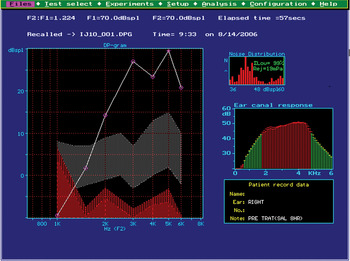
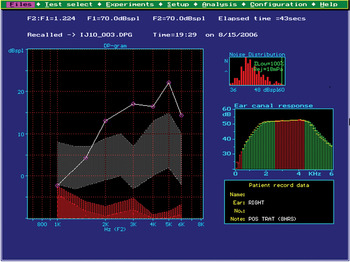
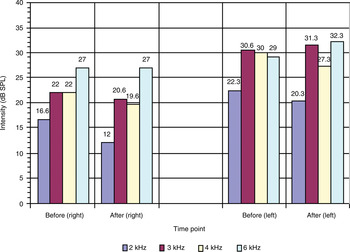
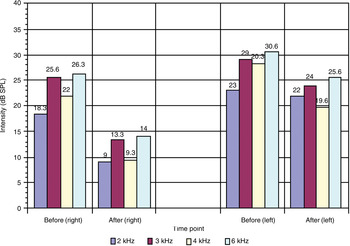
A response was obtained in both ears of all guinea pigs undergoing distortion product OAE (DPOAE) examination, both before and after sodium salicylate dosage, according to the analytical parameters established (Figures 1 and 2). There was no statistically significant difference in response amplitude before versus after sodium salicylate administration (p > 0.05), except for the 48 and 168 hour groups, which showed a significant reduction in response amplitude after drug administration (p < 0.05) (Figures 1–4).
Screengrab showing pre-dosage data for distortion product otoacoustic emission amplitude, for guinea pigs sacrificed 8 hours after salicylate administration.

Screengrab showing post-dosage data for distortion product otoacoustic emission amplitude, for guinea pigs sacrificed 8 hours after salicylate administration.

Distortion product otoacoustic emission amplitude (signal-to-noise ratio) in guinea pigs sacrificed 48 hours after sodium salicylate administration (500 mg/kg), comparing responses before and after dosage, in the right and left ears. Differences were statistically significant.

Distortion product otoacoustic emission amplitude (signal-to-noise ratio) in guinea pigs sacrificed 168 hours after sodium salicylate administration (500 mg/kg), comparing responses before and after dosage, in the right and left ears. There was a statistically significant difference in results before and after this single dose treatment.

Brainstem auditory evoked potential
Results for brainstem auditory evoked potential were analysed for wave I latency. All groups showed maintenance of the electrophysiological threshold of wave I at 5 dB both before and after salicylate administration, with no statistically significant difference between the two measurements (p > 0.05).
Scanning electron microscopy
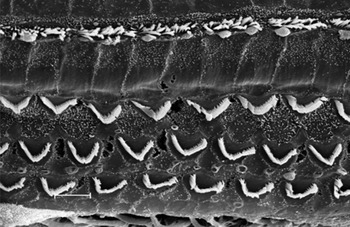
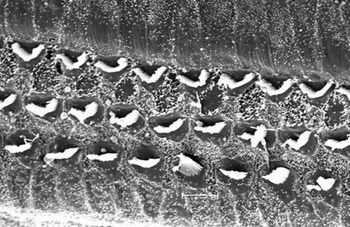
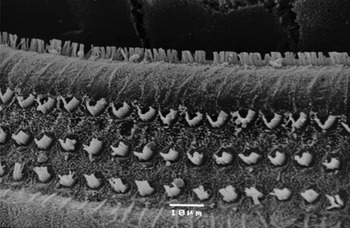
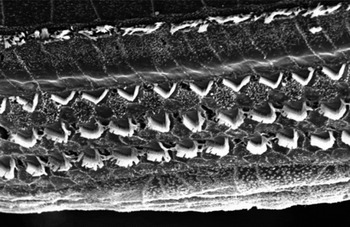
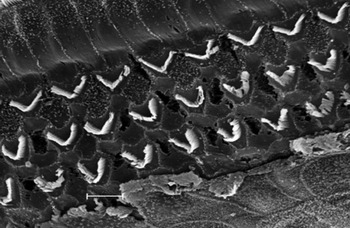
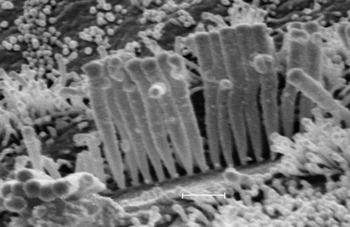
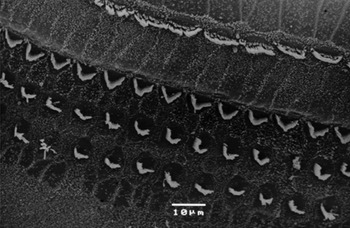
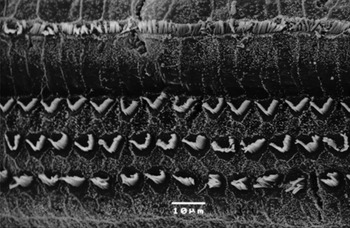
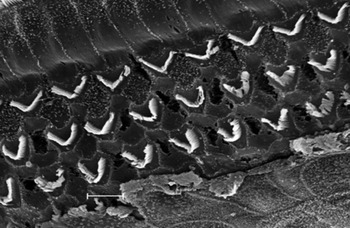
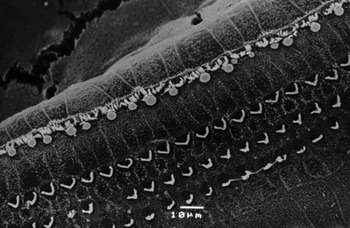
Analysis of scanning electron microscopy results revealed evidence of developing ciliary injury 2 hours after salicylate administration, with derangement of cilia and vesiculations in both the outer and inner hair cells (Figures 5 and 6). Clearly visible derangement of the ciliary pattern was observed over subsequent hours, with ciliary distortions in all three outer hair cell rows (Figure 7). Sixteen hours after drug administration, these characteristics were seen predominantly in outer hair cell rows one and two (Figure 8). Twenty-four hours after administration, there were important signs of ciliary recovery: while row three still showed clear ciliary changes, the row one appearance was close to the normal ciliary pattern, and row two presented few distortions. In groups sacrificed at longer intervals, signs of ciliary derangement and distortion were detected to a lesser extent and in a smaller number of outer hair cells, predominately in row three, and showed a pattern of progressive improvement up to 168 hours post-dosage (Figures 9 to 14).
Scanning electron photomicrograph of the cochlea of a guinea pig sacrificed 2 hours after salicylate administration, showing ciliary derangement in outer hair cells and vesiculations in inner hair cells. (×4000; bar = 5 µm)

Scanning electron photomicrograph of the cochlea of a guinea pig sacrificed 4 hours after salicylate administration, showing ciliary derangement in the three outer hair cell rows. (×4000; bar = 5 µm)

Scanning electron photomicrograph of the cochlea of a guinea pig sacrificed 8 hours after salicylate administration, showing ciliary derangement in the three outer hair cell rows. (×1500)

Scanning electron photomicrograph of the cochlea of a guinea pig sacrificed 16 hours after salicylate administration, showing more marked ciliary derangement in the first and second outer hair cell rows. (×3000)

Scanning electron photomicrograph of the cochlea of a guinea pig sacrificed 24 hours after salicylate administration, showing ciliary derangement in the three outer hair cell rows. (×4000; bar = 5 µm)

Scanning electron photomicrograph of the cochlea of a guinea pig sacrificed 24 hours after salicylate administration, showing detail of outer hair cell ciliary distortion. (×24 000; bar = 1 µm)

Scanning electron photomicrograph of the cochlea of a guinea pig sacrificed 36 hours after salicylate administration, showing outer hair cell ciliary distortion. (×1500)

Scanning electron photomicrograph of the cochlea of a guinea pig sacrificed 48 hours after salicylate administration, showing ciliary derangement in the three outer hair cell rows. (×1500)

Scanning electron photomicrograph of the cochlea of a guinea pig sacrificed 72 hours after salicylate administration, showing ciliary derangement in the outer hair cells. (×2000; bar = 5 µm)

Scanning electron photomicrograph of the cochlea of a guinea pig sacrificed 120 hours after salicylate administration, showing inner hair cells vesiculations. (×1000)

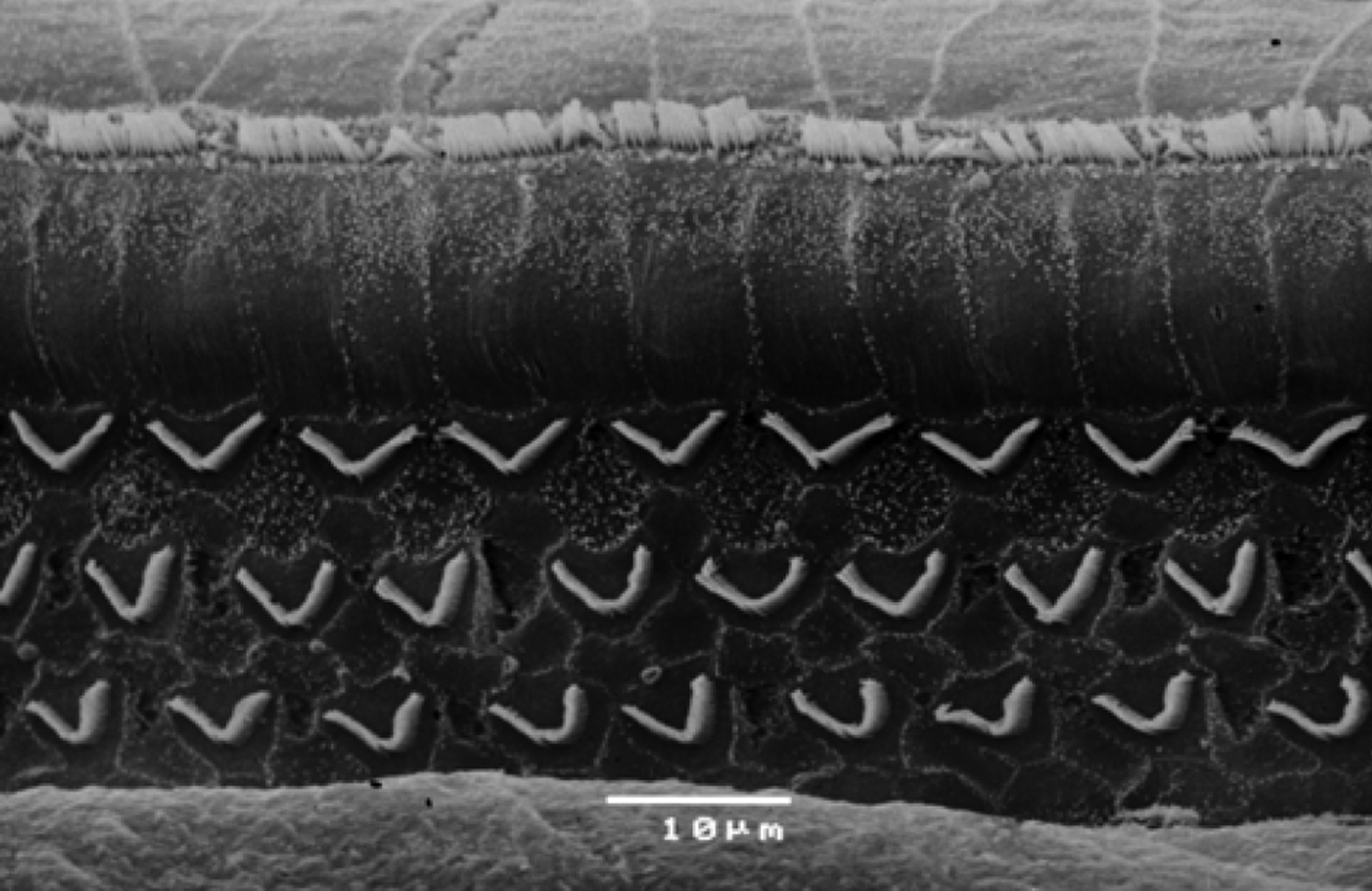
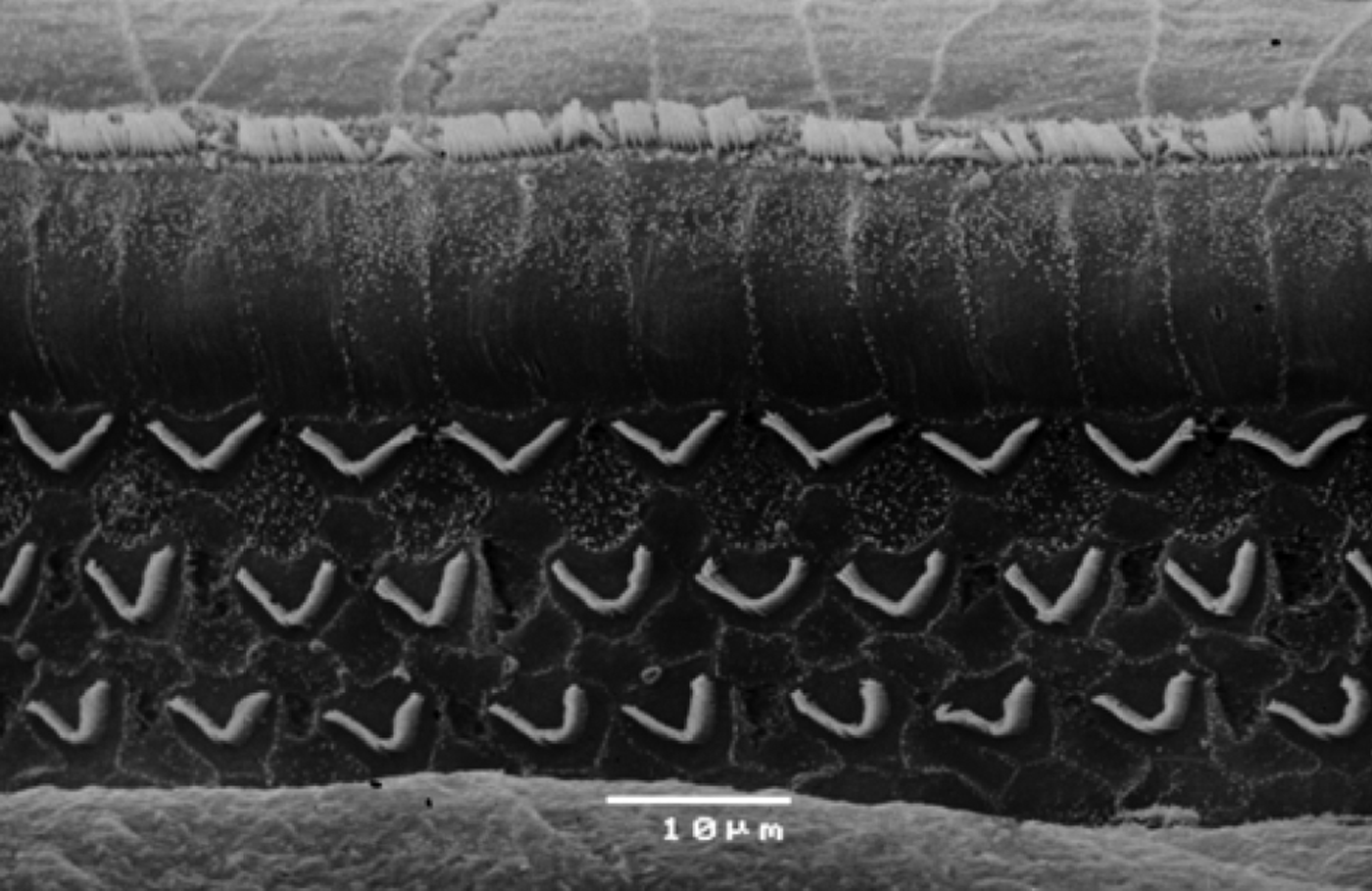
The group sacrificed 168 hours after salicylate administration presented a near-normal ciliary pattern, although a small number of ciliary distortions were observed, indicating that salicylate-mediate damaged had not yet been fully reversed (Figure 15).
Scanning electron photomicrograph of the cochlea of a guinea pig sacrificed 168 hours after salicylate administration, showing mild lesions in the outer hair cells. (×2000)
Discussion
The length of isolated outer hair cells can alter by as much as 4 per cent when the cells are submitted to a low voltage current. The cells of both the high and low frequency regions of the cochlea respond with some elongation when hyperpolarised, and with shortening when depolarised.Reference Ashmore7 Alteration in outer hair cell length results in a change in the separation between the reticular lamina and the basilar membrane, which in turn affects the mechanosensitivity of the stereocilia and the modulation of cochlear compliance.Reference Brownell, Bader, Bertrand and Ribaupierre5 According to Brownell et al., these observations provide direct evidence of an active mechanical process in the organ of Corti.
In the present study, analysis of distortion product OAE (DPOAE) results indicated the presence of a response both before and after sodium salicylate administration, in all groups studied. There was a statistically significant post-drug reduction in response amplitude only in the 48 and 168 hour groups (p < 0.05). These findings may be related to a transitory ototoxic effect of a single dose of 500 mg/kg sodium salicylate at 48 hours, and may help explain the tinnitus known to be induced following reversible sodium salicylate ototoxicity. These effects may be caused by reduced electromotility of the outer hair cell, also suggested by Yang et al. (following study of sodium salicylate ototoxicity (250 mg/kg) in a rat tinnitus model).Reference Yang, Lobarinas, Zhang, Turner, Stolzber and Salvi21
Characteristics of salicylate toxicity observed in vivo include hearing loss, reduced OAEs, reduced evoked compound action potentials and alteration of the VIIIth cranial nerve pair.Reference Shehata, Brownell and Dieler4
In animals sacrificed 168 hours after salicylate administration, DPOAEs were present both before dosage and just before sacrifice, indicating restoration of outer hair cell function. This result was confirmed by maintenance of the brainstem auditory evoked potential electrophysiological threshold. However, DPOAE amplitudes were significantly reduced (although DPOAEs were not erased), using the test frequencies of 2 to 6 kHz. Due to the high sodium salicylate dosage (500 mg/kg) and subcutaneous administration route used, complete hepatic metabolism of the drug may not have occurred, allowing it to recirculate and to be altered by succinate dehydrogenase in the stria vascularis, and also intracochlearly in the perilymph and endolymph, resulting in decreased malic dehydrogenase activity and consequent interference in some outer hair cell functions.Reference Shehata, Brownell and Dieler4, Reference Yang, Lobarinas, Zhang, Turner, Stolzber and Salvi21–Reference Sahley and Nodar25
In experiments conducted in pigs, Fujimura et al. detected changes in the pattern of electrically evoked OAEs after administration of sodium salicylate; Stewart and Hudspeth reported the same observation in lizards.Reference Fujimura, Yoshida, Goto, Mori and Suzuki2, Reference Stewart and Hudspeth22 We did not observe qualitative changes in the presence of DPOAEs before versus at pre-programmed times after sodium salicylate administration.
Several authors have reported the presence of electrophysiological changes in the cochlea following salicylate administration.Reference Shehata, Brownell and Dieler4, Reference Kachar, Brownell, Altschuler and Fex6, Reference Tunstall, Gale and Ashmore10, Reference Kakehata and Santos-Sacchi11, Reference Jero, Coling and Lalwani26, Reference Jastreboff and Sasaki27 Stypulkowski concluded that the hearing loss and tinnitus produced by salicylates may be intimately linked to a mechanical process.Reference Stypulkowski3 According to this author, the interruption of the normal cellular process, which results in loss of cochlear sensitivity, may also be responsible for the generation of ‘abnormal’ standard impulses of the afferent fibres of the cochlear nerve, which would be perceived as tinnitus. Following salicylate administration, Stypulkowski observed a reduction in the intensity of action potentials, summation potential and cochlear microphonics, as well as a reduction in the amplitude of two tones of the distortion product of electrically evoked emissions. This author believed that these changes in cochlear function were attributable to mediation of increased conductance of the outer hair cell membrane by salicylate. The change in membrane permeability interferes with the process of reverse transduction, effectively reducing the gain of cochlear amplification.
In the present study, we observed ciliary changes in animals sacrificed 2 hours or more after intraperitoneal administration of 500 mg/kg sodium salicylate. Ciliary injuries were identified on scanning electron microscopy in subsequently sacrificed groups, up to 24 hours post-administration. We observed derangement of outer hair cell cilia in all cochlear rows, in addition to vesiculations in the outer and inner hair cells, possibly due to a direct action of salicylate on rapid electromotility and membrane conductance.Reference Shehata, Brownell and Dieler4 In their study of the effects of salicylate on guinea pig outer hair cells, Shehata et al. observed a loss of turgidity and flattening of isolated cells, and found that cell recovery varied according to the concentration of salicylate administered.Reference Shehata, Brownell and Dieler4 Furthermore, Lue and Brownell demonstrated that salicylate administration reduced the rigidity of the lateral wall of isolated guinea pig outer hair cells, with possible alteration of the osmotic intracellular pressure in a reversible fashion.Reference Lue and Brownell8
The scanning electron microscopy conducted in the present study (using magnifications of 2000 to 24000) revealed visible differences in the way the outer hair cell rows of the organ of Corti were affected. In all groups studied, we detected a predominance of injury in rows one and two; however, during periods with evidence of ciliary recovery, we detected a predominance of injury in row three, with cochlear recovery progressing from the basal to the apical region. This same pattern of recovery has also been observed by Oliveira et al. in a study of the otoprotective effect of amikacin on outer hair cells.Reference Oliveira, Canedo and Rossato18
High doses of sodium salicylate lead to reversible hearing loss. This effect has been observed to reverse within 24 to 72 hours of cessation of dosage.Reference Lue and Brownell8 In our study, we observed persistent ciliary damage 168 hours after administration of a single dose of sodium salicylate, as well as a reduction in DPOAE response amplitude, indicating that ciliary damage had not yet fully reversed, as reported above.
The cochlear outer hair cells play an important role in hearing sensitivity, frequency selectivity and hearing dynamics; the rigid coupling of their cilia to the tectorial membrane is important for normal cochlear functioning.Reference Withnell, Shaffer and Lilly23, Reference Jastreboff and Sasaki27, Reference Tonndorf28 In Tonndorf's model of tinnitus generation, varying degrees of decoupling of outer hair cell cilia from the tectorial membrane (due to stereocilia structural changes, e.g. fusion and disorganisation) are responsible for tinnitus.Reference Tonndorf28 Our findings may support this hypothesis. Jastreboff and Sasaki have stated that a possible physiological basis for this model would be a reduction of calcium concentration in cochlear fluids causing decoupling between the cilia and the tectorial membrane, since calcium reduction leads to a rapid stretching of the tectorial membrane, separating it from the stereocilia; however, this hypothesis has not been confirmed experimentally.Reference Jastreboff and Sasaki27
In a study of albino guinea pigs, Zenner and Ernst also found tinnitus of cochlear origin to be associated with outer hair cell decoupling; the partial decoupling between the outer hair cells and the tectorial membrane resulted in greater vibratory amplification in response to electrical stimuli.Reference Zenner and Ernst24 The resulting outer hair cell hypermotility stimulated neighbouring inner hair cells, triggering sound perception which manifested as tinnitus.
Sahley and Nodar have proposed a new biomechanical model of peripheral tinnitus.Reference Sahley and Nodar25 These authors observed that dynorphin (an endogenous opioid receptor) potentiated the excitatory effects of glutamate on N-methyl-D-aspartate (NMDA) receptors in the cochlea. They concluded that sodium salicylate has a similar mechanism of action on glutamate-sensitive NMDA receptors, leading to the production of synchronous auditory neural discharges in the presence of silence, which were perceived as sound.
• Sodium salicylate causes reversible hearing loss and tinnitus
• The cellular damage mechanism seems to be related to reduced electromotility of outer hair cells
• This anatomical and electrophysiological study investigated the reversibility of cochlear ototoxicity after sodium salicylate administration
• Normal outer hair cell anatomy recovered progressively from 24 to 168 hours post-dosage
• However, at 168 hours post-dosage some ciliary changes persisted, and electrophysiological function had not recovered fully
In the present study, scanning electron microscopy preparations did not permit quantification of the relation of ciliary derangement to decoupling of the tectorial membrane. However, the observed presence of distortion and disorganisation of outer hair cell stereocilia, together with the observed maintenance of DPOAEs, supports the hypothesis of the presence of outer hair cell hypermotility, which would stimulate neighbouring inner hair cells in the absence of a fine syntony of frequency. This would trigger action potentials, represented in this study by maintenance of the brainstem auditory evoked potential electrophysiological threshold, with small variations in wave I latency in all groups studied. The results of scanning electron microscopy, together with the presence of DPOAEs and the maintenance of the brainstem auditory evoked potential wave I threshold, suggest that the reversibility of ciliary changes following cessation of sodium salicylate administration may explain the reversible tinnitus produced by this drug. These findings also support the hypothesis of decoupling of stereocilia from the tectorial membrane as a mechanism of salicylate ototoxicty.
Conclusion
In this study, scanning electron microscopy showed that ciliary changes persist for up to 168 hours after cessation of sodium salicylate administration.
Acknowledgements
The authors wish to thank the Laboratory of Electron Microscopy, Department of Cellular and Molecular Biology and Pathogenic Bioagents, and the Laboratory of Experimental Surgery, Department of Surgery and Anatomy, Faculty of Medicine of Ribeirão Preto, University of São Paulo, as well as the Department of Chemistry, Faculty of Philosophy Sciences and Letters of Ribeirão Preto, University of São Paulo, for technical assistance. We also thank the Conselho Nacional de Desenvolvimento Científico e Tecnológico for financial support.