As individuals enter the third decade of life, they are faced with new and unique challenges. Some emerging adults flourish amid the novel social situations (e.g., work, living with roommates, college campus) whereas others flounder as they traverse the challenges of the third decade of life (Nelson & Padilla-Walker, Reference Nelson and Padilla-Walker2013). In particular, some individuals are hindered during this period by social withdrawal, which has been linked to numerous internalising and relationship problems in emerging adulthood (Nelson, Reference Nelson2013; Nelson et al., Reference Nelson, Padilla-Walker, Badger, Barry, Carroll and Madsen2008). Theoretical work highlights the importance of social interactions in the development of the self, as it is in social settings that individuals look to others for feedback in the form of verbal and non-verbal reactions and assessments. These attributions are then used to construct a picture of the self (i.e., Cooley's ‘looking glass’ self, Reference Cooley1902). Accordingly, it may be that having positive experiences within a high-quality, satisfying relationship may have a positive impact on individual's feelings of self-worth compared to others who do not have a similar relationship. Thus, given the psychological and relationship struggles of socially withdrawn emerging adults, the purpose of this study was to examine the moderating effect that relationship quality with others may have on the link between social withdrawal and self-worth in emerging adulthood.
Emerging Adulthood
The term ‘emerging adulthood’ refers to a period of time (ages 18–29) thought to be unique in the lifespan in regard to demography (e.g., delay of marriage and parenthood), feelings of being ‘in between’ adolescence and adulthood, and, important for the current study, a unique time of life for identity exploration (Arnett, Reference Arnett2000). Indeed, in comparison to children and adolescents, for whom parents play a much larger role in their development, emerging adults experience greater levels of independence and autonomy from parents (Aquilino, Reference Aquilino, Arnett, Tanner, Arnett and Tanner2006). This increase in autonomy and re-centring of the parent-child relationship as young people strive to become more independent brings about new responsibilities and social contexts, including college (e.g., living with roommates, large classes), work (e.g., job interviews, interactions with coworkers and employers), and romantic relationships. Although these examples are not all inclusive, they portray some social contexts common to many emerging adults that could potentially require new levels or types of social interactions with others. Though these new situations may induce situational anxiety or nervousness in most individuals, some withdrawn emerging adults might experience a larger degree of anxiety and apprehension in these contexts that affects their overall wellbeing. Further, this added fear might not only influence the success or failure of how they navigate these social settings (i.e., school, work, romantic relationships), but it could also affect their feelings of self-worth.
Subtypes of Social Withdrawal
Although some research exists examining how withdrawn emerging adults fare during emerging adulthood, most of the work has used global measures of ‘shyness’. More recently, attempts have been made to examine the multiple reasons or motivations for why people may withdraw from social interactions. Employing an approach-avoidance model, three typologies of social withdrawal motivations have emerged (Asendorpf, Reference Asendorpf1990). Shy individuals desire to interact (high-approach) but simultaneously experience fear and anxiety (high-avoidance), creating an internal conflict. Unsocial individuals withdraw due to low-approach and low-avoidance tendencies, not being fearful of or actively avoiding social situations, but merely being less interested in initiating interactions with others. Avoidant individuals are low-approach and high-avoidance, actively avoiding social situations.
This motivational model of social withdrawal has been used to study subtypes of withdrawal across the lifespan, and each has been found to be uniquely linked to numerous indices of maladjustment. For instance, the shy and avoidant subtypes of social withdrawal have been linked to internalising problems and negative peer relations in children (Coplan, Prakash, O'Neil, & Armer, Reference Coplan, Prakash, O'Neil and Armer2004), adolescents (Bowker & Raja, Reference Bowker and Raja2011), and emerging adults (Nelson, Reference Nelson2013). In contrast, unsocial withdrawal has repeatedly been found to be a rather benign motivation for social withdrawal, experiencing few, if any, internalising or relationship problems (e.g., Nelson, Reference Nelson2013). Because unsocial motivations have not typically been associated with internalising problems (e.g., lower self-worth), and the focus of this study was to examine possible relational moderators between subtypes of withdrawal and lower self-worth, we chose to focus only on shy and avoidant emerging adults.
Shyness, Avoidance, and Self-Worth
As noted, one specific internalising problem that shy and avoidant individuals generally experience is lower feelings of self-worth. There are two reasons why some forms of withdrawal may be specifically linked to lower self-worth. First, withdrawn individuals are more likely to experience negative peer interactions (e.g., peer rejection; Nelson et al., Reference Nelson, Hart, Evans, Coplan, Roper and Robinson2009). Employing the theoretical notion of the looking-glass self (Cooley, Reference Cooley1902; Mead, Reference Mead and In Morris1934), withdrawn individuals may use these negative peer experiences and assessments to view themselves more negatively, thereby negatively impacting their feelings of self-worth. Second, shy children are more likely to attribute their social failures to internal rather than external causes (Findlay, Coplan, & Bowker, Reference Findlay, Coplan and Bowker2009). For example, when a shy child experiences rejection from their peers, they are more likely to view and label themselves more negatively rather than consider other explanations (e.g., peers’ affect). This negative coping strategy can be detrimental to individuals’ general self-perceptions and specifically their feelings of self-worth.
Building upon these conceptual links between social withdrawal and self-worth, previous work has found negative relations between subtypes of social withdrawal and constructs related to the self in various developmental periods. For instance, socially withdrawn behaviours have been linked to poorer self-esteem (Boivin & Hymel, Reference Boivin and Hymel1997; Boivin, Hymel, & Bukowski, Reference Boivin, Hymel and Buikowski1995) and lower self-perceptions (Nelson et al., Reference Nelson, Hart, Evans, Coplan, Roper and Robinson2009) in young children and in middle and late childhood (Rubin, Chen, McDougall, Bowker, & McKinnon, Reference Rubin, Chen, McDougall, Bowker and McKinnon1995). One longitudinal study found that non-social behaviours at age 4 were directly and negatively linked to self-perceptions at age 7 for boys, and indirectly related for girls via peer acceptance (Nelson, Rubin, & Fox, Reference Nelson, Rubin and Fox2005). In emerging adulthood, Nelson (Reference Nelson2013) found subtypes of motivations for social withdrawal (shyness and avoidance, but not unsociability) to be negatively linked to lower self-worth. These links between social withdrawal and negative aspects of the self are troubling because low self-concept has been linked to various problems, including depression (Harter & Jackson, Reference Harter and Jackson1993), eating disorders (Heatherton & Baumeister, Reference Heatherton and Baumeister1991), and suicidal ideations (Harter, Marold & Whitesell, Reference Harter, Marold and Whitesell1992). In sum, one of the risk factors for having shy or avoidant motivations in the third decade of life appears to be in how these individuals view their self-worth.
Shyness, Avoidance, and Emerging Adult Relationships
Although most of the work examining the links between withdrawal and relationships has used global ratings of ‘shyness’, some work has distinguished between subtypes of withdrawal and found that both shy and avoidant individuals report lower quality relationships with best friends, romantic partners and parents, in contrast to unsocial individuals and their more sociable peers (Nelson, Reference Nelson2013). Thus, relationships with others seems to be an area for which shyness and avoidance in emerging adulthood appear to be significant risk factors, but little work has been done to examine the role that these interpersonal relationships may play in how shy and avoidant emerging adults feel about themselves (e.g., self-worth). However, different types of relationships may play different roles in the lives of emerging adults.
Peers
Emerging adults spend considerable amounts of time with peers (particularly their romantic partners; Collins & Laursen, Reference Collins, Laursen, Lerner and Steinberg2004), and the quality of the relationship with both friends and romantic partners has been associated with happiness (Demir, Reference Demir2008; Demir & Weitekamp, Reference Demir and Weitekamp2006). In fact, some work suggests that emerging adults have both close friendships and romantic relationships (Collins & Madsen, Reference Collins, Madsen, Vangelisti and Perlman2006). Despite these similarities, relationships with friends and romantic partners serve distinct functions (Furman & Buhrmester, Reference Furman and Buhrmester1992) in that friendships tend to satisfy social integration needs (i.e., companionship), feelings of worth and, to a lesser degree, intimacy, whereas romantic relationships primarily satisfy intimacy needs and provide emotional support (Weiss, Reference Weiss and Rubin1974).
However, some work suggests that shy and avoidant emerging adults tend to struggle in peer relationships. For example, compared to their non-withdrawn peers, shy emerging adults engage in less dating (Leck, Reference Leck2006), feel less competent in romantic relationships, believe themselves to be less socially accepted by peers (Nelson et al., Reference Nelson, Padilla-Walker, Badger, Barry, Carroll and Madsen2008), and report lower quality relationships with friends and romantic partners (Barry, Nelson, & Christofferson, Reference Barry, Nelson and Christofferson2013; Nelson et al., Reference Nelson, Padilla-Walker, Badger, Barry, Carroll and Madsen2008). Similarities between these two forms of peer relationships exist in that young people consider their friends and romantic partners to be important persons within their social networks (Fraley & Davis, Reference Fraley and Davis1997), especially as they begin the process of establishing themselves as being independent from their parents (Aquilino, Reference Aquilino, Arnett, Tanner, Arnett and Tanner2006).
Although it appears that friends and romantic partners may play an important role in the lives of emerging adults generally, they may play a particularly important role in the lives of shy and avoidant individuals. Friends have been found to have a positive influence on withdrawn children and adolescents. Specifically, withdrawn children with a quality friendship were seen as more sociable and popular by their peers (Rubin, Wojslawowicz, Burgess, Rose-Krasnor, & Booth-LaForce, Reference Rubin, Wojslawowicz, Burgess, Rose-Krasnor and Booth-LaForce2006), less likely to self-depreciate (Burgess, Wojslawowicz, Rubin, Rose-Krasnor, & Booth-LaForce, Reference Burgess, Wojslawowicz, Rubin, Rose-Krasnor and Booth-LaForce2006), less likely to develop internalising behaviours in adolescence (Bowker & Rubin, Reference Bowker and Rubin2008), and less likely to experience negative group interactions such as victimisation (Oh et al., Reference Oh, Rubin, Bowker, Booth-LaForce, Rose-Krasnor and Laursen2008). These findings are evidence that friends can positively influence withdrawn children and adolescents, yet little research has investigated these links with shy and avoidant emerging adults.
Just as friendships may play an important role for withdrawn young people, romantic partners may play a particularly significant role in the lives of withdrawn emerging adults (Birditt & Antonucci, Reference Birditt and Antonucci2007). Numerous studies suggest that withdrawn individuals tend to struggle in romantic relationships. Shyness has been found to impede individuals in initiating new relationships with others (Hansson, Jones, & Carpenter, Reference Hansson, Jones, Carpenter and Shaver1984), reduce relationship satisfaction for both withdrawn individuals and their partner (Nelson et al., Reference Nelson, Padilla-Walker, Badger, Barry, Carroll and Madsen2008; Luster, Nelson, & Busby, Reference Luster, Nelson and Busby2013), and play a role in predicting marital problems (Baker & McNulty, Reference Baker and McNulty2010). There is evidence to suggest, however, that for those who do form a positive relationship, it can foster positive outcomes. For example, Rowsell and Coplan (Reference Rowsell and Coplan2013) found that shy emerging adults with a secure attachment to their romantic partners experience better wellbeing in comparison to their non-securely attached shy peers. Relative to the shyness subtype of social withdrawal, little work has examined how peer and romantic relationships may play a role in the lives of avoidant emerging adults. In sum, given the challenges facing shy and avoidant individuals in forming and maintaining peer and romantic relationships, there is a need to examine the role that these relationships may play in their lives. It might be expected that for those shy and avoidant emerging adults who are able to experience a positive peer or romantic relationship, it may be especially beneficial for their feelings of self-worth.
Parents
Peers, however, are not the only individuals with whom emerging adults have important relationships during emerging adulthood. Though young people may be striving for greater independence and self-reliance, studies have demonstrated that emerging adults desire a stronger, more mature and equal relationship with parents (e.g., Nelson & Barry, Reference Nelson and Barry2005). Other work has shown that positive parent-child relationships are related to positive outcomes for young people during the third decade of life (e.g., Nelson & Padilla-Walker, Reference Nelson and Padilla-Walker2013). Thus, there is evidence that the parent-child relationship is important for positive development in emerging adulthood generally, but less is known about the potential role that a positive relationship with parents may have for shy and avoidant emerging adults specifically. As noted previously, shy and avoidant emerging adults tend to report lower quality relationships with their parents (Nelson, Reference Nelson2013; Nelson et al., Reference Nelson, Padilla-Walker, Badger, Barry, Carroll and Madsen2008), but we do not know whether a positive relationship with parents might moderate the relation between motivations of social withdrawal (shyness and avoidance) and low self-worth.
The Current Study
Taken together, there is evidence to suggest that shy and avoidant individuals are at risk for internalising problems, including low self-worth, in emerging adulthood (e.g., Nelson, Reference Nelson2013). However, little work has examined potential factors that might moderate the extent to which shy and avoidant individuals experience negative feelings about the self. Work with children and adolescents suggests that healthy relationships can positively influence the development of withdrawn individuals’ self-concept (Bowker & Rubin, Reference Bowker and Rubin2008; Oh et al., Reference Oh, Rubin, Bowker, Booth-LaForce, Rose-Krasnor and Laursen2008). Hence, it may be that even though the majority of withdrawn individuals struggle with their relationships, those who are able to experience a positive relationship may experience higher feelings of self-worth. Thus, one potential protective factor in the link between shyness and avoidance, and lower self-worth in emerging adulthood may be having a high-quality relationship with at least one other individual. Hence, the purpose of this study was to examine the moderating effect that relationship quality with others may have on the link between motivations of social withdrawal and self-worth in emerging adulthood.
Specifically, the first purpose of the study was to examine the moderating role that peers (i.e., best friends and romantic partners) and parents (i.e., mothers and fathers) may have in the association between shyness and self-worth. Shy individuals may benefit tremendously by having a high-quality relationship with others, especially peers. Because of their high approach motivation, they appear to have a strong desire to engage with others, but because of their avoidance motivation (i.e., fear) this desire may not often be fulfilled. Hence, for those who are able to form a high quality relationship with another person, their perception of themselves may benefit tremendously. Because of the need to become more independent from parents, it may be particularly beneficial to form high-quality relationships with peers (friend or romantic partner), but as this may be slightly more difficult for shy individuals, it may also be important to have a positive relationship with parents during this time. In sum, we expected that relationship quality with peers (i.e., best friends, romantic partners) and parents (i.e., mother, father) would moderate the link between shyness and self-worth.
The second purpose of the study was to examine the moderating role that peers (i.e., best friends and romantic partners) and parents (i.e., mothers and fathers) may have in the association between avoidance and self-worth. Unlike shy individuals, avoidant individuals do not have a high-approach motivation. Hence, having high-quality relationships with peers may simply not be important to them or their development of the self. Indeed, it has been found that, unlike shyness, avoidance is not linked to various other-oriented processes related to the formation of the self, including making social comparisons or experiencing fear of negative evaluation (Nelson, Reference Nelson2013). In sum, peers may not be central to feelings about the self for avoidant individuals. As such, we did not expect peer relationships to moderate the link between avoidance and self-worth. However, because peers may not play a central role in the lives of avoidant individuals and their evolving notions of the self, a more rewarding relationship with parents may play a more prominent role in the lives of emerging adults, especially in regard to their self-worth. Hence, we hypothesised that the relationship quality with parents (both mothers and fathers) would moderate the associations between avoidance and self-worth.
Method
Participants
The study's 519 participants were recruited from four universities across the United States, including large public universities in the western, mid-western, and southern United States, as well as a private university in the eastern United States (M age = 19.90, SD = 2.00, range = 18–29, 60% female). Response rates varied by site (ranging from 50–71%), with an overall response rate of approximately 60%. The majority of the emerging adult sample was European American (61% European American, 4% African American, 23% Asian American, 5% Latino American, and 5% mixed/biracial) and living outside of their parents’ homes (89%). Finally, participants reported that 30% of parents had a combined income of less than $50,000 per year, and 28% reported their parents having a combined income over $100,000.
Procedure
Participants were recruited through faculty's announcement of the study in undergraduate courses. Professors at the various universities were given a handout to give to their students that provided a brief explanation of the study and directions for accessing the online survey. Interested students then accessed the study website with a class-specific recruitment code. Informed consent was obtained online before students could begin the questionnaires. Each participant was given a survey that took approximately 45 minutes to complete. The majority of the participants were given a $20 Amazon gift code for their participation, whereas participants from one institution were offered extra credit for their participation. The following measures were selected from the survey data to capture the specific variables of interest.
Measures
As noted above, all measures were collected via the internet. Because of the number of items in the survey, some variables were measured using shortened versions of established measures (e.g., Self-Perceptions Profile for College Students; Neeman & Harter, Reference Neeman and Harter1986). In this case, items with the highest factor loadings (based on published information or pilot testing) were selected for inclusion in data collection.
Shyness and avoidance
Motivations of social withdrawal were measured with the Child Social Preference Scale (Coplan et al., Reference Coplan, Prakash, O'Neil and Armer2004) which was revised and adapted for college students (Nelson, Reference Nelson2013). Questions were answered on a 5-point scale ranging from 1 (strongly disagree) to 5 (strongly agree). Shyness was assessed using seven items (e.g., ‘I'd like to hang out with other people, but I'm sometimes nervous to’). Avoidance was measured using six items (e.g., ‘I like to be with people’ — reverse coded). Internal consistency for each withdrawal-subtype scale were shy (α = .91), avoidant (α = .81).
Self-worth
To measure self-worth, participants answered questions from the self-worth subscale of the Self-Perceptions Profile for College Students (Neeman & Harter, Reference Neeman and Harter1986). Five questions were answered on a 4-point scale ranging from 1 (not at all true for me) to 4 (very true for me). Sample questions include ‘I like the kind of person I am’ and ‘I would really rather be different’. Negatively worded items were reversed scored so that higher scores reflected higher levels of self-worth. The internal consistency of the scale revealed adequate reliability (α = .84).
Relationship quality
In order to assess the relationship quality emerging adults had with a best friend, romantic partner, and parents (mother and father), the 12-item Social Provisions Questionnaire (Carbery & Buhrmester, Reference Carbery and Buhrmester1998) was used. Participants answered the same 12 items for each relationship. Participants answered questions on a 5-point scale ranging from 1 (little or none) to 5 (the most). Items (e.g., ‘How much does this person like or love you?’ and ‘How much does this person really care about you?’) were averaged to provide an overall score for relationship quality with each person (mother, α = .93; father, α = .95; romantic partner, α = .98; best friend, α = .96).
Results
Analysis Plan
To test hypotheses, correlational, multiple regression and simple slopes analyses were used to examine the moderating effect of relationship quality on the link between various motivations of social withdrawal (shyness and avoidance) and self-worth among emerging adults. Analyses were performed using Stata SE 14. Correlational analyses were first conducted to examine the links found between shyness, avoidance, self-worth, and control variables. Separate regression models were then tested to assess the moderating effect of relationship quality by relationship types. In each regression model, we controlled for age, gender (males = 0), socioeconomic status through a parental income variable, and whether emerging adults lived with their parents or away from home, as this may influence the quality of participants’ relationships with their peers and parents. To examine main effect and interaction effects, variables were centred. Finally, we used simple slopes to further aid our interpretation of significant interactions.
Correlational Analyses
Bivariate correlations were conducted to analyse the relations between all variables in the study. Shyness and avoidance, respectively, were negatively associated with self-worth (r = −.40, p < .01; r = −.25, p < .01), relationship quality with best friends (r = −.24, p < .01; r = −.25, p < .01), mothers (r = −.16, p < .01; r = -.12, p < .01), fathers (r = −.15, p < .01; r = −.12, p < .01) and romantic partners (r = -.28, p < .01; r = -.11, p < .01). Self-worth was positively associated with relationship quality with best friends (r = .19, p < .01), mothers (r = .28, p < .01), fathers (r = .28, p < .01), and romantic partners (r = .25, p < .01). Finally, shyness and avoidance were moderately associated with one another (r < .32; p < .001). See Table 1 for full correlational analyses results and descriptive statistics.
Correlations and Descriptive Statistics of Each Control Variable, Subtype of Withdrawal, Self-Worth, and Relationship Quality

Note: *p < .05, **p < .01, ***p < .001.
Regression Analyses
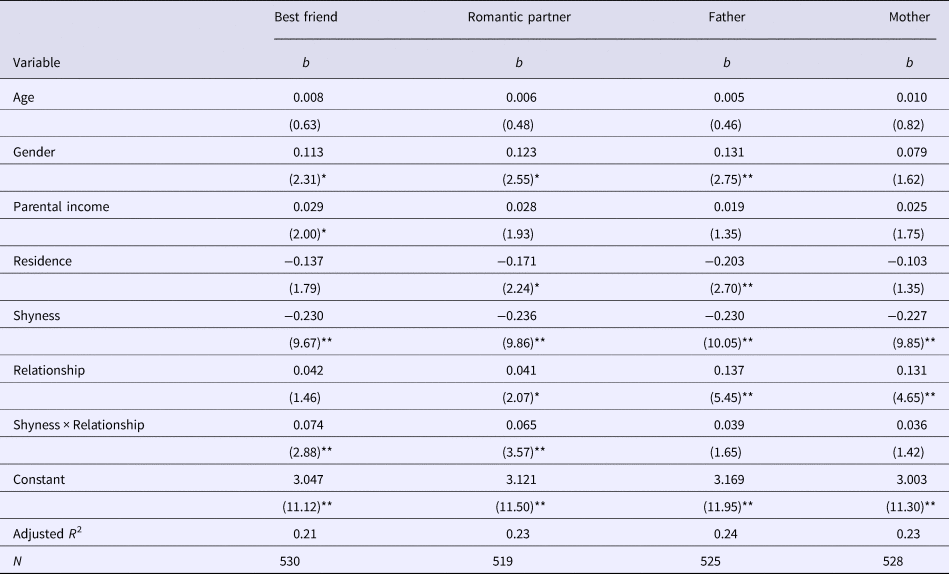
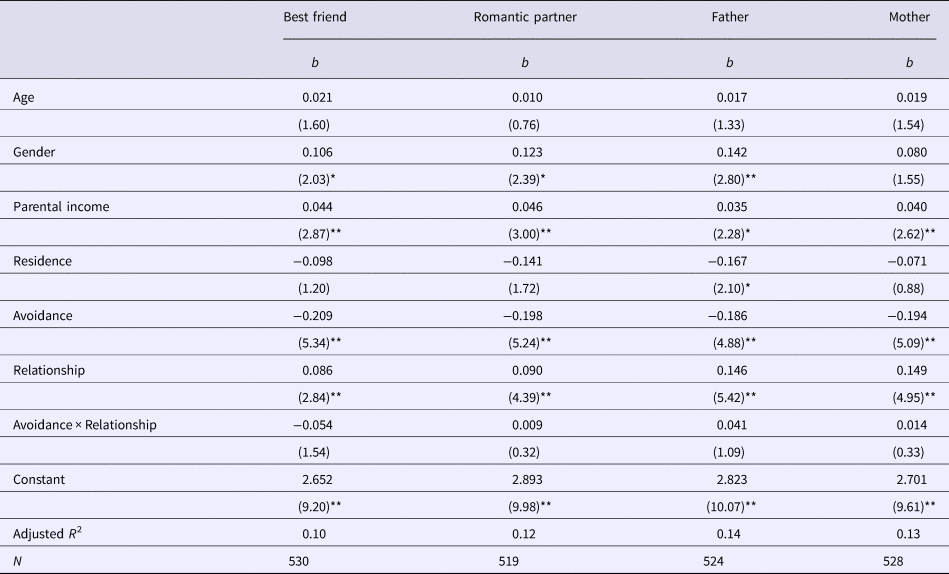
Regression analyses tested the relation of shyness, avoidance and relationship quality in the prediction of self-worth. Four models were used to test the moderating role of relationship quality (best friends, romantic partners, mothers, and fathers) in the association between shyness and self-worth, and four additional models used to test the moderating role of relationship quality (best friends, romantic partners, mothers, and fathers) in the association between avoidance and self-worth. It should be noted that the overall N in each respective model varied slightly due to missing data for a particular variable (e.g., some participants were not in a romantic relationship so did not respond to those items). For the sake of parsimony, all main effects and interaction effects can be found in Tables 2 and 3, but only results for the interactions will be summarised and discussed here as research has already established direct links among these variables (Nelson, Reference Nelson2013), and our current hypotheses were aimed at addressing questions of moderation.
Hierarchical Regression Results of Shyness on Predicted Self-Worth by Relationship Quality

Note: Values below coefficients in parentheses indicate t values.
*p < .05; **p < .01
Hierarchical Regression Results of Avoidance on Predicted Self-Worth by Relationship Quality

Note: Values below coefficients in parentheses indicate t values.
*p < .05; **p < .01
Interaction Effects
Results revealed that there were no interactions between shyness and relationship quality with either mothers or fathers. Furthermore, no interactions were found between avoidance and any of the relationship variables. However, in addition to the main effects in each of these models, analyses revealed two interaction effects to be significant. First, in the shyness-best friend model, analyses revealed the interaction of shyness-best friendship relationship quality to be significant (b = .07, t = 2.88, p < .01), accounting for the control variables and main effects. Further, we used an F test and determined that this interaction significantly (F = 8.29; p < .01) added to the variance predicted (R 2) by the control variables and the shyness and best friend relationship quality variables. Additionally, in the shyness-romantic partner model, analyses revealed the interaction of shyness and romantic partner relationship quality to be significant (b = .07, t = 3.57, p < .001), accounting for the control variables and main effects. Again, we used an F test to determine that this interaction significantly (F = 12.74; p < .001) added to the variance predicted (R 2) by the control variables and the shyness and romantic partner relationship quality variables.
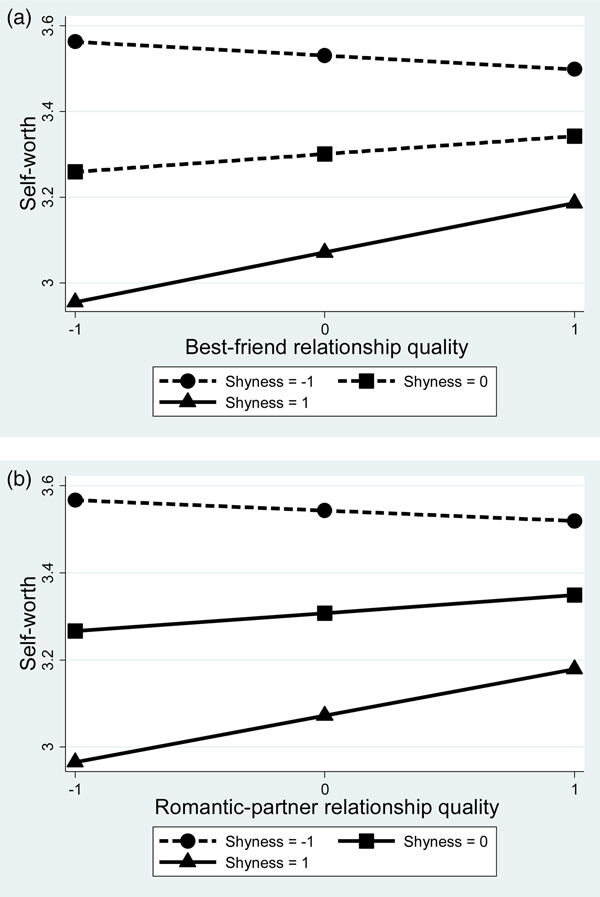
To further explore these interactions, we used STATA SE 14 to graph (see Figure 1) and examine the simple slopes to better understand the relationship between best friend and romantic partner relationship quality and self-worth at three different levels of shyness (Aiken & West, Reference Aiken and West1991). In the shyness-best friend model, we discovered one slope to be significantly different from zero. At high levels of shyness (+1), for every one unit increase in best friend relationship quality, there was a .12 increase in self-worth, accounting for all other variables in the model (b = .12, t = 3.14, p < .01). However, the other two slopes depicting middle and lower levels of shyness were not significantly different from zero. In the shyness-romantic partner model, we discovered two of the three slopes to be significantly different from zero. At the middle and high levels of shyness (0 and + 1), for every one unit increase in romantic partner relationship quality, there was a .04 (b = .04, t = 2.07, p < .05) and .11 (b = .11, t = 4.32, p < .001) increase respectively in self-worth accounting for all other variables in the model.
Interactions between (a) shyness and best friendship, (b) shyness and romantic partner relationship quality indicated by solid lines.

Discussion
The purpose of the current study was to assess the moderating effect of relationship quality on the link between subtypes of withdrawn motivations and self-worth in emerging adulthood. Specifically, we assessed the moderating effect of four different relationships (best friend, romantic partner, father, mother) of emerging adults and how they moderated the association between shyness and avoidance, and self-worth. The results of the study replicate several important findings from previous work (e.g., Nelson, Reference Nelson2013) but also extend our current understanding of the role of relationships in the lives of withdrawn emerging adults. Specifically, main effect findings demonstrate that being withdrawn (shy or avoidant) is related to lower self-worth. Results of the study also support what has been found in extant work in showing that shyness and avoidance are associated with poorer quality relationships with peers and parents. Hence, the most important results are those showing the protective moderating role of relationships with friends and romantic partners in the association between shyness and self-worth. Specifically, friends and romantic partners appear to make a significant difference in how highly shy individuals feel about themselves. Interestingly, relationships with peers and parents did not appear to provide a protective role for avoidant individuals. The contributions of these findings will be discussed in turn.
Subtypes of Withdrawal and Peer Relationships
Shyness
Results indicated that shy emerging adults may benefit from having a high-quality relationship with a best friend or romantic partner in that their self-worth was higher than those with a middle or low-quality best friendship or romantic partnership. This is an important contribution to our understanding of the importance of relationships for withdrawn individuals, given that shy emerging adults tend to struggle with regard to the peer relationships (e.g., Nelson et al., Reference Nelson, Padilla-Walker, Badger, Barry, Carroll and Madsen2008; Nelson, Reference Nelson2013). Indeed, this finding with emerging adults extends the work that has been conducted with children and adolescents examining the beneficial role the relationships can play for those who are withdrawn. As previously mentioned, research has repeatedly shown that children (Burgess, Wojslawowicz, Rubin, Rose-Krasnor, & Booth-LaForce, Reference Burgess, Wojslawowicz, Rubin, Rose-Krasnor and Booth-LaForce2006) and adolescents (Oh et al, Reference Oh, Rubin, Bowker, Booth-LaForce, Rose-Krasnor and Laursen2008) benefit from having a quality best friendship. Specifically, children with quality best friendships are more likely to be protected from negative group factors like peer rejection (Rubin, Chen, & Hymel, Reference Rubin, Chen and Hymel1993), peer exclusion (Rubin et al., Reference Rubin, Wojslawowicz, Burgess, Rose-Krasnor and Booth-LaForce2006), and victimisation (Erath, Flanagan, & Bierman, Reference Erath, Flanagan and Bierman2007; Hanish & Guerra, Reference Hanish and Guerra2004), which often reinforce the already lower self-perceptions of shy children (Gazelle & Rudolph, Reference Gazelle and Rudolph2004; Oh et al., Reference Oh, Rubin, Bowker, Booth-LaForce, Rose-Krasnor and Laursen2008). Further, the presence of a quality friendship in childhood has been found to protect withdrawn children from developing internalising behaviours in adolescence (Bowker & Rubin, Reference Bowker and Rubin2008). As previous research with younger samples has found many positive influences stemming from a quality best friendship, our findings suggest that friends continue to play an important role in the lives of shy emerging adults.
Another important contribution of the study is the finding that romantic partners can also play a moderating role in the association between shyness and self-worth. As noted previously, romantic relationships appear to take on a meaningful role in the lives of emerging adults. For instance, high quality romantic parnterships have been linked to better overall wellbeing (Rowsell & Coplan, Reference Rowsell and Coplan2013) and happiness (Demir, Reference Demir2008). Hence, despite the fact that shy emerging adults generally tend to have lower quality romantic partnerships, they appear to experience the same positive effects as their non-withdrawn peers when they do experience a high-quality romantic partnership. In other words, a high quality romantic relationship may be a protective factor against negative feelings about the self for shy emerging adults. Taken together, our findings indicate that best friendships can continue to play an important role in the lives of shy individuals, and that romantic partners can also play a similar positive role, specifically in regard to their feelings of self-worth.
Avoidance
In contrast to the finding that shy emerging adults benefit from a quality best friendship or romantic relationship, our analyses revealed that avoidant emerging adults do not benefit in the same way. In other words, high-quality relationships with best friends or romantic partners did not moderate the association between avoidance and self-worth. Asendorpf's (Reference Asendorpf1990) motivational model of social withdrawal suggests that avoidance is characterised by a high-avoidance motivation and a low-approach motivation, that is, they have little desire to interact with others and actively avoid having to do so. Unlike shy individuals who may be afraid of social settings but who want to be with and have relationships with others (i.e., high approach motivation), avoidant individuals appear to actively shun interactions with others, which may explain why relationships would have little effect on their feelings of self-worth.
Regardless, consistent with past work (Nelson, Reference Nelson2013), our findings show that shyness and avoidance are both linked to lower levels of self-worth in emerging adulthood, but this association is not influenced by best friend or romantic partner relationships for avoidant emerging adults in the same way that it is for shy emerging adults who possess a more high approach motivation. Indeed, taken together, shy emerging adults, perhaps because of their high approach motivation, benefit from a quality best friendship and/or romantic relationship while avoidant emerging adults do not appear to be influenced in the same way.
The Changing Nature of Parent and Peer Relationships
The lack of findings pertaining to the parent-child relationship for either shy or avoidance emerging adults prompts a discussion of the changing nature of parent relationships versus peer relationships during the third decade of life. Again, results revealed that relationship quality with mothers and fathers did not play a role in how shy or avoidant emerging adults view themselves. These findings are somewhat surprising for two reasons. First, research suggests that parents can continue to play an important role in the lives of their emerging adult children (e.g., Nelson & Barry, Reference Nelson and Barry2005). Second, parents have been found to have a positive impact on the lives of their withdrawn children during this (Nelson & Padilla-Walker, Reference Nelson and Padilla-Walker2013) and earlier developmental periods (van Wel, ter Bogt, & Raaijmakers, Reference van Wel, ter Bogt and Raaijmakers2002; Barry, Padilla-Walker, Madsen, & Nelson, Reference Barry, Padilla-Walker, Madsen and Nelson2008).
Perhaps one reason why parents do not appear to play a role in their shy and avoidant children's feelings of self-worth is because of the changing nature of the parent-child relationship throughout development. Indeed, numerous studies affirm that attachment with parents and peers matter in the adjustment of adolescents (Laible, Carlo, Raefelli, Reference Laible, Carlo and Raffaelli2000; Wilkinson, Reference Wilkinson2004). However, work by Rosenthal and Kobak (Reference Rosenthal and Kobak2010) found attachment figures to differ between early and late adolescents; specifically, that attachment with parents (compared to peers) was more important in negatively predicting adjustment problems in early adolescence, with the converse being true during late adolescence. More specifically, recent work has indicated that attachment strength with fathers can ameliorate adolescents’ stress (Goh & Wilkinson, Reference Goh and Wilkinson2017). Although this research speaks to the changing nature of relationships during adolescence, it supports the notion that the role of parents becomes increasingly less important in the wellbeing and adjustment of emerging adults.
Another possible explanation may be the amount of time emerging adults spend with their parents. For example, consistent with most emerging adult samples, 89% of the participants in the current study reported living away from home. Perhaps the relationships that matter most to emerging adults are the ones with whom they spend the most time. As the amount of time emerging adults spend with their parents generally decreases as they transition to adulthood (partly because they have moved out), these relationships may become less important, at least with regard to their feelings of self-worth. Therefore, peers may not only become the individuals with whom emerging adults spend most of their time, but also become the ones with whom they form relationships that are highly influential in the lives of withdrawn emerging adults (Steinberg & Morris, Reference Steinberg and Morris2001). Taken together, despite the research literature suggesting that parents are able to play a positive role, we found parents to have little to no impact on their shy and avoidant emerging adult childrens’ feelings of self-worth.
Limitations and Future Directions
Although the current study adds to the research literature, it is not without limitations. First, the cross-sectional nature of the current study precludes inferences of causation. Future work should investigate the moderating effects of relationship quality on the link between withdrawal and self-concept using longitudinal analyses. Further, future research should investigate the bidirectionality in the relations between withdrawal and aspects of the self-concept. A second limitation to the current study is that most of the items used to measure avoidance were sociability items that were then reverse scored. It might be argued that they do not directly assess a high-avoidance and low-approach motivation. Although this measure has been used in multiple other studies (e.g. Nelson, Reference Nelson2013; Nelson, Coyne, Howard, & Clifford, Reference Nelson, Coyne, Howard and Clifford2016) and has demonstrated acceptable psychometric properties, future studies should implement a more direct measure of avoidance. A third limitation is the use of a college student sample. Albeit sampling occurred from four separate universities across the United States, this study does not account for others in the population of interest. Specifically, some withdrawn individuals may choose to elude the college experience altogether because of their tendencies to withdraw; therefore, it may be particularly important to conduct work that includes non-students.
Though the current study indicates only shy individuals to be influenced by their relationships in a positive way, future research should do more to distinguish between subtypes of withdrawal. Future studies could use multiple group analysis, creating groups for shy, avoidant and unsocial individuals with and without a quality relationship with best friends, mothers, fathers, and romantic partners. By taking a more person-centred approach, analyses could utilise numerous dependent variables to discriminate further between both subtypes of withdrawal and whether quality relationships are present, and the role they play in the lives of withdrawn young people. Further, future work should aim to replicate these findings using other measures of relationship quality. Indeed, although the measure used in this study was more comprehensive in that it captured various peer and parental relationships, there may be nuances in the specific relationships that could be better captured by other measures.
Conclusion
Despite its limitations, the current study offers numerous contributions to our understanding of social withdrawal in emerging adulthood. The results demonstrate the important role that peer relationships play in the lives of shy emerging adults. Indeed, the results of the study extend into the third decade of life, providing evidence of the moderating effect of relationships on the link between shyness and self-worth that have been found in childhood and adolescence. The results also contribute to our understanding of social withdrawal in emerging adulthood by differentiating between various forms of social withdrawal that have been found to be associated with various risk factors. Specifically, this study differentiated between shyness and avoidance and found that relationships appear to matter more for the former and less for the latter with regard to self-worth. In doing so, this study adds to the growing body of evidence demonstrating the necessity of studying social withdrawal as a multidimensional construct, as shyness and avoidance appear to be distinct forms of withdrawal with separate and unique outcomes during emerging adulthood.