One of the challenges in archaeological research is finding ways to understand or bridge the gap that extends from basal domestic units to the organization of larger communities and regional populations (Kolb and Snead Reference Kolb and Snead1997). To begin with, a focus on the archaeological manifestations of ancient households is essential for identifying mechanisms of community integration (Bawden Reference Bawden1982:166). With the increasing frequency of excavations in domestic contexts over the past several decades, archaeology is beginning to get a more complete picture of the range of activities and rituals that were practiced in past Mesoamerican households (Feinman and Nicholas Reference Feinman, Nicholas, Feinman and Manzanilla2000; Feinman et al. Reference Feinman, Nicholas and Haines2002; Flannery and Marcus Reference Flannery and Marcus2005; Garber et al. Reference Garber, Driver, Sullivan, Glassman and Mock1998; Haines et al. Reference Haines, Feinman and Nicholas2004; Manzanilla Reference Manzanilla1986, Reference Manzanilla1993, Reference Marcus, Flannery and Marcus1996; Plunket [editor] Reference Plunket2002; Santley and Hirth Reference Santley and Hirth1993; Smith Reference Smith1992; Wilk and Ashmore Reference Wilk and Ashmore1988; Winter Reference Winter1974) and, thus, a basis to examine how those domestic units were woven into larger social segments. Domestic variation is most visible between higher-status households and commoners, yet residential units of seemingly the same social strata from a single settlement also may exhibit variability along several dimensions (Plunket Reference Plunket and Plunket2002:3–4). To date, less study has been focused on understanding the overarching interconnections that linked households and sets of households into larger spheres. Although there is greater recognition of the necessity to examine organizational networks both within and between communities (Robin Reference Robin2003), given the generally small sample of excavated houses at any one site, we often have lacked the means to define and understand how those household residents were integrated into larger societal entities.
For pre-Hispanic Mesoamerica, rituals enacted in domestic settings are considered to have been a principal mechanism for integrating and bonding the members of a social unit (Cyphers Guillén Reference Cyphers Guillén1993; Drennan Reference Drennan and Flannery1976a; Flannery and Marcus Reference Flannery and Marcus2005; Hendon Reference Hendon, Grove and Joyce1999; Manzanilla Reference Manzanilla and Plunket2002; Marcus Reference Marcus1998; Spence Reference Spence and Plunket2002; Winter Reference Winter and Plunket2002). Ritual activities serve as a means of communicating with the supernatural, including ancestors; the material manifestation of this interaction is a potential indicator of group identity and how people affiliate themselves with larger groups (Marcus and Flannery Reference Marcus, Flannery, Renfrew and Zubrow1994; Osborne Reference Osborne2004; Renfrew Reference Renfrew, Renfrew and Zubrow1994). Thus, distinct strategies for accessing the supernatural may signify different group identities or affiliations. Although certain pre-Hispanic Mesoamerican domestic rituals have been described in detail (Marcus Reference Marcus1998; Plunket [editor] Reference Plunket2002), there has been little comparative discussion of how domestic ritual activities varied or were similar among a range of households or across segments at a specific site.
Prior archaeological investigations at the household (Flannery and Marcus Reference Flannery and Marcus2003, Reference Flannery and Marcus2005) and regional (Blanton Reference Blanton1978; Kowalewski Reference Kowalewski, Brumfiel and Fox1994) scales in Oaxaca have revealed barrio or neighborhood segments within larger communities, but we are still learning how these community segments were integrated. In this paper, we focus on the Classic period (a.d. 300–850) at El Palmillo, in the Valley of Oaxaca, and build on prior research that examined production and consumption from a series of residential contexts and how these domestic units were interconnected (Feinman et al. Reference Feinman, Nicholas and Haines2002, Reference Feinman, Nicholas and Haines2006; Haines et al. Reference Haines, Feinman and Nicholas2004; Haller et al. Reference Haller, Feinman and Nicholas2006). We examine domestic ritual as a vehicle to understand other means through which El Palmillo households were linked into the larger community. The site's assemblage of domestic offerings provides an additional vantage to probe these links in ancient Oaxaca.
COMMUNITY SEGMENTS IN OAXACA
In the Valley of Oaxaca today, many communities (large and small) are subdivided into several (or more) barrios, also referred to as neighborhoods or colonias (Murphy and Stepick Reference Murphy and Stepick1991; Parsons Reference Parsons1936:1–21). Traditionally, these community segments have had administrative, economic, and ritual functions (Kowalewski Reference Kowalewski, Brumfiel and Fox1994:135). Barrio organization also was noted when the Spanish arrived in the sixteenth century (Bandelier Reference Bandelier1884:272; Gay Reference Gay1982 [1881]:124) and is documented for the Colonial period (Taylor Reference Taylor1972:21, 72, 88). The barrio organization of at least one Valley of Oaxaca town, Cuilapan, has continued from early colonial times into the present (Kowalewski Reference Kowalewski, Brumfiel and Fox1994:134).
Based on archaeological excavations and regional settlement pattern surveys in the valley, the existence of barrio organization has been postulated for much of the pre-Hispanic era. During the Early Formative period (1150–850 b.c.), neighborhood wards at San José Mogote were separated from each other by gullies or natural ravines, with each barrio engaged in its own range of craft activities (Flannery and Marcus Reference Flannery and Marcus2005:11, 469). At the time of its establishment around 500 b.c., Monte Alban is thought to have consisted of barrios or wards, each situated on a different side of the site's Main Plaza (Blanton Reference Blanton1978:37). Based on surface collections of ceramics, Blanton (Reference Blanton1978:39) found greater ceramic similarity within each ward than between them. By the Classic period (approximately a.d. 300–850), Monte Alban is postulated to have consisted of as many as 15 neighborhoods or barrios, often distinguished from each other in terms of the size and monumentality of public and residential architecture, differential distributions of artifacts, and variability in craft-working activities (Blanton Reference Blanton1978:67, 75–93). Deep ravines or other natural features separate many of these wards. Contemporaneous Teotihuacan in the Basin of Mexico also comprised many neighborhood wards, including those associated with different ethnic or regional affiliations such as the Oaxaca barrio (Manzanilla Reference Manzanilla1993, Reference Manzanilla1996; Millon Reference Millon and Wolf1976; Spence Reference Spence and Plunket2002).
Regional survey data from the Valley of Oaxaca and surrounding areas (Blanton et al. Reference Blanton, Kowalewski, Feinman and Jill1982; Feinman and Nicholas Reference Feinman and Nicholas1990, Reference Feinman and Nicholas1996, Reference Feinman and Nicholas2004a; Kowalewski et al. Reference Kowalewski, Feinman, Finsten, Blanton and Nicholas1989) have also revealed internal, spatial divisions, especially at larger sites, that may represent neighborhoods or barrios (see especially Kowalewski Reference Kowalewski, Brumfiel and Fox1994). In addition to Monte Alban, other densely settled hilltop terrace sites often have groups of residential terraces that are defined or subdivided by natural features. In an intensive surface study of three Classic period terrace sites in Oaxaca, including the site of El Palmillo (Feinman and Nicholas Reference Feinman and Nicholas2004a), we found patterns similar to those at Monte Alban. Groups of terraces often were located on distinct ridge tops and slopes or separated by ravines. These spatially segregated sets of terraces often are found to have artifact variability that indicates discrete patterns of craft activities or exchange ties (Feinman and Nicholas Reference Feinman and Nicholas2004a:120–121). Yet if these sets of residential terraces really do represent distinct site segments or neighborhood barrios, what social mechanisms held the households in each site segment together, and how were they then interconnected into the larger community?
To begin a consideration of these questions, we first present a brief review of our prior investigations and general findings concerning a series of excavated residential complexes at El Palmillo. We then turn to discussions of domestic offerings—more broadly in Mesoamerica, then specifically at El Palmillo, where our focus is on Classic-period domestic ritual. We use these activities as a means to illustrate how household groups may have been interconnected across the site.
BACKGROUND TO EL PALMILLO
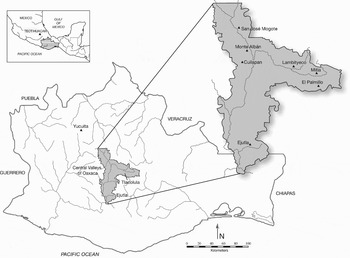
El Palmillo is a large, hilltop terraced site located near the modern community of Santiago Matatlan in the dry eastern, or Tlacolula, arm of the Valley of Oaxaca (Figure 1) (Feinman and Nicholas Reference Feinman and Nicholas2004a; Kowalewski et al. Reference Kowalewski, Feinman, Finsten, Blanton and Nicholas1989). During the Classic period, when the site reached its greatest spatial extent, more than 1,400 residential terraces were arranged along the top and sides of a steep rock cliff (Feinman and Nicholas Reference Feinman and Nicholas2004a). Although many terraces were densely packed together on the main western face of the hill, often in strings connected by long stone retaining walls, other, more discrete groups of terraces were dispersed across the ridge tops and on lower descending slopes. A series of monumental public buildings that included a three-mound group with an enclosed plaza was erected on the highest ridge top. Other, much smaller structures and platforms are dispersed across the residential areas of the site, much like at Monte Alban (Blanton Reference Blanton1978).
Mexico and the Valley of Oaxaca, with sites mentioned in the text.

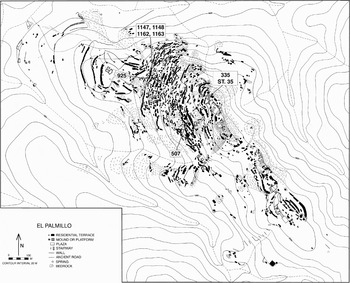
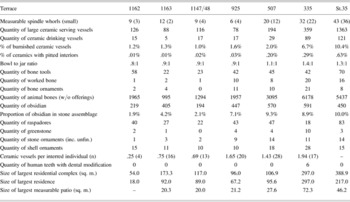
To explore households and their associated economic activities, access to goods, and variation in residential and mortuary architecture, we have excavated a series of residential spaces dispersed across the site's main western slope. Our sample includes several adjacent terraces near the bottom of the hill (Terraces 1162, 1163, and 1147/1148), two intermediately positioned terraces (Terraces 925 and 507), and two more elaborate complexes at the top of the hill (Terrace 335 and Structure 35) (Figure 2 and Table 1) (Feinman et al. Reference Feinman, Nicholas and Haines2002, Reference Feinman, Nicholas and Haines2006; Haines et al. Reference Haines, Feinman and Nicholas2004; Haller et al. Reference Haller, Feinman and Nicholas2006). To facilitate comparison of residential contexts across the site, our basic field procedures have remained consistent throughout the project (see Feinman et al. Reference Feinman, Nicholas and Haines2002; Middleton et al. Reference Middleton, Feinman and Nicholas2002). Our basic excavation strategy is to expose the top use or residential occupation on each terrace in its entirety and to map the extent of the residential architecture and associated exterior work areas or other cultural features. After exposing the uppermost surface, we proceed down to lower occupational surfaces. Our exposure of lower surfaces on each terrace is somewhat more limited, largely due to conservation issues and disturbances from later constructions.
Site map of El Palmillo showing location of the excavated terraces.

Axes of Variation at El Palmillo

All intact deposits are screened through wire mesh to recover small artifacts and production debris. House and patio floors generally were very clean, and most of the artifact collections derive from fill and trash contexts associated with structures and other features on each terrace. Throughout, we have made the assumption that this domestic and craft-related debris primarily reflects activities carried out on or very near that terrace. The trash is most likely to have originated with the inhabitants of that residential complex or nearby households in the immediate vicinity (Bayman Reference Bayman1996; Beck Reference Beck2003; Beck and Hill Reference Beck and Hill2004; Blinman Reference Blinman, Lipe and Hegmon1989). Thus, the artifactual assemblages and features on each terrace represent broadly comparable samples.
Each excavated terrace contains a residential unit or house. Residences generally consist of a series of rooms around a small patio, often with a lime-plastered floor (Figure 3). Some patios are enclosed by a small raised banquette; others are not. Most rooms have plaster floors and walls constructed of adobe bricks, although the thickness of the walls is variable. On lower terraces, patios generally are open on one side, with three or more rooms on three sides of the patio. Larger residential complexes near the top of the hill generally have more rooms and patios that are closed to the outside. Some of the larger residences also include a second patio. The complexes on the terraces were occupied for centuries, from about a.d. 250–300 to a.d. 750–850, and were rebuilt several times over that time span, often with minor remodeling events taking place between more major rebuilding episodes. Each residential complex appears to have been associated with a single domestic unit. These units likely were larger for the two complexes at the apex of the hill, where two-patio residences were associated with some occupational episodes.
Residential complex on Terrace 925.

As was common practice in pre-Hispanic Oaxaca (Middleton et al. Reference Middleton, Feinman and Villegas1998; Romero Molina Reference Romero Molina1983; Winter Reference Winter1974, Reference Winter1995, Reference Winter and Plunket2002), the site's inhabitants routinely buried their dead near their houses, generally under house or patio floors but also in terrace walls or subfloor domestic tombs. Other indications that these spaces were residential include small domestic offerings that were found on all terraces, the presence of hearths and other fire installations, including two large ovens on the lower terraces that appear to have been used to roast maguey (Feinman et al. Reference Feinman, Nicholas and Haines2002; see also Serra Puche et al. Reference Serra Puche, Lazcano Arce and Hernández2000), and domestic refuse. Intermixed with the domestic trash on all terraces was evidence of several craft activities.
The pre-Hispanic inhabitants of El Palmillo engaged in a range of different craft activities and produced a variety of basic goods. Economic activities on many terraces centered on the production of stone tools from local cherts, many of which were used in processing xerophytic plants for food and fiber (Feinman et al. Reference Feinman, Nicholas and Haines2002; Haines et al. Reference Haines, Feinman and Nicholas2004). The plant community on site, which comprises many economically useful xerophytic plants such as maguey and yucca that provide edible fruit and leaves or fiber (Feinman and Nicholas Reference Feinman, Nicholas and Blanton2005; Feinman et al. Reference Feinman, Nicholas and Haines2002, Reference Feinman, Nicholas, Haines, Thurston and Fisher2007; Middleton et al. Reference Middleton, Feinman and Nicholas2001; see also Evans Reference Evans1990; Hough Reference Hough1908; Parsons and Darling Reference Parsons and Darling2000; Parsons and Parsons Reference Parsons and Parsons1990), provides important empirical support for this assessment.
Large, specialized, dome-shaped stone scrapers called raspadores are abundant at El Palmillo, where they occur in all households (Table 1). These tools have long been considered effective in extracting fibers from maguey leaves (Hester and Heizer Reference Hester and Heizer1972; Robles García Reference Robles García1994). The importance of maguey as a pre-Hispanic economic resource has been documented for Aztec times in central Mexico (Evans Reference Evans1990; Ortiz de Montellano Reference Ortiz de Montellano1990). The plant also has a long history of use in Oaxaca (Flannery Reference Flannery, Flannery and Marcus1983a, Reference Flannery and Flannery1986; Flannery and Spores Reference Flannery, Spores, Flannery and Marcus1983; King Reference King and Flannery1986; Smith Reference Smith Jr.1978, Reference Smith and Flannery1986). Fibers from the plant (ixtle) could be processed into a variety of goods, including textiles, rope, sandals, and nets.
The production of maguey fiber (and possibly cloth) seems to have been a significant household craft activity at El Palmillo. Spindle whorls for spinning maguey fibers are found in all the excavated households (Table 1). Other weaving tools found on several terraces include small ceramic and stone “bowls” for holding the distal end of spindles (Anawalt Reference Anawalt1981:11; Berdan and Anawalt Reference Berdan and Anawalt1992:54; Smith and Hirth Reference Smith and Hirth1988). Many of the bone tools recovered during excavations (especially battens, awls, and needles) also were associated with a fiber industry (Table 1; see also Haines et al. Reference Haines, Feinman and Nicholas2004:259). Other, less widespread craft activities include pottery manufacture, ground-stone-tool production, and lapidary working.
Although many households at El Palmillo crafted stone tools and processed xerophytic plants, each domestic unit did not carry out the same suite of productive activities; nor did those activities have equal importance in each residential unit (Haines et al. Reference Haines, Feinman and Nicholas2004). For example, while most households at El Palmillo engaged in some stone working, the residents of the lower terraces appear to have been more intensively involved in the manufacture of formal tools (and possibly preforms and cores) that were intended for house-to-house exchange. Even though all households appear to have engaged in some spinning, based on variation in whorl size (see Parsons and Parsons Reference Parsons and Parsons1990; Parsons Reference Parsons, Spence, Parsons and Parsons1972), they may have focused on different kinds of thread. Larger whorls, for spinning coarse maguey fibers, are more abundant on lower terraces (Terraces 1162, 1163, 1147/1148), whereas smaller whorls that are more suitable for spinning cotton (wild cotton still grows on the site today) and fine maguey thread are more abundant on upper terraces (Terraces 507, 335, Structure 35).
Variation in residential architecture and access to goods provides evidence of status distinctions among the residents of different domestic complexes. Houses generally are more elaborate, if not always larger, as one moves up the hill. Located adjacent to the civic-ceremonial core at the top of the hill, the residential complexes on Terrace 335 and Structure 35 are much larger and more elaborate than residential structures on other excavated terraces at the site. These palace-like residences, with enclosed patios surrounded by as many as eight or nine rooms, share many features with palaces at Monte Alban (Caso Reference Caso1938; Flannery Reference Flannery, Flannery and Marcus1983b; Marcus and Flannery Reference Marcus1996:208–212) and Lambityeco (Lind Reference Lind and Robles García2001; Lind and Urcid Reference Lind and Urcid1983; Paddock et al. Reference Paddock, Mogor and Lind1968). The richest and most elaborate mortuary context was found on Terrace 335 (no burial contexts were uncovered on Structure 35). This stone masonry tomb, constructed with five courses of faced stone blocks and three wall niches, was much larger and more finely constructed than tombs on several lower terraces (Terraces 507 and 925) (Feinman and Nicholas Reference Feinman and Nicholas2003; Feinman et al. Reference Feinman, Nicholas and Haines2006). In fill in front of the tomb were six teeth with dental inlays, a marker of high status (Romero Molina Reference Romero Molina and Stewart1970, Reference Romero Molina1986); modified teeth have not been found elsewhere on site (Table 1).
The distribution of portable wealth items follows the same basic pattern, with greater quantities of elaborate goods in households of higher status. Obsidian and tools of higher-quality cherts, greenstone, stone, shell, and bone ornaments, and animal bones are present in slightly greater quantities on the upper terraces (Table 1) (Feinman et al. Reference Feinman, Nicholas and Haines2006; Haller et al. Reference Haller, Feinman and Nicholas2006). Materials made from finer fibers (fine maguey or cotton) are generally associated with individuals of higher status in pre-Hispanic Mesoamerica (Berdan Reference Berdan1987:244–245). The greater abundance of small spindle whorls on the upper terraces would seem to indicate that finer woven goods were made, and worn, by residents of those more elaborate residences. The number of grave goods associated with burials also tends to increase from the bottom of the hill to the top, with by far the greatest number of grave offerings associated with the masonry tomb on Terrace 335.
The architectural distinctions between the two uppermost residences and all of the others distinguish two social segments (elites and commoners) at El Palmillo, yet the more continuous pattern of access across the seven residences indicate that socioeconomic relations in the community were more complicated (Marcus Reference Marcus, Lohse and Valdez2004; Robin Reference Robin2003:319). We turn to the assemblage of domestic offerings at the site for additional insight into the nature of these relationships.
OFFERINGS AND DOMESTIC RITUAL
Domestic ritual was an important part of everyday life in pre-Hispanic Mesoamerica (Gonlin and Lohse Reference Gonlin and Lohse2007; Plunket [editor] Reference Plunket2002). Not only were domestic rituals a principal mechanism for integrating and bonding the members of a social unit (Drennan Reference Drennan and Flannery1976a:347–348; Flannery and Marcus Reference Flannery and Marcus2005:469; Manzanilla Reference Manzanilla and Plunket2002:48; Marcus Reference Marcus1998:2, 311; Spence Reference Spence and Plunket2002:55; Winter Reference Winter and Plunket2002:67), they also may have eased internal community stress (Johnson Reference Johnson, Renfrew, Rowlands and Segraves1982:405). As a means of communicating with the supernatural, these ritual activities are an important part of group identity and how people affiliate themselves with larger groups (Marcus and Flannery Reference Marcus, Flannery, Renfrew and Zubrow1994). But how much variation in ritual practice existed within communities? Did individual households or site segments have distinct strategies for accessing the supernatural that signified their subgroup (barrio or ward) identity or affiliation? Was the principal purpose of these ritual activities to increase solidarity among a group of households, or were these actions focused on strengthening bonds within an individual family group (Spence Reference Spence and Plunket2002:55)? Can we always make this distinction based on the context and physical remains of the ritual activity (Flannery Reference Flannery and Flannery1976:333)?
Based on sixteenth-century ethnohistoric accounts from the Valley of Oaxaca, the Zapotec had a rich tradition of ritual practice, with the notion of sacrifice at the core of those beliefs (del Paso y Troncoso Reference del Paso y Troncoso1905; Marcus and Flannery Reference Marcus, Flannery, Renfrew and Zubrow1994). They attributed life to many inanimate things, including natural phenomena such as lightning and wind (Flannery and Marcus Reference Flannery and Marcus1976; Marcus Reference Marcus, Flannery and Marcus1983; Marcus and Flannery Reference Marcus, Flannery, Renfrew and Zubrow1994:57–58; Starr Reference Starr1987:374) and held that deceased ancestors transitioned at death into clouds (Marcus and Flannery Reference Marcus, Flannery, Renfrew and Zubrow1994:58–59). Ancestors were venerated, and it was believed that they could intercede with the supernatural world if they were reciprocally compensated through offerings (Marcus Reference Marcus, Flannery and Marcus1983, Reference Marcus, Sharer and Grove1989; Marcus and Flannery Reference Marcus, Flannery, Renfrew and Zubrow1994:57–59). In the documentary accounts, ritual offerings consisted of sacrificed animals, especially dogs and birds; humans, including children; and blood (Asensio Reference Asensio and del Paso y Troncoso1905; Canseco Reference Canseco and del Paso y Troncoso1905; del Río Reference del Río and del Paso y Troncoso1905; Espíndola Reference Espíndola and del Paso y Troncoso1905; Horcasitas and George Reference Horcasitas and George1955; Marcus and Flannery Reference Marcus, Flannery, Renfrew and Zubrow1994:58–61; Pérez de Zamora Reference Pérez de Zamora and del Paso y Troncoso1905; Spores Reference Spores and Willey1965:970; Starr Reference Starr1987:374), often through auto-sacrifice (Flannery Reference Flannery, Flannery and Marcus1983b:132; Marcus and Flannery 1996:15). Something live was considered the greatest sacrifice one could offer to the supernatural forces (Marcus and Flannery 1996:19). As described, the making of offerings often was part of larger ritual occasions that included ceremonial feasts that also featured dancing and the consumption of pulque (Asensio Reference Asensio and del Paso y Troncoso1905; Canseco Reference Canseco and del Paso y Troncoso1905; del Río Reference del Río and del Paso y Troncoso1905; Horcasitas and George Reference Horcasitas and George1955; Starr Reference Starr1987:372).
Domestic ritual practice in pre-Hispanic Mesoamerica encompasses a range of activities, including enactments using figurines, auto-sacrifice, divination, mortuary interment, and rites of dedication and termination (Mock Reference Mock1998; Plunket [editor] Reference Plunket2002). The use of figurines in domestic ritual extends back to the Formative period in Oaxaca (Drennan Reference Drennan and Flannery1976a, Reference Drennan, Flannery and Marcus1983; Marcus Reference Marcus, Sharer and Grove1989, Reference Marcus1996, Reference Marcus1998, Reference Marcus, Grove and Joyce1999; Marcus and Flannery Reference Marcus, Flannery, Renfrew and Zubrow1994:63) and elsewhere in Mesoamerica (Angulo Reference Angulo and Grove1987:155; Cyphers Guillén Reference Cyphers Guillén1993; Drennan Reference Drennan and Flannery1976a; Grove Reference Grove and Grove1987:423; Grove and Gillespie Reference Grove, Gillespie and Plunket2002; Harlan Reference Harlan and Grove1987). Figurines also form part of the ritual paraphernalia in the Classic period (Hendon Reference Hendon2003a; Sanders Reference Sanders1967:138), and we have uncovered hundreds of figurines in our excavations at El Palmillo and Ejutla, another Classic-period site in the southern part of the Valley of Oaxaca (Feinman and Nicholas Reference Feinman, Nicholas, Feinman and Manzanilla2000, Reference Feinman, Nicholas, Feinman and Nicholas2004b). One limitation of focusing on figurines, however, is that the locus or context of the ritual activity is often unclear, as the figurines, almost always broken, are most often found in refuse deposits or construction fill (Hendon Reference Hendon2003a; Plunket Reference Plunket and Plunket2002:6; Sanders Reference Sanders1967:138). There also is no consensus that figurines were produced solely for ritual (Spence Reference Spence and Plunket2002; Winter Reference Winter and Plunket2002).
We focus on domestic offerings as one kind of domestic ritual because they leave a relatively clear archaeological signature that can be examined as a subset of domestic rituals across households. The placement of domestic offerings, often under house or patio floors, has a long history in Oaxaca, extending from the pre-Hispanic era (Bernal and Gamio Reference Bernal and Gamio1974:35–58; Casparis Reference Casparis2006:60; Markens et al. Reference Markens, Winter and López2007:190; Sherman Reference Sherman2005:210; Winter et al. Reference Winter, Markens, López, Alicia Herrera, Gonlin and Lohse2007) into the present (Parsons Reference Parsons1936:76).
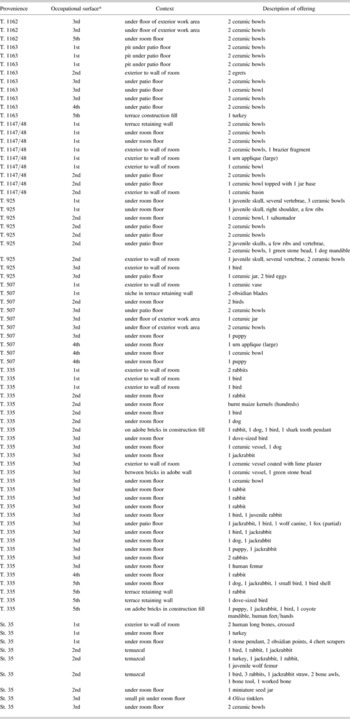
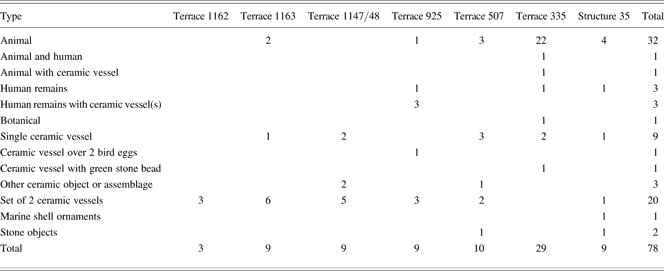
Although the complete offering assemblage at El Palmillo includes objects from both mortuary and domestic rituals, we are concerned here with domestic (or non-mortuary) offerings (Table 2). There is not always a clear-cut distinction between these two sets of features and associated goods (Kunen et al. Reference Kunen, Galindo and Chase2002). We consider items that are found in direct association with human interments, placed either inside burials or immediately adjacent to a burial context, such as near a tomb entrance, to be primarily mortuary offerings (Martínez López et al. Reference Martínez López, Winter, Juárez and Winter1995:227). At El Palmillo, these grave goods are mostly ceramic vessels but a variety of stone or bone ornaments and tools, shell ornaments, and occasionally animal remains, most often a dog, were interred with the deceased individual(s).
Provenience, Context, and Contents of Domestic Offerings at El Palmillo

*On all terraces, occupational surfaces are numbered sequentially from the most recent/top (1st) to the those below. The attribution of occupational surface includes both offerings in construction fill (placed after the end of the prior surface) and those placed in pits or other contexts during the occupation of that surface.
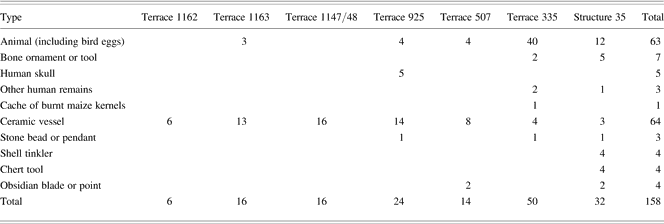
Domestic offerings, then, are the remains of non-mortuary rituals that occurred in or near a residential complex and may include dedicatory and termination rites. In pre-Hispanic Mesoamerica, houses have been argued to have their own lifecycle (Garber et al. Reference Garber, Driver, Sullivan, Glassman and Mock1998:125; Stross Reference Stross and Mock1998:31) and required an offering before they could be inhabited (Grove and Gillespie Reference Grove, Gillespie and Plunket2002:17). At El Palmillo, most domestic offerings were placed in layers of relatively clean fill during construction episodes between occupational surfaces, beneath either the patio or a room floor. A few were placed just beneath room floors while structures were still occupied or just beyond an exterior wall of a structure. Ceramic vessels and small animals were by far the most common domestic offerings (Tables 3–4). The completeness of these remains (if not complete, clearly a large segment of the interred object or individual) in an otherwise relatively clean matrix of fill is one factor we use to identify and define these contexts as purposeful offerings as opposed to refuse.
Total Number of Domestic Offering on Each Terrace

Total Number of Objects in Domestic Offerings on Each Terrace

In some cases, human remains may represent a domestic offering instead of a mortuary interment (Caso Reference Caso1942; Chase and Chase Reference Chase, Chase and Houston1998; Christenson and Winter Reference Christenson and Winter1997). Most human remains at El Palmillo were recovered from burials, usually as complete (or nearly complete) skeletons, either extended, flexed, or positioned as a bundle. In some cases, the human remains were partial, but we could determine fairly confidently that the lack of elements was due to post-depositional events, such as erosion or later disturbances to the burial deposit and thus that the deceased individual was interred in a mortuary ritual. There are a few contexts at El Palmillo, however, where the extremely partial nature of the human remains appears intentional, such as when we uncovered a lone skull, with or without several vertebrae, or a few hand or foot bones in contexts similar to those where we generally find offerings (Caso 1942:173; Chase and Chase Reference Chase, Chase and Houston1998:300, 309; Christenson and Winter Reference Christenson and Winter1997:474). These deposits were categorized as domestic offerings when the rest of the skeletal remains were not present in the specific context and the missing bones were not lost to post-depositional taphonomic or erosional processes.
INTEGRATIVE STRATEGIES: AN APPROACH INFLUENCED BY DURKHEIM
In previous publications concerning El Palmillo, we have considered intracommunity variation and cross-settlement modes of integration along several axes, including residential architecture, economic activities, and differences in access and consumption (Feinman et al. Reference Feinman, Nicholas and Haines2002, Reference Feinman, Nicholas and Haines2006; Haines et al. Reference Haines, Feinman and Nicholas2004; Haller et al. Reference Haller, Feinman and Nicholas2006). Although not discussed in such specific terms, we have recognized different aspects of social integration. In expanding our analysis to include domestic offerings from seven Classic-period houses at El Palmillo, both commoner and high-status households, we employ a perspective adapted from Durkheim's (Reference Durkheim and Simpson1933 [1893]) seminal distinction between mechanical and organic solidarity as two basic modes of organization.
To recapitulate Durkheim's constructs briefly, mechanical solidarity is based on the organization of similar units, emphasizing self-sufficiency and replicability. In contrast, organic solidarity features complementary differences between component units and interdependence. The application of Durkheim's model to the organization of a community and labor sets up a contrast between mechanical solidarity, where component household members engage in a similar set of activities and practices, and organic solidarity in which household members specialize, engaging in a different range of labors and behaviors. In the latter, each household would require the services, goods, or customary practices enacted by others to fulfill both their needs and those of the community. In other words, mechanical solidarity directly integrates individuals into society by drawing on the common collective while organic solidarity indirectly links individuals via webs of interdependencies (Alpert Reference Alpert1941:177–178; Müller Reference Müller1994:81).
Durkheim's theory of social integration has been widely discussed, and critiqued, in the social-science literature (Alpert Reference Alpert1941; Corning Reference Corning1982; Crow Reference Crow2002; Merton Reference Merton1934, Reference Merton1994; Müller Reference Müller1994; Rueschemeyer Reference Rueschemeyer1982, Reference Rueschemeyer1994; Turner Reference Turner1990). One aspect that has been criticized is the linearity of the evolutionary framework that Durkheim initially employed. Durkheim associated mechanical integration with more egalitarian forms of organization and organic solidarity with larger and more complex social formations (Merton Reference Merton1934:324–325, Reference Merton1994). Yet Durkheim himself did not see these integrative modes as entirely mutually exclusive (Alpert Reference Alpert1941:178). And once these contrasting modes are no longer restricted to a unilineal framework (see Merton Reference Merton1934:320) and are recognized to potentially co-occur in time and space, they have been considered as “one of the peak contributions of modern sociology” (Merton Reference Merton1934:328).
Previously, some Mesoamericanist archaeologists have seen utility in this evolutionary aspect of Durkheim's mechanical–organic contrast for explaining past sociopolitical or economic change (Coe Reference Coe1965; Price Reference Price, Lee and Navarrete1978; Sanders and Price Reference Sanders and Price1968), but other scholars recognize that these two modes of organization may co-occur (de Montmollin Reference de Montmollin1989:205, 226; Kurjack Reference Kurjack1974:4) and that patterns of integration are more diverse within societies of similar levels of hierarchical complexity (Blanton et al. Reference Blanton, Feinman, Kowalewski and Peregrine1996; Kowalewski et al. Reference Kowalewski, Blanton, Feinman and Finsten1983; see also Turner Reference Turner1990:1101).
Building on these notions of diverse organizational dynamics and Durkheim's concepts, we recognize three potential strategies or modes of integration. In addition to mechanical (based on similarities), we subdivide possible organic modes into hierarchical and nonhierarchical. Hierarchical organic strategies emphasize distinctions in social practice that are manifest in differential access to power, decision making, and goods between individuals and/or groups. Nonhierarchical organic strategies are based on the interdependence of households (of primarily similar social standing) that are engaged in different activities. For de Montmollin (Reference de Montmollin1989:204), the uneven distribution of specific items, such as goods related to craft production, is evidence of an organic strategy; we more precisely define this pattern as a nonhierarchical organic means of solidarity.
To apply Durkheim's theoretical frame and the three organizational modes outlined above to offerings, and so patterns of domestic rituals, several interpretive assumptions are in order. As presented in previous sections of this paper, we presume that shared domestic practice and ritual activities linking to the supernatural world in certain specific ways signal a degree of social affiliation, solidarity, and integration (Marcus and Flannery Reference Marcus, Flannery, Renfrew and Zubrow1994; Osborne Reference Osborne2004; Renfrew Reference Renfrew, Renfrew and Zubrow1994). Yet taking this argument one step further, we propose that if households in a community shared both spatial propinquity and similar domestic ritual practices, then they may have been part of a subgroup barrio or ward organization that identified itself as different in some way from other, similar groups at the site (see Manzanilla 1993 for a broadly comparable approach to different apartment compounds at Teotihuacan).
AN INTERPRETIVE CONTEXT FOR DOMESTIC OFFERINGS AT EL PALMILLO
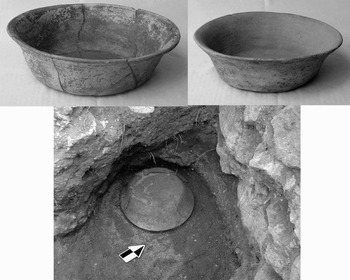
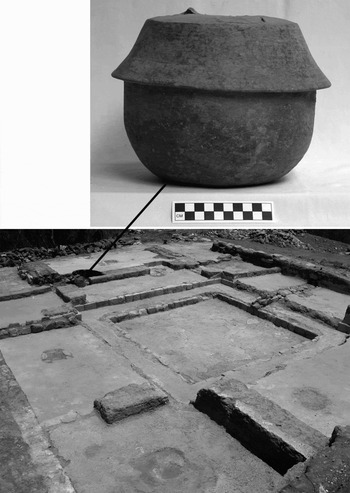
Domestic offerings at El Palmillo illustrate variability in both content and spatial distribution (Tables 3–4). As noted, the most common offerings are ceramic vessels and interred animals. More than half of the ceramic-offering contexts consist of two vessels, with the top bowl placed upside down (like a lid) on top of a smaller bowl sitting right side up (Figures 4–5). Larger bowls, often with out-flared walls and tripod supports, were most frequently used as the top vessel, while smaller cylindrical or hemispherical bowls were the most common bottom vessel. These offerings were most often found beneath the surfaces of patios and rooms, either in construction fill or immediately below lime-plastered floors (Figure 6). For example, one offering on Terrace 1163 consists of an amarillo bowl with out-leaned wall, flared rim, flat base, and three hollow supports that covered a smaller blackened café hemispherical bowl with a flat bottom (Figure 4). These vessels were placed together with two other similar offerings in a pit under the patio floor of the residential complex on Terrace 1163. Occasionally, these two-pot offerings also were placed in a terrace wall or below a path or other surface exterior to the residential unit.
Two-pot offering under patio floor of residence on Terrace 1163.

Two-pot offering in construction fill at base of wall on Terrace 1163.

Two-pot offering in construction fill at base of looter's pit on Structure 35.

Similar two-pot offerings have been found elsewhere in Classic and Postclassic contexts in Oaxaca (Bernal and Gamio Reference Bernal and Gamio1974; Markens et al. Reference Markens, Winter and López2007; Sherman Reference Sherman2005; Winter et al. Reference Winter, Markens, López, Alicia Herrera, Gonlin and Lohse2007), among the Maya (Chase and Chase Reference Chase, Chase and Houston1998; Garber et al. Reference Garber, Driver, Sullivan, Glassman and Mock1998; Pendergast Reference Pendergast and Mock1998), and in the Oaxaca barrio at Teotihuacan (Spence Reference Spence and Berlo1992, Reference Spence and Plunket2002). In contrast to Maya two-pot offerings, which often contained human skulls (Borhegyi Reference Borhegyi and Gordon1965:22–23; Ricketson and Ricketson Reference Ricketson and Ricketson1937:55–58), human finger bones (Chase and Chase Reference Chase, Chase and Houston1998:308, 318), or other, nonhuman remains (Pendergast Reference Pendergast and Mock1998:58), we rarely have found any artifacts inside any of the lower bowls at El Palmillo. Most two-pot offerings elsewhere in Oaxaca and in the Oaxaca barrio at Teotihuacan also lacked objects when found (cf. a covered jar found by Caso [1938:63] at Monte Alban). On rare occasions, the lower bowl contained several obsidian blades (Bernal and Gamio Reference Bernal and Gamio1974:37, 41; Spence Reference Spence and Plunket2002:58–59). Some of these offerings may once have contained a perishable substance of ritual significance, such as a placenta (Parsons Reference Parsons1936:76).
At El Palmillo, other offerings contain a single, uncovered ceramic vessel (or sometimes a vessel that may already have been broken) that was placed in an adobe wall, under the floor of patios and rooms, or in an exterior area adjacent to the house. A variety of ceramic forms were used in these offerings—generally bowls, but also urns, incense burners (sahumadores), jars, and cylindrical vases. In a few instances, the vessel was accompanied by another object: a green stone bead in one case; human or animal remains in others. On one terrace, a partial jar base covering two bird eggs was placed in construction fill (see Table 3). Although the eggshells were broken when we uncovered them, they appear to have been whole at the time the offering was made. A similar finding of whole eggs placed under an upside-down vessel has been reported at the Late Preclassic site of Yucuita in the Mixteca Alta of Oaxaca (Robles García Reference Robles García1988:91).
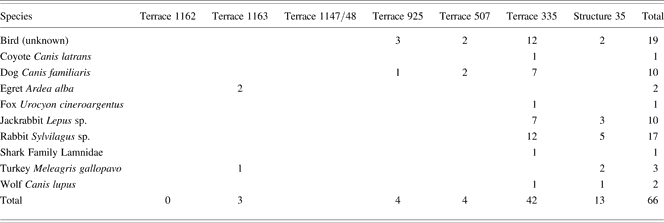
Animal offerings are particularly common in the upper residential precinct (Tables 3–4). Two-thirds of these offerings were placed in fill layers under room floors, occasionally on top of adobe bricks included in the construction fill. Others were placed in terrace walls, in exterior areas adjacent to a residence, or under a patio floor. Animals generally were placed individually, but sometimes they were grouped together with other specimens of the same or different species, including human remains. The animals most often included in offerings were birds, rabbits, dogs, and jackrabbits (Table 5). The completeness of the remains and the articulation of bones indicate that the offerings consisted of whole animals. It is highly likely that the animals were sacrificed on the spot immediately prior to interment. Offerings of rarer, wild species, such as coyote or wolf (Caso Reference Caso1938:47), generally consisted of only a mandible or long bone. Bone ornaments and tools, including a perforated shark's tooth that may have been used for bloodletting (Flannery Reference Flannery and Flannery1976:344), also occasionally were included with some of the animal offerings. In fact, we might conjecture that the shark's tooth, which accompanied an offering containing a bird, a dog, and a rabbit on Terrace 335, was used to dispatch one or all of those animals.
Animal Species Diversity and Abundance* in Domestic Offerings on Each Terrace

* Values reflect MNI (minimum number of individuals) estimate for each species and include bone ornaments and tools when species are identifiable.
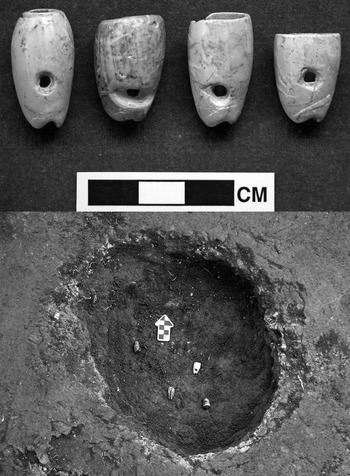
A less common form of offering, found on only a few terraces, contains human remains (Table 3). These offerings most commonly consist of a child's skull with several vertebrae present, but they occasionally also include a few other upper-body bones. These lone skulls usually were covered with an upside-down bowl. Additional human remains in offerings include long bones and hand and feet bones. Other unusual offerings were found only in the upper residential precinct. We found hundreds of burned maize kernels stashed under a room floor on Terrace 335. On Structure 35, an offering in a small pit under the floor of the northeastern corner room contained four perforated Oliva tinklers (Figure 7). A grouping of stone objects placed in the corner of the same room during an episode of reconstruction included a stone pendant, two obsidian tools, two chert end scrapers (from the same abundant local source), and two side scrapers of chalcedony, a higher-quality chert (Figure 8).
Offering of four shell tinklers placed in pit under room floor on Structure 35.

Offering of seven stone objects placed in corner of room on Structure 35.

When we examine the suite of offerings for each of the seven excavated residences (two elaborate and five lower-status, or commoner), can we recognize patterning indicative of the three organizational modes extrapolated from Durkheim's model? Great similarity in the quantity and kinds of offerings found on each terrace would indicate mechanical modes of organization, in which ritual practice was conducted in similar ways. Alternatively, the inclusion of markedly more elaborate or exotic goods in certain offerings or the practice of more frequent or diversified offerings would indicate hierarchical distinctions between those residences and others. Such distinctions would coincide with hierarchical organic modes of integration (Johnson Reference Johnson, Renfrew, Rowlands and Segraves1982:409). Nonhierarchical organic organization would be manifest by variation in the kinds of offerings that were made on terraces on which the residents appeared to be of relatively comparable socioeconomic status. Here the expectation is that the frequency and degree of elaboration in making offerings would be relatively similar. The qualitative distinctions in the kinds of offerings made would signify differences in ritual practice and hence the ways in which the different households communicated with the supernatural world. In the discussion to follow, we start by outlining and summarizing some of our previous observations focused on intracommunity organization and integration at El Palmillo. We then proceed to a discussion of the offering assemblage and discuss how it dovetails with prior assessments.
INTRACOMMUNITY MODES OF INTEGRATION AT EL PALMILLO
Most residents of El Palmillo shared certain basic aspects of life that reflect mechanical modes of organization. They lived on artificially constructed terraces where residences composed of rooms around a patio were situated. Except for the residential complexes on Terrace 335 and Structure 35, house size varied within a narrow range (see Table 1). For the most part, the population of the settlement shared similar ideas and attitudes regarding the interment of bodies, burying most of their dead under room and patio floors, whether in tombs, cists, or simple pits. The site's inhabitants relied on xerophytic plants and local stone resources, and relatively homogenous ceramic assemblages are present on all terraces.
The only indicator for mechanical integration in domestic offerings is that they are found in every residential complex (Table 3). All households and community members engaged in domestic rituals; the practice was not restricted to a particular subset of the population. That such rituals were performed in residences spanning the hill, from near the bottom to adjacent to the civic-ceremonial core of El Palmillo, indicates their importance to, and practice by, individuals of different socioeconomic status.
Hierarchical organic integration at El Palmillo is visible in distinctions in residential architecture and funerary remains. Larger and more elaborate houses are associated with the uppermost residential contexts, especially Terrace 335 and Structure 35, where the inhabitants lived in palace-like complexes. Compared with lower houses, these elaborate residences had large patios. Although the two intermediate residences (on Terraces 925 and 507) also had subfloor tombs, they were much less elaborate and finely made than the masonry tomb on Terrace 335. Distinctions in social status also are indicated in the treatment of the human body. Only in association with the masonry tomb on Terrace 335 did we find teeth with dental inlays and bones that had been painted red. In death, as in life, the special treatment of the body was an important signifier of status. These two elements, residential location/architectural elaboration and bodily modification, are what most clearly distinguished the residents of the upper terrace from those living farther down the slope.
The households in the upper residential precinct may have hosted rituals and other special events of socially integrative significance that either were not carried out or were held much less frequently on the lower terraces. Based on the greater abundance of animal bones, large serving bowls, drinking vessels, and vessels with pitted interiors (possibly indicating alcohol production and/or consumption [Arthur Reference Arthur2002]), we suspect that the residents of Terrace 335 and Structure 35 hosted feasting and drinking festivities more frequently than did the inhabitants of lower terraces (Table 1). The ceramic assemblages in these upper residences also have higher ratios of bowls to jars compared with other residential contexts, which is another possible indicator of feasting (Drennan Reference Drennan1976b:77; Marcus Reference Marcus1998:279; Whalen Reference Whalen, Wilk and Ashmore1988:258). Hosting such events most likely was related to labor mobilization, building alliances, or maintaining social networks (Dietler Reference Dietler, Dietler and Hayden2001:69; Flannery and Marcus Reference Flannery and Marcus2005:51; Hayden Reference Hayden, Dietler and Hayden2001:26; Hendon Reference Hendon and Bray2003b:205; LeCount Reference LeCount2001; Marcus and Flannery 1996:115–116; Robin Reference Robin2003:321).
Status distinctions between the occupants of the two uppermost excavated residences and the inhabitants of the terraces below also are indicated by differences in access to and the consumption of a range of items that appear to be related to status. Although not marked, the abundance of portable wealth items and other goods grade from the top of El Palmillo to the bottom of the hill. The amount of animal bone, obsidian, greenstone and other stone ornaments, burnished and imported ceramics, tools of high-quality stone, and spindle whorls for spinning fine threads all generally increase as one moves from household to household in ascending the hill. The quantity and variety of mortuary offerings in burials also increases from the bottom of the hill to the top. The tomb on Terrace 335 also included finer vessels than other funerary contexts.
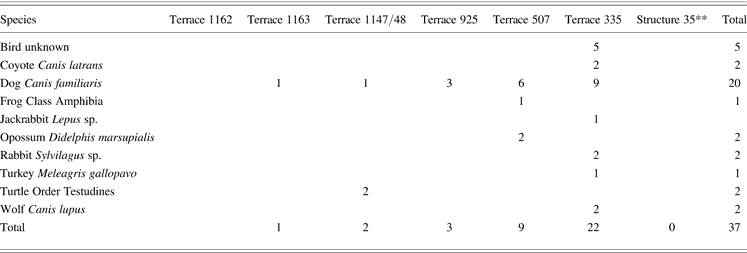
Organic hierarchical integration also is evident in the pattern of domestic offerings. Compared with the lower terraces, Terrace 335 and Structure 35 not only have the highest total number of offered items but also a greater abundance of animal offerings, including the greatest range of animal species (Tables 4–5). This pattern matches the overall access to animal resources at the site (Haller et al. Reference Haller, Feinman and Nicholas2006). Most of the animal species placed in offerings were potential food sources (especially dog, rabbit, and jackrabbit), although a few were rare, wild species (coyote, wolf). Birds could be sources of feathers or colorful eggs. Because of the symbolic significance of offering something alive (Pohl Reference Pohl, Leventhal and Kolata1983), including blood (Marcus and Flannery 1996:19), and the strong association between the distribution of animal offerings and other indices of high status at the site, we suspect that the animal offerings were highly valued. A similar pattern is observed for the distribution of animals in mortuary contexts (Table 6). The greatest number of animals and range of species were found in burials on Terrace 335. One mortuary context near the entrance of the large masonry tomb on Terrace 335 included the remains of five different animals (bird, dog, cottontail rabbit, coyote, and turkey).
Species Diversity and Abundance* of Mortuary Fauna on Each Terrace

* Values reflect MNI (minimum number of individuals) estimate for each species.
**No burial contexts were excavated on Structure 35.
The variety of offerings also varies considerably with terrace location, with the two residences at the top of the hill associated with a greater diversity of offering contents. Most or all of the offerings on the lowest set of terraces (Terraces 1162, 1163, 1147/1148) are ceramic vessels. Variety increases slightly on the intermediate terraces (925, 507), although ceramics are still the most common offered object. In contrast, few ceramic vessels were included in domestic offerings on Terrace 335 and Structure 35. Nevertheless, those residences have by far the greatest range of offered items, including separate contexts with burnt maize kernels, shell tinklers, and a grouping of small stone ornaments and tools.
The occupants of Terrace 335 and Structure 35 were differentiated economically and ritually from the residents of the other excavated terraces at El Palmillo. Modes of hierarchical organic integration, including the hosting of feasts, likely tied the inhabitants of these uppermost terraces to the people below. Yet in prior research (Feinman and Nicholas Reference Feinman and Nicholas2004a, Reference Feinman, Nicholas, Feinman and Nicholas2004b), we also have noted high degrees of economic and social connectivity between the lower-status or commoner households at the site. Some of these interconnections indicate organic, yet nonhierarchical, forms of supra-household integration.
At El Palmillo, a high degree of household interconnection and interdependency is evident, with steps, ramps, and passageways linking neighboring houses that shared sidewalls and retaining walls (Feinman and Nicholas Reference Feinman and Nicholas2004a). This spatial arrangement would facilitate daily interaction and communication between individuals living and working in the same sector or ward of the site (Robin Reference Robin2003:328). The intentional engineering of these routes and pathways between neighboring residences implies a high degree of house-to-house communication. In addition, extensive remodeling and renovations at the site involved raising the surface of a terrace half a meter or more by bringing in massive amounts of intentional fill. Rebuilding terrace walls that were shared by households and residential complexes on adjacent terraces most likely required coordinated effort between neighbors (Feinman et al. Reference Feinman, Nicholas and Haines2002:262). The implementation and completion of these construction projects would have necessitated the cooperation between laborers with different skills including terrace planning, stone cutting, hauling, and building.
The residents of El Palmillo specialized in a range of craft activities that included stone-tool manufacture, processing xerophytic plants for food and fiber, textile production, stone masonry, ceramic production, farming, and hunting. Although most of these productive activities were practiced on more than one of the excavated terraces, the distribution and variety of recovered artifacts indicates that not all households participated in these activities to the same degree; nor did they engage in all aspects of any one occupation. For example, the residents of the lowest terraces (especially Terrace 1162) were more involved in the production of chipped- and ground-stone tools than the occupants of the other terraces. The only ceramic firing feature observed to date is located on Terrace 1162. Only on one of the middle terraces (Terrace 507) have we found evidence of lapidary activities (Haines et al. Reference Haines, Feinman and Nicholas2004:260). The variable distribution of weaving tools across the excavated terraces indicates that some households were more involved with different stages or activities related to processing maguey, such as processing maguey leaves for fiber (using raspadores), spinning thread (both large spindle whorls for spinning coarse maguey fibers and smaller whorls for finer threads), and weaving cloth (battens).
Because each household did not produce the full range of goods that it consumed and likely made more than it could use of certain specialized products, house-to-house mechanisms of exchange must have been in place. Through these mechanisms, households likely acquired commodities such as pottery and obsidian, as well as rarer items such as marine shell. In dry years, if not more frequently, maize also certainly was imported (Nicholas Reference Nicholas, Kowalewski, Feinman, Finsten, Blanton and Nicholas1989). These economic interdependencies between commoner households are indicative of nonhierarchical organic means of integration, since the exchange of basic goods between large numbers of domestic units on a nearly constant basis is not likely to have moved largely through centralized channels.
Differences in the domestic-offering assemblages on the lower and middle terraces also appear to reflect nonhierarchical organic modes of integration. The three main types of offerings on these terraces are two-pot offerings, a single ceramic vessel or other ceramic object, and human remains. Interestingly, these three types of offerings are not found in comparable frequencies on all of the lower terraces. For example, two-pot offerings are especially common on the lowest set of terraces (Tables 2–3). These offerings are found in between most occupation layers, usually placed below patios or in fill under house floors, and are associated with episodes of rebuilding.
The two intermediate terraces are distinguished from the lowest group of terraces by having greater variability in offerings and a smaller proportion of two-pot offerings. Terrace 925 especially stands out from all the other middle and lower terraces by the inclusion of human skulls in its domestic offerings (see Tables 2–3). Although we did find human bone in several domestic offerings on Terrace 335 and Structure 35, in all cases the remains consisted of only one or two long bones or a few hand or foot bones. The offerings of human skulls on Terrace 925 were of children, and most were covered by an inverted ceramic bowl and placed under patio or room floors. Elsewhere in Oaxaca, at Monte Alban and Yucuita, several contexts of lone skulls, with or without several vertebrae, and including adults and children are thought to be offerings (Acosta Reference Acosta1975:6; Caso Reference Caso1938:42, 1942:173; González Licón Reference González Licón2003:104–105; Romero Molina Reference Romero Molina1983:107; Rubín de la Borbolla Reference Rubín de la Borbolla1933:198–199). Part of this practice at El Palmillo also extended to several mortuary contexts on Terrace 925. Only on this terrace have we found burials (one adult and two children) with inverted bowls placed over the skulls. Interments where inverted bowls were placed on top of human skulls are not common but have been documented at Monte Alban (Rubín de la Borbolla Reference Rubín de la Borbolla1933:191, 195; Winter Reference Winter1995: Figures 22, 23a, 35b, 37, 39a). Ritual practice on Terrace 925 at El Palmillo clearly varied from that found on the other excavated terraces.
Although the assemblage of offerings on Terrace 507, like that on Terrace 925, showed a bit more variety than the sets of offerings associated with any of the residences on the lowest group of terraces (Tables 2–3), there were no human remains in any of the domestic offerings on Terrace 507. What most distinguishes the assemblage of offerings on Terrace 507 is a greater proportion of contexts with a single ceramic vessel (and corresponding low number of two-pot offerings). Also unique to this terrace is an offering of two gray obsidian blades showing almost no signs of use that was placed in a niche in the stone retaining wall at the back of the residential complex.
In sum, excavations on El Palmillo terraces have exposed seven residences that are spatially arrayed across the site in four locales. Each of these locales is associated with a different assemblage of offerings, much like each has its own distinct mix of economic activities or specializations. In regard to offerings, the two uppermost terraces stand out in both the quantity and the diversity of offerings. Inhabitants of these terraces not only appear to have contacted the supernatural through this customary practice more frequently than did occupants of any of the lower residences, but they sacrificed goods that were rare and that had significant consumption value. They offered animals that were the product of the hunt, including rare species such as wolf, and an economic staple, maize, that was seemingly not easy to grow in the dry setting where the site was located. The offering assemblages of these two elaborate residences at the top of the hill also varied from that found in any of the more modest residences below in that they included much higher proportions and frequencies of animal offerings. When looked at relative to the offerings on other terraces, the nature, number, and diversity of the offerings from these uppermost residences support the pattern of hierarchy and inequality that distinguishes these residences at the site apex from others at the site, indicating that hierarchical organic modes of integration were important for structuring interaction at the site.
Yet when we focus on the sample of five commoner houses at El Palmillo, we see three different patterns in the offering assemblages, each of which is segregated by space. The houses on Terraces 1162, 1163, and 1147/1148 largely featured two-pot offerings. In contrast, the offerings on Terrace 925 often included human remains, while one-pot offerings were most abundant on Terrace 507, where the only offering of unused obsidian blades also was uncovered. Only Terrace 925 had an offering that included bird eggs. The differences in the offering assemblages between these five lower residences do not seem to be the product of status distinctions, since, with the exception of Terrace 1162, the total number of offerings and offering contexts on these lower terraces was roughly equivalent. Therefore, if we use the three patterns of offerings as a guide, we may be seeing distinctions in the ways in which the residents of these terraces ritually approached the supernatural, perhaps indicating that the inhabitants of Terraces 1162, 1163, and 1147/1148 were members of one ward or social segment; the residents of Terrace 925 belonged to another such social grouping; and the occupants of Terrace 507 were part of a third. Clearly, our sample sizes are exceedingly small, but when considered in conjunction with the two uppermost terraces, we see four patterns of offering practice, each of which has a strong spatial component in which the ritual behaviors of adjacent neighbors tended to be highly similar. Based on topographical features and the recovery of surface artifacts during our earlier site-mapping project, we grouped the two uppermost residences into one sector of the site, Terrace 507 into another, and the other four excavated terraces into a third (Feinman and Nicholas Reference Feinman and Nicholas2004a). However, these site sectors were broadly drawn, and the nature of offering practice on Terrace 925 stands markedly apart from those of the terraces farther down slope.
If the three different patterns of offering practice observed for the five lower-status households signified the participation of these El Palmillo residents in distinct wards, barrios, or social segments, then the offering findings would also imply the importance of nonhierarchical organic means of solidarity and integration at the site. As noted, economic interdependence and cooperation clearly were important during El Palmillo's occupational history, and other politico-religious ties may have linked groups of socially affiliated households at the site. Ward or barrio organization has long been a key aspect of community and settlement organization in the Valley of Oaxaca, and for recent times we have notions about how these social segments or wards were integrated. For example, in the 1920s, barrio organization in one valley town (Mitla) was recognized as very important (Parsons Reference Parsons1936:6–7), although somewhat diminished from the late nineteenth century. Nevertheless, 1920s barrio leaders met on a regular basis to coordinate and communicate, even deciding during this era whether to have amicable or conflictive relations with their neighbors in other community segments. We propose that these kinds of non-centralized modes of organization likely were important at El Palmillo during the Classic period, along with more hierarchical means of integration and communication.
SUMMARY THOUGHTS AND IMPLICATIONS
The domestic offerings at El Palmillo not only illustrate the expected differences between houses at the top of the hill compared with those below but also spatial differences among non-elite households in the community. Domestic offerings in neighboring households tended to be more similar to each other than to households farther away, hinting at site segments or barrios with at least slightly different ritual practices and group identities. In that these households were part of a larger community, with a long occupational history, we suspect that organic integration among commoner households, including economic interdependencies, probably served as an important integrative mechanism to hold the community together.
Recognition of these community segments at Classic-period El Palmillo is not surprising, given the repeated recognition of barrios in present-day Oaxaca and in the deeper past. Our next step is to understand more fully the nature of these social and spatial groupings. Are they found at other contemporary sites, and what were the mechanisms that wove them together and ultimately broke them apart? If such social segments were important at other Classic-period communities in the Valley of Oaxaca, how much of a role did the integration of site segments (or lack thereof) play in the transition to the Postclassic period in the valley, when settlement patterns were more dispersed?
Integration at Classic-period El Palmillo occurred through various mechanisms simultaneously, both mechanical and organic, and organic integration involved more than just hierarchical strategies. Hierarchical mechanisms of integration clearly were significant in the complex societies of pre-Hispanic Mesoamerica, but nonhierarchical mechanisms were important, as well (Blanton et al. Reference Blanton, Feinman, Kowalewski and Peregrine1996; Manzanilla Reference Manzanilla2001). Identifying the presence of multiple mechanisms of intracommunity integration at El Palmillo is just a first step. Future research must define much more precisely the diverse mechanisms, hierarchical and less centralized, that served to integrate large Mesoamerican communities for centuries and even longer. Empirically based elucidations of such strategies may eventually bring to light one of the significant and fascinating accomplishments of ancient Mesoamerican peoples and their societies.
RESUMEN
Aunque el tema recientemente ha recibido atención, se sabe relativamente poco sobre la manera en que las comunidades mesoamericanas prehispánicas fueron interconectadas y organizadas internamente. En este artículo, examinamos esta cuestión desde la perspectiva del asentamiento clásico de El Palmillo, en el brazo oriental del valle de Oaxaca, México, donde hemos excavado siete residencias en partes diferentes del sitio que está situado encima de un cerro. Estudios previos en el valle de Oaxaca han postulado que muchas veces las comunidades fueron (y todavía son) subdividas en barrios, aunque los modos de integrar estos segmentos no son bien definidos. A lo largo de estas líneas, previamente hemos identificado casas de la gente común y de la gente de alto estatus en El Palmillo (incluyendo la arquitectura y los complejos de artefactos asociados con cada residencia). También hemos notado grupos de actividades artesanales distintos en diferentes residencias de la gente común, indicando que hubo un grado de interdependencia económica entre estas unidades domésticas plebeyas. En el presente trabajo, extendemos nuestro análisis a las ofrendas domésticas en las cuales encontramos variaciones entre las residencias excavadas. Adaptando una perspectiva de Durkheim sobre la distinción entre dos tipos de solidaridad—mecánico y orgánico—encontramos una relación orgánica (jerárquica), más o menos esperada, entre los complejos de ofrendas en las residencias de alto estatus y las ofrendas en las residencias de la gente común. Al mismo tiempo, vemos otro eje de variación en las ofrendas domésticas que parece más orgánica, pero no jerárquica, en carácter. Este eje de variación en El Palmillo tiene un componente espacial muy claro y sostiene las hipótesis previas que proponían que los barrios o segmentos sociales definidos espacialmente fueron importantes en las comunidades prehispánicas del valle de Oaxaca. En El Palmillo, parece que los rasgos de definición de estos segmentos sociales fueron ideológicos además de económicos.
ACKNOWLEDGMENTS
We gratefully acknowledge the National Science Foundation support given to Gary M. Feinman for the excavations at El Palmillo (SBR-9805288, BCS-0349668). We also appreciate the valuable support received from the National Geographic Society, the H. John Heinz III Fund of the Heinz Family Foundation, the Field Museum, the Negaunee Foundation, Mark and Connie Crane, and the Graduate School of the University of Wisconsin, Madison. We thank Linda Manzanilla, Patricia Plunket, the journal's editors, and an anonymous reviewer for their constructive suggestions. This study would not have been possible without the assistance of our Oaxacan and North American field and laboratory crews over nine seasons (one survey and eight excavations). We especially appreciate the efforts of Jill Seagard, who helped prepare the graphics for this work. We profoundly thank the Instituto Nacional de Antropología e Historia of Mexico, the Centro Regional de Oaxaca, and the local authorities of Santiago Matatlan for the necessary permissions to implement these field studies, as well as for their essential support. Finally, we dedicate this work to the people of Matatlan. Their untiring assistance, interest, and encouragement in various stages of this study have made our effort rewarding in so many ways.