I. Introduction
In the past few decades, a growing body of empirical and experimental studies have documented systematic deviations from the assumptions of economic rationality. These findings have had a profound impact on legal theory and policy making (Jolls, Sunstein, and Thaler Reference Jolls, Sunstein and Thaler1998; Zamir and Teichman Reference Zamir and Teichman2014). Specifically, prominent jurists and economists have argued that behaviorally informed regulation can induce self-benefiting and socially desirable behaviors, as well as discourage self-injurious and socially undesirable conducts, with little infringement of autonomy (Sunstein and Thaler Reference Sunstein and Thaler2003; Thaler and Sunstein Reference Thaler and Sunstein2009). These proposals have sparked a heated normative debate among jurists, economists, and philosophers (see, e.g., Mitchell Reference Mitchell2005; Grüne-Yanoff Reference Grüne‐Yanoff2012; Rebonato Reference Rebonato2012; Wright and Ginsburg Reference Wright and Ginsburg2012; Conly Reference Conly2013). This theoretical controversy notwithstanding, legal policy makers on both sides of the Atlantic have embraced the behavioral insights. Thus, in 2009 Professor Cass Sunstein was appointed Administrator of the White House Office of Information and Regulatory Affairs (OIRA)—also known as the “Regulation Czar.” Under Sunstein's leadership, OIRA has adopted many initiatives that may be described as “nudges”—namely, “low-cost, choice-preserving, behaviorally informed approaches to regulatory problems” (Sunstein Reference Sunstein, Zamir and Teichman2014b). In the United Kingdom, the Behavioural Insights Team (BIT or Nudge Unit), established in 2010, actively pursues similar goals (Lunn Reference Lunn2012; Baldwin Reference Baldwin2014). Comparable initiatives are beginning to take root in the European Community (European Commission—Joint Research Centre 2013; Sunstein Reference Sunstein, Zamir and Teichman2014b).
As further detailed below, behaviorally informed regulators have been using such measures as “provision of information to the public in a form that is clear and intelligible” (US President Executive Order 13563 of January 18, 2011), prompting people to do the right thing by making it the default arrangement, and forcing people to decide. This article calls attention to another psychological phenomenon that can and should be used in regulation: the deadline effect.
Marketers and marketing researchers have long recognized that deadlines are a powerful means of encouraging consumer purchases. Thus, for example, price reductions may be offered “for two weeks only” or “while stock lasts.” In this study we examine the possible expansion of this technique beyond the market sphere. We test the hypothesis that by setting deadlines, regulators may promote self-benefiting and socially desirable behavior, and that, by the same token, eliminating or relaxing existing deadlines may dissuade people from doing things that policy makers wish to discourage. To explore these largely overlooked possibilities, this article reports the results of four new studies: two survey experiments, a randomized field experiment, and a natural experiment. Together, their findings support the claim that setting deadlines may indeed sometimes encourage desirable behavior, and that relaxing deadlines may discourage undesirable behavior.
Deadlines are already set by the law in contexts such as filing tax returns, submitting applications for various governmental benefits, and appealing court decisions. However, as further explained below, currently used deadlines usually serve other goals, such as facilitating the enforcement of duties (e.g., by tax-collection authorities) and streamlining governmental decision making (e.g., when considering competing requests for the allocation of governmental resources). In this article, we focus on deadlines for decisions or actions that people are not obliged to undertake, but that are expected to benefit them, or society at large. Our findings call for further examination of the use of deadlines by the law as a means of encouraging both expedient and prosocial behavior, and for reconsideration of existing deadlines to discourage less desirable behavior.
The advantages and shortcomings of deadlines should be compared with those of other alternatives, such as compulsory rules, default arrangements, and forcing people to decide. To be sure, using deadlines to induce desirable conduct and extending deadlines to reduce undesirable conduct is not always feasible and effective—and may have disadvantages. For example, even if setting a deadline might induce some people to perform a desirable action, preventing those who have missed the deadline from subsequently taking the same action may be too costly. Similarly, even if repealing—or considerably extending—the deadline for appealing a court judgment might reduce the volume of appeals, such repeal or extension might unduly compromise the overall interests of the winning party. Rewarding people who meet a deadline and disadvantaging people who do not (without totally denying the latter of the relevant options), or repeatedly extending deadlines, may overcome some of these difficulties, but also create new ones. Nonetheless, we maintain that setting deadlines for desirable behavior and removing or extending deadlines for undesirable behavior are viable options that should be considered by legal policy makers. Among other things, deadlines may be superior to other options in that they entail less interference with people's autonomy. Thus, regulators should consider using deadlines as a means of encouraging savings for retirement and the purchase of desirable insurance coverage. They may also be used to prompt vaccination against seasonal diseases, making charitable donations, and so forth. At the same time, relaxing the timeframe for appeals on administrative and judicial decisions may reduce the volume of appeals, without blocking meritorious ones.
An important caveat about the scope and aims of this article is in order. This is a preliminary study. It draws attention to the usefulness of deadlines as a regulatory device rather than providing specific prescriptions for the design of deadlines in each and every context. Further empirical studies of the underlying psychological mechanisms and consideration of the relevant normative arguments are necessary before employing deadlines in particular contexts.
The article proceeds as follows. Section II sets the theoretical background by reviewing the behavioral research on deadlines, pointing to the current use of deadlines by the law, and describing some of the existing, behaviorally informed, regulatory means. Section III describes four new experimental studies of the effect of deadlines on people's nonmarket behavior. Section IV analyzes our findings, their strengths and limitations. Finally, Section V discusses the policy and normative aspects of the law's use of deadlines. A conclusion follows.
II. Theoretical Background
A. The Psychology of Deadlines
Social scientists have long noticed that people behave differently with and without deadlines. Some studies have examined the effect of deadlines on task performance. When the time for doing something—be it completion of a project or group decision making—is limited, people are less wasteful, and more focused, productive, and creative (Gersick Reference Gersick1988; Kelly and Loving Reference Kelly and Loving2004; Mullainathan and Shafir Reference Mullainathan and Shafir2013, 19–27). Deadlines are also a useful antidote to procrastination. Unlike an intentional avoidance of a task or a decision, procrastination usually involves the postponement of performance or decision that one does intend to pursue—resulting in undesirable delay or even nonperformance, or no decision (Steel Reference Steel2007). As Tversky and Shafir (Reference Tversky and Shafir1992) have put it: “Many things never get done not because someone has chosen not to do them, but because the person has chosen not to do them now” (for a meta-analysis of several causes and correlates of procrastination, see Steel Reference Steel2007; see also O'Donoghue and Rabin Reference O'Donoghue and Rabin1999). Procrastination may delay or preclude the completion of tasks that people are obliged to perform (such as paper submissions in the case of students, or writing judgments in the case of judges), as well as the performance of voluntary actions, such as saving for old age. Rather than, or besides, affecting creativity and engagement, deadlines may induce people to avoid postponing performance endlessly. Thus, in one study, a paid task was completed by 60 percent of the participants who were given a five-day deadline, by 42 percent of those given a three-week deadline, and by only 25 percent of those receiving no deadline (Tversky and Shafir Reference Tversky and Shafir1992; on other means of overcoming procrastination, see Steel Reference Steel2007). In the absence of a deadline, or with a remote deadline, people may simply forget to perform the task.
A separate line of theoretical and experimental research—which is less relevant to our study—has examined the effect of deadlines on bargaining, where strategic considerations often induce people to arrive at an agreement, if at all, only at the last minute (Roth, Murnighan, and Schoumaker Reference Roth, Murnighan and Schoumaker1988).
While some deadlines—such as the timeframe for buying Christmas gifts—are inevitable or natural (Miyazaki Reference Miyazaki1993), others are set consciously. A few studies have compared the efficacy of self- versus externally imposed deadlines, with mixed results: while some have found that self-imposed deadlines are more effective at ensuring performance (Roberts and Semb Reference Roberts and Semb1990), others have shown that externally imposed deadlines are more effective (Ariely and Wertenbroch Reference Ariely and Wertenbroch2002). Since we are interested in deadlines as possible regulatory tools rather than as commitment devices, our focus is on externally imposed deadlines, rather than self-imposed ones (on deadlines and other commitment devices, see Ayres Reference Ayres2010).
Putting aside the effect of deadlines on effortful tasks in terms of enhancing focus and creativity, there are two primary explanations for the deadline effect. One relates to the broader phenomenon of scarcity or unavailability and its effect on the desirability of objects. This explanation portrays time and quantity limitations as being similar to other devices used to enhance the subjective value of objects by increasing their scarcity—such as limits on the amount produced (“limited edition”), prestige pricing, and restricted maximum order size (Lynn Reference Lynn1991,Reference Lynn1992; Gierl, Plantsch, and Schweidler Reference Gierl, Plantsch and Schweidler2008; Cialdini Reference Cialdini2009, 198–226).
A different (albeit related) explanation for time and quantity limitations is based on loss aversion. For example, in the context of sale promotions, while customers plausibly view price reduction as a gain, missing the opportunity to capture this gain is likely perceived as a loss (Howard, Shu, and Kerin Reference Howard, Shu and Kerin2007). A deadline makes the prospect of foregoing an attractive option much more salient. This increased salience may also trigger anticipation of regret, were the deadline to be missed (Inman and McAlister Reference Inman and McAlister1994). Importantly, it has been shown that people are motivated by loss and regret aversion even if ex post they do not experience as much an adverse effect as they had predicted ex ante (Gilbert et al. Reference Gilbert, Morewedge, Risen and Wilson2004; Kermer et al. Reference Kermer, Driver‐Linn, Wilson and Gilbert2006). Deadlines may thus induce action even if no significant loss or regret would have been experienced ex post, or if the experienced loss and regret would not have been affected by the existence of a deadline.
Very often, the enhanced desirability of objects due to scarcity operates in tandem with loss or regret aversion, and the two are difficult to tell apart (Cialdini Reference Cialdini2009, 200). Disentangling the different mechanisms underlying the deadline effect is important for psychologists. Arguably, such disentangling is less crucial for practitioners—be they marketers or legal policy makers—who are more interested in attaining effective results than in distinguishing the often-confounded, underlying psychological mechanisms.
Deadlines are regularly used in marketing. Standard economic models predict that shorter deadlines reduce demand because longer deadlines provide more option value (Bertrand et al. Reference Bertrand, Karlan, Mullainathan, Shafir and Zinman2010). Nonetheless, along with other marketing techniques, sale promotions are commonly limited to a fixed (often rather short) period, to a certain number of items, and so forth. Over 99 percent of coupons have an expiration date (Inman and McAlister Reference Inman and McAlister1994; see also Tan and Chua Reference Tan and Hwang Chua2004; Howard, Shu, and Kerin Reference Howard, Shu and Kerin2007). These limitations serve different purposes, including limiting the seller's financial liability, allowing stock planning, and facilitating price discrimination. However, the primary purpose of these limitations appears to be to influence consumer behavior.
Thus, an experimental study found that time-limited promotions were more effective than time-independent promotions in reducing the likelihood of subjects continuing to search for a better deal, in enhancing their willingness to buy, and in promoting favorable attitudes toward the deal (Aggarwal and Vaidyanathan Reference Aggarwal and Vaidyanathan2003). Another experimental study revealed that scarcity signals significantly enhance the effect of price discounts and quality commendations on the likelihood of purchase (Gierl, Plantsch, and Schweidler Reference Gierl, Plantsch and Schweidler2008). The importance of the concern over losing an opportunity has also been established in an empirical study of the time patterns of coupon redemption: in the absence of an expiration date, redemption rate drops steadily over time (Ward and Davis Reference Ward and Davis1978), while with coupons that do have an expiration date, redemption rate rises considerably just before the expiration date (Inman and McAlister Reference Inman and McAlister1994).
It should be noted, however, that the impact of deadlines is not uniform. Thus, a field experiment that examined the impact of various marketing techniques in direct-mail advertisements for consumer credit found that, in this particular sphere, shorter deadlines reduced, rather than increased, the demand for loans (Bertrand et al. Reference Bertrand, Karlan, Mullainathan, Shafir and Zinman2010).
Limited availability may be the byproduct of ordinary marketing, but it may also be strategically manipulated. To trigger consumers' loss aversion and expected regret, suppliers often create the false impression that if a certain item is not purchased soon, it will no longer be available, or at least not on such favorable terms (Cialdini Reference Cialdini2009, 198–204).
Interestingly, it has been found that a short deadline may not only encourage desirable behavior (from the perspective of the entity setting the deadline), such as purchases, but also undesirable behavior, such as the return of purchased goods (Janakiraman and Ordóñez Reference Janakiraman and Ordóñez2012). To suppress returns when the deadline is short, firms may have to increase the perceived effort involved in returning the goods.
Beyond the market sphere, while procrastination is often described as an irrational behavior—that is, one that fails to enhance the procrastinator's own interests (Akerlof Reference Akerlof1991; Steel Reference Steel2007, 66)—it may, of course, negatively affect other people as well. In particular, procrastination may adversely affect the provision of public goods. A huge body of literature in psychology, sociology, economics, game theory, political science, and law discusses possible explanations for people's failure to contribute to the provision of public goods, the variables affecting people's propensity for prosocial behavior, and possible mechanisms for encouraging such behavior (see, e.g., Hardin Reference Hardin1982; Taylor Reference Taylor1987; Ledyard Reference Ledyard, Kagel and Roth1995; Lewinsohn-Zamir Reference Lewinsohn‐Zamir1998). While failure to contribute to the provision of public goods may reflect rational self-interest, it may also be the result of procrastination. In the considerable body of empirical research on procrastination and deadlines, we found only one study on the effect of deadlines on prosocial behavior—specifically, registering as an organ donor (Birkimer et al. Reference Birkimer, Barbee, Francis, Berry, Deuser and Pope1994, 1751–55). In this experimental study, various persuasion techniques were used to encourage actual registration for posthumous organ donation. In one reported experiment, participants attended two sessions, seven to nine days apart. In addition to other means of persuasion that were common to all conditions, in one condition participants were also informed that not making a decision by the second session was equivalent to deciding not to sign, were induced to pick a date to decide by, and prepared a reminder postcard that was then sent to them by mail. The cumulative effect of these measures resulted in increased registration. While important, the particular combination of means used in this experiment limits the generalizability of its results.
Along with their advantages, deadlines also have harmful effects. In the context of effortful tasks, it has been demonstrated that a deadline may adversely affect the intrinsic interest in the required performance (Reader and Dollinger Reference Reader and Dollinger1982). Overconcentration on a task due to time pressure may tunnel one's attention to the task at hand, at the expense of other, sometimes more important, things (Shah, Mullainathan, and Shafir Reference Shah, Mullainathan and Shafir2012; Mullainathan and Shafir Reference Mullainathan and Shafir2013, 27–38). Excessive time pressure is also likely to impede creativity (Amabile et al. Reference Amabile, Conti, Coon, Lazenby and Herron1996, 1161–62). Furthermore, deadlines may reduce the quality of decisions made just before the expiration of the deadline (Carpenter, Zucker, and Avorn Reference Carpenter, Zucker and Avorn2008), and weaken the decision maker's belief in the correctness of her decision (Sheppard Reference Sheppard2012).
Having reviewed the psychological and marketing literature on deadlines, the next section describes the role deadlines currently play in the law.
B. Legal Deadlines
Deadlines are already used in various legal contexts. These include statutes of limitation for filing civil claims (28 USCS §§ 2401, 2501 [2014]); time limits on initiating criminal proceedings (18 USCS § 3282; NY Crim. Proc. Law § 30.10 [Consol. 2014]; Doyle Reference Doyle2012); numerous deadlines for taking steps in the litigation process (Fed R Civ P 12; Fed R App P 4); deadlines for filing applications for various governmental benefits (8 CFR §§ 208.4, 1208.4 [2014]); tax deferrals for deposits in retirement accounts that are conditional upon making the deposit by a certain date each year (26 USCS § 6072(a)); and requiring courts and administrative agencies to begin or complete tasks within a certain timeframe (Dodd-Frank Wall Street Reform and Consumer Protection Act, Pub L No 111-203, 124 Stat 1376 [2010]; 21 CFR 10.30(e)(2), 17.45(c) [2014]).
Zooming out from these specific rules, there appear to be several categories of legal (and other) deadlines. One category includes deadlines for the performance of duties, such as filing tax returns and rendering judicial decisions. While such deadlines may help overcome procrastination, their primary goals are usually different. These include attaining the very purpose of the duty, as in the case of the immediate compliance required by a police officer's order: “Put your hands behind your back!” Deadlines may also be necessary to facilitate examination of compliance with ongoing duties, such as the duty to pay taxes. A second category is of deadlines that are not about compliance with a duty, but about ensuring a certain advantage for oneself (sometimes called burdens or onuses). Thus, a person who fails to file a lawsuit within the time limit set by the statute of limitations, or to submit an application for a governmental benefit on time, is not violating any duty. He or she is only losing an advantage. Such deadlines serve the interests of other people, such as potential defendants or governmental authorities. However, they may also help people overcome procrastination (and possibly make the relevant object more desirable). Finally, there are deadlines for tasks whose performance is neither a duty nor even a burden—such as answering a public survey. Since we are interested in the potential use of deadlines as a form of nudge, our focus is on the latter two categories, rather than the first.
There is some literature on specific legal deadlines, such as deadlines for judicial actions (Struve Reference Struve2010); administrative agencies' decision making (Gersen and O'Connell Reference Gersen and O'Connell2008); applications to class action settlement funds and governmental compensation funds (Zimmerman Reference Zimmerman2010); refugees' applications for asylum (Schrag et al. Reference Schrag, Schoenholtz, Ramji‐Nogales and Dombach2010); and filing proofs of claim in bankruptcy (Glover Reference Glover2007). This literature commonly assumes that legal deadlines compromise the interests of the person or entity subject to the deadline, for the sake of competing interests. For example, statutes of limitations curtail people's ability to vindicate meritorious claims to protect potential defendants' certainty and peace of mind, to minimize the deterioration of evidence, and to reduce the volume of litigation (Ochoa and Wistrich Reference Ochoa and Wistrich1997).
Only a handful of legal studies have raised the possibility of using deadlines as a means of promoting the interests of those who are subject to the deadline, or of society at large—which is the focus of our attention. These studies will be reviewed below against the background of other devices used by behaviorally informed regulators.
C. Behaviorally Informed Regulation and Deadlines
In recent years, legal policy makers in the United States and elsewhere have systematically explored and implemented behavioral insights in regulation. Among other things, they have insisted on the clarity and simplicity of the information provided, taken framing effects into account in designing disclosure duties, and made beneficial social norms more salient (Sunstein Reference Sunstein2011). The two means of regulation most relevant to our discussion are default arrangements and forced choices.
A large body of psychological, economic, and legal literature has studied people's omission bias or default effect—namely, the tendency to avoid active choices between options that involve both advantages and disadvantages, prospects and risks (Ritov and Baron Reference Ritov and Baron1990,Reference Ritov and Baron1992; Anderson Reference Anderson2003; Baron and Ritov Reference Baron and Ritov2004; Zamir Reference Zamir2015, 17–21). It has been shown that omission bias can be used to promote individual and social welfare. For instance, due to shortsightedness and hyperbolic discounting, people often do not save enough for retirement (Shefrin Reference Shefrin2002, 139–56). Thus, one study examined the rate of employee participation in a retirement savings plan at a large US corporation before and after a change in the default. Before the change, employees were required to affirmatively choose to participate; after the change, new employees were automatically enrolled in the plan unless they opted out of it. The change of default resulted in a dramatic increase in retirement plan participation (Madrian and Shea Reference Madrian and Shea2001; see also Samuelson and Zeckhauser Reference Samuelson and Zeckhauser1988, 26–33; Choi et al. Reference Choi, Laibson, Madrian, Metrick and Wise2004). Comparable data exist in relation to postmortem organ donations. In some countries of the European Union, people are organ donors unless they register not to be, while in others no one is an organ donor without registering to be one. The donation rate in most presumed-consent countries is close to 100 percent, while in the explicit-consent countries it ranges from 4 to 27 percent (Johnson and Goldstein Reference Johnson and Goldstein2003; see also Davidai, Gilovich, and Ross Reference Davidai, Gilovich and Ross2012).
Based on these findings, leading scholars have advocated using the default effect as a benign way of steering people's choices in the right direction for their own good (so-called libertarian paternalism), or for the good of society at large (Camerer et al. Reference Camerer, Issacharoff, Loewenstein, O'Donoghue and Rabin2003; Sunstein and Thaler Reference Sunstein and Thaler2003; Thaler and Sunstein Reference Thaler and Sunstein2009). Setting a default arrangement allows people to opt out of the default, thus hardly curtailing their freedom. At the same time, since people are unlikely to opt out of the self- or socially beneficial arrangement due to their omission bias, the default arrangement is expected to benefit people and society, including counteracting biases such as myopia and procrastination (but see Willis [Reference Willis2013], who argues that such defaults fail when motivated firms set out to move consumers out of the default).
Other scholars have criticized the default technique. On the one hand, it has been claimed that it works best in the dark, and therefore manipulates people's cognitive limitations. Exploitation of imperfections in human judgment and decision making, so the argument goes, undermines people's control over their choices, and is therefore more threatening to their autonomy than overt coercion (Bovens Reference Bovens, Grüne‐Yanoff and Ove Hansson2009, 216–17; Hausman and Welch Reference Hausman and Welch2010, 128–32; Selinger and Whyte Reference Selinger and Whyte2011, 928–30). On the other hand, it has been pointed out that in order to make their suggestions more palatable politically, proponents of libertarian paternalism disregard the behavioral findings that call for much stricter limitations on people's choices—thus failing to pursue the full implications of the behavioral findings (Bubb and Pildes Reference Bubb and Pildes2014). A host of additional critiques have been leveled against the use of defaults (Keller et al. Reference Keller, Harlam, Loewenstein and Volpp2011, 377).
Another method of helping people overcome their tendency to procrastinate (which often accompanies the omission bias) is to compel them to make decisions. For example, people who apply for a driver's license may be required to indicate whether they consent to donate their organs posthumously (New York Dep't of Motor Vehicles, Application for Driver License or Non-Driver ID Card (Form MV-44) [2014]). A natural experiment revealed that requiring new employees to make an active decision about enrollment in a pension plan, without changing the default, increased enrollment by 28 percentage points (Carroll et al. Reference Carroll, Choi, Laibson, Madrian and Metrick2009). Randomized laboratory and field studies have also showed increased rates of willingness to vaccinate when an active choice was required (Keller et al. Reference Keller, Harlam, Loewenstein and Volpp2011). However, critics of this approach point out that there are certain choices that people strongly prefer not to make (due, e.g., to their unpleasantness, or for fear of regret), so forcing people to make them adversely affects their welfare as well as their autonomy (Sunstein Reference Sunstein2014a).
Turning to deadlines, the proposal to use them as a regulatory means has largely been overlooked in the legal literature. Only a handful of studies have theoretically considered this tool. Thus, a few studies considered the possibility of setting periodic deadlines as a means of overcoming procrastination (Camerer et al. Reference Camerer, Issacharoff, Loewenstein, O'Donoghue and Rabin2003, 1247–50; see also Zimmerman Reference Zimmerman2010, 1149–55); discussed deadlines as an antiprocrastination measure in the context of the statute of limitation (Wistrich Reference Wistrich2008, 632–38); and mentioned the potential adverse effect of regulation that mandates a minimal—but no maximum—redemption period for consumer rebates (Edwards Reference Edwards2007, 415–16). It has also been noted that the existence of a fetus viability deadline in the case of abortions may actually increase the number of abortions carried out (Utset Reference Utset, Andreou and White2010, 269). These studies have neither empirically tested these conjectures, nor discussed the issue in a comprehensive and systematic manner. Section III describes four experiments we conducted to address the first deficiency.
III. Experimental Findings
This section describes two survey experiments, a randomized field experiment and a natural experiment that we conducted to examine the hypotheses that deadlines may encourage socially desirable behavior, and that relaxing deadlines may discourage less desirable behavior (these experiments are not meant to answer the preliminary question of whether any given behavior is indeed desirable or not).
A. A Survey Experiment: Raising Pension Deductions
1. Background and Motivation
Our first experiment sought to examine whether it would be possible to induce people “to do the right thing” by setting a deadline for making a decision. Unlike the manipulation of a default, setting a deadline does not supplant the agent's decision with someone else's: the individual is not automatically entered into a given default position that the policy maker has deemed desirable, such as saving for retirement. Unlike compelled decision making, a deadline allows individuals to avoid making any active choice.
In this survey experiment, participants were asked about their willingness to increase the deductions to their pension plans under various deadline conditions. We examined both the effect of a deadline for choosing such an increase, and for revoking one's choice. We tested the possible effect of a deadline for canceling one's decision to increase deductions to see if the expected default effect, after the initial decision, might affect that decision. We hypothesized that a deadline for choosing to raise one's deductions would increase the rate of such choices (because it makes clear that doing nothing is tantamount to forgoing—i.e., losing—this opportunity, and because it may enhance the subjective value of increased deductions). In contrast, we had no clear hypothesis as to the effect of a deadline for revoking one's decision. On the one hand, such a deadline might deter people from raising their deductions in the first place, for fear that they might miss the revocation deadline and get stuck with the higher deductions. On the other hand, those who are aware of their own omission bias might find a deadline for changing their mind reassuring, as it would ensure them a chance to reconsider their initial decision.
2. Participants and Method
A total of 471 people from the United States—286 men and 185 women—took part in the study. Their ages ranged between eighteen and sixty-eight, with a mean of thirty-three. The study was conducted through Amazon's Mechanical Turk website. Participants were paid 50 cents each for completing the questionnaire. They were randomly assigned to one of four conditions.
The full text of the four conditions is reproduced in Appendix A. In all four conditions, participants were asked to imagine that they had been working in a firm for some time, and that a certain percentage of their monthly salary has been deducted and transferred to a pension fund (to which their employer also contributes a certain amount every month). Out of concern that the amounts put aside for people's pensions were too low, their employer had written to them, advising them that they could increase the amounts deducted from their salary and transferred to the pension fund, so that their postretirement pension would increase accordingly.
Next, each condition described one of four deadline situations, which varied in terms of the existence or absence of a deadline for deciding to increase one's pension contributions, and the existence or absence of a deadline for revoking such an increase once it has been made (yielding a 2 × 2 between-subject design). Thus, for example, the Deadline for increasing deductions, no deadline for revocation condition read as follows (with alternative conditions shown in square brackets):
If you wish to increase the deductions to your pension plan, you'll have to fill a form and send it to the employer within one month [at any time]. If you do so, you'll be free [able] to change your mind and restore the current deduction rate at any time in the future [within one month from sending the form].
Respondents in all four conditions were then asked how likely they were to fill out and send the form authorizing an increase to their pension contributions. Responses were given by marking one number on a scale of nine points, where 1 represented “I will certainly not fill and send the form,” and 9 indicated “I will certainly fill and send the form.”
Finally, at the very end of the questionnaire, as an attention and comprehension check, we included two questions as to whether or not there was a time limit for deciding to increase the deductions to their pension plans, and a time limit for restoring the original deduction rate.
Of the 471 respondents, 351 answered both comprehension questions correctly (of course, the correct answer depended on the condition). We report the analyses of the data from these respondents in the main text. Analyses of the entire sample, reported in a footnote, yielded very similar results.Footnote 1
3. Results
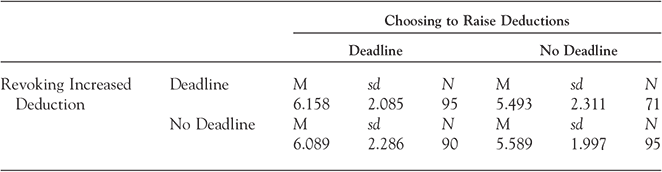
The mean likelihood of completing and sending the form in each of the four conditions is reported in Table 1. ANOVA of likelihood-of-acting rating by the two independent deadline factors yielded a significant effect of the deadline for increasing contributions—namely, the likelihood of the form being completed and sent was higher when a deadline was imposed for initiating the increase, than when no such deadline existed (6.124 and 5.548, for deadline and no-deadline, respectively, F(1,347) = 6.269, p = .013, η2 = .018). The existence of a deadline for restoring the original deduction rate had no significant effect, nor did it interact with the deadline for increasing the deductions (p > .7 for both).Footnote 2
Mean Likelihood Rating for Filling and Sending the Form (N = 351)

| Choosing to Raise Deductions | |||||||
|---|---|---|---|---|---|---|---|
| Deadline | No Deadline | ||||||
| Revoking Increased Deduction | Deadline | M | sd | N | M | sd | N |
| 6.158 | 2.085 | 95 | 5.493 | 2.311 | 71 | ||
| No Deadline | M | sd | N | M | sd | N | |
| 6.089 | 2.286 | 90 | 5.589 | 1.997 | 95 | ||
B. A Survey Experiment: Appealing Court Judgments
To examine the generality of the results of the pension-deductions survey, we conducted another survey experiment with a different group of participants, and in a different context. In this second experiment, the participants were Israeli students, and the survey referred to a quintessentially legal issue: the inclination to appeal a court judgment with or without a deadline for doing so. We hypothesized that a deadline would increase the reported tendency to appeal the judgment. A total of 124 students from various departments in the Hebrew University of Jerusalem and the Ben-Gurion University of the Negev in Israel—fifty-four men and sixty-nine women (one did not indicate gender)—took part in the study. Their ages ranged from twenty to forty-four, with a mean of twenty-six. The study was conducted through a website designed for controlled judgments and decision-making experiments. Participants were registered in a database of respondents who had expressed willingness to answer online questionnaires. They were invited by email to log onto the website and to fill out a short questionnaire. To encourage participation, one out of twenty participants was selected by lottery to win a prize of NIS 60 (one NIS approximately equals US $0.25).
Participants were randomly assigned to one of two conditions (see English translation in Appendix B). In both conditions, participants were asked to imagine that they owned a business, and that in a certain year there was disagreement between them and the tax authority over the amount of tax due for the business's income. According to their position, the tax authority overcollected approximately NIS 100,000—roughly 10 percent of their usual annual tax bill. The tax authority claimed that it collected the correct amount. The court deciding the case rejected the business owner's position and ruled in favor of the tax authority. The taxpayer's attorney estimates that if he or she appeals the judgment, there is a reasonable, though not very high, chance that the court of appeal would accept the appeal. If the appeal is accepted, the court would order the authority to repay the unduly collected tax plus indexation and interest, and to reimburse the taxpayer's court and lawyer fees. If the appeal is dismissed, the taxpayer would have to pay the authority's court and lawyer fees.Footnote 3 There is a fee for submitting an appeal. If an appeal is submitted, the appellant can withdraw it in the future. In the deadline condition, participants were told to assume that under the relevant law, there is a thirty-day time limit for submitting an appeal. In the no-deadline condition, they were told to assume that there was no time limit for appealing the judgment. Participants were then asked how likely they were to submit an appeal, on a nine-point scale ranging from 1 (“Would certainly not submit an appeal”) to 9 (“Would certainly submit an appeal”).
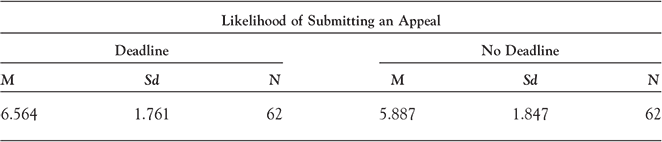
Table 2 shows the mean reported likelihood of submitting an appeal in the two conditions. Respondents in the Deadline condition were more likely to submit an appeal than those in the No Deadline condition (t(1,122) = 2.090, p = .039).
Mean Likelihood of Submitting an Appeal (N = 124)

| Likelihood of Submitting an Appeal | |||||
|---|---|---|---|---|---|
| Deadline | No Deadline | ||||
| M | Sd | N | M | Sd | N |
| 6.564 | 1.761 | 62 | 5.887 | 1.847 | 62 |
C. A Randomized Field Experiment: Student Feedback
Survey experiments are a limited platform for examining the effect of deadlines on people's decisions. Most people plausibly believe that merely setting a deadline to acquire a private good or to contribute to a public good should not rationally increase the good's value. Similarly, procrastination is commonly perceived as irrational and undesirable. Since people tend to think of themselves as rational (and to be overly optimistic about their ability to overcome the tendency to procrastinate), survey experiments may not be an ideal method of testing the effect of deadlines on people's choices and behavior. To overcome this limitation and to test people's actual—rather than perceived—reaction to deadlines, we conducted a randomized field experiment. Specifically, we tested students' willingness to answer a feedback questionnaire without receiving any reward in return, with or without a deadline. The hypothesis was that a deadline would increase the answering rate.
As in other units of the Hebrew University, students at the Faculty of Law are invited to complete feedback questionnaires on all of their courses with regard to the quality of the course and the instructor. To prevent the students' final grades having any impact on their evaluations, these questionnaires are completed prior to the final exam. To prevent the students' feedback from having any effect on the teacher's grading of the exams, teachers receive the anonymous, aggregated results of the survey only after submitting the students' grades. One downside of this timing is that professors do not receive any systematic feedback on the quality of their exams. To receive feedback on their exams, two of the authors of this article asked their students to anonymously answer a few questions about the exam they had taken. To examine the effect of deadlines on students' voluntary cooperation, half these requests included a strict deadline for answering the questionnaire, and half did not.
By way of background, in Israel, the basic law degree (LL.B.)—which entitles one to be admitted to the Bar after a year of clerkship and passing bar exams—is studied at the undergraduate level. At the Hebrew University, Contract Law is a mandatory, six-credit, two-semester course in the first year of law school. Property Law is a mandatory, six-credit, two-semester course held in the second year. In the academic year 2012/1213—when this field study was conducted—Eyal Zamir taught the two sections of the Contract Law course, and Daphna Lewinsohn-Zamir taught one of the two sections of the Property Law course.
As further detailed in Section III.C, Hebrew University students can take each exam once or twice (on “Date A,” “Date B,” or the “Special Date”), with the last grade being the one that counts. Shortly after the Date A exam in Contract Law, we sent all students enrolled in the course a request for feedback on the exam. The request was sent from an e-mail account created specifically for that purpose, which also served for receiving the completed questionnaires. Half the students—selected at random—received an e-mail message requesting them to send the feedback within a short deadline (about forty-eight hours), while the other half received a message with no definite deadline.
The message to the students (see English translation in Appendix C) first explained that since the regular feedback questionnaire is completed before the exam, it makes no reference to the exam. Thus, to obtain some feedback on the exam for coming years, the students were kindly asked to answer a few questions about the exam they had taken a few days before. The message further assured the students that their answers would be processed with absolute anonymity, and only after all exams had been graded, so that they would have no effect on either the drafting of questions at the various exam dates, or their grading in the present academic year. Students were instructed to answer the questions posted at the bottom of the message by clicking “Reply” and marking one number on a scale of 1 to 9 in each question. As seen in Appendix C, the questionnaire comprised five questions about the exam: Was sufficient time given for writing the exam? How difficult was it? Did the exam, in the students' opinion, focus on examining their analytical ability or rather their ability to memorize the material? Did the fact that this had been a closed-book exam contribute to the reliability of the assessment of the students' knowledge and understanding of contract law? Would it be possible to adequately assess the students' knowledge and analytical ability in a two-hour exam (instead of the current three-hour one)?
The only difference between the two conditions was that the no-deadline message stated that the questionnaire could be answered “during the coming weeks,”Footnote 4 while the deadline version stated: “To make sure that the exam is fresh in your memory, only replies received by Tuesday, July 23, at 12:00 noon will be considered” (the requests were sent on the morning of July 21, 2013).Footnote 5 To establish the number of responses given for each condition without reading the content of the replies before the grading of the exams of all three dates had been completed (as promised to the students), a subtle difference was introduced in the title of the e-mail message for each condition: the no-deadline message was titled “A Short Survey on the Contract Law Test” (in Hebrew, Seker Katzar al Hamivhan Be'Dinei Hozim), while the deadline version was titled “A Short Survey on the Contract Law Exam” (Seker Katzar al Habhinah Be'Dinei Hozim). While the words test and exam may have different connotations in English, in Hebrew the words mivhan and bhinah have a practically identical meaning.
The messages were sent to the e-mail addresses of the 291 students registered in the course. Of these students, 150 took the Date-A exam. The students were randomly allocated to one of two conditions: the deadline condition or the no-deadline one. A total of seventy-eight students taking the exam received the no-deadline questionnaire, and seventy-two the deadline version (since the random allocation was conducted on the entire list of students enrolled in the course, the size of the two groups was not identical). While twenty-eight out of the seventy-two students in the deadline condition (39 percent) filled out the questionnaire, only nineteen out of seventy-eight in the no-deadline (24 percent) did.
To increase the number of participants in the experiment, we repeated it with the Date-B exam in the Property Law course. The reason for not running the experiment with the students who took the Date-B exam in Contract Law was that students were allowed to take the exam twice, and a random allocation of the two conditions might have resulted in some students receiving a different condition of the questionnaire each time—making the manipulation rather obvious. We also wanted to avoid the possible effect of students in the Contract Law course discussing the survey after the Date-A exam. The introductory explanation of the messages was identical to that used in the Contract Law course (with the exception, of course, of the term “Contract Law,” which was replaced by the term “Property Law”). The five questions were similar to those used in the Contract Law questionnaire. However, since the Property Law exam was two hours long, rather than three, the last question was rephrased accordingly. Also, while the Date-A Contract Law questionnaire was sent to all students in the Contract Law course (although only those who had sat the Date-A exam could, and actually did, answer it), the Date-B Property Law questionnaire was sent to only those students who had taken the Date-B exam. This was necessary to provide a plausible explanation for the time limit in the deadline condition (“to make sure that the exam is fresh in your memory”).Footnote 6 A total of forty-seven students took the Date-B exam in Property Law. Of this group, twenty-three were randomly chosen to receive the deadline e-mail message, and twenty-four the no-deadline message. Five of the twenty-three receiving the deadline message answered the questionnaire—versus only one of the twenty-four who received the no-deadline message.
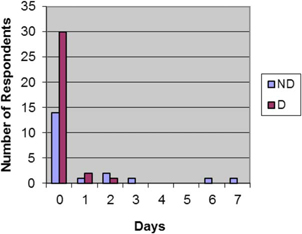
In all, twenty of the 102 examinees receiving the no-deadline message (19.6 percent), and thirty-three out of the ninety-five who received the deadline message (34.7 percent), completed the questionnaire. This difference is statistically significant (chi-square (1, N = 197) = 5.725, p = 0.16). As shown in Figure 1, a clear majority of students who completed the questionnaire in both the deadline and no-deadline groups—forty-four out of fifty-three, that is, 83 percent—did so on the day the request was sent to them—in all likelihood immediately upon reading the message. While participants in the deadline condition had more than forty-eight hours to complete the questionnaire (all messages were sent in the morning, and the deadline expired two days later, at noon), 91 percent of them (thirty out of thirty-three) did so on the day they received the request. In comparison, only 70 percent of those responding in the no-deadline condition (fourteen out of twenty) replied on the first day. No statistically significant differences were found between the students' answers to the five questions in the two conditions. Interestingly, the deadline appears to have affected the students' behavior not by inducing action just before the expiration date, but rather at the beginning of the timeframe.
Feedback on Exams [Color figure can be viewed at wileyonlinelibrary.com]

D. A Natural Experiment: Deadline for Appealing Grades
As customary in Israeli academia (and since 2007, under state law as well), students at the Faculty of Law of the Hebrew University are entitled to take the final exam in any course on two occasions—“Date A” and/or “Date B”—and if they miss either or both of these for a justified reason, they can take the “Special-Date” exam. The last grade is the one that counts. In the Faculty of Law, a “justified reason” in this context is interpreted liberally to include medically documented sickness, active military (reserve) duty, too short an interval (less than forty-eight hours) between exams in mandatory courses, and more. Students are entitled to appeal their exam grades, and there is no limit on the number of appeals they can submit throughout their studies. In large classes, exams are usually graded by teaching assistants. The principal instructor of the course, who decides the appeal, may read the entire exam and lower the grade if he or she deems the original grade too high. Grade reductions following appeals are rare, however.
Since the 2011/2012 academic year, all exams are scanned and made available to the students online (previously, students could see their graded exams only during specific hours at the Faculty's offices). An outline of the model exam answers is posted online as well. Exams are graded on a scale of 0 to 100, with 60 being the passing grade. The Faculty of Law's guidelines stipulate that the grade average in both mandatory and elective courses must be within the 77–81 range. This rule does not apply to small classes.
Just before the academic year 2012/2013, Hebrew University's exam guidelines were revised, with the primary aims of (1) eliminating, or at least reducing, the overlap between the exam period(s) and the regular teaching period, and (2) encouraging students to complete their exams for any given academic year before the start of the next one. Accordingly, the overall period of “Date-B” exams was considerably shortened, the time limits for grading the exams and appealing grades were shortened, and the overall schedule of the academic year was slightly changed. In addition, the number of exam dates in Masters degree courses was reduced from three (two regular and one special) to two (one regular and one special), thus eliminating the right to take any exam twice in these courses. Since not all elements of the reform were implemented equally throughout the university, we focus on those implemented at the Faculty of Law.
Up until and including the academic year 2011/2012, exams had to be graded within two weeks (or, in exceptional cases where one person graded more than fifty exams, within three weeks). Since 2012/2013, exams must be graded within ten days (or, in exceptional cases, within two weeks). Until 2011/2012, the university's bylaws allowed students to appeal their exam grades within one week (seven days) from the time their graded exams and the model answers were made available to them. Since 2012/2013, the time limit for appeals has been shortened to seventy-two hours (three days). Unlike other departments, the overall “Date-B” exam period was not significantly shortened at the Faculty of Law in 2012/2013, nor has the liberal policy regarding the entitlement to take the “Special-Date” exam been changed.
This reform—specifically, the shortening of the appeal period from one week to three days, with virtually all other variables at the Faculty of Law remaining the same—provided a natural setting for examining the hypothesis that the stricter appeal deadline would result in students being more likely to appeal their grades. To this end, we created a dataset that included the number of students taking any of the exams (in the A, B, and “Special” Dates) and the number of students appealing their grades for those exams. This dataset included all courses taught in both the 2011/2012 and the 2012/2013 academic year by the same teacher, and where the grades, in both years, were determined primarily on the basis of the final exam. Thus, we excluded from the dataset elective courses that were taught in only one of the two years; courses taught by different professors in each year; and courses (or seminars) whose grades were not primarily determined by a final exam in one or both years. Since the number of exam dates in the Master degree courses was reduced, the dataset included only LL.B. courses.
We did not collect information about the appeal rates in previous years, for two reasons. First, since there are constant changes in the curriculum and in the identity of the professors teaching each course from one year to the next, this would have drastically reduced the number of comparable courses. Second, and more important, the introduction of the exam scanning system in 2011/2012—which allows students to read their graded exams and submit their appeals online—made appeals considerably easier compared to previous years. We did not collect information about appeal rates in the following year, 2013/2014, either, for two reasons. The first reason was the same as the one for not looking at previous years; namely, the constant changes in the curriculum. The second reason was that due to the outbreak of a military conflict between Israel and the Hamas government of Gaza in the summer of 2014 (resulting in reserve soldiers being called up for military duty for considerable periods), the exam procedures were temporarily modified, including adding a second “Special Date” and relaxing the criteria for taking the exam on one of the special dates.
In total, the dataset included forty-three courses, taught by forty-five full-time or adjunct professors (one professor taught two courses; three courses were cotaught by two professors). The total number of exams (in the A, B, and “Special” Dates) and appeals in the two years are presented in Table 3. Compared to the 2011/2012 academic year, the overall appeal rate went up from 6.67 percent to 8.2 percent—that is, by 23 percent. This is a significant increase (chi-square(1, N = 8,160) = 6.047, p = 0.008). Comparisons of individual courses revealed that in twenty-nine of the forty-three courses (chi-square(1, N = 43) = 5.233, p = .019), the percentage of students who appealed was higher in 2012/2013 than in 2011/2012.
Exams and Appeals

| Academic Year | Total Number of Exams | Total Number of Appeals | Appeal Rate |
|---|---|---|---|
| 2011/1212 | 4,085 | 272 | 6.67% |
| 2012/1213 | 4,075 | 334 | 8.2% |
Arguably, the significant increase in the appeal rate may have resulted from the change (i.e., shortening) of the deadline in 2012/2013 compared to 2011/2012, rather than from the difference between the two deadlines in absolute terms. To test for this possibility, we compared the appeal rate in first-year courses alone. Since first-year students in the 2012/2013 academic year (or at least the great majority of them) had not experienced the seven-day deadline of 2011/2012, that could not have served as a reference point for them. The dataset included four mandatory and one elective courses. In four of the five courses, the percentage of appeals increased in 2012/2013. The total number of exams in these courses was 1,135 in 2011/2012 and 1,334 in 2012/2013; and the number of appeals was 78 and 123, respectively. Thus, the appeal rate had risen from 6.87 percent to 9.2 percent—namely, by 34 percent (chi-square(1, N = 2,469) = 4.522, p = .033).
We have also looked into how the seventy-two-hour deadline was communicated to the students—lest the very communication of this information made the option of appeal more salient than in previous years. We found that no special announcements were made in this regard—rather, the notices that the exams had been graded, scanned, and made available to the students online, along with the model answers, merely mentioned the existence of the deadline.
We also examined the acceptance rate of appeals in the two years as a proxy for the quality of the initial grading. According to the available data, the acceptance rate was 37.21 percent in 2011/2012 and 35.48 percent in 2012/2013. This difference is not statistically significant (p = 0.700).
IV. Summary of Findings, Strengths, and Limitations
While the results of the pension deductions and judgment appeal surveys may reflect an increased desirability as a result of a scarcity effect, and the student feedback study may involve an additional persuasion measure (as discussed below), the main focus of the four studies was the use of deadlines as a means of overcoming procrastination. All four studies demonstrated a deadline effect: respondents reported a greater likelihood of increasing their deductions for a pension fund when they had to make their decision within a one-month deadline (where the control condition was “at any time”); subjects exhibited a greater tendency to appeal court judgments when they had a one-month deadline for doing so (the control being “no time limit”); law students were more likely to take part in a voluntary survey about the quality of an exam when they had a two-day deadline (the control being “during the coming weeks”); and students actually submitted more appeals about their exam grades when the deadline for doing so was seventy-two hours, rather than a full week. The first two results were obtained in online survey experiments; the third in a randomized field experiment; and the fourth in a natural experiment. In the first experiment, the deadline induced people to save for retirement for their own, long-term benefit. In the second, the deadline increased the inclination to appeal a court judgment (an activity whose desirability is debatable). In the third, a field experiment, the deadline induced people to act altruistically and contribute to the common good. In the final, a natural experiment, a shorter deadline increased students' engagement in an activity that those who had set the deadline, at least, might have preferred not to encourage.
These results extend the findings of previous experimental and empirical studies of people's purchasing decisions to nonmarket, self-benefiting, and socially desirable (or arguably undesirable) behaviors. The pension experiment suggests that deadlines can be an effective means of helping people overcome common self-injurious cognitive biases: myopia, hyperbolic discounting, and procrastination. The judgment appeal experiment suggests that a deadline is likely to increase the rate of appeals, even when there is “a reasonable, though not very high, chance” of success. The exam feedback study shows that deadlines can effectively induce socially beneficial behavior, even if actors can expect no self-benefit from it. It thus extends the findings of Birkimer et al. (Reference Birkimer, Barbee, Francis, Berry, Deuser and Pope1994, 1751–55) to a “cleaner” deadline setting. It also appears to show that deadlines can affect people's behavior not only by inducing action or decision immediately before the deadline, but also at the start of the limited period. The grade appeal study confirms that, counterintuitively, shorter deadlines may actually increase—rather than decrease—people's engagement in arguably undesirable behavior, thus extending a similar finding on the rates of return of purchased goods by consumers (Janakiraman and Ordóñez Reference Janakiraman and Ordóñez2012) to a nonmarketing context.
Each of our studies has its methodological strengths and weaknesses. The online pension experiment provides a controlled environment and uses participants from the general population. It may, however, raise concerns about its external validity, for two reasons: first, participants' replies did not involve real monetary outcomes and, second, the survey revealed participants' expectation about their behavior, rather than their actual behavior. The first concern is, of course, valid, but it is an inevitable trait of laboratory experiments aimed at providing insights into large-scale and economically substantial behaviors in the real world. As for the second concern, we would cautiously argue that inasmuch as there are differences between people's answers to the pension questionnaire in our study and their actual behavior regarding saving for retirement, deadlines may prove to be even more effective in real life than in our experiment. This is because phenomena such as procrastination and enhancement of an object's subjective value merely by virtue of its scarcity are commonly perceived as imprudent and irrational. Since people like to think of themselves as rational, and might be overly optimistic about their ability to overcome the tendency to procrastinate, they are less likely to exhibit procrastination and a scarcity effect in an abstract survey than in their actual behavior. Similar observations may be made with regard to the court appeal survey.
Another possible critique of the pension survey experiment is that it did not provide a definite identification of the psychological mechanism underlying the deadline effect. In addition to overcoming procrastination, the deadline perhaps produced a scarcity effect, which made the option of increasing deductions more desirable. From a policy-making perspective, however, identification of the precise psychological mechanism by which deadlines induce increased savings for retirement may be less crucial—assuming, of course, that increasing savings is a worthwhile policy goal. Once again, similar observations may be made concerning the judgment appeal survey—where the desirability or undesirability of submitting appeals when there is “a reasonable, though not very high, chance” of success is questionable, given the costs that such appeals impose on the court system.
The natural experiment about grade appeals has the advantage of external validity. Unlike other natural experiments—where the expectation of a change in the rules may affect people's behavior before the change—students' behavior in the 2011/2012 academic year could not, as far as we can tell, have been influenced by an expectation that the deadline for appeals would be shortened in the following year (both because the change had not been widely discussed beforehand and because students were unlikely to decide on whether to appeal a grade in a 2011/2012 course based on the expectation of shorter deadlines for appeals in future years).
As is always the case with natural experiments, it may be argued that there were other causes for the significant rise in the appeal rate between the two years in question—such as differences in the characteristics of students or teaching assistants. However, given the size of the dataset and the absence of any reason to assume that such differences actually existed, these arguments are unconvincing. The one conjecture that may have some merit is that the shortening of the grading period from two weeks to ten days adversely affected the quality of grading, thus giving rise to more appeals. However, while this cannot be ruled out completely, it is not very plausible. For one thing, graders likely devote only a few days to this task (probably the last days before the expiration of the deadline), so the total time spent on grading in the two years need not have changed. Second, if the rate of successful appeals is anything to go by, the quality of grading did not decline, since the rate of successful appeals did not increase in 2012/2013—if anything, it went down slightly.
Nonetheless, caution should be taken with regard to the generality of these findings. The large increase in the appeal rate may have to do with a particular characteristic of the grade appeal decision—one that is common to some decisions, but not all. The decision to appeal one's grade is often driven by emotions of disappointment and frustration. When the deadline for appeal is shorter, people have less time to cool off before the expiration of the deadline, so they are more likely to appeal. It may also be argued that the natural experiment involved a shortening of an existing deadline (from seven to three days), and it is not obvious that extending an existing deadline (say, from three to seven days) would have had a similar effect in the opposite direction. However, the fact that there was a similar (and even greater) increase in the appeal rate when comparing only first-year courses may appease this concern. The students in these courses had not experienced the previous deadline; hence they were affected by its absolute length, rather than by a change in the deadline in relation to previous years.
Finally, the exam feedback field experiment has the advantage of both controlled randomization and external validity, yet it is not free of its own limitations. Specifically, one could argue that the words “To make sure that the exam is fresh in your memory”—which served as an explanation for setting the deadline in the deadline condition (and hence were not included in the no-deadline condition)—signaled that the instructors had a keen interest in the students' feedback. This signal may have had an effect along with the deadline itself. Although this possibility cannot be casually dismissed, it does not appear to raise a serious concern in the present context. The main purpose of the field experiment was not to isolate the mechanism underpinning the deadline effect, but to gain insight into the use of deadlines by policy makers. Since deadlines set by policy makers very often contain some explanation for the deadline (lest it be perceived as arbitrary and raise antagonism), including such an explanation in the deadline condition may actually enhance the external validity of the result.
As in the other three studies, the question remains as to the generalizability of the results of the field experiment. The experiment demonstrated that a deadline can induce students to voluntarily spend a few minutes to answer a short survey for the benefit of future generations of students. It is unclear to what extent deadlines would induce such behavior in other groups, or when the costs to the individual are higher.
Fortunately, there is some external support for our findings. There is anecdotal support for the claim that deadlines encourage voluntary contributions to other people's projects, as in crowd-funding platforms. For example, the Kickstarter website, which helps to finance creative projects, reports that shortening the fundraising period enhances the rate of success. Projects with a time limit longer than sixty days or so are considerably less successful than projects with shorter deadlines (Strickler 2011).
Our findings are also supported by the setting of periodic deadlines for tax-exempt individual retirement account (IRA) contributions in the United States (Camerer et al. Reference Camerer, Issacharoff, Loewenstein, O'Donoghue and Rabin2003, 1249–50). Tax-deductible contributions must be made by April 15 of the following year. While fully rational people would invest in IRAs on a regular basis, thereby reducing the taxes they pay on the interest earned during the delayed contribution, procrastinators may postpone such contributions or even forego them altogether. The April 15 deadline may serve those people well. In the same vein, support for the socially beneficial impact of deadlines can be found in the experimental study of registration for organ donation conducted by Birkimer and his colleagues (Reference Birkimer, Barbee, Francis, Berry, Deuser and Pope1994, 1751–55). The fear that shortening deadlines might actually induce less desirable activities is corroborated by the study showing that product return policies that set shorter periods may increase product returns (Janakiraman and Ordóñez Reference Janakiraman and Ordóñez2012).
In general, our four studies are preliminary, leaving considerable room for more experimental and empirical research. It remains to be examined how effective deadlines are in different contexts, what variables impinge upon their effectiveness, and what undesirable side-effects they might have. To begin with, each of our studies involved a single deadline with a definite outcome: those who failed to meet the deadline lost the option in question entirely. It would be useful to study the effect of more nebulous deadlines, such as “within the coming days” or “only a few slots remain” (on the effect of norm specificity on compliance and performance, see Boussalis, Feldman, and Smith Reference Boussalis, Feldman and Smith2014). Other less categorical measures that are worth studying include an explicit option of asking for extension; ex-post extension(s) of the deadline; recurring, periodic deadlines; and extenuated outcomes of missing the deadline (e.g., being able to join a pension plan on less favorable terms, or to receive a vaccine at a less convenient location, rather than missing the opportunity altogether). In some contexts, such as blood or money donations, it would be interesting to explore the choice between setting a deadline for performing the act itself, or for preregistration to perform it. One should also examine the effect of deadlines in conjunction with other means, such as sending (possibly repeated) reminders.
Our studies indicate that deadlines can spur action both in riskless tasks, such as answering an anonymous questionnaire about exams, and risky ones, such as appealing a court judgment and facing the possibility of losing the appeal and having to pay the opponent's expenses (or one's own expenses if the appeal is subsequently withdrawn). However, we did not directly compare risky and riskless decisions, and it might be useful to further examine this variable.
It is also unclear what the optimal length of the deadline in different circumstances is, and how remote it can be and still be effective. The deadlines in our studies were in the range of days or weeks—it remains to be studied whether deadlines in the range of months or years would have a comparable (or any) effect. In fact, remote deadlines can have the countereffect of inducing people to postpone performance of tasks for a long time, and eventually forgetting all about them. In setting the length of a deadline, policy makers should take into account the complexity of the decision or task, so as not to compromise the quality of decision or performance. Another question is whether there is a real risk that some deadlines might “overcorrect,” resulting in people engaging excessively in a given encouraged activity.
Furthermore, our studies referred to actions and decisions that laypersons make by themselves. Some actions and decisions—including those associated with litigation and investments—are sometimes made by experienced professionals on behalf of other people. It remains to be studied whether and, if so, to what extent, professionals and people acting on behalf of others are affected by deadlines.
Future empirical studies should also investigate the magnitude of the deadline effect, and its long-term impact on people's behavior. Does “doing the right thing” because of a deadline in one context improve one's inclination to make prudent and socially beneficial decisions on other occasions or in other contexts—or does it, in fact, weaken it?
In addition to the concerns about the generalizability of our findings and the need for further empirical research in specific contexts, using deadlines by the law raises a host of normative questions. We now turn to discuss these questions.
V. Normative Implications
Our experimental findings suggest that deadlines potentially can serve as a useful policy device. A relatively short deadline can enhance socially desirable behavior, such as joining a pension plan or undergoing a medical examination. At the same time, extending (or even removing) deadlines may help discourage unwanted activities. For example, the number of appeals of administrative and judicial decisions might decrease if individuals are given more time than currently provided to submit their appeals.Footnote 7
The efficacy and legitimacy of using deadlines to promote prosocial behavior and help people overcome their tendency to procrastinate depend on several variables. Using this technique requires in-depth examination of each particular context and further empirical research. Generally speaking, the greater the interest in promoting a certain behavior and the perils of procrastination, the greater the prima facie justification for using deadlines. Here we can only offer some observations and tentative guidelines.
One preliminary question is whether legal intervention in any given context is warranted at all. Some scholars believe that legal interventions should be limited to preventing people from harming others (Mill [1859] Reference Mill and Gray1991, 13–14, 84–85, 92–93), while others argue that such interventions should be extended to preventing harm to the actors themselves (Conly Reference Conly2013, 48–53; Raz Reference Raz1986, 412–29; on legal paternalism, see also Feinberg Reference Feinberg and Sartorious1983; Zamir and Medina Reference Zamir and Medina2010, 313–47). We do not engage in this debate (nor in the debate about libertarian paternalism mentioned above). Rather, we assume, for the sake of discussion, that intervention is warranted in a particular context, either to advance the overall social good or to help people advance their own interests,Footnote 8 and focus instead on choosing between different intervention techniques. To take our field experiment as an example, one might argue that paying heed to students' opinion when designing exams is undesirable, and therefore receiving their feedback on the exams is unnecessary. Moreover, even if receiving such feedback is desirable from the instructor's perspective, it may be argued that spending time on giving such feedback is irrational from the student's perspective. We believe that information about students' preferences is relevant even if one does not ultimately attribute much weight to it, and that contributing to a public good should be encouraged. In any event, these questions lie beyond the scope of our study. To use another example, Weisbord (Reference Weisbord2012) has proposed using deadlines to encourage people to write wills. However, if the costs of writing a will (and subsequent squabbling over its validity and interpretation) often outweigh its benefits, as may well be the case, such encouragement—through deadlines or otherwise—is unwarranted. Our analysis does not purport to answer such questions.
The use of deadlines must always be considered in comparison with alternative devices, such as setting default rules, forcing people to choose, or establishing mandatory rules that forbid or compel certain behaviors.Footnote 9 Without reiterating the pros and cons of each method, for our purposes it suffices to note that of all possible paternalistic legal measures, setting deadlines is an exceedingly mild measure. Encouraging people to make their own decision within a certain deadline leaves them the freedom to make any decision they want; thus it is less restrictive than mandatory rules. Deadlines are also less intrusive than setting a default, as they do not replace the agent's discretion with that of the default-setting authority. True, any deadline assumes some default arrangement in the absence of any decision or action by the agent. However, by employing the default effect, policy makers are effectively stating what they deem to be the desirable arrangement (e.g., saving for retirement), whereas setting a deadline leaves the supposedly undesirable, preexisting state of affairs (e.g., not saving for retirement) as the default, and encourages people to make the desirable decision by themselves.Footnote 10
Furthermore, whereas defaults may be described as manipulatively using one cognitive bias (the omission bias) to counteract other biases, deadlines are more of a debiasing technique (on the distinction between “debiasing” and “benevolent biasing,” see Pi, Parisi, and Luppi Reference Pi, Parisi, Luppi, Zamir and Teichman2014). A deadline corrects the erroneous perception that an omission is not a choice, thus leaving all options open. In other words, the deadline clarifies that “doing nothing” is tantamount to making a decision. This message accords with reality, since postponed decisions and inertia often lead to the loss of beneficial opportunities. It should be conceded, however, that whenever a deadline does more than just increase the salience of the decision to be made or correct a misapprehension about the appropriate timeframe for decision—for instance, by artificially creating a sense of scarcity or loss—it may be qualified as a case of “benevolent biasing” rather than a mere debiasing technique. Compared with other regulatory means, it is still a very mild intervention.
Deadlines appear to be even less intrusive than forcing a person to make an active choice, especially when the decision process itself is unpleasant or costly (on the preference not to choose, see Sunstein Reference Sunstein2014a), since they allow her to let the deadline pass without making any positive decision. At the same time, a standard objection to paternalism—including the so-called libertarian paternalistic use of the default effect—is that it adversely affects people's motivation to act deliberately and the “development of effective decision-making skills and strategies” (Klick and Mitchell Reference Klick and Mitchell2006, 1626; see also Mill [1859] Reference Mill and Gray1991, 62–82). In that sense too, deadlines are less objectionable than default rules, as they encourage people to make the decision by themselves.
A possible counterargument is that by depriving an agent of a certain option altogether (once the deadline expires), deadlines compromise his or her freedom more than default arrangements that he or she can always opt out of. This argument could also be presented in distributive terms: while the deadline benefits people who would not have acted otherwise, this benefit comes at the expense of people who might have acted at a later point in time in the absence of the deadline, and lose this opportunity due to its imposition. In response, it should first be noted that the default effect is sometimes extremely powerful, so much so that practically nobody opts out of it (see Johnson and Goldstein [Reference Johnson and Goldstein2003] on organ donation). Moreover, the alleged harm to people's freedom assumes that were it not for the deadline, they might have acted at a later time. However, in all likelihood, procrastinators who fail “to do the right thing” even when faced with a deadline of reasonable length would not have acted at all if no deadline existed. These responses would not appease those who believe that freedom of choice is valuable even if people are unlikely to ever exercise it. One possible way of handling this concern is to set deadlines with extenuated—rather than categorical—outcomes. These may include an explicit option to ask for extension of the deadline ex post, or to subsequently make the decision under less favorable terms, rather than excluding it altogether.
The degree to which a legal device harms people's autonomy is an important consideration, but not the only one. Although deadlines compare favorably with other measures in terms of their impact on autonomy, they may not be as effective as other means. The relative impact of deadlines, compared with interventions such as changing the default or compelling people to make a decision, should be examined in each context. Since deadlines only encourage a desirable behavior, but do not guarantee that people will indeed act by the deadline, it is important to consider how critical it is that they do. If it is unacceptable, from a public policy point of view, for people to lose a certain opportunity when a deadline has passed, the state should consider using a different method. In this respect, the case of vaccinating against a life-threatening plague is different than the case of, say, joining a somewhat superior retirement plan, answering a public opinion survey, or signing a petition. Similarly, in the context of financing the provision of public goods by the state, deadlines are certainly no substitute for compulsory taxes.
Repeatedly extending deadlines may mitigate the “missed opportunity” problem, but it may also create a new one: to work well, deadlines must be credible. Once people realize that deadlines are not enforced, the deadlines might lose their beneficial impact (although, as long as the deadline extension is not guaranteed, loss-, regret-, and risk-averse people are still likely to be influenced by the deadline). One intermediate solution may be to employ periodic deadlines (Camerer et al. Reference Camerer, Issacharoff, Loewenstein, O'Donoghue and Rabin2003, 1249–50): once the deadline has passed, the opportunity is lost for a given term, but will become available again, for a certain period, in the future.Footnote 11
While extending a deadline ex post can adversely affect the credibility of future deadlines, an even thornier issue is whether legal policy makers should be allowed to knowingly set false deadlines ex ante. For example, should health authorities be allowed to create the false impression that the stock of vaccines is limited, so as to encourage people to vaccinate early? While consequentialists would answer this question based on a simple cost-benefit analysis (taking into account the long-term and indirect effects of governmental authorities telling untruths), deontologists might wish to prohibit such deceptions even if they produced a net benefit—unless the amount of net benefit surpasses a certain, possibly high, threshold (see generally Zamir and Medina Reference Zamir and Medina2010). In any event, there is much room for using deadlines by legal policy making without the use of deception.
Setting a deadline for a certain task or decision may divert people's attention from other tasks or decisions. Such diversion would usually count as a negative side-effect, but when engaging in the other task is considered undesirable, this could actually be a positive side-effect. Anyhow, policy makers should take such externalities into account in setting deadlines. They should assess the relative importance of the different tasks and avoid deadlines whose overall impact is negative.
Another relevant consideration is the characteristics of the targeted population. People vary in their tendency to procrastinate, as well as in their likelihood to employ measures that would shield them from this tendency, such as commitment devices and entrusting certain tasks to paid professionals, such as lawyers and accountants. In the absence of other grounds for setting a deadline, there is no need to limit the time available for a given task or decision when no procrastination is expected (Camerer et al. Reference Camerer, Issacharoff, Loewenstein, O'Donoghue and Rabin2003, 1247). To the extent that legal policy makers are able to characterize different groups in society as being more or less susceptible to otherwise unremedied procrastination, and as more or less likely to react positively to deadlines, they may set deadlines accordingly. This idea echoes the notion of personalized default rules (Sunstein Reference Sunstein2013; Porat and Strahilevitz Reference Porat and Strahilevitz2014). It should be noted, however, that setting deadlines for people who are not prone to procrastination is largely harmless, as they would have acted promptly anyway (cf. the notion of libertarian paternalism: Camerer et al. Reference Camerer, Issacharoff, Loewenstein, O'Donoghue and Rabin2003; Sunstein and Thaler Reference Sunstein and Thaler2003). Moreover, setting deadlines for some populations but not for others may raise serious concerns about disparate treatment.
As in the case of setting deadlines to induce desirable behavior, repealing or considerably extending deadlines as a means of discouraging undesirable behavior compares favorably with the alternatives in terms of its adverse effect on autonomy and freedom. Obviously, such relaxation of deadlines is not an appropriate reaction for behaviors that should be prohibited altogether and may warrant civil or even criminal sanctions. Rather, it should be limited to activities that, while legitimate and legal, are wasteful or costly, such as unmeritorious appeals of administrative or judicial decisions. Policy makers can reduce the volume of appeals in various ways. They can raise the fee for submitting an appeal, require complex forms, or otherwise make the appeal process burdensome. They may also restrict the types of decisions that can be appealed, or the grounds for appeal. However, such measures may obstruct meritorious appeals and are likely to be perceived as unfair. By contrast, longer deadlines may achieve the same desired result, at least to some extent, by giving people more time in which to file their appeal, and without the imposition of any further financial or other costs. Inasmuch as the urge to file an appeal is fueled by emotions of frustration or a desire to retaliate, the passage of time may have a calming effect (cf. Bronsteen, Buccafusco, and Masur Reference Bronsteen, Buccafusco and Masur2008). Once again, there may be competing considerations that tilt the scales against the deadline-relaxation technique. Extending deadlines for appeals might unduly compromise the interests of the winning party and, more generally, the need for legal certainty. The latter considerations may, however, weigh less heavily in administrative and other contexts where the possibility of appeal does not significantly affect the decision maker or other people.
Finally, as with any regulatory measure, there is a risk of mistakes or even ulterior motives. For example, a deadline that purportedly aims to overcome procrastination may actually preclude the exercise of rights if it is unreasonably short (cf. Covey Reference Russell2007, 242–43). To use another example, even if it is true that most people do not save enough for retirement, and that setting a deadline would increase overall savings, other issues should be considered before such a deadline is set. If some individuals are better off not increasing their retirement savings, and a deadline would induce those people to increase their savings because they are particularly bad at making decisions under time constraints, or because they are excessively regret aversive (were the deadline to be missed)—the existence of such people weighs against setting the deadline. This is not to say that the very existence of a few people who would be adversely affected by a deadline precludes its use, since virtually any form of regulation is liable to adversely affect some people or have other detrimental side-effects. It does mean, however, that despite their mild nature, deadlines must be used with caution, and with the same judicial, political, and public supervisory mechanisms that are in place in other contexts.
These are but general observations. When considering the use of deadlines in any particular context—whether in lieu of, or in addition to, other means—further considerations may figure prominently, and further empirical studies may well be necessary to examine how a deadline might affect different people, given their heterogeneity. Nevertheless, we maintain that suitably tailored deadlines may be a useful legal tool—sometimes superior to its alternatives. In light of the above considerations, we would tentatively recommend using (possibly repeated) deadlines for joining savings and retirement plans. Unlike enrollment for such plans by default—which sets the same plan for all employees unless they opt out of the default—the use of a deadline (preferably in conjunction with an appropriate choice architecture that would simplify decision making) may well result in different employees choosing different plans that better suit their individual characteristics. Deadlines could also be used to encourage people to vaccinate against seasonal diseases and undergo routine medical examinations. As in other contexts, the outcomes of missing the deadline need not be categorical. It may be sufficient, for example, that once the deadline expires, the vaccine would be more expensive or that it would be available only at less convenient hours or locations. Deadlines may also be used to induce people to purchase elective insurance coverage, donate money to charity or blood to a blood bank, and answer public opinion surveys. At the same time, considerably extending the timeframe for appeals on administrative and judicial decisions may reduce the volume of appeals, without blocking meritorious ones. To minimize the adverse effects of such extensions, the execution of the appealed decision or judgments, such as the serving of time in jail, should not be delayed.
VI. Conclusion
This article sought to highlight the feasibility, effectiveness, and legitimacy of a hitherto largely overlooked tool of legal policy making—namely, deadlines. Setting relatively short deadlines can encourage socially desirable and self-beneficial behaviors, and removing or setting relatively long deadlines can discourage socially undesirable behavior. Our experimental studies suggest that deadlines can serve as a means to steer people in the right direction, and that extending deadlines can discourage less desirable conduct.
Our experimental findings are preliminary—leaving many questions for future research; and our normative analysis is very tentative—calling for additional examination of the relevant policy considerations in each particular context. Notwithstanding these important caveats, we maintain that deadlines—which have long been used in the market sphere—may prove effective in nonmarket spheres as well, and should be seriously and systematically considered by legal policy makers.
Imagine that you are working in a firm for some time, and that a certain percentage of your monthly salary is deducted and transferred to a pension plan (to which your employer also contributes a certain sum every month). Since there is a general concern that the sums saved for people's pension are too low, your employer sent you a letter informing that you can increase the sums of money deducted from your salary and transferred to the pension plan, so that your post-retirement pension would increase accordingly.
[In – No deadline; Out – No deadline] If you wish to increase the deductions to your pension plan, you'll have to fill a form and send it to the employer at any time. If you do so, you'll be free to change your mind and restore the current deduction rate at any time in the future.
[In – No deadline; Out – Deadline] If you wish to increase the deductions to your pension plan, you'll have to fill a form and send it to the employer at any time. If you do so, you'll be able to change your mind and restore the current deduction rate within one month from sending the form.
[In – Deadline; Out – No deadline] If you wish to increase the deductions to your pension plan, you'll have to fill a form and send it to the employer within one month. If you do so, you'll be free to change your mind and restore the current deduction rate at any time in the future.
[In – Deadline; Out – Deadline] If you wish to increase the deductions to your pension plan, you'll have to fill a form and send it to the employer within one month. If you do so, you'll be able to change your mind and restore the current deduction rate within one month from sending the form.
How likely are you to fill and send the form asking to increase the deductions to your pension plan [In – Deadline: within this timeframe]? Please mark one number between 1 and 9, where 1 indicates that you will certainly not send the form, and 9 indicates that you will certainly send the form.

| Certainly not send | 1 | 2 | 3 | 4 | 5 | 6 | 7 | 8 | 9 | Certainly send |
Is there a time-frame within which you must decide whether to increase the deductions to your pension plan? Yes/No
In case you decide to increase the deductions to your pension plan, is there a time limit to changing your mind and restoring the current deduction rate? Yes/No
Imagine that you own a commercial business. In a certain year, there was disagreement between you and the tax authority over the amount of tax you have to pay for your business's income. In your view, the tax authority collected an excessive amount and should repay you approximately NIS 100,000—roughly 10 percent of your usual annual tax bill. The tax authority claims that it collected the correct amount. The court deciding the case has rejected your position and ruled in favor of the tax authority. Your attorney estimates that if you appeal the judgment, there is a reasonable, though not very high, chance that the court of appeals would accept the appeal and rule in your favor. If the appeal is accepted, the court would order the authority to repay you the unduly collected tax, plus indexation and interest, and pay your court and lawyer fees. If the appeal is dismissed, however, you would have to pay the authority's court and lawyer fees. There is a fee for submitting an appeal. If the appeal is submitted, you would be able to withdraw it in the future. [Deadline] Assume that under the applicable law, the last day for submitting the appeal is 30 days from the original court's ruling. [No deadline] Assume that under the applicable law, there is no time limit for submitting the appeal.
How likely are you to appeal the judgment [Deadline: within the aforementioned time]? Please answer by marking one number between 1 and 9, where 1 means that you will certainly not submit an appeal and 9 means that you will certainly submit an appeal.

| Would certainly not submit an appeal | 1 | 2 | 3 | 4 | 5 | 6 | 7 | 8 | 9 | Would certainly submit an appeal |
Appendix C
Dear Students,
The university's satisfaction survey is generally conducted prior to the exams, hence it does not include questions about the exams themselves. To get feedback on the Contract Law exam for the coming years, we would be grateful if you could answer a few questions about the exam held a few days ago. Your answers will be processed absolutely anonymously, and only after all exams of all exam dates have been graded, so they will have no effect whatsoever on the drafting of the questions given on the various exam dates or the grading of the exams in the present academic year. Please answer by return (“Reply”) after marking, in the body of this message, one number (by bolding, highlighting or otherwise marking) one number on the scale in each of the following questions.
[No deadline] This questionnaire can be completed during the coming weeks.
[Deadline] To ensure the exam is still fresh in your memory, only replies received by Tuesday, July 23, at 12:00 noon will be considered.
Thank you for your cooperation,
Eyal and the Teaching Assistants Team
-
1. To what extent was the time you had for writing the exam sufficient? Please reply by marking one number between 1 to 9, where 1 means that the time was not at all sufficient, and 9 means that there was plenty of time to write the exam.

Insufficient time 1 2 3 4 5 6 7 8 9 Absolutely sufficient time -
2. How difficult was the exam? Please reply by marking one number between 1 to 9, where 1 means that the exam was very easy, and 9 means that it was very difficult.
Very easy exam 1 2 3 4 5 6 7 8 9 Very difficult exam -
3. To what extent, in your mind, was the focus in the exam on analytical ability, as opposed to memorizing? Please reply by marking one number between 1 and 9, where 1 means that the focus of the exam was primarily on analytical ability, and 9 means that the focus was primarily on memorizing.
Analytical ability 1 2 3 4 5 6 7 8 9 Memorizing -
4. To what extent had the fact that this was a closed-book exam (as opposed to an open-book one) contributed to the reliability of the assessment of the students' knowledge and understanding of contract law? Please reply by marking one number between 1 and 9, where 1 means that a closed-book exam greatly contributes to a reliable assessment of knowledge and understanding, and 9 means that a closed-book exam contributes nothing to such an assessment.
Greatly contributes to reliable assessment 1 2 3 4 5 6 7 8 9 No contribution to reliable assessment -
5. Would it be possible to get an adequate assessment of students' knowledge and analytical ability in contract law with a two-hour exam (instead of a three-hour one, as at present)? Please reply by marking one number between 1 and 9, where 1 means that this is perfectly possible and even desirable to achieve this in a two-hour exam, and 9 means that it is impossible and undesirable.
Exam time should be reduced 1 2 3 4 5 6 7 8 9 Exam time must not be reduced