Introduction
Sustainability is becoming the most important driving force behind human actions: “Sustainable economic development involves maximising the net benefits of economic development, subject to maintaining the services and quality of natural resources over time” (Pearce et al., Reference PEARCE, BARBIER and MARKANDYA1988). This means that the mission of economic activities aims not only to produce, but to also save the stock of natural capital. However, putting sustainable-production plans into practice is a complex process, which involves the integration of three different dimensions: economic, social and environmental.
The environmental impact of livestock is well known and has been one of the most important constraints to the development of animal breeding in certain areas, and, thus, analysis of sustainability become increasingly relevant. In free-range systems (Attra Publication IP300), livestock may overgraze the land, which contributes to desertification, and pollution of water sources. On the other hand, intensive farming systems can cause problems due to manure management, including: pollution, insect, dust, and odour (Abbozzo et al., Reference ABBOZZO, BOGGIA and BRUNETTI1996).
Sustainability is not easy to measure; it might be seen as a complex balance between the whole body of fluxes, and the consumption of the resources within a given socio-economic context (Daly, Reference DALY1996). Whereas economic and social aspects are commonly measured, the environmental impact is difficult to measure, especially if the measurements are not limited to merely the breeding phase, but embraces the entire life cycle.
The main aim of this paper is to compare the environmental impact of the different poultry production systems: conventional, organic, and organic-plus. Organic-plus has more restrictive requirements than the conventional organic system for improving animal welfare (i.e., use of slow-growing strains and 10 m2 pasture/bird), as well as taking into account the quality of the product (Castellini et al., Reference CASTELLINI, BERRI, LE BIHAN-DUVAL and MARTINO2008). Indeed, slow growing strains are better able to utilise the natural environment due to the high foraging behaviour, kinetic activity and better adaptation to free-range system.
In the poultry production field, there are only a few studies that compare the environmental impact of different systems, and the organic-plus system is not usually included. Castellini et al. (Reference CASTELLINI, BASTIANONI, GRANAI, DAL BOSCO and BRUNETTI2006) compared conventional and organic poultry systems using the ‘emergy’ approach, and they found that all the emergy-based indicators were in favour of the organic farming system. Emergy represents the total amount of available solar energy directly or indirectly required to make a product or to support a process (see Brown and Herendeen, Reference BROWN and HERENDEEN1996; Odum, 1996).
For this environmental evaluation, we used life cycle assessment (LCA), which is a method to evaluate the environmental impact of products, activities and services during their entire life cycle. This kind of analysis is commonly denoted 'from cradle-to-grave' (Owens, 1997). The implementation of LCA is rapidly developing in all sectors of the economic system. In agriculture, and particularly in animal husbandry, the LCA approach is very useful, because it allows an overall view of the environmental impact, emissions and the consumption of resources involved in every step of the productive chain, from the cultivation of crops and their transformation into feed for animal husbandry. LCA can help in decision-making and may assist both in the definition of the problem and in the assessment of alternatives (Tillman, Reference TILLMAN2000). Therefore, this article provides information for improving environmental impact in a process of assessing the sustainability that is specific for poultry production, and for adapting production systems in order to ensure equilibrium is found among environment protection, animal welfare and meat quality.
Using life cycle assessment
The LCA was defined in 2006 by the International Organization for Standardization (ISO) 14040 as a ‘compilation and evaluation of the inputs and outputs, and the potential environmental impacts of a product system throughout its life cycle’. It is a method to evaluate the environmental impacts of products, activities and services based on a 'cradle-to-grave' approach. This means that it is based on the identification and quantification of the flows of substances, materials and energy, to and from the techno sphere (i.e., the set of all human activities) and the environment, during the entire life cycle of the product or activity. The life cycle consists of the following phases: extraction of raw materials (cradle), production and assembly of the materials, use and disposal of the product (grave). To focus the analysis on the production phase, an LCA ‘from cradle to gate’ can be performed omitting the phases of product distribution. LCA is an iterative method, which means that the initial choices and assumptions can be later adapted when more information becomes available (Goedkoop et al., Reference GOEDKOOP, DE SCHRYVER and OELE2008).
The ISO 14044 gives the requirements for each phase of the LCA and lists which elements should be considered when conducting an LCA, and when communicating the results. According to ISO requirements, the LCA methodology consists of four main phases:
a) Goal and Scope definition: a definition of the goal of the study implies that the reasons for carrying out the study must be clearly set out and both its application and its intended audiences must be determined (Goedkoop et al., Reference GOEDKOOP, DE SCHRYVER and OELE2008). The structure of the analysis could differ considerably depending on the aim. The direct applications of LCA studies can be numerous (e.g., product development or improvement, public policy making and marketing). The scope definition describes the most important methodological choices, assumptions and limitations made in the study. Initially, the functional unit or comparison basis must be defined. It describes the primary functions fulfilled by a product system and indicates how much of this function is to be considered in the intended LCA study (Guinée et al., Reference GUINÉE, GORRÉE, HEIJUNGS, HUPPES, KLEIJN, DE KONING, VAN OERS, WEGE-NER SLEESWIJK, SUH, UDO DE HAES, DE BRUIJN, HUIJBREGTS, LINDEIJER, ROORDA, VAN DERVEN and WIEDEMA2002). Therefore, all of the inputs and outputs will refer to the functional unit. Subsequently, the system boundaries, which can be intended as the level of tracing of the system, the spatial, temporal, geographical and technological characteristics of the data, and the level of complexity of the study must be determined.
b) Life Cycle Inventory: this phase consists of a collection of all the necessary data, together with the quantification of inputs and outputs for each process of the system. Its main result is an inventory table that lists the quantified flows associated with the functional unit. The system under study must be modelled as a complex sequence of unitary operations that communicate among themselves and with the environment by means of inputs and outputs (Pizzigallo et al., Reference PIZZIGALLO, GRANAI and BORSA2008). The inventory phase is the most time-consuming; moreover, the quality, accuracy and representativeness of the inventory considerably influence the quality of the results.
c) Life Cycle Assessment: this is the evaluation of the environmental impacts derived from the data collected in the inventory. Life cycle impact assessment aims to understand and evaluate the magnitude and significance of the potential environmental impact of a production system (Goedkoop et al., Reference GOEDKOOP, DE SCHRYVER and OELE2008). Different impact categories and assessment methods can be selected depending on the goal of the study. Initially, the results of the inventory analysis are assigned to relevant impact categories. Then, characterisation and normalisation must be performed, the former to determine the relative contribution of each inventory result to the impact category indicators, and the latter to show to what extent an impact category can make a significant contribution to the overall environmental problem. Finally, it is necessary to determine which phases of the production system contribute most to the identified impacts.
d) Life Cycle Interpretation: this consists of a compilation of conclusions and recommendations for the improvement of the environmental performances of the studied system. Final recommendations can also lead to the implementation of a further LCA study.
Life Cycle Assessment applied to animal husbandry
LCA has been applied to many different fields ranging from the industrial to the agricultural-food sector. In particular, several studies have been implemented in the field of animal husbandry, especially for cattle and pig production.
Halberg et al. (Reference HALBERG, VAN DER WERF, BASSET-MENS, DALGAARD and DE BOER2005) compared different environmental assessment tools for the evaluation of European livestock production systems. The assessment tools differ in terms of which environmental objectives are included and how indicators are developed and interpreted. Among them, LCA and the ecological footprint analysis are considered. The authors demonstrate that the comparison between organic and conventional production of milk and pig meat give different results depending on the basis of the indicators (i.e., per hectare or per kg product). The paper ends with some recommendations for the choices of the agricultural and environmental indicators, taking into account the geographical scale, the system boundaries and methods of interpretation.
Thomassen and de Boer (Reference THOMASSEN and DE BOER2005) evaluated the effectiveness of the environmental indicators of the three methods widely used in the animal production field: input-output accounting, ecological footprint analysis and LCA. The data from organic dairy farms in the Netherlands were used to evaluate the effectiveness of the environmental indicators, in terms of relevance, quality and availability of data (Mitchell et al., Reference MITCHELL, MAY and MCDONALD1995; Bell and Morse, Reference BELL and MORSE1999; Cornelissen, Reference CORNELISSEN2003). The relevance of an indicator is base on its degree of significance and if it is understandable to all the stakeholders involved, whereas quality is related to its reliability, sensitivity and when a target value can be determined. According to the results, the indicators from input-output accounting are effective, but do not include all of the environmental impact categories. The indicators from the ecological footprint analysis are not effective due to their low quality and relevance, whereas those from LCA, although difficult to collect, show a high quality and relevance.
Cederberg and Mattsson (Reference CEDERBERG and MATTSSON2000) performed LCA on organic and conventional milk productions in Sweden. Their attention especially focused on the flow of ingredients in feed production, and on the flow of farm nutrients. The results showed that different feeding strategies in both production methods greatly affect several impact categories.
Haas et al. (Reference HAAS, WETTERICH and KÖPKE2001) used LCA to evaluate the impact caused by the three different types of pasture production system: intensive, extensive and organic. The results showed that the impact categories concerning climate change, acidification and eutrophication, fossil fuels, have lower values in both free-range and organic systems, compared to the conventional system.
Several LCA studies have been performed in pig production. Basset-Mens and van der Werf (Reference BASSET-MENS and VAN DER WERF2005) compared the three different production systems: conventional, organic, and the French extensive system called ‘label rouge’, which follows its own regulations. According to the study, acidification and eutrophication had lower values in the organic and in the label rouge systems, whereas global warming had similar values in all of the systems.
Eriksson et al. (Reference ERIKSSON, ELMQUIST, STERN and NYBRANT2005) evaluated the impact of feed choice in pig production by comparing three alternative scenarios of protein supply. The LCA results showed that feed production contributes more than animal husbandry to the environmental impact of the system for the following impact categories: energy use, global warming potential and eutrophication. The opposite situation was observed for acidification.
In the poultry sector, only a few LCA studies have been carried out. The study of Ellingsen and Aanondsen (Reference ELLINGSEN and AANONDSEN2006) aimed to assess the environmental impact of Norwegian cod fishing and salmon farming compared to chicken farming. This study tried to find reference levels for environmental performances, and to identify critical areas and potential improvements. The results showed that the fishing phase for the cod, and the feeding phase for both salmon and chicken have higher environmental impacts. Chicken is the most energy effective, followed by salmon and cod, which show almost the same value as each other in terms of energy consumption. The area of sea floor affected by bottom trawling is approximately 100 times larger than the land area needed to produce the chicken feed.
Pelletier (Reference PELLETIER2008) analysed the environmental performances along the US broiler poultry chain by means of LCA. The study showed that the feed production phase accounted for 80% of the energy supply chain use, 82% of greenhouse gas emissions, 98% of ozone depleting emissions, 96% of acidifying emissions, and 97% of eutrophying emissions associated with the cradle-to-farm gate production of broiler poultry. In comparison, on farm inputs and emissions, this is largely related to heating and ventilation, contributed on average of only 9% of these impacts. Hatchery chick production contributed negligibly to the total amount.
Case study: the poultry rearing systems
the conventional rearing system
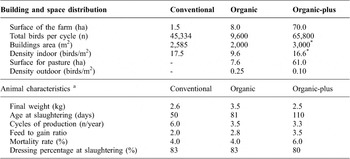
The conventional rearing system analysed was located in a rural zone of Central Italy. The farm surface area was 1.5 hectares, and the animals’ buildings covered a surface of 2,585 square metres, whereas the remaining area was destined for internal viability (Table 1). The construction materials of the sheds consist mainly of steel tubes, bricks, polyvinyl chloride, polyurethane, and concrete for the foundations. The shelters were air-conditioned to maintain a correct temperature and humidity level for maximising the chickens’ performances. The feeding and drinking systems were completely automatic. At the end of every production cycle, the sheds were cleaned and sanitised, and then left empty for 10 days.
Main characteristics of the three rearing system.

* Buildings only in case of bad weather and during the night
a For conventional and organic-plus: mean performance considering a female/male ratio = 1. For organic: only female
source: direct surveys of the three systems
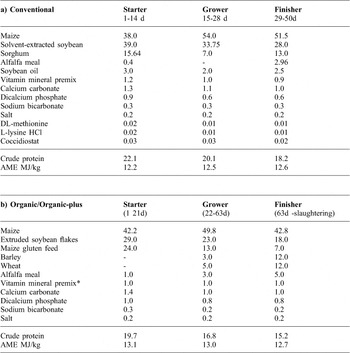
The density of birds per square metre was very high (17.5). The number of animals in a year reached about 261,120. Each cycle lasted 50 days (six production cycles per year). Broilers (Ross 308) of both sexes were used, with the weight of the animals on arrival at the farm being about 40 g, whereas at the end of the cycle, their weight was, on average, 2.6 kg (feed to gain ratio of 2.0). A slaughter yield of 83% of the final weight of the animals was considered normal. The conventional diets (starter: 1-14 d, grower: 15-28 d and finisher diets: 29-50 d) were formulated with common ingredients according to the standard recommendations (Aviagen Technical Team, Reference AVIAGEN TECHNICAL TEAM1999). The consumption of the different diets: starter (8%), grower (47%) and finisher (45%) was considered for LCA calculation (Table 2a).
the organic rearing system
The organic rearing system analysed was also located in Central Italy. Even though the rural zone differed from the previous one, the environmental and climatic characteristics of the two territories were similar. The organic farm has a surface of 8.0 hectares; 0.2 hectares designated as animal buildings, 0.2 hectares for viability, and all the remaining area (7.6 hectares) used as pasture. Each building consisted of two houses (regulated by the organic rules), each containing 4,800 animals, for a total of 9,600 animals per building and per cycle, with a density of 9.6 birds per m2. Therefore, the density was approximately half that of the intensive system. The buildings were completely air-conditioned via 2 warm air generators and 6 ventilators for cold air. The density outside was 0.25 birds/m2, and the number of animals produced in a year was approximately 67,200. Each cycle lasted 81 days (3.5 cycles per year). At the end of every production cycle there was a pause of 19 days. The strain used was the same as in the conventional system (Ross 308), but only female birds were reared to avoid excessively high final weights. The weight of the animals at the end of the cycle was, on average, 3.5 kg (FCR 2.8), with a typical slaughter yield of 83%.
Whereas typical fast-growing cross diets start at 22% crude protein and finish at 17-18% protein, organic rations start at about 20-21% protein and finish at 15-16%. Such a low-protein ration can also be used to slow down the rapid growth of meat type broiler. Starter, growing and finisher diets were formulated according to what has been adopted by the Italian poultry farms which is intermediate between National Research Council (Reference NATIONAL RESEARCH COUNCIL1994) recommendations (Table 2b) and Label Rouge diets (Lewis et al., Reference LEWIS, PERRY, FARMER and PATTERSON1997), with ingredients entirely coming from organic crops. The starter, grower and finisher diets represented respectively the 12% (1-21d) 52% (22-63d) and 36% (64-81d) of the total consumption. Chemical compounds are not present since they are not permitted. The main differences in the organic feed formulation, compared to the feed used in conventional rearing, are the absence of GMO ingredients, synthetic amino acids and coccidiostats.
the organic-plus rearing system
The organic-plus farm was located in the same rural zone as the organic farm. The total surface was 70 hectares, of which 0.3 hectares were animal buildings (used only in the case of bad meteorological conditions and during the night), 3.5 hectares formed the road network and 61 hectares were used as pasture (the remaining 5.2 hectares being forest and unused surface). The density of birds per square metre was 0.10. The number of animals in a year was about 217,140. Each cycle lasted 110 days (3.3 production cycles per year), and slow-growing strains (≤ 25 g/d) were used (Castellini et al., Reference CASTELLINI, BERRI, LE BIHAN-DUVAL and MARTINO2008). At the beginning of the cycle the birds weighed 38 g whereas at the end of the cycle they reached 2.5 kg (FCR 3.5) on average. A slaughter yield of 80% on the final weight of the animals was estimated. The feed formulation used was the same as in the organic system (Table 2b).
Table 2a,b Mean ingredients (% of diets) and calculated composition (%) of starter, grower and finisher diets used in conventional, organic and organic-plus systems.

* Vitamins in the organic diet were provided by cod liver oil and malt yeast.
Analysis and evaluation of environmental impacts
The goal of this LCA was to evaluate the environmental impacts of each of the three rearing production systems (conventional, organic, and organic-plus), and compare them. The functional unit considered in the LCA is 1 kg of poultry meat. In regards to the definition of the scope, an LCA study ‘from cradle to gate’ was performed; which means that only raw materials and poultry meat were taken into account. Factors that were not considered included transport to the slaughter house, slaughtering, processing of carcasses and distribution. This choice was made in order to focus attention only on production methods.
The Software SimaPro 8.0 was used to implement the LCA study (Product Ecology Consultants, Reference PRODUCT ECOLOGY CONSULTANTS1990). LCA analysis is based on both foreground and background data. Foreground data includes specific data describing a particular production system, whereas background data relates to general materials, energy, transport and waste management. The former should be determined by communicating with data providers, and developing questionnaires, whereas background data can be found in databases or in the literature. Foreground data were collected by means of direct surveys of local production scenarios for the cultivation of maize, grain, barley, sorghum and soya (which represent the main components of feed), for the transformation of maize (gluten feed) and soya (extrusion and solvent extraction of lipid) in feed, as well as for poultry rearing. Background data were mainly used for the remaining cultivation processes, and for the general data of transport, fuel consumption and electricity, with reference to SimaPro databases. The Ecoinvent database was primarily used for these purposes (Nemecek et al., Reference NEMECEK, HEIL, HUGUENIN, MEIER, ERZINGER, BLASER, DUX and ZIMMERMANN2004).
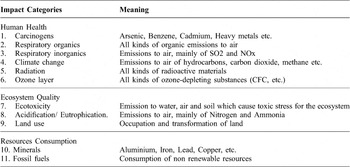
The impact assessment was developed using the ‘Eco-Indicator 99’ method (Goedkoop and Spriensma, Reference GOEDKOOP and SPRIENSMA2001), which measures various environmental impacts and is based on a ‘damage function’ approach. The damage function presents the relation between the impact and the damage to human health or to the ecosystem. Impacts can be computed according to 11 different impact categories, which can also be aggregated into the three wider categories: human health (cat. 1-6), ecosystem quality (cat. 7-9), and resources consumption (cat. 10-11). Table 3 presents a brief explanation of the categories’ meaning.
Meaning of the impact categories.

The table illustrates the meaning of the 11 impact categories (by Eco-Indicator 99 method), according to which the impact assessment is referred.
The results of the impact assessment are presented as normalised scores. Normalisation consists of dividing the impact category indicators by a ‘normal’ value. The most common procedure to ascertain the normal value is to determine the impact category indicators for a region during an entire year, and divide this result by the number of inhabitants in that area. Therefore, the final results are expressed in points; the higher the score, the more important the impact is. Even though this is an optional step of the LCA procedure, it is used in most of the LCA applications because it allows for showing to what extent an impact category can contribute to the overall environmental problem. For the calculation of the normal values, the same region was used for all the three systems. Normalisation, which is not always easily comprehended by non-LCA experts, is a necessary procedure, because it allows homogenisation of the different impact categories which all have different reference units.
The LCA analysis is referred to as the production from a year in each system. Each system analysis is divided into 3 main phases:
1) Production of raw materials (crops and other minor components).
2) Transformation of crops into feed.
3) Animal rearing.
Every phase includes different sub-processes.
production of raw materials
All of the processes related to crop cultivation (maize, soya, grain, barley and sorghum) that constitute the main feed ingredients were considered in the analysis. For each crop, the flows related to basic field operations (i.e., tillage, sowing, hoeing, application of plant protection products, fertilisation and harvesting) and the use of seed, fertilisers, and protection compounds were computed. In regards to the emissions derived from the use of fertilisers, a national manual of emissions was considered (Bini and Magistro, Reference BINI and MAGISTRO2002). Obviously, the organic and organic-plus systems do not use chemical fertilisers or other chemical products, rather they use organic manure. The emissions to water and air coming from manure were considered to be zero, because of the consistency of poultry manure (solid) and the characteristics of the soil (clay with high ions retention capacity). With reference to emissions to air, according to the best available techniques of the European Union for poultry rearing (which the three farms follow), poultry manure must be immediately incorporated into the ground; therefore emissions to air are so undetectable that they can be considered null (BREF European Commission, Reference EUROPEAN COMMISSION2003).Besides the cultivation of crops, other minor components were considered: wheat straw bedding, that was necessary for rearing, and the amino acids and coccidiostats, which were produced for use only in the conventional feed. Finally, all of the transport data were included together with the relative process of fuel production.
transformation of crops into feed
The transformation of the crops into feed ingredients, together with the assembly of the feedstuffs, is the second series of processes considered in the analysis. For each material, the flow relating to the transformation from crop to feed were computed. Several steps were taken into account, including milling, extrusion, and solvent extraction of oil. With reference to oil extraction, environmental emissions associated with the sub-production of oil were considered separately, not belonging to the transformation phase. Within the different steps, the main flows involved were those related to the consumption of electricity and water, and to air emissions. It is important to evaluate the requirement of energy by the system, and it is advisable to distinguish the energy used for the cultivation from the energy used for feed processing (Mourad et al., Reference MOURAD, COLTRO, OLIVEIRA, KLETECKE and BADDINI2007). The final feed is a mix of the transformed crops added with natural (in the organic and organic-plus) or synthetic (in the conventional) compounds (see Table 2a,b).
animal rearing
This step was developed, taking into account, together with the main input (feed), data concerning consumptions (water, electrical energy, and fuel), infrastructures (all the materials used), and emissions caused by animals, which consist mainly of ammonia, methane, nitrogen, and dust (BREF European Commission, Reference EUROPEAN COMMISSION2003).
The main differences detected in the three farming systems, which consequently influenced the LCA results, concern:
• The area involved, and consequently, the density of birds per m2
• The cultivation phase, with or without the use of chemical products
• In regards to the transformation phase, no great differences were detected except for the feed formulation (i.e., the use of synthetic versus natural compounds)
Final analysis
conventional rearing systems
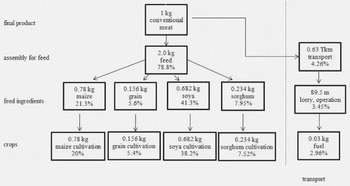
The production of feed, considering both crops’ cultivation and their transformation into feed, is the segment that contributes most to the overall environmental impact of the system, namely 78.8% (Figure 1a). In particular, cultivation and transformation of soya (which accounts for approximately 40%) and maize (approximately 20%) are the processes with the greatest impact.
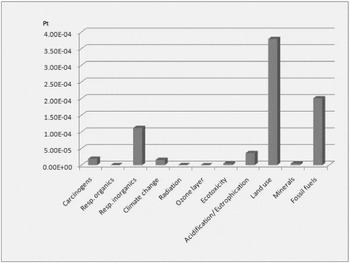
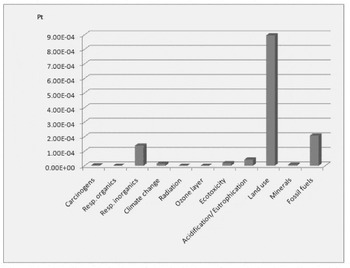
The impact assessment shows that land use is the category that is most involved, followed by fossil fuels and respiratory inorganics (Figure 1b). The analysis of impact assessment made for the single phases shows that the production of feed is what carries the most weight on the above mentioned categories, whereas animal rearing especially influences acidification and eutrophication, respiratory inorganics, and to a lesser degree climate change. The category of fossil fuels is also clearly influenced by transport flows.
a Life cycle of the conventional system.
This figure shows the principal processes which constitute the conventional poultry system. For each process, the quantity (kg) required to produce 1 kg of poultry meat (Functional Unit) and the contribution, given as a percentage, of the process to the environmental impact of the system are shown. The processes which cause an impact less than 5% of the total are not shown.

b Impact assessment of the conventional system.
This figure shows the environmental impact of the conventional poultry system relative to 11 different impact categories (Eco-Indicator 99 method).
Results are expressed as normalised points (pt). The higher the score, the more important is the impact.

organic systems
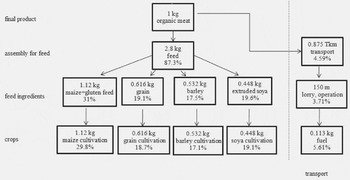
Feed production represents 87.3% of the total environmental impact of the system, which is even more than in the conventional system (Figure 2a). Cultivation and transformation of maize are the processes with the greatest impact, whereas the processes that are related to the other crops show, in general, an equal importance in terms of impact.
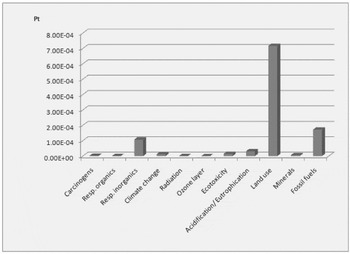
Impact assessment is reported in Figure 2b. As in the conventional system, the most relevant category is land use, followed by fossil fuels and respiratory inorganics. As in the previous analysis, the impact assessment for each phase shows a great influence of feed production on these three categories, and also on the influence of animal rearing on acidification and eutrophication, respiratory inorganics and climate change.
a Life cycle of the organic system.
This figure shows the principal processes which constitute the organic poultry system. For each process, the quantity (kg) required to produce1 kg of poultry meat (Functional Unit) and the contribution, given as a percentage, of the process to the environmental impact of the system are shown. The processes which cause an impact less than 5% of the total are not shown.

b Impact assessment of the organic system.
This figure shows the environmental impact of the organic poultry system relative to 11 different impact categories (Eco-Indicator 99 method). Results are expressed as normalised points (pt). The higher the score, the more important is the impact.

organic-plus systems
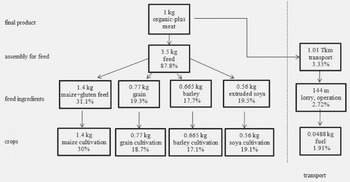
Here, the phase with the greatest impact (i.e., the production of feed once again) has the same relevance as to the organic system, namely 87.8% of the total impact (Figure 3a); the importance of the different crops in terms of impact is also very similar.
The impact assessment shows a situation that is very similar to the other two systems: the land use is most involved, followed by fossil fuels and respiratory inorganics (Figure 3b). Even the single-phase analysis remains the same as in the previous systems.
a Life cycle of the organic-plus system.
This figure shows the principal processes which constitute the organic-plus poultry system. For each process, the quantity (kg) required to produce 1 kg of poultry meat (Functional Unit) and the contribution, given as a percentage, of the process to the environmental impact of the system are shown. The processes which cause an impact less than 5% of the total are not shown.

b Impact assessment of the organic-plus system.
This figure shows the environmental impact of the organic-plus poultry system relative to 11 different impact categories (Eco-Indicator 99 method).Results are expressed as normalised points (pt). The higher the score, the more important is the impact.

Comparison among the different farming systems
The realised LCA shows that the relative importance of the different impact categories is the same in all the systems analysed. Therefore, the category that suffers the greatest impact is that of land use, followed by respiratory inorganics and fossil fuels. These three categories are mainly influenced by the feed production phase. Therefore, as in aforementioned studies (Ellingsen and Aanondsen, Reference ELLINGSEN and AANONDSEN2006; Pelletier, Reference PELLETIER2008; Eriksson et al., Reference ERIKSSON, ELMQUIST, STERN and NYBRANT2005), our results show that feed production contributes the greatest impact associated with poultry production systems, to a greater degree of influence than the animal rearing phase.
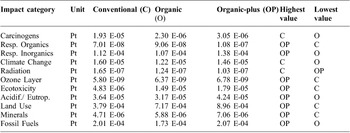
Comparing the systems in terms of values (Table 4), the organic-plus system shows the highest land use (8.96 E-3 normalised Pt) and respiratory inorganics (1.38 E-3 Pt) values. The first value is due to the large use of land, whereas the latter is mainly caused by feed production and by the rearing phase. On the other hand, regarding fossil fuels, the conventional and organic-plus systems have similar values (2.01 E-3 and 2.07 E-3, respectively), which are higher than in the organic system. The highest values for carcinogens and climate change are present in the conventional system, and the lowest values are in the organic system. However, the conventional system has the lowest values for respiratory organics, ozone layer and minerals. The organic-plus system has the lowest value only for the category of radiation, which has the highest value in the conventional system.
The results of the analysis show that the organic system has a better environmental performance, as it not only has the lowest values for two of the most important impact categories (respiratory inorganics and fossil fuels), but it also has the lowest values for most of the remaining categories (carcinogens, climate change, acidification-eutrophication).
Normalised values of the impact categories for the three systems.

Pt= Points
The table shows the environmental impact of the three systems relative to 11 different impact categories
(Eco-Indicator 99 method).
Results are expressed in normalised Points. Points are reference units set inside the normalisation process, which result from the ratio between the indicators and the normal value.
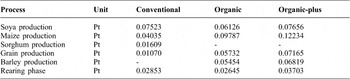
Table 5 reports the contribution of the main processes to the total normalised score. The most important process for the conventional system, in terms of impact, is the soya production, and as a consequence, soya transformation. The most important process for the organic system is maize production, whereas both soya production and grain production are the most important for the organic-plus system.
Contribution analysis for the three production systems.

Pt= Points
The contribution of the main processes to the overall environmental impact is reported for each system.
Results are expressed in normalised Points. Points are reference units set inside the normalisation process, which result from the ratio between the indicators and the normal value.
According to Eriksson et al. (Reference ERIKSSON, ELMQUIST, STERN and NYBRANT2005), which compared imported soybean meal, locally grown peas and rapeseed cake, simple or complemented with synthetic amino acids in pigs, the optimal environmental solution resulted in avoiding, almost entirely, soybean meal because of its poor environmental record. Standard diets for chicken are based on maize and soybean meal, and the complete substitution of soybean with other protein sources is quite impossible. However, our case study confirms that more emphasis should be placed on alternative crop proteins (faba bean, peas; Farrell et al., 1999), with significant implications for the protein and amino acid composition of the diet.
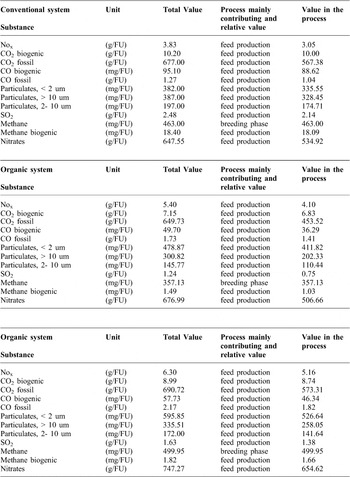
Table 6 reports the main emissions associated with each farming system. The organic-plus system has the highest values of Nox, of CO2 fossil and CO fossil emissions, particulates under 2 μm and methane emissions. The conventional system has the highest values of CO2 biogenic and CO biogenic emissions, of larger particulates and of biogenic methane emissions. Therefore, even from the point of view of emissions, the organic system provides the better result.
Main emissions associated with the three systems

FU= Functional Unit
This shows the principal emissions related to each system.
The total value in the system, the process mainly contributing to the emission, and the value in the process are reported, for each type of emission.
Each emission is calculated in g per FU, where FU is the Functional Unit of the system (1 kg of meat).
Conclusions
Our study has shown that land use is the most important impact category for all of the three systems studied, followed by the categories of respiratory inorganics and fossil fuels. In each system, all of these categories are mainly influenced by feed production. By contrast, the animal rearing phase affects acidification-eutrophication, respiratory inorganics and climate change. It is recommended from this study that greater attention should be paid to the feed production phase, since, for all of the systems, it contributes the greatest to the environmental impact of the overall system than animal rearing.
The comparison among the systems shows that the organic system presents the lowest environmental impact, since it has the lowest values for two of the most important impact categories (respiratory inorganics and fossil fuels), and the lowest values for most of the remaining categories (carcinogens, climate change, acidification-eutrophication).
The LCA results provide crucial data and specific indicators that can be used in a wider process of sustainability analysis. When attempting to measure the sustainability of human activities, one of the most vital gaps is the lack of information on environmental impacts. An environmental impact analysis that refers only to a single phase or a limited set of indicators does not enable the appropriate information to be guaranteed to be integrated with other information. Therefore, LCA can be seen as a tool to provide environmental information in a broader context (Miettinen and Hämäläinen, Reference MIETTINEN and HÄMÄLÄINEN1997), taking into account the whole life cycle of a product. Often, the results of LCA can change the perspective of an environmental analysis due to the consideration of the entire life cycle. Naturally, in a global evaluation of farming systems, many other factors, exogenous to environmental impacts should be taken into account (mainly animal welfare and product characteristics). Although EU Regulations (Council Regulations 1804/99 and 2092/91) recommends using local strains, the organic systems often use the same genetic strains as the conventional system. Even if this option is not consistent with the aim of organic agriculture, it leads to a higher productive efficiency of highly selected birds, and consequently to a lower environmental impact. Indeed, the organic-plus system, which uses slow growing strains and higher pasture availability, surely improves animal welfare and meat quality (Castellini et al., Reference CASTELLINI, BERRI, LE BIHAN-DUVAL and MARTINO2008), but the lower productive efficiency has a negative repercussion on the environmental impact. Therefore, to reach equilibrium among all of these factors, namely environment protection, animal welfare and meat quality, it would be necessary to find a production system that conciliates them into one coherent scheme. Since the productive efficiency of the organic-plus system is lower, possible strategies to overcome the problems include the partial substitution of soya bean with alternative feed ingredients, and a genetic improvement of the performance of slow-growing strains to save the adaptability to free range systems.
Acknowledgments
We would like to thank Emanuele Novelli for his contribution to data provision regarding the three rearing systems. We also wish to thank Cinzia Di Stefano for her assistance in data processing and Antonio Pizzigallo for his very helpful comments on LCA analysis.