




No CrossRef data available.
Advances in methods for surveillance of rejection
Published online by Cambridge University Press: 21 September 2005
Extract
Transplantation is an effective treatment modality for infants1 and children2 with end-stage cardiac diseases. Rejection remains a major complication (Figure 1), even in newborn infants.3 Acute rejection can best be operationally defined by clinical findings, histopathology, and/or abnormalities of ventricular function of new origin that require, and respond to, intensified immunosuppression. Mechanistically, the ability to detect acute rejection is critically dependent on the detection of significant new myocytic injury, damage, and/or death. Surveillance for rejection is critically important in determining both long and short-term outcomes following cardiac transplantation. The ideal strategy for surveillance should have a high negative predictive value, correctly identifying the absence of myocytic injury, with high specificity, such that it does not falsely predict such injury.4
Information
- Type
- Heart Transplantation
- Information
- Copyright
- © 2004 Cambridge University Press

Figure 1. The risk of rejection related to the time lapsing after transplantation.
Surveillance for rejection based on the biopsy
Histopathologic evaluation of ventricular septal endomyocardial biopsy obtained by percutaneous cardiac catheterization has been the traditional method used for surveillance of rejection following transplantation. Endomyocardial biopsy can be performed with relatively low risk in most children.5 Complications include perforation of the right ventricle, reported in about one-twentieth of procedures,6 and severe tricuspid valvar insufficiency, reported in up to one-fifth of children subsequent to transplantation, attributable, in part, to endomyocardial biopsies.7 Endomyocardial biopsies done on a scheduled basis also limits the opportunities for surveillance, particularly beyond the early period following tranplantation. Furthermore, the yield in detection of rejection is low with routine scheduled endomyocardial biopsies up to 5 years after transplantation in the absence of symptoms.8, 9 In adult recipients, biopsies performed as part of routine surveillance beyond the first year after transplantation have been questioned, and “clinical suspicion” has been proposed as the indication for performing biopsies beyond this time.10 In younger children, however, the clinical symptoms and signs of rejection1 are similar to many common paediatric illnesses, a fact that could lead either to many unnecessary endomyocardial biopsies, or delayed diagnosis of rejection. The most compelling argument favoring continued refinement of our assessment of ventricular functional and morphological changes with rejection is the observation that a significant number of children with symptomatic rejection have a biopsy score of zero.11 This group of patients is also at the greatest risk for death following an episode of rejection. Evidence from hemodynamically compromising rejection in adults12 and children11 indicates that just over two-fifths of the biopsies did not show histopathologic evidence of myocytic injury (Figure 2). The low predictive value in this group of patients with unequivocal evidence for rejection, and known myocytic damage, could be due to any or all of the following:

Figure 2. The rate of rejection related to hemodynamic compromise.
- interpretation of the histopathology is subject to high inter-observer variability
- sampling error
- low sensitivity of criterions for “injury” criteria by light microscopy.
Surveillance of rejection based on echocardiography
Given the low yield from scheduled biopsies, as well as their costs and risks, an alternative strategy is to identify echocardiographic indexes predictive of myocytic injury that can improve the criterions for selection for biopsy. Despite many attempts, no single echocardiographic parameter has been identified with both high negative predictive value and specificity. Indexes of systolic function reportedly have high specificity but low sensitivity,13 in part because systolic dysfunction is a late finding. Diastolic dysfunction, as determined by echocardiographic indexes of left ventricular filling, has high sensitivity but low specificity,4, 14 in part because diastolic parameters are load-dependent and abnormal in a significant number of recipients in the absence of rejection.15 Other centers also recommend that routine use of biopsies should be reserved for patients at high risk of rejection,16 since significant late rejection is rare. European centers have reported that trans-telephonic surveillance of ventricular evoked responses can also be used to time the taking of biopsies with high predictive value,17, 18 a strategy that would be very attractive to families of transplanted children.
An alternative strategy uses a systematic quantitative evaluation of several echocardiographic parameters. This multi-parametric algorithm for M-mode analysis guided by cross-sectional imaging has been previously reported to be highly predictive of histopathologic changes of rejection in both children pediatric19, 20 and adults.21 As empirically developed, this algorithm incorporates systolic and diastolic parameters, as well as echocardiographic correlates of inflammation, in specifically analyzing the ratio of mural mass to thickness,13, 22 atrioventricular valvar insufficiency, and pericardial effusion.23 The algorithm assigns a numerical score when these selected parameters deviate from population-based normals adjusted for age.19 A cumulative score at or greater than 4 is highly predictive of endomyocardial biopsies graded at or greater than 3, with a negative predictive value exceeding 95%.
One limitation of this approach is that up to one-quarter of analyses produce a score at or greater than 4 when the histopathologic score is less than 3.21, 24 The interpretation of these analyses is problematic, ranging from rejection that is not associated with histopathologic scores at or greater than 3, as has been described in adults12 and children,11 or simply “false positives”. False positive analyses could be due to variations introduced by the operator, or biologic variabilities, as well as incomplete “normalization” of those echocardiographic parameters referable to ventricular function, particularly diastolic function, following transplantation.
Our group has determined that use of the algorithm, when modified to identify deviations of the parameters from baseline as determined in the recipient, improves the predictive power. We reanalyzed 701 consecutive echocardiograms obtained from 18 children with a median age at transplantation using a system for scoring based on a significant deviation, by one or more Z values, from the patient's own baseline. Episodes of treated rejection had occurred in 8 children during the first year after transplantation at a median time of 1.4 years. Approximately one-tenth of the analyses had a regular score at or greater than 4 that were not associated with treated rejection, and were considered false positives. Parameters that contributed to the false positive evaluations were identified, permitting us to calculate the mean of a patient-specific baseline along with its standard deviation. When these values were compared to the regular scores, the number of false positives decreased from 72 to 10, with the specificity increasing from 90% to 99%, and giving a fourfold increase in the positive predictive value, from 10 to 44% (Table 1). For patients with treated episodes of rejection, our use of the patient's own baseline increased the scores for the algorithm in 7 of 8 recipients, and increased the mean score from 6 to 8. Thus, an algorithm based on a change from baseline improved the positive predictive power without reducing the negative predictive value of multi-parametric quantitative analyses of the echocardiograms.
Table 1. The importance of using values obtained in the patient as the baseline for subsequent measurements.

Tissue Doppler imaging for surveillance
Acquired abnormalities in diastolic performance are early markers for rejection-related myocardial injury. The predictive values of most indexes are reduced, however, because they are dependent on heart rate and load.25 Recent advances in echocardiographic technology permit the direct determination of the maximum velocity of thinning of the inferior wall of the left ventricle using tissue Doppler imaging.26 Such indexes of diastolic performance derived from tissue Doppler are held to be relatively insensitive to preload.25, 27 Determination of the velocity of mural thinning by such means has been reported to be highly predictive of scores at or greater than 3 in children,28 or at or greater than 2 in adults,29 obtained using endomyocardial biopsy scores. The velocity of descent of the annulus of the mitral valve in diastole, determined by tissue Doppler imaging, has also been reported to be predictive of biopsy scores at or greater than 3 in adults.30 To date, the predictive value of such indexes of diastolic performance in children has been reported only in preliminarily form.31
The maximal diastolic velocity of thinning of the inferior left ventricular wall determined from digitized M-mode echocardiograms has been reported to become abnormal in both children and adults undergoing rejection.21, 32 This value has been noted to be a highly predictive index of scores of endomyocardial biopsies at or greater than 3.32 It is technically demanding, however, to determine this value using M-mode tracings, since they require endocardial definition throughout the cardiac cycle, as well as off-line analysis. The value as determined by tissue Doppler has been reported to be identical to the same value determined by M-mode echocardiography in adult human hearts.26
Our group has compared these values obtained by the two techniques in children after cardiac transplantation, and determined their concordance with episodes of rejection. The use of diastolic performance determined with tissue Doppler imaging was studied in 37 children with a median age of 2.54 years both in the absence and presence of rejection. Maximum velocities in diastole of the thinning of the left ventricular inferior wall and the rate of descent of the medial mitral valvar annulus were determined in 160 echocardiograms from 21 recipients who had experienced no rejection, comparing them with findings in 16 children who had suffered one or more episodes of rejection during the 2 year period of the study. Velocity of mural thinning as determined by tissue Doppler imaging in those without rejection increased during the first 90 days subsequent to transplantation (r = 0.31; p = 0.05), was dependent on the heart rate (r = 0.591; p < 0.001), and was significantly less than the value for this measure determined from digitized M-mode tracings (116 ± 31 vs. 135 ± 44 mm/s; p < 0.05). In a subgroup of 9 children transplanted during the study, and followed for more than 1 year, the diastolic thinning determined by tissue Doppler imaging was less in 6 infants less than 1 year old at the time of transplantation than in 3 older recipients (p = 0.015). In those suffering rejection, the values for thinning measured using the M-mode technique were decreased compared to baseline studies prior to rejection (p < 0.5). In contrast, rejection did not significantly change the values for diastolic velocity of mural thinning determined by tissue Doppler imaging. The ratio of early-to-late peak diastolic velocity (E/A) for descent of the mitral valvar annulus was significantly decreased in those patients with rejection (p < 0.05). As a single parameter, mitral valvar annular E/A less than 1.1 was predictive of rejection in 4 of 10 recipients in whom this ratio had been greater than 1.1 prior to the onset of rejection. Thus, we have concluded that mural diastolic values measured using tissue Doppler varied with age at transplant, heart rate, and the time following transplantation. A decrease in the E/A value for the mitral valvar annulus, but not the diastolic velocity of thinning of the inferior left ventricular wall, can be of added predictive value in non-invasive surveillance for rejection in children after cardiac transplantation, but is limited by the high number of recipients in whom the E/A ratio is less than 1 in the absence of rejection (Table 2).
Table 2. Values for tissue Doppler imaging of the descent of the mitral valvar annulus.

Isovolumic acceleration is the peak velocity of isovolumic contraction divided by the acceleration time. In contrast to velocities derived using tissue Doppler imaging, isovolumic acceleration was the same in normal children and those undergoing cardiac transplantation in the absence of rejection. With rejection, the myocardial isovolumic acceleration decreased.33 Thus, isovolumic acceleration as measured using tissue Doppler imaging is a better marker of acute rejection than myocardial velocities, since it selectively decreased only during acute rejection.
References
Bailey Ll, Nehlsen-Cannarella SL, Doroshow RW, Jacobson JG, Martin RD, Allard MW, Hyde MR, Dang Bui RH, Petry EL. Cardiac allotransplantation in newborns as therapy for hypoplastic left heart syndrome. New Engl J Med 1986; 315: 949–951.Google Scholar
Boucek MM, Far A, Novick RJ, Bennett LE, Keck BM, Hosenpud JD. The Registry of the International Society for Heart and Lung Transplantation: Fourth Official Pediatric Report – 2000. J Heart Lung Transplant 2001; 20: 39–52.Google Scholar
Rotando K, Naftel D, Boucek R, Canter C, McGiffin D, Pahl E, Chinnock R, Morrow R, Kirklin J and Group aPS (1996). Allograft rejection following cardiac transplantation in infants and children. J Heart Lung Transplant 15: S80.
Valantine HA, Yeoh TK, Gibbons R, McCarthy P, Stinson EB, Billingham ME, Popp RL. Sensitivity and specificity of diastolic indexes for rejection surveillance: temporal correlation with endomyocardial biopsy. J Heart Lung Transplant 1991; 10: 757–765.Google Scholar
Pophal SG, Sigfusson G, Booth KL, Bacanu SA, Webber SA, Ettedgui JA, Neches WH, Park SC. Complications of endomyocardial biopsy in children. J Am Coll Cardiol 1999; 34: 2105–2110.Google Scholar
Yoshizato T, Edwards WD, Alboliras ET, Hagler DJ, Driscoll DJ. Safety and utility of endomyocardial biopsy in infants, children and adolescents: a review of 66 procedures in 53 patients. J Am Coll Cardiol 1990; 15: 436–442. [Review]Google Scholar
Hussain A, Balzer D, Thomas P, Ruble S, Canter C. Tricuspid regurgitation after pediatric cardiac transplantation. J Heart Lung Transplant 1996; 15: 583.Google Scholar
Chin C, Akhta MJ, Rosenthal DN, Bernstein D. Safety and utility of the routine surveillance biopsy in pediatric patients 2 years after heart transplantation. J Pediatr 2000; 136: 238–242.Google Scholar
Wagner K, Oliver MC, Boyle GJ, Miller SA, Law YM, Pigula F, Webber SA. Endomyocardial biopsy in pediatric heart transplant recipients: a useful exercise? (Analysis of 1169 biopsies). Pediatr Transplant 2000; 4: 186–192.Google Scholar
Sethi GK, Kosaraju S, Arabia FA, Roasdo LJ, McCarthy MS, Copeland JG. Is it necessary to perform surveillance endomyocardial biopsies in heart transplant recipients? J Heart Lung Transplant 1995; 14: 1047–1051.Google Scholar
Pahl E, Naftel DC, Canter EC, Frazier EA, Kirklin JK, Morrow WR. Pediatric Heart Transplant Study. Death after rejection with severe hemodynamic compromise in pediatric heart transplant recipients: a multi-institutional study. J Heart Lung Transplant 2001; 20: 279–287.Google Scholar
Mills RM, Naftel DC, Kirklin JK, Van Bakel AB, Jaski BE, Massin KE, Eisen HJ, Lee FA, Fishbein DP, Bourge RC. Heart transplant rejection with hemodynamic compromise: a multi-institutional study of the role of endomyocardial cellular infiltrate. Cardiac Transplant Research Database. J Heart Lung Transplant 1997; 16: 813–821.Google Scholar
Moran AM, Lipshultz SE, Rifai N, O'Brien P, Mooney H, Perry S, Perez-Atayde A, Lipsitz SR, Colan SD. Non-invasive assessment of rejection in pediatric transplant patients: serologic and echocardiographic prediction of biopsy-proven myocardial rejection. Journal of Heart & Lung Transplantation 2000; 19: 756–764.Google Scholar
Holzmann G, Gidding S, Crawford S and Zales V. Usefulness of left ventricular inflow Doppler in predicting rejection in pediatric cardiac transplant recipients. American Journal of Cardiology 1994; 73: 205–207Google Scholar
Valantine HA, Hatle LK, Appleton CP, Gibbons R, Popp RL. Variability of Doppler echocardiographic indexes of left ventricular filling in transplant recipients and in normal subjects. J Am Soc Echocardiogr 1990; 3: 276–284.Google Scholar
Leonard HC, O'Sullivan JJ, Dark JH. Long-term follow-up of pediatric cardiac transplant recipients on a steroid-free regime: the role of endomyocardial biopsy. J Heart Lung Transplant 2000; 19: 469–472.Google Scholar
Grasser B, Iberer F, Schreier G, Schaffellner S, Kleinert R, Prenner G, Kastner P, Hutten H, Tscheliessnigg K. Non-invasive cardiac allograft monitoring: the graz experience. J Heart Lung Transplant 2000; 19: 653–659.Google Scholar
Kniepeiss D, Iberer F, Grasser B, Schaffellner S, Schreier G, Tscheliessnigg KH. Noninvasive cardiac allograft monitoring. Transplant Proc 2001; 33: 2456–2457.Google Scholar
Boucek MM, Mathis CM, Boucek RJ Jr, Hodgkin DD, Kanakriyeh MS, McCormack J, Gundry SR, Bailey L. Prospective evaluation of echocardiography for primary rejection surveillance after infant heart transplantation: comparison with endomyocardial biopsy. J Heart Lung Transplant 1994; 13: 66–73.Google Scholar
Tantengco MV, Dodd D, Frist WH, Boucek MM, Boucek RJ. Echocardiographic abnormalities with acute cardiac allograft rejection in children: correlation with endomyocardial biopsy. J Heart Lung Transplant 1993; 12: S203–S210.Google Scholar
Dodd DA, Brady LD, Carden KA, Frist WH, Boucek MM, Boucek RJ Jr. Pattern of echocardiographic abnormalities with acute cardiac allograft rejection in adults: correlation with endomyocardial biopsy. J Heart Lung Transplant 1993; 12: 1009–1017.Google Scholar
Santos-Ocampo SD, Sekarski TJ, Saffitz JE, Bridges ND, Huddleston CB, Spray TL, Canter CE. Echocardiographic characteristics of biopsy-proven cellular rejection in infant heart transplant recipients. J Heart Lung Transplant 1996; 15: 25–34.Google Scholar
Valantine HA, Hunt SA, Gibbons R, Billingham ME, Stinson EB, Popp RL. Increasing pericardial effusion in cardiac transplant recipients. Circulation 1989; 79: 603–609.Google Scholar
Putzer GJ, Cooper D, Keehn C, Asante-Korang A, Boucek MM, Boucek RJ Jr, An improved echocardiographic rejection-surveillance strategy following pediatric heart transplantation. J Heart Lung Transplant 2000; 19: 1166–1174.Google Scholar
Garcia MJ, Thomas JD, Klein AL. New Doppler echocardiographic applications for the study of diastolic function. J Am Coll Cardiol 1998; 32: 865–875. [Review]Google Scholar
Gorcsan J 3rd., Gulati VK, Mandarino WA, Katz WE. Color-coded measures of myocardial velocity throughout the cardiac cycle by tissue Doppler imaging to quantify regional left ventricular function. Am Heart J 1996; 131: 1203–1213.Google Scholar
Aranda JM Jr., Weston MW, Puleo JA, Fontanet HL. Effect of loading conditions on myocardial relaxation velocities determined by Doppler tissue imaging in heart transplant recipients. J Heart Lung Transplant 1998; 17: 693–697.Google Scholar
Puleo JA, Aranda JM, Weston MW, Cintron G, French M, Clark, Fontanet HL. Noninvasive detection of allograft rejection in heart transplant recipients by use of Doppler tissue imaging. J Heart Lung Transplant 1998; 17: 176–184.Google Scholar
Dandel M, Hummel M, Muller J, Wellnhofer E, Meyer R, Solowjowa N, Ewert R, Hetzer R. Reliability of tissue Doppler wall motion monitoring after heart transplantation for replacement of invasive routine screenings by optimally timed cardiac biopsies and catheterizations. Circulation 2001; 104: I184–I191.Google Scholar
Stengel SM, Allemann Y, Zimmerli M, Lipp E, Kucher N, Mohacsi P, Seiler C. Doppler tissue imaging for assessing left ventricular diastolic dysfunction in heart transplant rejection. Heart 2001; 86: 432–437.Google Scholar
Boucek RJ, Asante-Korang A, Boucek M, Fickey M. Myocardial Wall Doppler Imaging. J Heart Lung Transplant 2002; 21: 84.Google Scholar
Boucek MM, Mathis CM, Kanakriyeh MS, Hodgkin DD, Boucek RJ Jr., Bailey LL. Serial echocardiographic evaluation of cardiac graft rejection after infant heart transplantation. J Heart Lung Transplant 1993; 12: 824–831.Google Scholar
Pauliks L, Pietra B, DeGroff C, Knudson O, Logan L, Boucek M, Valdes-Cruz L. The Novel Tissue Doppler Marker of Systolic Function, Isovolumic Acceleration, Improves Non-invasive Detection of Acute Graft Rejection in Pediatric Heart Transplant Recipients. 2003

The rate of rejection related to hemodynamic compromise.
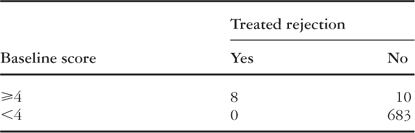
Table 1.
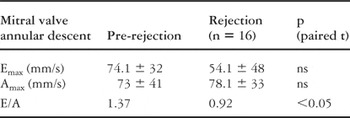
Table 2.
 You have Access
- 10
- Cited by