Introduction
Governments in Europe are now facing demographic transitions that are making increasing demands on health and long-term care (Christensen et al. Reference Christensen, Doblhammer, Rau and Vaupel2009; Sirven and Debrand Reference Sirven and Debrand2008). Healthy ageing can alleviate some of these demand pressures, and many health-care systems are exploring new ways to create health-promoting activities. One instrument that has received significant policy interest lately is to involve civic society voluntary associations in activities that promote health and wellbeing (Cahn Reference Cahn2000; Pestoff Reference Pestoff2009). We define civic society voluntary associations as ‘voluntary and community organisations’ (VCOs henceforth), which are non-profit, employ voluntary staff, and produce services and activities for themselves or the public, e.g. in the fields of culture, leisure, sport, social services, community and housing (Brandsen and Pestoff Reference Brandsen and Pestoff2006; Osborne and McLaughlin Reference Osborne and McLaughlin2004).
VCOs promote healthy ageing through the co-production of services aimed at older adults, e.g. to improve diets and/or levels of physical and social activity, which has explicitly been described as an instrument of disease prevention in connection with heart disease in older adults (Bovaird and Loeffler Reference Bovaird and Loeffler2012: 1129). VCOs also create opportunities for volunteering that multiple international studies have demonstrated promote health among older adults (Dulin Reference Dulin2017):
volunteering is related to better psychosocial, physical and cognitive health, as well as better functional performance…; amelioration of depressive symptoms, improved life satisfaction, and enhanced social support; improvements in memory and executive functioning; delayed mortality. (Anderson et al. Reference Anderson, Damianakis, Kröger, Wagner, Diedre, Dawson, Bernstein, Caspi and Cook2014: 1523)
Municipal collaboration with VCOs, which has been labelled ‘co-production’, can lead to flexible, innovative and contextually sensitive delivery modes (Pestoff, Brandsen and Veshuere Reference Pestoff, Brandsen and Vershuere2013). There are many examples of local governments and VCOs that are currently collaborating within programmes to encourage and enhance healthy ageing in Denmark. Examples include local sports clubs providing venues and instructors to offer physical activities for older adults, a bi-annual ‘Health Day’ hosted by a local government in collaboration with patient organisations and ‘friends circles’ associations in which senior citizens visit older adults in nursing homes in order to reduce unwanted social isolation.
However, the international literature in the field of health care for the ageing also points to a number of governance issues and challenges related to increased volunteerism (Lowndes and Pratchett Reference Lowndes and Pratchett2012). Many of these issues are rooted in basic differences in organisational conditions between VCOs and public authorities. VCOs are based on principles of independence and voluntarism. As a result, members of VCOs are typically not bound by formal employment contracts or clear hierarchical structures (Brandsen and Pestoff Reference Brandsen and Pestoff2006). Public authorities, on the other hand, are formal, hierarchical structures based on governmental universalism and subject to bureaucratic rules and norms that facilitate predictability and continuity. This means that local governments must operate with some degree of formal governance and control in their interaction with VCOs (Andersen Reference Andersen2011: 55). At the same time, they need to develop new forms of flexible governance in order to support and empower VCOs (Brandsen and Pestoff Reference Brandsen and Pestoff2006; La Cour Reference La Cour, Åkerstrøm Andersen and Sand2012; Sørensen and Torfing Reference Sørensen and Torfing2005). These two principles of formality and flexibility often collide in practice, which can create ambiguities for both the public and the private partners.
Previous studies of co-production have often taken a top-down perspective: they have looked at systemic or governance-related issues from the perspective of public authorities (Brandsen and Pestoff Reference Brandsen and Pestoff2006; La Cour Reference La Cour, Åkerstrøm Andersen and Sand2012; Sørensen and Torfing Reference Sørensen and Torfing2005). Other studies have focused on the perspective of citizens (Anderson et al. Reference Anderson, Damianakis, Kröger, Wagner, Diedre, Dawson, Bernstein, Caspi and Cook2014; Voorberg, Bekkers and Tummers Reference Voorberg, Bekkers and Tummers2013). These studies are highly relevant, but they leave a gap in the understanding of collaborative initiatives from the perspective of the private associations (Osborne and McLaughlin Reference Osborne and McLaughlin2004; Rees, Mullins and Bovaird Reference Rees, Mullins and Bovaird2012). This is a critical gap in the international literature because it limits our ability to understand the success and failure of policies to promote co-production and the issues and concerns that arise in practice.
In light of this gap, the aim of this paper is to explore VCOs awareness of and attitude towards public policy strategies for co-production of services for the elderly.
Analysing these issues provides a deeper understanding of the potentials and challenges in the governance of co-production of welfare services, particularly those directed at healthy ageing. We use the Danish case to illustrate such issues, but argue that the results can be relevant in other countries.
Theory
Our analysis of public–private collaboration builds on concepts from the network governance literature. This perspective emphasises the non-hierarchical relationship between public authorities and private-sector organisations. Due to the voluntary nature of civic society organisations, it is not possible for the public authority to force them into collaboration. Instead, public authorities must rely on various forms of ‘soft governance’, such as policy strategies, agreements, economic and other resources, and various types of facilitation activities. These measures are ‘soft’ as they rely on nudging, incentives and self-regulation rather than formal legislation and legal sanctioning. The awareness of and attitude towards such soft governance mechanisms among VCOs is therefore of crucial importance for understanding the dynamics of the collaborative efforts.
Network governance
Private VCOs constitute a ‘third sector’, which is defined by autonomy and formal independence from the public sector. These characteristics represent a challenge for hierarchical rule-based governance (Jessop Reference Jessop1998; Kickert, Klijn and Koppenjan Reference Kickert, Klijn and Koppenjan1997). VCOs operate on a not-for-profit basis, they have open enrolment and rely on a significant degree of voluntary commitment by their members (Brandsen and Pestoff Reference Brandsen and Pestoff2006; Henriksen, Boje and Ibsen Reference Henriksen, Boje, Ibsen and Osborne2008; Ibsen and Boje Reference Ibsen and Boje2006; Pestoff, Brandsen and Veshuere Reference Pestoff, Brandsen and Vershuere2013). These characteristics of VCOs represent a challenge for hierarchical rule-based governance (Jessop Reference Jessop1998; Kickert, Klijn and Koppenjan Reference Kickert, Klijn and Koppenjan1997). Moreover, VCO member participation is voluntary and exit always remains a possibility. This implies that none of the involved actors can command or force the other in the manner that is possible in a system of hierarchical rule (Sørensen and Torfing Reference Sørensen and Torfing2005).
To arrive at an operative definition of the relationship between local government and VCOs, we should speak of an interdependent network rather than a hierarchical relationship. This approach is predicated on municipalities relying on VCOs to achieve their policy goals (Sørensen and Torfing Reference Sørensen and Torfing2005: 203), while VCOs typically depend on municipal resources, e.g. money, venues and knowledge (Pestoff, Brandsen and Veshuere Reference Pestoff, Brandsen and Vershuere2013). How can municipalities operate in such interdependent network structures? Municipalities apply ‘network governance’, which is a form of management that operates through strategic alliances and collaboration with various public and private actors based on some degree of shared goals and exchange of resources, information and expertise (Jessop Reference Jessop1998). Public network governance concerns the operational co-operation between interdependent public and private actors that is guided most often by public policies (Kickert, Klijn and Koppenjan Reference Kickert, Klijn and Koppenjan1997; Rhodes Reference Rhodes1997). The success of such network governance depends on a number of dimensions, including effective and continuous communication; common visions; mutual learning; agreement on distribution of tasks; ability to handle problems as they occur; and some form of reflexivity about the performance of the network that can be used to generate debate and corrective actions (Jessop Reference Jessop1998; Sørensen and Torfing Reference Sørensen and Torfing2012). A number of these dimensions rest on the assumption that VCOs and municipalities have shared perceptions about the collaborative endeavour. However, there are few empirical studies that actually investigate collaboration from the perspective of VCOs. This paper aims to remedy this gap.
The purpose of the network governance is to develop co-production, which refers to the ‘hands-on’ involvement of public authorities and VCOs or individuals in joint production (Evers Reference Evers and Matthies2006, in Brandsen and Pestoff Reference Brandsen and Pestoff2006). Co-production contains two dimensions. First, it involves co-management, where VCOs and municipalities collaborate in producing services or organising events. Second, it involves co-governance, which concerns third-sector participation in the development of municipal policies and/or in the planning of public services (Brandsen and Pestoff Reference Brandsen and Pestoff2006: 497). In practical terms, this collaboration often takes place in committees or ad hoc working groups consisting of representatives from both municipalities and associations (Ackerman Reference Ackerman2004).
Methods and data
Case selection
Like many other European countries, Denmark has a long tradition of providing public services through co-operative civic society organisations and various forms of public–private collaboration (La Cour Reference La Cour, Åkerstrøm Andersen and Sand2012). The largest national association for old age citizens, Ældre Sagen, has almost 800,000 members (close to 15% of the entire population) and 215 local branches that organise an extensive network of volunteers.
The Danish National Act on Social Services requires local authorities to co-operate with voluntary social organisations and societies and to support voluntary social work financially. However, it is up to the individual municipality to decide which associations to support, and by which means, while adhering to general public administration rules (Ibsen Reference Ibsen1996). Such decisions are typically based on local policy strategies concerning voluntarism, health and senior citizens (La Cour Reference La Cour, Åkerstrøm Andersen and Sand2012). These policy strategies provide the foundation for establishing and governing networks and for the specific interaction between VCOs and public authorities. These strategies typically describe policy aspirations, principles, guidelines and action recommendations at the general level, and present an important reference point and overall framework for co-production. Yet, the delicate balance in these strategies is how to create a framework structure for collaboration without compromising the special nature of VCOs as independent and voluntary as opposed to conventionally governed municipal institutions (La Cour Reference La Cour, Åkerstrøm Andersen and Sand2012). Our investigation of VCO perceptions provides an indication of how successful the strategies are in such an endeavour, thus contributing to general lessons about the anatomy of the challenges of collaborating with VCOs that are relevant beyond the case of Denmark.
We selected three out of 98 Danish municipalities. The municipalities of Copenhagen, Ishoej and Vordingborg were selected to achieve maximum variation with regard to size measured by the number of inhabitants and the type of municipality (Copenhagen: 580,184, urban; Ishoej: 22,025, suburban; Vordingborg: 45,471, rural; compared to the national average of 55,572 inhabitants per municipality) (Patton Reference Patton2005; Statistics Denmark 2016).
Data collection
The quantitative data are based on an electronic survey. Survey questions refer to practical and theoretical issues concerning municipal policies for network governance of co-production. Background information about types of association activity, membership and members’ ages is collected in the survey. Theory-based questions address issues about the associations’ relationship with the municipality in the following areas: collaboration practices; municipal support and communication; perceptions of municipal policies and administration; division of responsibilities concerning network governance between the associations and the municipalities; and the associations’ attitudes towards the previous issues. The wording and categories for these questions were based on previous studies in this field in combination with theoretical literature on co-production (Boje, Fridberg and Ibsen Reference Boje, Fridberg and Ibsen2006; Brandsen and Pestoff Reference Brandsen and Pestoff2006; Sørensen and Torfing Reference Sørensen and Torfing2012).
Part One of the survey included background information (e.g. the association's name; types of activity; and distribution of members/users according to age). Part Two concerned the degree of network governance between municipalities and associations. Questions addressed responsibility for various network governance parameters including: communication; solving problems; developing common goals; distributing tasks between the two actors; evaluating network performance; and creating common learning. This was followed by a question about who should take responsibility for these parameters. Part Two also concerned how VCOs perceive municipal policies relevant for co-production with a question that addressed the significance of each of these policies, i.e. voluntarism policy, policy on senior citizens and policy on health. Part Three addressed co-management as one element of co-production. It also contained questions about whether the municipality or the associations obtain the larger amount of advantages when collaborating, and questions about the extent of co-management with regard to development and implementation of tasks. In the final part of the survey, we explored associations’ perceptions about their level of involvement in the development of municipal policies.
Data analysis consisted of basic descriptive statistical analysis in SAS Analytics software (e.g. frequencies tables and cross-tabulations) as well as construction of indexes. When testing the internal consistency of our indexes, we used SAS Analytics to execute a Cronbach's alpha test in which values above 0.7 were considered acceptable (Tavakol and Dennick Reference Tavakol and Dennick2011).
Identifying VCOs is a challenge: there is no central register of information about activity types and membership details of such organisations in Denmark (Boje, Fridberg and Ibsen Reference Boje, Fridberg and Ibsen2006). Therefore, we employed a strategy consisting of several steps. First, we asked the administrations in each of the three municipalities to provide a list of VCOs that they were aware of as being potentially relevant for healthy ageing promotion. We then validated the lists and checked for completeness, which was accomplished by extensive internet searches, investigation of umbrella association registers and local (physical and Web-based) telephone books. This resulted in a final sample of 1,060 associations across the three municipalities that are non-profit; employ voluntary staff; and produce services for the public of relevance for healthy ageing within the fields of culture, leisure, social service, community and housing. Examples of such associations are Red Cross Visitors Friends, patient organisations and sports clubs. Organisations focusing on younger citizens, for example, including those that deal with extreme sports, were excluded. We then distributed our Web-based survey to prospective participants and followed up with two rounds of reminders. Out of the 1,060 associations, 571 answered the survey fully or partially, which resulted in a response rate of 54 per cent. The survey was answered by the associations’ contact person. While in small associations this person might be the association's chair, it was typically the head of the administration or head of communication in larger associations. We were only able to control for systematic bias in the non-responding associations based on which municipality they came from, as we had no other independent background information. We found that associations from the Copenhagen Municipality had a marginally large non-response frequency compared to associations in the other two municipalities.
Results
Policy strategies
An analysis of current strategy documents from the three municipalities of Ishøj, Vordingborg and Copenhagen shows that policies concerning voluntarism aim to promote co-production in collaboration with the associations according to key network governance parameters (Copenhagen Municipality 2015; Ishoej Municipality 2015; Vordingborg Municipality 2015). All of these policies emphasise the importance of continuous communication and the development of shared visions in order to promote partnerships. Other policies underline the importance of evaluation of collaboration in order to create shared learning and counteract conflicts, which are explicit parameters in the network governance of VCOs (Sørensen and Torfing Reference Sørensen and Torfing2012). The principle of network configuration is emphasised throughout the voluntarism policies, as is the importance of the associations as collaboration partners for service production according to principles of co-management and as facilitators of local democracy according to co-governance (Brandsen and Pestoff Reference Brandsen and Pestoff2006).
The senior citizens and health policies in these strategy documents are framed within the policies on voluntarism: the role of VCOs is emphasised – they are seen as networked partners responsible for co-producing and co-managing public services relevant to healthy ageing thereby emphasising co-management (Brandsen and Pestoff Reference Brandsen and Pestoff2006). Finally, all of the policies concerning voluntarism, senior citizens and health explicitly describe how the VCOs have taken an active part in the policy development process according to the principles of co-governance (Brandsen and Pestoff Reference Brandsen and Pestoff2006). We conclude that all three municipalities have extensive policy aspirations to include VCOs in activities that promote health and address the challenges of an ageing population. The question, then, is whether the VCOs are aware of these policies and whether they perceive them as relevant to and beneficial for their activities. The following section presents an analysis of the collaboration seen from the perspective of the VCOs.
How many VCOs have collaborated with the municipalities?
We asked a filter question in the survey: ‘Has the association collaborated with the municipality during the last five years?’, in order to avoid respondents answering irrelevant questions concerning collaboration. A total of 289 associations answered ‘Have not collaborated with the municipality during the last five years’, which reduced the total possible answers in many cases from 571 to 282. The fact that more than half of the associations have not collaborated with their municipalities during the last five years constitutes a noticeable finding on its own. We conducted an analysis of those 289 associations and found that the following factors increase the probability of not having collaborated during the last five years: higher shares of ethnic minority members, associations being located within Copenhagen municipality and smaller shares of older adult members. We found no effect of the size of the association or the gender balance of its members.
Network governance
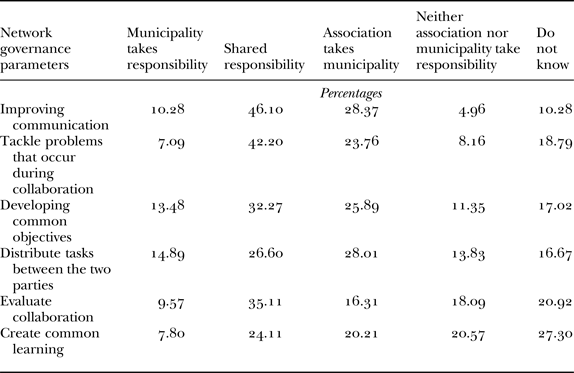
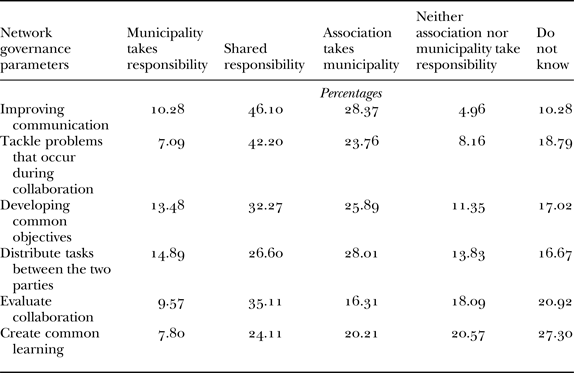
A key issue in network governance is whether the municipalities or the associations take responsibility for collaboration. Based on the theory presented, we selected a set of indicators for this and asked the respondents to indicate who takes responsibility for network governance as reported in Table 1.
Who takes responsibility concerning network governance parameters
Notes: Total number eligible = 282; item non-response = 0 (non-response not possible within this question).
The responses within Table 1 indicate that the majority of associations see the responsibility as shared. This is a positive sign, although it should also be noted that on average 13 per cent declare that neither the association nor the municipality takes responsibility for the network governance parameters or say that they do not know. It is only with regard to ‘improving communication’ that there is a fairly unanimous understanding of who takes responsibility – 85 per cent of the associations perceive that both parties take responsibility. The corresponding figure for the rest of the parameters is 70 per cent or less, which suggests that overall network governance can be improved; 32 per cent indicate that the municipalities need to take a larger share of the responsibility in order to balance power and the use of resources within the network. It is of concern that only 8 and 10 per cent of the associations, respectively, perceive that the municipalities take responsibility for ‘creating shared learning’ and ‘evaluating collaboration’. This is because these tasks require an administrative capacity which primarily can be expected to exist within the municipal administration. Similarly, only 7 per cent of the associations perceive that the municipalities take responsibility for ‘tackling problems within the network’. On the positive side, the level of imbalance is lower concerning ‘developing common objectives’ and ‘distributing tasks between the parties’, as both these responsibilities may mitigate the development of problems within these categories.
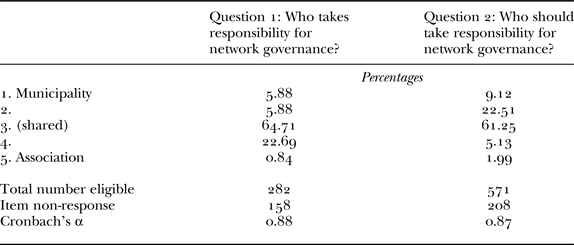
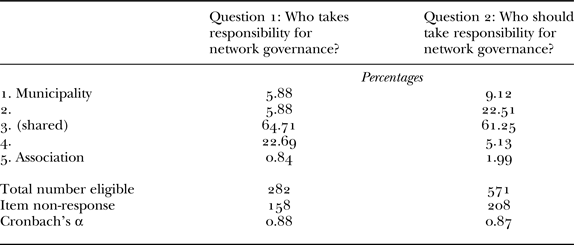
The answers from Table 1 can be elaborated further by aggregating the six indicators into an index that can be compared to the question of ‘who should take responsibility according to the associations’, as illustrated in Table 2.
Responsibility for network governance
Note: Location of responsibility.
Table 2 confirms the generally positive impression of associations and municipalities sharing responsibilities for network governance, but it also indicates that some associations experience a disparity between what actually takes place in their interaction with the municipalities and what should be taking place in terms of governing the network. The higher frequency of ‘non-response’ in question 2 compared to question 1 can be explained in part by respondents answering ‘Neither association nor municipality take responsibility’ or ‘Do not know’ in Table 1 because those responses have been coded as item ‘non-response’ in connection with aggregating the index. The vast majority of item non-response in question 2 are associations that declared to have collaborated with the municipality during the last five years.
Co-management
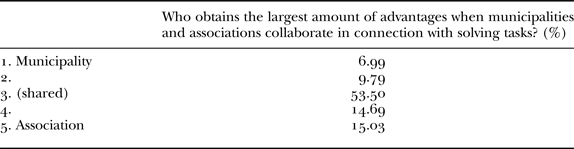
Co-management occurs when associations produce services (at least in part) in collaboration with the municipality (Brandsen and Pestoff Reference Brandsen and Pestoff2006). Collaborative service production entails the pooling of resources in order to increase capacity. In an optimal situation, this creates benefits for both parties and facilitates further collaboration. We asked the respondents about their perception of the distribution of benefits using a scale of 1–5, where 1 represents the municipality obtaining the full advantage, 3 indicates the sharing of advantages and 5 represents the associations obtaining the full advantage. This is illustrated in Table 3.
Distribution of advantages
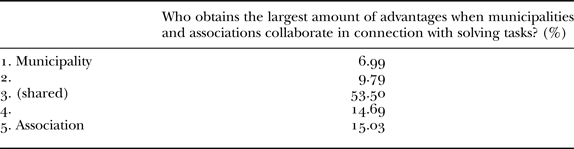
Notes: Respondents were asked about their perception of the distribution of benefits using a scale of 1–5, where 1 represents the municipality obtaining the full advantage, 3 indicates the sharing of advantages and 5 represents the associations obtaining the full advantage. Total number eligible = 282; item non-response = 16.
About one-half of the associations indicate that the advantages of collaboration are shared equally. A total of 30 per cent of the associations perceive that they obtain the majority of the advantages. This can be interpreted as a relatively positive result; the associations’ experience indicates that there are grounds for continued collaboration. These results are also in line with the responses in a subsequent question about who ‘should’ obtain benefits (not shown), although a slightly higher proportion of respondents to this question say that associations should obtain even more advantages through the collaboration.
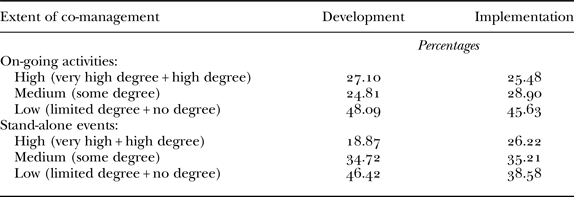
Next, we asked the associations about the extent of collaboration with municipalities related to different types of activities. We differentiate between development and implementation of either on-going activities or stand-alone events. This depiction of the relative emphasis, which is detailed in Table 4, gives an indication of the depth and continuity of involvement.
Extent of co-management
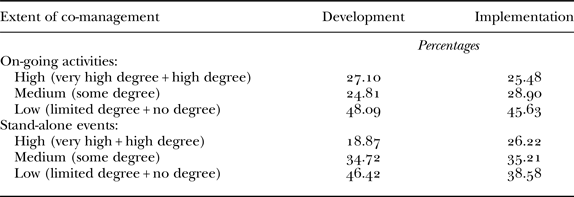
Notes: Total number eligible = 282; ‘do not know’ = 29–34 depending on the question; item non-response = 16.
The general trend is that approximately one-half of the associations report a high degree of co-management in on-going activities and stand-alone events with regard to both development and implementation. This suggests that there is a substantial unused potential for co-production according to the concept of co-management. Furthermore, Table 4 indicates a slight degree of polarisation with regard to the extent of on-going activities compared to stand-alone events: there is a slightly larger share of co-management at a ‘low-level’ extent in on-going activities. The study indicates that if the associations are involved in co-management of on-going activities, they want co-management to occur to a wider extent in these activities compared to stand-alone events. Associations that report a high extent of involvement in the development of on-going activities and stand-alone events report a correspondingly high extent of implementation, which is according to expectations. Following this, we asked the associations what significance the policies on voluntarism, health and senior citizens have for their operations. Based on these three questions, we constructed Table 5.
‘Voluntarism’, ‘health’ and ‘senior citizen’ policies’ significance
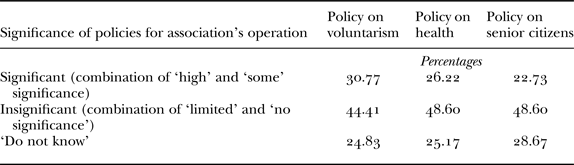
Notes: N = 571; item non-response = 273.
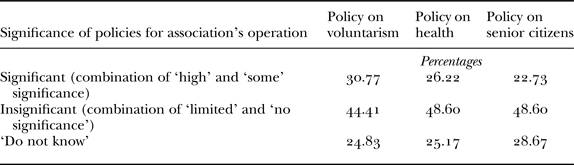
Table 5 demonstrates that between one-third to a bit less than one-half of respondents find these policies significant. As the policy on voluntarism concerns all of the associations, it is not surprising that this policy is rated as significant by a larger share of the associations compared to the other two policies. Furthermore, we found that associations that say that they conduct health-related activities are 43 per cent more likely to find the policy on health significant compared to the rest of the associations, which indicates that the policy reaches its target group.
Co-governance
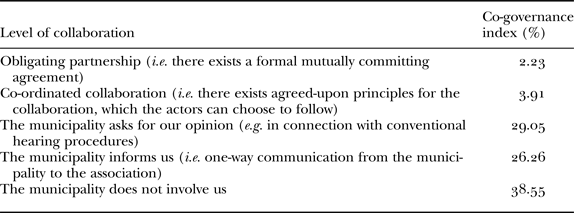
Co-governance concerns the associations’ participation in municipal policy development (Brandsen and Pestoff Reference Brandsen and Pestoff2006). In correspondence with Table 6, we asked the associations at which level they collaborate with the municipality concerning the development of the policies of voluntarism, senior citizens and health. We constructed an index based on these three questions, which formed the basis for Table 6.
Co-governance collaboration level
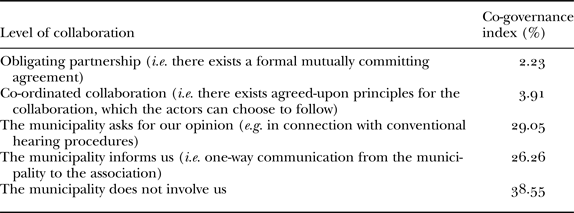
Notes: Total number eligible = 282; ‘do not know’ = 81–92 depending on the question; item non-response = 6; Cronbach's α = 0.89.
Our results show that 39 per cent of the associations report not being involved by the municipality and 26 per cent of the associations report experiencing only one-way communication. These results do not indicate a solid basis for creating effective co-governance. Only 35 per cent of the associations engage on a level of collaboration that is conducive for co-governance; among these, 29 per cent (numerically) of this collaboration is at the most basic level. These results conflict with the municipal policies on voluntarism, which state that the associations in the municipality have taken part in the policy development process according to the concept of co-governance. Moreover, the high Cronbach's alpha value indicates that there is a limited difference between the levels of collaboration across policies.
Discussion
Evidence from Denmark, the United Kingdom, France, Germany and the Czech Republic indicate elderly citizens generally engage more often in co-production (Parrado, Van Ryzin and Bovaird Reference Parrado, Van Ryzin and Bovaird2013). The Danish municipalities in our study have realised this potential and have developed strategies to promote co-production. However, it was also apparent in our material that a sizeable number of VCOs were not engaging in co-production for various reasons. Moreover, many VCOs were not aware of municipal strategies for co-production or they did not find them adequate.
More than 50 per cent of the associations in our study reported that they have not collaborated with the municipality during the last five years. Some of those associations may not be interested in collaboration; other associations may lack capacity and administrative resources to engage in collaboration (Ackerman Reference Ackerman2004). This indicates that municipalities should emphasise support for capacity-building in VCOs as a key part of their co-production strategies.
Our analysis shows that VCOs with larger shares of older adults are more likely to collaborate compared to associations with lower shares of older members. This confirms previous findings that older Danes have a higher level of volunteer participation – predominantly in associations – compared to younger age segments (Boje, Fridberg and Ibsen Reference Boje, Fridberg and Ibsen2006; Erlinghagen and Hank Reference Erlinghagen and Hank2006; Hank and Stuck Reference Hank and Stuck2008) and it underlines the feasibility of using this policy instrument to promote healthy ageing objectives.
Our results in Table 1 indicate that a majority of associations experience that the responsibility for network management is shared equally between the two parties. This indicates that a number of municipalities have succeeded in establishing relatively mature relationships that correspond to the spirit of networked co-governance. Between 20 and 30 per cent of the associations find that they take the primary responsibility for co-governance activities such as communication, dealing with ongoing problems, developing common objectives, learning and distribution of tasks. This can be interpreted positively as an indication that a sizeable number of voluntary associations are able to take a pro-active role in the collaborative relationship. A smaller number of associations find that the municipalities take the main responsibility for network governance tasks. Overall, we interpret the results as relatively positive as the majority of associations actually point to a shared responsibility, which is in accordance with the principles of network-governed co-production (Sørensen and Torfing Reference Sørensen and Torfing2012), and a sizeable minority indicate that they are in fact taking the main responsibility for the collaboration.
Out of the six parameters, ‘improving communication’ has the highest rate of ‘shared responsibility’ and the lowest scores with regard to ‘neither association nor municipality take responsibility’ and ‘do not know’. This is positive, since information plays a pivotal role in connection with network governance (Hale Reference Hale2011). Concerning ‘dealing with problems that occur during collaboration’, we find that the share of associations that perceive taking the majority of the responsibility is three times higher than associations perceiving that the municipality takes the majority of the responsibility. These observations indicate that this may be a more important issue for the associations than for the municipalities. This tendency is much less pronounced concerning ‘developing common objectives’ and ‘distributing tasks between the two parties’ in combination with lower rates of perceived shared responsibility, which demonstrates that the associations perceive that these issues are more important for the municipalities.
Both parameters are important in network governance. Developing common objectives constitutes indirect steering, while distribution of tasks demonstrates that the municipalities also operate with some degree of formal hierarchical control (Andersen Reference Andersen2011: 55). With regard to ‘evaluating collaboration’ and ‘create common learning’, we find that close to one-half of the associations report that neither party takes responsibility or they answer ‘do not know’. This is a considerably higher share compared to the other four parameters, which suggests that the network requires further time and effort to mature because these parameters tend to require that basic network governance functions are adequate (Klijn and Koppenjan Reference Klijn and Koppenjan2015: 240–56).
The majority of the respondents that answered the normative questions about responsibility (see Table 2) said that the responsibility should be shared. Shared responsibility creates the basis for balanced power, which contributes to the mutual respect and facilitates the joint deliberation that is conducive for network-based co-production (Entwistle and Martin Reference Entwistle and Martin2005; Sørensen and Torfing Reference Sørensen and Torfing2005). However, there is a secondary tendency, illustrated in Table 2, that indicates that the associations believe that the municipalities should take relatively more responsibility. This can be seen as a demand for more active involvement of the municipalities. Yet, it comes with an implicit risk of tipping the balance of power towards the municipalities, which may be detrimental to creating a truly collaborative relationship in the long run. In recognition of this, we suggest that the municipalities should consider how they can implement VCO capacity-building, e.g. by helping the associations increase their membership and participant base, as suggested in Vordingborg's and Ishoej's municipalities’ policies on voluntarism.
The municipal policies of our three cases emphasise the importance of co-management. The purpose of co-management is to create joint benefits, e.g. by combining resources such as financial and human resources, knowledge or administrative capacity in public service production (Bovaird Reference Bovaird2007; Brandsen and Pestoff Reference Brandsen and Pestoff2006). The majority of the associations in our study say that they share these advantages equally with the municipalities (see Table 3). However, there is a tendency on the part of the associations to perceive that they obtain a relatively larger share of the advantages. When considering that the associations also indicate that they want the responsibility for network governance tilted away from themselves towards the municipality (see Table 2), it appears that some associations lack the resources or confidence to enter into a balanced network with the municipality. This may constitute a barrier for further co-production (Dezeure and De Rynck Reference Dezeure, De Rynck, Pestoff, Brandsen and Vershuere2013). Furthermore, the problem illustrates that although balanced collaboration is part of the municipal policies on voluntarism, this may not be the actual or even the desired outcome for the VCOs.
Concerning co-management, Table 4 indicates a large potential for increased collaboration with regard to on-going activities as well as stand-alone events. The reason why these figures are not higher may be related to powerful cultural and systemic barriers, e.g. ‘lack of funding and commissioning; asymmetry as cost and benefits occur in different services; lack of professional [network] management skills; political risk aversion; and political and professional reluctance to lose control’ (Bovaird and Loeffler Reference Bovaird and Loeffler2012: 1129–130). Municipal policies are well-suited as co-management network governance instruments because they operate indirectly and can be used as mediums for developing common goals (Kickert, Klijn and Koppenjan Reference Kickert, Klijn and Koppenjan1997; La Cour Reference La Cour, Åkerstrøm Andersen and Sand2012). However, as Table 5 demonstrates, these policies do not seem to have the desired effect. Even though there was a high level of item non-response (273 out of 571), 258 of the 273 missing responses were associations that said they had not collaborated with the municipality during the last five years. Accordingly, those associations seem not to relate themselves at all to the municipal policies despite potentially being affected by them. This indicates that the share of associations that find the policies insignificant in reality may be considerably higher.
We found that the policy on voluntarism was regarded as most significant (30.8%) compared to policies on health and senior citizens being less significant (26.2 and 22.7%, respectively, cf. Table 5). On the one hand, these figures demonstrate that the policies have some outreach. On the other hand, the combination of associations that find the policies insignificant indicated by the number of item non-response (which suggest that the question and thereby probably also the policies are difficult to relate to) demonstrate that policies do not function well as intended (cf. section ‘Municipal policies for network governance of co-production relevant for healthy ageing’). There is, however, variance concerning which types of association find the policies significant: associations with health activities find the health policies more significant than other types of association. This indicates that the municipality has more success in reaching the policy's target group although it is reason for concern that the same associations do not find the policy on voluntarism significant for its operation even though it contains key principles for municipal support of and collaboration with the associations. Associations with more than 51 per cent of its members or users above 60 years old find the health and senior citizens policies more significant – though not the policy on voluntarism – which echoes the previous point. This indicates that a positive starting point exists for increased co-production of services with the elderly that could be further enhanced through increased awareness of the policy on voluntarism (Parrado, Van Ryzin and Bovaird Reference Parrado, Van Ryzin and Bovaird2013).
One way of increasing such awareness is to include the VCOs in the policy development process (i.e. co-governance). The municipal policies indicate that this is a municipal priority, while the associations, on the other hand, do not find themselves adequately involved in the policy development process. According to Table 6, co-governance only occurs at a very basic level. This corresponds with only 13 per cent of the associations perceiving that the municipality takes responsibility for developing common goals (see Table 1). Municipalities should consider prioritising efforts in this area because engaging citizens, e.g. by involving VCOs in the development of policies according to the principles of co-governance, further promotes co-production (Lindsay, Osborne and Bond Reference Lindsay, Osborne and Bond2014). In addition, these policies would benefit from becoming more concrete, e.g. by introducing politically and administratively monitored quantitative indicators to connect the implementation deficit with the policies themselves (Hill Reference Hill1997). Possible key performance indicators are ‘extent of public awareness of policies’ and ‘amount of VCOs collaborating with the municipality (with regard to co-management and co-governance respectively)’, thereby creating the basis for making politicians accountable for lack of co-production of services aimed at healthy ageing (Johnsen Reference Johnsen2005).
Conclusion
This paper has examined municipal policies for governance of co-production of activities that promote the health and wellbeing of older citizens, and the perceptions of such policies among VCOs in Denmark. The municipal policies relevant for this topic all include the explicit ambition of network-governed co-production aimed at promoting health and wellbeing among older adults. However, our study demonstrates that a significant number of associations are unaware of municipal policies or find them of limited relevance. This is also reflected in the fact that less than 50 per cent of the associations have actually engaged in collaboration with municipalities. Overall, this indicates a municipal failure to implement policy goals about collaboration fully. In addition, only a limited number of associations perceive themselves as being involved in co-governance, despite the fact that this is a clearly articulated goal in all municipal policies. Related to this, less than one-third of the responding VCOs say that the policies, which are central for municipal network governance of co-production, are significant. This perception is likely to be a consequence of the policy formulation and design because they express general intentions rather than conventional incentives and policy instruments. While this is in line with the theory of governance of co-production, the policies could benefit by operationalising the general municipal intent, e.g. through key performance indicators followed by monitoring at the political level in order to ensure deeper implementation and political accountability. In order to understand why there is not a larger degree of success in connection with the implementation of the policy goals of co-production with the third sector, it could be worthwhile further examining the challenges perceived by the associations in other policy settings, as well as in municipal implementation practices.
Acknowledgements
We would like to acknowledge the valuable input from Trine Svendsen Andrä, Organisational Consultant, Ishoej Municipality, as well as Sys Skive, Manager and Specialist, Vordingborg Municipality, in the form of participating in discussions concerning the study, testing the survey and providing information on the voluntary associations. Furthermore, we want to thank our respondents for answering the survey. This research was conducted as part of the Centre for Healthy Ageing (CEHA) and Centre for Health Economics and Policy (CHEP) at the University of Copenhagen. The purpose of the survey, data confidentiality, right to withdrawal and anonymity were explained in mail including the link to the survey. By answering the survey the informants consented to both participation and material being published. All data and material are available by contacting the corresponding author. C. Scheele and K. Vrangbæk conceived the study. M. Kriegbaum carried out the quantitative analyses. This paper was drafted by C. Scheele and K. Vrangbæk, and revised and edited by all authors. There are no competing interests to declare.