Introduction
The evolution of mating systems in arthropods has raised the interest of scientists since Darwin's theory of sexual selection (Thornhill & Alcock, Reference Thornhill and Alcock1983; Arnqvist & Nilsson, Reference Arnqvist and Nilsson2000). Contrary to monogamy, in which there is fidelity between the sexual partners, in polygamy, one individual has two or more sexual partners, and it is divided in polygyny and polyandry. In polygyny, a single male copulates with multiple females and this is the most common sexual system found in insects and animals alike (Matthews & Matthews, Reference Matthews and Matthews2010). Thus, usually the terms polygamy and polygyny are used as synonyms. On the other hand, in polyandry, the female has multiple mates. In addition, when males and females mate multiple times, the best term applied is polygynandry, whereas when they mate indiscriminately with each other, we have promiscuity (Thornhill & Alcock, Reference Thornhill and Alcock1983; Matthews & Matthews, Reference Matthews and Matthews2010). Polygynandry is quite common in insects, especially among the Coccinellidae (Majerus, Reference Majerus1994; Haddrill et al., Reference Haddrill, Shuker, Amos, Majerus and Mayes2008; Omkar et al., Reference Omkar, Singh and Mishra2010). In ladybird beetles, polygamy has been investigated since the 1970s, and was demonstrated for the first time in Adalia bipunctata (Linnaeus) (Semyanov, Reference Semyanov1970). Since then, the possible effects of polygamy has been studied regarding the reproductive performance of insects, such as fecundity and fertility (Bayoumy & Michaud, Reference Bayoumy and Michaud2014), increase in longevity (Colares et al., Reference Colares, Michaud, Torres and Silva-Torres2015), and faster development and improved survival of offspring (Mirhosseini et al., Reference Mirhosseini, Michaud, Jalali and Ziaaddini2014). Multiple mating should evolve only when the benefits exceed the costs to both sexes (Thornhill & Alcock, Reference Thornhill and Alcock1983). However, overall findings about the effects of polyandry (one female mating with multiple males) on insect fitness are not clear-cut. This may be because the costs associated with polygamy can be high, including risk of injury or acquiring a pathogen. According to Kvarnemo & Simmons (Reference Kvarnemo and Simmons2013), the most important effects of polyandry on males are sperm competition and cryptic female choice; it increases the male ejaculate expenditure that can affect sexual selection on males by reducing their potential reproductive rate. Furthermore, it is well recognized that male insect ejaculates may variously affect females, including acceleration of oviposition rate, increases in fecundity and fertility, and other subtle paternal effects (Gillott, Reference Gillott2003; Avila et al., Reference Avila, Sirot, LaFlamme, Rubinstein and Wolfner2011). In this context, some authors have suggested that if a male's investments in seminal fluid are high, young and virgin males could better boost female's fitness compared with older and previously mated males (Michaud et al., Reference Michaud, Bista and Omkar2013; Jiaqin et al., Reference Jiaqin, Yuhong, Hongsheng, Ping, Congshuang and Hong2014; Mirhosseini et al., Reference Mirhosseini, Michaud, Jalali and Ziaaddini2014; Colares et al., Reference Colares, Michaud, Torres and Silva-Torres2015; McDonald & Pizzari, Reference McDonald and Pizzari2016). Thus, females would be expected to recognize and choose younger virgin males to maximize their fitness. Further knowledge of coccinellid reproduction could lead to a better understanding of their mating systems and improve mass rearing of these biological agents. In addition, studies regarding the sexual behavior of ladybird could help us identify some kind of peculiarity such as the presence of semiochemicals as pheromones that may in the future improve their aggregation in areas of release (Aldrich et al., Reference Aldrich, Oliver, Taghizadeh, Ferreira and Liewehr1999; Chauhan et al., Reference Chauhan, Levi, Zhang and Aldrich2007; Aldrich & Zhang, Reference Aldrich and Zhang2016; Fassotte et al., Reference Fassotte, Francis and Verheggen2016).
Recently, the predatory ladybird, Tenuisvalvae notata (Mulsant) (Coleoptera: Coccinellidae), has been found in Brazil on plants of cotton, cactus, and hibiscus infested with mealybugs such as Ferrisia dasylirii (Cockerell) and Phenacoccus solenopsis (Tinsley), Dactylopius opuntiae (Cockerell) (Barbosa et al., Reference Barbosa, Oliveira, Giorgi, Silva-Torres and Torres2014a), and Maconellicoccus hirsutus (Green) (Peronti et al., Reference Peronti, Martinelli, Alexandrino, Marsaro Júnior, Penteado-Dias and Almeida2016). It potentially preys on either larvae or adult mealybugs, can survive up to 60 weeks after emergence under 25°C, and has a high reproductive rate when well fed (Dreyer et al., Reference Dreyer, Neuenschwander, Baumgärtner and Dorn1997; Barbosa et al., Reference Barbosa, Oliveira, Giorgi, Silva-Torres and Torres2014a). As with other coccinellids, T. notata is polygynandrous, which can be a determinant factor in its fitness since a single mated female could suffer a reduction in reproductive performance or have differences in survival in comparison to those that have access to multiple mating. This fact is recognized as a ‘trade-off’ between reproduction and survival under such conditions (Barbosa et al., Reference Barbosa, Oliveira, Giorgi, Oliveira and Torres2014b; Bayoumy & Michaud, Reference Bayoumy and Michaud2014).
We hypothesized that: (1) since T. notata adults are polygynandrous we expect no preference between sexual partners; and (2) male ability to influence female reproductive success and offspring development would reduce with multiple mating. Thus, the objectives of this study were to evaluate the effects of aging and multiple mating between males and females of T. notata on adult sexual behavior regarding partner choice, female's reproductive success, adult survival, male virility, and offspring development.
Material and methods
Experimental insects
To rear T. notata, a colony of F. dasyrilii was kept in the laboratory of the Insect Behavior of the Agronomy Department of the Universidade Federal Rural de Pernambuco (UFRPE). These were fed pumpkins var. ‘Jacarezinho’ obtained regularly from the local market. Mealybugs were cultured on pumpkins placed in plastic trays (29 cm × 41.5 cm × 7.3 cm) lined with paper towels until complete pumpkin infestation, which lasted for about 30 days, following procedures in Sanches & Carvalho (Reference Sanches and Carvalho2010). The coccinellid colony was maintained in transparent Plexiglas™ cages (40 cm × 25 cm × 20 cm) containing lateral openings of 10 cm diameter and covered with a 2 mm nylon mesh to allow ventilation of the cages. Each rearing cage was lined on the bottom with paper towels and received one pumpkin infested with F. dasyrilii nymphs and adults following procedures in Barbosa et al. (Reference Barbosa, Oliveira, Giorgi, Oliveira and Torres2014b). Both colonies were kept at 25 ± 2°C, 60 ± 10% relative humidity, and photoperiod of 12:12 h (light:darkness).
To ensure that we were using virgin males in bioassays when needed, T. notata pupae were individually isolated in Petri dishes (3.5 cm diameter) and observed daily for adult emergence. After that, adults were sexed based on morphological differences; females are usually larger than males, have two black spots on the superior portion of the head between the eyes, and have a narrower tip of the abdomen (Mulsant, Reference Mulsant1850; Barbosa et al., Reference Barbosa, Oliveira, Giorgi, Oliveira and Torres2014b).
Sexual partner choice
Here we tested the ability of T. notata to recognize and choose among sexual partners, based on their previous mating status. Initially, one virgin male and one sexually mature female (>5 days old) were paired during the photophase in a Petri dish and observed until they were seen to complete one mating, with the time interval from pairing to first mating recorded. After copulation, adults were isolated individually and received food ad libitum. Couples that did not mate during the up to 8 h observation period were excluded from further experiments. A total of 60 replicates (e.g. mating couples) were conducted. Following mating, the beetles were marked on the elytra with non-toxic paint in order to differentiate them from virgin adults. By this process, a total of 60 mated couples were established for further experiments. Next, 24 h later, sex partner preference of each member of each couple was tested. Each mated female (n = 30) and each mated male (n = 30) was offered two individuals of the opposite sex simultaneously in a Petri dish, one of which was a virgin and the other the individual it had mated with the day before. Again, observations lasted up to 8 h (9 am to 5 pm), or until one couple mated, and we recorded the latency to first mating.
Effect of aging and mating frequency on reproductive performance
This experiment was designed to test the effects of adult age and mating frequency on T. notata fitness and survival. Couples were paired in Petri dishes and observed for 12 h (7 am to 7 pm) according to the following treatments: (i) virgin male and female (5–10 days old), allowed to mate once; (ii) virgin male and female (5–10 days old), allowed to mate multiple times (n-mated adults); (iii) virgin male and female (95–100 days old), allowed to mate once; and (iv) virgin male and female (95–100 days old), allowed to mate multiple times (n-mated adults). Each treatment had 20 replicates (e.g. couples). We observed the elapsed time (mean latency time) to first mating in all treatments, and the mean number of mating for all couples in treatments (ii) and (iv) performed during the 12 h observation period. After mating, according to their respective treatments, males and females were isolated individually and fed ad libitum. We recorded the number of eggs laid by females and subsequent egg viability for the next 60 days, as well as the longevity of all adults after mating.
Polygynandry and reproduction
The next experiments were designed to investigate the relative contributions of female mating frequency, male novelty, and male mating status (sexual activity) to female fitness and male virility, as determined by female egg production and offspring viability. Adults used in the experiments were 5–10 days old.
Test 1. Four different mating treatments were established (n = 10 females per treatment) as follows: (i) a virgin female was allowed to mate once with a virgin male of same age on the first day of the experiment; (ii) each female was allowed to mate with the same male, for ten consecutive mating, with 5 days interval between mating; (iii) each female was allowed to mate for ten consecutive mating with different virgin males, with 5 days interval between mating; and (iv) each female was allowed to mate for ten consecutive mating with different males (males for this treatment were held in isolation and each mated once with a different, unrelated female for each mating), with 5 days interval between mating. As before, couples were held in Petri dishes (3.5 cm diameter) and observed during the photophase until mating occurred. Next, male and females were isolated individually in Petri dishes and fed ad libitum. We recorded the number of eggs laid by females in each treatment and subsequent egg viability during the next 60 consecutive days.
Test 2. We set up ten replicates where virgin females were allowed to mate once with males of different mating histories as follows: (i) virgin males; (ii) once-mated males; (iii) twice-mated males; and (iv) thrice-mated males. Previously, to obtain the respective male treatments, a virgin couple was allowed to mate once, after that for treatments (ii), (iii), and (iv), another virgin female replaced the mated female until the minimum number of mating per male was reached. We recorded copulation duration, and after that beetles were separated, females were kept individually in Petri dishes and fed ad libitum for 60 consecutive days after mating. We recorded the number of eggs laid daily and egg viability per female. To assess whether paternal effects on the offspring development were sensitive to male mating history, we took a sample of ten first instar larvae of each treatment. Larvae were reared individually in Petri dishes and fed daily with mealybugs until pupation. Immature survival and development times were recorded for egg, larval, and pupal stages. After emergence, adults were euthanized by freezing at −10°C, sexed, dried in oven at 50°C for 48 h, and weighed on an analytical balance (MARCONI AL 500C, precision 0.0001 g).
Data analysis
Sexual partner choices of males and females was analyzed by the Wilcoxon rank-sum test with α = 0.05% (Proc NPAR1WAY, SAS Institute 2002). Meanwhile, the latency time for copulation, in the first and second mating was analyzed by the Student t test with α = 0.05% (Proc T TEST, SAS Institute 2002). The mean number of mating and developmental parameters of progeny were transformed to square root of (x + 0.5) to meet analysis of variance (ANOVA) assumptions for normality and homogeneity of variance, and data were analyzed by ANOVA and means separated using Tukey's HSD test with α = 0.05% (Proc ANOVA, SAS Institute 2002). Latency time for copulations during the photophase, the number of eggs laid by females and egg viability along 60 consecutive days (mean oviposition in successive 10-day intervals) for each treatment were analyzed by ANOVA for repeated measures (Proc GLM, SAS Institute 2002). The survival curves for adults subjected to different mating regimes were determined using the Kaplan-Meier method (Klein & Moeschberger, Reference Klein and Moeschberger2003), and were compared using the log-rank test (Proc LIFETEST, SAS Institute 2002).
Results
Sexual partner choice
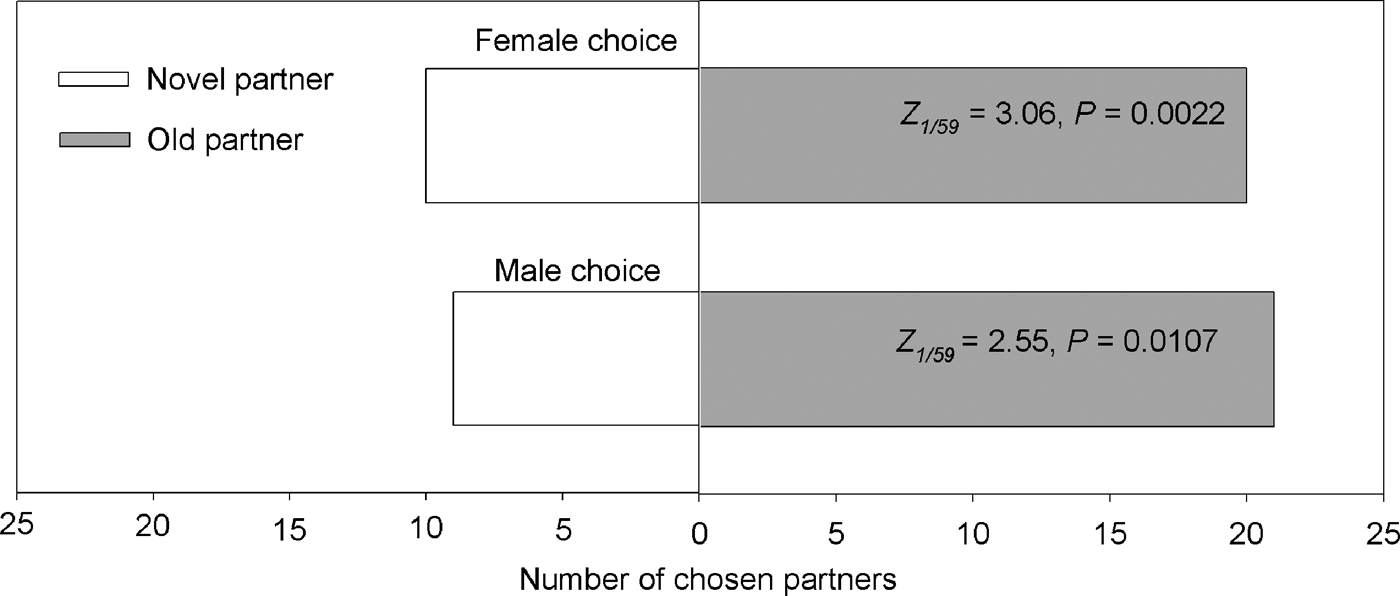
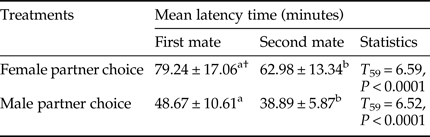
Both female and male T. notata showed preference for mating with a sexual partner that they had encountered one day before when offered novel ones on the second mating (females: Z 1/59 = 2.55, P = 0.0107; males: Z 1/59 = 3.06, P = 0.0022, fig. 1). In addition, the latency time to achieve the second copulation was significantly shorter (table 1).
Sexual partner choice in males and females of the ladybird Tenuisvalvae notata when offered simultaneously a previously known partner and a novel one 24 h after the first mating (Wilcoxon rank-sum test, α = 0.05).

Mean latency time (±SEM) to the first and second mating between couples of Tenuisvalvae notata subjected to a partner choice bioassay.

† Means followed by the different letters within the lines are significantly different (paired t test, α = 0.05).
Effect of aging and mating frequency on reproductive performance
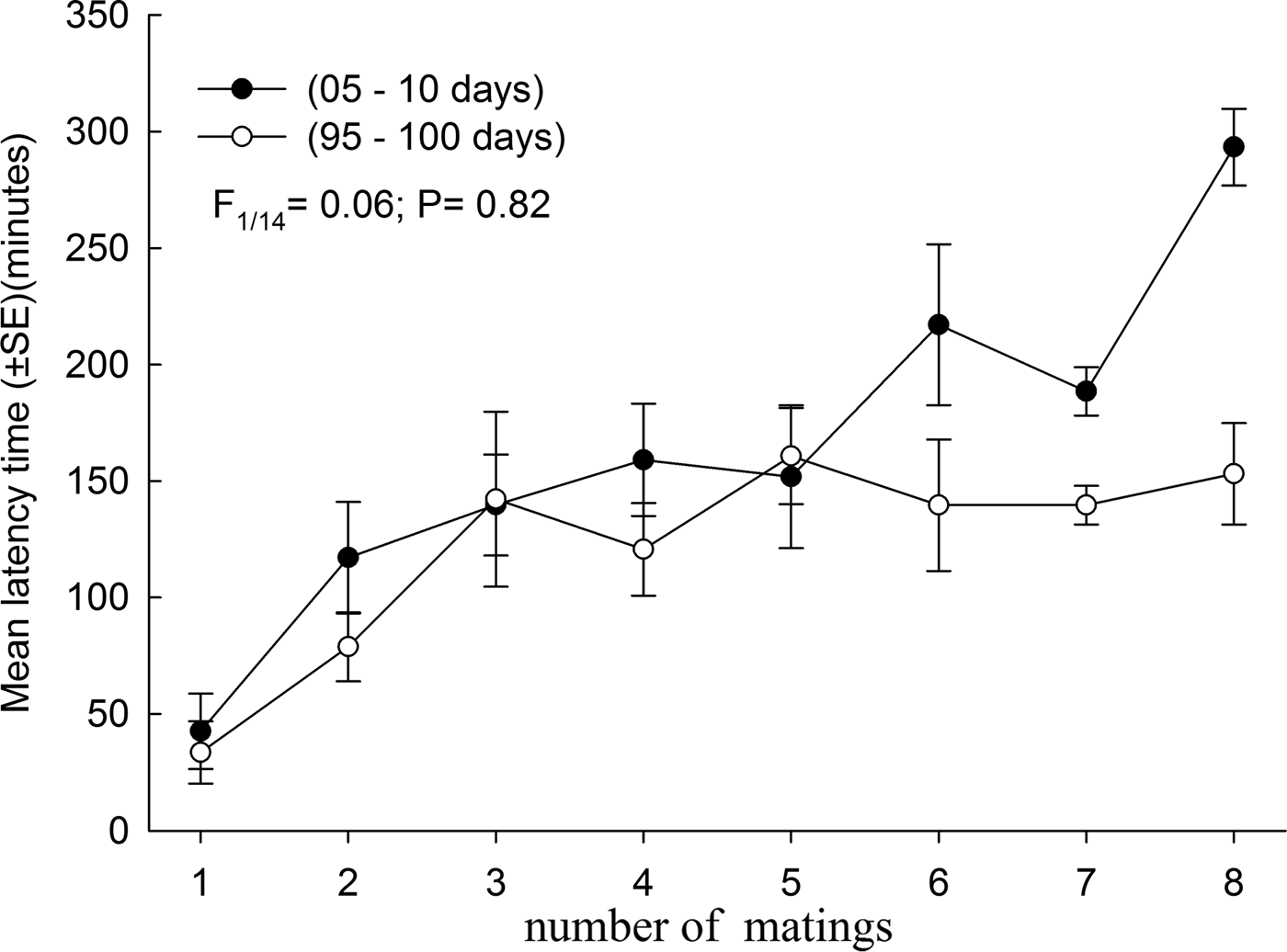
There was no difference in the mean number of mating per day between young (5–10 days old) and older (95–100 days old) couples of T. notata (F 1/27 = 1.14, P = 0.29), with an average of 2.24 mating per day regardless of couples’ age. Similarly, there was no difference in the latency between mating, for young and older couples (F 1/15 = 0.06, P = 0.82), with an average of 28.77 min between copulation bouts (from the onset to the end of mating when couples separated). The mean latency time to first mating per couple was about 30 min, whereas mean latency time to reach up to eight mating per day was about 300 min (fig. 2). Therefore, there was a positive correlation between latency and number of mating, with increasing time intervals over the course of the day for both young and older couples (F 7/21 = 11.39, P = 0.0024) (fig. 2).
Mean latency time for copulations (±SEM) (minutes) in young (5–10 days) and old (95–100 days) couples of Tenuisvalvae notata along the 12 h of photophase.

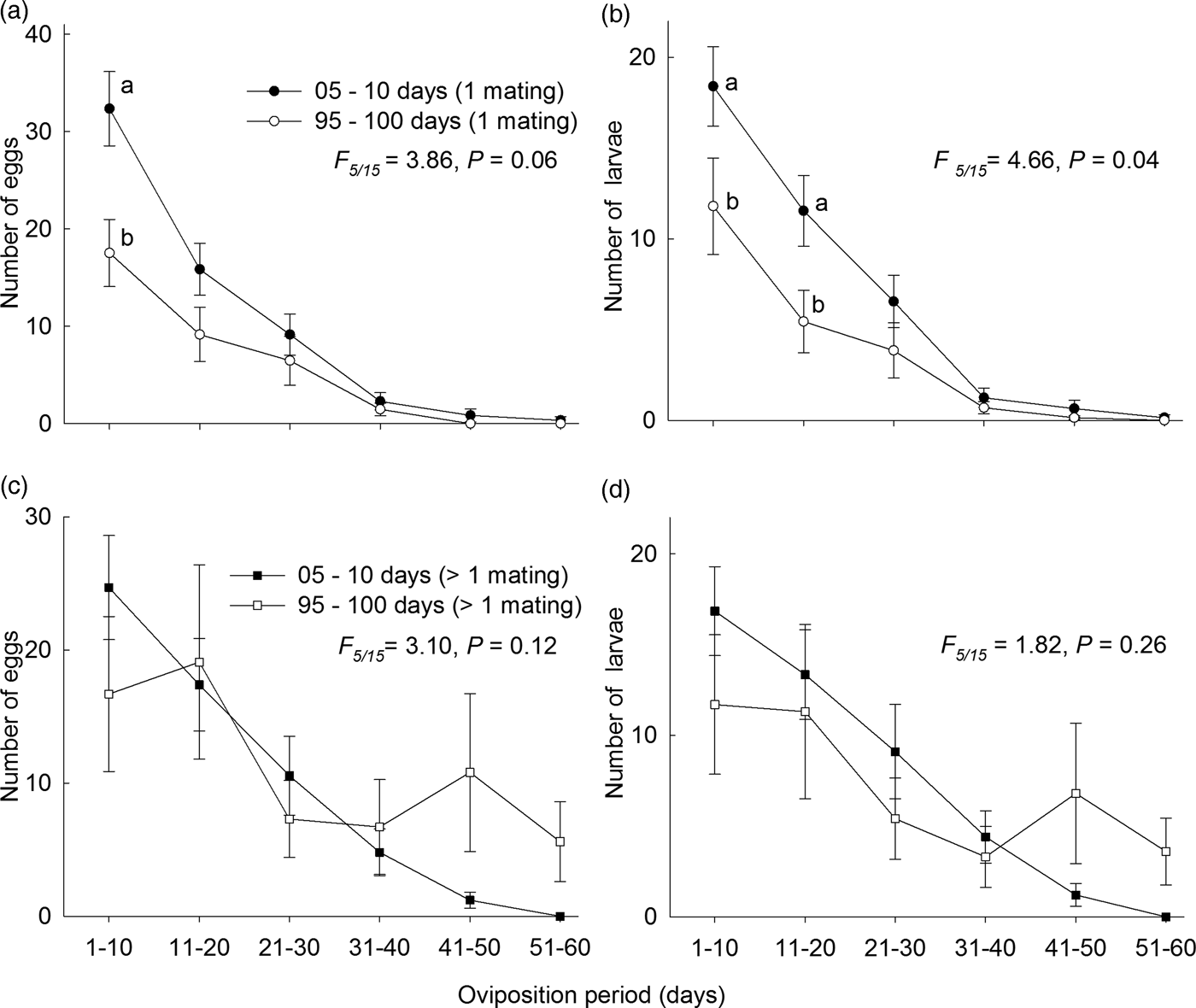
The experiments on the effect of age on the reproductive performance of T. notata showed that younger (5–10 days old) females had significantly higher fecundity in the first 10 days of oviposition compared with older (95–100 days old) females (Wilks’ λ = 0.51, F 5/15 = 3.86, P = 0.003) (fig. 3a), as well as significantly higher egg viability in the first 20 days of oviposition [time intervals (1–10 days): F 1/19 = 4.66, P = 0.04; and (11–20 days): F 1/19 = 6.21, P = 0.02] (fig. 3b).
Reproductive parameters (means ± SEM) of Tenuisvalvae notata young (5–10 days) and older (95–100 days) couples subjected to one or multiple mating on a single day. Results for 60 consecutive days after mating, presented in 10-day intervals. Means with different letters were significantly different (Tukey's HSD test, α = 0.05) among treatments within the same time interval.

With regard to the number of mating per female (one vs. multiple), there were no significant effects on female fecundity (Wilks’ λ = 0.24, F 5/15 = 3.10, P = 0.12) (fig. 3c) or egg viability (fertility) (Wilks’ λ = 0.35, F 5/15 = 1.82, P = 0.26) (fig. 3d) for any time interval comparison.
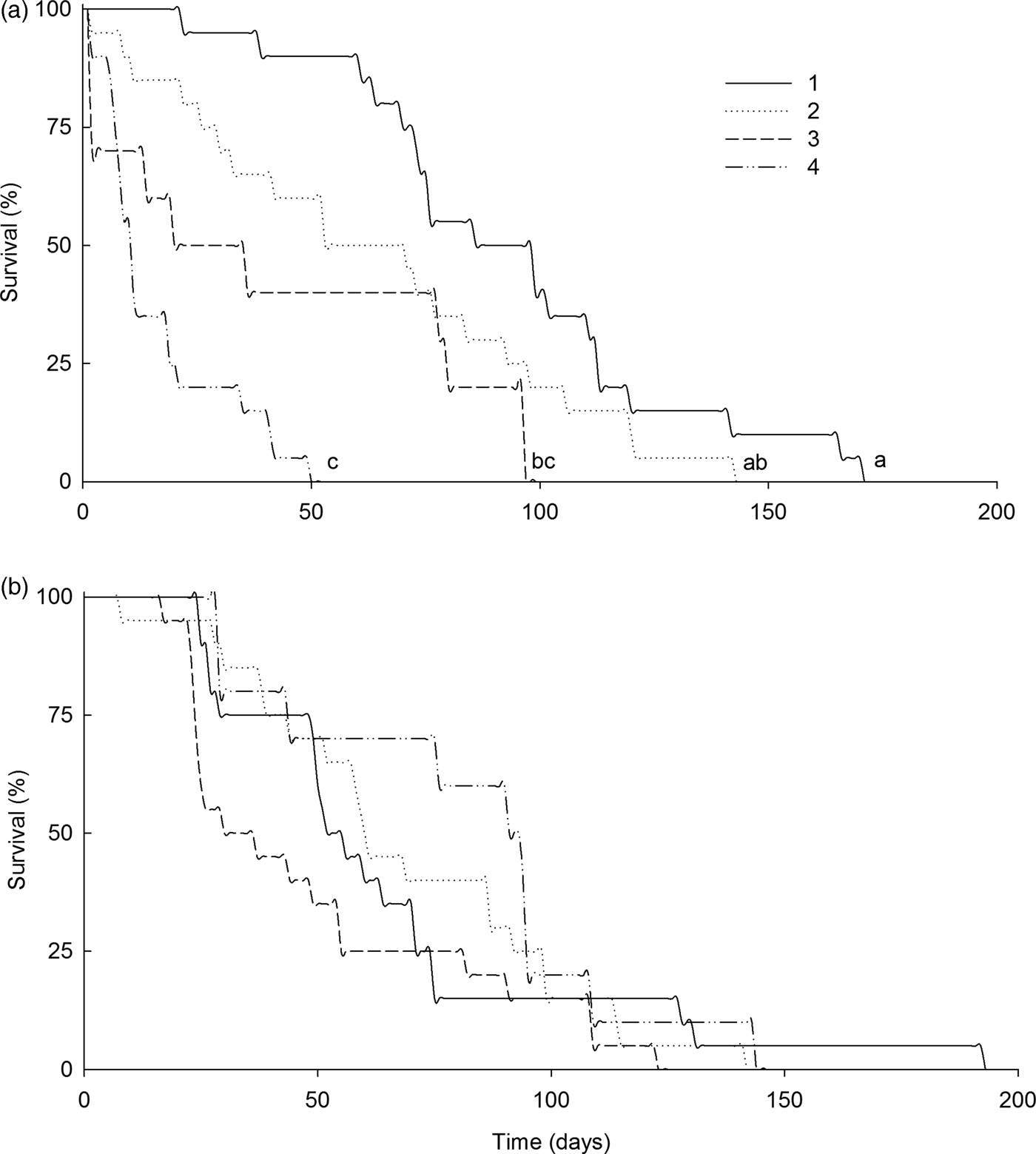
Additionally, there was a significant effect of female age and number of mating on female survival (χ23 = 100.69, P < 0.001) (fig. 4a). Young females mated once lived longer for about 180 days, whereas young females mated multiple times (n-mated) lived only for 100 days. The same pattern was observed for older females, in which those that mated once lived longer than those mated multiple times. There was no effect of age and number of mating on survival of male T. notata (χ23 = 5.28, P = 0.15) (fig. 4b).
Age-specific survivorship of Tenuisvalvae notata females (A) (χ23 = 100.69, P < 0.001) and males (B) (χ23 = 5.28, P = 0.15) subjected to four different treatments: (1) young (5–10 days old) once-mated adults (solid line); (2) older (95–100 days old) once-mated adults (dotted line); (3) young (5–10 days old) n-mated adults (dashed line); (4) older (95–100 days old) n-mated adults (dotted and dashed line). N-mated adults were subjected to multiple mating. Curves were calculated by the Kaplan–Meier method and compared by log-rank test.

Polygynandry and reproduction
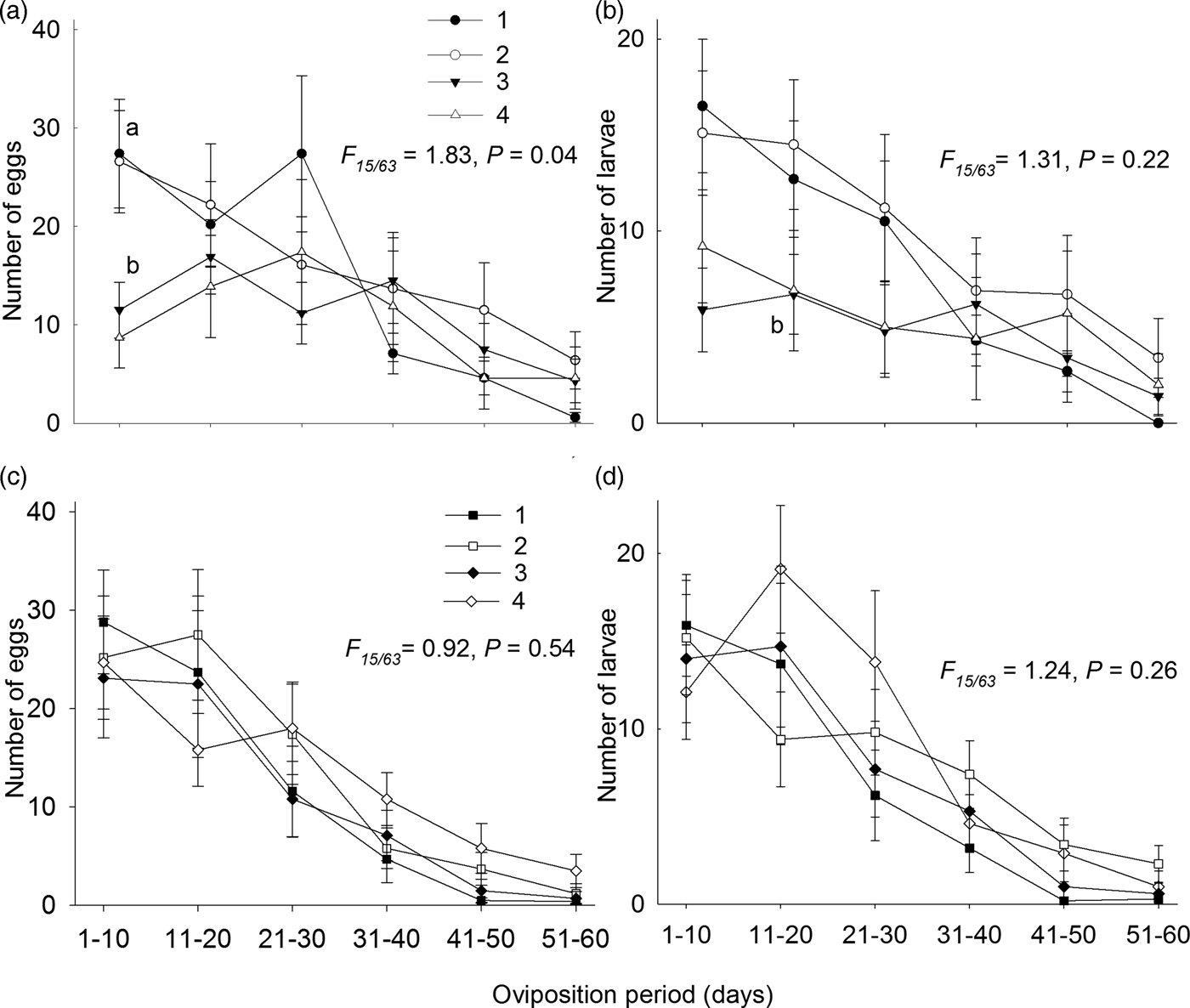
Test 1. Females that mated once or mated ten times with the same male laid significantly more eggs only in the first 10 days of oviposition than females mated with ten different previously experienced males or ten different virgin males (Wilks’ λ = 0.37, F 15/63 = 1.83, P = 0.04). This effect was not observed for fertility (=egg viability) (Wilks’ λ = 0.47, F 15/63 = 1.31, P = 0.22). Over time, there was a similar and significant reduction in both fecundity and fertility for all treatments (fecundity: Wilks’ λ = 0.25, F 5/23 = 13.32, P = 0.0001; fertility: Wilks’ λ = 0.24, F 5/23 = 14.0, P = 0.0001) (fig. 5).
Reproductive parameters (means ± SE) of Tenuisvalvae notata females. Number of eggs (A) and number of larvae (B) subjected to different treatments as follows: (1) female mated with a virgin male (closed circles); (2) female mated ten times with the same male (open circles); (3) female mated ten times with alternated previously mated males (closed triangles); (4) female mated ten times with different virgin males (open triangles). Number of eggs (C) and number of larvae (D) were subjected to different treatments as follows: (1) virgin males (closed square); (2) once-mated males (open square); (3) twice-mated males (closed diamond); (4) thrice-mated males (open diamond). Results for 60 consecutive days after mating, presented in 10 days intervals. Means (±SEM) with different letters were significantly different (Tukey's HSD test, α = 0.05) among treatments within the same period of evaluation.

Test 2. There was no significant effect of male mating history on female fecundity (Wilks’ λ = 0.58, F 15/63 = 0.92, P = 0.54) or fertility (Wilks’ λ = 0.49, F 15/63 = 1.24, P = 0.26). Similar to test 1, fecundity and fertility showed significant declines over time (fecundity: Wilks’ λ = 0.17, F 5/23 = 21.65, P = 0.0001; fertility: Wilks’ λ = 1.18, F 5/23 = 20.50, P = 0.0001) (fig. 5).
Male mating history affected most of the progeny developmental parameters measured (table 2). Embryonic development period was significantly higher (2.86 days) for those laid by females mated with thrice-mated males, in comparison to eggs laid by females mated with once-mated or twice-mated males; however, it was similar to females mated with virgin males. Larval developmental time was longer for offspring of once-mated (3.75 days) and twice-mated (3.70 days) males. There was no effect of male mating history on pupal development, and time of mating between couples (F 3/39 = 0.42, P = 0.73), which averaged 68.82 s; nor was there any effect of male mating history on offspring sex ratio, which was 1 : 1 in all treatments. Finally, there was a significant effect of male mating history on the weight of adult offspring. Descendant females were heavier when they originated from mating with virgin males, whereas descendant males were heavier when originated from mating with thrice-mated males (table 2).
Mean values (±SEM) of various developmental parameters for Tenuisvalvae notata offspring (n = 10) resulting from different male mating histories.

† Means followed by the different letters within the lines are significantly different (Tukey's HSD test, α = 0.05).
Discussion
According to Darwin's theory of sexual selection, males usually court females, and females often choose the most profitable male to engage in sex. Later, Parker (Reference Parker and Bateson1983) added that females are more likely to choose attractive males with morphological embellishments or those capable of offering some kind of benefits through sex, such as nuptial gifts. In contrast, when there is time restriction for copulation or the variability of male sexual traits is small, copulation may be random and females less choosy. In fact, the ladybird beetle T. notata is polygynandrous, adults have little sexual dimorphism, and males do not offer any kind of nuptial gifts that could be attractive for females. In addition, T. notata have a very long adult lifespan and probably widespread dispersal of both sexes, and vast variation in age classes of natural populations. Thus, these facts would make it unlikely that strong preferences for a prior partner would ever occur in nature, and partner choice would be random, depending on the natural encounter of partners.
Interestingly, we found some indication of preference for sexual partners in T. notata independent of sex, with beetles choosing more often to copulate with partners with whom they had previous sexual interaction. This finding is not completely clear yet, since we did not consider mating status and familiarity in our experimental design. Therefore, further investigation is necessary to clarify this result. Alternatively, if there were some kind of preference in T. notata, this would be a female preference toward virgin males, because of the costs involved in the production of seminal fluid, which may include not only sperm but also some non-sperm components that may affect female fitness (Parker et al., Reference Parker, Lessells and Simmons2013; Parker & Birkhead, Reference Parker and Birkhead2013). Moreover, females would select males indirectly by the quality of the seminal fluid, or the most ‘sexy’ males, which would in turn result in a better reproductive performance (Fisher et al., Reference Fisher, Double, Blomberg, Jennions and Cockburn2006; Kvarnemo & Simmons, Reference Kvarnemo and Simmons2013). Even though we have not measured sperm production or quality of components in our study, it would be expected that virgin males would have a greater contribution to fecundity and fertility, help a faster progeny development, and increase survival and genetic variability of the offspring in comparison to previously mated coccinellid males (Perry & Rowe, Reference Perry and Rowe2010; Michaud et al., Reference Michaud, Bista and Omkar2013).
We expected that female fecundity and fertility would increase with multiple mating. However, we found that when females mated only once or with the same male at 10 days intervals, they had a higher fecundity at least in the first days of oviposition in comparison with females given multiple mating with different partners, virgin or previously mated ones. Although our study did not examine these factors, other researchers (Dunn et al., Reference Dunn, Sumner and Goulson2005; Gay et al., Reference Gay, Hosken, Eady, Vasudev and Tregenza2010) have pointed out that having multiple sexual partners probably increases risks associated with injuries and transmitted diseases, a trade-off that could reduce any potential benefits associated with polygamy.
Regarding possible adult age effects on T. notata fitness, we supposed that aging, at least for adults about 100 days old, would not be an important factor in its sexual behavior and reproduction. T. notata adults have an impressive longevity, more than 450 days under optimal food and environmental conditions (Dreyer et al., Reference Dreyer, Neuenschwander, Baumgärtner and Dorn1997); hence, in colonies with overlapping generations of adults, mating would very likely occur among insects of different ages. As expected, age did not affect mating behavior of T. notata males and females or latency between successive mating. Similar results have been found for the ladybird beetle Propylea dissecta (Mulsant) (Pervez et al., Reference Pervez, Omkar and Richmond2004). On the other hand, adult age had a significant impact on T. notata females’ fecundity and fertility in the first days of oviposition, a difference that disappeared toward the end of the observation period (60 days after mating). Younger T. notata females (5–10 days old) deposited a higher proportion of fertile eggs than older females (95–100 days old), when mated with males of the same age group, respectively. Other researchers have postulated that male aging may have an impact on male virility, which naturally declines with cellular senescence (Omkar et al., Reference Omkar, Singh and Mishra2010). Therefore, the age of males may affect female reproductive success by sperm aging. Additionally, Mirhosseini et al. (Reference Mirhosseini, Michaud, Jalali and Ziaaddini2014) note that this only occurs when males are deprived of mating for a long period before reproduction starts. This was exactly the case in our study, since old males used in experiments were virgins for up to 95–100 days before first mating. In fact, when males copulated multiple times, this difference disappears, which is a condition closer to what likely happens in nature, because it seems unlikely that a male would retain its virgin status for 100 days in nature.
Regarding the effects of multiple mating on females’ survival, we expected that polygynandrous females would live longer than once-mated females, possibly due to the acquisition of nutritional benefits from seminal fluid obtained through multiple mating. In some insect species, benefits may accrue through male offering spermatophores or nuptial gifts during courtship and copulation (Michaud et al., Reference Michaud, Bista and Omkar2013; Jiaqin et al., Reference Jiaqin, Yuhong, Hongsheng, Ping, Congshuang and Hong2014; Colares et al., Reference Colares, Michaud, Torres and Silva-Torres2015). In contrast, our results showed that for T. notata this is not the case. Clearly, males of T. notata do not offer any kind of spermatophore or nuptial gift besides seminal fluid. Furthermore, we feel it is likely that females may have limited capacity in their spermathecae that does not allow the storage of extra material from multiple mating. Perhaps this presumed morphological limitation may even impose sperm competition, a fact that is already under investigation in another study involving T. notata reproductive apparatus.
It is generally acknowledged that in insects, there is a trade-off between reproduction and longevity. For example, lower reproductive success and reduced longevity after mating multiple times have been shown for female Callosobruchus maculatus (Fabricius) and Drosophila melanogaster (Loew), respectively (Hollander & Gwynne, Reference Hollander and Gwynne2009; Dowling et al., Reference Dowling, Williams and Garcia-Gonzalez2014). Individuals that invest more energy in reproduction usually have a reduction in longevity in comparison to those that invest less in reproduction (Mirhosseini et al., Reference Mirhosseini, Michaud, Jalali and Ziaaddini2014). Additionally, it is expected that with an increase in oviposition period, as in synovigenic insects such as many parasitoid species, longevity would also be extended, as those insects do not concentrate oviposition in the first days after emergence. In T. notata regardless of female age, the number of mating was the most important factor affecting their longevity, which was reduced approximately by half for those that mated multiple times; this difference was even more pronounced for older multiple-mated females. In T. notata, females that mated only once were still able to lay fertile eggs for 60 days. In female insects, longevity reduction can be directly due to mating, such as from toxic substances present in male ejaculates (Arnqvist & Nilson, Reference Arnqvist and Nilsson2000), or a higher metabolic rate and oxidative stress caused by the energy expenditure during courtship and mating, which can also induce faster aging in insects (Monaghan et al., Reference Monaghan, Charmantier, Nussey and Ricklefs2008; Dowling et al., Reference Dowling, Williams and Garcia-Gonzalez2014).
Against our expectations, T. notata males did not suffer any decline in longevity after multiple mating. Similar results have been found for Cheilomenes sexmaculata (Omkar & Mishra, Reference Omkar and Mishra2005) and P. dissecta (Mishra & Omkar, Reference Mishra and Omkar2006). This result might be explained by the ability of T. notata males to replenish seminal material between mating, a possibility that requires further investigation, and/or because mating duration is short (about 84 s). Since T. notata females initiate courtship, this could reduce the energetic costs associated with sexual behavior for males.
Male mating status had no effect on females’ fecundity and egg viability in all treatments. Therefore, we can assume that whether they are once-, twice-, or thrice-mated, males are able to transfer similar amounts of sperm per copulation, based on the mean number of mating per day (2.83) per couples. Additionally, females’ storage capacity of sperm may be limited as previously discussed. In contrast to our findings, female fecundity and fertility were affected by male mating status in A. bipunctata (Linnaeus), which males were unable to transfer spermatophores after successive mating (Perry & Tse, Reference Perry and Tse2013). Additionally, in Coccinella transversalis (Fabricius) and Coccinella septempunctata (Linnaeus), the reduced amount and quality of seminal fluid transferred by successive mating affected female fitness (Michaud et al., Reference Michaud, Bista and Omkar2013).
Fecundity and egg viability were higher in the first days after mating for all treatments. Several plausible, non-exclusive explanations exist. One is simply that after this period, sperm material starts to decline. Another possibility is sperm precedence, in which sperm from the most recent, male to copulate with a female could displace the sperm previously deposited by earlier partners (Wang et al., Reference Wang, Michaud, Zhang, Zhang and Liu2009; Hotzy et al., Reference Hotzy, Polak, Rönn and Arnqvist2012; Chaudhary et al., Reference Chaudhary, Mishra and Omkar2016), and for this to be proven in T. notata, we would have to look at male genitalia morphology, as well as sperm competition within the spermatheca and check for progeny paternity. Still another possibility is that males, being unable to prevent future female mating, might use allomones to induce earlier onset of oviposition (Colares et al., Reference Colares, Michaud, Torres and Silva-Torres2015).
We expected a negative effect on developmental parameters, such as reduced size and weight, and longer developmental time, for descendants of multiple-mated males in comparison to those descended from mating with virgin males, but found none. Studies involving the coccinellids Cryptolaemus montrouzieri (Mulsant) and Eriops connexa (Germar) also have found no effects of male mating history on progeny developmental parameters (Kaufmann, Reference Kaufmann1996; Colares et al., Reference Colares, Michaud, Torres and Silva-Torres2015). As noted by others (Gillott, Reference Gillott2003; Avila et al., Reference Avila, Sirot, LaFlamme, Rubinstein and Wolfner2011; Mirhosseini et al., Reference Mirhosseini, Michaud, Jalali and Ziaaddini2014; Colares et al., Reference Colares, Michaud, Torres and Silva-Torres2015), offspring development can be influenced by many genetic, hormonal, and environmental factors not directly related to a species sexual system.
We conclude that T. notata can be monogamous if given a chance, choosing to mate with the same known partner. Additionally, the longevity of females mating multiple times was greatly reduced, and the reproductive output of monogamous couples did not differ from polygynandrous ones. Maybe polygynandry is maintained in this species because they are naturally long lived; it also serves to increase the genetic variability of the progeny and mitigate fitness loss that would result from a single mating with a low-quality or infertile male (Fox & Rauter, Reference Fox and Rauter2003).
Acknowledgements
To Janice R. Matthews (University of Georgia, USA) for her helpful editorial comments on the manuscript. To Coordenação de Aperfeiçoamento de Pessoal de Nível Superior (CAPES), for a scholarship offered to the first author. This work was supported by the National Counsel of Technological and Scientific Development (No. 478739/2013).