On a global scale populations are aging, the prevalence of chronic diseases is on the rise and healthcare budgets are strained. One of the most common chronic diseases is chronic heart failure (CHF) with 1–2 percent prevalence and a 1–2 percent toll on healthcare budgets of the developed countries (Reference Benatar, Bondmass, Ghitelman and Avitall1). Telehealth, being the use of telecommunication technologies in healthcare, is about to emerge as one of the tools to help solve the ever-increasing number of people suffering from chronic diseases. In the current healthcare climate where a quarter of countries worldwide have a telehealth policy in place (2), we need to know to what extent telehealth is an effective solution in addressing the rise in chronic diseases, and moreover whether it is a cost-effective solution.
The Whole System Demonstrator program (Reference Steventon, Bardsley and Billings3), the largest randomized control trial of telehealth and telecare in the world, has reinforced the knowledge how telehealth improves clinical outcomes, but our understanding of the impact on costs of such technology is vague. The limited evidence from systematic reviews indicates some promising results in the field of chronic heart failure. Klersy et al. (Reference Klersy, De Silvestri and Gabutti4) performed a meta-analysis of 21 randomized controlled trials (RCTs) where economic modeling was used to bridge the gap of economic data. They have showed for the first time that the management of congestive heart failure by telemonitoring is cost-saving. The cost-savings were linearly related to the implementation rate of remote patient monitoring, due to the savings in hospitalizations. They believe that “the scientific community should acknowledge the lack of prospectively and uniformly collected economic data and should request new studies incorporating full economic analyses.” Inglis et al. (Reference Inglis, Clark, McAlister, Stewart and Cleland5) have found comprehensive evidence, in their systematic review of the outcomes of structured telephone support or telemonitoring, that telehealth interventions are effective and cost-effective in CHF management. Of twenty-five studies, eleven studies reported the effect of the intervention on the cost of care, and all but three reported on reduced costs.
The cost and cost-effectiveness of telehealth is becoming increasingly important in policy-making and reimbursement schemes (Reference Kobb, Chumbler, Brennan and Rabinowitz6). It seems historically neglected within this field, but cost-effectiveness will play a critical role in implementation of future services and technologies. Telehealth in fact contains a promise to tackle the rising costs in healthcare, but its own cost is not fully apprehended. If proved cost-effective, it is very likely that telehealth will be more readily adopted and used.
The aim of our research is to assess the methodological quality and results of economic evaluations of telehealth for patients with chronic heart failure and to provide guidance in devising a full economic analysis in telehealth.
THEORETICAL CONSIDERATIONS
A full economic evaluation must include both inputs and outputs, usually called costs and consequences (Reference Drummond, Sculpher, Torrance, O'Brien and Stoddart7). If only costs, or only consequences, are examined the study is referred to as a partial evaluation. Considering at least two alternative solutions is perceived important as it allows others to “a) judge the applicability of the program to their own settings, b) understand if any cost or consequence has been omitted from the analysis, c) potentially replicate the study” (Reference Drummond, Sculpher, Torrance, O'Brien and Stoddart7). A full economic analysis thus presents choices between two or more competing alternatives, in our case costs and consequences of usual care and a telehealth intervention. One can argue that when the effectiveness is equal for alternatives it is sufficient to focus on differences in costs and to perform a so-called “cost-minimization analysis.”
Cost analyses can be found in the literature. They deal with resources used to deliver the intervention and evaluate the costs of opportunities lost (the value of the best alternative forgone by the investment), although these cannot be considered a full economic evaluation. The most common full economic evaluations in telehealth are cost-effectiveness analysis and cost-benefit analysis (Reference Dávalos, French, Burdick and Simmons8). Cost-effectiveness analysis compares monetary investments of at least two interventions and a common nonmonetary outcome (e.g., life-years gained, hospital days prevented, clinical parameters). Cost-benefit analysis is the most comprehensive economic evaluation as it compares economic cost with monetized economic benefits. It aims at analyzing if the intervention is economically justified and better than the competing alternative (Reference Drummond, Sculpher, Torrance, O'Brien and Stoddart7).
Telehealth is seen as an innovative way of health services delivery, which can empower chronically ill patients in an outpatient setting. Telehealth entitles a broad set of telecommunication solutions which allow for health related activities between parties involved and over a distance. It is the field that includes all other sub-fields, interchangeably named in the scientific literature as telemedicine, telecare and telemonitoring. The World Health Organization (9) provides the mainstream definition of telemedicine as “the delivery of healthcare service, where distance is a critical factor, by all healthcare professionals using information and communication technologies for the exchange of valid information for diagnosis, treatment and prevention of disease and injuries, research and evaluation, and for the continuing education of healthcare providers, all in the interest of advancing the health of individuals and their communities.”
Chronic heart failure (CHF) is a deterioration of pumping function of the heart accompanied by typical signs or symptoms, such as shortness of breath or fatigue. Chronic Heart Failure is a severe disease that has 3-year mortality rate of approximately 60 percent (Reference Khand, Gemmel, Clark and Cleland10). After a person is admitted to a hospital with CHF, there is a one in four chance of patient's re-hospitalization or death within 12 weeks (Reference Cleland, Swedberg and Follath11). One of the causes for the re-hospitalization of CHF patients is worsening of the disease as a result of nonadherence to treatment. The “usual care” for CHF abides to the international and national guidelines.
METHODS
Retrieval of Studies and Data Extraction
We searched for key papers published in English since 1999, presenting economic data in telehealth trials for CHF. We considered the time frame of 12 years to be optimal, as “the interest in telemedicine increased dramatically in the 1990s”, followed by an increased interest in economic evaluation of medical technologies from newly created National Institute for Health and Clinical Excellence (NICE) in the United Kingdom in 1999 (Reference Perednia and Allen12). We have not distinguished between different types of telehealth interventions, because we did not know in advance which properties of telehealth contribute the most to the cost-effectiveness and overall success (Reference Wootton and Hebert13).
We used The Scientific & Technical Information Network (STN), a database from FIZ Karlsruhe and Chemical Abstracts Service, Columbus/Ohio (14), which provides access to an integrated network of the most important and comprehensive scientific databases, including MEDLINE, EMBASE, and WOK. The subject of our search had three topics: chronic heart failure, cost and telehealth. For each of the three topics, we defined the queries (with similar keywords) and combined them in a final query (Table 1).
Detailed query list for the literature search

Papers were selected based on title and abstracts reading (double reading by A.G. and J.S. and mediation by H.V. in case of a disagreement). The abstract/title exclusion criteria were: (a) telehealth not as the main intervention, (b) heart failure not the main disease, (c) full economic analysis not present, and (d) not a primary study (i.e., review, letter to the editor, opinion, commentary). References of the retrieved papers (J.v.N.) were checked (“snowballed”) to certify if all relevant articles have been selected.
Full papers were scrutinized (A.G.) using a data extraction form based on a modified Cochrane Collaboration Summary Table (15). We supplemented the extraction form with an entry on “frequency of contact” as this is of interest to the economic evaluation for the purpose of costing.
Data were mined in accordance to the recommendations from the Cochrane Collaboration and summarized on all important domains: source/disease, methods, participants, intervention, outcomes, and results/costs (15). We divided the outcomes in three categories: usage related (admission rate/hospitalization, readmissions, length of stay, ER visits, service utilization, etc.), patient related (quality of life, satisfaction of care, mortality, depression, etc.) and cost related (intervention costs, total costs, hospitalization charges, cost of personnel, etc.) outcomes. Both the summary of the studies and the data mining are available at request.
Data Analysis: Appraisal of Economic Evaluation
We collected data on two proxies of the quality of the study design: concerns about bias and participants blinding. For this we followed the instructions from the Cochrane Handbook for Systematic Reviews of Interventions (15). The Handbook presents the tool for assessing the bias in reviews which encompasses six domains: adequate sequence generation, allocation concealment, blinding of participants, addressing incomplete outcome data, selective reporting, and other sources of bias. The tool recognizes “low,” “high,” and “unclear” risk of bias. If one of the domains was marked with “unclear risk,” the whole study was deemed “risk unclear.”
To assess the validity of the economic evaluation, the methodological quality of each paper was assessed according to the 10-item-checklist from Drummond et al. (Reference Drummond, Sculpher, Torrance, O'Brien and Stoddart7). Quality check of the assessment (J.S.) was performed on a random sample of five papers with an overlap of 85 percent with the first author (A.G.).
RESULTS
Search Strategy
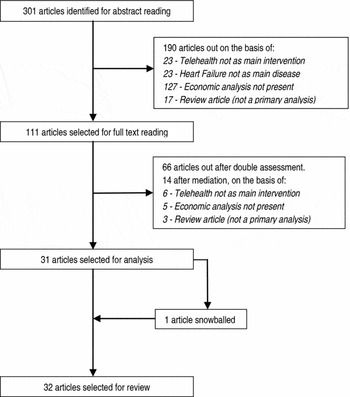
Our search strategy identified 301 publications in total. After abstract assessment phase, 190 papers were excluded. Twenty-seven papers called for the selection mediation after full text reading. In total we included thirty-two articles in our analysis. Three of those articles by Riegel et al. (Reference Riegel, Carlson, Glaser, Kopp and Romero16–Reference Riegel18) described the same intervention and two papers by Wootton et al. (Reference Wootton, Gramotnev and Hailey19;Reference Wootton, Gramotnev and Hailey20) described similar intervention in two consecutive years. Thus, we were able to retrieve thirty-two papers on twenty-nine interventions. The findings from the search process and the exclusion criteria are listed in Figure 1.
The search process and exclusion criteria.

We retrieved twenty-six papers dealing with chronic heart failure only, and six more (Reference Wootton, Gramotnev and Hailey20–Reference Wennberg, Marr, Lang, O'Malley and Bennett25) dealing with CHF and co-morbidities. The study that dealt with the most chronic diseases was by Johnston et al. (Reference Johnston, Wheeler, Deuser and Sousa22) who reported on CHF, chronic obstructive pulmonary disease, cerebral vascular accident, cancer, diabetes, anxiety, and chronic wound care.
Description of the Studies: Design, Participants, and Interventions
Design. Regarding the design, twenty-one papers reported on the RCT design and two on quasi-experimental design (Reference Johnston, Wheeler, Deuser and Sousa22;Reference Myers, Grant, Lugn, Holbert and Kvedar26). One paper each reported on the evaluation of RCT (Reference Wootton, Gramotnev and Hailey20), a stratified randomization design (Reference Wennberg, Marr, Lang, O'Malley and Bennett25), concurrent matched-cohort (Reference Berg, Wadhwa and Johnson27), nonconcurrent prospective design (Reference Chen, Ho and Huang28), prospective cohort study (Reference Heidenreich, Ruggerio and Massie29), cost-effectiveness analysis conducted alongside a randomized trial (Reference Hebert, Sisk and Wang30), pre-post study (Reference Hudson, Hamar and Orr31), matching of the retrospective control data with the observed intervention data (Reference Vaccaro, Cherry, Harper and O'Connell32), and a prospective study (Reference Ho, Hsu and Chen33).
Participants. Twenty-five articles originated from the United States, two from Australia (Reference Wootton, Gramotnev and Hailey19;Reference Wootton, Gramotnev and Hailey20), two from Italy (Reference Giordano, Scalvini and Zanelli34;Reference Scalvini, Capomolla and Zanelli35), one from the United Kingdom (Reference Dar, Riley and Chapman36), one from China (Reference Chen, Ho and Huang28), and one from Taiwan (Reference Ho, Hsu and Chen33). Almost all of the studies were published after the year 2000 except for one (Reference Heidenreich, Ruggerio and Massie29). In most of the studies the mean age of participants was more than 60 years, except in nine (Reference Heidenreich, Ruggerio and Massie20;Reference Wennberg, Marr, Lang, O'Malley and Bennett25;Reference Hebert, Sisk and Wang30;Reference Hudson, Hamar and Orr31;Reference Ho, Hsu and Chen33–Reference Scalvini, Capomolla and Zanelli35;Reference Copeland, Berg, Johnson and Bauer37;Reference Dunagan, Littenberg and Ewald46). In terms of sex, all studies had mixed populations, where percentage of females ranged just above 1 percent, in a study done by the US Department of Veterans Affairs (Reference Copeland, Berg, Johnson and Bauer37), to 63 percent (Reference Benatar, Bondmass, Ghitelman and Avitall1). All of the studies explicitly stated the home (outpatient) setting except for one (Reference Wootton, Gramotnev and Hailey19).
Interventions. Fifteen studies described a telephone case management, seven a combination of telephone case management and telemonitoring (Reference Benatar, Bondmass, Ghitelman and Avitall1;Reference Noel, Vogel, Erdos, Cornwall and Levin23;Reference Myers, Grant, Lugn, Holbert and Kvedar26;Reference Hudson, Hamar and Orr31;Reference Giordano, Scalvini and Zanelli34;Reference Scalvini, Capomolla and Zanelli35;Reference Smith, Hughes-Cromwick, Forkner and Galbreath38), and another seven described only telemonitoring intervention (Reference Heidenreich, Ruggerio and Massie29;Reference Vaccaro, Cherry, Harper and O'Connell32;Reference Dar, Riley and Chapman36;Reference Galbreath, Krasuski and Smith39–Reference Tompkins and Orwat42). Three studies reported on video visits: one on bare video conferencing (Reference Finkelstein, Speedie and Potthoff21), one on video visits accompanied by telephone “visits” (Reference Jerant, Azari and Nesbitt43), and one on video system that included peripheral equipment for assessing cardiopulmonary status in combination with in-person and telephone contact (Reference Johnston, Wheeler, Deuser and Sousa22). Of all the papers, only two reported on two distinct intervention arms. Finkelstein et al. (Reference Finkelstein, Speedie and Potthoff21) had two intervention groups, first receiving video visits and the second monitoring equipment. Smith et al. (Reference Smith, Hughes-Cromwick, Forkner and Galbreath38) reported on a two-arm intervention in addition to the comparison group. Subjects in the intervention arm were assigned a disease manager, a registered nurse who performed patient education and medication management with the patient's primary care provider, while subjects in the augmented disease management group received in-home devices for enhanced self-monitoring.
In most studies a specialized nurse case management and nurse contact was reported (others reported on use of disease managers and physicians). In all studies, the telehealth intervention also included some form of health education. In most cases a nurse specialist supervised automatic patient data transmission by means of telemonitoring devices and provided telephone support and education. Majority of studies provided a detailed description of the content of the intervention. Four studies did not provide details of the comparison group (Reference Wennberg, Marr, Lang, O'Malley and Bennett25;Reference Ho, Hsu and Chen33;Reference Copeland, Berg, Johnson and Bauer37;Reference Tompkins and Orwat42), where the rest was mostly the usual care for chronic heart failure patients. Seven studies provided details on the usual care group, receiving traditional home health care for a similar time period. Capomolla et al. (Reference Capomolla, Pinna and Larovere44), in their study, compared home monitoring to “usual care” (i.e., referring a patient to a community primary care physician and cardiologist at the discharge). During the follow-up period patients were managed by different providers applying a range of strategies: emergency room management, hospital admissions, and outpatients access.
The frequency of contact ranged from once per day, up to once per quarter. Six studies reported daily interaction (Reference Myers, Grant, Lugn, Holbert and Kvedar26;Reference Hudson, Hamar and Orr31;Reference Vaccaro, Cherry, Harper and O'Connell32;Reference Dar, Riley and Chapman36;Reference Schwarz, Mion, Hudock and Litman40;42), five intermittent interactions (16–18;22;24), five reported a median of five interactions (Reference Wennberg, Marr, Lang, O'Malley and Bennett25;Reference Berg, Wadhwa and Johnson27;Reference Ho, Hsu and Chen33;Reference Scalvini, Capomolla and Zanelli35;Reference Copeland, Berg, Johnson and Bauer37), four weekly interactions (Reference Heidenreich, Ruggerio and Massie29;Reference Giordano, Scalvini and Zanelli34;Reference Laramee, Levinsky, Sargent, Ross and Callas45;Reference Dunagan, Littenberg and Ewald46), and two studies weekly interactions spreading to monthly (Reference Galbreath, Krasuski and Smith39;Reference Kasper, Gerstenblith and Hefter47). One study each reported on a two times per week interaction (Reference Finkelstein, Speedie and Potthoff21), three times per week and decreasing (Reference Benatar, Bondmass, Ghitelman and Avitall1), biweekly (Reference Chen, Ho and Huang28), and quarterly contact (Reference Hebert, Sisk and Wang30). Six studies did not specify the frequency of contact (Reference Wootton, Gramotnev and Hailey19;Reference Wootton, Gramotnev and Hailey20;Reference Noel, Vogel, Erdos, Cornwall and Levin23;Reference Smith, Hughes-Cromwick, Forkner and Galbreath38;Reference Soran, Feldman and Piña41;Reference Jerant, Azari and Nesbitt43). The length of intervention was 2, 3, 6, 12, and 18 months predominantly. One study (Reference Copeland, Berg, Johnson and Bauer37) reported on a 1-year preintervention data collection period and a 1-year intervention and follow-up period (totaling to 24 months), one on 17 months in total (Reference Johnston, Wheeler, Deuser and Sousa22), one on 11 months period (Reference Ho, Hsu and Chen33), and one ranging from 11 days to 10.9 months (Reference Heidenreich, Ruggerio and Massie29).
Methodological Quality and Bias of Design
Regarding the bias, sixteen studies did not report any concern, fourteen provided caveats and two were explicit about no concerns at all (Reference Ho, Hsu and Chen33;Reference Dunagan, Littenberg and Ewald46). This finding called for meticulous exploration of the possible induced bias. In the summary assessment (across domains) we ascertained unclear risk of bias for the grand majority of the papers, 24 of them, low risk of bias for seven studies and high risk of bias for one study by Finkelstein et al. (Reference Finkelstein, Speedie and Potthoff21). Results are summarized in the Supplementary Table 1, which can be viewed online at http://dx.doi.org/10.1017/S0266462313000779.
Twenty studies did not provide information on blinding, six studies reported on blinding procedure (Reference Wootton, Gramotnev and Hailey19;Reference Wootton, Gramotnev and Hailey20;Reference Hebert, Sisk and Wang30;Reference Dar, Riley and Chapman36;Reference Dunagan, Littenberg and Ewald46;Reference Kasper, Gerstenblith and Hefter47), three explicitly said no blinding was attempted (Reference Noel, Vogel, Erdos, Cornwall and Levin23;24;Reference Laramee, Levinsky, Sargent, Ross and Callas45) and three studies reported on partial blinding (Reference Riegel, Carlson, Glaser, Kopp and Romero16;Reference Riegel, Carlson, Glaser and Romero17;Reference Soran, Feldman and Piña41). Soran et al. (Reference Soran, Feldman and Piña41) confirm that “because of the nature of the intervention, both patients and the primary research teams could not be blinded. . . [which] might have introduced bias into the trial”. To address the issue of bias by the study design, authors blinded the staff to group assignments and the adjudication of events was carried out by an independent committee.
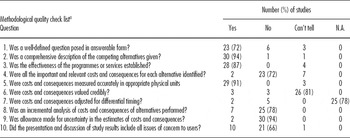
Regarding the methodological quality of the studies, our analysis show that the major deficiencies were in identifying relevant costs and consequences for each alternative (71.9 percent of the studies), lack of incremental analysis (78.1 percent) and issues regarding the uncertainty of the analysis (93.7 percent). The overview is presented in Table 2.
Overview of the methodological quality of the studies

aDerived from Drummond, Sculpher, Torrance, O'Brien, & Stoddart (Reference Drummond, Sculpher, Torrance, O'Brien and Stoddart7)
Limitations
Dávalos et al. (Reference Dávalos, French, Burdick and Simmons8) suggested that there are many limitations to performing an economic evaluation in telehealth. We used their research to address the reported issues in our batch of retrieved publications. The authors of the reviewed studies have listed following as the main challenges: limited generalizability (Reference Wennberg, Marr, Lang, O'Malley and Bennett25;Reference Hebert, Sisk and Wang30;Reference Giordano, Scalvini and Zanelli34;Reference Copeland, Berg, Johnson and Bauer37;Reference Smith, Hughes-Cromwick, Forkner and Galbreath38;Reference Dunagan, Littenberg and Ewald46), disparate estimation methods (Reference Galbreath, Krasuski and Smith39), few completed cost-benefit analysis (Reference Wootton, Gramotnev and Hailey20;Reference Noel, Vogel, Erdos, Cornwall and Levin23;Reference Peikes, Chen, Schore and Brown24;Reference Giordano, Scalvini and Zanelli34;Reference Copeland, Berg, Johnson and Bauer37;Reference Jerant, Azari and Nesbitt43), lack of randomization (26;28;29;31;33;37;47), lack of long-term evaluation studies (23;28;30;31;33;36;38), absence of quality data and appropriate measures (20;26;29;30;34;38–41;45), and small sample sizes (1;21;23;31;36;46).
Valuation of Costs and Consequences
The majority of the studies were RCTs where the researchers considered the comparison of two alternatives. Although some questions were not well specified, they solicited the answer to whom the intervention was effective and in comparison to what. Thus more than 70 percent of the studies posed a well-defined question in an answerable form. However, most of them did not consider the “ripple effect” when stating their viewpoint of the analysis, and the (potentially) far reaching consequences to society were not considered.
In 87.5 percent of the studies, the effectiveness of the intervention was established. In other words, a telehealth intervention indeed brought improvement in outcomes of chronic disease management. Almost every study provided a comprehensive description of the competing alternatives but none considered the “do-nothing” alternative.
More than 70 percent of the studies did not take into account expenses in one of the following categories: healthcare sector, other sectors, patient/family expenses or productivity losses. As a positive example, Wennberg et al. (Reference Wennberg, Marr, Lang, O'Malley and Bennett25) estimated the total cost and not just the marginal cost. They included salaries and benefits, training expenses, amortized capital expenditures, data and coaching operations, fulfilment, and overhead. The same study provides an exhaustive list of resources used and costs according to each cohort group. However, they did not provide an explanation of the allocation of shared costs (overhead) to services or programs, which is a common omission in economic evaluations. None of the studies analyzed a shift of costs, from specialist to heart failure nurse to general practitioner, for instance.
The biggest problem we encountered in this overview is with the valuation of costs and consequences. In more than 80 percent of the studies the sources and methods of the evaluation were not clear. Authors mostly focused on direct costs and benefits (i.e., resources in the healthcare sector) while omitting indirect costs (i.e., productivity gains and losses) and intangible costs (consequences that are hard to value, like relief from pain, lost leisure time for patient or family, etc.). The sources of all values could potentially include market values, patient, policy-makers’ or health professionals’ perspectives. However, most of the studies did not provide necessary viewpoint of the analysis. In addition, the market values were not used for resources gained or depleted, or there is no account of this being performed. Principally, the costs that were missing across majority of the studies are those of the intervention overheads, training of personnel, and patient related costs (travel, productivity loss, etc.).
In 78 percent of the studies adjustment for differential timing was not applicable due to the time horizon shorter than one year. In the remaining studies however the costs and consequences were not adjusted for differential timing. For instance, Smith et al. (Reference Smith, Hughes-Cromwick, Forkner and Galbreath38) run the intervention for eighteen months but did not discount the costs in respect to the elected time horizon.
In 78 percent of the studies the incremental analysis was not the basis of the evaluation. From the ones that did perform the incremental analysis, Hebert et al. (Reference Hebert, Sisk and Wang30) provided the best methodological clarity. In the same study, which ranked the highest in our methodological quality assessment, the allowance for uncertainty in the estimates of costs and consequences was made.
On the account if study results included all issues of concern to users, our sample was overly negative (65.6 percent). The conclusions of the studies were rarely based on some index or ratio of costs to consequences. There was barely a discussion on generalizability of the results and usefulness for the reader. The implementation issues, such as the feasibility of adopting the preferred program (given existing financial or other constraints) and whether any freed resources could be redeployed to other worthwhile programs, were seldom discussed.
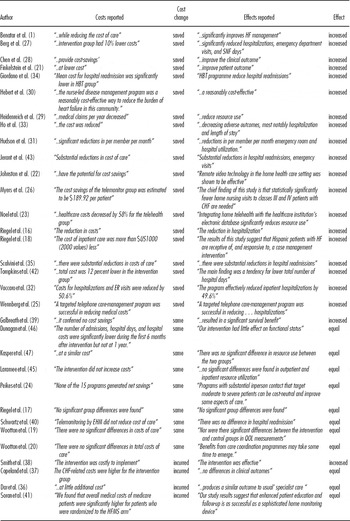
We tried to explore the two dimensions of interest for cost-effectiveness of telehealth: costs and effects in terms of patient outcome. Presented in the cost-effectiveness plane, introduced by Black (Reference Black48), the cost-effective intervention sits in the south-east quadrant and is called “dominant.” Results of our review suggest that nineteen authors, of thirty-two, reported on a dominant intervention (saved costs with increased effectiveness). Eight authors reported same costs and equal effectiveness and three incurred costs with equal effectiveness. One author reported on an intervention with same costs and increased effectiveness (Reference Galbreath, Krasuski and Smith39) and one on incurred costs but increased effectiveness (Reference Smith, Hughes-Cromwick, Forkner and Galbreath38). The overview is presented in Table 3.
Reported costs and effects

Note: arranged by cost change and effect (alphabetically within groups)
DISCUSSION
We presented a review of thirty-two studies reporting on cost-effectiveness of telehealth in chronic disease management of heart failure patients. The studies suggest that telehealth is cost-effective for management of CHF patients. Nineteen studies reported on cost savings, nine on costs being the same during and after the intervention and four on incurred costs. Majority of the retrieved studies (Reference Finkelstein, Speedie and Potthoff21 of Reference Vaccaro, Cherry, Harper and O'Connell32) reported on improved outcomes after the intervention, thus supporting the hypothesis that telehealth is more effective than the usual chronic disease management care - and saves costs. However, we performed a qualitative evaluation of the outcomes without analyzing the magnitude of the effects, or costs incurred. The interventions and outcomes in these reviews were diverse and sometimes incomparable. The economic aspect of telehealth was present in all of the studies, but in different forms. The methodological quality was considered to be low.
The results are consistent with other reviews and meta-analysis. Inglis et al. (Reference Inglis, Clark, McAlister, Stewart and Cleland5) performed a systematic review and found three out of eleven studies reporting on reduction in costs with application of telemonitoring and telephone contact in CHF, while Klersy et al. (Reference Klersy, De Silvestri and Gabutti4) showed in a meta-analysis of 21 RCTs that management of CHF patients by telemonitoring is cost saving, mainly because of reduction in number of hospitalizations. They have, in the same light as we, expressed some concerns due to great variety in reviewed studies.
Limitations of the Study
Our review has some limitations. First, in respect to assessing the abstracts and full texts we used a double-reading technique and solved disputes by inviting third author to mediate. In the methodological assessment phase we decided that the main author should assess all of the articles and the second author should assess the random sample of five studies. The overlap of 85 percent or more was deemed as unbiased. Second, data mining, extraction, and analysis was performed by the main author only and could potentially be flawed. Much of it is subjective and qualitative, and the repeatability debatable. Third limitation is in presenting an overview of the results in absolute rather than relative terms. We sought for a report in change in costs and effects but did not look into the size of the effect. This could potentially bias our judgment as even a slightest improvement in cost-effectiveness was deemed as an “improvement.”
CONCLUSIONS
Although almost 60 percent of the reviewed studies showed that telehealth interventions for CHF patients are cost-effective, based on the analysis of the seven studies with low risk of bias, we believe that cost-effectiveness of telehealth in CHF is not ascertained: four studies reported same costs with equal effectiveness (Reference Riegel, Carlson, Glaser and Romero17;Reference Peikes, Chen, Schore and Brown24;Reference Dunagan, Littenberg and Ewald46;Reference Kasper, Gerstenblith and Hefter47), two incurred costs with equal effectiveness (Reference Dar, Riley and Chapman36;Reference Soran, Feldman and Piña41) and only one on saved costs with increased effectiveness (Reference Riegel, Carlson, Glaser, Kopp and Romero16). Thus, we have reached three conclusions.
First, the evidence from the scientific literature is scarce and thus insufficient for our understanding of the economic aspect of implementing telehealth services. More full economic analyses are needed to reach a sound conclusion.
Second, the quality of evidence in the scientific literature is poor. We sought for studies of decent methodological quality to attain unbiased conclusions. To our surprise we were able to retrieve only a handful of papers that could withstand rigorous methodological check.
Third, there is a difficulty in capturing all of the consequences/effects of telehealth intervention. Thus the cost-effectiveness evidence for specific implementations in the field of telehealth is limited. As suggested by some authors (Reference Dávalos, French, Burdick and Simmons8), problems with telehealth interventions reside in absence of quality data and appropriate measures. The quality of economic data is especially questionable.
POLICY IMPLICATIONS
We cannot conclude whether telehealth interventions in CHF are cost-effective or cost-ineffective: papers are heterogeneous and of poor methodological quality. Still, there is a political need for strong evidence. A possible short-time solution is to get evidence based on cost-consequence principles. The cost-effectiveness framework for telehealth needs valid cost-effectiveness modeling to assess the full long-term impact of telehealth interventions.
SUPPLEMENTARY MATERIAL
Supplementary Table 1: http://dx.doi.org/10.1017/S0266462313000779
CONTACT INFORMATION
Andrija S. Grustam, MD, MSc, MPH (grustam@bmg.eur.nl), Research Scientist, Institute of Health Policy and Management, Erasmus University Rotterdam, Rotterdam, The Netherlands; Care Management Solutions, Philips Research, Eindhoven, The Netherlands
Johan L. Severens, PhD, Professor of Evaluation in Health Care, Institute of Health Policy and Management, Erasmus University Rotterdam, Rotterdam, The Netherlands
Jan van Nijnatten, MSc, Information Architect, R-IT CIS, Philips Research, Eindhoven, The Netherlands
Ron Koymans, PhD, Principal Architect, Care Management Solutions, Philips Research, Eindhoven, The Netherlands
Hubertus J. M. Vrijhoef, PhD, Professor and domain leader Health Systems & Policy, Saw Swee Hock School of Public Health, National University of Singapore, Singapore
CONFLICTS OF INTEREST
Andrija Grustam has received support for travel to meetings and payment for writing the manuscript from Philips. Johan Severens has received a consulting fee to his institution from Philips. The other authors report they have no potential conflicts of interest.