Atrial septal defect is one of the most common CHDs. Most of the patients have no symptoms and diagnosis is delayed.Reference Geva, Martins and Wald1 Early diagnosis and treatment are very important to prevent complications such as pulmonary hypertension, right heart failure, and atrial arrhythmias.Reference Kaya, Baykan and Dogan2 In patients with atrial septal defect, the volume overload in right heart causes prolongation in atrial activation time and non-homogeneous sinus impulses by changing geometrical and electrical structure of the heart.Reference Chubb, Whitaker and Williams3–Reference Roberts-Thomson, John and Worthley5 All these changes provide a basis for atrial arrhythmia. These electrophysiological changes can be detected by measuring P wave maximum duration and P wave dispersion on electrocardiogram. While P wave maximum duration displays inter-atrial conduction disturbances, P wave dispersion displays non-homogeneous atrial conduction. Regional changes in atrial activation time have various effects in P waves in different locations. So, regional delay in atrial depolarisation may cause heterogeneous P wave duration, in other words it may cause increased P wave dispersion.Reference Baspinar, Sucu, Koruk, Kervancioglu and Ustunsoy6–Reference Dilaveris, Gialafos and Sideris8
The electrophysiological studies in patients with secundum type atrial septal defect show that sinus node dysfunction begins in early childhood.Reference Ho, Chia, Yip and Chan9 One of the indications for closure in secundum type atrial septal defect is to prevent probable atrial arrhythmias. The defect can be closed surgically or by transcatheter method. While transcatheter closure can be performed in only selected secundum type atrial septal defect patients, surgical closure can be performed in all types of atrial septal defects and also in complicated ones. While both methods have similar success rates, in transcatheter method the complication rates and duration of hospital stay are less and patients’ satisfaction is more.Reference Du, Hijazi and Kleinman10–Reference Cowley, Lloyd, Bove, Gaffney, Dietrich and Rocchini14 Surgical repair may cause arrhythmia, pericardial and pleural effusions, complications related to blood transfusion, and incisional scars.Reference Villablanca, Briston and Rodés-Cabau12 In this study, we aimed to evaluate the risk of atrial arrhythmia in patients with secundum type atrial septal defect by measuring P wave dispersion before and after closure, and to observe the effect of surgical and transcatheter closure on P wave dispersion and therefore on the risk of atrial arrhythmia.
Materials and methods
We enrolled two groups as patient and control groups. Sixty-one patients followed up due to repaired secundum type atrial septal defect in Marmara University Pediatric Cardiology Clinics and 30 controls who applied to our clinic for non-specific complaints and had normal echocardiography were investigated. The patient group is also divided into transcatheter and surgical groups according to their repairment method. Demographic findings, signs of physical examination, data of telecardiography, echocardiography, and angiography if present were evaluated from patients’ records, retrospectively. In patient group, before and after closure and in control group at the time of presentation, 12-lead electrocardiography records were evaluated.
Demographic findings
We recorded the age, sex, physical examination findings, blood pressure values, medications, genetic syndromes, and arrhythmias if present, in both patients group before closure and control group.
Telecardiography findings
We investigated telecardiography findings in patients group before closure and in control group at the time of admission. We recorded calculated cardiothoracic ratio, the status of pulmonary vascularity, and congestion.
Echocardiography findings
Echocardiographic examinations were performed using Philips IE33 echocardiography machine equipped with S5-1, S8-3 transducers. We recorded echocardiography findings in patients group before closure and in control group at the time of admission. We investigated dilatation findings in right atrium and ventricle, existence of paradoxical septal motion, the size of the atrial septal defect, the length of septum, and any other cardiac pathology in two-dimensional echocardiography. We recorded the values of interventricular septum thickness at end-diastole (IVSd), left ventricular dimensions at end-diastole (LVDd), left ventricular dimensions at end-sistole (LVSd), left ventricular posterior wall thickness at end-diastole (LVPWd), calculated shortening fraction, and ejection fraction using M-Mode echocardiography from parasternal long axis. Using pulse wave Doppler echocardiography from mitral inflow, we recorded the peak early diastolic flow velocity (mitral E), the peak atrial flow velocity (mitral A), and their ratio (E/A), deceleration time, and isovolumetric relaxation time.
Catheter angiography findings
The diameter of the atrial septal defect measured by balloon sizing, pulmonary arterial pressures, and pulmonary-to-systemic flow ratio were recorded.
Electrocardiography
Twelve-lead surface electrocardiography records were investigated in patient group before and 1 month after closure and in control group at the time of admission. Each electrocardiography was measured at a paper speed of 25 mm/second and 10 mm/mV standarisation. The electrocardiographies which had less than nine derivations and different standardisation were excluded from the study. One observer evaluated the electrocardiographies in order to exclude inter-observer variability. Heart rate and axis, P wave axis, P wave maximum duration, P wave minimum duration, P wave dispersion, PR interval, duration and amplitude of P wave in lead II, QRS duration, corrected QT interval, QT dispersion, amplitude of R and S waves, and their ratio in lead V1 and V5 were recorded. We compared findings separately between control group and patient group before closure and also in patient group before and after closure.
Statistical analysis
All statistical analysis was performed using the SPSS Statistical Package for Windows version 17.0. Data were expressed as means ± standard deviations or median and range as appropriate. Kolmogorov–Smirnov test, Pearson chi square test, Fisher’s exact test, independent samples t-test, Mann–Whitney U test, and repeated measures ANOVA test were used. A p value of <0.05 was considered statistically significant.
Results
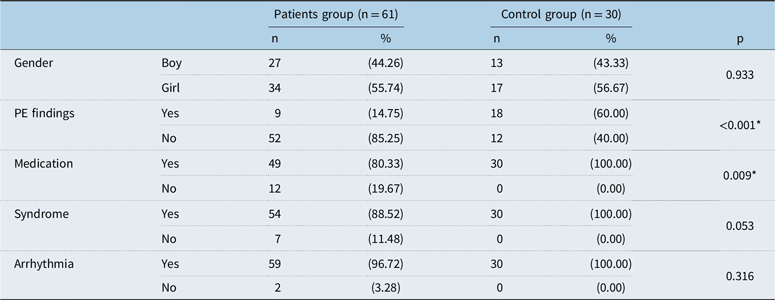
We enrolled 61 patients with repaired secundum type atrial septal defect and 30 controls in the study. In patient group, the defect was closed by transcatheter method in 34 of 61 patients and by surgery in 27 patients. There was no significant difference with respect to age, gender, weight, existence of genetic syndrome, and arrhythmia between patient and control groups (p > 0.05) (Tables 1 and 2). There were 34 girls (55.74%) in patient group and 17 girls (56.67%) in control group. The mean age was 72.19 ± 49.24 months in patients group and 68.33 ± 58.07 months in control group. In terms of physical examination findings and medications, there was statistically significant difference between two groups (p value <0.001 and 0.009, respectively) (Table 2).
Comparison of age and weight between patients and control groups

Comparison of demographical findings between patients and control groups

PE = physical examination
* p < 0.05, statistically significant
The patient group was divided into transcatheter and surgical groups. The mean age and weight was lower in surgical group (55.77 ± 48.95 months and 18.75 ± 14.73 kg, respectively) than transcatheter group (82.23 ± 46.09 months and 24.30 ± 13.59 kg, respectively) (p value 0.007 and 0.011, respectively). In surgical group, more patients took medication than transcatheter group (37.04% versus 5.88%, p = 0.002). While there was no arrhythmia in transcatheter group, 7.41% of the patients in surgical group had atrial arrhythmia but this was not statistically significant (p = 0.107).
We also examined telecardiography findings in terms of cardiothoracic ratio, pulmonary vascularity, and pulmonary venous congestion. We found that mean cardiothoracic ratio was higher in the patient group than the control group (0.53 ± 0.06 and 0.47 ± 0.03, respectively, p < 0.001) and in surgical group than transcatheter group (0.55 ± 0.6 and 0.51 ± 0.05, respectively, p = 0.003).
We recorded the size of the atrial septal defect, total septum length measured by echocardiography, and calculated their ratio. The mean size of defect was higher in surgical group (15.23 ± 7.0 mm) than transcathether group (12.02 ± 3.41 mm) (p = 0.085). The ratio of defect size and total septum length was higher in surgical group (0.51 ± 0.17) than transcatheter group (0.34 ± 0.07) and this was statistically significant (p = 0.002). The echocardiography findings were examined in terms of right ventricular dilatation and paradoxical septal movement. While right ventricular dilatation was seen in 61.76% of patients in transcatheter group, all of patients had right ventricular dilatation in surgical group (p < 0.001). Although no patients had paradoxical septal movement in transcatheter group, 14.81% of patients in surgical group had paradoxical septal movement (p = 0.020).
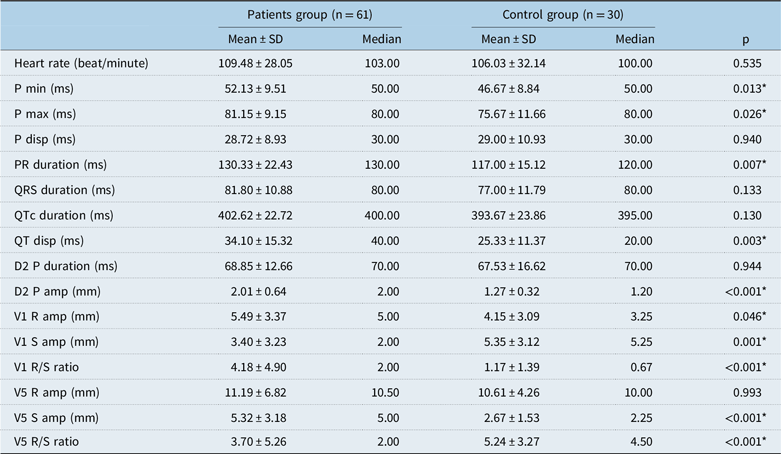
Surface electrocardiographies of control group and patients group before closure were examined. While mean values of P wave minimum duration, P wave maximum duration, PR duration, QT dispersion, P amplitude in D2 derivation, R amplitude and R/S ratio in V1 derivation, and S amplitude in V5 derivation were higher, S amplitude in V1 derivation and R/S ratio in V5 derivation were lower in patients group than control group. Other parameters were similar in both groups (Table 3).
Comparison of surface electrocardiography findings between patients and control groups
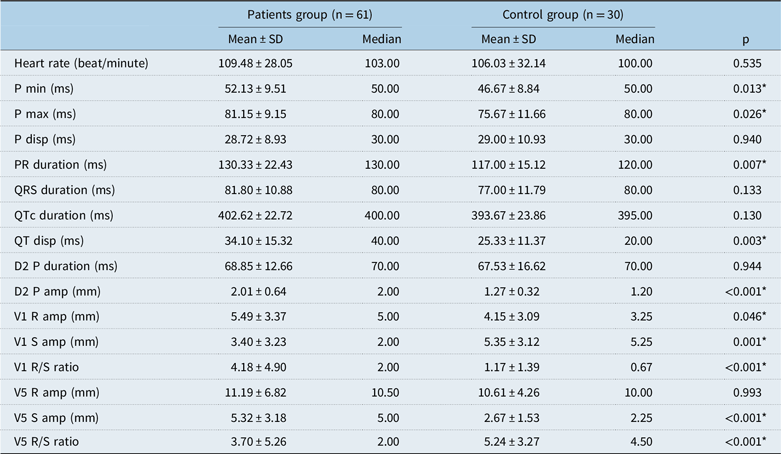
SD = standard deviation; P min = P wave minimum duration; P max = P wave maximum duration; P disp = P wave dispersion; QTc = corrected QT interval; amp = amplitude
* p < 0.05, statistically significant
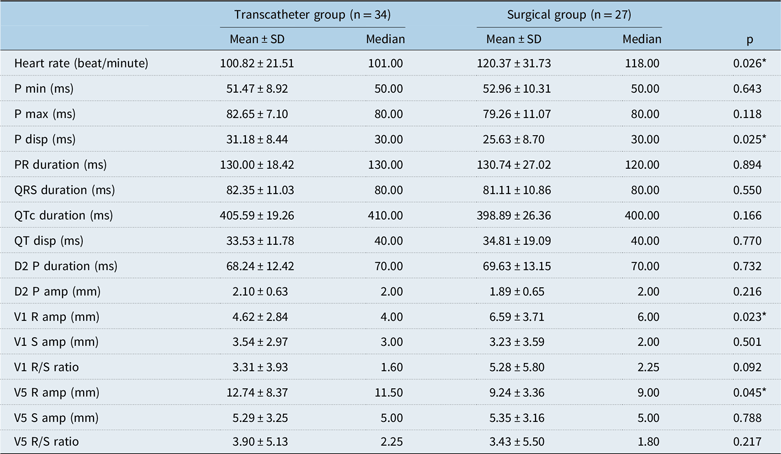
Electrocardiography measurements of transcatheter and surgical groups before defect closure were compared. Mean heart rate and R amplitude in V1 derivation were higher in surgical group. P wave dispersion and R amplitude in V5 derivation were higher in transcatheter group. There was no statistically significant difference by means of other parameters (Table 4).
Comparison of surface electrocardiography findings between transcatheter and surgical groups before defect closure

SD = standard deviation; P min = P wave minimum duration; P max = P wave maximum duration; P disp = P wave dispersion; QTc = corrected QT interval; amp = amplitude
* p < 0.05, statistically significant
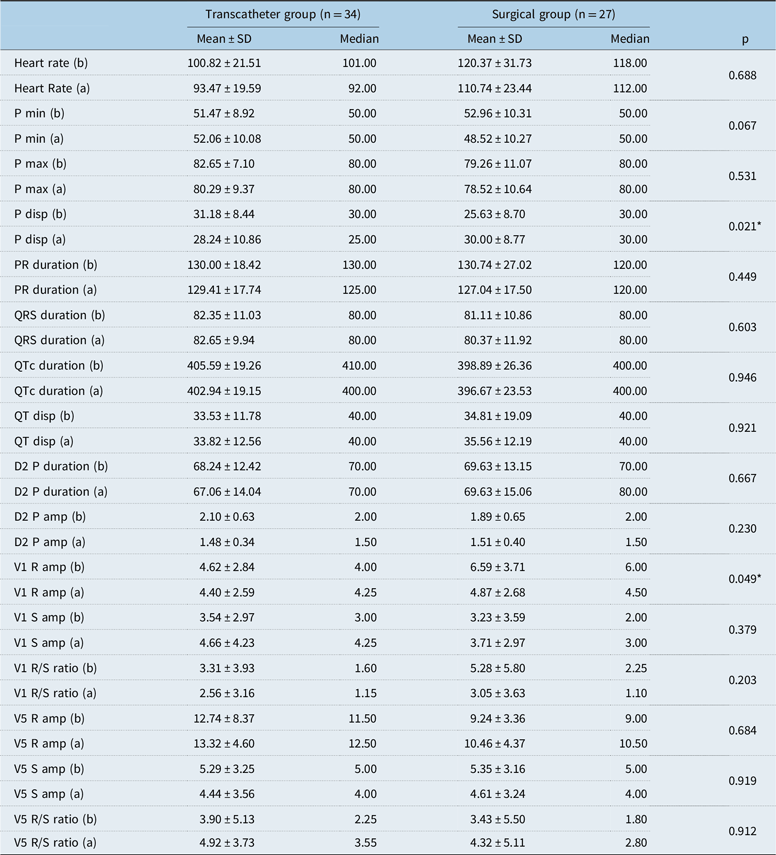
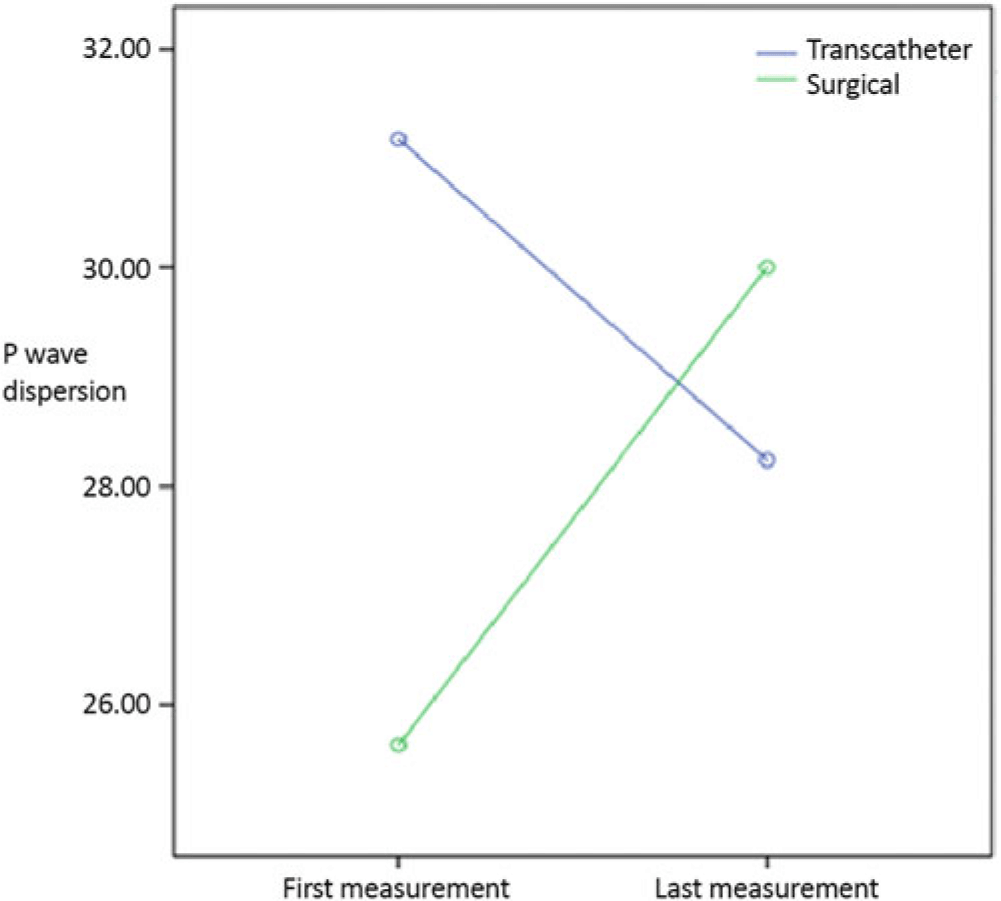
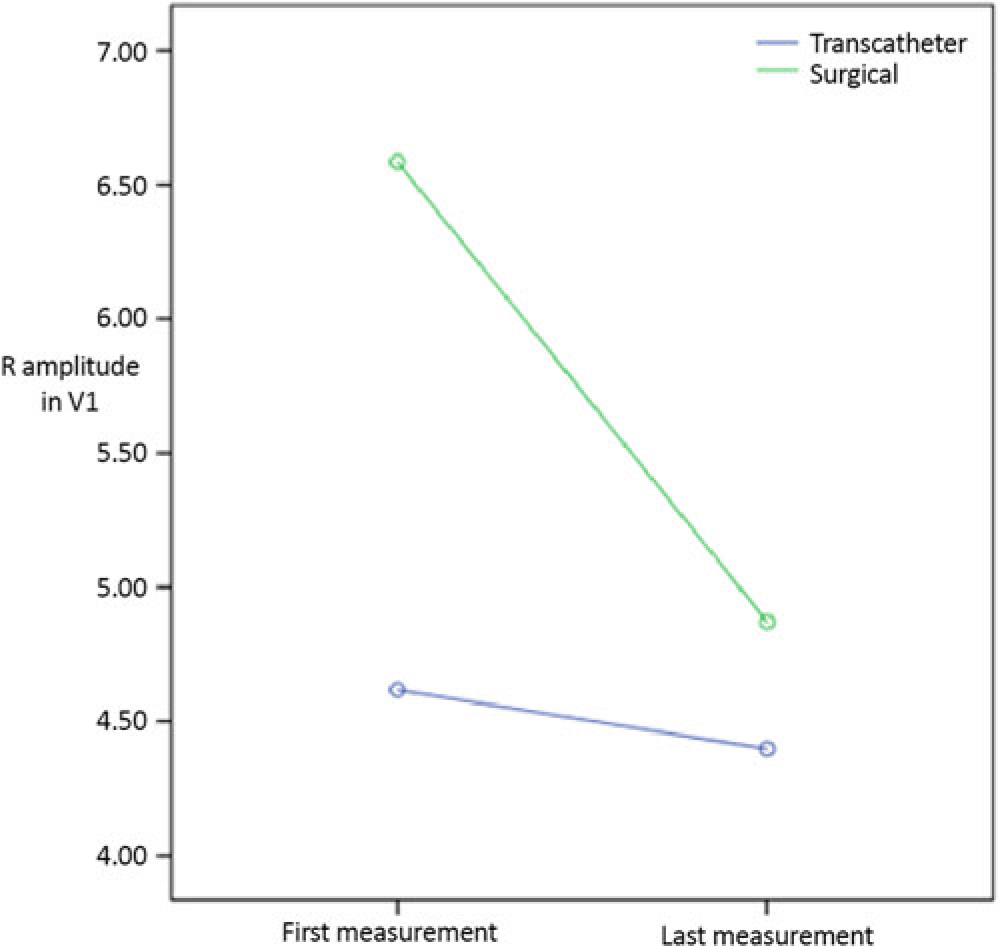
We also compared the electrocardiography measurements before and after defect closure between transcatheter and surgical groups. While P wave dispersion was decreasing in transcatheter group after closure, it increased in surgical group (p = 0.021). And R amplitude in V1 derivation was decreased in both groups (Table 5, Figs 1 and 2).
Comparison of surface electrocardiography findings between transcatheter and surgical groups before and after defect closure

SD = standard deviation; (b) = before defect closure; (a) = after defect closure; P min = P wave minimum duration; P max = P wave maximum duration; P disp = P wave dispersion; QTc = corrected QT interval; amp = amplitude
* p < 0.05, statistically significant
Comparison of the change in P wave dispersion between groups.

Comparison of the change in R amplitude in V1 between groups.

Discussion
Atrial septal defect is a common CHD and accounts for 13–17% of all CHDs.Reference Reller, Strickland and Riehle-Colarusso15, Reference Schwedler, Lindirger and Lange16 Even though most of patients have no symptoms until adulthood, early diagnosis and treatment of atrial septal defect is important to prevent complications such as pulmonary hypertension, right heart failure, and atrial arrhythmias. Atrial arrhythmias in atrial septal defect result from dilation of atriums, but risk of arrhythmia continues even after closure. It is the most important reason of morbidity and mortality in adult patients with atrial septal defect and operated atrial septal defect patients. P wave dispersion shows the heterogeneous conduction in atrial muscle and gives information about atrial arrhythmias. In several studies, it has been shown that P wave dispersion is increased in patients with atrial septal defect and paroxysmal atrial fibrillation.Reference Dilaveris and Gialafos7–Reference Ho, Chia, Yip and Chan9 Atrial arrhythmias, especially atrial fibrillation, are seen in adulthood in patients with atrial septal defect.Reference Chubb, Whitaker and Williams3, Reference Gatzoulis, Freemann, Siu, Webb and Harris17, Reference Oliver, Gallego, Gonzalez, Benito, Mes and Sobrino18 In our study, we evaluated the risk of atrial arrhythmia by examining P wave dispersion before and after closure, and we aimed to observe the effect of closure on P wave dispersion and thereby atrial arrhythmia between transcatheter and surgical groups.
In our study, the mean age of surgical group (55.7 months) was younger than transcatheter group (82.23 months) (p = 0.007), possibly due to early presentation of symptomatic patients with larger atrial septal defects which are not suitable for transcatheter closure. Other studies had also shown that surgical closure was performed at younger patients.Reference Du, Hijazi and Kleinman10, Reference Villablanca, Briston and Rodés-Cabau12, Reference Butera, Carminati and Chessa19, Reference Mylotte, Quenneville and Kotowycz20
Typical examination findings of atrial septal defect are systolic murmur in pulmonary valve and fixed splitting second heart sound. In our study, 85.25% of patients had physical examination findings. In control group, 40% of patients had heart murmur but all of them were innocent. Geggel and Christensen had examined the patients who had haemodynamically significant atrial septal defect and had closure, and found auscultation signs in more than 90% of the patients.Reference Geggel21, Reference Christensen, Vincent and Campbell22
Cardiomegaly, increased vascularity, and pulmonary congestion can be seen in patients with atrial septal defect. In our study, 67% of patients had increased vascularity and 54% of patients had pulmonary congestion. Cardiothoracic ratio was higher in patients group than control group (p < 0.001). Cardiothoracic ratio was also significantly higher in patients undergone surgery compared to transcatheter group (p = 0.003). We can claim that there is cardiomegaly in patients with atrial septal defect in proportion with increased right ventricular volume and that is why cardiomegaly is more apparent in surgical group. Du et al. have found cardiomegaly in 69.1% of the patients who had transcatheter closure and 76.6% of the patients who had surgical closure; however, this finding was not statistically significant (p = 0.096).Reference Du, Hijazi and Kleinman10
Increased right ventricular volume affects the movements of interventricular septum and causes paradoxical motion.Reference Hung, Uren, Richmond and Kelly23 In this study, while all of surgical group had right heart dilatation, 61.76% of patients in transcatheter group had right heart dilatation (p < 0.001). While there was no septal paradoxical movement in transcatheter group, 14.81% of patients in surgical group had septal paradoxical movement (p = 0.020). Surgery was performed in patients with more right ventricular volume overload. Similarly, Bettencourt et al found that 92% of patients in surgical group and 84% of patients in transcatheter group had right heart dilatation.Reference Bettencourt, Salome´ and Carneiro24 On the contrary, Castaldi et al found no difference among the patients with transcatheter or surgical closure with respect to the ratio of right heart dilatation.Reference Castaldi, Vida and Argiolas25
We found that defect size was larger in surgical group (15.23 ± 7.0 mm) than transcatheter group (12.02 ± 3.41 mm) (p = 0.085). This was not statistically significant. On the other hand, the ratio of defect size to the total septal length was significantly higher in surgical group (0.51 ± 0.17) than transcatheter group (0.034 ± 0.07) (p = 0.002). It is claimed that success rate of the defect closure by transcatheter method is increased significantly if defect size/total septal length ratio is lower than 0.35.Reference Hekmat, Mehlhorn and Rainer de Vivie26–Reference Justino28 Closure by transcatheter method is not suitable for patients whose defect size/total septal length ratio is high. We can say that best closure method was chosen for our patients when considered from this point of view.
Anatomical or physiological abnormalities in atrium cause abnormalities on P wave morphology. While first part of P wave represents right atrial depolarisation, last part represents left atrial depolarisation.Reference Hancock, Deal, Mirvis, Okin, Kligfield and Gettes29 Right atrial dilatation in atrial septal defect patients causes an increase in P wave amplitude. In our study, we analysed mean P wave amplitude in D2 derivation and found it higher in patient group than control group (p < 0.001) and in surgical group than transcatheter group (p = 0.216). Sánchez-Cascos et al had also find higher P wave amplitudes in atrial septal defect patients compared to healthy controls.Reference Sánchez-Cascos and Deuchar30
While P wave maximum duration indicates inter-atrial conduction, P wave dispersion indicates heterogeneous conduction within the atriums. We compared the electrocardiographies of patients group before closure and control group. P wave maximum duration was higher in patients group than control group, but contrary to expectations, P wave dispersion was similar in both. In other studies, both P wave maximum duration and P wave dispersion were higher in patients with atrial septal defect than control group.Reference Ho, Chia, Yip and Chan9, Reference Özyılmaz, Özyılmaz and Tola31, Reference Güray, Güray and Yılmaz32
Our study showed mean R amplitude and R/S ratio in V1 and mean S amplitude in V5 were higher in patient group than control group as an indication of right ventricular hypertrophy. Furthermore, mean R amplitude in V1 derivation was higher in surgical group than transcatheter group, mean R amplitude in V5 derivation was lower in surgical group. Depending on these results, we can say that right heart volume overload is higher in patients with atrial septal defect than healthy children and in surgical group than transcatheter group.
When we compared the electrocardiography measurements before and after closure between each patient group, we found that heart rate, mean P wave amplitude in D2, R/S ratio in V1 decreased, and R/S ratio in V5 increased significantly after closure in transcatheter group. While mean P wave amplitude in D2, mean R amplitude in V1, and R/S ratio in V1 decreased, R/S ratio in V5 increased significantly in surgical group after closure. All these findings indicate that right heart volume overload decreased after closure in both groups. There are many other studies denoting the decrease in the right heart volume overload after closure.Reference Castaldi, Vida and Argiolas25, Reference Kaya, Baykan and Dogan2, Reference Patel, Lopez, Banerjee, Joseph, Cao and Hijazi33–Reference Du35
When we compared the P wave dispersion before and after closure in each patient group, we found that while mean P wave dispersion decreased in transcatheter group after closure, it increased in surgical group (p = 0.021). There are several studies detecting that mean P wave dispersion decreases after closure. Roushdy et al evaluated the electrocardiographies of 30 children who had defect closure by transcatheter method. They found that mean P wave dispersion decreased after closure and this decrease continued even months after.Reference Roushdy, Attia and Nossir36 Grignani et al had similar results in their study and saw that 25 children with atrial septal defect whose defects were closed by transcatheter method had a decrease in P wave dispersion after 2 months of closure (p < 0.001).Reference Grignani, Tolentino, Rajgor and Quek37 On the other hand, there are studies claiming that there is no change in mean P wave dispersion after closure or moreover showing an increase after closure. Başpınar et al evaluated the electrocardiographies of 31 atrial septal defect patients whose defects were closed by transcatheter method before and 1 year after closure and found no change in mean P wave dispersion.Reference Baspinar, Kervancioglu, Koruk, Kilinc and Irdem38 Paç et al evaluated the electrocardiographies of 121 atrial septal defect patients whose defects were closed by transcatheter method before and just after closure, they detected an increase in mean P wave dispersion from 38.1 ± 2.9 ms to 47.7 ± 3.9 ms (p < 0.001). They concluded that the “foreign body” effect of the device had caused inflammation of the atrial myocardium.Reference Paç, Ballı, Topaloğlu, Ece and Oflaz39 In contrary to our study, Başpınar et al found a decrease in mean P wave dispersion of 27 atrial septal defect patients whose defects were closed by surgery.Reference Baspinar, Sucu, Koruk, Kervancioglu and Ustunsoy6 In Guray’s study, 34 adult patients whose defect closed by surgery were analysed. They divided the patients into two groups according to occurrence of atrial fibrillation after surgery and found that mean P wave dispersion was higher during the first year following surgery in group with atrial fibrillation.Reference Güray, Güray, Mecit, Birhan, Sasmaz and Korkmaz40 In our study, mean P wave dispersion increased after surgical closure. Similarly, Uçak et al found an increase in P wave dispersion between 5 days and 3 months after surgical closure in 101 atrial septal defect patients.Reference Uçak, Temizkan and Ugur41 All these findings implicate that heterogeneous conduction in atriums increases and risk of arrhythmia still exists after surgical closure. The controversial findings between the studies may be related to patient selection for surgery and the duration of follow-up.
Differences in right and left atrial filling may cause differences in P wave dispersion. Left atrial filling is decreased in patients with non-restrictive atrial septal defect because of left-to-right shunt, left and right atrial pressures are equal before closure. Disappearance of the shunt after closure causes an increase in pressure and volume of the left atrium. In small restrictive atrial septal defect, left atrial pressure is higher than right atrium even at the beginning. While there is a decrease in the pressure and volume of right atrium after closure, there is no change in left atrium. The increase in P wave dispersion in our study can be caused by the difference of left atrial filling and tension of left atrial wall. Increase in P wave dispersion can result from the patients whose defect closed surgically had wider, non-restrictive defect.
Even though shunt disappears and dimensions of atriums returns to normal after surgical closure, scar tissues due to surgery, effect of cardiopulmonary by-pass, and previously existing pathological changes in the atriums may cause dysrhythmia. This may be represented as an increase in P wave dispersion. In our study, the decrease in P wave dispersion after closure by transcatheter method may be related to decreased volume overload of the right atrium after closure which causes equalisation of the both atrial wall tensions. After closure volume overload disappeared completely and risk of arrhythmia decreased. There is advantage in transcatheter group in terms of arrhythmia because there is no scar tissue and by-pass effect.
We evaluated the changes in electrocardiographies just 1 month after closure. It is possible that different results may be obtained with a longer duration of follow-up. The process of tissue repair and atrial remodelling may continue after surgery, there may be differences in ventricular compliances by age and the risk of arrhythmia may change by time. The transcatheter and surgical closure groups were not identical because of the nature of the disease and this may have caused another limitation for the study. Further studies with a longer follow-up duration may be helpful and may demonstrate real related rhythm disturbances especially in adulthood.
In conclusion, atrial septal defects may cause atrial repolarisation abnormalities and this effect persists even after surgical closure. Transcatheter closure in childhood may decrease dysrhythmia risk in long-term follow-up.
Acknowledgement
None.
Financial Support
This research received no specific grant from any funding agency, commercial, or not-for-profit sectors.
Conflicts of Interest
None.
Ethical Standards
The study was approved by the medical ethics committee of Marmara University (Protocol number: 09.2018.219, Date: 02.03.2018). Written informed consent was obtained from all patients.