INTRODUCTION
Animal species that live in sympatry and have a similar diet are assumed to have evolved species-specific adaptations to coexist (Begon et al. Reference BEGON, TOWNSEND and HARPER2006, Krebs Reference KREBS2009). Competition occurs ‘when a number of animals utilize common resources, the supply of which is short’ (Birch Reference BIRCH1957). Where ecological factors remain constant, stronger competitors will exclude competitively inferior species, leading either to the extinction of the inferior competitor or to a behavioural shift of the weaker or smaller species towards a different ecological niche (Connell Reference CONNELL1983, Gause Reference GAUSE1934, Hardin Reference HARDIN1960, Persson Reference PERSSON1985).
The relationship between overlap in resource utilization and competition has been a subject of much debate (Begon et al. Reference BEGON, TOWNSEND and HARPER2006, Krebs Reference KREBS2009, Schoener Reference SCHOENER1983). Some researchers use degree of resource overlap as a proxy for competition (Hansen & Ueckert Reference HANSEN and UECKERT1970), yet others argue that quantifying overlap while ignoring resource availability measures nothing but the degree to which two species are similar (Alley Reference ALLEY1982, Sale Reference SALE1974). Nonetheless, most researchers would agree that the scale of contemporary competition is affected by many ecological and environmental factors; it is most intense when resources are scarce and it can vary in time and space (Begon et al. Reference BEGON, TOWNSEND and HARPER2006, Connell Reference CONNELL1983, Wiens Reference WIENS1977). Whilst to date most studies of interspecific competition have focused on rodents (Eccard & Ylönen Reference ECCARD and YLÖNEN2003, Grant Reference GRANT1972, Morris Reference MORRIS1996), it has also been studied in other species, where competitive exclusion was not seen at all temporal and/or spatial scales and was related to increased competitor density (Mitchell & Banks Reference MITCHELL and BANKS2005) and reduced food availability (Eriksson Reference ERIKSSON1979, Lambert Reference LAMBERT, Glenn and Cords2002, Razgour et al. Reference RAZGOUR, KORINE and SALTZ2011).
The goal of this study was to examine interspecific competition, dietary overlap and niche partitioning in habitat use among three sympatric species using remote video-camera traps in Loango National Park, Gabon: the central African chimpanzee (Pan troglodytes troglodytes), western gorilla (Gorilla gorilla gorilla) and forest elephant (Loxodonta cyclotis). All three species live sympatrically across much of central Africa, consume fruit, leaves and herbs to varying degrees (Blake Reference BLAKE2002, Doran-Sheehy et al. Reference DORAN-SHEEHY, MONGO, LODWICK and CONKLIN-BRITTAIN2009, Tutin & Fernandez Reference TUTIN and FERNANDEZ1993) and have a high degree of overlap in fruit consumption (White et al. Reference WHITE, TUTIN, FERNANDEZ, Thierry, Anderson, Roeder and Herrenshmidt1994). Research has indicated that there may be a positive correlation both between density of terrestrial herbaceous vegetation (THV) and gorilla density (Rogers et al. Reference ROGERS, ABERNATHY, MAGDALENA, CIPOLLETTA, DORAN, MCFARLAND, NISHIHARA, REMIS and TUTIN2004), and between fruit tree density and chimpanzee density (Balcomb et al. Reference BALCOMB, CHAPMAN and WRANGHAM2000). Furthermore, there may be a negative correlation between the density of elephant and that of both chimpanzee and gorilla due to considerable dietary overlap among them (Rogers et al. Reference ROGERS, ABERNATHY, MAGDALENA, CIPOLLETTA, DORAN, MCFARLAND, NISHIHARA, REMIS and TUTIN2004, Tutin & Fernandez Reference TUTIN and FERNANDEZ1993); and gorilla may compete more with elephant than with chimpanzee (White et al. Reference WHITE, TUTIN, FERNANDEZ, Thierry, Anderson, Roeder and Herrenshmidt1994).
We predicted that habitat use will be positively related to seasonal variation in availability of food for all species. Specifically, patterns of habitat use by chimpanzee will be primarily influenced by availability of fruit, while habitat use by gorilla and elephant will also be influenced by herb availability. We also expected precipitation to influence patterns of habitat use in one habitat; specifically we expected differentiation between the three species in the seasonal use of swamps for feeding, resulting from variation in body size and aversion to water (Breuer et al. Reference BREUER, NDOUNDOU and FISHLOCK2005, McGrew Reference MCGREW, Chevalier-Skolnikoff and Poirier1977). We predicted that there will be competition for fruit between chimpanzee and elephant (Balcomb et al. Reference BALCOMB, CHAPMAN and WRANGHAM2000), competition for both herbs and fruit between gorilla and elephant (Doran-Sheehy et al. Reference DORAN-SHEEHY, MONGO, LODWICK and CONKLIN-BRITTAIN2009, White et al. Reference WHITE, TUTIN, FERNANDEZ, Thierry, Anderson, Roeder and Herrenshmidt1994); and that dietary overlap and competition will be higher between gorilla and elephant than between either of them and chimpanzee due to their more similar dietary strategies. Finally, we predicted that spatial and temporal variation in fruit availability and herb density will affect the ability of elephant to competitively exclude chimpanzee and gorilla and that exclusion will increase at times of low food availability and decrease when resources are abundant.
METHODS
Study site
The study site was located in Loango National Park, Gabon (2°04′S, 9°33′E), covering 160 km2 on a strip of land bordered to the west by the Atlantic Ocean and to the east by a large lagoon. Habitat types include mature, secondary, coastal and swamp forest and savanna. Mean annual rainfall (collected daily at the research camp) was 2215 mm and the mean daily minimum and maximum temperatures were 22.9 °C and 27.2 °C, respectively (Head et al. Reference HEAD, BOESCH, MAKAGA and ROBBINS2011). There is a long rainy season (October–April) that is often interrupted by a short dry season (December–January). The long dry season stretches from May to September.
Dietary composition and overlap
We collected data on chimpanzee, gorilla and elephant diet opportunistically between March 2010 and November 2010, from faecal examination, trail signs and direct observations (Head et al. Reference HEAD, BOESCH, MAKAGA and ROBBINS2011). We recorded the presence/absence of fruit in 126, 162 and 139 faeces of chimpanzee, gorilla and elephant, respectively, and we examined a maximum of one faecal sample per day per species to ensure the independence of sampling. Chimpanzee and gorilla faeces were dissociated through a 1-mm-mesh sieve with water, whereas elephant faeces were examined in situ. Feeding remains on trails were assigned to a species as a result of the characteristic manner in which they had been processed. Accompanying imprints or faecal remains which could be distinguished from those of other animals were also used (genetic analysis of faecal samples showed that we were able to distinguish between chimpanzee and gorilla faeces with 96% accuracy; Arandjelovic et al. Reference ARANDJELOVIC, HEAD, BOESCH, KUEHL, ROBBINS, MAISELS and VIGILANT2010). We measured dietary overlap between species as the percentage of all food items eaten by one species that were also eaten by another species; and not on actual amounts consumed.
Defining habitat type
We created a vegetation map of the study area by recording forest type every 50 m along 21 transects oriented east to west between the ocean and the lagoon, latitudinally separated by 500 m. The total distance covered by transects was 147 km. Forest type was split into six categories: mature, secondary and coastal forest, seasonally and permanently inundated swamp and savanna. For permanently inundated forest we also distinguished between Cyperaceae-dominated and non-Cyperaceae swamp, since Cyperaceae are an important gorilla and elephant food. Coastal forest, swamps and savanna were distinguished by their geographic location and unique vegetation composition. We used a visibility estimate to distinguish between mature (visibility > 10 m) and secondary forest (visibility ≤ 10 m) since the principal difference between the two forest types was the density of saplings (J.H. unpubl. data).
Measures of food availability
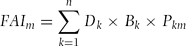
On a monthly basis, we monitored presence of ripe fruit in 750 trees from 57 species known to be consumed by chimpanzee, gorilla or elephant, over a distance of 35 km along a trail system. We calculated fruit availability (F) separately for each habitat type and animal species on a monthly basis with the same method as that described in detail in Head et al. (Reference HEAD, BOESCH, MAKAGA and ROBBINS2011) which is based on the commonly applied Fruit Abundance Index (FAI) (Chapman et al. Reference CHAPMAN, CHAPMAN, WRANGHAM, HUNT, GEBO and GARDNER1992):
 \begin{equation*}
{\it FAI}_m = \sum\limits_{k = 1}^n {D_k \times B_k \times P_{km}}\end{equation*}
Density of herbs was measured from 872 1 × 1-m plots using the same method as that described in detail in Head et al. (Reference HEAD, BOESCH, MAKAGA and ROBBINS2011). We estimated the availability of herbaceous vegetation (H) in each habitat using the formula:
 \begin{equation*}
{\bm H}_{\bm y} {\rm} = {\rm}{\bm t}_{\bm y} {\rm}/{\rm}{\bm p}_{\bm y}\end{equation*}
Remote camera traps
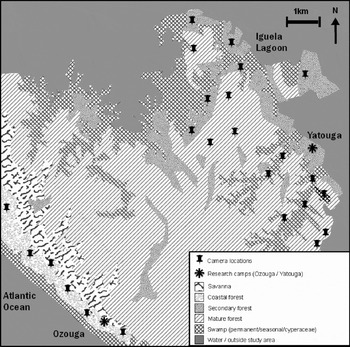
Over a period of 13 mo between November 2009 and November 2010 we monitored 24 remote-sensor video-camera traps (Scoutguard 550 and Bushnell Trophy Cam; Figure 1) that were equally distributed between four forest types: mature, secondary and coastal forest and Cyperaceae-dominated swamp (hereafter referred to as ‘swamp’); we did not include savanna in the study since it was never used by chimpanzee or gorilla as a foraging habitat. The camera traps were placed in a systematic 1-km2 grid overlying the study area and were not moved during the study, but the uneven distribution of forest types throughout the study area resulted in some grid squares with no cameras in them. The cameras were located in neutral areas that were equally accessible to all three species such as animal trails and natural bridges (a pilot study confirmed the elephant's regular use of bridges to access swamps) and were not biased towards a particular fruiting tree consumed by one species and not another. Months and days when a camera was not filming due to technical problems were excluded from analysis. Since habitat type and animal body size strongly affected camera coverage, we measured the total area covered by the motion sensors separately for each camera and species (mean = 15.4 m2, range = 4.9–29.2 m2 for elephant and mean = 9 m2, range = 1.5–19.5 m2 for chimpanzee and gorilla). Motion sensors in the cameras were programmed to trigger immediately when movement was detected, were active for 24 h d−1 and filmed for 60 s after every trigger. There were a total of 219, 180 and 2449 triggers for chimpanzee, gorilla and elephant respectively.
Map of the study area in Loango National Park, Gabon, with different habitat types and camera locations (created in ArcGIS).

Measuring habitat use
In order to investigate the response of the three species (chimpanzee, gorilla and elephant) to changes in fruit availability and rainfall per month in each habitat type, we used a Generalized Linear Model (GLM; McCullagh & Nelder Reference MCCULLAGH and NELDER2008) with negative binomial error distribution and log link function. The total number of triggers and the number of individual animals counted per camera and month were correlated with one another for all three species (Spearman rank correlation coefficient, chimpanzee: r s = 0.85, n = 219, P = 0.0002; gorilla: r s = 0.85, n = 180, P = 0.0002; elephant: r s = 0.88, n = 2449, P < 0.0001). Because each species has a different social structure and group size which affected capture probability, we measured capture frequency as the number of individuals of a species counted per camera per month (Table 1).
Capture frequencies of chimpanzee, gorilla and elephant on remote video cameras in four different habitat types during a 13-mo period in Loango National Park, Gabon.

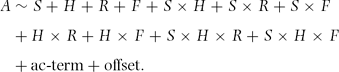
The four main effects included in the GLM were fruit availability, rainfall, habitat type and animal species (the latter was included as a factor so that we could run one model instead of three and directly compare the differential responses of the animal species). We also included the three-way interaction between animal species, habitat type and fruit availability and also that between species, habitat type and rainfall, because we predicted that seasonal changes in fruit availability and rainfall would affect the distribution of the three species and that their responses to changes would be similar in some habitats but different in others. In addition we included all two-way interactions comprised by the two three-way interactions and also a specific term controlling for spatio-temporal autocorrelation (‘ac-term’). We also accounted for effort per camera and month by incorporating camera coverage and functioning camera days (both log-transformed) as offset variables in the model. Hence the full model was:
 \begin{eqnarray*}
&& A{\rm}\sim{\rm}S{\rm} + {\rm}H{\rm} + {\rm}R{\rm} + {\rm}F{\rm} + {\rm}S{\rm} \times {\rm}H{\rm} + {\rm}S{\rm} \times {\rm}R{\rm} + {\rm}S{\rm} \times {\rm}F\nonumber\\
&&\quad +\, {\rm}H \times {\rm}R{\rm} + {\rm}H{\rm} \times {\rm}F{\rm} + {\rm}S{\rm} \times {\rm}H{\rm} \times {\rm}R{\rm} + {\rm}S{\rm} \times {\rm}H{\rm} \times {\rm}F{\rm}\nonumber\\
&&\quad +\, {\rm ac}\hbox{-}{\rm term} + {\rm offset}.\end{eqnarray*}
We accounted for spatio-temporal autocorrelation by first running the full model as specified above without the autocorrelation term included and deriving the residuals from it. Then, separately for each data point, we averaged the residuals of all other data points for the same respective species, whereby the contribution of the other data points to this average depended on the spatial distance and the time lag between the two data points. Specifically, we weighted the contribution of the residuals to the average by the product of two weighting functions, one for the spatial distance and one for the time lag, both having the shape of a Gaussian function with a mean of zero. The resulting variable was then included as an additional term into the model. The standard deviations of the two functions were determined by maximizing the likelihood of the full model with the respective autocorrelation term included.
Prior to fitting the model we log-transformed rainfall and square root-transformed fruit availability to achieve more symmetrical distributions and then z-transformed them both (to a mean of zero and a standard deviation of one) and also the autocorrelation term. We tested the significance of the full model by comparing it with the null model (comprising only the autocorrelation term and the offset variables) using a likelihood ratio test (Dobson Reference DOBSON2002). The significance of the three-way interactions were also determined using likelihood ratio tests comparing the full model with reduced models not comprising the respective interaction (but including everything else). In all the reduced models the autocorrelation term included was that derived from the full model.
The analysis was conducted in R (version 2.11.1), the GLM was run using the function glm.nb from the R package MASS (Venables & Ripley Reference VENABLES and RIPLEY2002) and likelihood ratio tests were conducted using the R-function ANOVA. The autocorrelation term was derived using a self-written function and the standard deviations of the weighting functions were optimized using the R-function optim.
Elephant density as a predictor for ape abundance
We also ran a model to investigate if elephant abundance had a negative impact on the presence of chimpanzee and gorilla on a daily basis (total number of individuals per 24-h period per camera). First we ran a model to explain the distribution of elephant in time and space. For this we used a Generalized Linear Mixed Model (GLMM; Baayen Reference BAAYEN2008) with binomial error distribution and logit link function, based on 7650 combinations of day and camera. We used presence/absence of elephant rather than abundance because we wanted the model to be less sensitive to erratic appearances of large numbers of elephant and more sensitive to the coarser pattern of spatio-temporal elephant distribution. We included the individual camera location as a random effect and season as a fixed effect. Season was included by first converting the day number within the year to a circular variable (i.e. sine and cosine of 2π × day number/365) and then including the two terms into the model. Since we expected the effect of season to vary between cameras even within the same habitat due to the random distribution of food resources, we allowed for this variation by including season as a fixed effect, whilst allowing for the effect of season to randomly vary between cameras. We also allowed for the effect of season per camera location to correlate with the overall probability of elephant occurrence at a given camera. Finally, including spatio-temporal autocorrelation resulted in a ‘predicted elephant presence’.
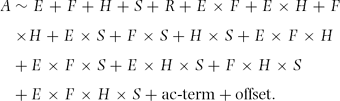
We then ran a GLM to measure the differential impact of elephant presence, fruit availability and herb availability on both chimpanzee and gorilla presence (i.e. the four-way interaction between these predictors on the response variable ape abundance, which we included because we expected the effect of each predictor to vary depending on the other predictors involved) and we also included rainfall as a predictor. We included herbs as a predictor variable because they are important foods for gorilla and elephant and because herb availability varied between habitat types, but we did not include habitat type in the model since this was correlated with herb availability. Species was included as a factor as described above. In addition, we included all effects comprised in the four-way interaction, an autocorrelation term as described above and an offset variable (camera coverage) to account for effort. Hence, the full model was:
 \begin{eqnarray*}
&& A \sim E + F + H + S + R + E \times F + E \times H + F\nonumber\\
&&\quad \times H + E \times S + F \times S + H \times S + E \times F \times H\nonumber\\
&&\quad +\, E \times F \times S + E \times H \times S + F \times H \times S\nonumber\\
&&\quad +\, E \times F \times H \times S + {\rm ac\hbox{-}term} + {\rm offset}{\rm .}
\end{eqnarray*}
We first tested the significance of the full model as compared with the null model (comprising only the autocorrelation term and the offset variable) using a likelihood ratio test. Once this revealed significance, we checked for the significance of the four-way interaction. The analysis was conducted in R using the same functions as described above. The GLMM was fitted using the function lmer from the R-package lme4 (R package version 0.999375-32).
RESULTS
Dietary composition
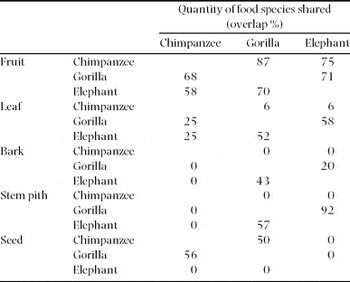
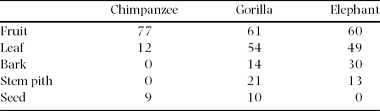
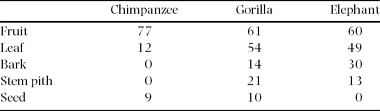
Dietary overlap for fruit among all three species was high (58–87%), but overall dietary overlap between gorilla and elephant was higher than between either of them and chimpanzee (Table 2). Chimpanzee consumed fruit from more species than either gorilla or elephant (Table 3); 12 of which were high in crude lipids and which the other two species avoided. Seeds from fruits were found in 99%, 84% and 87% of chimpanzee, gorilla and elephant faeces respectively during the 9 mo when data for all three species were available.
Per cent overlap in all food items eaten by chimpanzees, gorillas and elephants in five food categories (overlap shown as the percentage of all foods in that category consumed by that species) in Loango National Park, Gabon.

Total number of food items per category consumed by chimpanzee, gorilla and elephant in Loango National Park, Gabon.
Habitat type and food availability
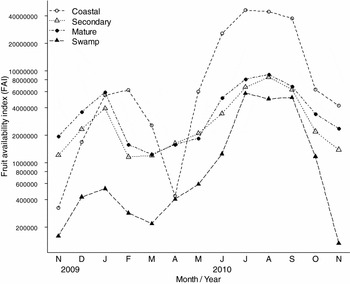
Mature forest was the most common habitat type representing 67% of the study area, secondary forest represented 10% and coastal forest and Cyperaceae swamp each represented 2.7%. The remaining 17% of the study area comprised savanna and non-Cyperaceae swamp (Figure 1). Herb density varied between habitats and was lowest in mature forest (0.49 herbs m−2), similar in secondary (1.08 m−2) and coastal forest (1.24 m−2) and highest in swamp forest (6.21 m−2). Fruit availability showed a similar pattern of seasonal variation in all habitat types (Figure 2), but different overall availability.
Monthly variation in fruit availability in four habitat types (coastal, secondary, mature and swamp forest) in Loango National Park, Gabon.

Habitat use of chimpanzee, gorilla and elephant
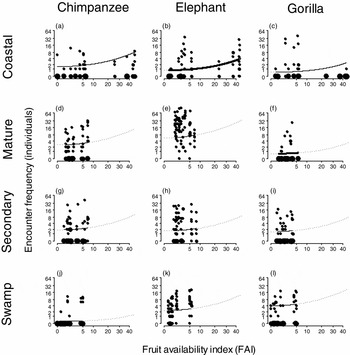
In terms of overall abundance, the chimpanzee was most common in mature and secondary forest, gorilla in swamp and secondary forest and elephant in mature and swamp forest (Table 1). The full model testing for the effect of rainfall and fruit availability was highly significant as compared with the null model (GLM, likelihood ratio test: LR = 179, df = 35, P < 0.0001). The three-way interaction between animal species (chimpanzee, gorilla and elephant), habitat type and fruit availability was not significant (LR = 9.98, df = 6, P = 0.12) and inspection of the results revealed that all three species were found at higher densities in all habitat types when fruit availability was higher (Figure 3).
Response of chimpanzee, gorilla and elephant to changes in fruit abundance in coastal, mature, secondary and swamp forest in Loango National Park, Gabon. Figures (a, d, g, j) display chimpanzee abundance, (b, e, h, k) elephant abundance and (c, f, i, l) gorilla abundance. Encounter frequency is number of individuals captured per month per habitat (lines represent the data trend and thicker lines denote significant responses, i.e. P ≤ 0.05 in a univariate model). Larger points indicate a greater number of observations. Fruit availability index (FAI) is one million times the values on the x-axis.

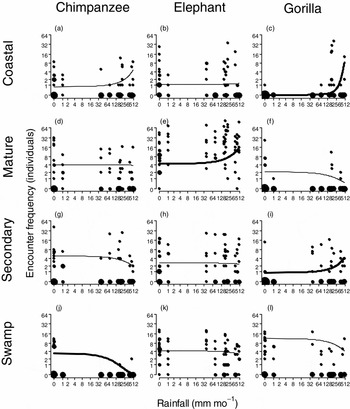
The three-way interaction between species, habitat type and rainfall was highly significant (LR = 24.1, df = 6, P = 0.0004, Appendix 1) showing that the three species responded differently to changes in rainfall and that the differences between their responses to rainfall differed between habitat types (Figure 4). The gorilla showed variation in response to rainfall across habitat types; and increased precipitation correlated significantly with its abundance in both the coastal and secondary forest. The chimpanzee also showed variation in response to rainfall across habitat types; it was present in mature forest throughout the study period irrespective of rainfall, but there was a negative correlation between precipitation and its abundance in the swamp forest. Elephant abundance correlated significantly with rainfall in mature forest, but there was no obvious response to rainfall in all other habitat types.
Response of chimpanzee, gorilla and elephant to changes in rainfall in coastal, mature, secondary and swamp forest in Loango National Park, Gabon. Figures (a, d, g, j) display chimpanzee abundance, (b e, h, k) elephant abundance and (c, f, i, l) gorilla abundance. Encounter frequency is number of individuals captured per month per habitat (lines represent the data trend and thicker lines denote significant responses, i.e. P ≤ 0.05 in a univariate model). Larger points indicate a greater number of observations.

Elephant density as a predictor for ape abundance
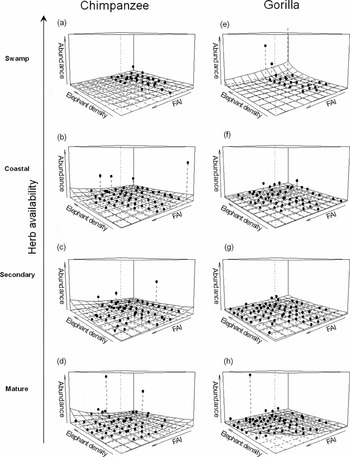
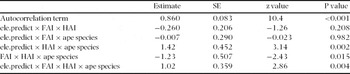
The GLM with elephant presence as a predictor of ape abundance was significant as compared with the null model (LR = 66.7, df = 16, P < 0.0001). The four-way interaction between ape species, elephant presence, fruit availability and herb availability was also significant (z = 2.86, P = 0.004, Figure 5, Appendix 2) showing that chimpanzee and gorilla responded differently to changes in elephant abundance and that these differences varied according to variation in fruit availability and herb density.
Impact of elephant density, fruit availability (FAI) and herb availability on chimpanzee (a–d), and gorilla (e–h) in Loango National Park, Gabon in four habitat types (swamp, coastal, secondary and mature forest). Vertical arrow represents increasing herb availability among habitats. Dashed lines denote the grid lines of the model fitted at the bottom of the box, dots represent the data points and dotted lines beneath the data points represent the average chimpanzee or gorilla abundance for each combination of elephant density and FAI. Curved plane represents the overall response of apes to changes in elephant density and FAI.

Inspection of the results suggested that in habitats with both low and medium herb density (mature, secondary and coastal) the chimpanzee did not experience competitive exclusion by elephant when fruit availability was higher, but when fruit availability was lower there was evidence that the chimpanzee was excluded as it was more abundant in areas where elephant density was lower. The gorilla was excluded by the elephant in the habitat with low herb density (mature forest) when fruit availability was higher, but in secondary and coastal habitats where herb density was higher the gorilla showed no response to elephant presence and was not excluded. In the habitat with the highest herb density (swamp forest), the gorilla was not excluded by the elephant regardless of fruit availability and was more likely to occur where elephant abundance was higher.
DISCUSSION
Habitat use of chimpanzee, gorilla and elephant
As predicted, spatial and temporal variation in habitat use was related to fruit availability and rainfall. The variable use of habitats by the three species and their differential responses to rainfall may reflect the different foraging strategies of each species. As predicted, the gorilla was most frequently found in the swamp forest, which contains a higher density of herbaceous vegetation. The chimpanzee on the other hand appeared to be less influenced by the availability of herbs and was least abundant in the two habitats with the highest herb density. In addition, the high abundance of elephant in both mature and swamp forest throughout the study period supports our prediction that both ripe fruit and herbaceous vegetation are important in its diet.
The different responses of the three species to changes in rainfall in the swamp forest may have resulted from morphological differentiation in body size and a natural aversion to water, with the smaller chimpanzee being the least abundant and showing the strongest negative response to an increase in rainfall in this habitat. The slightly larger and less water-shy gorilla (Breuer et al. Reference BREUER, NDOUNDOU and FISHLOCK2005) was more abundant than the elephant in this habitat but still responded negatively to increasing rainfall (although it was not significant), whereas the elephant appeared largely unaffected by rainfall and still entered the swamps even during months of heavy rain.
Dietary overlap and competitive exclusion
Dietary overlap between chimpanzee, gorilla and elephant in Loango was high (Kuroda et al. Reference KURODA, NISHIHARA, SUZUKI, OKO, McGrew, Marchant and Nishida1996, Tutin & Fernandez Reference TUTIN and FERNANDEZ1993), and as predicted spatial and temporal variation in competitive exclusion was related to fruit availability and herb density. The larger-bodied elephant competitively excluded both chimpanzee and gorilla when resources were limited, but the presence of elephant clearly impacted the two ape species differently. Our results are similar to other studies that found that the intensity of competition among species showed temporal and spatial variation in relation to both competitor density and food availability (Eriksson Reference ERIKSSON1979, Lambert Reference LAMBERT, Glenn and Cords2002, Razgour et al. Reference RAZGOUR, KORINE and SALTZ2011).
The response of the chimpanzee to elephant presence suggests that when fruit availability was higher the two species competed at a low level and shared resources, but that when fruit was scarce the chimpanzee was competitively excluded from areas where the elephant was abundant. Lower dietary overlap for fruit between chimpanzee and elephant (compared with the gorilla) may help explain why the chimpanzee only experienced competitive exclusion by the elephant when fruit availability was reduced, since at other times a large number of fruit species were available to the chimpanzee that were never consumed by elephant.
The response of the gorilla to elephant presence among habitats suggests that in areas where herb density was low and the two species primarily competed for fruit, the gorilla was competitively excluded by the elephant even when fruit availability was increased. However, in habitats with higher herb density, competition levels were reduced and both species could utilize the resources. Overall, these results suggest that fruit availability drove competitive exclusion of the chimpanzee by the elephant, but that competitive exclusion of the gorilla was driven primarily by low density of herbs. These findings highlight the complexity of interspecies relationships and emphasize the importance of considering the interactions between different variables in ecological studies.
Our results suggest that in Loango gorilla density in mature forest (containing low abundance of herbs) may be limited by elephant presence in addition to food availability and that the gorilla may have been subject to evolutionary competitive exclusion and unable to compete with the elephant for fruit in this habitat. However, an absence of competitive exclusion in the three other habitats despite high dietary overlap indicates that where herbaceous foods were more abundant, gorilla and elephant competed at a lower level and could coexist. There was evidence of competitive exclusion of the chimpanzee by the elephant in three of the four habitats but only when fruit availability was lower; suggesting that in habitats with lower herb density the chimpanzee experienced less competitive exclusion by elephant than the gorilla did, but where herb density increased then competition for fruit between chimpanzee and elephant may have been higher than between gorilla and elephant in those habitats.
One limitation of our study was that we were unable to specifically measure competition levels between chimpanzee and gorilla under different ecological conditions due to lower capture frequency of both species on cameras compared with elephant. However their differential responses to elephant presence and their different use of each habitat suggests that the two ape species may also have evolved a certain degree of dietary flexibility to avoid competition with one another and make coexistence possible (Head et al. Reference HEAD, BOESCH, MAKAGA and ROBBINS2011). In addition we were unable to directly measure whether there was seasonal variation in arboreality of chimpanzee and gorilla, which could have affected their capture probability and overstated the competitive exclusion we found between them and elephant at times of reduced food availability. While this remains a possibility, we would expect seasonal variation in arboreality to be constant across habitats, and the differential responses of each species to both rainfall and elephant presence between habitats suggests that it was food availability and not seasonal variation in arboreality which influenced the results.
Conclusions
In summary our results support the idea that the distribution and abundance of resources may be more important than the degree of dietary overlap between competing species (Krebs Reference KREBS2009, Schoener Reference SCHOENER1983) and emphasize the caution that should be employed when using dietary overlap as a proxy for competition between species. Our results indicate that there is potential for increased competitive exclusion of the chimpanzee by the elephant in locations that contain fruits consumed by both species and which do not contain an adequate density of fruits consumed only by the chimpanzee. Our results also highlight the conservation value of heterogeneous forest habitats for multispecies preservation (Longepierre et al. Reference LONGEPIERRE, HAILEY and GRENOT2001) and strongly suggest that conservation management planning for the gorilla in areas where mature forest is the primary habitat should include additional habitat types, to permit the coexistence of the gorilla with the elephant.
This study highlights the complex relationships found among sympatric competitors and stresses the importance of examining habitat use and competitive exclusion on finer temporal and spatial scales, in addition to emphasizing the value of employing a community ecology approach in ecological research and conservation management planning.
ACKNOWLEDGEMENTS
We thank the Agence Nationale des Parcs Nationaux (ANPN), the Centre National de la Recherche Scientifique et Technique (CENAREST) and the Institut de Recherché en Ecology Tropicale (IRET) of Gabon for their collaboration and for permission to conduct our research in Loango National Park. We also thank C. Orbell, E. Wright and the other field assistants of the Loango Ape project for their assistance in data collection. We are particularly grateful to the Max Planck Society, Mr Rombout Swanborn and to BHP Billiton for their financial support throughout the study and to the ANPN, Africa's Eden and WCS staff in Gabon for logistical support at the field site.
APPENDICES
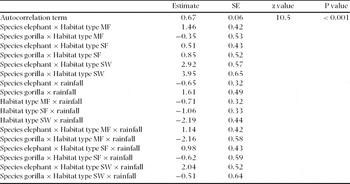
Response of chimpanzee, gorilla and elephant to changes in fruit availability and rainfall in Loango National Park, Gabon. The four main effects included in the final reduced model (GLM with negative binomial error and log link function) were fruit availability, rainfall, habitat type and animal species. The three-way interaction between animal species, habitat type (MF = mature forest, SF = secondary forest, SW = swamp) and fruit availability was removed because it was not significant in the full model (LR = 9.98, df = 6, P = 0.12). Interactions are denoted by ×.

GLM measuring the differential impact of elephant presence (ele.predict), fruit availability (FAI) and herb density (HAI) on both chimpanzee and gorilla presence (ape species) using a four-way interaction, in Loango National Park, Gabon. Interactions are denoted by ×.