Introduction
South Korea's population has been rapidly aging for decades. Older people comprised only 7% of the general population in 2000, but this figure is expected to increase to 14% by 2014 (Lee and Lee, Reference Lee and Lee2009). Suicide among the aged population has garnered national attention. Elderly people are twice as likely to successfully commit suicide as the remainder of the population (Statistics Korea, 2009). Suicide completion among adults older than 60 years old increased 20% from 2002 to 2012. Furthermore, in 2012, the suicide rate was 73.1/100,000 for residents between 70 and 79 years of age and 115.6/100,000 for residents older than 80 years old (Statistics Korea, 2013). These suicide rates were much higher than the average rates of the Organization for Economic Cooperation and Development (OECD) countries.
Suicide prevention among older people is becoming an urgent public health issue for several reasons. First, suicidal behavior in elderly people is highly lethal (Conwell et al., Reference Conwell, Van Orden and Caine2011). Half of the older people who attempt suicide complete the act (Mcintosh et al., Reference Mcintosh, Santos and Hubbard1994). Second, elderly people display a high prevalence of physical illness, lethality of suicide methods, and social isolation. Furthermore, elderly people are less likely to report suicidal thoughts and/or utilize mental health services (Conwell and Thompson, Reference Conwell and Thompson2008).
Mental health professionals have been attempting to determine the risk factors for suicide for many years. Numerous factors have been associated with suicide ideations and attempts, including psychiatric disorders, gender, marital status, socio-economic status, social isolation, stressful life events, and physical illness (De Leo et al., Reference De Leo2002; Zeppegno et al., Reference Zeppegno2005). However, there have been conflicting ideas concerning which variables have a greater impact on suicide ideation and whether these variables are “direct or indirect” (Gong et al., Reference Gong, Zhang, Wang and Liang2011).
Considering these variables, we aimed to identify the factors associated with suicide ideation in older people by creating a path model. Both direct and indirect factors were included in the study. The initial hypotheses of the study were as follows: (1) depression would be the most powerful direct predictor of suicide ideation in older adults; and (2) depression would mediate the relationship between suicide ideation and indirect variables of social relationship, psychological well-being, and economic status.
Methods
Subjects
The current data were derived from a depression and early prevention of suicide program for community-dwelling older people. Individuals older than 65 years were recruited in Seongbuk-gu, Seoul, South Korea, which had a total population of 480,000, including 47,000 elderly. The target number of subjects for the present study was 700 (1.5% of the total aged population of the district). Following an explanation of the study, the subjects provided written informed consent. After the subjects were enrolled in the study, a door-to-door interview using a structured interview manual was administered. We trained the interviewers for several hours to minimize biases, such as the subjects’ literacy and comprehension levels. The subjects were offered financial reimbursement of 3,000 KW (approximately 2.5 USD) for participating in the study. The mean interview duration was approximately 30 minutes, with interviews typically between 30 minutes and 1 hour. We excluded 16 subjects who provided incomplete data, rejected the interview process, or did not understand the interviewer's question appropriately because of cognitive or hearing problems. A total of 684 participants (males = 147, females = 537, mean age = 78.20±7.02 years) were enrolled. Participants who were classified as being at high risk of suicide were referred to the community mental health center for further evaluation and possible interventions, including psychiatric treatment. The study was approved by the Institutional Review Board of Konkuk University Medical Center, a center with which the authors are affiliated.
Variables
Socio-demographic characteristics
The socio-demographic characteristics included gender, age, education, family, economic status, and insurance coverage (National Health Insurance or Medical Care; Medical Care is a government program for low-income people. It is estimated that the lowest 3rd percentile of the general population).
Physical health
We collected information on medical disorders that are prevalent in the older population, including diabetes mellitus, hypertension, osteoarthritis, liver disorders, kidney disorders, cancer, congestive heart failure, chronic obstructive pulmonary disorders, heart attack, gastrointestinal disorders, hearing difficulty, and ophthalmologic disorders.
Alcohol problems
Alcohol problems were assessed using the Cut down, Annoyed, Guilty, Eye-opener (CAGE) questionnaire, which has been shown to easily identify older adults with alcohol disorders (Nam et al., Reference Nam, Kang, Kim, Lee and Bae2004). This measure's internal consistency in the current study was Cronbach's α 0.99.
Social relationships
We quantified the extent of social relationship using the Scale for Social Support, which includes marital relations, sibling relations, relationships with children, religious involvement, interactions with confidantes, games with friends, and number of friends (Vaillant et al., Reference Vaillant, Meyer, Mukamal and Soldz1998). These components are evaluated on a three-point Likert scale, and the total score is a sum of the seven subscales. Higher scores indicate a higher degree of social involvement. The internal consistency of this scale was Cronbach's α 0.50.
Sense of psychological well-being
An individual's sense of psychological well-being was evaluated by ten items on a self-report questionnaire (using a five-point Likert scale). The questionnaire was extracted from the 18-item Korean Psychological Wellbeing Scale (Kim et al., Reference Kim, Kim and Cha2001). Higher scores indicate a higher state of subjective psychological well-being. The scale's internal consistency, as assessed by Cronbach's α, was 0.87.
Depression
The Geriatric Depression Scale (GDS) Short Form, which consists of 15 questions, was applied to evaluate the severity of depression (Sheikh and Yesavage, Reference Sheikh, Yesavage and Brink1986). The proposed optimal cut-off score for a diagnosis of depression is 8 in South Korea (Bae and Cho, Reference Bae and Cho2004). This measure's internal consistency in the current study was Cronbach's α 0.87.
Suicide ideation
Beck developed a 19-item questionnaire with a three-point Likert scale to evaluate suicide ideation (Beck et al., Reference Beck, Kovacs and Weissman1979). We used the Korean version of the Beck Scale for Suicide Ideation (K-BSI) (Lee and Kwon, Reference Lee and Kwon2009). Higher scores indicate a stronger motivation for suicide completion. This measure's internal consistency in the current study was Cronbach's α 0.92.
Statistical analysis
The following steps were taken for the data analysis. First, descriptive analysis procedures were performed to describe the demographic information. Second, parametric and non-parametric correlation tests, along with Pearson's and Spearman's correlation analyses, were conducted to compare suicide ideation with other variables. Third, variables with a p-value ≤0.05 in the correlation analysis were entered into a hierarchical multiple linear regression model with suicide ideation as a dependent variable. Social relationships, severity of depression, and psychological well-being were considered to be continuous variables, and objective economic status was coded as 0 or 1, depending on whether the subject had National Health Insurance (coded as 1) or Medical Care (coded as 0). Finally, the results from previous analyses were further tested using a path analysis. PASW 17.0 for WINDOWS was used for the data entry and analysis (SPSS Inc., Chicago, IL).
Results
Table 1 shows the socio-demographic details of the study population and the average K-BSI scores. Most of the subjects were female (78.5%), and the mean participants’ age was 78.20±7.02 years. Regarding education level, 252 participants (36.84%) were uneducated. Only approximately 15% of the participants had over ten years of education. The mean score of the K-BSI was 4.39±5.93. Fifty-two subjects reported having prior suicide attempts, and the self-reported reasons for suicide attempts were family conflict (n = 19), economic problems (n = 10), and other. The mean GDS score was 6.61 (±4.41). Approximately 43% of the subjects were considered to have depression, as defined by the GDS cut-off score. Other socio-demographic characteristics, including family, objective economic status, and physical illness, were noted (Table 1).
Mean score of suicidal ideation in groups with different demographic characteristics of the study population

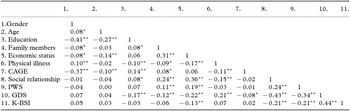
Parametric and non-parametric correlation analyses were performed to determine which variables were associated with suicide ideation. Depression severity was positively associated with suicide ideation (r = 0.44, p < 0.01), and economic status (r s = –0.13, p < 0.01), psychological well-being (r = –0.21, p < 0.01), and social relationships (r = –0.21, p < 0.01) were negatively correlated with suicide ideation (Table 2). Gender, age, education, physical illness, alcohol problems, and residing with family members had no significant relationships with suicide ideation.
Parametric and non-parametric correlation analysis

*p < 0.05; **p < 0.01.
Note. CAGE = questionnaire of alcohol problems: cut down, annoyed, guilty, eye-opener; PWS = Psychological Wellbeing Scale; GDS = Geriatric Depression Scale; K-BSI = Korean version of the Beck Scale for Suicide Ideation.
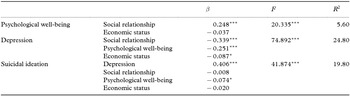
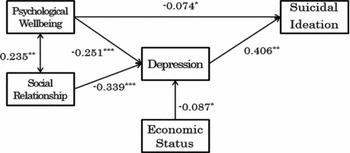
Using hierarchical multiple linear regressions to examine the path analysis, psychological well-being was positively correlated with social relationships (β = 0.248, p < 0.001). Depressive symptom severity had a significant correlation with objective economic status (β = 0.087, p < 0.05), social relationships (β = –0.339, p < 0.001), and psychological well-being (β = –0.251, p < 0.001). Suicide ideation displayed a significant relationship with depression severity (β = 0.406, p < 0.001) and psychological well-being (β = –0.074, p < 0.05) (Table 3).
Hierarchical multiple linear regression for path analysis

*p < 0.05; ***p < 0.001.
Note. Psychological well-being: measured by ten-item, five-point Likert scale extracted from the Korean Psychological Wellbeing Scale; Depression: score obtained by the short form of Geriatric Depression Scale; Suicidal ideation: measured by Korean version of the Beck Scale for Suicide Ideation; β = standardized regression coefficient; R 2 = percent variance explained by each variable.
Figure 1 demonstrates the interaction between the factors associated with suicide ideation. Standardized regression coefficients are presented on each arrow. Using a path analysis, we found that depression severity had a direct impact on suicide ideation. The influences of social relationships and economic status on suicide ideation were mediated by depression severity. Psychological well-being had both direct and indirect effects on suicide ideation. The indirect effect of psychological well-being was also mediated by severity of depression.
Path analysis of suicidal ideation.

The direct, indirect, and total effects of variables on suicide ideation are presented in Table 4. The total effects are the sum of the direct and indirect effects. Indirect effects represent the effects of one variable on another variable through indirect routes. Among the standardized total effects the absolute value of depression was the greatest (0.406), followed by psychological well-being (0.176) and social relationships (0.138).
Standardized effects on suicidal ideation from path analysis

Note. Economic status: coded as 0 or 1 depending on whether the subject had National health insurance or Medical care, where Medical care is a government program for the lowest 3 percentile of general population; Social relationship: measured by the three-point Likert scale; Psychological well-being: measured by ten-item, five-point Likert scale extracted from the Korean Psychological Wellbeing Scale; Depression: score obtained by the short form of Geriatric Depression Scale.
Discussion
The current study suggested that single-cause models of suicide ideation cannot explain the complexity of suicide; rather, multiple-cause paths lead to suicide ideation in older adults. The results were similar to those of previous studies of other age groups in other countries (Conwell and Thompson, Reference Conwell and Thompson2008; Gong et al., Reference Gong, Zhang, Wang and Liang2011). Most notably, depression severity had the most powerful and direct relationship with suicide ideation in the current study. This result closely aligned with a previous study that underlined interventions designed to reduce suicidal thoughts and behavior among those with prevalent and past depressive and anxiety disorders (Almeida et al., Reference Almeida2012). A psychological autopsy study found that depression was the most common psychiatric diagnosis among older age suicide completers (Conwell et al., Reference Conwell, Olsen, Caine and Flannery1991). Additionally, the suicide rate among depressed patients who have been hospitalized because of suicide ideation or attempts is 8.6%, whereas the suicide prevalence among the general population is only 0.5% (Bostwick and Pankratz, Reference Bostwick and Pankratz2000). These results suggest that untreated depression in older people is associated with suicide attempts.
The proportion of community-dwelling older adults with significant depression (based on the GDS cut-off) was 43%. Previous Korean studies similarly reported high rates, ranging from 30–40%. These rates are higher than those in other countries, which range from 13–22% (Kim et al., Reference Kim, Shin, Yoon and Stewart2002; Bisschop et al., Reference Bisschop, Kriegsman, Deeg, Beeckman and Tilburg2004; Shin et al., Reference Shin, Jung, Jo and Kang2009). Because the current study was originally designed as part of a community suicide prevention program, the subjects were enrolled from populations that were assumed to be at high risk for suicide, i.e. populations with lower incomes or more older people living alone compared with the putative average of same-age older people in South Korea. These factors might have affected the higher incidence of depression in the study. In addition to the special circumstance of the current study, the higher rate of depression among older people in South Korea was reviewed in a previous paper. In the context of a historical profile of older Koreans, Kim et al. explained that these adults experienced dramatic socio-cultural changes throughout their lifetimes (Kim et al., Reference Kim, Shin, Yoon and Stewart2002).
The current study found that social relationships and economic status had only indirect effects on suicide ideation. A previous study demonstrated conflicting results concerning the effects of these two factors (Rubenowitz et al., Reference Rubenowitz, Waern, Wilhelmson and Allebeck2001). Specifically, the study revealed that both social and relational problems, such as family discord and financial trouble, were significant; however, when controlling for other factors, including depression, only relational problems remained predictive. Furthermore, a recent study proposed that social factors were strong determinants of suicidal feelings and depression (Fassberg et al., Reference Fassberg, Ostling, Borjesson-Hanson, Skoog and Waern2013). In the current study, these factors affected suicide ideation only when accompanied by depression severity, which implies that depression mediates the process of developing suicide ideation.
Psychological well-being had both direct and indirect impacts on suicide ideation. Psychological well-being has been defined by the aspects of self-acceptance, positive relationships with others, autonomy, environmental mastery, purpose in life, and personal growth. This positive psychological state has been negatively correlated with depression (Ryff, Reference Ryff1989). Although there has been little evidence to suggest a relationship between psychological well-being and suicide ideation, the current study found that psychological well-being partially negated other variables. It was difficult to verify the clear influence of well-being on suicide ideation, whether directly or indirectly. However, using path analysis, we cautiously proposed that psychological well-being would affect suicide ideation directly or through depressive symptoms and found that it had both direct and indirect effects on suicide ideation in older people. Thus, the enhancement of psychological well-being may aid in preventing suicide ideation.
The factors that were associated with suicide ideation in previous studies (e.g. physical illness and lack of family support) had neither a direct nor indirect effect on suicide ideation in the current study. Although physical illness was positively correlated with depression severity, we found that positive social relationships had a compensatory effect. The lack of family support was negatively correlated with social relationships, psychological well-being, and depression severity. However, it did not directly affect suicide ideation (Szanto et al., Reference Szanto, Gildengers, Mulsant, Brown, Alexopoulos and Reynolds2002).
In terms of research implications, the direct and indirect roles of variables must be understood to administer intervention strategies. The current results imply that early depression detection and active intervention, including pharmacotherapy, may be effective in reducing suicide ideation in an aging population. The present results are similar to those of past studies of suicide ideation and attempts. For example, the study “Improving Mood: Promoting Access to Collaborative Treatment” (IMPACT) examined the effect of active depression intervention as opposed to typical depression therapy. The study found that the subjects who received active intervention had not only lower rates of depression, but also lower rates of suicide ideation (Unutzer et al., Reference Unutzer2006). It has been suggested that community-based suicide prevention programs help to reduce the risk of suicide (Oyama et al., Reference Oyama, Fujita, Goto, Shibuya and Sakashita2006). Furthermore, psychosocial programs that enhance subjective psychological well-being and social relationships may be a great benefit to the community (Szanto et al., Reference Szanto, Gildengers, Mulsant, Brown, Alexopoulos and Reynolds2002). Consequently, suicide intervention should not be restricted to medical or psychiatric interventions. Based on the current path analysis of the factors associated with suicide ideation, we suggest that the severity of depression is the most precise indicator of suicide ideation. Therefore, high priority should be given to depression screening. Furthermore, multidimensional efforts to enhance psychological well-being and social relationships may reduce suicide ideation in older people.
The present study has several limitations. First, because the study participants lived in only one district and random sampling was not performed, the generalization of the results is unclear. Second, because most of the subjects were female (78.5%), there might be a gender bias. This percentage of females was greater than that of elderly people in the research district (female = 58%). Males were less inclined to participate in the survey than females. We considered that older men are less inclined to utilize community-based social activities than older women. In the cultural context of South Korea, males are reluctant to participate in these types of community surveys and are unaccustomed to expressing their emotions in another person's presence. These factors might account for the low male participation rate in the study. As older males showed relatively higher suicide rates than older females (Szanto et al., Reference Szanto, Gildengers, Mulsant, Brown, Alexopoulos and Reynolds2002), caution should be used when interpreting the results. Third, the current study did not gather information on the participants’ previous history of mental illness or measure general cognition and functional ability. Because we analyzed data using hierarchical multiple regression models, we could not verify the fit of the final model. A structural equation model analysis is recommended for future studies. To conclude, depression has a significant and direct impact on suicide ideation. Social relationships and economic status only affect suicide ideation when accompanied by depression severity. Psychological well-being has both direct and indirect impacts on suicide ideation. Efficient strategies for suicide prevention in an aging population should involve early detection and prioritize the active treatment of clinical depression. Prevention strategies should also aim to increase psychosocial support and psychological well-being to enhance social relationships and reduce the occurrence of suicide ideation, respectively.
Conflicts of interest
None.
Description of authors’ roles
S. Kim was involved in the study conception and design, data analysis and interpretation, and drafting of the paper; J. H. Ha was involved in the study conception and design, data acquisition and interpretation, drafting of the paper, and supervision; and J. Yu, S-H. Ryu, and D-H. Park shared responsibility for the study conception and design, data interpretation, and supervision.