Introduction
Bone-anchored hearing aids (BAHAs) are used to rehabilitate conductive, sensorineural or mixed hearing loss.Reference Snik, Mylanus, Proops, Wolfaardt, Hodgetts and Somers1 They have been used since 1977Reference Tjellstrom, Lindstrom, Hallen, Albrektsson and Branemark2 in more than 75 000 patients.Reference Dun, de Wolf, Hol, Wigren, Eeg-Olofsson and Green3 Bone-anchored hearing aids are indicated in children with ear canal atresia and congenital auricular deformities because they have better sound transmission and increased comfort compared with behind-the-ear hearing aids.Reference Snik, Bosman, Mylanus and Cremers4, Reference Banga, Lawrence, Reid and McDermott5
Trauma to BAHAs is a recognised problem in children.Reference Zeitoun, De, Thompson and Proops6 If the sound processor is damaged, this can be replaced. However, trauma renders approximately 3–26 per cent of all titanium fixtures in children lost or unusable,Reference Zeitoun, De, Thompson and Proops6–Reference Kraai, Brown, Neeff and Fisher10 which is higher than the frequency in adult patients (1 per cent).Reference Hobson, Roper, Andrew, Rothera, Hill and Green11 More serious complications of trauma include intrusion injuries,Reference McDermott, Barraclough and Reid12 intracerebral abscess after BAHA abutment replacementReference Deitmer, Krassort and Hartmann13 and epidural haematoma.Reference Mesfin, Perkins, Brook, Foyt and German14 These complications are very rare indeed. However, it has been reported that up to 39 per cent of implants are inserted in contact with the dura, mastoid air cells or sigmoid sinus.Reference Granstrom, Bergstrom, Odersjo and Tjellstrom15
Paediatric complications pose difficulties for the subsequent clinical management of hearing loss. Issues associated with subsequent management should be discussed by a multidisciplinary team with involvement of the parents.
We report the challenging management of a case where a five-year-old boy with coloboma, heart defects, atresia of nasal choanae, retarded growth, genital abnormalities, ear defects and deafness (‘CHARGE’ syndrome)Reference Zeitoun, De, Thompson and Proops6, Reference Stevenson, Proops, Wake, Deadman, Worrollo and Hobson7, Reference Granstrom, Bergstrom and Tjellstrom16–Reference Edwards, Van Riper and Kileny18 suffered from repeated traumatic falls that caused intrusion of his initial and replacement BAHA abutments. The rationale for the management and potential neurological concerns for each episode of trauma is discussed.
Case report
A three-year-old boy with varying degrees of coloboma, heart defects, atresia of nasal choanae, retarded growth, genital abnormalities, ear defects and deafness, with an intelligent quotient of 70, was provided with a BAHA for severe conductive hearing loss and congenital external ear malformations. A two-stage BAHA placement procedure was employed, wherein a second sleeping implant was fitted into drilled skull bone and fixed under a C-shaped skin flap (Proops methodReference Proops19).
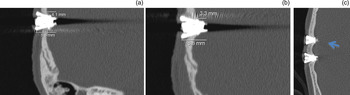
After 6 months, as a result of a traumatic fall, the BAHA abutment became unusable due to a 4.1 mm intrusion of the titanium screw (Figure 1a). There was no clinical or radiological evidence of neurological complications. Moreover, no cerebrospinal fluid (CSF) leakage or subdural haematoma was detected. We decided not to remove the intruded BAHA for two reasons. Firstly, the two other reports of intrusion trauma to a BAHA note that the dura was intact even after removal of the implants.Reference McDermott, Barraclough and Reid12, Reference Deitmer, Krassort and Hartmann13 Secondly, the parents felt that their child would not cope with the surgical wound of a mini-craniotomy because of his behavioural problems. In order to aid his hearing, a second abutment was uneventfully inserted on the same side, anterior to the first abutment (Figure 1c).
(a) Transverse computed tomography (CT) scan showing the original intruding titanium screw after a traumatic fall. (b) Transverse CT scan demonstrating the second fixture intruding after a second fall. (c) Axial CT scan showing the two damaged titanium fixtures. The second abutment (arrow) was placed anterior to the original.

Two years later, at the age of five years, the child sustained another intrusion injury of 3.3 mm (Figure 1b) after falling and damaging his second BAHA abutment. Again, the patient did not have any clinical signs of neurological injury. Having been informed of the potential neurological consequences and the option of surgery, the parents opted to keep the abutments in situ, and to aid hearing with a Baha® Softband.
Discussion
Direct trauma to the fixture of a BAHA is a recognised and relatively common long-term complication in paediatric patients, which can disrupt osseointegration and disable the implant. Neurological sequelae are rare.Reference Zeitoun, De, Thompson and Proops6–Reference Kraai, Brown, Neeff and Fisher10
The management of this child's repeated trauma to his BAHA was challenging. Although there was no clinico-radiological evidence of neurological complication following the first or second episode of trauma, this child was prone to falling, which, in our experience, is common in children with developmental disorders.
After the child's first traumatic fall, it was decided not to remove the BAHA screw that had intruded by 4.1 mm. Instead, we placed a second abutment over the sleeping implant, adjacent to the first (damaged) screw. We rationalised that there was a low risk of damage to the dura or other neurological injury. This rationale was based on the two reports (in the international literature) of intrusion trauma to BAHAs, in which the dura was intact before and after the removal of the implant.Reference McDermott, Barraclough and Reid12, Reference Deitmer, Krassort and Hartmann13
When the child sustained a 3.3 mm intrusion injury to the replacement abutment two years later, we could not refer to the literature or personal experience, as a case like this had not been encountered before. It was originally decided that the damaged screws would be removed from the patient's temporal region. This rationale was based on our concern regarding the potential weakening of the skull associated with two traumatic falls combined with the two penetrating screws. In addition, the child's proneness to falling could result in further damage to the region. During the surgical removal of the implants, in the event of CSF leakage, the plan was to connect both implant drilling holes in the temporal bone, using a mini-craniotomy to explore the region and close the dura. However, after several discussions with the parents, it was decided that this child's behavioural problems would not allow him to tolerate the aftermath of such an operation. Reportedly, he was likely to damage the surgical wound in his skull.
• Trauma to a bone-anchored hearing aid (BAHA) is relatively common in children
• Intrusion of the BAHA rarely causes neurological complications
• A patient's age and proneness to fall should be considered when implanting a BAHA
• A BAHA Softband is a non-invasive alternative; aided hearing thresholds are similar to conventional bone conducting hearing aids
Early audiological intervention is important in patients with coloboma, heart defects, atresia of nasal choanae, retarded growth, genital abnormalities, ear defects and deafness, as coexisting visual problems can compound the delay in speech and language development.Reference Edwards, Kileny and Van Riper17, Reference Arndt, Laszig, Beck, Schild, Maier and Birkenhager20, Reference Raqbi, Le Bihan, Morisseau-Durand, Dureau, Lyonnet and Abadie21 Generally, the appropriateness of a BAHA in any paediatric patient (especially those under five years of age) should be considered within the context of the patient's intellectual handicap and behavioural problems, both of which increase the likelihood of common childhood falls.
Non-invasive alternatives to aiding hearing with a BAHA include a BAHA Softband. This provides an aided hearing threshold almost equal to conventional bone conducting hearing aids, and is not associated with serious neurological complications.Reference Verhagen, Hol, Coppens-Schellekens, Snik and Cremers22