CHDs are the most common and lethal birth defect. Reference Hoffman and Kaplan1–Reference Oster, Lee, Honein, Riehle-Colarusso, Shin and Correa3 A subset of CHDs (25%) are considered severe and life-threatening without intervention. Reference Oster, Lee, Honein, Riehle-Colarusso, Shin and Correa3 Medical advances in cardiology have made surgical and catheter-based intervention possible for most complex CHDs. However, even with intervention, individuals diagnosed with some types of severe CHDs face a serious risk of mortality, morbidity, and lifelong complications with an uncertain quality of life. Reference Best and Rankin4–Reference Schaefer, von Rhein and Knirsch7 For severe CHDs, (e.g., hypoplastic left heart syndrome), termination, palliative care, and surgery may be considered as treatment options for an affected foetus or neonate. Reference Barron, Kilby, Davies, Wright, Jones and Brawn8–Reference Zeigler11
Parents of a foetus or neonate diagnosed with severe CHDs are then confronted with an unexpected and challenging treatment decision about whether or not to pursue surgical intervention. After the initial diagnosis and during the decision-making process, up to 80% of parents have severe psychological distress Reference Woolf-King, Anger, Arnold, Weiss and Teitel12 and experience high rates of post-traumatic stress symptoms, depression, anxiety, and grief. Reference Woolf-King, Anger, Arnold, Weiss and Teitel12–Reference Lawoko and Soares15 There is a significant need to determine how to best support and counsel parents during this difficult decision-making process. Although some qualitative studies have begun to explore parents’ perspectives on making treatment decisions, these previous studies have had small samples of parents from a single medical centre who chose surgery. Reference McMahon and Chang16–Reference Rempel, Cender, Lynam, Sandor and Farquharson19 Therefore, there is a need to build a more robust understanding of parent perspectives by including those who chose termination or palliative care, as well as, identify information and factors that support parents making the treatment decision.
The purpose of this multisite qualitative study was to examine how parents made treatment decisions for their foetus or neonate with a severe CHD, including what factors played a role in the decision-making process and identify challenges they faced during the decision-making process.
Methods
A qualitative study design was used to provide in-depth insight and robust understanding into an emotionally-laden and complex experience. Reference Giacomini and Cook20 Focus groups were chosen based on our belief that being with others who had reached a similar treatment decision would offer a supportive and inclusive environment and elicit thoughtful reflection on this sensitive topic. 21,Reference Lederman22 Institutional review boards at the University of Utah, Primary Children’s Hospital, Ann & Robert H. Lurie Children’s Hospital of Chicago, Duke Children’s Hospital, and Children’s National Hospital approved this study and data transfer agreements were completed. Prior research suggests that to reach at least 90% thematic saturation Reference Namey, Guest, McKenna and Chen23,Reference Guest, Namey and McKenna24 , five focus groups are typically necessary thus, we planned to recruit for ten focus groups to provide us with enough data to reach our study objective.
A purposive sample of parents who had a foetus or neonate diagnosed within the last 6 months to 5 years with a severe CHD, who chose between one or more of three viable treatment options (i.e., termination, palliative care, or surgery), were recruited from four academic medical centres in metropolitan cities across the United States of America (see Supplementary Table S1 for list of CHDs). Participants (biological and non-biological parents) were identified through cardiac ICUs, high-risk clinics, and/or foetal cardiology databases at each study site. Eligible individuals were sent a letter inviting them to participate in a focus group; upon agreement or initial interest, they were provided additional information by telephone or email. Because we expected thematic deviation and wanted parents to feel comfortable, focus groups were divided according to parents’ treatment decisions: termination or palliative care, or surgical intervention. Prior to the focus group, parents were sent a letter with a brief description of the project goals and questions that would be discussed.
Data collection
We conducted 10 focus group discussions: 4 in Salt Lake City, UT and 2 each in Chicago, IL, Durham, NC, and Washington, DC (November, 2017-April, 2019). Equal numbers of focus groups for the two treatment categories were held in each city. One experienced moderator, trained on qualitative interviewing and the sensitive nature of the topic, conducted all focus group discussions. Most (n = 9) were conducted in person and in English; two parents participated via video conference call and one parent was supported by a Spanish interpreter. One focus group was conducted exclusively by video conferencing due to severe weather. Before each focus group discussion, the study team informed parents about the confidentiality of their statements, addressed questions or concerns, and obtained written informed consent. Parents completed a self-administered questionnaire on demographic information (e.g., age, gender, education, household income). A study team member attended most focus group discussions (n = 9) and took notes. Focus group discussions were approximately 2 hours long, audio-recorded, and transcribed verbatim by a third-party transcription service. Parents received a $50 gift card as remuneration.
The team developed a semi-structured interview guide Reference Barriball and While25,Reference Kallio, Pietilä, Johnson and Kangasniemi26 with open-ended questions and probes to facilitate discussion. The guide included four questions; two of which are described here: “What information did you learn after your baby was diagnosed?” and “What mattered most to you when making decisions about your baby’s medical care?” Questions were asked in a general manner without referencing specific clinical situations. After each focus group discussion, the study team members debriefed, reviewed notes, discussed emerging findings, and assessed the extent to which thematic saturation was reached (i.e., the point at which little or no new information occurred). Reference Guest, Bunce and Johnson27
Data analysis
Data analysis was conducted using Crabtree and Miller’s editing approach, Reference Crabtree and Miller28 which involves a grounded interpretation of text and open coding to identify emergent themes. This is an inductive, or “bottom-up” approach whereby the text is reviewed and coded into meaningful categories, in order to develop overarching conclusions that are “grounded in” the data. Qualitative analysis software (Altas.ti) was used to organise and code the textual data. Analysts first conducted a deep reading of the text to develop insights on the research questions and inductively identify themes. Reference Crabtree and Miller28 The emergent themes, together with structural codes from the interview guide, were used to create a preliminary codebook. Three transcripts were independently reviewed by two reviewers and discussed to reach a consensus on the application of codes. The codebook was updated iteratively and the team regularly discussed coding to establish consensus. A final report with findings was compiled, reviewed, and corroborated by numerous stakeholders (e.g., parents, clinicians, researchers) to establish face validity and develop additional insights on the data. Reference Tracy29 We largely received support and consensus regarding our findings from stakeholders. As a result, no significant changes were made to the report.
Results
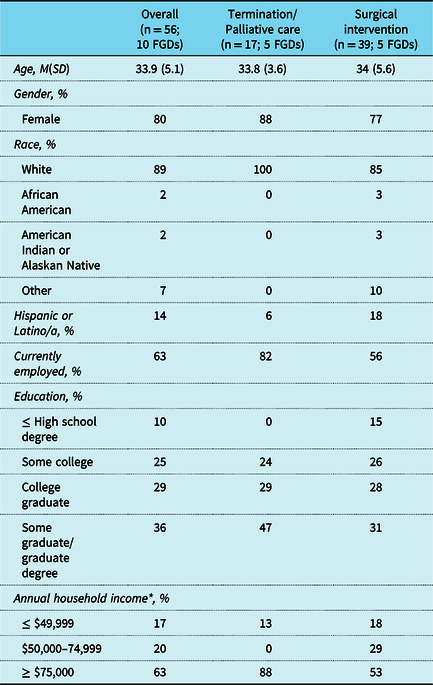
Fifty-six parents participated across ten focus group discussions. Parents had an average age of 34 years (20–52 years; SD = 5.1) and a median education level equivalent to a 4-year college degree. Most were women (80.3%), and most identified themselves as White (89%; Table 1). Significant differences in parent characteristics between groups were only found for household income (X2 = 7.04, p = 0.007).
Parent characteristics overall and by focus group category across 10 focus groups

FGD = focus group discussion. Independent samples t-tests (for continuous variables) and chi-square tests (for categorical variables) were computed to test for significant differences by focus group category.
*Significant differences in income were found (Χ 2 = 7.04, p = 0.007) but no significant differences were found among other parent characteristics.
Themes resulting from focus group discussions
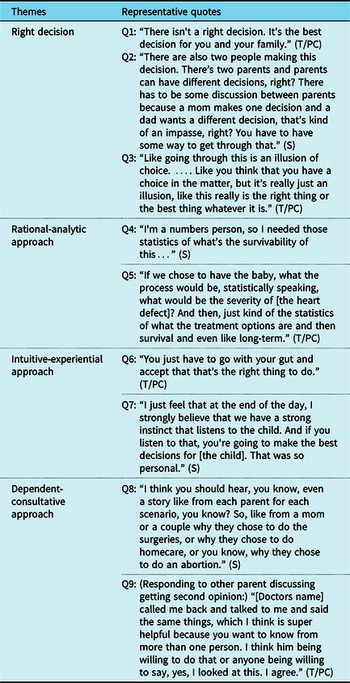
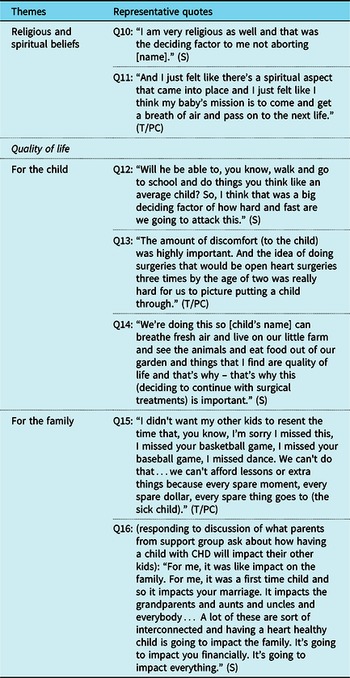
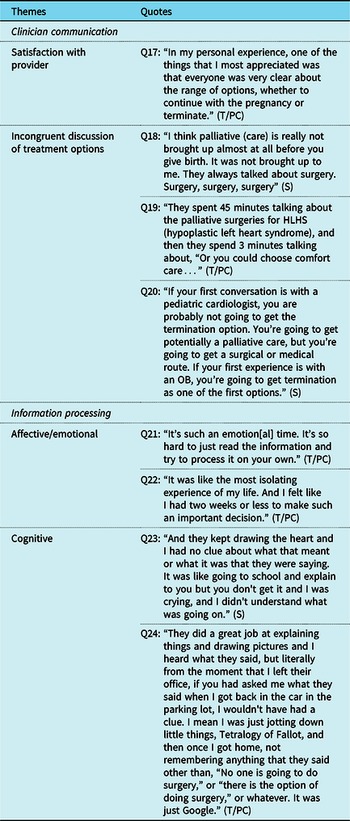
The analysis of the focus group transcripts resulted in 11 dominant themes, which are organised within 1 of the 3 overarching domains: decision-making approaches; values and beliefs; and decision-making challenges. Representative, exemplar quotes (Q) are highlighted for each theme within the results section and Tables 2, 3, and 4.
Decision-making approaches: summary of themes
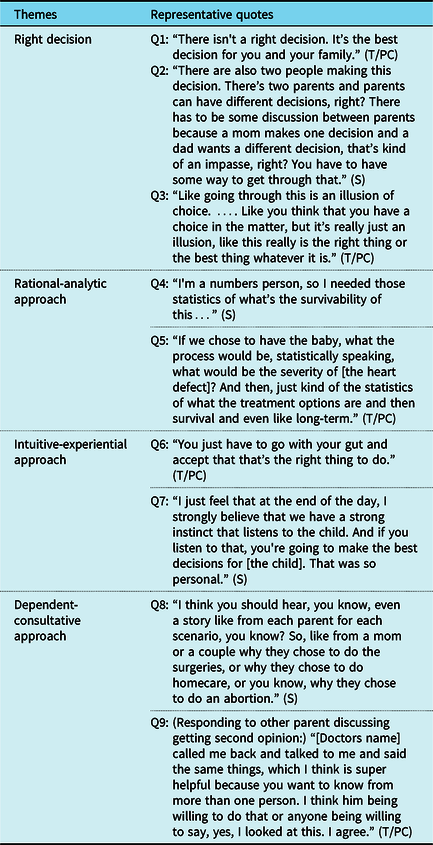
(S) = quote from parent in surgical intervention focus group discussion; (T/PC) = quote from parent in termination/palliative care focus group discussion.
Values and beliefs: summary of themes

(S) = quote from parent in surgical intervention focus group discussion; (T/PC) = quote from parent in termination/palliative care focus group discussion.
Decision-making challenges: summary of themes

(S) = quote from parent in surgical intervention focus group discussion; (T/PC) = quote from parent in termination/palliative care focus group discussion.
Decision-making approaches
Four themes emerged signifying diverse approaches to making the initial treatment decision: right decision, rational-analytic, intuitive-experiential, and dependent-consultative (Table 2). Parents acknowledged the complex and multifaceted nature of the decision, with most acknowledging that there was no clear right or wrong decision (Q1), and that each parent may differ in their decision preferences (Q2). One parent highlighted that there was “an illusion of choice,” (Q3) suggesting that it does not feel like a real choice is being offered when there is no clear “right” option.
Multiple decisional approaches emerged in the focus group discussions as identified in decision-making literature. Reference Stanovich and West30–Reference Delaney, Strough, Parker and Bruine de Bruin33 Some parents described a rational-analytic approach where statistics, probabilities, and numeric values were important (Q4, Q5). Others discussed an intuitive-experiential approach, relying upon gut feelings and instincts (Q6, Q7) to guide their decision. Some also described a dependent-consultative approach, where they sought advice and direction from others, like their providers or other parents who previously faced a similar decision (Q8, Q9). These approaches were not mutually exclusive, as some parents discussed using a combination of these.
Values and beliefs
Three dominant themes were found within the values and beliefs domain that parents noted as important factors for their treatment decision: religious and spiritual beliefs, quality of life for the child, and quality of life for the family (Table 3). Religious and spiritual beliefs were one of the most common values mentioned by parents in both focus group categories. For some, religious and spiritual beliefs guided their decision not to terminate (Q10). Although parents made different treatment decisions, their religious and spiritual beliefs offered support and perspective for the development of their values related to their choices (Q11).
Quality of life was a significant consideration described across all focus group discussions. First, parents considered what the quality of life, both in the short-term and long-term, would be like for their child with a severe CHD depending on each option. Common indicators of quality of life mentioned were pain or discomfort; suffering; cognitive and physical abilities; ability to attend school; independence; and adulthood (Q12–Q14). Second, parents across focus group discussions spoke about how they weighed the impact of their decision on the quality of life of their family, such as whether caring for a child with a CHD would influence care for their other children, and how each option might impact marriage, career, or finances (Q15, Q16).
Decision-making challenges
Four dominant themes within the decision-making challenges domain were found with overarching challenges discussed related to clinician communication: satisfaction with provider, incongruent discussion of treatment options and information processing, affective/emotional, and cognitive (Table 4). Although some parents expressed satisfaction with communication from clinicians (Q17), other parents noted shortcomings in how clinicians communicated diagnoses and treatment options. Across both focus group categories, parents felt clinicians did not devote equal attention to the various treatment options available. Parents reported that clinicians spent the most time discussing surgical options, with less time devoted to termination and little or no discussion of palliative care as an option (Q18, Q19). One parent suggested that clinicians’ specialty contributes to inconsistent communication of options (Q20).
Across both focus group categories, parents discussed how difficult it was for them to process information regarding diagnosis and treatment options. In particular, parents noted challenges in understanding and processing pertinent information related to the heightened emotions and distress associated with the diagnosis, and the short timeline to make a decision (e.g., pre- versus postnatal diagnosis, state laws regarding termination; Q21, Q22). Parents also expressed that the way clinicians communicated the diagnosis and treatment options were challenging to understand (Q23). Even if they comprehended information during their medical appointment, they often did not remember it by the time they got home (Q24).
Discussion
Our study sought to understand how parents made treatment decisions for their foetus or neonate diagnosed with a complex, life-threatening CHD. By including perspectives from parents from across the United States of America who made different decisions, our study adds to the literature by providing a comprehensive understanding of domains to leverage in the development of interventions to support parents in making a challenging choice between termination, palliative care, or surgery. Our findings highlight variability in how parents approach and process the decision, important values and beliefs that influence their decision, and challenges in clinician communication and processing information about the diagnosis and treatment options. These important insights can be used to develop interventions to support families during the treatment decision-making process for their foetus or neonate diagnosed with CHD. In addition, the domains and themes we found can be used to inform how to engage surrogate decision makers in other cardiac or end-of-life decisions in paediatric contexts.
Similar to the literature on decision-making approaches Reference Stanovich and West30–Reference Delaney, Strough, Parker and Bruine de Bruin33 and qualitative research on decision making after an antenatal diagnosis of CHD, Reference Bratt, Järvholm, Ekman-Joelsson, Mattson and Mellander17,Reference Rempel, Cender, Lynam, Sandor and Farquharson19 we found that parents reported varying reliance on statistics, intuition, and advice from clinicians or families with shared experiences when making their decision. Providing comprehensive information that can encompass each decision style or tailoring interventions (e.g., decision support tools) to parents’ preferred approach(es) are important next steps. Reference Rempel, Cender, Lynam, Sandor and Farquharson19,Reference Miller, Fang, Diefenbach, Bales, Baum and Andersen34 For example, clinicians could ask parents what information would be most helpful to them when making this decision and provide information (e.g., statistics) congruent with their preferences, thus engaging in conversations to promote shared decision-making. Reference Charles, Gafni and Whelan35,Reference Kon, Ackerson and Lo36
Our study found a variety of beliefs and values that influenced treatment decisions. While our study and others Reference Ellinger and Rempel18 have found that religious and spiritual beliefs can influence parents’ decisions, some clinicians may not feel comfortable addressing these with families. Reference Lee-Poy, Stewart, Ryan and Brown37 Clinician training and education in approaches to discussing religious and spiritual beliefs could address this barrier. Engaging other professionals such as social workers and hospital chaplains already trained in facilitating these discussions may help families to make decisions that align with their belief systems.
We found that quality of life for their family and their child with a CHD was a significant consideration for parents when making treatment decisions, especially considering how surgery and subsequent caregiving of a child with a CHD can change family lifestyles and dynamics. Reference Connor, Kline, Mott, Harris and Jenkins38,Reference Daily, FitzGerald and Downing39 Providing information about how a family’s daily life would be similar or different for each treatment option could guide parents in their decision. Clinicians and other parents who have gone through this treatment decision before, for example, could help provide this information. In addition, values clarification methods could be used to address the values and beliefs domain. Values clarification methods are increasingly being developed to help parents review information and identify what matters most to them to ultimately inform their preferences towards an option. Reference Fagerlin, Pignone and Abhyankar40,Reference Witteman, Gavaruzzi and Scherer41 For example, items could be included about what quality of life (e.g., physical and mental health outcomes, need for lifelong medical care) would be like depending on the treatment decision and have parents reflect on what experience feels better to them and their family. Parents could then use the information generated from a values clarification exercise as a foundation for talking to family, friends, and clinicians about how their values support their treatment decision.
This study significantly adds to the limited qualitative research regarding palliative care as a treatment option for severe CHDs. While one qualitative study conducted in Canada with parents who chose surgery for their child with hypoplastic left heart syndrome reported that palliative care was discussed Reference Ellinger and Rempel18 , parents from our focus group discussion reported that surgery was discussed and emphasised over palliative care. Differences in options discussed may arise due to lack of knowledge or discomfort discussing termination or palliative care, Reference Braun, Grady and Kutner42 institutional ethical standards, and differing opinions on the success of a surgical intervention. Reference Prsa, Holly, Carnevale, Justino and Rohlicek43 The predominant focus on surgery, however, could influence parents’ perceptions that surgery is the only option. Despite some controversy amongst medical professionals in offering palliative care for severe CHDs, Reference Prsa, Holly, Carnevale, Justino and Rohlicek43, Reference Rychik44 we believe that presenting balanced, unbiased information for each option is critical for ensuring parents have adequate information to make their decision. Decision aids are one method that could be used to address this barrier to clinician communication of treatment options, within the decision-making challenges domain. Decision tools have been shown to improve patient knowledge and preparation for treatment choices in other serious illnesses Reference Austin, Mohottige, Sudore, Smith and Hanson45 and could be a method used to better support a standardised discussion of options and reduce bias. Within the decision aid, information about treatment options including risks and benefits of each should be included. A list of questions that parents could ask their clinician about each treatment option could also be provided so that parents are better prepared for having conversations with their clinicians, ultimately improving communication between families and clinicians. Palliative care specialists can also help families clarify the quality of life goals, provide emotional support, and navigate potential conflicts between families and clinical care teams throughout multiple medical decisions. Reference May and Thompson46 While these specialists often exist within larger healthcare systems, they can be underutilised during the foetal and newborn stage Reference Keele, Keenan, Sheetz and Bratton47,Reference Feudtner, Kang and Hexem48 , thus it would be advantageous to improve strategies for integrating them into maternal foetal medicine. Educating and training clinicians within maternal foetal medicine and cardiology on how to communicate about palliative care will also be important for improving clinical practice and care for these families.
Parents reported significant challenges in processing information about the diagnosis and treatment options. These difficulties were further compounded by the heightened emotional distress when receiving the diagnosis and limited time frame to make a decision. Parents were often confused, stating that they did not remember what clinicians said during the visit. This is common and may be why many parents report using the Internet for information, Reference Bratt, Järvholm, Ekman-Joelsson, Mattson and Mellander17 which may not provide scientifically-reliable or relevant information specific to their foetus or neonate’s diagnosis. Making medical decisions under emotional circumstances can also impact risk perceptions and evaluation of decisional consequences. Reference DeSteno, Gross and Kubzansky49 Parents from our focus group discussions, as well as other studies, Reference Bratt, Järvholm, Ekman-Joelsson, Mattson and Mellander17 have requested and strongly support the development of online resources with high-quality, digestible information on how a normal versus affected heart functions and other information about the diagnosis. Having information located on a website would also facilitate families’ ability to review and obtain evidence-based information as needed outside of the clinic.
Limitations of the study include the potential for recall bias since we recruited parents who had a foetus or neonate diagnosed with a severe CHD within the last 6 months to 5 years. Our inclusion criteria were intentionally broad to help with recruitment efforts, as severe CHDs are relatively rare and we wanted to be sensitive to parents who were more recently coping with their foetus or neonate’s diagnosis or death. Future work could consider capturing real-time information about how parents make these decisions by using short, semi-structured interviews or surveys to help minimise parent burden and distress. Second, despite efforts to recruit similar numbers for both focus group categories, fewer parents participated in the termination/palliative care focus group discussions, which could have influenced the representativeness of our sample. This may relate to fewer parents overall who choose or are offered these options, Reference Ellinger and Rempel18,Reference Rychik44 perceived stigma surrounding this choice, Reference Hanschmidt, Linde, Hilbert, Riedel- Heller and Kersting50 and limitations of our recruitment strategies. Nevertheless, this is one of the few studies to include the insights of parents with these experiences. Thus, it represents an important addition to this literature. It is critical for future research to be conducted with families, particularly those who chose termination or palliative care who are underrepresented in the literature. Third, focus groups were not stratified based on pre- or postnatal diagnosis, which could be important for future work to consider as the timing of the diagnosis can affect parental stress and anxiety, Reference Pinto, Weng and Sheng51 particularly for those choosing between palliative care and surgery. Furthermore, it will be important for future research to conduct studies separately for families who choose termination and palliative care as they have unique experiences that may not be fully captured when focus group discussions are conducted together. Fourth, focus group discussions were chosen to promote interactive discussion, provide greater breath, and context to understanding how parents made treatment decisions. However, they may offer less depth and detail relative to semi-structured interviews and have the potential for social desirability bias, particularly related to sensitive topics. Reference Kaplowitz and Hoehn52 As noted previously, future work could conduct semi-structured interviews and surveys to obtain greater detail of how parents make decisions in this challenging clinical context. This research would be particularly important to obtain a more detailed understanding of how overarching domains and themes we found interact and impact treatment decisions. Lastly, although we conducted a multisite qualitative study across the United States of America and offered different methods (e.g., Spanish interpreter, video conference call) to minimise participation barriers, we had a less diverse study sample than we had intended to recruit. Thus, our sample was not representative of the United States of America population demographics which potentially limits the generalisability of our study findings. Additionally, while most demographic characteristics were similar between focus groups, parents in the surgery group reported lower income relative to the termination/palliative care group. Differences may arise related to the financial burdens of long-term care (e.g., reduced work hours to provide home care) and medical costs for surgery. Reference Connor, Kline, Mott, Harris and Jenkins38
Conclusion
The aim of this qualitative study was to gain an in-depth understanding of how parents across the United States of America made their initial decision about treatment for a foetus or newborn diagnosed with severe CHD, considering the options of termination, palliative care, and surgical intervention. Parents varied in their decision approaches and values and how they weighed their family’s preferences and goals in their decision-making process. Parents noted significant challenges in processing the information they needed to make the decision. Improving the communication process may help reduce cognitive and emotional burdens. Future directions should include developing interventions and improving counselling that present parents with standardised information about available options, assist in clarifying their values and preferences, and prepare parents for counselling during appointments with their clinicians.
Acknowledgements
We are very grateful to our parent co-investigators who helped develop our focus group guide and who provided their perspective on the data analysis. We thank members of the Qualitative Research Core at the University of Utah, Rachel Andes, Grace Perry, Patrick Galyean, and Alex Bellenger, for their effort in coding and generating a qualitative report for the study. Finally, we thank Mingfen Xu (Duke University) and Kathleen Vanʼt Hof (Northwestern University) for their help in preparing for the focus groups and taking notes during the focus groups. We also thank Mandy Pershing for her assistance in editing and conducting a literature search.
Supplementary material
To view supplementary material for this article, please visit https://doi.org/10.1017/S1047951121003218
Financial support
This research was supported by the American Heart Association’s Children’s Strategically Focused Research Network grant (17SFRN33660465) to Dr Fagerlin. Dr Delaney’s effort was additionally supported by the National Institutes of Health under Ruth L. Kirschstein National Research Service Award T32HL007576 from the National Heart, Lung, and Blood Institute.
Conflicts of interest
None.
Ethical standards
The authors assert that all procedures contributing to this work comply with the ethical standards of the relevant national guidelines on human experimentation and with the Helsinki Declaration of 1975, as revised in 2008, and has been approved by the institutional committees at the University of Utah, Primary Children’s Hospital, Ann & Robert H. Lurie Children’s Hospital of Chicago, Duke Children’s Hospital, and Children’s National Hospital.