

%20--%3e%3c!DOCTYPE%20svg%20PUBLIC%20'-//W3C//DTD%20SVG%201.0//EN'%20'http://www.w3.org/TR/2001/REC-SVG-20010904/DTD/svg10.dtd'%3e%3csvg%20version='1.0'%20id='Layer_1'%20xmlns='http://www.w3.org/2000/svg'%20xmlns:xlink='http://www.w3.org/1999/xlink'%20x='0px'%20y='0px'%20width='64px'%20height='64px'%20viewBox='5.5%20-3.5%2064%2064'%20enable-background='new%205.5%20-3.5%2064%2064'%20xml:space='preserve'%3e%3cg%3e%3ccircle%20fill='%23FFFFFF'%20fill-opacity='0'%20cx='37.785'%20cy='28.501'%20r='28.836'/%3e%3cpath%20fill='%23595959'%20d='M37.441-3.5c8.951,0,16.572,3.125,22.857,9.372c3.008,3.009,5.295,6.448,6.857,10.314%20c1.561,3.867,2.344,7.971,2.344,12.314c0,4.381-0.773,8.486-2.314,12.313c-1.543,3.828-3.82,7.21-6.828,10.143%20c-3.123,3.085-6.666,5.448-10.629,7.086c-3.961,1.638-8.057,2.457-12.285,2.457s-8.276-0.808-12.143-2.429%20c-3.866-1.618-7.333-3.961-10.4-7.027c-3.067-3.066-5.4-6.524-7-10.372S5.5,32.767,5.5,28.5c0-4.229,0.809-8.295,2.428-12.2%20c1.619-3.905,3.972-7.4,7.057-10.486C21.08-0.394,28.565-3.5,37.441-3.5z%20M37.557,2.272c-7.314,0-13.467,2.553-18.458,7.657%20c-2.515,2.553-4.448,5.419-5.8,8.6c-1.354,3.181-2.029,6.505-2.029,9.972c0,3.429,0.675,6.734,2.029,9.913%20c1.353,3.183,3.285,6.021,5.8,8.516c2.514,2.496,5.351,4.399,8.515,5.715c3.161,1.314,6.476,1.971,9.943,1.971%20c3.428,0,6.75-0.665,9.973-1.999c3.219-1.335,6.121-3.257,8.713-5.771c4.99-4.876,7.484-10.99,7.484-18.344%20c0-3.543-0.648-6.895-1.943-10.057c-1.293-3.162-3.18-5.98-5.654-8.458C50.984,4.844,44.795,2.272,37.557,2.272z%20M37.156,23.187%20l-4.287,2.229c-0.458-0.951-1.019-1.619-1.685-2c-0.667-0.38-1.286-0.571-1.858-0.571c-2.856,0-4.286,1.885-4.286,5.657%20c0,1.714,0.362,3.084,1.085,4.113c0.724,1.029,1.791,1.544,3.201,1.544c1.867,0,3.181-0.915,3.944-2.743l3.942,2%20c-0.838,1.563-2,2.791-3.486,3.686c-1.484,0.896-3.123,1.343-4.914,1.343c-2.857,0-5.163-0.875-6.915-2.629%20c-1.752-1.752-2.628-4.19-2.628-7.313c0-3.048,0.886-5.466,2.657-7.257c1.771-1.79,4.009-2.686,6.715-2.686%20C32.604,18.558,35.441,20.101,37.156,23.187z%20M55.613,23.187l-4.229,2.229c-0.457-0.951-1.02-1.619-1.686-2%20c-0.668-0.38-1.307-0.571-1.914-0.571c-2.857,0-4.287,1.885-4.287,5.657c0,1.714,0.363,3.084,1.086,4.113%20c0.723,1.029,1.789,1.544,3.201,1.544c1.865,0,3.18-0.915,3.941-2.743l4,2c-0.875,1.563-2.057,2.791-3.541,3.686%20c-1.486,0.896-3.105,1.343-4.857,1.343c-2.896,0-5.209-0.875-6.941-2.629c-1.736-1.752-2.602-4.19-2.602-7.313%20c0-3.048,0.885-5.466,2.658-7.257c1.77-1.79,4.008-2.686,6.713-2.686C51.117,18.558,53.938,20.101,55.613,23.187z'/%3e%3c/g%3e%3c/svg%3e)
%20--%3e%3c!DOCTYPE%20svg%20PUBLIC%20'-//W3C//DTD%20SVG%201.0//EN'%20'http://www.w3.org/TR/2001/REC-SVG-20010904/DTD/svg10.dtd'%3e%3csvg%20version='1.0'%20id='Layer_1'%20xmlns='http://www.w3.org/2000/svg'%20xmlns:xlink='http://www.w3.org/1999/xlink'%20x='0px'%20y='0px'%20width='64px'%20height='64px'%20viewBox='5.5%20-3.5%2064%2064'%20enable-background='new%205.5%20-3.5%2064%2064'%20xml:space='preserve'%3e%3cg%3e%3ccircle%20fill='%23FFFFFF'%20fill-opacity='0'%20cx='37.637'%20cy='28.806'%20r='28.276'/%3e%3cg%3e%3cpath%20fill='%23595959'%20d='M37.443-3.5c8.988,0,16.57,3.085,22.742,9.257C66.393,11.967,69.5,19.548,69.5,28.5c0,8.991-3.049,16.476-9.145,22.456%20C53.879,57.319,46.242,60.5,37.443,60.5c-8.649,0-16.153-3.144-22.514-9.43C8.644,44.784,5.5,37.262,5.5,28.5%20c0-8.761,3.144-16.342,9.429-22.742C21.101-0.415,28.604-3.5,37.443-3.5z%20M37.557,2.272c-7.276,0-13.428,2.553-18.457,7.657%20c-5.22,5.334-7.829,11.525-7.829,18.572c0,7.086,2.59,13.22,7.77,18.398c5.181,5.182,11.352,7.771,18.514,7.771%20c7.123,0,13.334-2.607,18.629-7.828c5.029-4.838,7.543-10.952,7.543-18.343c0-7.276-2.553-13.465-7.656-18.571%20C50.967,4.824,44.795,2.272,37.557,2.272z%20M46.129,20.557v13.085h-3.656v15.542h-9.944V33.643h-3.656V20.557%20c0-0.572,0.2-1.057,0.599-1.457c0.401-0.399,0.887-0.6,1.457-0.6h13.144c0.533,0,1.01,0.2,1.428,0.6%20C45.918,19.5,46.129,19.986,46.129,20.557z%20M33.042,12.329c0-3.008,1.485-4.514,4.458-4.514s4.457,1.504,4.457,4.514%20c0,2.971-1.486,4.457-4.457,4.457S33.042,15.3,33.042,12.329z'/%3e%3c/g%3e%3c/g%3e%3c/svg%3e)
Introduction
Clinical and Translational Science Award (CTSA) hubs support Academic Health Centers (AHCs) by providing mentoring, training, and technologies to improve clinical and translational research [Reference Daudelin, Peterson and Welch1]. Decentralized AHC Clinical Research Professionals (CRPs), including Clinical Research Coordinators (CRCs) and Clinical Research Nurses (CRNs), manage clinical study operations, participant activities, and data management across departments, sites, and institutions, thereby limiting opportunities for peer connection, mentoring, and shared learning [Reference Cranfill, Deeter, Hannah, Snyder and Freel2,Reference Carey, Dunn and Braxton3]. In addition to location silos, coordinator roles have become increasingly complex, creating high demands for proficient CRPs [Reference Cagnazzo, Testoni and Speranza4–Reference Nelson, Dunn and Levites Strekalova9]. Despite their critical role, CRPs experience heavy workloads, workforce instability, limited opportunities for career advancement, role strain, and burnout [Reference Cagnazzo, Testoni and Speranza4–Reference Nelson, Dunn and Levites Strekalova9]. Role expectations vary across organizations when coordinator roles are not standardized [Reference Cranfill, Deeter, Hannah, Snyder and Freel2,Reference Snyder, Gaudaur and Marchant5,Reference Stroo, Reyes and Deeter6]. Recent clinical research workforce reports have identified ongoing challenges in hiring and retention across the profession [Reference Daudelin, Peterson and Welch1,Reference Cagnazzo, Testoni and Speranza4–Reference Stroo, Reyes and Deeter6]. One study reported that nearly 80% of voluntary departures from the CRP workforce occurred within the first five years of employment [Reference Snyder, Gaudaur and Marchant5].
Co-mentoring supports professional relationships, reciprocal personal and professional growth through shared learning experiences, peer support, and career guidance [Reference Nelson, Dunn and Levites Strekalova9,10]. However, high turnover rates and role variability create challenges for developing and sustaining mentor relationships [Reference Cranfill, Deeter, Hannah, Snyder and Freel2–Reference Stroo, Reyes and Deeter6,Reference Nelson, Dunn and Levites Strekalova9]. These challenges reduce the number of experienced coordinators available to serve as one-to-one mentors, making traditional mentoring models difficult to sustain across decentralized AHCs [Reference Nelson, Dunn and Levites Strekalova9,10]. As a result, innovative mentoring models, such as group, co-mentoring circles, virtual, and hybrid mentoring approaches, have been adopted to support early-career professional development (PD), peer connections among geographically distributed CRPs, and career growth, thereby reducing attrition [Reference Cranfill, Deeter, Hannah, Snyder and Freel2,Reference Stroo, Reyes and Deeter6,Reference Nelson, Dunn and Levites Strekalova9,10].
This Special Communication describes a hybrid, digitally supported, competency-based mentoring program, designed to support multisite collaboration, professional connection, and skill development [Reference Carey, Dunn and Braxton3,Reference Nelson, Dunn and Levites Strekalova9–13]. Mentors and mentees mutually develop their skills through peer support, expert-led workshops, and shared resources [Reference Nelson, Dunn and Levites Strekalova9,10]. Through co-led mentoring groups, role-relevant monthly learning activities, a digital workspace, and professional recognition opportunities, this program aims to establish an interinstitutional clinical research workforce community [Reference Cranfill, Deeter, Hannah, Snyder and Freel2,Reference Carey, Dunn and Braxton3,Reference Lee-Chavarria, Loucks and Paranal7,Reference Nelson, Dunn and Levites Strekalova9,10].
Materials and methods
Conceptual framework
The University of Florida (UF) and Florida State University (FSU) CTSA hub initiated the program. The Analysis, Design, Development, Implementation, and Evaluation (ADDIE) instructional design model [Reference Branch14] guided program logic model inputs, activities, outputs, expected outcomes, impacts, and evaluations, with iterative refinement across cohorts based on cohort feedback (Supplementary Materials 1). See Figure 1 and Supplementary Materials 2 for program overview and supporting documents.
Mentoring program logic model.

Figure 1. Long description
The figure presents a logic model for a hybrid clinical research mentorship program. Inputs include a needs assessment, the ADDIE instructional design framework, program leadership, mentors, Microsoft Teams, educational resources, and institutional support. Activities include recruitment, mentor-mentee matching, monthly mentoring sessions, professional development workshops, and networking through Microsoft Teams. Outputs include mentoring groups, sessions, workshops, resource utilization, and participant engagement. Program evaluation uses the Kirkpatrick Model to assess participant reaction, learning, behavior change, and results. Expected outcomes include increased clinical research knowledge, mentoring skills, confidence, professional networks, and collaboration. Long-term impacts include professional development, leadership growth, career advancement, workforce retention, a sustainable mentoring culture, and strengthened workforce capacity.
Analysis phase
During the Analysis Phase, the CTSA hub Translational Workforce Development (TWD) leadership team identified learner needs, defined the target audience, and established learning goals using national CRP workforce survey results and an institutional CRP needs assessment survey [Reference Carey, Dunn and Braxton3,Reference Cagnazzo, Testoni and Speranza4,Reference Stroo, Reyes and Deeter6,Reference Townsend8]. National and institutional findings identified coordinators as the majority of respondents with identified mentorship, peer networking, community building, and role-specific, relevant training as priority needs for coordinators working within a decentralized AHC environment [Reference Carey, Dunn and Braxton3,Reference Cagnazzo, Testoni and Speranza4,Reference Townsend8].
Following a literature review, the TWD leadership team sought the feasibility of a competency-based mentoring program within our CTSA hub environment [Reference Cranfill, Deeter, Hannah, Snyder and Freel2,Reference Nelson, Dunn and Levites Strekalova9,Reference Samuels, Champagne and Lyden15–Reference Jones, LIU, Hornung, Fritter and Neideker17]. Targeting this CRP audience and the relevant identified learner needs, a pre-program feasibility interest survey was distributed via the CTSA hub Coordinator Email ListServ to assess interest in the program and the feasibility of recruiting volunteer mentors, with the subject line, “Gauging Interest from UF + FSU CTSA hub CRCs in Participating in a Pilot Coordinator Mentoring Program.” The email explored preferences in mentor models, program length, preferred institutional platform (Microsoft Teams vs. Canvas), orientations, mentoring goals and training needs, preferred PD topics and resources, research areas and funding mechanisms, networking preferences (in-person versus hybrid), and the coordinator’s usual scheduling availability [Reference Nelson, Dunn and Levites Strekalova9–13].
Design phase
Based on findings from the Analysis Phase, a structured six-month hybrid mentoring model was developed for coordinators, incorporating elements of group mentoring and peer co-mentoring circles [Reference Nelson, Dunn and Levites Strekalova9,10]. Program goals included building mentoring relationships, strengthening knowledge, skills, and confidence (KSC) in the coordinator role, expanding professional networks, and promoting a supportive interinstitutional clinical research community to improve job satisfaction and retention [Reference Nelson, Dunn and Levites Strekalova9,Reference Samuels, Champagne and Lyden15–Reference Pfund, Byars-Winston, Branchaw, Hurtado and Eagan18].
The program focused on five areas: (1) creating small mentoring groups led by co-mentors; (2) strengthening competencies by integrating content from the Center for the Improvement of Mentored Experiences in Research (CIMER) curriculum [13] and the Joint Task Force for Clinical Trial Competency (JTF) framework [12]; (3) supporting professional networking and career development [Reference Lee-Chavarria, Loucks and Paranal7,Reference Nelson, Dunn and Levites Strekalova9]; (4) encouraging peer learning and community building [Reference Cranfill, Deeter, Hannah, Snyder and Freel2,Reference Carey, Dunn and Braxton3]; and (5) promoting continued PD through reflection, discussion, and practical skill-building activities [Reference Samuels, Champagne and Lyden15–Reference Pfund, Byars-Winston, Branchaw, Hurtado and Eagan18].
Microsoft Teams 365 Classroom (Microsoft Corporation, Redmond, WA) was selected based on the availability of technology across participating institutions and coordinator preferences identified in the Analysis Phase, thereby enabling support for a geographically distributed workforce through a single, secure platform that serves as the program hub for communication, resource sharing, and ongoing engagement [Reference Lawson, Barros, Evans and Saleem11].
Based on the program design, the TWD leadership identified the institutional resources, software, and personnel needed to develop, implement, and sustain the program, including program administration, mentor support, workshop coordination, evaluation, and reporting, and budgeted 0.25 FTEs for a TWD leadership administrator. Access to survey development and management tools, such as Qualtrics (Provo, UT) and Canva (Sydney, Australia), was used to build resources, including checklists, PowerPoint presentations, and visuals. Credly digital badges (Credly by Pearson, New York City, NY) were used to distribute badges.
Development phase
During the Development Phase, the TWD leadership administrator built the Microsoft Teams platform, curricula, Qualtrics program surveys, Microsoft Forms workshop satisfaction surveys, and supportive resources designed in Canva and aligned with the JTF competency framework and CIMER curricula [12,13,Reference Samuels, Champagne and Lyden15–Reference Hyun, Rogers, House, Sorkness and Pfund19]. Initial workshop presenters were identified and vetted for the proposed workshop content and topics. Credly digital badges were created for mentees, mentors, and presenters who participated in the program. The Association of Clinical Research Professionals (ACRP) and the Society of Clinical Research Associates (SoCRA) were contacted to obtain approval for PD workshops that offer continuing education hours for recertification [20,21].
Senior CRPs and TWD leadership team validated the platform, curricula, assessments, and resources to support consistent but scalable cohort delivery and to ensure they reliably reflected relevant coordinator responsibilities, program objectives, and CTSA hub TWD priorities [Reference Carey, Dunn and Braxton3,Reference Pfund, Byars-Winston, Branchaw, Hurtado and Eagan18].
Implementation phase
The Implementation Phase includes participant-facing activities before program launch, including recruitment, mentor group matching, mentor onboarding, orientation, and program activities completed during the six-month program: (1) monthly co-led mentoring group meetings, (2) monthly PD workshops, and (3) utilization of a Microsoft Teams digital collaboration platform [Reference Cranfill, Deeter, Hannah, Snyder and Freel2,Reference Carey, Dunn and Braxton3,Reference Nelson, Dunn and Levites Strekalova9,Reference Lawson, Barros, Evans and Saleem11].
Participant recruitment
Recruitment occurred two to three months before the cohort launch using a Qualtrics registration survey titled, “Sign Up for the Pilot CRC/CRN Group Mentoring Program.” The program was promoted through CTSA hub listservs, email announcements, website postings, and colleague referrals. Coordinators involved in clinical research activities across the CTSA hub were eligible to participate, including those engaged in regulatory activities, participant recruitment and informed consent, protocol implementation, study coordination, and data management [Reference Cagnazzo, Testoni and Speranza4,12,Reference Samuels, Champagne and Lyden15]. Interested individuals completed the registration survey, which included participant demographics, research experience, research focus, funding sources, preferred program role (mentor or mentee), and preferred mentor group. Information collected during the registration and preference surveys supported mentor-mentee matching and mentor group placement. During recruitment, the TWD leadership team shared program objectives, expectations, and participation requirements. Individuals who expressed interest after enrollment closed could still join the cohort during its first month, provided they completed registration and onboarding activities.
Mentor vetting
Coordinators interested in serving as mentors identified this preference during registration and completed a telephone interview to discuss prior mentoring experience, role expectations, and areas where additional support may be helpful. Individuals with previous mentoring or leadership experience were preferentially selected as co-lead mentors.
Mentor group matching
Groups consisted of two co-lead mentors and three to six mentees, with group size anticipated to vary across cohorts. Registration survey responses were used to create mentoring groups. Whenever possible, participants were matched based on shared research or clinical focus areas, including department affiliation, clinical disorders, disease specialty, and study type; experience level; mentor availability; and participant preferences for exploring research areas outside their usual practice [Reference Samuels, Champagne and Lyden15–Reference Jones, LIU, Hornung, Fritter and Neideker17].
Once groups were organized and mentor vetting completed, an additional preference survey was administered to all participants, including (1) group assignments, team members, research focus, and (2) cohort topic requests. In this preference survey, participants reviewed their pre-cohort group-mentoring matching assignments and had opportunities to submit change requests. The cohort topic requests included JTF and CIMER content, which were tabulated per cohort for PD workshop curricula and per group for co-led group meeting curricula [12,13].
Mentor onboarding
Mentors participated in two additional onboarding sessions in the month prior to the cohort launch, resulting in a seven-month commitment from mentors. Onboarding activities included program expectations, mentoring using the CIMER Entering Mentoring curriculum [13], partnering with a co-lead, establishing mentoring relationships and communication pathways, facilitating a mentoring group and adapting to group dynamics, creating a JTF-aligned lesson plan and group-specific activities to enhance skill application [12], reviewing competency-based mentoring resources, and reviewing use of the Microsoft Teams platform. Mentee’s per-group registration surveys and PD topics were distributed to co-lead mentors, and group meeting lesson plans and activities were created by mentors prior to program start and supported by the TWD leadership administrator [12,13]. A Microsoft Teams mentor channel was used to provide a designated space for mentors to ask one another questions and share resources and activities.
Orientation and office hours
During the first month, all cohort members participated in an orientation and meet-and-greet that covered mentoring program expectations, mentor and mentee roles, CIMER and JTF competencies, expected cohort and group activities, and Microsoft Teams navigation. The TWD leadership administrator provided weekly virtual office hours to assist with program questions, concerns, technology access, platform and research navigation, and related topics.
Co-led monthly group mentoring meetings
Experienced co-lead mentors, assigned to small groups of mentees, established a monthly schedule and group expectations with their mentees and met for 30–90 minutes each month for six months. Mentors started each cohort with a structured lesson plan and adapted throughout the cohort based on their group’s ongoing needs. Meetings supported competency-based activities, reciprocal learning, discussion of workplace challenges, best-practice sharing, and collaborative problem-solving specific to their group research areas and workflows [12,13]. Mentors were encouraged to adapt research-specific activities to their group’s research focus, experience level, and learning needs. As groups matured, mentees were cultivated to lead discussions and share insights with peers [Reference Pfund, Byars-Winston, Branchaw, Hurtado and Eagan18].
Professional development workshops
Participants engaged in monthly 60–90-minute competency-based, role-relevant workshops throughout the program [12,13]. Workshop topics were selected based on cohort-specific preferences. Workshops were designed to support workflows, skill application, and confidence through developed clinical research practices, including protocol adherence, team dynamics, audit readiness, study operations, and regulatory processes [12]. Experienced CRPs and institutional experts were selected based on their demonstrated leadership in clinical research operations, regulation, administration, and workforce development. Because participant interests varied across cohorts, workshop topics were adjusted over time to reflect identified learning needs. To support ongoing learning, workshop recordings were stored within Microsoft Teams and remained available to current and future cohorts.
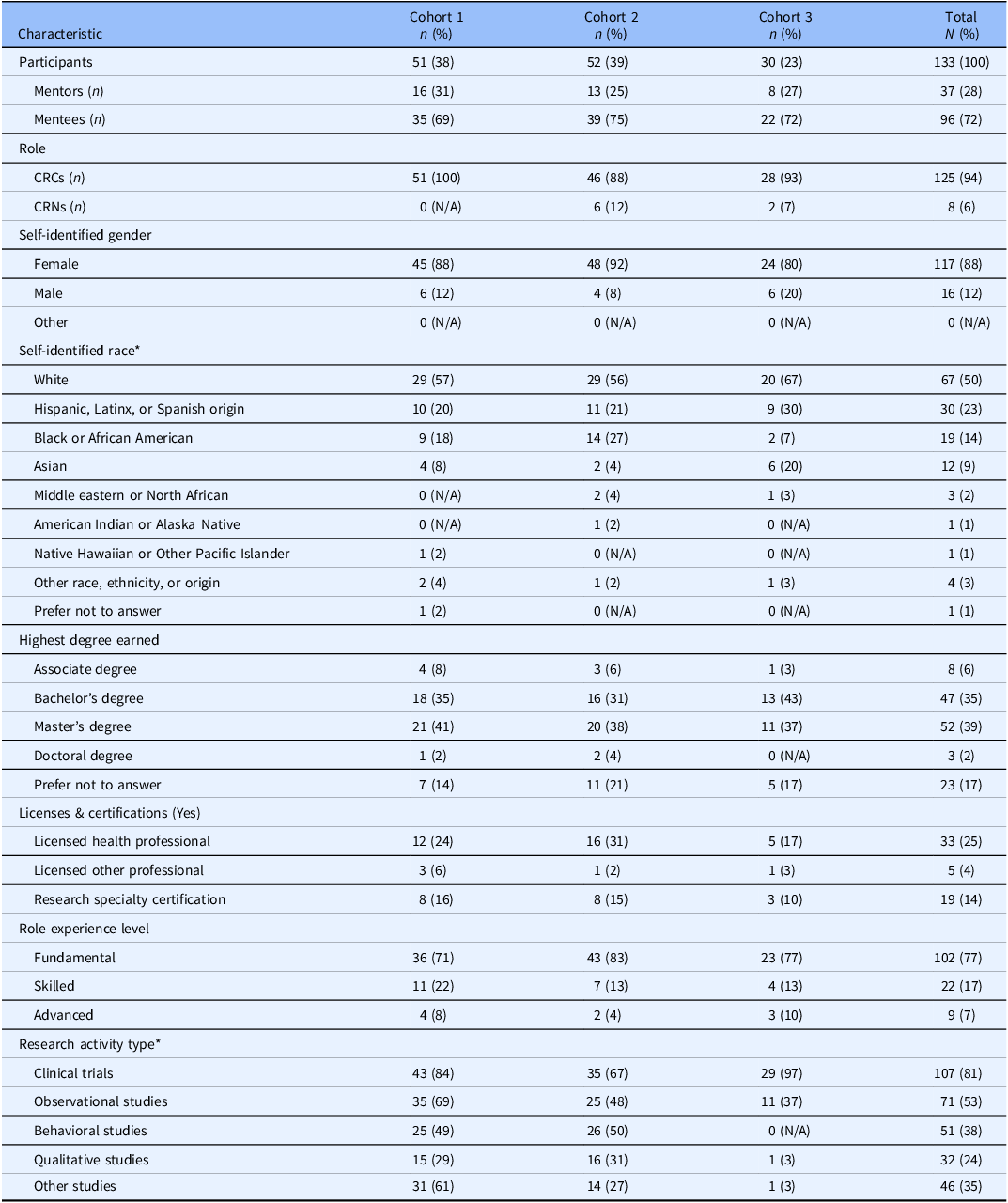
Participant characteristics by cohort.

Table 1. Long description
Table 1 presents participant characteristics for three mentorship program cohorts totaling 133 participants. This table summarizes participant demographics and professional characteristics. Across cohorts, participants included 37 mentors (28%) and 96 mentees (72%). Most participants were clinical research coordinators (94%), female (88%), held a bachelor’s or master’s degree, were at the fundamental experience level (77%), and participated in clinical trials (81%). Participants represented diverse professional backgrounds and research activities.
Note: Cohort percentages were calculated using the total number of participants within each cohort (Cohort 1 = 51, Cohort 2 = 52, Cohort 3 = 30). Total percentages were calculated using all participants across cohorts (N = 133). Assignment of mentor and mentee roles was based on participant experience, availability, willingness to mentor, and prior mentoring experience, with mentees paired to experienced coordinators. Role experience levels were defined as Fundamental (<2 years in the current role), Skilled (>3 years of clinical research experience and >3 years in the current role), and Advanced (>6 years of clinical research experience and >6 years in the current role).
*Participants could select more than one response for race/ethnicity and research activity type; therefore, percentages for these variables may exceed 100%.
Digital platform
Microsoft Teams Classroom served as the program’s digital workspace for communication, group-based activities, and resource sharing. The Home page provided an easy-access dashboard to event calendars, a question-and-answer board, mentor and mentee checklists, contact information, reminders, and housed a Bookings schedule for additional protocol consultation services. Additional applications used throughout the platform included SharePoint, Planner, Whiteboard, Reflections, and Kudos to support program activities [Reference Lawson, Barros, Evans and Saleem11]. A clinical research library was created and organized by JTF domains [12] to share resources and support research navigation. In addition to the general communication pathways and Teams chat, each group had a private channel for group-specific use.
Evaluation phase
In the Evaluation Phase, formative and summative feedback were reviewed and used to improve cohort program operations, activities, workshops, and resources [Reference Branch14]. The Kirkpatrick Model measured program effectiveness at four levels: Reaction (Level 1), Learning (Level 2), Behavioral Change (Level 3), and Results (Level 4), evaluating participant experiences, learning outcomes, application, and program sustainability [Reference Kirkpatrick and Kirkpatrick22]. Engagement indicators provide insight into the participant’s program experience and perceived quality [Reference Quinton, Tidmarsh, Parry and Cumming23]. Previous studies indicated that professional recognition is an important motivator for TWD program engagement [Reference Carey, Dunn and Braxton3,Reference Lee-Chavarria, Loucks and Paranal7]. In response, Credly acceptance rates (digital badge and program completion certificate) and sharing rates (social media) were monitored as additional engagement indicators.
Data collection and analysis
Quantitative and qualitative feedback were collected throughout the program using Qualtrics and Microsoft Forms: T0 (registration and participant preference surveys); T1 (pre-program assessments); T1–T6 (workshop evaluations); T3 (formative evaluation); and T6 (post-program surveys). Kirkpatrick Level 1 (Reaction) measures included program satisfaction, perceived value, program recommendation, and interest in future program participation. Sense of community was preliminarily assessed using the Sense of Community Index 2.0 (SCI-2) [24] in Cohort 1 and supplemented with measures of networking, connection, and community engagement in subsequent cohorts. Kirkpatrick Level 2 (Learning) focused on participants’ self-reported KSC improvements [12,13]. For mentees, pre- and post-assessment surveys focused on JTF competency domains [Reference Jones, LIU, Hornung, Fritter and Neideker17], whereas mentor assessments focused on CIMER Entering Mentoring competencies [Reference Hyun, Rogers, House, Sorkness and Pfund19]. Kirkpatrick Level 3 (Behavior) examined participant behavior change and application of learning to CRP research workflows and mentoring practices [Reference Kirkpatrick and Kirkpatrick22,Reference Quinton, Tidmarsh, Parry and Cumming23]. Kirkpatrick Level 4 (Results) measured program completion and participant-to-mentor progression to evaluate program feasibility, sustainability, and organizational impact [Reference Kirkpatrick and Kirkpatrick22,Reference Quinton, Tidmarsh, Parry and Cumming23].
Results
The six-month mentorship program launched as Cohort 1 in July 2024. Additional consecutive cohorts started in January 2025 (Cohort 2) and July 2025 (Cohort 3). Outcomes evaluate Cohorts 1–3 (July 2024–December 2025). Program participation includes 133 coordinators, including 37 mentors and 96 mentees, across 20 mentor groups. Groups were organized around shared clinical or research focus areas.
Program and participant characteristics
Participants represented two institutions, four sites, six colleges, 52 departments, and multiple research settings. Most participants were affiliated with the College of Medicine (89%), supported clinical trials (81%), and served in CRC roles (94%). Mentors generally reported greater research and role experience than mentees. See Table 1 for participant and cohort-specific program characteristics.
Program outcomes by Kirkpatrick level
Kirkpatrick level 1: Reaction
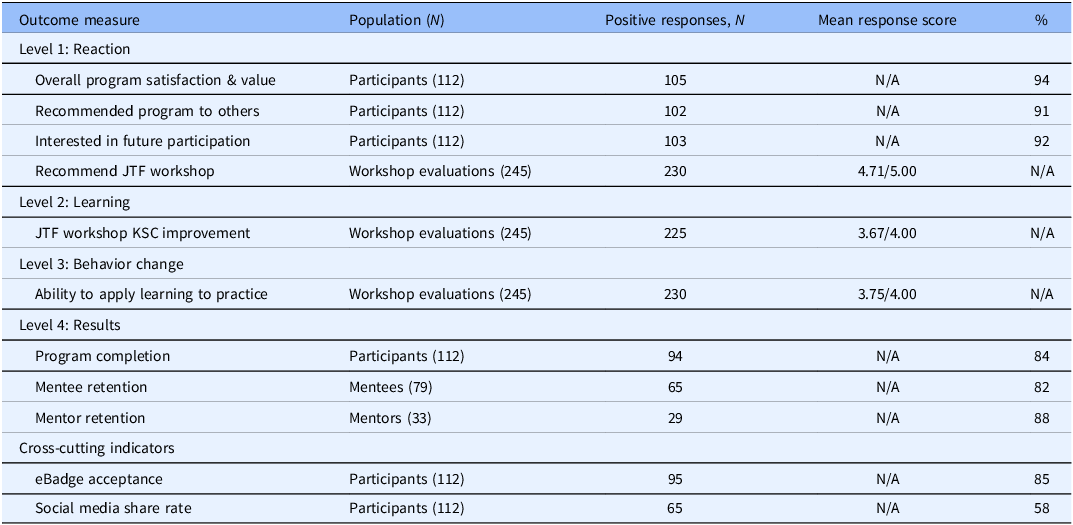
Participants reported strong positive reactions to the program, including high satisfaction and perceived value levels (94%), program recommendation (91%), and interest in future participation (92%) (Table 3). Participants reported a high likelihood of recommending the workshops to other coordinators (mean response score 4.71/5.00). Qualitative feedback described expanded professional networks, strong professional connections, and a sense of community across departments and institutions. Negative feedback was primarily related to limited group engagement (Table 3).
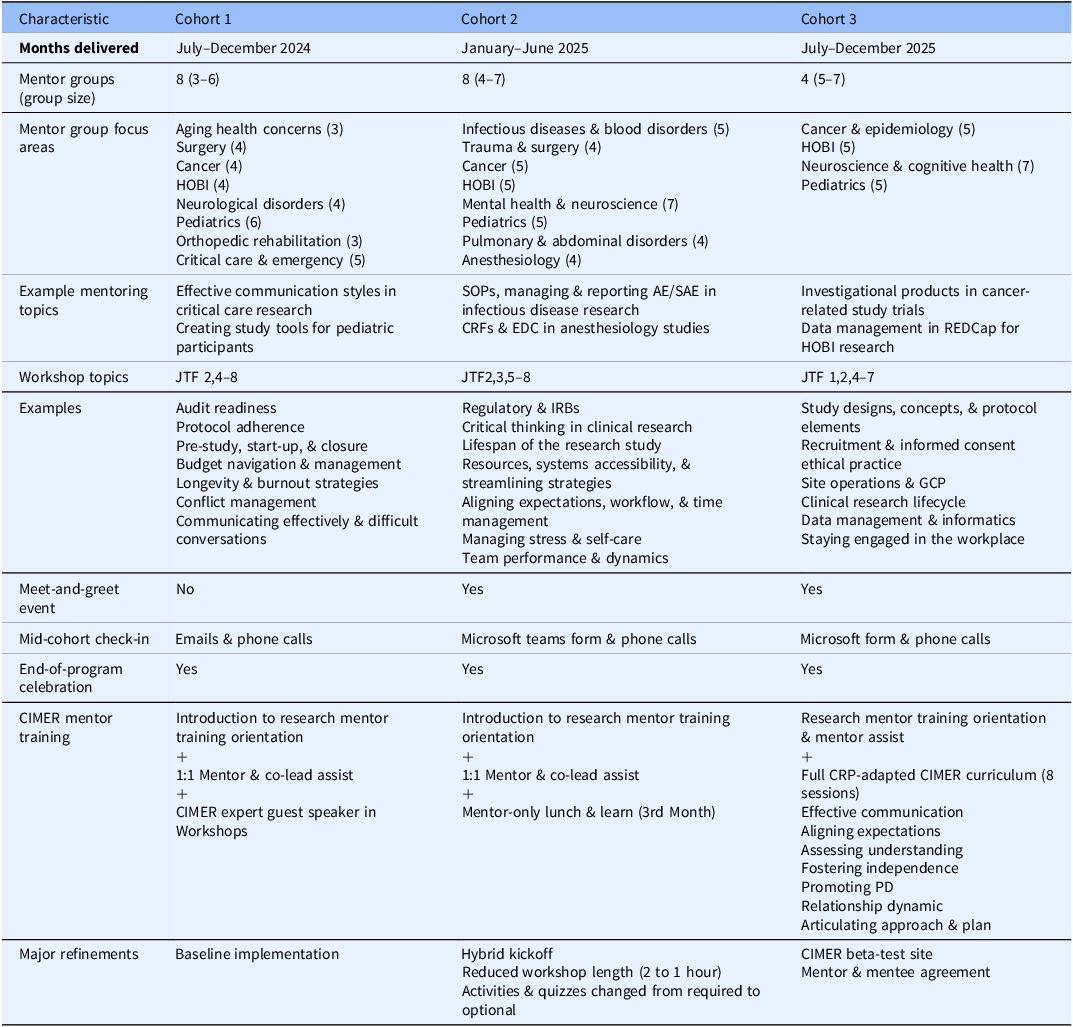
Program characteristics by cohort.

Table 2. Long description
Table 2 presents program characteristics for three mentorship program cohorts totaling 133 participants. This table summarizes program characteristics across cohorts delivered from 2024 to 2025. Cohorts included 4 to 8 mentor groups and offered mentoring meetings, professional development workshops, networking opportunities, mentor training, and program evaluation activities. Program refinements were implemented across cohorts to enhance delivery and participant experience.
Kirkpatrick level 2: Learning
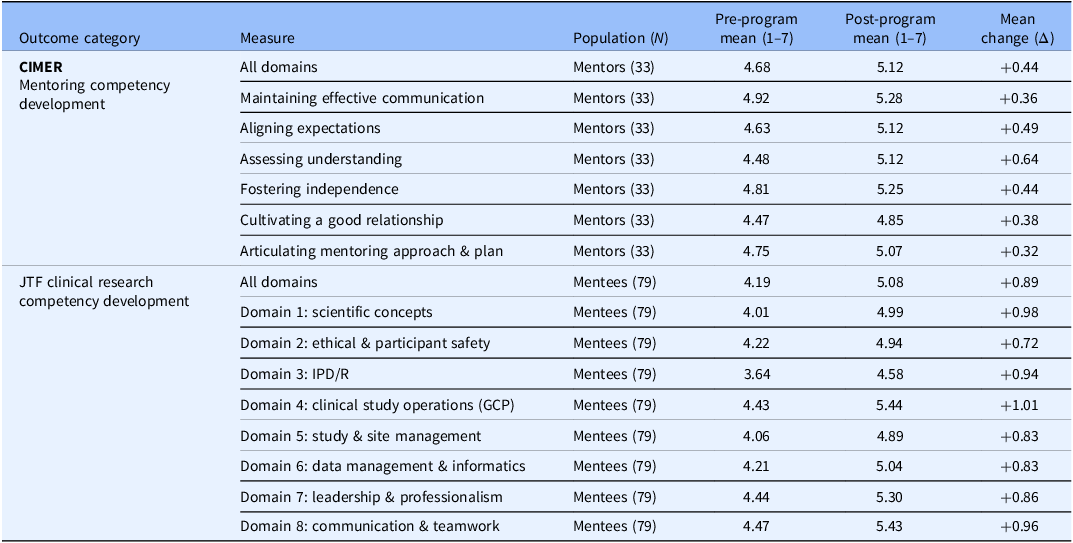
Participants reported gains in KSC following program participation. Among mentees, the mean KSC in JTF competency scores increased from moderately skilled to proficient across all eight domains, with overall scores increasing from 4.19 to 5.08 (+0.89) (Table 5). The largest gains were observed in Clinical Study Operations (+1.01), Scientific Concepts (+0.98), and Communication and Teamwork (+0.96). Participants reported PD workshops improved their KSC (mean response score 3.67/4.00) (Table 3).
Quantitative outcomes by Kirkpatrick evaluation level.

Table 3. Long description
Table presents quantitative outcomes of the mentorship program organized by the Kirkpatrick evaluation framework. Level 1 (Reaction) demonstrated high participant satisfaction (94%), program recommendation (91%), interest in future participation (92%), and strong workshop ratings. Level 2 (Learning) showed improvements in knowledge, skills, and confidence. Level 3 (Behavior) indicated application of learning, communication strategies, and mentoring practices. Level 4 (Results) demonstrated high program completion (84%), mentee retention (82%), mentor retention (88%), and workforce development. Additional engagement indicators included digital badge acceptance (85%) and social media sharing (58%). Qualitative findings highlighted benefits related to community, networking, confidence, learning, and professional growth, while challenges primarily involved engagement, time constraints, workload demands, and group participation.
Note: Kirkpatrick evaluation levels include Level 1 (Reaction), Level 2 (Learning), Level 3 (Behavior), and Level 4 (Results) [Reference Jones, LIU, Hornung, Fritter and Neideker17]. Participants include all program completers (N = 112), including mentees (n = 79) and mentors (n = 33). JTF workshop evaluation data [Reference Samuels, Champagne and Lyden15] were drawn from completed monthly workshop surveys across three cohorts (Cohort 1: n = 98; Cohort 2: n = 92; Cohort 3: n = 55; Total evaluations: n = 245). Workshop measures: Workshop evaluation outcomes reflect the proportion of positive responses. For workshop recommendation items, positive responses included ratings of 4 or 5 on a 5-point Likert scale. Workshop recommendation was assessed using the item, “How likely are you to recommend this month’s workshop to another coordinator?” rated on a 5-point Likert scale (1 = Not at all Likely; 5 = Extremely Likely). Learning and application outcomes were assessed using the items, “Taking this month’s workshop improved my knowledge, skills, and/or confidence in being a coordinator” and “I can use or apply what I learned to improve my work performance in my career,” rated on a 4-point Likert Scale (1 = Strongly Disagree; 2 = Partially Disagree; 3 = Partially Agree; 4 = Strongly Agree). Individual participants may have completed multiple workshop evaluations. Credly average for digital badge and certificate “Acceptance Rate” is 67% and “Shared on Social Media Rate” is 47%.
JTF = Joint Task Force for Clinical Trial Competencies; KSC = Knowledge, Skills, and Confidence; CIMER = Center for the Improvement of Mentored Experiences in Research; eBadge = Electronic Digital Badge.
Mentoring skills also improved over time. Qualitative feedback from mentors in Cohorts 1 and 2 identified a need for additional mentor-focused training, particularly in group facilitation, mentee engagement, and mentoring strategies (Table 4). In response, mentors in Cohort 3 completed a CRP-adapted CIMER Entering Mentoring eight-session curriculum, as part of a University of Minnesota CTSA hub beta test site (Bowman et al., 2024, abstract, doi: 10.1017/cts.2024.135). Mean scores remained consistent across cohorts, with the mean KSC in CIMER mentoring competency scores increasing from moderately skilled to proficient, from 4.68 to 5.12 (+0.44) (Table 5).
Qualitative outcomes by Kirkpatrick evaluation level.

Table 4. Long description
Panel A: Level 1 Reaction. Positive examples include community building and program satisfaction. Negative examples include small group engagement issues and program structure challenges. Panel B: Level 2 Learning. Positive examples include professional confidence and skill development. Negative examples include topic applicability and relevance concerns. Panel C: Level 3 Behavior. Positive examples include application of learning and behavior change. Negative examples include time constraints and mentoring barriers. Panel D: Level 4 Results. Positive examples include institutional adoption and sustainability. Negative examples include conflicting demands and time burden.
Note: Qualitative findings were derived from post-program surveys and monthly workshop evaluations collected across mentees and mentors from all three cohorts.
Pre- and post-program competency mean scores (Kirkpatrick level 2: learning)

Table 5. Long description
Table presents pre- and post-program self-assessment competency scores for mentors (n=33) and mentees (n=79). Mentors demonstrated improvements across all CIMER mentoring competency domains, with the overall score increasing from 4.68 to 5.12 (+0.44). The largest improvement was observed in assessing understanding (+0.64). Other gains were reported in communication, aligning expectations, fostering independence, relationship building, and articulating a mentoring approach. Mentees demonstrated improvements across all JTF clinical research competency domains, with the overall score increasing from 4.19 to 5.08 (+0.89). The largest gains were observed in clinical study operations (+1.01), scientific concepts (+0.98), communication and teamwork (+0.96), and investigational products development and regulation (+0.94). All domains showed positive improvement following program participation.
Note: Participants rated their skill level before and after program participation using a 7-point self-assessment scale (1= Not at All; 2 = Slightly; 3 = Somewhat; 4 = Moderately; 5 = Proficiently; 6 = Very; 7 = Extremely). Mean change (Δ) was calculated as post-program mean minus pre-program mean. Higher scores indicate greater perceived KSC.
CIMER = Center for the Improvement of Mentored Experiences in Research; KSC = Knowledge, Skills, Confidence; JTF = Joint Task Force for Clinical Trial Competencies; IPD/R = Investigational Products Development & Regulation; GCP = Good Clinical Practice.
Kirkpatrick level 3: Behavior
Participants reported using mentoring discussions for problem-solving, professional reflection, and accountability. When engagement was consistent, participants described applying mentor guidance to workplace challenges and professional decision-making. Mentors reported growth in leadership confidence and communication practices, including setting clearer expectations, using active listening techniques, and adapting their approaches to support mentee development. Participants reported applying newly acquired knowledge, skills, and resources to daily work responsibilities, with responses approaching “Strongly Agree” on the workshop evaluation scale (mean response score 3.75/4.00).
Resources introduced during workshops and mentor group meetings, such as study logs, budget worksheets, workflow trackers, and self-audit tools, were available on Microsoft Teams and regularly referenced throughout the program to increase awareness and encourage use. Participants reported enjoying and using shared resources and tools, leading to workflow optimization, documentation practices, communication strategies, and regulatory processes (Table 4).
Kirkpatrick level 4: Results
Program outcomes reflected sustained engagement and organizational value across cohorts. Overall retention was 84%, with 82% among mentees and 88% among mentors (Table 3). Attrition was primarily associated with role changes, institutional departures, and competing workload demands. Because workshop topics were tailored to each cohort’s interests, returning participants were exposed to new content and experiences (Table 2).
Qualitative feedback highlighted organizational benefits, including onboarding, TWD, and continued institutional support (Table 4). Participants described the program as a valuable mechanism for building professional networks and strengthening workforce connections across departments and institutions. Twelve participants from Cohorts 1 and 2 elected to participate in a subsequent cohort, reflecting continued engagement with the program. Three former mentees subsequently served as mentors in later cohorts, demonstrating the potential for progression within the mentoring model.
Cross-cutting digital engagement outcomes
Participants described Microsoft Teams as a useful space for accessing recorded content, shared resources, and peer learning opportunities (Table 4). Comparable platform analytics were not available across all cohorts; however, available data from Cohort 3 suggested sustained engagement during group meetings, workshops, and major program milestones.
Digital recognition outcomes
Additional engagement drivers were encouraging: 85% of participants accepted their Credly digital badge and program certification, and 58% shared their achievement on social media, both exceeding the reported Credly platform averages (Table 3) Participants described the digital badge and workshop ACRP and SoCRA recertification CEs as valuable program incentives.
Discussion
This program demonstrated that a hybrid, digital mentoring model supports CRCs and CRNs across decentralized AHCs, through co-led mentoring groups, monthly PD activities, and shared digital community workspaces [Reference Cranfill, Deeter, Hannah, Snyder and Freel2,Reference Nelson, Dunn and Levites Strekalova9,Reference Lawson, Barros, Evans and Saleem11–13]. The program encouraged peer connections across various settings, shared learning experiences, and improved KSC relevant to coordinator responsibilities [Reference Carey, Dunn and Braxton3,Reference Nelson, Dunn and Levites Strekalova9,10]. Organizing mentoring groups around shared interests, primarily similar research or clinical focus areas, enhanced topic relevance and practical application of content. These shared goals facilitated further group discussion of role-specific challenges and enabled adaptability across topics, all while maintaining a consistent program structure.
Competency-based, role-relevant workshops were identified as engaging and easy to apply to daily workflows. Providing opportunities for peer experts to present at workshops allowed specialized content to be incorporated without dedicated instructional staff. Digital platforms enabled mentor groups to connect across boundaries that often limit access to shared opportunities [Reference Lawson, Barros, Evans and Saleem11]. The flexibility of combining hybrid opportunities and easily accessible, centralized resources may be particularly valuable for coordinators who balance competing clinical and research responsibilities.
Autonomy in choosing mentor groups and topics promoted positive reactions toward program facilitators and peers, increased participant enjoyment, engagement, and learning, and thus improved KSC and demonstrated program effectiveness [Reference Quinton, Tidmarsh, Parry and Cumming23]. Relationships with mentors and facilitators appeared to be highly influential in skill development [Reference Quinton, Tidmarsh, Parry and Cumming23]. Workshops, CEs toward recertifications, and Credly digital badges were positive incentives and drivers of engagement for program participation.
The program also demonstrated potential for scalability to other CTSA hubs. Using existing institutional infrastructure, resources, and volunteer mentors reduces the need for superfluous funding; however, administration required approximately 0.50 FTE during program development and implementation, which decreased to approximately 0.25 FTE after workflows were established. Together, these features suggest that similar mentoring programs may be feasible if supported by existing institutional learning platforms, personnel, and experienced CRPs willing to serve as mentors.
Lessons learned
Several implementation challenges emerged. Differences in digital literacy and access to technology required additional support to ensure consistent participation and engagement. Competing priorities, high workload demands, and participant turnover affected mentor group engagement. These barriers reinforced the need for mentorship models that remain flexible and functional despite workflow variability.
Feedback from Cohort 1 recommended an in-person touchpoint, which led to hybrid meet-and-greet events and program celebrations at each site. Mentors recommended formal mentoring training, protected preparation time, and financial incentives. Another lesson involved managing communication volume within the digital platform. Both limited and excessive messaging hindered engagement. Active communication oversight and adaptation included adjusting posting frequency, consolidating announcements, and using targeted reminders to sustain engagement while minimizing communication fatigue.
Limitations
This program was implemented within a single CTSA hub. Outcomes were assessed using self-reported measures. Future participant follow-up and performance metrics are needed to assess the program’s long-term impact. Technology constraints at locations 2–4 limited access to guest status, which limited full platform accessibility for some participants.
Future directions
Structuring future cohorts by experience level will help learning activities and discussions better align with participants’ learning needs and increase peer connections among participants at similar career stages. Planned enhancements include expanded mentor development offerings and individualized needs assessments, such as the eMPACT Training and Career Advancement Survey, to guide individualized learning opportunities [26]. Future programs include shared governance co-mentoring circles, connecting skilled CRPs and academic practice partners, and branching clinical and research practices [Reference Carey, Dunn and Braxton3,Reference Nelson, Dunn and Levites Strekalova9,Reference Johnson27]. Together, these efforts reflect a commitment to sustaining and refining mentorship models that support the clinical research workforce’s evolving needs across AHCs.
Supplementary material
The supplementary material for this article can be found at https://doi.org/10.1017/cts.2026.10850
Acknowledgements
The authors thank the mentors and mentees who volunteered to participate in this program, including Socorro (Tet) Pata and Jennifer Hosford for championing the program. We also thank all workshop presenters and J. Hope Dover, Dr Roger Fillingim, Dr Wayne McCormack, and Dr Jennifer Moses, for sharing their expertise, which contributed to the success of this initiative.
We further acknowledge Kristin Boman and the University of Minnesota Clinical and Translational Science Institute Workforce Development group for the opportunity and support to participate as a beta test site.
AI-assisted tools were used for drafting and editing support; authors retain full responsibility for the content and compliance with the journal’s authorship policy.
Author contributions
Alexandria A. Carey: Conceptualization, Data curation, Formal analysis, Investigation, Methodology, Project administration, Resources, Supervision, Validation, Visualization, Writing – original draft, Writing – review & editing; Kimberly Mattox: Formal analysis, Validation, Visualization, Writing – original draft; Emilie Schmidt: Validation, Writing – original draft, Writing – review & editing; Steven Fowler: Writing – original draft; Evan Waters: Writing – original draft; Elizabeth C. Dunn: Conceptualization, Funding acquisition, Resources, Supervision, Validation, Writing – review & editing.
Funding statement
Research reported in this publication was supported by the National Center for Advancing Translational Sciences of the National Institutes of Health (NIH) under Award Number UM1TR005128. The content is solely the responsibility of the authors and does not necessarily represent the official views of the NIH. This manuscript is the result of funding in whole or in part by the NIH. It is subject to the NIH Public Access Policy. Through acceptance of this federal funding, NIH has been given a right to make this manuscript publicly available in PubMed Central upon the Official Date of Publication, as defined by NIH.
Competing interests
None.




 Open access

