Implications
The in ovo development of broiler gives the opportunity to manipulate the embryos by alteration of external factors like the incubation temperature. This manipulation hopefully results in changes of the chicks/ broiler post-hatch, especially in the improvement of the growth and breast weights, as these are important features for the farmers and the meat industry. The aim of the present study was to elucidate, how an increasing/decreasing incubation temperature during middle embryogenesis up to embryonic day (ED) 13 influences the growth properties during post-hatch growth and what might be the reasons for these alterations.
Introduction
The effects of incubation temperature alterations during poultry embryogenesis have been presented in different publications (Hammond et al., Reference Hammond, Simbi and Stickland2007; Piestun et al., Reference Piestun, Halevy and Yahav2009; Krischek et al., Reference Krischek, Janisch, Naraballobh, Brunner, Wimmers and Wicke2013; Loyau et al., Reference Loyau, Berri, Bedrani, Metayer-Coustard, Praud, Duclos, Tesseraud, Rideau, Everaert, Yahav, Mignon-Grasteau and Collin2013; Janisch et al., Reference Janisch, Sharifi, Wicke and Krischek2015; Krischek et al., Reference Krischek, Kuembet, Wicke and Gerken2016). For example, Krischek et al. (Reference Krischek, Janisch, Naraballobh, Brunner, Wimmers and Wicke2013) showed that an increasing incubation temperature (+1°C) from ED 3 up to ED 6 (ED 3 to 6) has no impact on the weight characteristics of 33-day-old broilers. In contrast to this, a decrease of the temperature (−1°C) from ED 7 till ED 10 (ED 7 to 10) or from ED 10 till ED 13 (ED 10 to 13) of broiler embryogenesis results in lower BWs of 35-day-old broilers (Janisch et al., Reference Janisch, Sharifi, Wicke and Krischek2015). In a similar study, Krischek et al. (Reference Krischek, Kuembet, Wicke and Gerken2016) presented that the temperature decrease also reduces the BWs of embryos, collected directly after temperature treatment at ED 10 or ED 13. This alteration was accompanied with reduced mitochondrial respiratory activities (MRAs) in the breast and leg muscles of the ED-10 and ED-13 embryos. In addition, the temperature decrease also resulted in lower phosphofructokinase (PFK), glycogen phosphorylase (GP), lactate dehydrogenase (LDH) and cytochrome oxidase (COX) activities in the embryonic breast muscles. Mitochondrial respiratory activity and COX activity were analyzed to elucidate the influence of the temperature alteration on the aerobic metabolism, whereas LDH activity was determined to consider the impact of the anaerobic metabolism. The other enzymes are involved either in the anaerobic or aerobic degradation of carbohydrates like glycogen or glucose (England et al., Reference England, Scheffer, Kasten, Matarneh and Gerrard2013; Russell et al., Reference Russell, Foletta, Snow and Wadley2014). As shown before, an alteration of the incubation temperature before ED 7 has no persistent effect on the BWs of the broilers after hatch, whereas temperature changes after ED 7 affected the embryo and broiler growth and in embryos these alterations were clearly related to the muscle metabolism. Considering this aim of the present study was to analyze, if the temperature treatment after incubation of broiler eggs at 36.8°C (group L), 37.8°C (control) and 38.8°C (group H) from ED 7 up to ED 10 and ED 10 up to ED 13 has a persistent effect on the mitochondrial respiratory and metabolic enzyme activities within the breast and leg muscles of day-old chicks and 35-day-old broilers. For the best of our knowledge, no studies have been published that investigated these parameters after changing the incubation temperature during middle embryogenesis in broilers.
Material and methods
Incubation conditions
From a commercial company (Wimex GmbH, Regenstauf, Germany) 1001 eggs of a fast-growing broiler line (Cobb-Vantress Inc., Siloam Spring, AR, USA) were purchased. The eggs were from breeder flocks with a mean age of 42 weeks. The eggs were initially incubated at 37.8°C and 55% relative humidity (RH) up to ED 7 in a commercial incubator (HEKA; Euro-Lux, Rietberg, Germany). After candling of all eggs unfertilized eggs (N=78, fertilization rate: 92.2%) and dead embryos (N=30) were removed. On ED 7 and ED 10, 162 and 152 eggs, respectively, were transferred to a second identical incubator (HEKA) and incubated at higher temperature (group H: 38.8°C, 65% RH) for 3 days up to ED 10 and 13. After this treatment the eggs were transferred back to the incubator with normal temperature and RH (37.8°C, 55% RH) and were further incubated until hatching. The previously described treatment was repeated with the alteration that eggs were incubated in an identical incubator at lower temperature (group L: 36.8°C, 55% RH) between ED 7 and 10 (Time A, N=156) and ED 10 and 13 (Time B, N=154). All control eggs (N=269) were incubated at 37.8°C and 55% RH during the whole incubation period. From ED 18 until hatch all eggs were incubated at 37.8°C and 65% RH.
Sample collections
After hatching, the chicks remained in the incubator, until all broiler chicks had hatched. Then all chicks were sexed using the feather sexing method, as female broilers showed longer primary feathers at the wing tips in comparison with the males. The hatch rates were determined by calculating the amount of hatched chicks in relation to the amount of fertilized eggs with vital embryos at ED 7.
Eight day-old chicks per treatment group and sex (male, female) were killed and dissected immediately after hatch. The body, liver and heart weights were determined. From the Musculus pectoralis superficialis (MPS) and the leg muscles up to 100 mg of the muscle samples were stored in a storage buffer (15 mM phosphocreatine, 49 mM potassium morpholino-ethanesulfonic acid, 20 mM taurine, 20 mM imidazol, 5.2 mM ATP, 9.5 mM MgCl2, 3 mM potassium hydrogen phosphate, 0.5 mM dithiothreitol, pH 7.1) for analysis of the MRA. In addition, up to 10 g of the MPS was immediately frozen in liquid nitrogen and stored at −80°C until determination of the metabolic enzyme activities. A block (1×1×1 cm3) was removed from the MPS according to Scheuermann et al. (Reference Scheuermann, Bilgili, Tuzun and Mulvaney2004) and frozen in liquid nitrogen for histological analysis of the cross-sectional areas (CSA).
For the growth experiments, at least 35 female and male broilers per treatment group were weighed and wing-marked. The broilers were subsequently raised in the same barn equipped with 10 compartments separated by wire fences under similar conditions. The male and female broilers of the treatment groups were raised in separate compartments that have a size of about 6 m2. To minimize any disturbing environmental influences no birds had access to the outdoor area. At the beginning the temperature was 24°C and the light intensity 22 Lux and the parameters were gradually reduced to 18°C and 4 Lux up to day 35. The daily light period was decreased from 24 to 16 h within the 1st week and was kept at 16 h until slaughter of the broilers. The litter (chipped wood) was controlled daily (e.g. dirt, wetness) and additional material added in case the animals were slightly dirty. At the end of the growth period the stocking density did not exceed 25 kg/m2. The animals were fed a conventional diet ad libitum.
At day 35, 30 broilers/incubation group and sex were randomly removed from the pens and weighted. The birds were slaughtered in the experimental poultry abattoir of the Department of Animal Sciences (Goettingen, Germany). After stunning (0.12 A, 5 to 10 s) and bleeding, the broilers were scalded (58° to 60°C, 3 min) and mechanically defeathered. Subsequently the carcasses were manually eviscerated and the carcass weight was determined. All carcasses were dissected by removing the MPS and the legs. The MPS and leg weights were determined. From eight broilers per treatment group and sex (male, female) samples from the MPS and the m. iliotibialis (MIT) were removed for analysis of MRA and metabolic enzyme activities (only MPS) as described above. A block (1×1×1 cm2) was removed from the MPS according to (Scheuermann et al., Reference Scheuermann, Bilgili, Tuzun and Mulvaney2004) and frozen in liquid nitrogen for CSA analysis.
Methods
For histological analysis of the MPS the collected muscle blocks were cut in cross-sectional direction and stained with eosin. The CSA were determined by circumscribing at least 100 muscle fibers from three different sections (Janisch et al., Reference Janisch, Krischek and Wicke2011).
The frozen samples from the MPS were diluted 1 : 10 in 100 mM KCL, 50 mM Tris, 10 mM MgCl2×6H2O and 1 mM EGTA. After homogenization for 1 min at 1200 U/min on ice with a Potter-homogenisator (B. Braun Biotech International, Melsungen, Germany), the protein concentrations of the homogenates were determined according to Bradford (Reference Bradford1976). The activities of GP, PFK, LDH, citrate synthase (CS) and COX activities were analyzed according to Krischek et al. (Reference Krischek, Kuembet, Wicke and Gerken2016) with a spectrophotometer (Libra S22; Biochrom, Cambridge, UK) within 2 h to prevent negative storage-dependent effects. The homogenates were incubated at 37°C for 5 min (LDH, CS, COX) or 10 min (PFK, GP) and the results were stated in U/g protein.
The state-3-MRA of the MPS and MIT samples were determined with an Oxygraph (Oroboros, Innsbruck, Austria) according to Krischek et al. (Reference Krischek, Kuembet, Wicke and Gerken2016) using the substrate combinations pyruvate/malate (Pyr/Mal) for analysis of the complex I-dependent respiration and succinate/rotenone (Succ/Rot) for analysis of the complex II-dependent respiration.
Chemicals
All chemicals were purchased from Sigma-Aldrich GmbH, Taufkirchen, Germany, unless otherwise indicated.
Statistical analysis
The data obtained from the mitochondrial respiratory and enzymatic activities were analyzed by ANOVA with the mixed procedure of SAS version 9.3 (SAS Institute, 2012) according to the following model:
 $$y_{{ijke}} {\equals}\mu {\plus}\alpha _{i} {\plus}\beta _{j} {\plus}\gamma _{k} {\plus}\alpha \beta _{{ij}} {\plus}\alpha \gamma _{{ik}} {\plus}\beta \gamma _{{jk}} {\plus}\alpha \beta \gamma _{{ijk}} {\plus}e_{{ijke}} $$
where y is the mitochondrial respiratory and enzymatic activity of the day-old chicks and the 35-day-old broilers, μ the general mean, α i the fixed main effect of incubation time (i: 1=ED 7 to 10, 2=ED 10 to 13), β j the fixed main effect of treatment (j: 1=control, 2=group H, 3=group L), γ k the fixed main effect of sex (k: 1=male, 2=female), αβ ij , αγ ik , βγ jk and αβγ ijk the interactions between the main effects and e ijke the random error.
As no significant effect of the incubation time could be found, only the effects of the treatment (β j ) and sex (γ k ) and their interaction (βγ jk ) are presented in the ‘Results and discussion’ section.
Results
Hatch results
The hatch rates for the five treatment groups were 88.3% (143/162, group H, Time A), 88.2% (134/152, group H, Time B), 89.7% (140/156, group L, Time A), 91.5% (141/154, group L, Time B) and 87.4% (235/269, Control) not differing (P>0.05) between all groups.
Growth characteristics
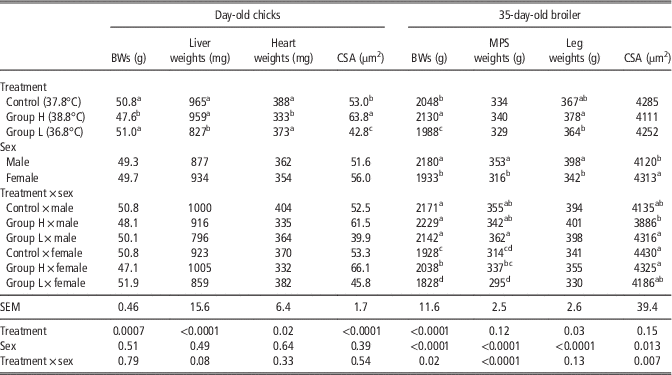
The day-old chicks of the control and group L showed higher (P⩽0.05) body and heart weights than the group H chicks. The liver weights of the group L chicks were lower (P⩽0.05) in comparison with the control and group H chicks who had similar (P>0.05) liver weights. The CSA values of the MPS in the group L chicks were lower (P⩽0.05) in comparison with the group H chicks, whereas the results of the control chicks were in-between thereby differing (P⩽0.05) from the CSA results of the other groups (Table 1). No effect of the sex and the treatment×sex interaction on the body, liver and heart weights as well as the CSA results could be determined (Table 1).
Least squares means (+ SEM) of body and slaughter traits and histological results of day-old chicks and 35-day-old broiler and significance results of the effects of treatment and sex and their interaction

MPS=Musculus pectoralis superficialis; CSA=cross-sectional area of the MPS.
a,b,c,dMeans in a column within the same group (treatment, sex, treatment×sex) showing different superscripts differ significantly (P<0.05).
The 35-day-old broilers of the group H had higher (P⩽0.05) body and leg weights in comparison with the group L birds. The body and leg weights of the control broilers were in-between, whereas the body, but not the leg weight results differ (P⩽0.05) from those of the other groups. The MPS weights were comparable (P>0.05) between group H, group L and control animals. The CSA values of the MPS were not differing (P>0.05) between the treatment groups (Table 1). Considering the effect of the sex the male broiler showed higher (P⩽0.05) body, MPS and leg weights as well as lower CSA values (P⩽0.05) in comparison with the female broilers (Table 1). For the body and MPS weights as well as CSA results significant effects (P⩽0.05) of the treatment×sex interaction could be found. The male group H, group L and control broiler (cocks) showed comparable body and MPS weights (P>0.05). However, in the hens the highest body and MPS weights could be found in the group H broiler followed by the control and group L hens. The BW results differed (P⩽0.05) between the groups, but the MPS weights differed only (P⩽0.05) between the group H and group L hens. The MPS results of the control hens were in-between not differing (P>0.05) from the values of the other two groups. The CSA results of all female MPS were comparable (P>0.05). However, the male group H birds had lower (P⩽0.05) CSA values than the male group L broiler, whereas the results of the control broiler were in-between not differing (P>0.05) from those of the other groups (Table 1).
Metabolic enzyme activities
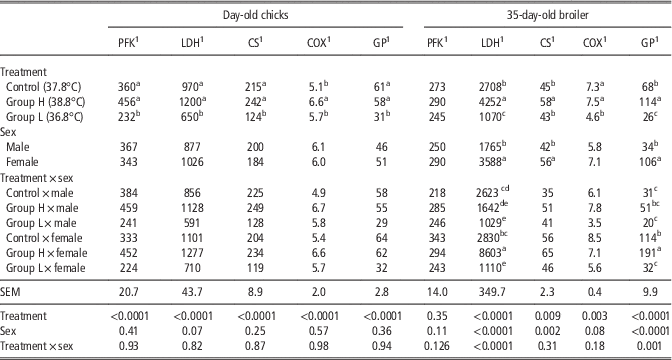
The MPS of the group H chicks had higher (P⩽0.05) activities of PFK, LDH, CS, COX and GP in comparison with the group L chicks. The same differences were found between the control and group L chicks, except for the COX activities that were comparable between control and group L. No effect of sex and treatment×sex interaction on the enzyme activities of the day-old chicks could be found (Table 2).
Least squares means (+ SEM) and significance for enzymatic activity in the m. pectoralis superficialis of day-old chicks and 35-day-old broiler in dependence of treatment and sex and their interactions

1 Enzyme activity in U/g protein: PFK=phosphofructokinase; LDH=lactate dehydrogenase; CS=citrate synthase; COX=cytochrome oxidase; GP=glycogen phosphorylase.
a,b,c,d,eMeans in a column within the same group (treatment, sex, treatment×sex) showing different superscripts differ significantly (P<0.05).
The MPS of the group H broiler had higher (P⩽0.05) activities of LDH, CS, COX and GP compared with the group L broilers. The LDH and GP activities of the control broiler were in-between differing (P⩽0.05) from the results of the other groups. The CS activities were comparable (P>0.05) between the control and group L broiler and the COX between the control and group H birds (Table 2). With regard to the sex of the broiler LDH, CS and GP activities of the female broiler were higher (P⩽0.05) compared with males. Significant (P⩽0.05) effects of the treatment×sex interaction on the LDH and GP activities could be found. In the hens the LDH and GP activities are clearly affected by the treatment with the highest results in the group H broiler followed by the control and group L birds. It is interesting to note that the LDH and GP activities of the group H hens were 3.0-fold and 1.6-fold higher (P⩽0.05) than the control values and 7.7-fold and 6.0-fold higher (P⩽0.05) in comparison with group L broilers. The LDH results of the group L broiler were lower (P⩽0.05) than the results of the control birds. The LDH activities of the group H broilers were comparable (P>0.05) with the results of the control and group L cocks. The GP values were comparable (P>0.05) between all groups (Table 2).
Mitochondrial respiratory activities
The factors treatment, sex and their interactions had no effect (P>0.05) on the MRA results in the breast muscles samples of day-old chicks with Pyr/Mal-MRA values of 12 nmol O2/min×mg and Succ/Rot-MRA results between 8 and 10 nmol O2/min×mg. However, in the leg muscle samples of the group L chicks the Pyr/Mal-MRA (22±7 nmol O2/min×mg), but not the Succ/Rot-MRA results (13±3 nmol O2/min×mg), were lower (P⩽0.05) in comparison with the group H chicks (Pyr/Mal: 26±5 nmol O2/min×mg; Succ/Rot: 14±3 nmol O2/min×mg). The control values (Pyr/Mal: 23±8 nmol O2/min×mg; Succ/Rot: 12±3 nmol O2/min×mg) did not differ from the results of the leg MRA results of the other treatment groups (data not shown).
In the breast and leg muscle samples of the 35-day-old broilers no effects (P>0.05) of the factors treatment, sex and their interaction on the MRA results could be found. The Pyr/Mal-MRA values were between 11 and 12 nmol O2/min×mg for the MPS and 9 and 11 nmol O2/min×mg for the leg samples. The Succ/Rot-MRA results were between 7 and 8 nmol O2/min×mg (MPS) and between 5 and 6 nmol O2/min×mg (leg) (data not shown).
Discussion
The positive effects of a temperature increase between ED 7 to 10 or ED 10 to 13 on the 35-day-old broiler BWs in the present study could be related to data, presented by Krischek et al. (Reference Krischek, Kuembet, Wicke and Gerken2016). In the latter study, the authors found higher BWs of ED-10 and ED-13 broiler embryos after temperature increase within the same embryonic periods (ED 7 to 10, ED 10 to 13) indicating a persistent effect of the temperature treatment during middle incubation up to slaughter, respectively, day 35 post-hatch. Krischek et al. (Reference Krischek, Kuembet, Wicke and Gerken2016) argued, referring to Hammond et al. (Reference Hammond, Simbi and Stickland2007), that the incubation temperature alteration influences the growth of the embryos by changing the embryonic movement/activity. Higher activity during embryonic development is associated with stimulation of the energy metabolism (Papa, Reference Papa1996; MacDougall et al., Reference MacDougall, Hicks, MacDonald, McKelvie, Green and Smith1998; Kang and Lim, Reference Kang and Lim2016). Therefore, the assumed increased embryonic movement/activity also explains the higher enzyme activity results of group H compared with group L ED-10 and ED-13 embryos (Krischek et al., Reference Krischek, Kuembet, Wicke and Gerken2016), day-old chicks and 35-day-old broilers (present study). However, the lower body and heart weight and, in contrast to this, higher liver weight and CSA results of the group H compared with group L day-old chicks are obscure. The heart weight results should not be overestimated, as this alteration is due to a negative association between incubation temperature and heart weight (Leksrisompong et al., Reference Leksrisompong, Romero-Sanchez, Plumstead, Brannan and Brake2007). Leksrisompong et al. (Reference Leksrisompong, Romero-Sanchez, Plumstead, Brannan and Brake2007) increased in three independent experiments the incubation temperature of broiler eggs between ED 14 and 20 and found in all experiments reduced heart ratios, although other parameters like BW or relative liver weights (in g/100 g) were either influenced or not influenced by the temperature alteration. Leksrisompong et al. (Reference Leksrisompong, Romero-Sanchez, Plumstead, Brannan and Brake2007) partly support our results, as they found in two of the three experiments lower BWs of day-old chicks incubated at higher temperature and in one of these experiments also higher relative liver weights. The authors explained these effects, referring to Gladys et al. (Reference Gladys, Hill, Meijerhof, Saleh and Hulet2000), that a higher incubation temperature accelerates the embryo development resulting in a negative effect on the hatchling BW. In relation to this Leksrisompong et al. (Reference Leksrisompong, Romero-Sanchez, Plumstead, Brannan and Brake2007) found in one experiment besides the lower chick weights higher relative yolk sac weights in the chicks incubated at higher temperature. They assumed that due to a reduced nutrient absorption from the yolk sac by the embryo the nutrients, necessary for development, are reduced accompanied with a lower chick weight. The latter explanation is supported by the results of Ipek et al. (Reference Ipek, Sahan, Baycan and Sozcu2014). The authors found comparable chick, higher yolk sac and lower yolk-free chick weights at day 1 after hatch after incubation of eggs between ED 10 and 18 at higher eggshell temperatures (EST) in comparison with embryos incubated within this period at low EST. Considering these explanations a higher yolk sac weight accompanied with a reduced nutrient uptake of the group H embryos/chicks compared with the group L animals might be also an explanation for the BW differences in the present study. Unfortunately, we did not determine the yolk sac and yolk-free chick weights. However, these assumptions cannot fully explain the diverging BW results directly after hatching in the present study, as nearly all results (enzyme activities, liver weights, CSA) of the day-old chicks agree with those of the ED-10 and ED-13 embryos or 35-day-old broilers (present results; Krischek et al., Reference Krischek, Kuembet, Wicke and Gerken2016). Further investigations are necessary to clarify this discrepancy. The treatment effects on the MRA results of the chicks partly agree with the results of Krischek et al. (Reference Krischek, Kuembet, Wicke and Gerken2016), who also found lower MRA values in the leg muscles of 10- and 13-day-old embryos of group L in comparison with group H embryos. However, Krischek et al. (Reference Krischek, Kuembet, Wicke and Gerken2016) also found effects of the temperature treatment on the breast muscle MRA results of the embryos. Why does the treatment effect on the embryonic MRA results, presented by Krischek et al. (Reference Krischek, Kuembet, Wicke and Gerken2016), persist in the leg but not the MPS samples of the chicks and also not in the leg and MPS samples of the 35-day-old broiler, although treatment effects on the weight and enzyme activity results could be found in chicks and broiler? A clear answer is difficult due to the complexity of muscle structure and metabolism. Possible reasons with regard to the chicks are that the activity of the animals after hatch is more related to the leg muscles accompanied with increased (muscle) metabolism and that the MPS and the leg muscles are structurally and metabolically different. The MPS which is more involved in flight movement and therefore less important for the chicks only consists of ‘white’ fast-twitch-glycolytic muscle fibers. The leg muscles (like the MIT) contain also high percentages of ‘red’ slow-twitch-oxidative (STO) muscle fibers (Branciari et al., Reference Branciari, Mugnai, Mammoli, Miraglia, Ranucci, A. Dal Bosco and Castellini2009). Fast-twitch-glycolytic fibers in comparison with STO fibers usually have larger CSA values and are more anaerobic due to lower amounts of mitochondria (Branciari et al., Reference Branciari, Mugnai, Mammoli, Miraglia, Ranucci, A. Dal Bosco and Castellini2009; Lefaucheur, Reference Lefaucheur2010). These structural differences also explain the twofold lower MRA results in the MPS compared with the leg muscles of the chicks. Therefore, the missing treatment effects on the breast MRA results in the group H chicks might be due to the low post-hatch breast muscle activity, to the mainly anaerobic metabolism of the MPS and additionally to dilutionary effects by the increased fiber hypertrophy (higher CSA values) in these animals. The latter assumption is, for example, supported by Kristiansen et al. (Reference Kristiansen, Uhrbrand, Hansen, Shiguetomi-Medina, Vissing, Stodkilde-Jorgensen and Langberg2014) who showed higher CSA and water content values after resistant exercise of humans or Mora-Rodriguez et al. (Reference Mora-Rodriguez, Sanchez-Roncero, Fernandez-Elias, Guadalupe-Grau, Ortega, Dela and Helge2016) who found higher water and lower protein contents (in relation to the muscle wet weight) after aerobic interval training of obese humans. Considering the MRA results of the broiler, the comparable leg and MPS respiration values indicate that with aging of the animals mitochondrial function becomes less important in the leg muscles, despite the structural differences in comparison with the MPS (Branciari et al., Reference Branciari, Mugnai, Mammoli, Miraglia, Ranucci, A. Dal Bosco and Castellini2009). Bottje et al. (Reference Bottje, Tang, Iqbal, Cawthon, Okimoto, Wing and Cooper2002) also presented comparable complex I-dependent (Glu/Mal) MRA values in mitochondria, isolated from leg and breast muscle samples of 7-week-old broiler. Therefore, the general reduction of the aerobic metabolism in the breast and leg muscle samples during growth could be an explanation for the missing treatment effect on the MRA results in the broiler.
Considering the effects of the sex, the weight results of the chicks and broiler agree with data published by different broiler breeding companies (Aviagen, 2017; Cobb-Vantress, 2017) and the sex-dependent CSA results of the MPS in the chicks with Henry and Burke (Reference Henry and Burke1998) and in the broiler with results of Berri et al. (Reference Berri, Le Bihan-Duval, Debut, Sante-Lhoutellier, Baeza, Gigaud, Jego and Duclos2007) and Werner et al. (Reference Werner, Wecke, Liebert and Wicke2010). Sexual dimorphism is found in different slaughter species, but the (genetic) mechanisms for the sexual selection are not really clear (Van der Heide et al., Reference Van der Heide, Lourenco, Chen, Herring, Sapp, Moser, Tsuruta, Masuda, Ducro and Misztal2016). Especially the CSA results are difficult to explain, as muscle growth is mainly due to hypertrophy and the cocks have despite the higher breast muscle weights lower CSA results. One reason could be higher fiber numbers in the male MPS, another might be higher percentages of non-muscular components (e.g. fat) in the male MPS replacing the muscle-specific tissue. Higher fiber numbers in cocks were also presented by Scheuermann et al. (Reference Scheuermann, Bilgili, Tuzun and Mulvaney2004) and Werner et al. (Reference Werner, Wecke, Liebert and Wicke2010) in the MPS or Rehfeldt et al. (Reference Rehfeldt, Schadereit, Weikard and Reichel1997) in the m. extensor hallucis longus of chicken. In contrast to this, the second assumption is less likely, as Baeza et al. (Reference Baeza, Chartrin, Meteau, Bordeau, Juin, Le Bihan-Duval, Lessire and Berri2010) or Krischek et al. (Reference Krischek, Janisch, Gunther and Wicke2011) found comparable fat, protein and water contents in the MPS of broiler cocks and hens. Before discussing the enzyme activities of the LDH and GP in the MPS the treatment×sex interaction has to be considered. As treatment×sex interaction analysis showed that in the control hens the GP activities were higher and the LDH results were similar compared with the control cocks, it could be suggested that the activity of the GP is sex-related and the LDH results are independent of the sex of the broilers. The higher LDH activities of the hens were due to the strong activation of the enzyme in the group H broiler hens and are therefore clearly temperature-related. As GP catalyzes the degradation of muscle glycogen, GP activities might be higher, if the glycogen concentration or the related glycolytic potential is higher. This assumption is supported by Dadgar et al. (Reference Dadgar, Lee, Leer, Crowe, Classen and Shand2011) who found higher glycolytic potentials in the MPS of female broilers. However, as other authors found similar glycogen contents or glycolytic potentials in breast muscles of female and male broilers (Berri et al., Reference Berri, Le Bihan-Duval, Debut, Sante-Lhoutellier, Baeza, Gigaud, Jego and Duclos2007; Fidan et al., Reference Fidan, Türkyılmaz, Nazlıgül, Ünübol Aypak and Karaarslan2015), a relation of these parameters to the GP activity is less likely. Another explanation of the GP differences might be a faster (mainly anaerobic) metabolism in the hens’ MPS. This assumption can be related to the higher CSA results (hypertrophy) of the female breast muscle fibers, as Semsarian et al. (Reference Semsarian, Sutrave, Richmond and Graham1999) showed in a skeletal muscle cell model that muscle fiber hypertrophy, induced by IGF, is associated with stimulation of the anaerobic metabolism. However, further investigations are necessary to understand the sex-related effects on the muscle in chicken.
The treatment×sex effects on the body and MPS weights and the CSA values in the broiler are difficult to explain. As already during early embryogenesis male and female chicken differ with regard to the growth and the gene expression (Feng et al., Reference Feng, Peng, Li and Gong2009; Zhang et al., Reference Zhang, Mathur, Hattem, Tassy and Pourquie2010; Tagirov and Golovan, Reference Tagirov and Golovan2015), it could be suggested that these differences result in varying impacts of the temperature treatment during ED 7 to 10 or ED 10 to 13. Independent of this, the GP results generally agree with the weight results with no treatment effects in the male but clear effects in the female breast muscles. The LDH values in the hens are in accordance with the female body and MPS weight results, but the male results are contradictory. The data only partly agree with the weight and MPS results of the cocks with similar LDH activities in the MPS of the group H and group L broiler, whereas the results of the control birds were significantly higher in comparison with those of the group L broiler. As the enzyme activity data principally agree with the weight results, the contradictory result should not be overestimated.
The present study shows that an alteration of the incubation temperature during middle embryogenesis in broilers was accompanied with effects on the BWs and metabolic enzyme activity results of day-old chicks and 35-day-old broiler, probably due to altered embryonic activity and related molecular pathways. In the broiler these temperature-related differences were sex-dependent with clearer effects in the female than male broilers indicating that these effects of the sex already occur in the embryos and chicks, but become significant with the sexual dimorphic growth after hatch.
Acknowledgments
This study was funded by the German Research Foundation (DFG). The authors gratefully acknowledge all the people who participated in the time-consuming meat collections and analyses.