Bloodstream infections are a leading cause of morbidity, mortality, and increased healthcare costs. Reference Adrie, Garrouste-Orgeas and Ibn Essaied1,Reference Diekema, Beekmann, Chapin, Morel, Munson and Doern2 Early recognition of the causative agent and appropriate antibiotic therapy are needed for adequate management of bloodstream infections. Reference Adrie, Garrouste-Orgeas and Ibn Essaied1–Reference Opota, Croxatto, Prod’hom and Greub4 However, 0.6%–6% of all blood cultures in the United States are contaminated with commensal skin organisms. Reference Pien, Sundaram and Raoof5–Reference Doern, Carroll and Diekema7 Contamination of blood cultures often results in extended hospital stay and unnecessary use of broad-spectrum antibiotics. Reference Hall and Lyman6–Reference Klucher, Davis, Lakkad, Painter and Dare8
The conventional method of identifying microorganisms in blood cultures and providing antimicrobial susceptibility information can take up to 48–72 hours. Reference Gonzalez, Chao and Pettengill9 Recently, several new approaches have been explored for early identification of microorganisms and detection of resistance genes in blood-culture specimens. Reference Opota, Croxatto, Prod’hom and Greub4,Reference Gonzalez, Chao and Pettengill9 Rapid comprehensive panel-based molecular assays using the polymerase chain reaction (PCR) technique, such as the FilmArray Blood Culture Identification (BCID) panel (bioMérieux, Salt Lake City, UT), 10 can detect many major bloodstream pathogens and selected antimicrobial resistance genes in positive blood cultures. Reference Blaschke, Heyrend and Byington11–Reference Ledeboer, Lopansri and Dhiman13 Because clinicians receive PCR blood culture testing results within a few hours of a blood culture yielding microbial growth, some data suggest that using rapid diagnostic testing, particularly when coupled with robust antimicrobial stewardship efforts, can decrease mortality, length of hospital stay, duration of antibiotic therapy, as well as, the economic burden associated with bloodstream infections. Reference Pence14,Reference Buehler, Madison and Snyder15
However, there is limited and conflicting evidence on the impact of rapid molecular diagnostic testing on clinical outcomes of contaminated blood cultures. Pardo et al Reference Pardo, Klinker, Borgert, Butler, Giglio and Rand16 demonstrated that using PCR to detect blood pathogens led to a statistically significant shorter duration of hospital stay (2.3 days) compared to the control group before the PCR intervention (2.9 days; P = .008) in patients who were discharged within 6 days of a contaminated blood-culture result. Reference Pardo, Klinker, Borgert, Butler, Giglio and Rand16 However, they reported that the duration of antibiotic therapy did not significantly differ between the 2 groups. When comparing periods before and after PCR was implemented, MacVane et al Reference MacVane, Raux and Smith17 found the median length of hospital stay to be 8 days versus 7 days (P = .75) and antibiotic therapy duration with vancomycin to be 1.3 versus 1.7 days (P = .28) in patients with contaminated blood cultures. Reference MacVane, Raux and Smith17 Cattoir et al Reference Cattoir, Merabet and Djibo18 analyzed 154 episodes of contaminated blood cultures and reported that 17% of those in the PCR testing group were given unnecessary antibiotics compared to 10% patients in the conventional testing group (OR, 1.77; 95% CI, 0.62–5.12; P = .237).
Insufficient data are available on the impact of rapid blood culture testing on clinical outcomes of patients with contaminated blood cultures. Therefore, we assessed the impact of rapid blood culture testing on the length of hospital stay (LOS) and the duration of antibiotic therapy in patients with contaminated blood cultures.
Methods
Study setting
We conducted a retrospective cohort study involving secondary analysis of data extracted from hospital medical records at a single institution. This study was reviewed and approved by the University of Nebraska Medical Center Institutional Review Board. The study population included all adult patients who had blood culture(s) during an admission. The multiplex PCR FilmArray Blood Culture Identification (BCID) panel, was introduced at our institution in November 2013. 10 Following introduction of the BCID, clinicians were alerted of a positive blood culture and Gram-stain characteristics by telephone, which was followed by updated BCID information via the electronic medical record. Electronic medical records of patients with a date of admission between January 1, 2012, and June 30, 2013, were included in pre-PCR group and patients with a date of admission between June 1, 2014, and December 31, 2016, were included in the post-PCR group. Data were not available for July 2012 of the pre-PCR period.
Hospital admissions of patients aged ≥18 years and those who fit the study definition of a contaminated blood-culture episode were included. Participants who were discharged from the emergency department were not included; however, patients who were initially treated in the emergency department and subsequently admitted to the hospital were included. Only the first admission was included in the study sample if a patient had >1 eligible admission during the study period.
Study definitions
Contaminated blood culture. A blood culture was considered contaminated if skin-residing organism(s) were identified in 1 of the 2 (or more) blood-culture sets. The skin-residing organisms include coagulase-negative staphylococci (CoNS), Cutibacterium acnes, Micrococcus spp, viridians group streptococci (VGS), Corynebacterium spp, and Bacillus spp. Patients with only a single blood culture obtained were excluded.
Contaminated episode
A patient admission was categorized as a contaminated episode if the first ordered blood culture was reported as contaminated (based on the aforementioned definition of contaminated blood culture) and any subsequent blood culture was negative during the same admission.
Study size
The pre-PCR group with 305 contaminated blood-culture episodes and the post-PCR group with 464 contaminated blood culture episodes comprised the final analytical sample (n = 769) of the study.
Variables
The primary independent variable was PCR status (before or after) depending on whether PCR was used to detect pathogens in blood. To assess the potential impact of sociodemographic variables on outcomes, certain variables were included in the analysis. These variables were age categorized in quartiles (<50 years, 50–61 years, 62–73 years, >73 years), sex (male or female), race (white, black, or other), body mass index (BMI; kg/m2), smoking status (smoker or nonsmoker), alcohol status (drinks alcohol or does not drink alcohol), marital status (single, married), and medical insurance (insured or uninsured). We also controlled for underlying diseases that have been shown to affect duration of hospitalization and antibiotic therapy in patients with contaminated blood cultures. These underlying diseases were extracted from International Classification of Disease, Tenth Revision (ICD-10) codes listed in the electronic medical records of each patient admission and included chronic obstructive pulmonary disease (yes or no), chronic kidney disease (yes or no), liver cirrhosis (yes or no), and diabetes mellitus (yes or no). Some hospitalization-related variables, such as stay in intensive care unit (ICU) during admission (yes or no), admission from emergency department (yes or no) were also included. Finally, to control for the impact of seasonal variation on study outcomes between the 2 periods, we created a variable reflecting the 4 seasons. Patients were assigned to this variable based on date of admission and the effect of seasonality was tested against both outcomes before and after PCR BCID was implemented.
Outcomes
The study had 2 outcomes. The primary outcome was length of hospital stay (in days) and the secondary outcome was duration of antibiotic therapy (in days). Antibiotic therapy included data on intravenous antibiotics and some of the highly bioavailable oral antibiotics that are sometimes used to treat bacteremia (eg, fluoroquinolones). Only antibiotics that were prescribed within 72 hours after the first blood-culture draw were included, based on the assumption that antibiotics ordered within this timeframe would likely be related to the first blood-culture event. Duration of antibiotic therapy was measured as the average maintenance dose of antibiotics prescribed per day (ie, daily defined dose). To ensure the correctness of data on antibiotic administration and length of stay, a convenience subset of 50 patient admission records were checked manually.
Power calculation
An independent t test with a 2-sided α = .05, a sample of 305 contaminated episodes in the pre-PCR period and 464 contaminated episodes in the post-PCR period provided 80% power to detect a standardized mean difference of 0.206. G*Power software was used for power analyses. Reference Faul, Erdfelder, Lang and Buchner19
Statistical analysis
For descriptive statistics, means and standard deviations were calculated for continuous variables, and counts and percentages for categorical variables. The χ2 test and the 2-sample independent t test were used to determine associations between main exposure variable and secondary exposure variables. Variables associated (P < .10) with both the outcome variables in crude analyses were assessed further in the multivariable model. Generalized linear models with a negative binomial distribution were used for univariable and multivariable analysis of both outcomes. The final multivariable model was developed by adding secondary exposure variables in a forward stepwise selection process. We used the Akaike information criterion (AIC) value to assess model fit.
A segmented regression analysis was performed to ascertain trends before and after the introduction of the PCR-based BCID system. Thus, we tested the primary exposure variable (PCR status), a time variable (in months) and a 2-way interaction term between the time variable and primary exposure variable against the outcome. If any significant associations were detected during segmented regression analysis (P < .05), the same model would be used to create the final multivariable model by adding relevant covariates in a forward stepwise selection process. The model fit for the multivariable model would be based on the smallest AIC. Segmented regression analysis allowed for comparison of any difference in outcomes while controlling for the overall trend during the pre-PCR period that could carry over into the post-PCR period. All analyses were performed using SAS version 9.4 software (SAS Institute, Cary, NC).
Results
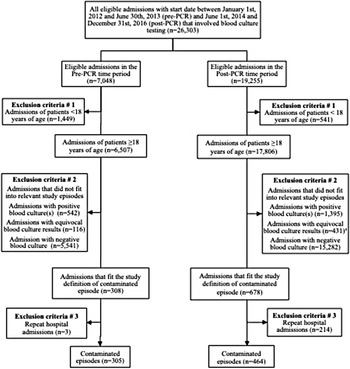
In total, 26,303 admissions that included blood-culture testing were identified between January 1, 2012, and June 30, 2013 (pre-PCR group; n = 7,048) and between June 1, 2014, and December 31, 2016 (post-PCR group; n = 19,255). After exclusions, 769 patients with 305 contaminated episodes from the pre-PCR period and 464 contaminated episodes from the post-PCR period were included in the final analytical sample (Fig. 1). Some data (<1%) pertaining to race, marital status, and health insurance were missing. BMI data were missing for up to 5% of patients. Nearly 8% of data were missing information on smoking status, and ∼50% of the data were missing on alcohol status.
Flowchart of study participants. aEquivocal accounts for any combination of blood culture results that did not strictly fit into positive, negative, or contaminated category.

A comparison of clinical and sociodemographic characteristics between the 2 groups is presented in Table 1. Although we were able to obtain data on underlying diseases relevant to the study outcomes, the numbers in each group were not sufficient for multivariable analysis.
Clinical and Sociodemographic Characteristics of Study Participants by PCR Status

Note: ED, emergency department; ICU, intensive care unit; SD, standard deviation.
a χ2 test.
b <1% missing data.
c Other includes Asian, Hawaiin, Pacific Islander, Native American.
d <50% missing data.
e Drinks alcohol includes drinks alcohol daily, drinks alcohol every other day, drinks alcohol occasionally.
f ≤8% missing data.
g Smoker includes current smoker, former smoker, daily smoker.
h <5% missing data.
i 2-sample independent t test.
j Fisher exact test.
Trend over time
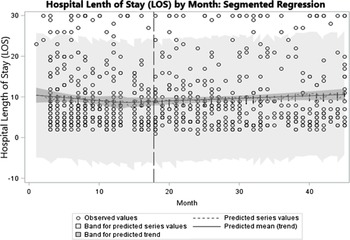
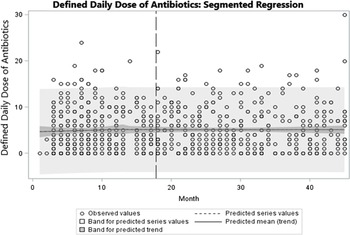
The segmented regression analysis did not reveal an effect of time on the association between primary exposure (PCR status) and either study outcome, that is, length of hospital stay (Fig. 2) and days of antibiotic therapy (Fig. 3). The 2-way interaction term between the time variable and primary exposure was not significant for both outcomes (P ≥ .05) and therefore were not included in the final multivariable models.
Segmented regression analysis of length of hospital stay (LOS) versus time. The vertical line designates the introduction of the rapid blood-culture system (BCID). The open circles are LOS for individual patients. The predicted series values (dashed line) vary in a very close proximity to the predicted mean trend (solid line). The (narrow) band for the predicted mean trend is at the 95% confidence level, whereas the (wider) band is for 95% likelihood prediction band of individual series values. At introduction of BCID (vertical line), neither significant vertical change (jump or drop) in mean trend line, nor statistically significant change of mean trend (slope) for LOS was observed.

Segmented regression analysis for defined daily dose of antibiotic therapy (DDD) versus time. The vertical line designates the introduction of the rapid blood-culture system (BCID). The open circles are days of antibiotic therapy for individual patients. The predicted series values (dashed line) and the predicted mean trend (solid line) are almost undistinguishable. The (narrow) band for the predicted mean trend is at the 95% confidence level, whereas the (wider) band is for 95% likelihood prediction band of individual series values. At introduction of BCID (vertical line), neither significant vertical change (jump or drop) in mean trend line, nor statistically significant change of mean trend (slope) for DDD was observed.

Duration of hospital stay
Rapid PCR-based blood-culture testing was not associated with a significant change in the length of hospital stay (LOS) for patients with contaminated blood cultures (P = .413) (Table 2). The mean adjusted LOSs for patients with contaminated blood cultures before and after the implementation of the rapid identification system were 10.8 days (95% confidence interval [CI], 9.8–11.9) and 11.2 days (95% CI, 10.2–12.3), respectively. A comparison of the unadjusted and adjusted mean length of stay is presented in Table 3.
Final Multivariable Model for Length of Stay (LOS) After Adjustment of Covariates

Note. CI, confidence interval; ED, emergency department; ICU, intensive care unit.
a Adjusted for age, race, admission from ED, ICU stay.
b Other includes Asian, Hawaiian, Pacific Islander, Native American.
Comparison of Adjusted and Unadjusted Means for Each Outcome.

Note. CI, confidence interval; PCR, polymerase chain reaction; LOS, length of stay; ED, emergency department; ICU, intensive care unit.
a Mean LOS adjusted for trend over time, age, race, admission from ED and ICU stay during hospitalization.
b Mean days of antibiotic therapy adjusted for trend over time and ICU stay during hospitalization.
Days of antibiotic therapy
Similar to LOS, duration of antibiotic therapy for patients with contaminated blood culture before and after implementation of rapid PCR blood culture testing did not differ significantly (P = .543) (Table 4). In the pre-PCR period, patients were treated with antibiotics for an average of 5.1 days (95% CI, 4.5–5.7), and during the post-PCR period patients were treated for 5.3 days (95% CI, 4.8–5.9), after controlling for ICU stay during hospitalization. A comparison of the unadjusted and adjusted mean days of antibiotic therapy is presented in Table 3.
Final Multivariable Model for Antibiotic Days of Therapy (Abx DOT) After Adjustment of Covariates

Note. Abx DOT, days of antibiotic therapy; CI, confidence interval; PCR, polymerase chain reaction assay; ED, emergency department; ICU, intensive care unit.
a Adjusted for ICU stay during admission.
Discussion
Results of this study indicate that the use of a molecular-based rapid blood culture identification system did not affect clinical outcomes in patients with contaminated cultures. Similarly, past studies on contaminated blood culture have also largely shown an insignificant impact of PCR testing on clinical outcomes. Reference Pardo, Klinker, Borgert, Butler, Giglio and Rand16,Reference Cattoir, Merabet and Djibo18,Reference MacVane and Nolte20 Several reasons may explain the lack of impact of PCR testing on clinical outcomes associated with blood-culture contamination.
First, clinicians continue to fear undertreating or missing real infections and are thus quick to respond to any positive blood culture. For example, although rare, given the serious consequences of untreated infection due to usual contaminants, such as coagulase-negative staphylococci, previous studies have shown that clinicians lean toward management of patients with contaminated blood cultures similar to true infections. Reference Sidhu, Malhotra, Devi and Tuli21,Reference Donner, Campbell, Lyden and Van Schooneveld22 Second, many clinicians do not fully appreciate harms associated with inappropriate treatment of blood-culture contamination such as prolongation of hospital stay, excess costs, emergence of antibiotic resistance, or Clostridiodes difficile infection. Reference Barrasa-Villar, Aibar-Remón, Prieto-Andrés, Mareca-Doñate and Moliner-Lahoz23–Reference Dellit, Owens and McGowan25 Increased awareness and education among clinicians is needed regarding the negative impact of contaminated blood cultures.
To be most effective, rapid PCR-based BCID systems should be coupled with an antimicrobial stewardship program (ASP) that can assist clinicians with real-time interpretation and appropriate clinical response. At our institution, the introduction of the BCID system was accompanied by a passive educational program. Past studies have shown that a robust ASP, that monitors patient management and provides feedback in real time, utilized in combination with rapid PCR testing, significantly reduces unwanted clinical consequences in patients with true bloodstream infections. Reference MacVane, Raux and Smith17,Reference MacVane and Nolte20,Reference Banerjee, Teng and Cunningham26 The influence of a strong ASP on patient outcomes has also been demonstrated in conjunction with conventional blood-culture methods. Reference MacVane and Nolte20 However, to obtain maximum benefit, the implementation of new technology should be accompanied by decision support tools and interpretive guidance. Reference Donner, Campbell, Lyden and Van Schooneveld22 At the Nebraska Medical Center, the ASP has developed recommendations and an educational program to guide antimicrobial use based on the BCID results. 27
A strength of our study was the larger sample size of patients with contaminated blood cultures in both pre-PCR and post-PCR groups than in previous studies, which allowed greater precision around the estimates. An advantage of the segmented regression analysis is that it allows and accounts for unintended consequences of interventions and policy changes that might have had an impact on study outcomes.
This study had several limitations. Potential information and misclassification bias is inherent in the retrospective study design. We noted differences between the groups regarding the presence of chronic obstructive pulmonary disease (COPD) and health insurance status, which could indicate cohort mismatch. Additionally, we did not have sufficient data to control for some underlying diseases, which might have resulted in confounding. Additional confounders were ASP efforts, clinician behavior, and staff turnover. The institution where this study was conducted is an academic medical center and thus has many trainees who turnover on a regular basis. As noted, the organization has in place a robust ASP, and various efforts were ongoing to improve antimicrobial use during the study period. Finally, we did not assess whether patients had indwelling prosthetic devices (eg, prosthetic heart valves, vascular grafts, etc), which could influence the clinical assessment of blood culture contamination.
In conclusion, the introduction of a rapid PCR-based blood culture identification system did not improve clinical outcomes, such as length of hospital stay and duration of antibiotic therapy, in patients with contaminated blood cultures.
Supplementary material
To view supplementary material for this article, please visit https://doi.org/10.1017/ice.2022.314
Acknowledgments
We acknowledge the expertise and support by Dr Paul Fey and Amy Armbrust in the Nebraska Medicine Clinical Microbiology Laboratory.
Financial support
No financial support was provided relevant to this article.
Conflicts of interest
M.E.R. reports having received research funding from Magnolia Medical Technologies. All other authors report no conflicts of interest relevant to this article.