I
It has long been known that there are two versions of Beethoven's String Quartet in F major Op. 18 No. 1. Beethoven presented a set of parts for the earlier version (Hess 32) to his friend Karl Amenda with a dedicatory inscription on the first page, dated 25 June 1799, shortly before Amenda's departure from Vienna.Footnote 1 Two years later, however, Beethoven wrote a letter to him dated 1 July [1801], in which he referred to the quartet as follows:
dein Quartett gieb ja nicht weiter, weil ich es sehr umgeändert habe, indem ich erst jezt recht quartetten zu schreiben weiss, was du schon sehen wirst, wenn du sie erhalten wirst.Footnote 2
Do not pass on your quartet to anyone, because I have very much altered it, since only now do I know how to write quartets properly, which you will see when you receive them.
When Amenda finally received the printed version, he would certainly not have had any difficulty seeing the changes, which permeate the entire quartet and affect many aspects of it, especially the texture. The differences between the two versions have in recent years been the subject of three separate studies, each focusing on one of the first three movements.Footnote 3 The studies demonstrate that the three movements remained essentially the same in form, metre and character but were much altered in small details, and the same is true of the finale.
The changes are also documented in Beethoven's sketchbooks, for the main sketches for the quartet are located at the end of the sketchbook Grasnick 1 and the first part of the sketchbook Grasnick 2, suggesting a date of about February to May 1799, whereas sketches for the revision appear chronologically separate, in the sketchbook Autograph 19e, dating from around mid-1800, shortly after the completion of the last three quartets in Op. 18.Footnote 4 Immediately after the sketches for the quartet in Grasnick 2 there appear sketches for the next quartet to be written, Op. 18 No. 2 in G major (No. 3 had actually been composed before either of these, as is indicated by the sketches in Grasnick 1 and suggested too by the heading ‘Quartetto No. II’ in Amenda's copy of No. 1). Here, however, the sketches for the slow movement are strikingly different from the published version, as was noted long ago by Gustav Nottebohm. The published version shows an Adagio in C major in 3/4 time which is interrupted in bar 26 by an Allegro in F in 2/4 time. The twenty-six-bar Adagio then returns in decorated form with slight expansion at the end (bars 58–86). Nottebohm's account of the relevant sketches in Grasnick 2 is as follows:
Die Entwürfe zum zweiten Satz (S. 45 bis 63) sind alle im C-Takt geschrieben. Eine mit der im 3/4-Takt bestehenden gedruckten Fassung übereinstimmende Skizze kommt nicht vor. Auch findet sich keine Skizze zu dem in 2/4-Takt stehenden Intermezzo. Letzteres muss also später entstanden sein. Dass aber die gedruckte Fassung des Hauptthemas aus der skizzirten hervorgegangen ist und auf einer allerdings durchgreifenden Umarbeitung beruht, zeigt ein Blick auf einige der zuerst vorkommenden Skizzen … Vergleicht man die letzte Skizze mit dem Anfang der gedruckten Melodie, so sieht man, dass die Noten rhythmisch geändert sind und dass bei dieser Aenderung die ursprünglich zweitaktige Gliederung der ersten Abschnitte des Anfangsthemas in eine dreitaktige umgewandelt worden ist. Auch haben die Skizzen im Allgemeinen mit dem Druck das auf eine Variirung des Hauptthemas abzielende, aus Zweiunddreissigstel-Noten und andern kurzen Notengattungen bestehende Passagenwerk gemeinsam.Footnote 5
The drafts for the second movement (pp. 45–63) are all in 4/4 time. A sketch matching the 3/4 metre of the printed version does not appear. Also there is no sketch for the 2/4 intermezzo section. Thus the latter must have originated later. Nevertheless, the printed version of the main theme derives from the sketch and is based on a thorough reworking of it, as is shown by a glance at some of the early sketches … [Here Nottebohm includes short quotations of two sketches for the main theme.] If one compares the latter sketch with the beginning of the printed melody, one sees that the notes are rhythmically altered and that by this change the original binary rhythm of the first section has been reworked into ternary rhythm. In addition, the sketches as a whole have in common with the printed version some passagework intended as a variation of the main theme, using demisemiquavers and other short note values.
Thus Nottebohm pointed out the main connections between the Grasnick 2 sketches and the final version: the melodic outline of the main theme, and the use of a varied repetition of it using short note values. He also emphasized two of the main differences: the metre and the absence of the F major section. He did not speculate, however, about when any later sketches approximating to the published version may have been made, nor whether the 4/4 version was ever completed by Beethoven before being replaced with the current one, but there was no reason at that stage to suppose that it was: in the case of many works Beethoven's early sketches are not very similar to the final version, though the differences are not usually so substantial as here, and his early sketches are not usually worked so extensively without coming close to the final version – at least not during this period. In fact, Beethoven had sketched revisions for this movement, like others in this quartet and those in Op. 18 No. 1, in Autograph 19e; but by the time Nottebohm studied Autograph 19e several leaves had been removed, including all those containing sketches for this movement.Footnote 6 He observed a few sketches for the finale in the sketchbook, but did not comment on their relationship to those in Grasnick 2.Footnote 7
In 1977 the question of the early version of the quartet was re-examined by Sieghard Brandenburg.Footnote 8 He argued that, by analogy with Op. 18 No. 1, Beethoven could be expected to have written out a score of Op. 18 No. 2 shortly after making the Grasnick 2 sketches; and since the sketches for the slow movement seem fairly complete, ‘there are no grounds for supposing that the movement was not shortly afterwards put into score and finished’. He also noted that sketches for the final version of the movement ‘survive on two leaves that once belonged to Aut. 19e’.Footnote 9 Douglas Johnson's account of the Beethoven sketchbooks indicates these two leaves to be the Stockholm leaf and one in New York Public Library (SV 378 and 357 respectively),Footnote 10 but this is incorrect, for the sketches on the New York leaf are not for this movement (they are almost exclusively for the finale). Sketches for the new slow movement do, however, survive on a leaf formerly in the Toscanini–Horowitz collection and now in the Dreesmann collection,Footnote 11 and so Brandenburg's reference to ‘two leaves’ is correct, although he did not indicate which two. He also gave no details of what was on the two leaves, and he finally concluded: ‘Op. 18 No. 2 existed in a first version that was completed around the end of May or the beginning of June 1799. At the same period it was probably copied in parts’.Footnote 12 He did not find any definitive proof that the work was completed and copied out at this time, however, and his use of a double negative and ‘probably’ was appropriately cautious, leaving room for doubt while presenting a strong case.
Further evidence to confirm Brandenburg's suppositions emerged only during the following decade. An investigation of the archives of the Lobkowitz family, descendants of Beethoven's patron Prince Franz von Lobkowitz, brought to light several important documents relating to Op. 18. One is a receipt for payment to Beethoven of two hundred gulden for delivery of three quartets:
Quittung
über Zwei Hundert Gulden welche unterzeichneter für drei an Sr Durchlaucht Herrn Fürsten v Lobkowitz gelieferte Quartetten, auf die untern 7ten 8ber 1799 an die Wiener Kassa erlassene Assignation, Baar- und richtig empfangen zu haben. Bestättiget
Wien den 14ten 8ber 1799. Idest 200 fr
Richtig empfangenLudwig van Beethowen.Footnote 13Receipt
for two hundred gulden which the undersigned is rightly to have received in cash, for three quartets delivered to His Serene Highness Prince v Lobkowitz, on the authorization remitted to the Vienna Bank on 7 October 1799. Confirmed
Vienna, 14 October 1799. I.e. 200 fr.
Rightly receivedLudwig van Beethoven.In October 1799 the only three quartets that Beethoven had completed were Op. 18 Nos 1–3, since the next to be completed, No. 5 in A major, was still being sketched until round about that time. Thus it can be confirmed that an early version of Op. 18 No. 2 was indeed written out during that summer, with the slow movement apparently very different from the published version. A second receipt for two hundred gulden, presumably for Op. 18 Nos 4–6, is dated 18 October 1800.Footnote 14
Manuscript copies of all six quartets survive in the same archives (though the autograph scores are lost). They were prepared before the quartets were published in 1801, yet they show the revised versions of Nos 1 and 2 (and of No. 3 if Beethoven revised this too, which seems probable). Thus the manuscripts that Lobkowitz had purchased in 1799 must have been replaced in 1800 or 1801 by fresh ones containing the revisions sketched in Autograph 19e, with the original manuscripts then being discarded. This substitution probably took place a few weeks or even months after Nos 4–6 had been delivered, since the sketches for the revisions to Nos 1 and 2 follow those for Op. 18 Nos 4–6, and the two groups of quartet manuscripts in the Lobkowitz archives use differing paper types.Footnote 15
It is clear, therefore, that Prince Lobkowitz had possession of early versions of Nos 1 and 2 for about a year or more, during which time Beethoven seems to have made no effort to publish them. This was quite normal, for Beethoven was frequently commissioned to compose new works on the basis that the sponsor would have exclusive use of them before publication for six months, twelve months or even longer, as explained in a letter of 5 December 1802.Footnote 16 Since the first three quartets were published in June 1801, and Nos 4–6 on 28 October 1801, just over a year after this second group was presented to Lobkowitz, this contract was probably for a twelve-month period. During the period that Lobkowitz had the early versions of Nos 1 and 2, it seems inconceivable that he would not have arranged for a performance of them, or more likely several performances, since that was the whole point of commissioning them. In 1799 he actually set up a kind of rehearsal centre at his palace in Vienna, where he sponsored many musical performances during the next few years, including several pre-publication trials of the Eroica,Footnote 17 which like the Op. 18 quartets was dedicated to him on publication.
Thanks to Amenda, we know what constituted the early version of No. 1, but the early version of No. 2 does not survive, as far as is known. Many details of it can, however, be deduced from the sketches in Grasnick 2 and Autograph 19e, and Brandenburg has provided a summary of this version. He shows that in the outer movements Beethoven made changes in 1800 that were comparable in scope to those in No. 1 (probably somewhat greater in the case of the finale of No. 2), whereas the scherzo seems to have been little altered in 1800, if at all.Footnote 18 The slow movement, however, was reworked so radically between the Grasnick 2 sketches and the final version that it is reasonable to speak of a discarded and lost movement that was replaced by one in a different form and metre, showing only loose thematic connections to the lost one.
This conclusion presupposes that the central Allegro section in the finished version was not composed until 1800. Such a conclusion is borne out by the two leaves of relevant sketches from Autograph 19e, and their evidence can be supplemented by that of an extra leaf from Autograph 19e, discovered at La Scala, Milan in 1998.Footnote 19 The first of these three leaves, the Dreesmann leaf (folio 20 in Richard Kramer's reconstruction of Autograph 19e), shows the Adagio already altered from 4/4 to 3/4 time; but Beethoven was still persisting with a slow central section in the same metre as the first section. Somewhat surprisingly, therefore, this sketch shows that he decided to change the metre of the opening section before developing any notion of a central Allegro section in 2/4. This new section is first found on the Stockholm leaf (folio 21), which shows early ideas for the 2/4 Allegro section on the recto. These are developed further on the verso, where the links between this section and the preceding and following Adagio sections are worked out. Further development, approaching the final version, appears on the La Scala leaf, which was originally contiguous with the Stockholm one. This shows detailed working-out of the Allegro section, including the link from the Adagio section (again), the first part of the Allegro section and the reprise of the Allegro theme at bars 43–52, more or less as in the final version, although the rest of the Allegro in the sketch is still substantially different from it. Thus these three leaves provide striking confirmation that the Allegro section could not have been present in the 1799 slow movement.
From the evidence given above, it becomes clear beyond all reasonable doubt that Beethoven completed and wrote out a slow movement in 1799 that is now lost and is very different from the one present in the final version of Op. 18 No. 2. This loss of a complete written-out slow movement has only gradually become apparent to scholars. It was not suggested by Nottebohm and was mere speculation when Brandenburg proposed it in 1977; but the 1799 receipt proves that a slow movement had been written out by October that year, and the sketches belonging originally to Autograph 19e confirm that this early slow movement did not include an Allegro section. Even since these findings, however, scholars have been slow to accept the significance of what has been lost. Kramer comments in his edition of the La Scala leaf: ‘For some years now, it has been suspected that this quartet had been completed in an earlier version’.Footnote 20 Yet the combination of the Lobkowitz receipt and the sketch evidence makes this ‘suspicion’ a certainty; and the earlier version of the quartet certainly contained a different slow movement.
II
In the light of this conclusion, therefore, it becomes a matter of considerable interest to establish the themes and structure of this missing movement as far as is possible at present, using the sketches in Grasnick 2 along with what is known about Beethoven's sketching habits in general. Brandenburg did in fact attempt to do this in 1977, but only very briefly: his account of the contents of the missing movement amounts to less than one paragraph in his entire article. Here is the relevant passage in full:
The original form of the movement can be reconstructed with some certainty from the sketches. Theme A, lasting fourteen bars, was followed by an expressive middle section in C minor (B), again fourteen bars in length. The two outer parts were in canon at the octave, while the middle parts had a tremolando accompaniment. Beethoven's conception is most clearly seen in an early sketch on page 45 [here Brandenburg quotes two bars of sketch material]. The middle section made its way to E flat major, whereupon a brief modulation on the opening motive of the theme led back to C major, for a second statement of the theme in full but in varied form (A′), again followed by the same middle section. Initially Beethoven was unsure as to whether he should bring the B section back in the same key as before, and vacillated between C minor and A flat major. The last and probably decisive sketch begins in A flat and ends in G major, consisting of eleven bars. This is the more probable version for Beethoven to have adopted in the score of the movement; the alternative, C minor version, which was also to have finished in G major, is nowhere written out in full. The second appearance of the middle section (B′) was followed by a long coda in which the theme was dissected in very free manner. According to the last sketch on page 50 the coda lasted about 21 bars, and the sketches reveal that the movement as a whole was 74 bars long. Originally marked ‘Largo’ (page 45), its structure was thus A B A′ B′ Coda.Footnote 21
Putting together such a coherent picture of the movement was no easy task, for Beethoven's sketches, as usual, are somewhat fragmentary, with much doubling back, omission and revision, and with some material discarded or greatly modified in later sketches. Nevertheless, a re-examination of the sketches confirms that Brandenburg's account is broadly accurate, save for a few details.
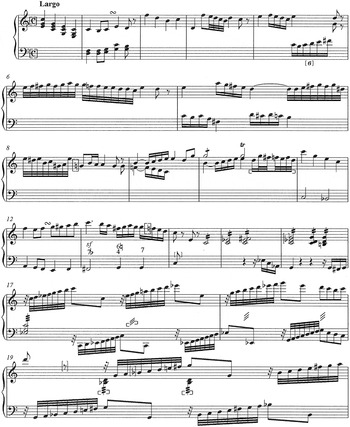
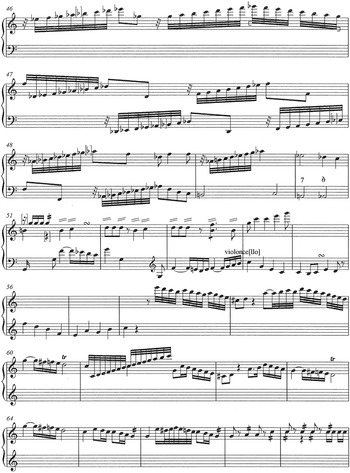
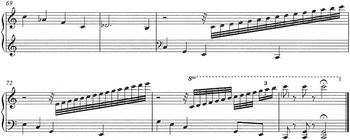
The sketches for the movement appear on pages 45–51 of Grasnick 2, but the first three pages contain early material that was largely discarded or much altered. On page 48, however, Beethoven made a fresh start (stave 1 and again on stave 4), continuing on to page 51. A detailed examination of these seven pages of sketches has been made by Donald Greenfield,Footnote 22 with some particularly useful observations about how the earliest sketches on pages 45–47 prepared the ground for those on the next four pages. But he did not attempt to reconstruct the lost movement, instead questioning whether it had ever existed, since at that time (January 1983) there was no certainty that it had. Thus he does not make clear that, in the sketches on pages 48–51, although there is much revision and duplication, every bar of a complete movement is represented and either continues into or can be joined editorially to another bar to make a continuous movement. This can be seen in the present reconstruction, which is shown in the Appendix (see below) along with an index giving the page and stave number from which each bar is taken. Like Brandenburg's reconstruction (which appears never to have been written out, although his description gives a clear idea of what he had in mind), the present one amounts to precisely seventy-four bars, with internal proportions only marginally different from the figures he provided. It is based on the following principles:
1 Since most of the sketches are single-stave drafts and none uses more than two staves, the reconstruction shows two staves throughout, with blank spaces where no sketches for lower (or upper) parts are found.
2 Although most of the sketches are quite short, they can be fitted together to produce longer sections, usually with some overlap at the joins.
3 Where more than one version of the same passage exists, the latest one has normally been adopted, as generally happened in Beethoven's sketching process.Footnote 23
4 Where two sketches show details of different elements within the same bar, both have been incorporated into the reconstruction.
5 Where the replacement movement of 1800 is sufficiently similar, it has been used as an additional guide to the shape or texture of the reconstructed movement.
6 Stem directions have been preserved where they may have significance for the part-writing.
7 Clefs have been added editorially at the start of each system; those in mid-system (bars 52 and 71) are in the sketches.
8 Small amounts of other editorial material have been added, indicated by square brackets, to clarify the notation or to insert notes that can be confidently conjectured.
It might be expected, judging by the apparent jumble of page and stave numbers in the index in the Appendix, that the end product would be horribly disjointed; but because Beethoven approached the creation of this movement in a systematic way, the fragments cohere remarkably well into a whole, both in terms of consecution from one to the next and in terms of overall structure, which is similar to that outlined by Brandenburg. The reconstruction does not, of course, represent a definitive version of the lost movement, but it can be confidently surmised that Beethoven followed his latest sketches closely, as in his other works of the period, to produce a movement that is unlikely to have differed substantially from the reconstruction. It would not be difficult to produce a fully scored version for string quartet from this material, by filling in the missing parts of the texture, since there are no gaps in the horizontal dimension, and the replacement movement provides some clues to missing parts. In bar 1, for example, the cello part in the 1799 movement probably had a rising arpeggio in contrary motion to the other three instruments, as in the 1800 movement.
III
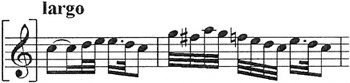
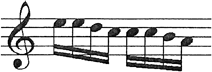
Now that the fragments have been arranged into a continuous whole, the reconstructed movement can be examined in more detail. The designation ‘largo’ comes from a very early sketch (Grasnick 2, page 45, stave 1), at which time Beethoven planned a theme in 2/4 time (see Example 1). This theme is so different from anything in Op. 18 No. 2 that it was not recognized by Hans-Günter Klein as belonging to the quartet at all,Footnote 24 but it does show tenuous links to the 1799 slow movement. After nine staves of sketching in 2/4 Beethoven resumed with a new theme in 4/4 (page 45/10), which begins in the same way as in the latest sketches for the 1799 movement, although the continuation is more primitive. Between writing these two sets of sketches, he appears to have turned over to the next right-hand page (page 47) and drafted some ideas for a 4/4 movement that also shows only tenuous connections to later sketches (Example 2), though it comes much closer than the sketch shown in Example 1. This group occupies staves 1–11, and it seems unlikely that they were drafted after the much more advanced ideas in the lower half of page 45 and most of page 46. This curious layout, where a first group of ideas appears on the upper part of page 45, a second group on the upper part of page 47 and a third one fills up the intervening spaces, is fairly typical of the kind of backtracking found in Beethoven's sketches in general.Footnote 25 All three of these sets of sketches show frequent use of demisemiquaver figuration – perhaps a rhythmic reference to the demisemiquavers in the first bar of the first movement. Since Beethoven rarely used largo in combination with a movement in 4/4 time, he might well have changed it to adagio as in the 1800 movement, at least in his mind, when he began sketching the movement in 4/4, where more use is made of crotchet note values than in the 2/4 sketches.
Grasnick 2, page 45, stave 1

Grasnick 2, page 47, stave 1

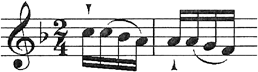
For the opening sentence Beethoven constructed two two-bar phrases. When he came to rewrite it in triple metre in 1800, however, he evidently found that squeezing four beats into only three, even with a newly added upbeat, was too compressed, while expanding each half-bar into a whole bar would be too prolix; thus he ingeniously compromised with two three-bar phrases, where the first and third bars of the original movement are compressed into three beats while the second and fourth bars are expanded into six beats, so that the overall length is not much altered – eighteen beats instead of sixteen (Example 3, which should be compared with bars 1–4 in the Appendix).
Beethoven, String Quartet Op. 18 No. 2, second movement, bars 1–6, from first edition (Vienna: Mollo, 1801)

In the rest of the first section of the substitute movement, most of the individual bars from the discarded one were expanded into two bars; thus bars 5–11 became bars 7–20 in 3/4 time, although the modulation to the dominant (bars 7–8) was substantially altered harmonically in 1800 (bars 11–14). Successive sketches for the 1799 movement show varying amounts of melodic decoration. In bar 6, for example, Beethoven showed some indecision in the main draft (page 49/1), with one version superimposed on another, but he later wrote a substitute version for this bar on its own (page 51/4), and it is likely that this was what was finally adopted. The cadential passage in C in the 1799 version (bars 12–14) was altered more substantially in 1800, with bars 12–13 compressed into only six beats (bars 21–22), while a new figure, anticipating the Allegro theme, was inserted at the cadence (bars 23–24). Thus a total of fourteen bars of 4/4 (fifty-six beats) has been converted into twenty-six bars of 3/4 (seventy-eight beats), and the relationship between the first section of the 1799 and 1800 movements can be shown as follows:
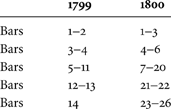
Although the thematic material and harmonic direction of the first section of these two movements are broadly similar, the movements are no more alike than two movements in a baroque variation suite or varied couple (such as a matching pavan and galliard). Beethoven has in effect done the equivalent of converting an allemande into a sarabande. The subsequent parts of the two movements are even less alike, for in 1799 the second section consisted of stormy scales for outer instruments in alternation. The two instruments are shown operating antiphonally in imitation in an early sketch, accompanied by demisemiquaver tremolandos (Grasnick 2, page 45/9+10 – the passage quoted by Brandenburg), but thereafter Beethoven mostly sketches only one or other instrument. The extent to which the inner instruments would also participate in the imitation is not indicated, and would be restricted by their playing of the tremolandos, but they may have participated to some extent, as seems to be implied in a sketch for bar 21 (page 49/10). This passage (bars 15–22) is mainly in C minor, with a brief excursion to G minor, and its key therefore looks forward to that of the fourth quartet in the Op. 18 set, whereas the key of the replacement Allegro looks back to that of the previous quartet in F major (Beethoven sometimes made such tonal connections between works within an opus, as in his Piano Sonatas Op. 10, where the D major of No. 3 is an important subsidiary key in No. 2). The Allegro also possesses a different character from the C minor original, light and wispy instead of stormy, and with internal repetitions instead of being through-composed.
The central section in the 1799 movement is set up by repeated semiquavers that build up into a C minor chord (bars 14–16). This gives way to a suspension (the chord C–D–G) on the third beat, resolved on the fourth beat, although the suspension was wrongly transcribed as another C minor chord by Virneisel.Footnote 26 The stormy section subsides in bar 22, and the exact continuity is not fully clear in the sketches at this point. At one stage Beethoven planned an extra bar or two here, with a longer run of demisemiquavers (page 49/12 and 13). What is clear from the sketches, however, is that the main theme returns in E flat at this point, followed by a restatement in E flat minor. The extraordinarily rapid modulation from this key to C major is one of the highlights of the movement, and Beethoven sketched this enharmonic retransition three times (pages 46/9, 49/14 and 51/5–6, this last being latest and probably closest to the final version). Although the details vary, the harmonic progression remains consistent: the tonic chord in E flat minor gives way to VI (notated as either C flat major or B major), which is treated as V in E minor; the following E minor chord then functions as iii in C major, being succeeded by V7 in that key (or slightly different chords in the sketch on page 46), and a reprise of the opening theme in the tonic follows at bar 29. This B section consists of fourteen bars in the present reconstruction, as in Brandenburg's.
Thereafter the A section returns, though it appears in different forms in different sketches. The first main draft (Grasnick 2, page 49/14–15) shows the retransition leading to a restatement of the A section but with the theme initially in the bass clef (as in the 1800 version, except that the opening bar is an octave lower in the sketch). After three bars of reprise, Beethoven writes ‘etc’ followed by a final cadential three bars, implying that the whole fourteen-bar A section would return exactly as before except for some rescoring. A later sketch, however (page 50/11–13), shows a fifteen-bar version of the opening section, implying a varied reprise, with a brief modulation to D minor after the central G major cadence. This may represent the final version, as shown in the reconstruction (see Appendix, bars 29–43), although this sketch could be an alternative for the opening paragraph.
This fifteen-bar reprise seems to lead to a restatement of the C minor episode (page 50/14–15), but the earlier sketch (page 49/15–16, continuing at the top of page 50) indicates there was to be a second contrasting episode, this time in D flat, using material similar to the first episode and leading to a second reprise of the main theme. This idea is confirmed in what is perhaps the latest sketch for the movement (page 51/9–12). In both cases the D flat tonality eventually functions as a Neapolitan chord in C minor, leading to a dominant on G in preparation for a third statement of the opening bars of the C major theme; earlier indecision about the precise details of the link from the D flat scales to the return of the main theme is resolved here. In the first case Beethoven sketches the cello part for the retransition, including a presentation of the main theme in the alto register but marked ‘violonce[llo]’ (page 50/1); in the second sketch the upper instruments are shown, and at the point of the reprise he shows just the first bar of a descant for first violin (page 51/12: the instrument is not specified but no other instrument plays such high notes anywhere in the Op. 18 quartets). These two sketches can therefore be combined, as in the reconstruction (bars 51–54).
According to Brandenburg's account, the reprise of A and B consisted of 14+11 bars, although in the present reconstruction it consists of 15+10 bars, thus making the same total of twenty-five bars overall. Brandenburg is inaccurate in describing the key of the B′ section as A flat major leading to G major: D flat major is unmistakable in both main sketches for this passage, and in both cases it leads eventually to a G major chord as V of C minor as shown, rather than in the key of G major. It is possible that Beethoven actually sketched the D flat episode as an alternative idea to the C minor one, resulting in the form A B A or A B Coda (based on A), thus quite similar to the form of the 1800 movement. But this is not the impression given by the sketches as a whole, for on page 49 there are sketches for a C minor episode followed by the beginning and end of a reprise of A and then immediately a D flat episode; page 51 also contains sketches that imply two flat-key episodes.
The final twenty-one-bar coda (bars 54–74) appears in one continuous draft (page 50/1–4) that follows the retransition. This shows that the third statement of the opening bars quickly dissolves into coda-like material that remains in or around C major. There are relatively few difficulties here, although the details of the repeated semiquavers in bar 68 are unclear. These repeated semiquavers are an echo of those in bars 65 and 66, and ultimately of the semiquavers that heralded the two flat-key episodes. The falling motif in bar 65 that precedes the reappearance of repeated semiquavers seems insignificant, but it proved to be important for the creation of the slow movement of 1800. Little imagination is needed to apply the four-semiquaver rhythm to this falling motif, giving the notional figure shown in Example 4. This is clearly the germinal idea from which the central Allegro section sprang in 1800 (Example 5), and Beethoven even provided a link by placing the figure in slow semiquavers at the end of the first Adagio section in the sketch on the Dreesmann leaf, thus showing a direct connection to the sketch for bar 65. Only after introducing this figure at the end of the 3/4 Adagio opening in 1800 did he decide to pick it up as the main theme of the Allegro.
Grasnick 2, page 50 stave 3, rhythm adjusted
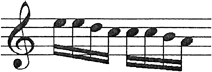
String Quartet Op. 18 No. 2, second movement, bars 28–29
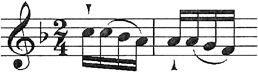
After the repeated semiquavers in bars 65–68, bars 69–70 appear to veer towards F major in the main draft (stave 4), but Beethoven then added an alternative on stave 5, marked ‘oder moll’ and outlining an F minor chord, which seems a more convincing solution and has been adopted in the reconstruction. The second note in bar 70 looks rather like a middle C, but a B (natural) would seem to make more sense harmonically, so as to prepare better for the C major chord in the following bar. The final four bars provide an ideal conclusion, for they show the original head-motive, now in the cello, reconciled with the rising demisemiquaver scales of the flat-key sections. These scales actually originated in the C major section in the early sketches, but they were quickly removed from it and transferred to the central episodes. A C major scale was later used in the sketch for bar 61 (page 50/2), but otherwise the C major sections were kept largely clear of such scales and one was even deleted in a sketch for bar 64 (page 50/3). Nevertheless, Beethoven decided at a fairly early stage (page 48/14) to reintroduce them at the very end of the movement, along with the opening figure in the cello. This reconciliation of opposites – in this case stormy, fast, rising scales and gentle, slow, descending arpeggios – at the end of a movement is characteristic of Beethoven's style and is highly effective, though on each occasion the result is quite different, and there is no example comparable to the present one. In the replacement movement, for example, the main motive of the Allegro section makes a final appearance in the viola and then the cello just before the end (bars 83–84), but in the Adagio tempo, thus fusing together elements from the two contrasting sections in a different way.
IV
The 1800 movement must be an improvement, at least in some ways, on the one it replaced. Beethoven surely knew what he was doing when he made the substitution, and the new Allegro section makes a wonderful contrast with the surrounding Adagio material. The Adagio opening, too, seems to have benefited from the greater expansiveness allowed by the 3/4 time signature, where two beats are generally spread out into three. Beethoven may also have been dissatisfied with the rather irregular form of the 1799 movement, which is not quite a rondo, or its considerable length, or the tonal instability of the two stormy sections, or the unsuitability of their character for a mild and somewhat gentle work – for all these elements were eliminated in 1800. But it is mere speculation to suggest precise reasons for the abandonment of the 1799 movement, in the absence of any statement from the composer. What is more significant is that it is almost impossible to make such a change in music without losing something beautiful and valuable, and it is therefore a matter of great regret that the original movement has disappeared. Not only would comparison between it and the replacement provide useful lessons about the art of composition and how Beethoven demonstrated his new ability at writing string quartets more effectively, as occurs with Op. 18 No. 1; its preservation would also have provided an interesting and attractive addition to the repertoire. Among the most appealing features are the striking contrast between the gentle opening and the stormy outbursts in C minor, their partial mollification in the D flat episode and their final reconciliation with the opening theme. The remarkable enharmonic modulation from E flat minor to C major within the space of four chords is also noteworthy. Beethoven was so pleased with it, in fact, that he tried at first to retain it when he began sketching the movement in 3/4 time on the Dreesmann leaf (stave 3), though here the progression begins with an F sharp chord rather than E flat minor.
Any editorial reconstruction of the entire missing movement, fully scored in four parts, could never be as satisfactory as Beethoven's original, but such a version would undoubtedly have the benefit of enabling the movement to be brought to the attention of a much wider audience than before, through live performances and recordings.Footnote 27 Moreover, a convincing result is a more realistic proposition than for most other incomplete Beethoven works, since so much of the movement is preserved in the sketches. Not only is there melodic material that provides an outline for the complete seventy-four-bar structure; additionally, for more than half of these bars some or all of the harmony and texture can be supplied through sketches for other voices. Some further indications of harmony, as well as dynamics and articulation, can be gleaned from the 1800 movement, at least for the opening fourteen-bar section. Thus there is limited room for manoeuvre in making a full reconstruction, and versions by two different editors are likely to be substantially similar, as is indeed the case with the present reconstruction and Brandenburg's, both seventy-four bars long. In this respect the situation is different from the more speculative completions of unfinished Beethoven works that have been undertaken in recent years – not least because this quartet movement did exist in finished form at one time.
The importance of this lost movement in Beethoven's output must not be overlooked. There are not many works that he is known to have completed and apparently had performed that are now lost or partly lost. Most of these are early works, such as a violin concerto in C major (WoO 5), of which less than half a movement survives; an oboe concerto (Hess 12), for which only sketches and opening themes survive; and a very early concerto for piano, flute and bassoon (Hess 13), of which only a section of the slow movement is known. Another example is the twenty-four-bar first movement of his unfinished string quintet of 1827 (WoO 62), a movement that may not have been fully completed and is preserved only in Diabelli's piano arrangement and a few sketches. A few songs seem also to have disappeared, such as ‘Ich wiege dich in meinem Arm’ (Hess 137) and ‘Minnesold’ (Hess 139).Footnote 28 Many of these works may never have been performed, however, and some may not even have been completed. Other lost works are very short and insubstantial. There appears to be no other missing work by Beethoven completed in 1799 or later that is of such a size as this discarded slow movement, and no other one of any date for string quartet (apart from a short fugal exercise, Hess 245, of which only the last sixteen bars survive).
Thus this movement stands out as the last substantial work that Beethoven composed in full and apparently had performed before it was replaced, discarded and lost. Other movements that were replaced were often reused in some other context. Examples include the original slow movement of the ‘Waldstein’ Sonata, published separately as an Andante favori (WoO 57); the original finale of the Violin Sonata Op. 30 No. 1, which became the finale of the ‘Kreutzer’ Sonata; and the original finale of the Quartet Op. 130, which was published separately as a Grosse Fuge. Two numbers and some shorter sections in the first version of Fidelio were also discarded during revisions, but these still survive. Meanwhile the three Leonore overtures indicate what magnificent music Beethoven might reject and replace, and there is no reason to suppose that the lost quartet movement is necessarily any less excellent. The prospect of hearing a Beethoven work that has been lost for over two hundred years after receiving a putative private performance in 1799–1800 should therefore be of much interest to audiences, even in an editorial reconstruction that must differ at least slightly from what Beethoven wrote.
APPENDIX
Reconstruction of the form of the original slow movement for Beethoven's String Quartet Op. 18 No. 2


Location of bars in Grasnick 2 sketches
The bars in the Appendix come from the pages and staves indicated below. Where a passage was sketched in a two-stave score, the stave numbers are shown as combined by a+sign; a dash indicates a bar that continues from the end of one stave to the beginning of the next.