1 Introduction
Whenever several functionally equivalent variants co-exist in a language, a wide array of determinants governs language users’ preferences for one variant over the other. Some of these influencing factors still demand thorough empirical analysis. A case in point is the frequently cited concept of end-weight (see Leech Reference Leech1983; Quirk et al. Reference Quirk, Greenbaum, Leech and Svartvik1985; Wasow Reference Wasow1997b), which so far lacks an in-depth investigation concerning its existence and its effect on linguistic variation and change. Generally, the term end-weight, which was coined by Geoffrey Leech (p.c.), refers to the language users’ tendency to position syntactic constituents that are particularly long or ‘heavy’ at the end of a phrase, clause or sentence.
Research on end-weight, however, is still a desideratum for at least three reasons. Firstly, end-weight is often treated synonymously with a principle with which it shares fundamental similarities, namely Behaghel's (Reference Behaghel1909–10) Law of Growing Constituents (‘Gesetz der wachsenden Glieder’), which describes the sequential ordering of syntactic constituents as short before long.Footnote 2 However, such a generalisation is not unproblematic, as Behaghel's observation of constituents being ordered according to their relative length mainly concentrates on coordinated phrases. In addition, it does not refer specifically to the absolute end of clauses or sentences. After all, the term end-weight itself emphasises a particular interest in the end of syntactic units (phrasal, clausal and sentential) and thus implies that it is more than a short-before-long tendency. Moreover, the term end-weight suggests that there is a necessity to put long elements at the end of a clause or a sentence to guarantee end-weight in the first place, an assumption that requires empirical validation.
Secondly, the notion of end-weight needs to be disentangled from another principle postulated for the end of sentences, namely the tendency of new information to be reserved for the end, commonly referred to as end-focus (see Quirk et al. Reference Quirk, Greenbaum, Leech and Svartvik1972: 943f.). With longer constituents usually expressing new information, a fulfilment of the principle of end-focus naturally satisfies end-weight at the same time. The question therefore arises whether end-weight is merely epiphenomenal to an information structuring principle. Indeed, a number of recent studies have shown information status to contribute to structural choice independently of weight (see e.g. Arnold et al. Reference Arnold, Wasow, Losongco and Gingstrom2000; Wiechmann & Lohmann Reference Wiechmann and Lohmann2013; Francis & Michaelis Reference Francis, Michaelis, Moravcsik, Malchokov and MacWhinney2014), but these studies have largely concentrated on ordering phenomena.
Thirdly, end-weight with its placement of long, heavy constituents at the end of clauses or sentences is commonly said to facilitate processing (see Leech Reference Leech1983: 83; Gibson Reference Gibson1998; Kaltenböck Reference Kaltenböck, Mair and Hundt2000: 166), an assumption also captured by Bever's (Reference Bever, Bever, Katz and Langendoen1971: 76) processing-related maxim to ‘save the hardest for last’. Yet, end-weight as a processing principle still lacks independent evidence, and it is not entirely clear why exactly placing long constituents at the end would reduce processing costs.
To be sure, various approaches have advocated the idea that the ordering of syntactic constituents in increasing length, with the longest constituent being placed last as a consequence thereof, proves advantageous from a processing perspective. For example, explanations in line with Hawkins’ (Reference Hawkins1994) Principle of Early Immediate Constituents or his more elaborate Domain Minimisation Principle (Reference Hawkins2004, Reference Hawkins2014) emphasise that postponing heavy constituents helps to keep distances between the respective verb and the connected heads of phrases preferably minimal, thereby facilitating the early recognition of all relevant syntactic constituents. Accessibility explanations such as the ‘Easy First Principle’ (MacDonald Reference MacDonald2013) or the ‘Principle of Immediate Mention’ (Ferreira & Dell Reference Ferreira and Dell2000), on the other hand, emphasise that shorter constituents are more readily accessible and therefore tend to be produced earlier than longer constituents in choice contexts. Still, these approaches underscore processing effects of the immediate postverbal environment of the sentential middle field rather than attributing a particular effect to the absolute end of a sentence.
In order to assess whether the end does indeed have an impact and to what extent end-weight may contribute to the ease of processing, the present article seeks to operationalise weight effects. It thus constitutes one of the first studies to gather empirical support for end-weight as an autonomous principle. For this purpose, the article focuses on grammatical variation phenomena that involve the alternation between short/light and long/heavy variants and investigates whether language users have a marked preference for longer, more explicit variants at the end of sentences, a choice that would substantiate the notion of end-weight.
The structure of the article is as follows. Section 2 surveys previous treatments of end-weight, thereby arriving at a more refined and terminologically adequate notion of end-weight that exceeds the common understanding of the term as a principle describing the sequential ordering of syntactic constituents. The implications that this differentiated notion bears for linguistic variation and change, namely that bulkier variants are favoured in final as opposed to non-final position, are then put to the test in sections 3 and 4, focusing on two grammatical variation phenomena that involve the alternation between a long, more explicit variant and a short, less explicit one. Section 3 provides a corpus-based analysis of selected semi-reflexive verbs that may either occur with the self-pronoun (I hide myself) or a zero variant (I hide ø). Drawing on both historical and Present-day English corpora, diachronic analyses of various semi-reflexive verbs investigate whether the self-supported variants take the larger share of occurrences at the end of sentences, while zero-variants prefer mid position. Moving on to Early Modern English affirmative declarative clauses, the case study in section 4 analyses to what extent end-weight influences the language users’ choice of do-support over the use of finite verb forms and to what extent the use of the bulkier do-supported verb reinforces the sentential end, thereby creating end-weight in the first place. Based on these two case studies, the discussion in section 5 reassesses the processing-facilitating function commonly attributed to end-weight and puts end-weight into the context of support strategies as discussed in the present issue. Finally, the conclusion in section 6 wraps up the article.
2 Towards a more refined notion of end-weight
Before end-weight is investigated with regard to its impact on grammatical variation phenomena, it is important to revisit the concept of end-weight as implemented in the literature at hand. Most generally, end-weight has been treated either as a (more or less controversially discussed) language universal or as a typological parameter categorising head-initial languages that are characterised by right-branching structures (on the controversy, see Hawkins Reference Hawkins2007: 92–4). In a more narrow sense and more to the point of the present account, end-weight has been referred to as a principle at work in a particular language – primarily concerning typical choices language users make.
The term end-weight has been originally defined as ‘the tendency to reserve the final position for the more complex parts of a sentence’ (Quirk et al. Reference Quirk, Greenbaum, Leech and Svartvik1972: 943), an inclination that Leech (Reference Leech1983: 65) goes on to specify as a maxim ‘ensur[ing] that complex constituents are placed at the end of a sentence’. Particularly noteworthy in these early definitions are two aspects. On the one hand, they make explicit mention of ‘complex’ constituents, which, for processing reasons, are preferably positioned towards the end of a sentence. On the other hand, the verbs ‘reserve’ and ‘ensure’ imply that the sentential end even requires such complex elements in final position, an assumption that ultimately gives the principle of end-weight its name. Such an intrinsic property of the sentential end is also emphasised by Quirk et al.’s (Reference Quirk, Greenbaum, Leech and Svartvik1985: 649) claim that the ‘clause-final position is associated with prosodic and semantic weight’.
End-weight has been brought into play as an explanation for quite a number of heterogeneous phenomena, resulting in basically three different notions of end-weight, i.e. end-weight as (a) an ordering principle, (b) as a constructional trigger and (c) as a balance or gravity principle. In the following, each of these conceptualisations and their respective implications will be discussed separately, based on paradigmatic examples, in order to arrive at a more refined notion of end-weight.
The first notion of end-weight as an ordering principle is essentially in line with Behaghel's Law of Growing Constituents, albeit with a more pronounced emphasis on the end of the sentence. It concerns the serialisation of syntactic elements in increasing length order, leaving the heaviest, i.e. longest and/or most complex,Footnote 3 constituent for final position (see Quirk et al. Reference Quirk, Greenbaum, Leech and Svartvik1985: 649, 1395). The following example taken from Wasow (Reference Wasow1997b: 81), originally gleaned from Pinker (Reference Pinker1994: 131), impressively highlights that even an extremely verbose sentence comprising a total of 57 words is readily understandable as long as shorter constituents precede longer ones:
-
(1) In my laboratory we use it [the example] as an easily studied instance of mental grammar, allowing us to document
-
in great detail [3 words]
-
the psychology of linguistic rules [5]
-
from infancy to old age [5]
-
in both normal and neurologically impaired people, [7]
-
in much the same way that biologists focus on the fruit fly Drosophila to study themachinery of genes. [19]
-
The architecture of the above sentence is highly remarkable for its proportions. The postverbal slot after the verb document is occupied by five syntactic constituents on the same hierarchical level totalling 39 words, which makes this part twice as long as the part before. Alternate constituent orderings within the postverbal slot would render this sentence less comprehensible at best – and it would become completely unintelligible if the last constituent, with its 19 words six times as long as the first postverbal constituent in great detail, were in any other position than in the last. Pinker's sentence from The Language Instinct is thus a perfect illustration of the universal claim that language users instinctively opt for a short-before-long distribution of syntactic elements for reasons of easier processibility.
Occasionally, the arrangement of constituents according to their increasing length leads to non-canonical word orders, which we can also see in (1) where the 3-word adjunct in great detail precedes the 5-word direct object the psychology of linguistic rules. In this respect, the ordering principle concerns what has become known as Heavy Noun Phrase Shift (see Wasow Reference Wasow1997a, Reference Wasow1997b; Arnold et al. Reference Arnold, Wasow, Losongco and Gingstrom2000; Wasow & Arnold Reference Wasow, Arnold, Rohdenburg and Mondorf2000). Consider (2a), which pertains to the canonical word order reduce NP to tears, and contrast it with the alternative non-canonical version in (2b), which sounds rather awkward with both syntactic constituents having equal length:
-
(2)
-
(a) He had been known to reduce [movie stars] [to tears].
-
(b) He had been known to reduce [to tears] [movie stars].
(adapted from Quirk et al. Reference Quirk, Greenbaum, Leech and Svartvik1985: 1159)
-
Yet, as soon as the direct object noun phrase gains in length and complexity, the non-canonical pattern reduce to tears NP would be preferred, as the heavy NP is shifted towards the end:
-
(2)
-
(c) He had been known to reduce [to tears] [some of the most seasoned and idolized movie stars in Hollywood]. (Quirk et al. Reference Quirk, Greenbaum, Leech and Svartvik1985: 1159)
-
End-weight, however, exceeds the notion of a mere organisational principle in that for the heaviest constituent to be positioned at the end, it is at times necessary to opt for a different construction. This is what the second notion of end-weight as a constructional trigger seeks to grasp. In these cases, the tendency to put heavy constituents at the end affects language users’ choices, so that the construction that reserves the final position for heavy elements is likely to be preferred. A classic case concerns dative alternation, which involves the choice between a ditransitive construction as in (3a), which puts the patient in last position, and a prepositional dative construction as in (3b), which reserves the end for the recipient:
-
(3)
-
(a) Chris gave [Terry] [a bowl of Mom's traditional cranberry sauce].
-
(b) Chris gave [a bowl] [to all family members present at the wedding]. (adapted from Arnold et al. Reference Arnold, Wasow, Losongco and Gingstrom2000: 28)
-
A large number of studies have shown the length of the respective NP to play the most decisive role in determining the choice between the two constructions (see Wasow Reference Wasow1997b; Wasow & Arnold Reference Wasow, Arnold, Rohdenburg and Mondorf2000; Arnold et al. Reference Arnold, Wasow, Losongco and Gingstrom2000; Bresnan & Nikitina Reference Bresnan and Nikitina2003; Mukherjee Reference Mukherjee2005).Footnote 4 Also, end-weight is said to result in a preference for extraposition patterns (see Erdmann Reference Erdmann, Duncan-Rose and Vennemann1988; Mair Reference Mair1990; Pérez-Guerra Reference Pérez-Guerra1999; Callies Reference Callies, Kraft and Geluykens2007). For example, the IT-extraposition pattern in (4b) shifts the heavy constituent to the end of the sentence, whereas the alternative rendition in (4a) keeps the long infinitival subject clause at the beginning, thus creating a long-before-short ordering:
-
(4)
-
(a) To give instructions after receiving so many was rather pleasant.
-
(b) It was rather pleasant to give instructions after receiving so many. (adapted from Erdmann Reference Erdmann, Duncan-Rose and Vennemann1988: 332)
-
Put differently, the order in (4a) violates the principle of end-weight in that it creates a sort of imbalance, an effect that is avoided by the choice of the extraposition pattern.
It is exactly this avoidance effect that characterises the third notion of end-weight, namely a perception of end-weight as a balance or rather gravity principle. This notion is based on the observation that particularly English displays a predominance of right-branching over left-branching so that the predicate is required to be longer than the subject (see Quirk et al. Reference Quirk, Greenbaum, Leech and Svartvik1985: 1398; Shaozeng Reference Shaozeng and Alatis1994: 164). If this is not the case, the result is an ill-balanced sentence. In this respect, end-weight guarantees that succeeding elements are considerably longer than preceding ones. For example, discontinuous structures, which involve constituents disrupted by other sentence elements, have been explained by means of end-weight (see Quirk et al. Reference Quirk, Greenbaum, Leech and Svartvik1985: 1398). In (5), the prepositional phrase of her phenomenal success in Australia is a complement to the subject noun phrase her story, which, for balance reasons, is placed at the end, splitting up the otherwise relatively long subject:
-
(5) The story is told of her phenomenal success in Australia. (Quirk et al. Reference Quirk, Greenbaum, Leech and Svartvik1985: 1398)
Likewise, in relative clause extraction (see Francis Reference Francis2010), relative clauses may be shifted towards the end of the sentence, thus being dislodged from their referent NP:
-
(6) Three people arrived here yesterday who were from Chicago. (Francis Reference Francis2010: 35)
Phenomena such as these reveal end-weight to be at work as a reordering principle that optimises the proportions between the first and the second half of the sentence. A more radical version of the balance principle can be observed in cases in which a light end is avoided by opting for a synonymous, more wordy construction, which, so to speak, artificially generates gravity at the end of a sentence and thus improves the proportions between subject and predicate. For example, as Quirk et al. (Reference Quirk, Greenbaum, Leech and Svartvik1985: 1401) speculate, there is a tendency to ‘make intransitive verbs bipartite’ when they are positioned in the end. In their view, (7a) sounds ‘oddly incomplete’, whereas (7b) equilibrates the sentence:
-
(7)
-
(a) My friend cooked.
-
(b) My friend would cook. (adapted from Quirk et al. Reference Quirk, Greenbaum, Leech and Svartvik1985: 1401)
-
With a similar effect, language users might rather opt for a support verb construction as in (7c), ‘stretching’ the single verb into a multi-word unit:
-
(7)
-
(c) My friend did the cooking. (Quirk et al. Reference Quirk, Greenbaum, Leech and Svartvik1985: 1402)
-
It has to be emphasised, though, that the notion of end-weight as a gravity principle has not yet been empirically validated, unlike the other alleged end-weight effects presented above. Also, this notion is not as readily applicable to processing-related accounts as the notions of end-weight as a length principle or as a constructional trigger, which have both been commented on in the context of the Domain Minimisation Principle or accessibility explanations.
As the previous survey of end-weight effects has shown, the common denominator for all three notions is that the final position is occupied by weighty elements. End-weight effects can be detected at various levels of linguistic analysis, depending on whether the phrasal, clausal or (absolute) sentential end is taken into consideration. As for absolute end-weight, I suggest the following concise definition in which ‘bulky’ refers to the material substance of the final constituent:
Absolute end-weight concerns the characteristic property of the end-position of a sentence to be occupied by bulkier constituents, which is instantiated
-
• by moving the longest constituent to the end,
-
• by choosing a syntactic construction that guarantees the longest constituent to be in the end, or
-
• by adding extra semantically neutral elements to the final constituent.
The definition treats end-weight as more than simply a heuristic device that explains specific orderings in a language, but captures end-weight as an autonomous principle that demands the end of a sentence to be filled by bulky constituents in order to achieve end-weight. Whether this is actually the case is, however, still an issue that needs to be resolved. Against this backdrop it proves highly instructive to zoom in on end-weight in the context of grammatical variation. As grammatical variation phenomena involve the alternation between functionally equivalent variants that can differ in length and explicitness, they offer the opportunity to investigate end-weight effects more precisely. In other words, they allow us to keep the factor semantics largely constant by analysing functionally overlapping variants.
In this way, it is possible to isolate end-weight effects by contrasting the choice of variants in final position as opposed to non-final position. If end-weight has an effect on the choice of variants, then we would expect the longer, more explicit variant to be preferred at the absolute end of a sentence rather than in the middle, while the shorter, less explicit variant would be assumed to take the larger share of occurrences in non-final environments. Such a distribution of variants would ultimately comply with the notions of end-weight as a constructional trigger and as a gravity principle.
Previous research has indeed gathered some initial support for end-weight as a factor governing language users’ choices and thus also for end-weight as an autonomous principle. For instance, in her study on more-support, Mondorf (Reference Mondorf2009: 99–107) has identified end-weight as one of the factors determining the choice between the synthetic -er comparative and the analytic more-supported alternative, the latter of which constitutes the bulkier variant. For a large number of monosyllabic and disyllabic adjectives, the use of more-support takes the larger share in absolute end position as opposed to mid position, i.e. due to end-weight, the analytic comparative can be said to be preferred at the end of sentences. Likewise, Krebs (Reference Krebs2011) studies the variation between synthetic adverbials (ADJ-ly) and analytic adverbials (in a ADJ way/manner/fashion); here, too, she detects a tendency to disprefer the shorter variant at the absolute sentential end.
The following two sections will add to the discussion of end-weight as a determinant of linguistic variation and change by drawing on two further grammatical variation phenomena.
3 Case study I: Semi-reflexive verbs
3.1 Background
The first study deals with semi-reflexive verbs, i.e. reflexive verbs that may take either the self-pronoun or the zero variant with no apparent change in meaning. In the latter case, the co-referentiality between agent and patient, otherwise expressed by the reflexive pronoun, is merely implied and has to be inferred during language processing. Both variants are thus functionally equivalent:
-
(8) He is hiding himself in the woods. vs He is hiding ø in the woods.
It is illuminating to take a brief diachronic glance at the development of self-marked reflexive verbs as it sheds some light on the emerging competition between the two options. In Old English, reflexive relations were indicated by means of two strategies depending on the kind of reflexive verb. The classification into essentially reflexive verbs and accidentally reflexive verbs, proposed by Ito (Reference Ito, Fisiak and Oizumi1998: 59–72), is very helpful in this context: essentially reflexive verbs denoting typically self-directed actions such as washing, dressing, bathing etc. would simply take the oblique personal pronoun. Verbs typically denoting other-directed actions, on the other hand, would have to resort to a different strategy. With these, the accidental and therefore unexpected co-referentiality between agent and patient is additionally marked by sylf ‘self’, mainly in order to avoid ambiguity as default pragmatic inferencing would rather make language users suppose two distinct participants involved in the verbal action (see Ariel Reference Ariel2008: 219ff.). Example (9) from Middle English illustrates how the addition of self serves to facilitate the correct parsing of semantic roles:
-
(9) Him self he hynge
‘He hanged himself.’ (Faltz Reference Faltz1985: 19, cited from Ariel Reference Ariel2008: 223)
Typically, the action of hanging would not be expected to be directed at oneself. The added self therefore helps one to correctly infer that in this case, the person hanged does indeed happen to be the one also performing the hanging. Making use of the simple personal pronoun in an alternative rendition of (9), Him he hynge, would instead be inherently ambiguous, potentially causing comprehension problems.
In the course of Middle English, the more innovative reflexive strategy originally reserved for accidentally reflexive verbs undergoes the process of grammaticalisation (see van Gelderen Reference Gelderen2000). As a consequence, the self-strategy extends its usage considerably in that it also comes to be used in first- and second-person contexts that are not potentially ambiguous. In these contexts, the reinforcement by means of self does not facilitate processing after all, as the oblique pronoun necessarily agrees with the subject and thus unequivocally induces a co-referential interpretation of agent and patient. A further indicator that the self-marked pattern is increasingly grammaticalised is that it is also applied with essentially reflexive verbs with which the action is typically self-directed and a co-referentiality between agent and patient usually expected. In this respect, then, the development of the explicit reflexive pronoun shows clear traces of paradigmaticisation and obligatorification, typical features of grammaticalisation according to Lehmann (Reference Lehmann1995: 121–78).
While Early Modern English witnesses the continuing rise of reflexive structures, it is also characterised by an opposing trend: the drastic decline of overtly marked reflexives (see Visser Reference Visser1963: 434ff.; Peitsara Reference Peitsara, Rissanen, Kytö and Heikkonen1997: 339ff.). The group of essentially reflexive verbs develops the tendency to drop the reflexive pronoun to the benefit of the zero variant, leading to a similar division of labour to that found in Old English – with the difference that the reflexive use of the oblique personal pronoun has been replaced by the zero variant. In Present-day English, the loss of overtly marked reflexive structures is spearheaded in American English, which, compared to British English, displays a clear preference for the zero variant with respect to both type and token frequency (see Rohdenburg Reference Rohdenburg, Rohdenburg and Schlüter2009).
We can safely assume with Peitsara (Reference Peitsara, Rissanen, Kytö and Heikkonen1997: 344) that the establishment of the zero variant at the expense of the self-marked pronoun is primarily driven by ‘economy of expression’ – but it seems to be even more than that. Mustanoja (Reference Mustanoja1960: 430) attests an ‘inherent aversion of English speakers to the reflexive form’, which, as Kirchner (Reference Kirchner1951: 158) puts it, is ‘somewhat unwieldy’. What makes the compound reflexive so unwieldy might be related to the original use of self to counteract a default pragmatic inference: if grammaticalisation had proceeded successfully, the self-marked pronoun would have become semantically bleached, which, however, does not seem to be the case. Fittingly, König & Siemund (Reference König and Siemund2000: 71) attribute ‘too much semantic substance’ to the compound reflexive pronoun, which is therefore dropped whenever possible.
Still, the fact that the self-pronoun is unwieldy or heavy raises the question whether this unwieldiness qualifies it for a preferred use at the end of a sentence to achieve end-weight. In other words, the question arises whether the steady decline of the self-pronoun to the benefit of the zero variant holds for all syntactic environments, or whether we can discern differences depending on the position of the reflexive verb within the sentence. If end-weight has an effect on the choice between the explicit self-variant and the zero variant, then we would expect the self-variant to be favoured in absolute final position as opposed to non-final position. Also, end-weight might constitute a competing motivation to retain the more explicit variant in absolute end-sentence contexts, whereas the decrease is sharper when the reflexive verb occurs in non-final position. This expectation is empirically tested in the following section.
3.2 Data and methodology
The corpus-based analysis focuses on five semi-reflexive verbs, namely hide, behave, recover, indulge and commit, which were selected for three main reasons. Firstly, they are well attested in all periods under investigation as well as in both syntactic environments of interest, i.e. absolute sentence-final contexts and non-final contexts. Secondly, they display considerable variation between an overtly marked reflexive relation by means of the self-pronoun and a covertly implied reflexive relation by means of the zero variant. Thirdly, for all of them, the explicit self-variant is functionally equivalent to the zero variant, ruling out instances in which the self-pronoun is used emphatically to counteract default pragmatic inferences.Footnote 6
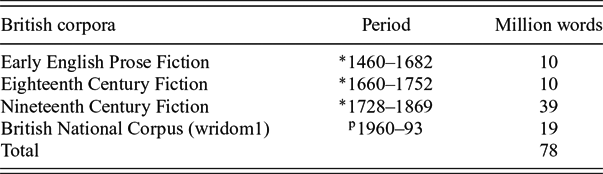
The analysis covers a time-span between the sixteenth and twentieth centuries and is thus able to take into account the trajectory of change characterised by the steady loss of the self-marked pronoun and the increasing adoption of the zero variant. Table 1 presents the British (sub)corpora used to trace the development of the selected semi-reflexive verbs. Only prose fiction was taken into account, keeping the factor genre constant across time. For the Eighteenth Century Fiction corpus and the Nineteenth Century Fiction corpus, subcorpora have been used starting and finishing at the turn of a century (ECF 1, ECF 2, NCF 1, NCF 2), so that it was ultimately possible to analyse timespans of equal length and contrast the occurrences of the respective semi-reflexive verbs in the seventeenth, eighteenth, nineteenth and twentieth centuries. For further tentative insights, additional corpora have been used for indulge and commit, which will be explained in due course.
The British English corpora (* authors’ birth dates, ppublication dates)

The corpus tool WordSmith was used for automatic retrieval of the reflexive verb constructions; for the early time periods, any spelling variants of the verbs in question were included as listed in the respective OED entries. All corpus hits were manually checked to discard cases which did not qualify as reflexive constructions. In this way, for each of the semi-reflexive verbs, final position was contrasted to non-final position, as exemplified below for the semi-reflexive verb hide.
-
(10)
-
(a) hide self in non-final position:
. . . I softly sneaked back and hid my self under the staires, . . . (EEPF: Head, Richard, The English Rogue, 1668)
-
(b) hide ø in non-final position:
. . . and not knowing where to hide ø, or what to do, . . . (EEPF: Behn, Aphra, The Amours of Philander and Silvia, 1688)
-
(c) hide self in final position:
. . . however, I shall consult M. DuBois, as soon as I can ferret out where he's hid himself. (ECF: Burney, Frances, Evelina, 1778)
-
(d) hide ø in final position:
. . . they were opposite the hollow oak in which on the day of battle it was supposed Bevis had hidden ø. (NCF: Jefferies, Richard, Bevis, 1882)
-
3.2 Results
The first semi-reflexive verb hide is clearly affected by the characteristic decrease of the self-variant. While in Early Modern English hide occurred almost exclusively with the explicit reflexive pronoun, it does so in less than 10 per cent in Present-day English. A more differentiated picture emerges, however, if we distinguish between different syntactic environments.
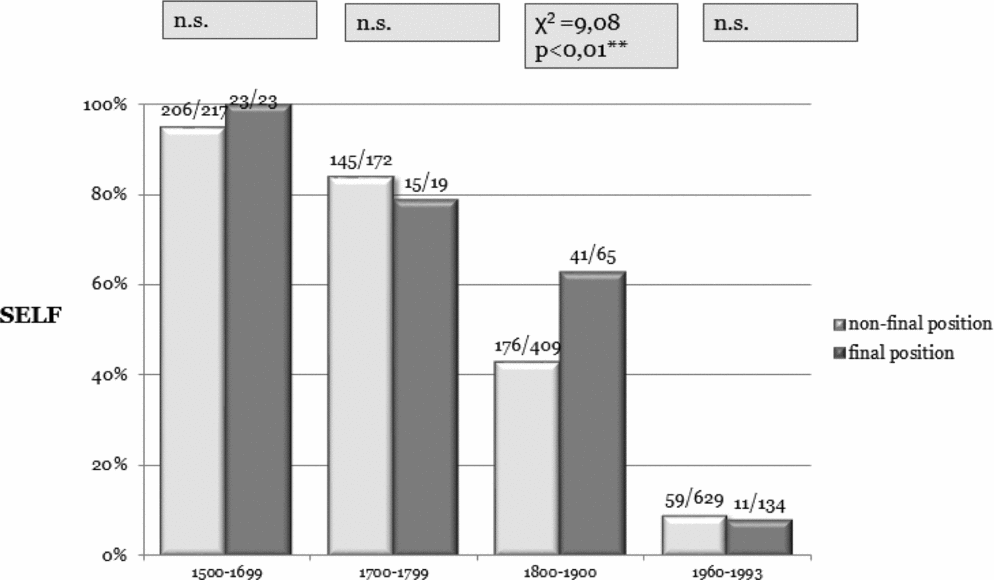
Figure 1 contains the occurrences of overtly marked reflexive hide in the periods under investigation. The light grey columns represent the percentages for hide self in non-final contexts, whereas the dark grey columns stand for absolute final contexts. The zero variant is implicitly represented in the graphs by the percentages that add up to 100 per cent in each column. To illustrate, in the period between 1800 and 1900, the self-variant occurs in 43 per cent of all non-final contexts, which implies that the other 57 per cent complementarily opt for the zero-variant.
hide self in non-final and final position

As we can see, hide self declines in both syntactic environments, but less rapidly in final position. While the first scattered occurrences of the zero-variant can be detected as early as in the Early Modern English period, the end position exclusively takes the self-variant. Particularly interesting is the Late Modern English period between 1800 and 1900, as the end position distinctly prefers the explicit variant (63 per cent), whereas the non-final position has decreased to 43 per cent, displaying a clear preference for the zero-variant. A two-by-two chi-squared test reveals this distribution to be very significant; the null-hypothesis that the percentages are due to chance can therefore be rejected.Footnote 7 Until the twentieth century, however, differences between the syntactic environments have been levelled out.
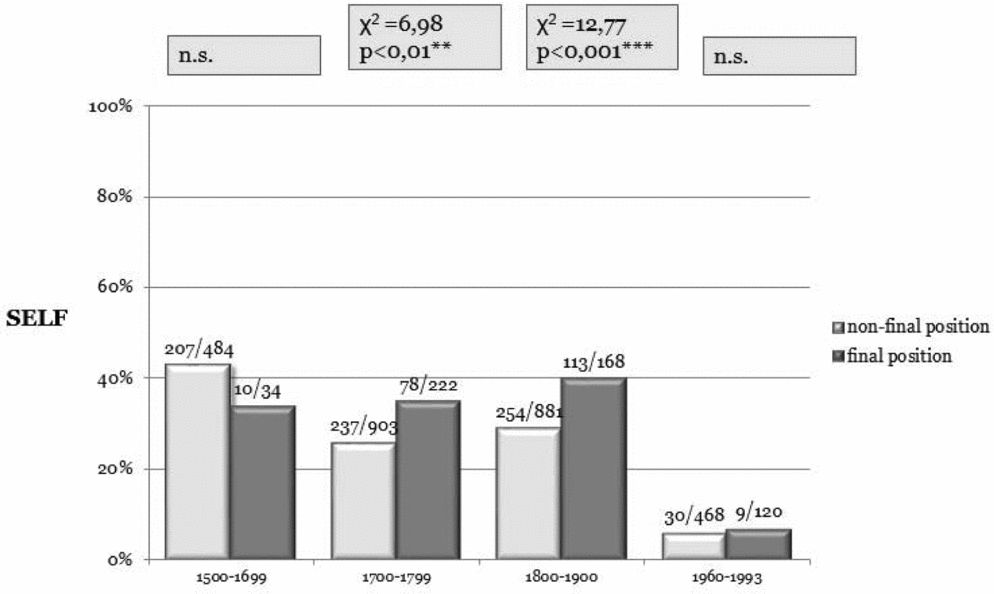
A similar picture emerges in figure 2 for semi-reflexive recover. Here, too, significant end-weight effects can be noticed in the periods between 1700 and 1799 as well as 1800 and 1900, when the final position takes the larger share of self. The distributions for the earliest period, which suggest a reverse effect, turn out to be non-significant.
recover self in non-final and final position

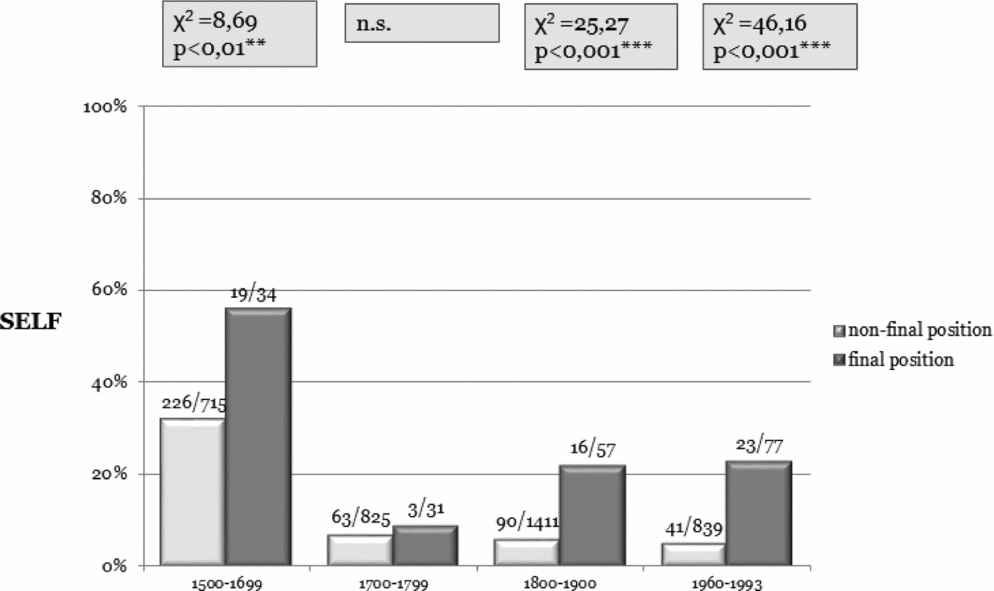
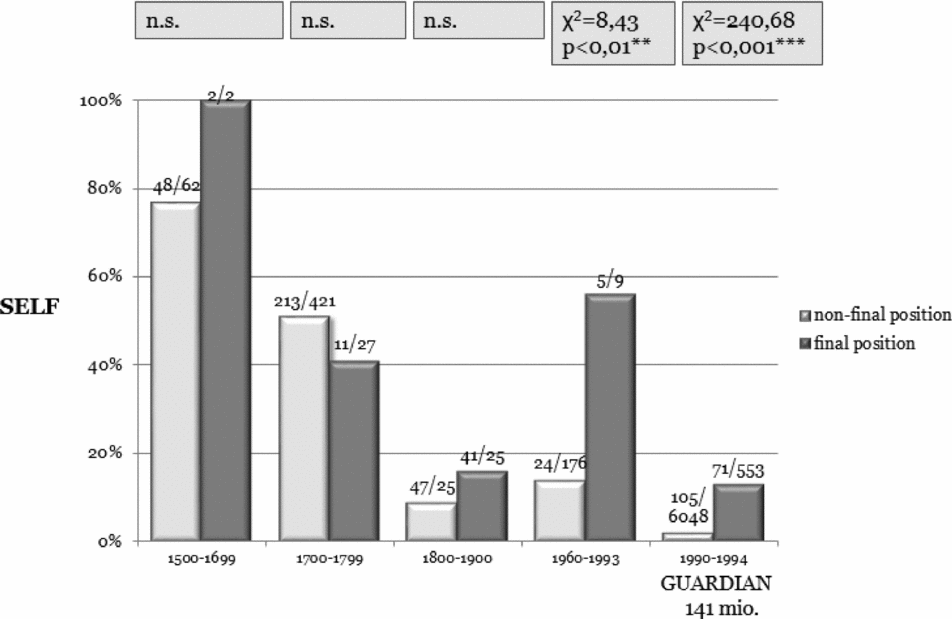
The third verb, behave, is a prototypical essentially reflexive verb as it does not allow for disjoint reference at all; as Smith (Reference Smith2004: 581) points out, one can only behave oneself, but not someone else. Accordingly, behave favours the zero-variant early on. Still, a more fine-grained analysis reveals the end position to retain explicit marking to a considerable degree: in the earliest period in more than half of all cases, in the more recent periods in slightly over 20 per cent.
Semi-reflexive indulge occurs in various contexts and may be used both with and without complements (indulge oneself/ø in NP or indulge oneself/ø, respectively). The data are rather inconclusive as the varied distributions in the first three periods turn out to be non-significant (see figure 4). Even though a very highly significant end-weight effect materialises in the twentieth century BNC data, the numbers for final position are extremely low and therefore not completely reliable. For this reason, additional data were extracted from a larger corpus to check whether an end-weight effect can be confirmed. Indeed, the occurrences of semi-reflexive indulge in the Guardian (1990-4) show that the end position takes the larger share of self to a highly significant degree.
behave self in non-final and final position

indulge self in non-final and final position

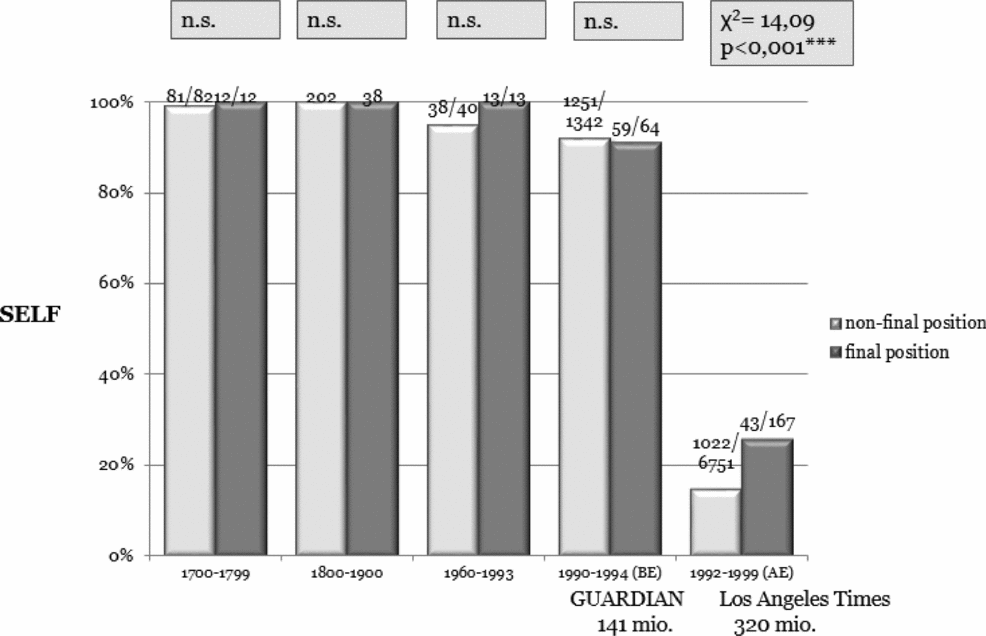
The last verb, commit, has been stable throughout English language history; it seldom drops the reflexive pronoun in the earlier periods. Overtly reflexive uses only start to decline as commit adopts the meaning of ‘to bind, to pledge’ and occurs in complementation patterns of the type commit oneself/ø to do(ing) something (see Shapiro Reference Shapiro1999). First traces of variation between self and the zero-variant can be detected in the twentieth-century BNC data, but it is notable that this only applies to the non-final position (see figure 5). In order to gather some more tentative insights, again two further corpora have been taken into consideration. The data extracted from the Guardian corpus verify that British English largely holds on to the self-marked variant, even though the zero-variant has slightly extended its domain. In contrast, the data extracted from the Los Angeles Times attest to the aforementioned observation that the decline of the self-marked strategy is more dramatic in American English. It is conspicuous, though, that the decline is not as straightforward in the final position which preserves self to 26 as opposed to 15 per cent in non-final position.
commit self in non-final and final position

To sum up the observations based on the investigation of five semi-reflexive verbs, we can say that end-weight has indeed been ascertained as a factor determining the choice between the more explicit, bulkier self-marked strategy and the less explicit zero-variant. Particularly the Late Modern English subperiod displays a preference for the self-pronoun in final position, while the non-final position leans towards the zero-variant in a more pronounced way. In this respect, then, end-weight has an impact on the trajectory of change as the preference of the more explicit variant at the end of sentences even delays the otherwise steady decline of the self-variant.
4 Case study II: do-support in Early Modern English affirmative declaratives
4.1 Background
The second case study concerns the use of auxiliary do in Early Modern English affirmative declarative clauses, thereby focusing on a period in which do-support is in its incipient stages of development. Usually used synonymously with dummy do in reference grammars, the term do-support does not refer to the notion of processing-facilitating support strategies in the narrow sense. However, a number of studies on the evolution of do-support consider processing-related factors to be at work, such as in the discussion of do as a strategy to avoid consonant clusters in second-person singular contexts (Stein Reference Stein1990) or as a strategy to keep the SVO order intact in transitive verb constructions (Kroch Reference Kroch, Fasold and Schiffrin1989; Warner Reference Warner, van Kemenade and Los2006).
As Ellegård's (Reference Ellegård1953) seminal study shows, do-support evolved in a typical S-curve of linguistic change from 1500 onwards; it developed at a rapid pace for negative interrogatives, with affirmative interrogatives quickly following suit and negative declaratives slowly but surely taking obligatory do-support as well. Interestingly, Ellegård's figures show that do-support takes an early lead in those contexts that can be assumed to demand the hardest processing effort, i.e. negative interrogatives.
Between 1540 and 1650, do-support also developed in affirmative declaratives where do, unlike in Present-day English affirmative clauses, is unstressed and semantically void. The do-supported verb constitutes a functionally equivalent variant of the finite verb form:
-
(11) he did love vs he loved
Compared to the aforementioned contexts, do-support gained ground in affirmative clauses to a much lesser degree: Ellegård's (Reference Ellegård1953: 162) data display an admittedly low peak at around 1575 with 10 per cent. In Raumolin-Brunberg & Nurmi's (Reference Raumolin-Brunberg, Nurmi, Nevalainen and Kahlas-Tarkka1997) data extracted from the more balanced Corpus of Early English Correspondence, the peak of do-support in affirmative declaratives is at around 1580, with do-support being continually used after that in 15–20 per cent of all affirmative statements. Yet, by 1700, we can suppose do-support to have lost ground completely in affirmative clauses. Only after that did the function familiar in Present-day English start to emerge, namely its pragmatic function of bearing ‘emphatic polarity or mark[ing] an implicit contrast’ (Warner Reference Warner, Bergs and Brinton2012: 746), as in He did love her (opposing the implied assertion that he did not).
As for the use of unemphatic do in Early Modern English affirmative declaratives, Bækken (Reference Bækken2002) makes explicit mention of end-weight as a factor contributing to the choice of do-support in her data, a self-compiled corpus of 31 texts from the seventeenth century. As she observes, an additional, otherwise redundant do may serve to ‘lengthen[] the verb phrase and increase[] its weight’ (Bækken Reference Bækken2002: 324). More specifically, intransitive verbs are singled out as having a particular propensity towards the do-supported variant (see also Wischer Reference Wischer2008: 142). In these cases, the verb, naturally stranded in the absolute final position of the sentence, is reinforced by the extra auxiliary do ‘to add weight to the final verb’ and ‘to achieve end-weight’ (Bækken Reference Bækken2002: 324), a wording reminiscent of end-weight as a gravity principle discussed earlier.
Other researchers have also commented upon a seeming tendency to opt for do-support in final position, however, without referring explicitly to the narrow term end-weight. According to Rissanen (Reference Rissanen1985: 173), the reinforcement via do has the function of ‘rounding off the clause’ and ‘improving the balance between the VP and the preceding NP’. Nevalainen (Reference Nevalainen and Kastovsky1991: 311) goes in the same direction when she attributes a compensatory function to the additional element that mitigates ‘the thematic oddity of a single clause-final predicate verb’. Warner (Reference Warner, Bergs and Brinton2012: 747), too, sees a tendency to use do when the verb occurs in absolute final position ‘for purposes of balance and sentence rhythm’.
The idea that there is a certain tendency in Early Modern English to use do-support at the end of an affirmative clause is therefore not entirely new, but the exact role of end-weight governing language users’ choice of do-support has so far remained inconclusive due to lack of data. The following analysis makes a contribution to closing this research gap.
4.2 Data and methodology
As in the study on semi-reflexive verbs, the hypothesis is tested that the do-supported variant takes the larger share of occurrences in final position as opposed to non-final position, which, if borne out, would correlate with the tendency of lengthier, more explicit constituents to be positioned at the sentential end. For this purpose, a corpus analysis was conducted based on 31 randomly selected verbs occurring in affirmative declarative clauses and alternating as in (12) between finite uses and do-supported ones in both syntactic environments of interest.
-
(12)
-
(a) finite V in non-final position:
. . . he was aduertised by the people who dwelled at the foote therof. . . (EEPF: Wroth, Lady Mary, The Countesse of Mountgomeries Urania, 1621)
-
(b) do-support in non-final position:
-
For I did dwell with as good men. . . (EEPF: Bernard, Richard, The Isle of Man, 1627)
-
(c) finite V in final position:
. . . and commaunded him to conducte the gentleman, to that part of the forest, where his father dwelled. (EEPF: Painter, William, The Palace of Pleasure, 1566)
-
(d) do-support in final position:
. . . accompting themselues most happye to dwell in that Towne, where a woman of such virtuous behauiour did dwel. (EEPF: Painter, William, The Palace of Pleasure, 1566)
-
The database for the corpus study is the Early English Prose Fiction corpus. Comprising 211 prose texts in total between 1518 and 1700, the EEPF covers a timespan in which do-support in affirmative declaratives still constituted a functionally equivalent alternative to the finite verb use, particularly so as the large majority of the texts (67 per cent) was published between 1540 and 1660, the humble heyday of affirmative do. As stated before, emphatic do with a contrastive focus only developed in the course of the eighteenth century, and indeed, no occurrences of contrastive do were found in the affirmative clauses retrieved from the EEPF.
As before, the corpus tool WordSmith was used for data extraction, and spelling variants recorded in the OED were taken into account. Only those affirmative clauses were considered in which subject and verb occurred in an SV-ordering, thereby excluding inversion contexts as these do not readily allow for a finite alternative.
4.3 Results
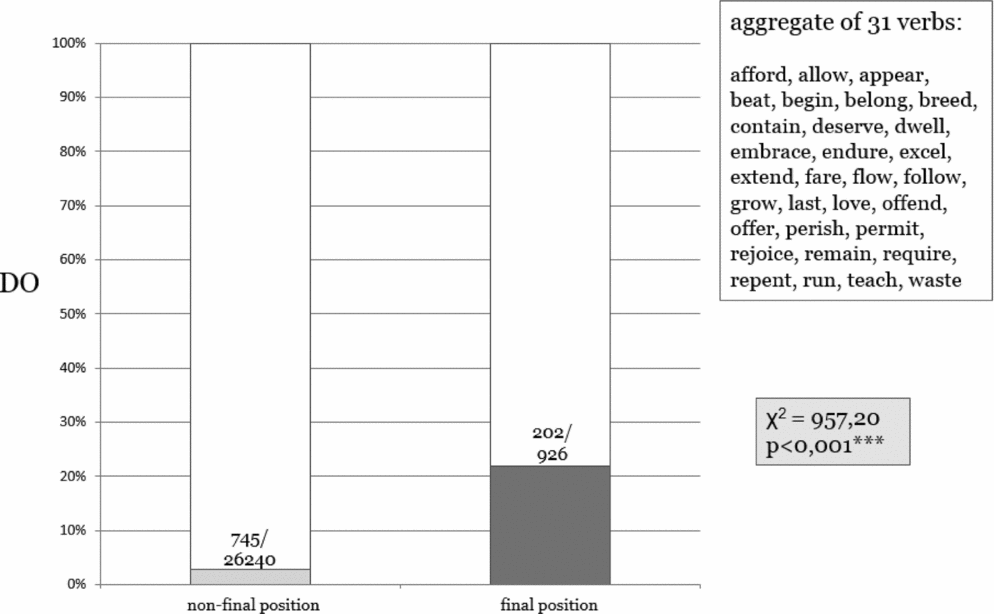
Figure 6 displays the percentages of do-support in affirmative declaratives for an aggregate of 31 verbs. As before, the columns represent the use of do-support in the two syntactic environments of interest, with the missing segments adding up to 100 per cent representing the use of the finite variant. Final position clearly takes the larger share of affirmative do with 22 per cent, whereas do-support is opted for in only 3 per cent of all cases in non-final position. This distribution turns out to be highly significant, so we can reject the null hypothesis that the language users’ choice is completely random and irrespective of the syntactic environment.
Affirmative do in non-final and final position

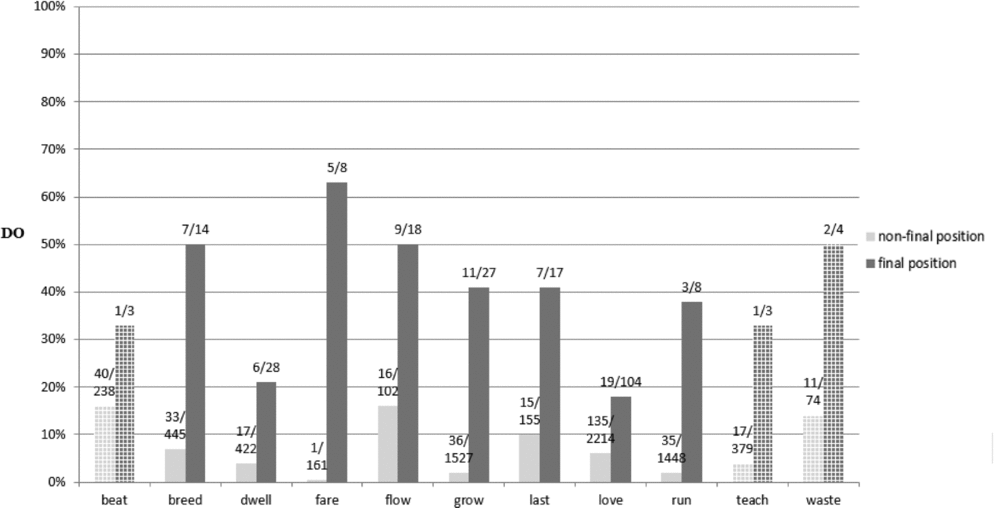
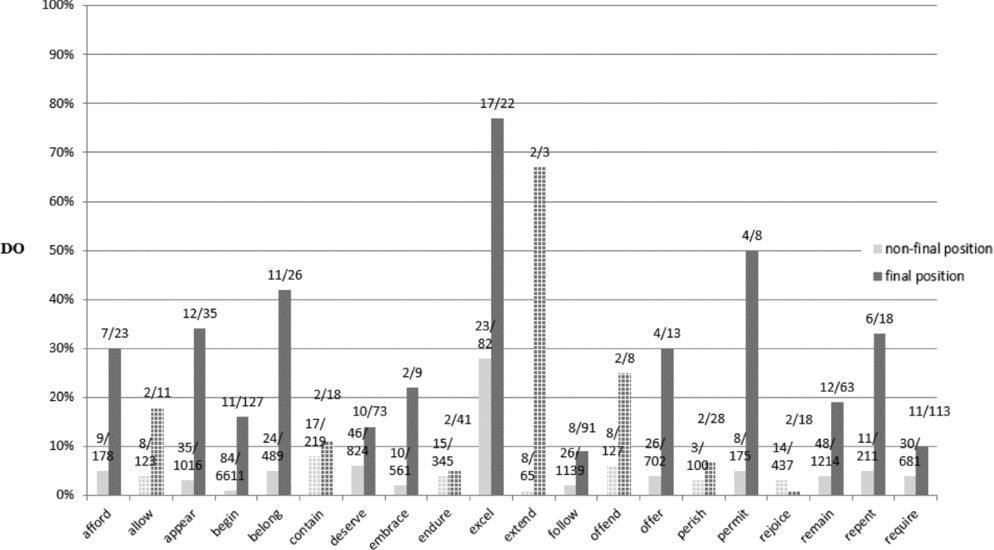
In order to check whether such an end-weight effect holds across all 31 verbs, figures 7 and 8 present the percentages of do-support in non-final as opposed to final position for each individual verb. Figure 7 contains the monosyllabic verbs investigated, whereas figure 8 presents the disyllabic verbs. As can be seen at first glance, all verbs – with the exception of rejoice – take do-support to a larger extent in final position as opposed to non-final position, corroborating end-weight effects across the board. The chequered columns represent verbs which have yielded non-significant results according to the two-by-two chi-squared test. That the percentages differ from verb to verb might be a reflex of the general process of lexical diffusion to be witnessed in the evolution of do-support in general: as Nevalainen (Reference Nevalainen2006: 109) points out, do-support spreads more quickly with certain verbs, while others prove to be more resistant in the long run; also, do-support typically seems to occur more frequently with less common verbs (see Warner Reference Warner, Bergs and Brinton2012: 749).
do-support with individual monosyllabic verbs in non-final and final position

do-support with individual disyllabic verbs in non-final and final position

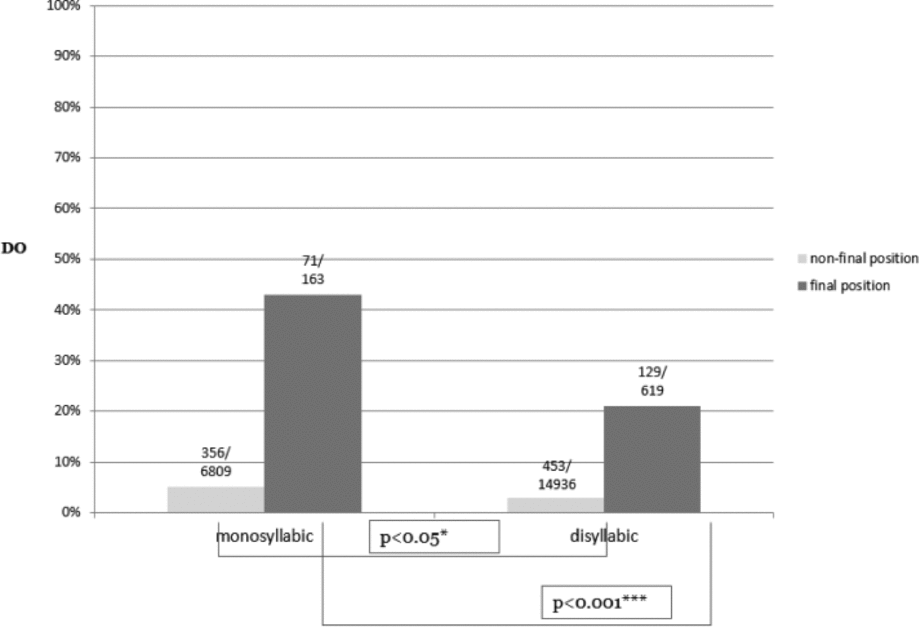
As the survey of the literature on do-support in Early Modern English affirmative clauses has foregrounded, previous research has hypothesised that single clause-final verbs tend to be reinforced, as otherwise they would be ‘inappropriately light’ (Warner Reference Warner, Bergs and Brinton2012: 747). Against this backdrop, the aggregate of monosyllabic verbs was contrasted to the sum of disyllabic verbs.
As figure 9 reveals, monosyllabic verbs tend to be do-supported in final position to a considerably higher degree than disyllabic verbs (43 vs 20 per cent), a distribution that is highly significant. As it seems, the thematic oddity of a verb in final position does indeed tend to be compensated for by the addition of an extra element, to make it substantially bulkier.
do-support with mono- vs disyllabic verbs in non-final and final position

The findings of this corpus study suggest that end-weight functions to create prosodic weight; bulkier variants are preferred with those verbs that are monosyllabic, whereas a similar reinforcement of the sentential end turns out to be considerably less the case with disyllabic verbs. In this regard, then, the findings for do-support in Early Modern English affirmative declaratives underscore the function of end-weight as a gravity principle, corroborating Rohr's (Reference Rohr1929: 21) early postulation of a principle characteristic to the English language to lengthen constituents at the end of an utterance.
5 End-weight as a support strategy
After the previous sections have collected evidence to support the notion of end-weight as an autonomous principle both theoretically and empirically, the present section provides a tentative discussion of end-weight as a support strategy.
Support strategies, as defined in the issue at hand, involve the language users’ choice of linguistic variants to compensate for an increased processing load. In essence, the postulation of processing-facilitating support strategies complies with Rohdenburg's (Reference Rohdenburg1996: 151) Complexity Principle stating that ‘[i]n the case of more or less explicit grammatical options the more explicit one(s) will tend to be favoured in cognitively more complex environments.’ Syntactic environments that demand higher processing efforts are for instance, as independent evidence has shown, hypotactical sentence structures, non-assertive contexts or passive constructions. As the two case studies of semi-reflexive verbs and do-supported affirmative clauses have demonstrated, more explicit variants were preferred in final position as opposed to non-final position, which raises the question whether the sentential end can be added to the list of cognitively more demanding contexts. After all, such a claim would tie in with an ease-of-processing effect commonly attributed to end-weight in the literature. Note, however, that this kind of reasoning would as yet be based on somewhat circular argumentation, i.e. in order to classify end-position as a cognitively complex environment, we require independent evidence, from e.g. psycholinguistic experiments. What is more, the question has to be addressed why exactly the bulkier variant could be said to mitigate the increased processing load at the end of a sentence – or, in other words, why exactly it is necessary to create prosodic end-weight under certain circumstances.
One explanation could be along the lines of the so-called sentence wrap-up effect as discussed in psycholinguistics (see Just & Carpenter Reference Just and Carpenter1980; Rayner Reference Rayner1998; Hirotani et al. Reference Hirotani, Frazier and Rayner2006). This effect refers to the assumption that it is at the absolute end that a sentence is conclusively processed or, as it were, ‘wrapped up’. Processes that occur during sentence wrap-up may involve a search for referents that have not been properly assigned yet or the tasks of drawing inferences, eliminating ambiguities or resolving any comprehension problems before proceeding to the next sentence. As a consequence, there is a slow-down effect at the end of a sentence measurable in more frequent regressions and longer pauses with respect to sentence-final constituents, which indicates the necessity of additional processing in absolute final contexts.
In an attempt to correlate end-weight and the sentence wrap-up effect, we could indeed interpret end-weight as a compensatory support strategy in that the more explicit variant opted for at the end of a sentence saves further processing costs. In the case of the self-marked reflexive strategy, the processing load is reduced in that the co-referentiality between agent and patient does not have to be reconstructed at an extra cost, while implicit marking does impose an additional effort on the human parser. In other words, the choice of the more explicit variant could be said to facilitate argument-checking in a harder-to-process environment and thus to support the co-referential reading of the sentence. Likewise, the do-supported option separately encodes the tense and mood of the verb in the respective form of dummy do, whereas this grammatical information would otherwise be contained in the finite verb form. Again, the more explicit variant would spare the human parser the effort of disentangling the morphologically more complex form by distributing grammatical and semantic properties over two distinct linguistic items.
In order to be sure whether a correlation between end-weight and the sentence wrap-up effect exists, we would have to conduct further experiments, expectations being that the end-weight scenario would bring about accelerated processing measurable in shorter first-pass reading times or fewer regressions from the target region of the sentential end. More specifically, tests would have to be designed in a way that would confront informants with variants of differing degrees of explicitness in final position. So far, however, such studies are lacking, so that the benefit of end-weight for sentence-wrap-up remains a matter of speculation. Another problem with this theory is that it does not sufficiently explain why end-weight functions as a kind of gravity principle, as evidenced for monosyllabic verbs taking do-support to a larger extent than disyllabic verbs.
An alternative hypothesis is based on another observation made in psycholinguistic research, namely the observation that language users already start planning the next sentence while still producing the current sentence. Again, this parallel activity would imply an increased processing effort at the sentential end as this environment constitutes the threshold between the sentence currently uttered and the sentence to follow. The inherent redundancy of the more explicit variant could be said to be beneficial in two ways at the same time. On the one hand, language users can be assumed to save extra costs by the choice of a variant that is easier to process, and on the other hand, the bulkier variant buys language users additional time at the end of a sentence and gives them a head start for planning the next one. In this account, then, the sentential end requires more substance to open up a facility for planning ahead, which is achieved by creating end-weight.
The latter explanation, which seems to be more plausible than the first, also ties in with processing-related approaches to end-weight that posit a greater benefit for the speaker than for the hearer (see Wasow Reference Wasow1997a). Still, further research is needed to find a conclusive answer for the processing-facilitating effect in cases of linguistic variation. It will also have to be seen to what extent end-weight as a gravitational principle ties in with processing-related approaches such as the Domain Minimisation Principle or accessibility explanations (see section 1) that explicate end-weight as an ordering principle or as a constructional trigger.
6 Conclusion
The present article has provided support for end-weight as an autonomous principle in three respects. Firstly, by conducting a survey of end-weight phenomena, a more narrow definition of the term was advocated. It is important to emphasise that end-weight does not boil down to an ordering preference with the longest constituent positioned at the end, but that it also has an impact on language users’ choice of constructions. To a certain extent, this may even result in language users’ opting for bulkier elements at the end of a sentence for no other reason than to provide a neater balance between the first and the second half of the sentence or to generate gravity at the end. This assumption was, secondly, investigated more closely in the two case studies that contributed to isolating and quantifying end-weight effects. They showed that indeed, end-weight has to be counted in as a factor that fundamentally motivates the choice between more and less explicit variants, depending on the syntactic context. Thirdly, the commonly accepted notion that end-weight serves a processing-facilitating function was discussed against the backdrop of support strategies. The two hypotheses that have been brought forward were admittedly speculative in nature and await experimental confirmation, but they are a first step towards providing an explanation why exactly more explicit variants should be preferred at the end, where they serve no other purpose than to create bulkiness.
Apart from the explication of end-weight as a processing-related principle, there are also other avenues of research to follow up in future work. The most important one concerns the consideration of end-weight together with other factors of linguistic variation in order to explore their synergetic and antagonistic interaction. Such a multivariate analysis would shed further light on the exact role of end-weight in linguistic variation and change.