Introduction
The genus Cichla Schneider, 1801, commonly called peacock-bass in English or tucunaré in Brazil, is native to the Tocantins-Araguaia and Amazon basins, accounting for the major piscivorous fishes of the Cichlidae family in South America (Lowe-McConnell, Reference Lowe-McConnell1975). Peacock-bass are very popular as sportfish, because of their great voracity in attacking natural or artificial baits and high resistance after being hooked by anglers (Shafland, Reference Shafland1996). As a consequence of such popularity, peacock-bass have been introduced into many tropical and subtropical systems around the world and non-native Cichla populations are now established in several reservoirs of Brazil, Panama, Hawaii and Puerto Rico and canals in Florida, with detrimental effects on native fish populations (Winemiller, 2001). Within the 15 peacock-bass species that are currently described (Kullander & Ferreira, Reference Kullander and Ferreira2006), Cichla kelberi and C. piquiti (mischaracterized as C. ocellaris or C. monoculus before the op. cit. revision) have probably accounted for most introductions into freshwater systems, especially those introduced into many hydroelectric reservoirs in south–southeast Brazil. Paradoxically, little effort has been directed to identify possible threats to, or biological controllers of, non-native Cichla populations (but see Santos et al., Reference Santos, Santos, García-Berthou and Hayashi2009).
Despite their recognized importance as vectors of new diseases for native species or for the demographic control of non-native Cichla populations, parasite assemblages of peacock-bass are poorly known. Some studies on parasitic fauna of the genus Cichla are largely restricted to native populations of the Amazon basin (Kritsky et al., Reference Kritsky, Thatcher and Boeger1989; Thatcher, Reference Thatcher2006; Araujo et al., Reference Araujo, Barros, Gomes, Varella, Viana, Silva, Fraga and Andrade2009) or introduced populations in the Paraná River (Takemoto & Pavanelli, Reference Takemoto and Pavanelli1996; Machado et al., Reference Machado, Almeida, Pavanelli and Takemoto2000; Santos et al., Reference Santos, Pimenta, Martins, Takahashi and Marengoni2002; Martins et al., Reference Martins, Santos, Marengoni, Takahashi and Onaka2009b). Few studies have addressed the parasitic fauna of non-native Cichla populations in reservoirs (Martins et al., Reference Martins, Mello, Paiva, Fujimoto, Schalch and Colombano2002, Reference Martins, Pereira, De Chambrier and Yamashita2009a), despite the general consensus that those are the systems in which peacock-bass often dominate and cause the most impact on native fishes (Agostinho et al., Reference Agostinho, Thomaz and Gomes2005).
The main purpose of this study was to characterize the gill ectoparasite assemblages of non-native C. piquiti and C. kelberi populations that were introduced into Itaipu and Lajes reservoirs, two large hydroelectric impoundments located in south–southeast Brazil. Prevalence, abundance and richness were used as the main ecological descriptors of gill ectoparasitism in Cichla, being correlated with size and sex of the hosts, and compared between the two host populations (C. piquiti versus C. kelberi). Gill ectoparasite assemblages were examined at both component community and infracommunity levels, in order to not only assess the general patterns of parasite composition and distribution, but also to examine species-specific interactions between parasites and hosts.
Materials and methods
Study sites
Itaipu reservoir is a 1350 km2 impoundment of the mainstream Paraná River, located on the Brazil–Paraguay border (24°05′–25°33′S, 54°00′–54°37′W). Cichla kelberi and C. piquiti were first recorded at Itaipu reservoir in the 1980s, but they became abundant in the local fisheries only after the 2000s (Espínola & Júlio-Júnior, Reference Espínola and Júlio-Júnior2007). Despite both species co-occurring in several habitats and often hybridizing (Oliveira et al., Reference Oliveira, Oliveira, Prioli and Prioli2006), C. piquiti mostly prevails in number over C. kelberi in Itaipu reservoir (L.N. Santos, unpubl. data).
Lajes reservoir (22°42′–22°50′S; 43°53′–44°05′W) is a 30 km2 impoundment in Rio de Janeiro State, Brazil (Santos et al., Reference Santos, Santos and Araujo2004). Cichla kelberi was introduced into this reservoir in the 1950s, and since the 1970s it has been the major species caught by local anglers (Santos et al., Reference Santos, Araujo and Brotto2008). Until now, there has been no record of C. piquiti or C. kelberi × C. piquiti hybrids in Lajes reservoir.
Fish collection and laboratory procedures
Cichla kelberi was collected bimonthly, from July 2005 to December 2006, in Lajes reservoir, whereas C. piquiti was captured monthly, from February to November 2006, in Itaipu reservoir. We also attempted to catch C. kelberi in Itaipu reservoir, but the very few individuals that were captured (N < 10) precluded any parasite–host analysis. All fish were caught through gillnets of different mesh sizes (30–70 mm) or angling (i.e. artificial baits) using standardized effort. Individuals were measured (standard length (SL) to the nearest 0.1 mm), weighed (to the nearest 0.1 g), and dissected for sex identification (i.e. macroscopic examination of gonad features). Gills were removed and placed in vials containing 1:4000 formalin solution. All collected parasites were fixed and stored in 5% formalin. Some parasite specimens were mounted unstained in Hoyer's medium in order to study the sclerotized structures, while others were kept stained with Gomori's trichrome to observe internal organs (Eiras et al., Reference Eiras, Takemoto and Pavanelli2006).
Data analysis
Parasite richness, diversity and numerical dominance were used as ecological descriptors, at the component community level (i.e. all parasites of all species exploiting a host population) of the gill metazoans associated with each host population. Simpson's index (C) was applied to appraise the numerical dominance trends among parasite species (C>0.25 = dominance, as in Stone & Pence, Reference Stone and Pence1978). Yates' corrected χ2 together with Spearman's rank correlation (rs) were also performed on pairs of co-occurring parasite species to investigate possible interspecific associations (i.e. co-operative or antagonistic relationships) (Ludwig & Reynolds, Reference Ludwig and Reynolds1988). Brillouin's index (H) was also calculated to appraise the ectoparasite diversity of the two host populations, and Sorenson's similarity index was applied to compare the ectoparasite assemblages of Cichla spp. between Lajes and Itaipu reservoirs (Ludwig & Reynolds, Reference Ludwig and Reynolds1988; Zar, Reference Zar1996).
The degree of parasite overdispersion (aggregation) and the relationships of parasite abundance, prevalence and diversity (H) with the biological features of the hosts were also investigated at the infracommunity level (i.e. the collection of all parasites of all species found in an individual host). Dispersion and Green's indices were used to assess the degree of overdispersion of parasite species in individual hosts. The dispersion index was tested through ‘d’ statistics; d>1.96 = aggregated distribution; d < − 1.96 = uniform distribution; − 1.96 < d < 1.96 = random distribution (Ludwig & Reynolds, Reference Ludwig and Reynolds1988). Log-likelihood G-test (paired contingency table) and Mann–Whitney's U-test were performed to measure the effects of host sex on the prevalence and abundance of each parasite species, respectively (Zar, Reference Zar1996). Pearson's linear correlation (r) was applied to examine the relationship between host SL and parasite prevalence, whereas Spearman's rank correlation (rs) was used to investigate the relationship of host SL with parasite abundance and diversity (H) (Zar, Reference Zar1996). Only ectoparasite species with prevalence>10% were retained for analyses at infracommunity level (Bush et al., Reference Bush, Aho and Kennedy1990). Hierarchical levels and terminology used in this study followed Bush et al. (Reference Bush, Lafferty, Lotz and Shostak1997) and Poulin (Reference Poulin2004), and the significance level adopted for statistical analyses was P < 0.05.
Results
Ectoparasite assemblages at the component community level
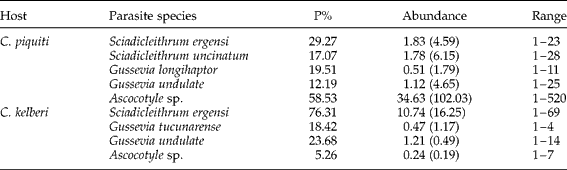
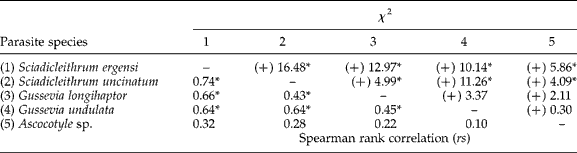
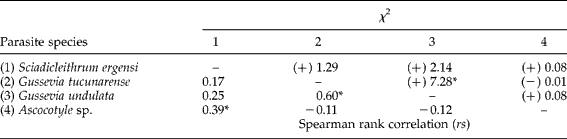
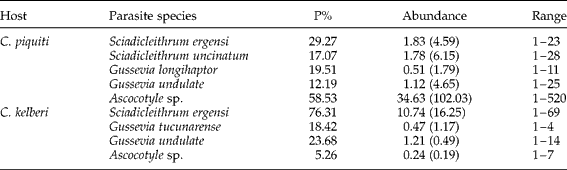
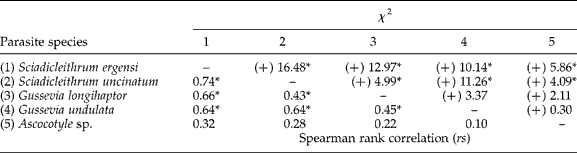
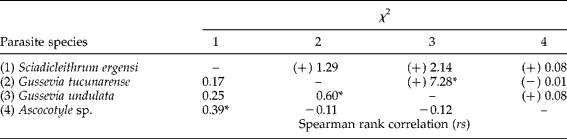
Five parasite species were recorded in C. piquiti from Itaipu reservoir and 25 out of 41 examined fishes (61%) were parasitized by at least one species, with Ascocotyle sp. being the most prevalent (58.53%) and most abundant helminth species. Four parasite species were found in C. kelberi from Lajes reservoir, with Sciadicleithrum ergensi being the most prevalent (76.31%) and most abundant helminth species (table 1). The parasite assemblages of both C. piquiti and C. kelberi populations were dominant in number (C = 0.27 with Ascocotyle sp. and C = 0.44 with S. ergensi, respectively). Most of C. piquiti's parasites were positively and significantly correlated (table 2) but for C. kelberi's parasites only the pair Gussevia tucunarense–G. undulata was positively and significantly associated (table 3). Gill parasite diversity (H) ranged from 0.15 ± 0.229, for C. kelberi, to 0.20 ± 0.057, for C. piquiti, with a high similarity of parasite species composition (66.67%) between the two host populations.
Prevalence (P%), abundance and numerical range per individual host (range) for gill ectoparasites of Cichla piquiti and Cichla kelberi caught, respectively, in Itaipu and Lajes reservoirs. Standard deviations are shown in parentheses.
Paired associations for gill ectoparasite species of Cichla piquiti caught in Itaipu reservoir between February and November 2006. χ2, Chi-square (Yates's corrected); (+), positive covariation; (−), negative covariation; *, significant values (P<0.05).
Paired associations for gill ectoparasite species of Cichla kelberi caught in Lajes reservoir between July 2005 and December 2006. χ2, Chi-square (Yates's corrected); (+), positive covariation; (−), negative covariation; *, significant values (P<0.05).
Ectoparasite assemblages at the infracommunity level
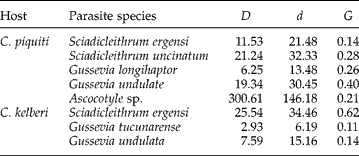
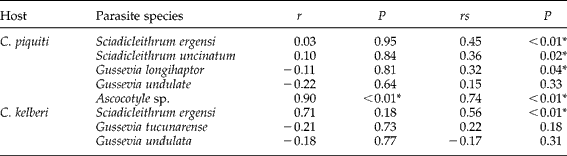
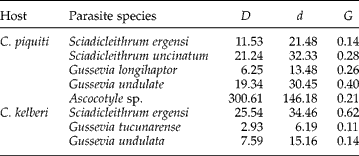
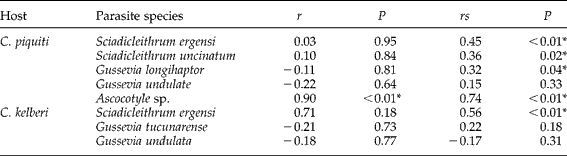
The metazoan gill parasites of the two host populations showed a pattern of overdispersion (aggregation) that is typical of most parasite–host systems, with the monogeneans G. undulata and S. ergensi showing the highest aggregation values within C. piquiti and C. kelberi populations, respectively (Green index = 0.40 and 0.62, respectively; table 4). Within C. piquiti hosts, 80% of females (N = 16 out of 20) and 92.30% of males (N = 12 out of 13) were parasitized by at least one ectoparasite species, whereas for C. kelberi hosts, 63.16% of females (N = 12 out of 19) and 73.33% of males (N = 11 out of 15) were parasitized. The sex of the host, however, did not show significant association with parasite prevalence or abundance for both Cichla populations. Only the prevalence and abundance of the metacercariae Ascocotyle sp. were significantly and positively correlated with C. piquiti SL, whereas the abundance of S. ergensi showed a significant and positive correlation with C. kelberi SL (table 5). A significant correlation between host SL and parasite diversity was recorded for the C. piquiti population (rs = 0.47; P = 0.002), but not for C. kelberi (rs = − 0.09; P = 0.59).
Calculated values of dispersion index (D), ‘d’ statistic, and Green index of aggregation (G) for major gill ectoparasites species (prevalence>10%) of Cichla piquiti and Cichla kelberi, caught, respectively, in Itaipu and Lajes reservoirs.
Pearson's correlation coefficient (r) and Spearman's rank correlation coefficient (rs) calculated, respectively, for prevalence and abundance of gill ectoparasites with host standard length (SL) of Cichla piquiti and Cichla kelberi populations. P=significance level; *, significant values (P<0.05).
Discussion
Our study revealed that gill ectoparasite assemblages of the non-native C. piquiti and C. kelberi populations were 60–70% less rich (N = 5 and 4 species, respectively) than that of the close congener C. ocellaris (N = 13 species) inhabiting native ecosystems (Thatcher, Reference Thatcher2006). Richness and diversity of fish parasites are often related to the host body size (Guégan & Hugueny, Reference Guégan and Hugueny1994), but in addition to great morphological similarity, C. kelberi, C. piquiti and C. ocellaris attain a very close maximum size (500–600 mm total length) (Kullander & Ferreira, Reference Kullander and Ferreira2006). Rohde (Reference Rohde1980) attributed the increasing monogenean richness of marine fish towards the equator to the faster evolutionary rates of parasite–host relationships in low latitudes, but whether parasite richness of freshwater fish is affected by latitudinal gradients is virtually unknown. Ecosystem characteristics may influence the diversity and richness of helminthic endoparasites, by affecting the composition and structure of intermediate hosts (e.g. invertebrate fauna) (Bell & Burt, Reference Bell and Burt1991), but there is no knowledge on whether the more host-specialized ectoparasites, such as the monogeneans, will respond to environmental differences. Even though species-specific host differences or large-scale (i.e. biogeographical) and fine-scale ecosystem differentiation (i.e. hydrodynamic and habitat complexity) might have contributed to some extent to the contrast between our findings and those of Thatcher (Reference Thatcher2006) on Cichla ectoparasite richness, these differences can be explained largely in the light of the colonization time hypothesis (Guégan & Kennedy, Reference Guégan and Kennedy1993), in which parasite richness is proportional to the time elapsed by a given host fish species after invading a new biogeographical region. Torchin et al. (Reference Torchin, Lafferty and Kuris2002) reported a lower parasite diversity in regions where marine invaders were recently introduced than in others where they were not, supporting the theory of parasite loss through the invasion process. Kennedy & Bush (Reference Kennedy and Bush1994) argued that the parasite species more easily lost through the invasion process will be those more strictly dependent on a narrow range of host taxa to spread out and survive (i.e. more specialized parasites). Therefore, the ectoparasite richness of recently introduced Cichla populations (i.e. C. piquiti and C. kelberi in south–southeastern Brazilian reservoirs; colonization time < 100 years) is expected to be lower than that of the formerly established native populations (i.e. C. ocellaris inhabiting Amazonian systems; colonization time of thousands of years).
The high similarity of the ectoparasite species composition between C. piquiti and C. kelberi suggests that these two host populations behaved in a similar fashion in Itaipu and Lajes reservoirs. However, C. piquiti and C. kelberi gill ectoparasites also varied in a suite of characteristics, such as total richness (i.e. N = 5 for C. piquiti versus N = 4 for C. kelberi), the prevalent species (Ascocotyle sp. versus S. ergensi, respectively) and the presence of exclusive species (i.e. S. uncinatum and G. longihaptor in C. piquiti versus G. tucunarense in C. kelberi). This indicates that the two host populations also responded to intrinsic characteristics of each environment. Differences between parasite assemblages may be related to many non-mutually exclusive factors, operating not only at broad evolutionary (i.e. host specificity) and biogeographical (i.e. latitudinal) scales, but also at narrower ecological dimensions, such as variations in hydrodynamic conditions and spatial heterogeneity among ecosystems, or changes in host diet, behaviour or habitat use (Simková et al., Reference Simková, Morand, Matejusová and Gelnar2001). As Itaipu and Lajes reservoirs are only about 2° (i.e. < 250 km) apart, latitudinal effects are not expected to explain such contrasts between the ectoparasite assemblages. We cannot exclude the possibility that environmental differences between the reservoirs (e.g. 1350 km2 versus 30 km2 of surface area, mesotrophic versus oligotrophic and 40 versus 286 days of water residence time, for Itapu and Lajes reservoirs, respectively) may have influenced Cichla gill parasite assemblages. However, the presence of C. kelberi in Itaipu reservoir and the lack of a close congener in Lajes reservoir were, perhaps, the key factors driving the differences found. According to Poulin (Reference Poulin2004), a parasite species may colonize a sympatric host species when the new host species is immunologically and physiologically similar to the original host. As C. piquiti is very similar ecomorphologically to its congener C. kelberi, and both species often hybridize in nature, differences in ectoparasite assemblages between C. piquiti from Itaipu reservoir and C. kelberi from Lajes reservoir could be linked to the process of ectoparasite colonization from a sympatric host species (i.e. the presence of C. kelberi in Itaipu reservoir in contrast to the lack of another sympatric Cichla species in Lajes reservoir). Although variations in host origin are not valid to explain the contrasts between C. piquiti and C. kelberi gill ectoparasites (i.e. both host species are native to Tocantins River Basin; Kullander & Ferreira, Reference Kullander and Ferreira2006), invasion pathways (i.e. single versus successive introduction events) might, instead, have contributed to such differences and should be further investigated.
Ectoparasite assemblages of Cichla of Itaipu and Lajes reservoirs showed, according to the results of Simpson's index (C), a concentration of numerical dominance, but we did not find any other evidence of competition among parasite infracommunities. Most ectoparasite species of the two Cichla populations correlated with each other positively, providing evidence of niche availability for species coexistence without competitive interference, or that parasite abundance was not so high as to cause agonistic interference. Rohde et al. (Reference Rohde, Hayward and Heap1995) documented a similar pattern of positive correlations between co-occurring species and low abundances for marine fish parasites, inferring that inter-specific negative interactions, such as competition, are weak or null. Although probably not influenced by competitive strengths, gill ectoparasite assemblages of C. piquiti and C. kelberi appeared to fit well to the concept of core-satellite species (Caswell, Reference Caswell1978; Hanski, Reference Hanski1982; Bush & Holmes, Reference Bush and Holmes1986). Caswell (Reference Caswell1978) proposed that parasite assemblages are composed of a core of a few dominant species in equilibrium, surrounded by numerous species interacting against this equilibrium. Hanski (Reference Hanski1982) idealized the concept of central (i.e. a few species that are very frequent and abundant) and satellite (many species that are occasional and scarce) parasite species. According to Bush & Holmes (Reference Bush and Holmes1986), only central species (in equilibrium) show predictable patterns, while satellite species behave in a stochastic fashion. This trend is also noticeable after analysing the gill ectoparasites of Cichla at the infracommunity level, in which only the most abundant parasite species showed consistent relationships with biological features of the host.
Standard length is directly related to fish age (Shotter, Reference Shotter1976), and many behavioural and biological changes through fish ontogeny are critical to parasite assemblages. Variations in amount, type and size of food, habitat use, body surface and time of exposure to parasitism are related overall to changes in parasite prevalence or abundance with fish age or size (Takemoto & Pavanelli, Reference Takemoto and Pavanelli1996). Host size was significantly and positively correlated with the abundance of dominant gill ectoparasite species in both Cichla populations (Ascocotyle sp. and S. ergensi, respectively, for C. piquiti and C. kelberi). This finding agrees with the hypothesis of cumulative effect (Rohde, 1993), in which larger hosts are prone to an augmented parasite accumulation due to the increased gill surface and time of exposure to parasitism. Our results also agree with those of Lizama et al. (Reference Lizama M. de los, Takemoto and Pavanelli2005), for monogenean and digenean parasites of Prochilodus lineatus in the Upper Paraná River floodplain, but contrast with those of Lizama et al. (Reference Lizama M. de los, Takemoto, Ranzani-Paiva, Ayroza and Pavanelli2007), who found negative correlations between monogeneans and the size of captive Oreochromis niloticus.
Host sex often influences the degree of parasitism due to behavioural and physiological differences between the sexes (Esch et al., Reference Esch, Kennedy, Bush and Aho1988), but prevalence or abundance of gill ectoparasites did not vary with sex differences in the two Cichla species. In addition to the differences between parasite taxa, our findings contrast with those of Machado et al. (Reference Machado, Almeida, Pavanelli and Takemoto2000) for C. kelberi (formerly identified as C. monoculus) in the Upper Paraná River floodplain, who recorded a higher intensity of Proteocephalus macrophallus and Sciadocephalus megalodiscus (Cestode), and Quadrigyrus machadoi (Acanthocephala) in males than in females. The intensity of parental care overall varies between the sexes for most cichlids, with females concentrating efforts primarily on reproduction and the protection of eggs, whereas males are more directed to defending the offspring against potential threats (Keenleyside, Reference Keenleyside and Keenleyside1991). All Cichla species, however, show biparental care, with no significant behavioural differences in guarding nests or offspring between both parents (Lowe-McConnell, Reference Lowe-McConnell and Keenleyside1991), which may explain why we did not record any variation in gill ectoparasites with sex of both C. piquiti and C. kelberi. Nevertheless, further studies are needed, since other factors may lead to unequal rates of parasite colonization between male and female hosts, such as seasonal changes in host behaviour (e.g. reproductive versus feeding periods) or differential ontogenetic growth (e.g. different physical space and time of exposure for parasite colonization) (Takemoto & Pavanelli, Reference Takemoto and Pavanelli1996).
In conclusion, our results accorded well with the general theories for parasite–host relationships, with most infracommunity attributes of the C. piquiti and C. kelberi gill ectoparasites relying not only on particular environmental characteristics of each reservoir but largely on species-specific features of parasites and hosts. We further stressed that applying concepts of invasion theory is critical to acknowledging the trends of gill ectoparasites at the component community level, in which information on host origin, invasion pathways and even the co-occurrence of close non-native congeners is critical. Although the potential of C. piquiti and C. kelberi to act as vectors of new gill ectoparasite species to native fishes is weak, given the high specificity of the monogeneans, our results revealed that the trend of parasite species loss through the invasion process might have contributed to the establishment of non-native Cichla populations in Brazilian reservoirs.
Acknowledgements
The authors were supported by a research fellowship from Conselho Nacional de Desenvolvimento Cientifico e Tecnológico (CNPq; Edital Universal, code 478541/2004-0), Brazil. We thank J.D. Latini, V.A. Capatti, F.A. Teixeira, J.R. Gonçalves and V.R. Casaré (Nupelia-UEM) for indispensable assistance in fieldwork and S.A. Heil, D.R. Fernandez and H.M. Fontes Jr (Itaipu-Binacional) for logistic support.