Introduction
The predicted epidemic increase in the incidence of dementing degenerative illnesses, such as Alzheimer's disease (AD) over the next 10–20 years (Deloitte Access Economics, 2011) has focused international research efforts on identifying potential pharmacological agents that can delay or prevent AD. An alternative, non-pharmacological approach receiving less attention is increasing understanding of what contributes to, and how to increase, the brain's ability to sustain effective cognitive function in the presence of cerebral lesions. Cognitive reserve (CR) is a hypothetical construct that describes neurological processes that support cognitive function in the face of pathology-related neural disruption (Stern, Reference Stern2002). Two complimentary neural processes, neural reserve and neural compensation, result in brain networks being better able to resist or compensate for the effects of neurological degeneration (Stern et al., Reference Stern2005). Individuals with higher CR, generated by a lifetime of cognitive engagement, have lower risk for dementia in spite of no decrease in their risk for accumulating frank AD pathology (Stern, Reference Stern2002). Although CR has been researched intensively, no operational measures exist for accurately estimating an individual's CR.
The notion that CR protects against the emergence of clinical symptoms in neurodegenerative disorders is supported by an autopsy investigation that found a subset of pathologically confirmed AD cases with preserved cognition prior to death (Katzman et al., Reference Katzman1988). Subsequent investigations identified education, occupational attainment, intelligence, and participation in cognitively stimulating leisure activities as being lifetime contributors to CR (Stern, Reference Stern2002). Excluding intelligence, the majority of proposed CR proxies are measures of environmental exposure (Stern, Reference Stern2002), with measures of individual cognitive processes tending not to be used as estimates of CR, with the possible exception of executive function (Satz et al., Reference Satz, Cole, Hardy and Rassovsky2011). Earlier studies demonstrating an inverse relationship between educational or occupational attainment and risk for dementia (Stern et al., Reference Stern, Gurlund, Tatemichi, Tang, Wilder and Mayeaux1994; Ott et al., Reference Ott1995) have been supported by more recent data (Karp et al., Reference Karp, Andel, Parker, Wang, Winblad and Fratiglioni2009; Brayne et al., Reference Brayne2010; Basu, Reference Basu2012; Meng and D’Arcy, Reference Meng and D’Arcy2012). Intellectual factors have been shown to possess similar cognition-preserving effects (Rentz et al., Reference Rentz2010; Vemuri et al., Reference Vemuri2011; Galioto et al., Reference Galioto, Alosco, Spitznagel, Stanek and Gunstad2013). Importantly, CR is modifiable throughout life and cognitively stimulating leisure activities in adults over the age of 65 years are also associated with a reduced risk for dementia (Akbaraly et al., Reference Akbaraly2009; Wilson et al., Reference Wilson2010; Norton et al., Reference Norton2012) and age-related cognitive decline (Small et al., Reference Small, Dixon, McArdle and Grimm2012; Wang et al., Reference Wang2012). However, such studies using longitudinal designs focused solely on a single-point measure of cognitive activities at baseline and neglect consideration of potential change in activities over time. Nonetheless, two systematic reviews have reported significant reductions in risk for dementia in people who lived cognitively engaged lives (Valenzuela and Sachdev, Reference Valenzuela and Sachdev2006; Fratiglioni and Wang, Reference Fratiglioni and Wang2007).
Neuroimaging studies indicate that life experience contributes to the preservation of cognition above and beyond the development of cognitive strategies that offset dementia. For example, in vivo investigations have linked some CR proxies to the integrity of neurological structures, suggesting an overlap between CR and cerebral reserve hypotheses (Barulli and Stern, Reference Barulli and Stern2013). Healthy individuals with more education have larger regional cortical thickness in transverse temporal cortex, insula, and isthmus of cingulate cortex (Liu et al., Reference Liu, Julkunen, Paajanen and Westman2012), and greater gray and white matter brain volumes (Foubert-Samier et al., Reference Foubert-Samier2012). As people with higher IQs obtain more education which, in turn, increases IQ (Ceci, Reference Ceci1991; Brinch and Galloway, Reference Brinch and Galloway2012), the expected positive correlation between IQ and gray matter volume has also been reported (Haier et al., Reference Haier, Jung, Yeo, Head and Alkire2004; Colom et al., Reference Colom, Jung and Haier2006). Life experience may also provide benefits through direct modification of detrimental age or disease processes, and data that relate lifetime cognitive engagement to reductions in β-amyloid deposition (Landau et al., Reference Landau2012) and rates of hippocampal atrophy (Valenzuela et al., Reference Valenzuela, Sachdev, Wen, Chen and Brodaty2008) have further underlined the importance of a lifespan approach to measuring CR.
As education, occupational attainment, and participation in leisure activities have been found to differently and independently contribute to CR (Foubert-Samier et al., Reference Foubert-Samier2012), a comprehensive estimate of CR must incorporate a number of contributors effectively (Sánchez et al., Reference Sánchez, Torrellas, Martín and Barrera2011). To date, the majority of research has focused on a single CR proxy when investigating potential relationships with dementia, whereas the assessment of multiple proxies over a lifespan may lead to research that improves understanding, and accurate application, of the theoretical construct. In spite of criticism of the a priori grouping of CR proxies regarding construct validity (Satz et al., Reference Satz, Cole, Hardy and Rassovsky2011), recent investigations increasingly take into account multiple proxy measures when assessing CR (Foubert-Samier et al., Reference Foubert-Samier2012). The method of combining several indicators of CR may provide a more precise estimate of reserve than can be obtained from the use of a single indicator (Jones et al., Reference Jones, Manly, Glymour, Rentz, Jefferson and Stern2011).
The lifetime approach to estimating CR was incorporated in the development of the Lifetime of Experiences Questionnaire (LEQ), a retrospective self-report tool designed to comprehensively assess complex mental activity over the lifespan (Valenzuela and Sachdev, Reference Valenzuela and Sachdev2007). The LEQ assesses educational, occupational, and cognitive lifestyle activities at different stages of life (early life: 13–30; midlife: 30–65; late life: 65+ years). The benefits of a lifespan approach to estimating CR are obvious when the considerable differences in inter-correlations between mental activity in different life stages are considered (young adulthood and midlife, r = 0.65; midlife and late life, r = 0.26; Valenzuela and Sachdev, Reference Valenzuela and Sachdev2007). However, the LEQ may be best suited to provide a measure of pre-existing cognitive lifestyle (Suo et al., Reference Suo2012) rather than a point measure of CR, a form of measurement required for longitudinal research or for the examination of potential benefits of interventions and treatments. Furthermore, while the LEQ assesses multiple proxies for CR, it does not assess intellectual capacity, a previously identified contributor to CR (Rentz et al., Reference Rentz2010; Vemuri et al., Reference Vemuri2011; Galioto et al., Reference Galioto, Alosco, Spitznagel, Stanek and Gunstad2013) independent of other proxies (Stern, Reference Stern2009).
Estimates of pre-existing CR that incorporate a range of proxy measures will most accurately reflect the individual's ability to compensate for neuropathology, yet commonly used CR variables do not allow for dynamic change in an individual's reserve due to new life experiences. Importantly, CR is not set in early life and, rather than being static, continues to develop and be affected by new life experiences across the lifespan (Richards and Sacker, Reference Richards and Sacker2003). In spite of this, CR proxies commonly used in research do not have the capacity to reflect a dynamic developmental change in CR, with measures of early life education, occupational attainment, and intelligence being relatively resistant to modulation from later-life experiences. Another retrospectively measured CR proxy variable is frequency of participation in cognitively stimulating activities (e.g. Wilson et al., Reference Wilson2010). However, participation in leisure activities in adult life is susceptible to change over time, and CR-based interventions that determine the effect of modulation in cognitive activities are eagerly awaited (Stern, Reference Stern2012). Although interventions that aim to increase CR in later life hold promise (Tucker and Stern, Reference Tucker and Stern2011), no operational measure exists to provide an estimate of dynamic change in CR resulting from exposure to new experiences. Such a measure might comprise cognitive tests that can detect changes in cognitive function due to exposure to environmental factors that contribute to prior CR (e.g. education). It is in the interest of the CR hypothesis that a validated measure of current CR is developed so that the efficacy of later-life interventions can be assessed prior to dementia onset.
The Tasmanian Healthy Brain Project (THBP; Summers et al., Reference Summers2013) is an on-going longitudinal investigation into the hypothesis that later-life tertiary education may result in increased CR, potentially contributing to delayed expression of clinical dementia symptoms. The sample consists of cognitively healthy older community residing participants, aged 50–79 years at study entry, who will complete annual comprehensive neuropsychological assessments. The need for an operational measure of CR is high, and the present study aims to develop two latent constructs of reserve: prior and current. The prior CR factor was derived from proxy measures traditionally associated with CR: estimated pre-existing intellectual capacity; cognitive life experience; and prior education. The current CR factor was derived from measures that had the potential to reflect dynamic change in CR in response to later-life activities that increase reserve: current intellectual capacity and academic ability. This measure of CR would allow preliminary examination of the efficacy of the later-life education intervention central to the THBP, prior to dementia onset. Latent CR variables, both prior and current, were constructed through factor analysis with the principal component analysis extraction method. This generated weighted linear combinations of CR proxies, which, when added together, represented quantifiable single-point measures of CR, both prior and current, for each participant in the THBP.
Methods
Participants
A total of 467 healthy English-speaking participants from the longitudinal THBP completed the baseline neuropsychological battery after informed consent was obtained. Trained assessors obtained measures of CR variables, neuropsychological function, and health and psychosocial function (Summers et al., Reference Summers2013). Participants were community residing 50–79 year-old adults at their first neuropsychological assessment, were predominantly females (68.1%), well educated (mean value 13.83 years), and of above average intelligence (mean Wechsler Test of Adult Reading (WTAR)-estimated Full-Scale IQ (FSIQ) = 112.50). The demographic characteristics of this sample of 50–79 year-old adults from Tasmania are consistent with the demographic characteristics of two previously published Tasmanian samples of older adults with mild cognitive impairment and dementia (Summers and Saunders, Reference Summers and Saunders2012; Klekociuk and Summers, Reference Klekociuk and Summers2014). Participants were recruited through an on-going campaign that involved print, radio, television advertising, and community information presentations. All participants underwent screening before being invited to undertake their first neuropsychological assessment and were excluded if they had a history of any condition independently associated with impairments to cognitive function (dementia; multiple sclerosis; previous significant head injury requiring hospitalization; epilepsy; history of cerebrovascular complications; poorly controlled diabetes; poorly controlled blood pressure; other neurological disorders; chronic obstructive pulmonary disease; heart disease; blindness; deafness; psychiatric disorder) (Summers et al., Reference Summers2013). Participants were not compensated for their time; however, those participating in the THBP experimental group were eligible to receive a waiver of individual course charges (Australian Higher Education Contribution Scheme) for a study load equivalent to a 12.5% unit per academic year at the University of Tasmania. The study had full approval from the Tasmania Human Research Ethics Network and was conducted in accordance with the ethical guidelines of the National Health and Medical Research Council of Australia (NHMRC).
Materials
Participants completed a comprehensive test battery as described in detail elsewhere (Summers et al., Reference Summers2013). To ensure that the sample was free from dementia symptoms and was in good physical and psychological health, the Mattis Dementia Rating Scale-2 (DRS-2; Jurica et al., Reference Jurica, Leitten and Mattis2001), the Hospital Anxiety and Depression Scale (HADS; Snaith and Zigmond, Reference Snaith and Zigmond1994), and the Medical Health Status questionnaire were used. The DRS-2 objectively assessed the presence and progression of dementia of Alzheimer's type, vascular dementia, Parkinson's disease, and Huntington's disease. The HADS assessed symptoms of anxiety and depression via self-report and has been widely used to detect such disorders among respondents (Bjelland et al., Reference Bjelland, Dahl, Haug and Neckelmann2002). A self-report medical health status questionnaire assessed health, medical conditions, prescription medication use, and drug and alcohol use for the preceding 12 months (Summers et al., Reference Summers2013). This questionnaire was developed for the THBP and also collected demographic information such as age, gender, handedness, height, weight, marital status, and educational and occupational history. An experienced neuropsychologist (MS) reviewed performance on these tools to determine participant inclusion.
Prior CR variables
To generate factors associated with prior CR, we used the WTAR (The Psychological Corporation, 2001) to estimate pre-existing intellectual capacity, the Lifetime of Experiences Questionnaire (LEQ; Valenzuela and Sachdev, Reference Valenzuela and Sachdev2007) to quantify prior lifetime experience, and the number of years of prior formal education recorded on the Medical Health Questionnaire (Summers et al., Reference Summers2013). The WTAR provided a stable and reliable estimate of pre-existing intellectual capacity by assessing the capacity of the participant to correctly pronounce 50 atypical grapheme–phoneme words (e.g. “ogre”). Using words with irregular pronunciations minimizes the individual's current ability to apply standard pronunciation rules to assess previous learning of the word. As such, the WTAR can be applied to estimate intellectual function prior to traumatic brain injury (Green et al., Reference Green, Melo, Christensen, Ngo, Monette and Bradbury2008) and dementia onset (Donnell et al., Reference Donnell, Pliskin, Holdnack, Axelrod and Randolph2007). Furthermore, tests of reading ability are frequently used to estimate CR (e.g. Vemuri et al., Reference Vemuri2011; Lo and Jagust, Reference Lo and Jagust2013). The LEQ is a self-report retrospective questionnaire that assessed the full range of complex mental pursuits (educational, occupational, and leisure activities) that build up over a person's lifetime from young adulthood, midlife, and late-life stages (Valenzuela and Sachdev, Reference Valenzuela and Sachdev2007). The LEQ has demonstrated adequate validity (Cronbach's α = 0.66) and reliability (3–6 month test-retest r = 0.98; Valenzuela and Sachdev, Reference Valenzuela and Sachdev2007). For the purpose of factor analysis we used specific, non-specific, and continuing education sub-scores from the Young Adulthood and Midlife sections of the LEQ. Total number of years of prior formal education was calculated as the sum of school education and post-secondary education reported by each participant.
Current CR variables
To identify factors associated with current CR, we used the Wechsler Adult Intelligence Scale, 3rd edition, Short Form 1 (WAIS-III-SF1; Donnell et al., Reference Donnell, Pliskin, Holdnack, Axelrod and Randolph2007) to assess current intellectual capacity, and two components from the Wide Range Achievement Test, 4th edition, Progress Monitoring Version (WRAT-4-PMV; Roid and Ledbetter, Reference Roid and Ledbetter2006) to assess current academic ability. The WAIS-III-SF1 extrapolates the full scale WAIS-III intelligence quotient from the performance across four WAIS-III subtests (picture completion, digit symbol coding, similarities, and arithmetic; Donnell et al., Reference Donnell, Pliskin, Holdnack, Axelrod and Randolph2007). The WRAT-4-PMV assesses academic performance factors: word reading; sentence comprehension; spelling; and math computation ability in adults with higher secondary education (Roid and Ledbetter, Reference Roid and Ledbetter2006). Scores in each WRAT-4-PMV subtest increase with level of education, including into college/university level. The WRAT-4-PMV was selected for its capacity to detect increased performance in subtests associated with increasing levels of education (Roid and Ledbetter, Reference Roid and Ledbetter2006). This differentiates education's contribution to prior CR, as measured by years, from current CR, by estimating future education-related change in cognitive function. For the current CR model we used only spelling and math computation, as reading could confound with the WTAR, which comprises prior CR, and sentence comprehension reported a very low extracted communality value (0.31). A previous version of the WRAT (WRAT-R) has been shown to correlate highly (r = 0.73) with the WTAR (Strauss et al., Reference Strauss, Sherman and Spreen2006), and in our sample high correlations were found between WTAR and WRAT reading (r = 0.69) and WRAT spelling (r = 0.61), but not between WTAR and WRAT math computation (r = 0.30).
Procedure
Participants were administered the selected tests by trained assessors as part of the larger THBP assessment battery (Summers et al., Reference Summers2013), which examined additional cognitive domains (memory and learning, working memory, language, and executive function). The assessment process took four hours to complete, on average, and was undertaken in a quiet room. Participants were encouraged to take ten-minute breaks as needed to reduce symptoms of fatigue.
Data analysis
The data's factorability was examined via the Bartlett's test of sphericity and the Kaiser–Meyer–Olkin (KMO) measure of sampling adequacy. Factor analysis with the principal components extraction method was conducted separately for the prior and current CR factors. Extraction of principal components was selected to maximize the likelihood that each variable would contribute to final CR models with Varimax rotation to ensure that the extracted factors remained independent and because it produced the simplest factor structure, which allowed for increased interpretability; a priority when using factor analysis (Kline, Reference Kline2002). For prior CR, the following variables entered into the analysis: Prior education (years); LEQ Young Adulthood Specific; LEQ Young Adulthood Non-specific; LEQ Midlife Specific; LEQ Midlife Non-specific; and LEQ Midlife Continuing Education Bonus. For current CR, the variables entered into the analysis were WAIS-III-SF1 FSIQ; WRAT-4-PMV Spelling Level Equivalent Score (LES); WRAT-4-PMV Math Computation LES. Factor scores for the prior and current CR factors were generated for each participant using the regression method. For prior CR, a participant's individual scores on all factors were added together to yield their overall prior CR score. All data were analyzed using SPSS v21.
Results
Participants
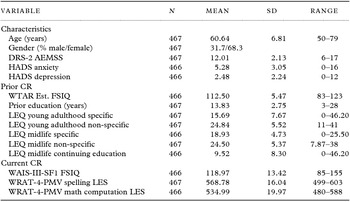
Participant demographics and characteristics of the final 467 THBP participants that comprised the baseline study population are presented in Table 1, along with summaries of CR variables.
Descriptive statistics of the study population (N = 467)

Note: Data represent proportions for categorical variables.
DRS-2 = Dementia Rating Scale-2; AEMSS = Age- and Education-corrected Mayo older American Normative Studies (MOANS) Scaled Score; HADS = Hospital Anxiety and Depression Scale; WTAR = Wechsler Test of Adult Reading; FSIQ = Full-Scale IQ; LEQ = Lifetime of Experiences Questionnaire; WAIS-III-SF1 = Wechsler Adult Intelligence Scale (3rd edn.) Short Form 1; WRAT-4-PMV = Wide Range Achievement Test-4 Progress Monitoring Version; LES = Level Equivalent Scores.
Prior CR factor analysis
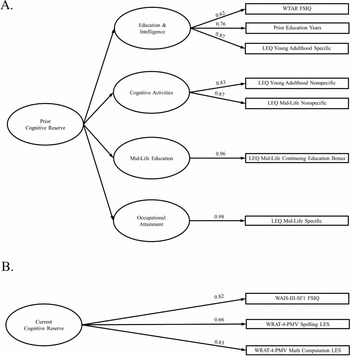
To develop a model of prior CR, the seven items were first examined for their factorability through widely used criteria. The sampling adequacy was verified by the KMO measure, i.e. KMO = 0.58. The Bartlett's test of sphericity, χ2 (21) = 519.74, p < 0.05, indicated that the variables were sufficiently correlated for factor analysis. All communality values were above 0.4, confirming that the entered variables shared sufficient common variance. As a result of these preliminary tests, the data were deemed suitable for factor analysis. As the goal was to combine CR proxy variables into a single construct that represents prior CR with composite scores computed for each participant in the study, the principal components extraction method was used. In order to test whether the structure of our prior CR model was resistant to lifetime variables, initial factor analyses were compared across age groups (under 65 years vs. 65 years and over) and employment status (still working vs. retired). The results indicated that, in both cases, the lifetime variables modulated the resulting structure of the prior CR model (see Figure S3, available as supplementary material attached to the electronic version of this paper at www.journals.cambridge.org/jid_IPG online supplement). In order to rectify this, an additional factor analysis was conducted that retained the fourth component and produced a factor structure that was stable across both age group and employment status. In combination, these factors explained 77.10% of the variance in the dataset. The structure of the final prior CR model with associated factor loadings following an orthogonal rotation (Varimax) is displayed in Figure 1, with variable loadings under 0.50 considered not essential to the final model. The clustering of variables suggested that factor 1 represents education and intelligence, factor 2 represents cognitive activities, factor 3 represents midlife education, and factor 4 represents occupational attainment. Z-scores were generated for each participant on each factor using the regression method, with an estimate of overall prior CR resulting from the addition of each factor score into the total score. The equation that resulted in total prior CR = 0.370 (WTAR FSIQ) + 0.408 (Prior education in years) + 0.567 (LEQ Young Adulthood Specific) + 0.565 (LEQ Young Adulthood Non-specific) + 0.630 (LEQ Midlife Non-specific) + 0.875 (LEQ Midlife Continuing Education Bonus) + 1.004 (LEQ Midlife Specific).
The results of the exploratory factor analyses that identified hypothesized (a) prior cognitive reserve (N = 464) and (b) current cognitive reserve (N = 465) models in a sample of healthy adults. Variables that were directly measured are denoted by squares, and circles denote latent variables. The numbers along the lines represent rotated factor loadings. Prior cognitive reserve was determined through the addition of an individual's scores on all three CR factors. WRAT-4-PMV = Wide Range Achievement Test-4 Progress Monitoring Version, level equivalent scores (LES); LEQ = Lifetime of Experiences Questionnaire.

Current CR factor analysis
To develop a model of current CR, the three items first had their factorability examined. The sampling adequacy was verified by the KMO measure, i.e. KMO = 0.62. The Bartlett's test of sphericity, χ2 (3) = 224.81, p < 0.05, indicated that the variables were sufficiently correlated for factor analysis. All communality values were above 0.3, confirming that the entered variables shared enough common variance. As a result of these preliminary tests, the data were deemed suitable for factor analysis. The initial factor analysis that used the principal components extraction method identified a single underlying component with an eigenvalue above Kaiser's criterion of 1 (Kaiser, Reference Kaiser1960). This factor explained 59.87% of variance in the dataset. The structure of the current CR model with associated factor loadings is displayed in Figure 1, with variable loadings under 0.50 considered not essential for the final model. The clustering of variables suggested that the single component represents current CR. A Z-score was generated for each participant for this factor using the regression method. The equation that resulted in total current CR = 0.454 (WAIS-III-SF1 FSIQ) + 0.369 (WRAT-4-PMV Spelling LES) + 0.463 (WRAT-4-PMV Math Computation LES).
Prior and current CR differentiation
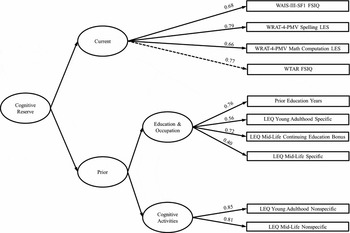
To test whether the proposed prior and current models of CR could be differentiated statistically, a final factor analysis was conducted that included all ten variables from both models. The sampling adequacy was verified by the KMO measure, i.e. KMO = 0.67. The Bartlett's test of sphericity, χ2 (45) = 1047.51, p < 0.05, indicated that the variables were sufficiently correlated for factor analysis. An initial factor analysis that used the principal components extraction method identified three underlying components with eigenvalues above Kaiser's criterion of 1 (Kaiser, Reference Kaiser1960). These factors explained 56.17% of variance in the dataset in combination. The structure of the model with associated factor loadings following Varimax rotation is displayed in Figure 2. The clustering confirmed that the variables that comprised prior and current CR models could be statistically differentiated, with the exception of WTAR Estimated (Est.) IQ, which loaded on the current CR component containing other intelligence- and academic-related variables. Importantly, the participant scores for prior and current CR were significantly correlated (r = 0.40, p < 0.01). This indicated that both models assessed a similar construct.
The results of the exploratory factor analysis that differentiated prior and current models of CR (N = 462). Variables that were directly measured are denoted by squares, and circles denote latent variables. The numbers along the lines represent factor loadings. The dotted lines denote an altered relationship from the one that was hypothesized. WRAT-4-PMV = Wide Range Achievement Test-4 Progress Monitoring Version; LEQ = Lifetime of Experience Questionnaire.

Discussion
The present study was designed to use the THBP baseline data to develop two operational measures of CR, prior and current, using factor analysis with the principal components extraction method. Assessment of prior CR was based on the combination of traditional estimates of reserve: years of prior education; estimated pre-existing intellectual capacity; and lifetime of cognitively stimulating activities. Assessment of current CR was based on the combination of dynamic measures of current intellectual capacity and academic ability. The results of the factor analyses indicate that significant latent variables were identified, which we labeled prior CR and current CR. Prior CR provided an operational measure of predominantly static CR, with the capacity to estimate an individual's increased protection from dementia due to prior education, intelligence, cognitive activities, and occupational attainment. Current CR provided an operational measure of dynamic CR, comprising cognitive variables that approximate traditional CR predictors but have an increased potential to reflect change in cognitive function due to exposure to CR-related activities. Our investigation supports the notion that multiple CR proxy measures can be used to assess CR. Future use of this method may lead to research that improves understanding and accurate application of the theoretical construct.
Although our analyses produced prior and current CR models with interpretable extracted components, three issues that arose in the process warrant discussion. First, our initial attempts to identify a prior CR structure independent of lifetime factors were unsuccessful. Here three-factor models of prior CR were modulated by age and employment status, resulting in different structures of prior CR variables for different groups. However, the extraction of a four-factor model of prior CR resulted in a structure that was stable between groups and a prior CR equation that could be applied equally to all participants in the THBP (Figure 1). Second, a factor analysis of whether the models could be statistically differentiated resulted in an unexpected relationship (Figure 2). Specifically, when all variables were analyzed concurrently, WTAR IQ, a measure of intelligence that was originally retained in the prior CR model, loaded significantly on the current rather than prior CR model. This may reflect an issue of shared variance, indicating that WTAR IQ does not contribute uniquely to the estimation of prior CR. However, we are unable to include WTAR IQ simultaneously in both factor models for current and prior CR due to a high degree of shared variance with the WAIS-III IQ measure, as reported in previous research (r = 0.73; Strauss et al., Reference Strauss, Sherman and Spreen2006). Ultimately, it may be impossible to disentangle current CR fully from prior CR, as current CR likely reflects a combination of prior CR plus change in CR (i.e. through further education). Third, the number of components retained in the differentiating model differs from the number of components retained in the final prior and current CR models. This is due to our decision to force the retention of four components in the prior CR model, whereas the full model only retained components with eigenvalues above Kaiser's criterion of 1 (Kaiser, Reference Kaiser1960).
Historically, studies of CR have relied upon a single indicator variable to estimate CR, but this may not be the best method. Our finding that factor analysis was successful in creating a prior CR model provides evidence that a multivariate approach to CR results in a more comprehensive estimate of an individual's prior CR. As the included proxy variables in the prior CR model have been shown to contribute to CR independently (Stern, Reference Stern2009; Foubert-Samier et al., Reference Foubert-Samier2012), the factor analysis technique is likely to result in increased accuracy for assessing CR in the absence of neuropathological data. Our data support this notion, as the components extracted from our prior CR analysis were not highly correlated, indicating independent contributions to the overall CR model when each component was added together. If an investigation relies upon an estimate of CR derived from a single indicator, there is an increased risk of interpreting a factor with reduced predictive power. This is in line with a comprehensive review of the construct validity of the multiple indicator method, which concluded that techniques that combine a number of indicators, rather than an individual indicator, may increase the statistical and interpretive power of the CR measurement (Satz et al., Reference Satz, Cole, Hardy and Rassovsky2011). However, as the present study does not include a measure of outcome (e.g. dementia onset), we are unable to comment on whether our method produces an increase in predictive power when compared with a single indicator.
To date, there is no reliable or valid measure of changes to CR over time; such as might occur following interventions designed to enhance CR. While research continues to explore the potential benefits of various interventions to modify an individual's CR and thereby reduce the risk of dementia within the individual (Tucker and Stern, Reference Tucker and Stern2011), there is no available operational measure of CR to substantiate the efficacy of the intervention before dementia onset. It is of significance that the present study successfully generated, through factor analysis, a measure of current CR that encompasses dynamic variables known to display change over time. Rather than using predominantly static variables to create the current CR model, we used measures that had the potential for change due to new life experience, which also closely approximated traditional measures of CR. Education was approximated using the WRAT-4-PMV (Roid and Ledbetter, Reference Roid and Ledbetter2006), which can detect change in academic performance (math computation, spelling) associated with increasing levels of education (Roid and Ledbetter, Reference Roid and Ledbetter2006). We also used a measure of intelligence, WAIS-III-SF1 (Donnell et al., Reference Donnell, Pliskin, Holdnack, Axelrod and Randolph2007), which is more likely to show change in intellectual function than the measure of crystallized intelligence used for prior CR estimation (WTAR; The Psychological Corporation, 2001). The WTAR provides a stable estimate of intellectual capacity that is resistant to brain damage arising from traumatic brain injury or dementia (Green et al., Reference Green, Melo, Christensen, Ngo, Monette and Bradbury2008), while the WAIS-III is not resistant to disease states and reflects reductions in FSIQ due to aging (Ardila, Reference Ardila2007).
Fundamentally, CR is a hypothetical construct that is theorized to delay the expression of clinical deficits arising from cortical disease burden (Stern, Reference Stern2002) and, although an estimate arising from multiple indicators is more likely to reflect this construct than a single variable/measure, this is still a limited approach. Empirical designs that incorporate an in vivo measure of brain damage/burden in addition to proxy measures of reserve and a measure of cognitive function will make the most influential contribution to CR literature. Such an approach is becoming more popular as relevant technology becomes more widely available, and a number of studies have supported the hypothesis by demonstrating that higher CR is associated with comparable cognitive ability to those with less reserve in spite of having more severe Alzheimer's pathology, such as cortical thinning (Querbes et al., Reference Querbes2009), medial temporal lobe atrophy (Perneczky et al., Reference Perneczky2009; Teipel et al., Reference Teipel2009), and reduced cerebral blood flow (Scarmeas et al., Reference Scarmeas2003).
A number of limitations in the present study warrant examination. First, the LEQ (Valenzuela and Sachdev, Reference Valenzuela and Sachdev2007) and the Medical Health Status questionnaire (Summers et al., Reference Summers2013) are retrospective self-report questionnaires. Here the accuracy of information gained in such a manner cannot be verified (Bernard et al., Reference Bernard, Killworth, Kronenfeld and Sailer1984). Second, it is important to note that variation in prior CR variables will be experienced in participants even after this measure is taken, and that our estimation of prior CR, while predominantly static, is not completely fixed, particularly in those participants whose age has not yet reached 65 years. Third, CR is a hypothetical construct that is mainly applied to samples experiencing traumatic brain injury or neurodegenerative disorders. Our sample was selected to be healthy due to extensive screening of medical conditions and impairments prior to assessment, and this may reduce the applicability of our data to less healthy samples.
The current CR model will be used to evaluate the efficacy of the THBP (Summers et al., Reference Summers2013), with the equation applied annually to quantify the effects of the education intervention, with increased scores thought to reflect increased CR. However, this observation cannot be confirmed until later in the project's life, when a subset of study participants begins to experience cognitive decline. In addition, after the onset of cognitive decline, the predictive power of a multivariate approach to CR will be assessed and compared with the predictive power of a single indicator (e.g. education). Initially, the THBP aims to determine which factors (i.e. genetic makeup, prior CR) moderate the magnitude of gain in current CR following the education intervention, and ultimately whether the intervention delays onset of cognitive decline. Other future investigations should validate the present models of CR using confirmatory factor analysis and attempt to identify additional proxies of CR that can be used to increase the predictive power of reserve estimates.
In conclusion, our study demonstrates that multiple CR proxy indicators can be successfully combined through factor analysis to yield two operational models of CR: prior and current. The prior CR model may more accurately reflect the CR hypothesis than a single indicator, while the current CR model provides a measure of dynamic change in CR over time. These methods of estimating CR will be used in the THBP to explore the modifiability of CR in later life due to participation in tertiary education, and will contribute data to elucidate why some older adults can temporarily suppress the detrimental effects of AD pathology, while others cannot.
Conflict of interest declaration
This research was supported by the National Health and Medical Research Council (NHMRC) of Australia Project Grant (No: 1003645) and the J.O. and J.R. Wicking Trust (ANZ Trustees).
Dr. Mathew J. Summers reports personal fees from Eli Lilly (Australia) Pty. Ltd., grants from Novotech Pty. Ltd. outside the submitted work. David D. Ward, Prof. James C. Vickers, and Dr. Nichole L. Saunders declare no conflicts of interest.
Description of authors’ roles
David D. Ward performed analyses and prepared the manuscript. Mathew J. Summers oversaw analyses and prepared the manuscript. Nichole L. Saunders contributed in manuscript preparation and data collation. James C. Vickers contributed in manuscript preparation.
Supplementary material
To view supplementary material for this article, please visit http://dx.doi.org/10.1017/S1041610214002075