INTRODUCTION
Neurofibromatosis type 1 (NF1) is one of the most common neurogenetic diseases with an autosomal dominant transmission and a prevalence averaging 1 in 3500 (Eliason, Reference Eliason1986; Levine, Materek, Abel, O’Donnell, & Cutting, Reference Levine, Materek, Abel, O’Donnell and Cutting2006; North et al., Reference North, Joy, Yuille, Cocks, Mobbs and Hutchins1994). NF1 is characterized by abnormal tissue growth and differentiation that can be localized in many organs, particularly in the central and peripheral nervous system. At the cerebral level, focal zones of spontaneous hyperintensity are usually identified by MRI scans in approximately 40 to 80% of NF1 children (North, Reference North2000). Named “unidentified bright objects” (Pont & Elster, Reference Pont and Elster1992) due to their as yet unclear origin and clinical significance, these zones reflect gliosis, abnormal myelinization, or cerebral dysplasia (Duffner, Cohen, Seidel, & Shucard, Reference Duffner, Cohen, Seidel and Shucard1989).
Children with NF1 may suffer from cognitive disturbances that vary in intensity and gravity. Most studies have revealed mean IQs within the average range (Ferner, Hughes, & Weinman, Reference Ferner, Hughes and Weinman1996; Hyman, Shores, & North, Reference Hyman, Shores and North2005; North et al., Reference North, Joy, Yuille, Cocks, Mobbs and Hutchins1994). Lower Performance IQ (PIQ) relative to Verbal IQ (VIQ) is reported in some studies (Descheemaeker, Ghesquière, Symons, Fryns, & Legius, Reference Descheemaeker, Ghesquière, Symons, Fryns and Legius2005; Eliason, Reference Eliason1986; Legius, Descheemaeker, Spaepen, Casaer, & Fryns, Reference Legius, Descheemaeker, Spaepen, Casaer and Fryns1994) and has led some researchers to formulate a visuospatial dysfunctioning hypothesis, confirmed by low scores on measures of visuospatial ability, even when controlling for IQ (Hyman et al., Reference Hyman, Shores and North2005). Deficits have also been documented in reading or oral language acquisition, praxis, and long-term memory (Eldridge et al., Reference Eldridge, Denckla, Bien, Myers, Kaiser-Kupfer and Pikus1989; Hofman, Harris, Bryan, & Denckla, Reference Hofman, Harris, Bryan and Denckla1994; Mazzocco, Turner, Denckla, Hofman, Scanlon, & Vellutino, Reference Mazzocco, Turner, Denckla, Hofman, Scanlon and Vellutino1995; North et al., Reference North, Joy, Yuille, Cocks, Mobbs and Hutchins1994). However, knowledge of the effects of NF1 on cognition has been hampered by the failure of many studies to examine deficits that are independent of IQ (Ozonoff, Reference Ozonoff1999).
Executive Function (EF) is the least investigated neuropsychological domain in children with NF1. EF comprises a varied group of controlled processes, including planning, organizational strategy, inhibition, flexibility, categorization, rule deduction, as well as divided and sustained attention. Its main function is to facilitate the adaptation to novel situations, particularly when routine actions are insufficient to produce an appropriate response (Rabbitt, Reference Rabbitt and Rabbitt1997; Shallice, Reference Shallice1988; Stuss & Benson, Reference Stuss and Benson1986). At the anatomical-functional level, EF is strongly dependent on the integrity of the prefrontal cortex, but it also requires the contribution of a large cerebral network, including the limbic system and the basal ganglia via the frontal-subcortical-frontal loops. The lack of isomorphism between the frontality of lesions and the EF symptomatology has led to the introduction of the functional concept of dysexecutive syndrome (Baddeley & Della Sala, Reference Baddeley, Della Sala, Roberts, Robbins and Weiskrantz1998).
Several signs of Executive Dysfunction (ED) have been identified in children with NF1. These children are described as being highly distractible, lacking organizational skills, unpredictable, impulsive, socially maladjusted, and lacking in the ability to generate problem solving strategies (Bawden et al., Reference Bawden, Dooley, Buckley, Camfield, Gordon and Riding1996; Eliason, Reference Eliason1986; North, Joy, Yuille, Cocks, & Hutchins, Reference North, Joy, Yuille, Cocks and Hutchins1995; Riccardi & Eichner, Reference Riccardi and Eichner1986; Stine & Adams, Reference Stine and Adams1989). Behavioral analysis by Chapman, Waber, Bassett, Urion, and Korf (Reference Chapman, Waber, Bassett, Urion and Korf1996) revealed that 60% of the children with NF1 examined for Learning Disabilities (LD) presented with verbal and motor disinhibition, difficulties in social discourse, and weak attentional regulation capacities, as compared to only 20% of children with LD without NF1.
Improved assessment techniques have revealed deficits in attention, working memory, inhibition, and mental flexibility in children with NF1 (Descheemaeker et al., Reference Descheemaeker, Ghesquière, Symons, Fryns and Legius2005; Ferner et al., Reference Ferner, Hughes and Weinman1996; Hofman et al., Reference Hofman, Harris, Bryan and Denckla1994; Hyman et al., Reference Hyman, Shores and North2005; Mazzocco et al., Reference Mazzocco, Turner, Denckla, Hofman, Scanlon and Vellutino1995). Moreover, two recent studies have evidenced a strong presence of executive impairments. Descheemaeker et al. (Reference Descheemaeker, Ghesquière, Symons, Fryns and Legius2005) reported that 16 of 17 children with NF1 presented with deficits in attention or inhibition / “shifting.” Hyman, Shores, and North (Reference Hyman, Shores and North2006) observed that all of the children in their study, including those without LD or a reduced IQ, made errors in executive / attentional tasks. Deficits in the executive/attentional system, in conjunction with qualitative observations of similar problems, suggest a neuropsychological profile similar to that of children with attention deficit hyperactivity disorder (ADHD), a syndrome present in around 50% of children with NF1 (Levine et al., Reference Levine, Materek, Abel, O’Donnell and Cutting2006).
However, few if any studies of children with NF1 have focused on planning abilities as an aspect of their deficits in EF. In her recent model of prefrontal development, Dennis (Reference Dennis, Risberg and Grafman2006) defines planning as the ability to formulate a series of operations aimed at achieving an objective and to project several steps ahead in an opportunistic manner—a definition similar to that used in adult neuropsychology (e.g., Luria, Reference Luria1966). The theoretical framework developed by Shallice (Reference Shallice1982) includes planning as a component of EF, and Shallice, Marzocchi, Coser, Del Savio, Meuter, and Runiati (Reference Shallice, Marzocchi, Coser, Del Savio, Meuter and Rumiati2002) have applied this framework in investigation of ADHD in children. Other theoretical or data driven models of EF in children that include planning as a major component are those of Anderson (Reference Anderson2002), Levin et al. (Reference Levin, Fletcher, Kufera, Harward, Lilly and Mendelsohn1996), and Pennington (Reference Pennington, Krasnegor, Lyon and Goldman-Rakic1997). Inhibition, shifting and working memory are other components of EF described in these models. Several studies in childhood brain injury and disease have found impairments in components of EF, including planning, in children with early onset brain damage (e.g., Jacobs & Anderson, Reference Jacobs and Anderson2002; Levin & Hanten, Reference Levin and Hanten2005; Tranel & Eslinger, Reference Tranel and Eslinger2000). These studies provide a helpful frame of reference for understanding ED in children with anomalies in brain development, such as those associated with NF1.
Studies of two tasks that satisfy Dennis’ criteria for tests of planning, the Rey-Osterrieth Figure (ROF, Rey, Reference Rey1959) and Tower of London (Shallice, Reference Shallice1982), have revealed impairments in children with NF1 (Chapman et al., Reference Chapman, Waber, Bassett, Urion and Korf1996; Descheemaeker et al., Reference Descheemaeker, Ghesquière, Symons, Fryns and Legius2005; Hofman et al., Reference Hofman, Harris, Bryan and Denckla1994; Hyman et al., Reference Hyman, Shores and North2005; Mazzocco et al., Reference Mazzocco, Turner, Denckla, Hofman, Scanlon and Vellutino1995). In contrast, Joy, Roberts, North, and de Silva (Reference Joy, Roberts, North and de Silva1995) failed to observe a deficit in an NF1 sample on Wechsler Mazes (Wechsler, Reference Wechsler1996). Although these studies raise the possibility of deficits in planning in children with NF1, the findings are thus inconsistent. Other limitations of past research include restriction of assessment to single measures of planning and failure to control for general cognitive deficits or for weaknesses in visuospatial skills, although Hyman et al. (Reference Hyman, Shores and North2005) found deficits on a Tower task in children with NF1 even with controlling for IQ. Further study is needed to investigate planning ability in this population using more comprehensive tests of EF and efforts to control for the effects of NF1 on general abilities and visuospatial skills (Denckla, Reference Denckla1996; Ozonoff, Reference Ozonoff1999). A further need is to investigate the extent to which ADHD is responsible for the deficits in planning evident in sample of children with NF1. In view of the high rate of ADHD in this population and the association of problems in planning with ADHD (Pennington & Ozonoff, Reference Pennington and Ozonoff1996), planning deficits may only be found in children with NF1 who also meet criteria for ADHD. However, it is unclear if this is the case or if weaknesses in planning are a more pervasive characteristic of NF1.
The present study was designed to clarify the cognitive phenotype observed in NF1 by testing the hypothesis that children with NF1 have specific executive deficits of action planning. The aims of this study were (i) to compare the performance of children with NF1 and healthy controls (HC) on tasks designed to specifically test executive planning, while controlling for intellectual and visuospatial competencies; and (ii) to examine associations of ADHD with planning within the NF1 group to determine if planning deficits are evident only in the subset of children who meet criteria for ADHD or are also found in children without ADHD. On the basis of existing findings, we hypothesized that children with NF1 would have deficits in planning even when controlling for IQ or for visuospatial skill. We further hypothesized that ADHD comorbidity in children with NF1 would be associated with planning deficits.
METHOD
Participants
Children with NF1 were selected consecutively when referred to the Neurofibromatosis Clinic of the University Hospital of Nantes (France) for medical diagnosis, treatment and/or follow-up between June 2004 and June 2006. The participation in the current study was voluntary, although efforts were made to recruit all children with NF1 meeting the inclusion criteria whether or not they had LD or suspected LD. Before participating in the study, informed consent was obtained from the parents, who were given a document describing the study procedure. The children also assented to participation, and all data were obtained in compliance with regulations of the Direction of Clinical Research of the University Hospital.
Children aged between 7 and 12 years who met the NIH criteria for NF1 (National Institutes of Health, 1988) and who were examined by a clinician within the previous 6 months were included in the sample. Exclusion criteria included elementary visual or auditory sensory deficits that precluded testing; other neurological disorders, epilepsy, or brain tumor identified on structural MRI scans completed within the previous 6 months; or a known history of psychiatric illness or premature birth. Only one child with previous epileptic seizures was excluded based on these criteria. The final sample comprised 36 children (18 boys and 18 girls), including 22 with the sporadic form of NF1 and 12 with the familial form. The remaining two children were adopted, and thus the form of NF1 was unknown.
Fourteen of the 36 children with NF1 satisfied the diagnostic criteria for ADHD as described by the DSM-IV (American Psychiatric Association, 1996). This assessment was based on the results of a behavioral rating scale completed by the parents of the children. The instrument, referred to as the Behavioural Rating Scale (BRS), was an adaptation of the scale proposed by Schrimsher, Billingsley, Slopis, and Moore (Reference Schrimsher, Billingsley, Slopis and Moore2003) to study the interaction between visual-spatial deficits and ADHD symptoms in children with NF1. The scale is similar to the Child Symptom Inventory (Gadow & Sprafkin, Reference Gadow and Sprafkin2002), a well-validated measure that includes a scale similar to the one used in this study. It consisted of Likert scale ratings of 0 (“never true”), 1 (“sometimes true”), and 2 (“often true”) for each of the behavioral symptoms of ADHD listed in the DSM-IV. The diagnosis of ADHD required ratings of 2 on 6 or more symptom ratings. The diagnosis also required that symptoms be evident at school and home, of at least 6 months duration, and present before 7 years of age. The ADHD ratings were systematically performed by an experienced pediatrician in collaboration with a senior child neuropsychologist.
A large group of 120 HC without NF1 between 7 and 12 years of age was available as part of a normative study of EF. Thirty-six of these children were individually matched to our clinical cases based on age, sex, and the average education level of the parents. Exclusion criteria for the HC were the same as those for the children with NF1. Additional exclusionary criteria included mental retardation as defined by a Full-Scale IQ (FIQ) < 70, intellectual precocity as defined by a FIQ > 130, and any history or evidence of LD or ADHD. Screening for ADHD among the HC was assessed using the same rating measure completed by parents of the children with NF1. None of the 120 initial HC was identified as having ADHD on the basis of the BRS. However, the document describing the study procedure given to the parents insisted on the fact that participants should not suffer from or have a suspicion of LD and that they would constitute the reference group for children with executive and attentional problems. Parents whose children might have had ADHD were thus discouraged from participation. Control subjects were recruited via advertising in schools and outdoor centers, and the protocol was given a thorough inspection by the Regional School Inspectorate.
The demographic characteristics of the sample are summarized in Table 1. The NF1 and HC groups did not differ significantly in age, education level, or sex.
Demographic characteristics of the population study (mean and standard deviations)

Note
NF1 = neurofibromatosis type 1; HC = healthy controls.
Materials and Procedure
The Wechsler Intelligence Scale for Children 3rd edition (WISC-III: Wechsler, Reference Wechsler1996) was used to evaluate the intellectual level of each participant. The Arrows subtest from the NEPSY (Korkman, Kirk, & Kemp, Reference Korkman, Kirk and Kemp2003) was administered to assess visuospatial processing. Consistent with the definition of planning provided by Lezak, Le Gall, and Aubin (Reference Lezak, Le Gall and Aubin1994) and Dennis (Reference Dennis, Risberg and Grafman2006), the planning tasks required the capacity to produce and operationalize strategic choices, monitor procedures, evaluate obtained results, and manage cognitive conduct. These tasks included the Tower subtest from the NEPSY (Korkman et al., Reference Korkman, Kirk and Kemp2003), WISC-III Mazes (Wechsler, Reference Wechsler1996), and a two-part Rey Osterrieth Figure (ROF, Rey, Reference Rey1959).
The NEPSY Tower is similar to the classic “Tower of London” laboratory test, a measure sensitive to frontal lobe damage in adults and children and derived from the theoretical model proposed by Shallice (Reference Shallice1982). It requires the subjects to rearrange colored beads according to a series of presented configurations within a prescribed number of moves. Contrary to the standard procedure, we did not include a stop criterion and fixed the time limit to 3 min (instead of 45 s), to compute the mean number of moves. The number of broken rules was also considered.
Wechsler Mazes require the children to solve 10 mazes of increasing difficulty. The score was the sum total of errors across items. To allow for more total errors, the standard procedure of stopping after a pre-specified number of errors was not imposed.
The first part of the ROF (“Formulation” condition) was similar to the classic task, consisting of the reproduction of the Rey figure on the basis of a presented model. For the second part (“Execution” condition), children progressively reproduced the figure on the basis of successive and progressive cues in which each new group of elements was represented in a distinct color. Children were not informed that they were creating a larger figure from its components. Each cue was presented on a new, separate sheet and children were systematically asked to continue their drawings by including the new colored group of elements. The order of these cues was (1) central rectangle; (2) central diagonals; (3) two major horizontal and vertical lines and upper and major right triangles; (4) diamond at the end of the major triangle, vertical line in major right triangle, lower left square and lower cross attached to vertical midline below rectangle, and upper left cross outside of rectangle; and (5) minor rectangle with diagonals, horizontal lines in upper left corner of central rectangle, vertical line in upper right corner of central rectangle, upper right circle, and lower right oblique lines. The contrast in scores on the cued and uncued versions of the ROF was adapted from a similar method used to examine changes in planning abilities associated with adult aging (Allain et al., Reference Allain, Nicoleau, Pinon, Etcharry-Bouyx, Barré and Berrut2005). On the basis of theoretical models of EF in adults (Grafman, Reference Grafman and Perecman1989; Shallice, Reference Shallice1982), this clinical method enables separation of the children’s spontaneous planning ability when structure is minimal (formulation condition) from their ability to execute an externally directed and highly structured strategy (execution condition). The score for both conditions was based on a count of the correct components of the drawing in the correct locations, according to the traditional guidelines developed by Rey. Specifically, each of the 18 parts of the figure was evaluated according to the two-point scale described in the original test scoring system. Validity and reliability data are not available for this task adaptation, but each version was submitted to a blind scoring procedure by two independent neuropsychologists. The inter-rater reliability of the scores was high (formulation condition: r = 0.94; p < .001; execution condition: r = 0.88; p < .001).
The tests were administered as part of a larger clinical investigation performed over 3 half-day sessions. The interval between the first and the last session did not exceed 1 month.
RESULTS
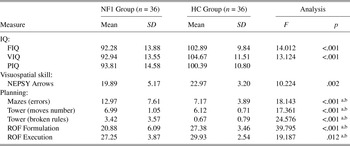
Analysis of variance (ANOVA) was used to compare the NF1 and HC groups on all dependent measures (IQ, Arrows and EF tests). Analysis of IQ and the ROF also included a within-subject factor to determine if the group differences varied according to IQ score (VIQ vs. PIQ) or form of ROF version (formulation vs. execution). Scores considered in analysis of planning included the Tower moves and rule breaks and the number of errors on Mazes. Scores on the ROF were the mean of the two raters’ scores for each version of the test. Raw scores were used for all EF measures, because these scores were not age-standardized. Similarly, we used raw scores for Arrows as French normative data for this test are incomplete. As we did not perform a paired analysis, age at assessment was included as a covariate in all group comparisons of the raw scores. Age at assessment was then included as a covariate in all group comparisons of EF and visuospatial scores. The significance level was set at p < .05 in analysis of IQ and visuospatial scores. For EF tests, a more conservative significance level of p < .01 was applied to adjust for multiple comparisons. Where significant differences were found between the NF1 and HC children on EF tests, secondary covariance analysis was conducted controlling for FIQ or the Arrows score. The purpose of covariance analysis was to determine if group differences could be attributed to differences in FIQ or visuospatial skills. The influence of ADHD on performance on action planning tasks in NF1 was examined by comparing the NF1 with ADHD and NF1 without ADHD subgroups to each other and to the HC group using analysis of covariance (ANCOVA). Because the two NF1 groups differed in parental education level (p = .011), this variable was entered as a covariate in analyses. Post hoc comparisons were made to determine how each subgroup of the NF1 sample scored relative to the HC group. All post hoc analyses were performed with the Bonferroni test. Table 2 presents mean scores and SD’s for the NF1 and HC groups, along with results of group comparisons.
Comparison of the NF1 and HC groups on measures of IQ, visuospatial skill, and executive function

Note
NF1 = neurofibromatosis type 1; HC = healthy controls; IQ = intellectual quotient; FIQ = Full Scale IQ; VIQ = Verbal IQ; PIQ = Performance IQ; VIQ versus PIQ (ANOVA with condition as within-subject factor): no condition effect (F1,70 = 1.131; p = .291), no interaction with group (F1,70 = 2.560; p = .114); ROF Formulation versus Execution scores (ANCOVA with condition as within -subject factor and age as a covariate): condition effect (F1,69 = 6.889; p = .011), interaction with group (F1,69 = 19.735; p < .001; interaction remaining significant when FIQ or Arrows as covariates).
a Differences remaining significant with IQ as a covariate
b Differences remaining significant with Arrows as a covariate.
Analysis revealed significant group differences in FIQ but did not indicate greater group differences in PIQ than in VIQ. The NF1 group also had significantly lower scores than HC on Arrows, but this group effect was not significant when FIQ was taken into account.
As shown in Table 2, the NF1 group performed more poorly than HC on all planning measures. The findings also revealed a group × version interaction effect in analysis of the ROF. Post hoc analyses revealed that both groups performed better in the execution condition than in the formulation condition and that the children with NF1 scored worse than HC on both conditions, but that the difference between the two groups was smaller for the execution condition than for the formulation condition. In fact, children with NF1 obtained scores for the execution condition that were similar to those achieved by HC for the formulation condition. When FIQ or the Arrows score was covaried, results remained largely identical for all EF variables.
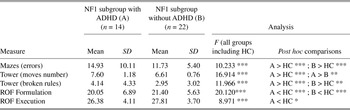
Results of ANCOVAs comparing the subgroups of children with NF1 with and without ADHD to HC failed to reveal significant differences in FIQ (p = .988) or Arrows (p = .620). As shown in Table 3, the two NF1 subgroups performed similarly on Mazes and ROF, with both subgroups obtaining lower scores than HC. In contrast, the mean number of moves on the Tower was significantly higher for the NF1 subgroup with ADHD than either the NF1 subgroup without ADHD or HC, whereas the latter two groups did not differ significantly on these scores.
Comparisons of subgroups of children with NF1 with and without ADHD to HC group, with age and parental education level as covariates

Note
NF1 = neurofibromatosis type 1; HC = healthy controls. Data for HC children used in statistical analyses reported in this table are those indicated in Table 2. ROF Formulation versus Execution scores (ANCOVA with condition as within-subject factor): condition effect (F1,67 = 14.244; p < .001), interaction with group (F2,67 = 9.384; p < .001). Post hoc analyses are indicated only when main ANCOVAs are significant (p < .01); only significant differences (p < .05) between groups are reported. *p < .05; **p < .01; ***p < .001.
DISCUSSION
The principal aim of the present study was to determine if children with NF1 had weaknesses in action planning skills relative to HC and if these weaknesses could be demonstrated even when taking into account intellectual level and visuospatial competencies. We also explored the association of these deficits with ADHD in the children with NF1. The global intellectual level of the participants with NF1 was within the lower end of the average range and is consistent with the mild reduction in IQ relative to normative data (Eliason, Reference Eliason1986; Ferner et al., Reference Ferner, Hughes and Weinman1996; Hyman et al., Reference Hyman, Shores and North2005; North et al., Reference North, Joy, Yuille, Cocks, Mobbs and Hutchins1994). The absence of a VIQ-PIQ disparity is also in accordance with the majority of published studies (North et al., Reference North, Riccardi, Samango-Sprouse, Ferner, Moore and Legius1997). In addition, the present data confirm past studies showing visuospatial deficits in children with NF1 (Levine et al., Reference Levine, Materek, Abel, O’Donnell and Cutting2006; North, Reference North2000; Ozonoff, Reference Ozonoff1999).
Most essentially, the findings confirm hypothesized weaknesses in planning in the NF1 group. The discovery of group differences in Wechsler Mazes is contrary to the results of Joy et al. (Reference Joy, Roberts, North and de Silva1995), who failed to find deficits on this measure in their NF1 sample. This discrepancy may be explained by the use of a more sensitive method for examining errors on this task and by our larger sample size. Group differences on the ROF test and Tower are consistent with previous results (Chapman et al., Reference Chapman, Waber, Bassett, Urion and Korf1996; Descheemaeker et al., Reference Descheemaeker, Ghesquière, Symons, Fryns and Legius2005; Hofman et al., Reference Hofman, Harris, Bryan and Denckla1994; Hyman et al., Reference Hyman, Shores and North2005; Mazzocco et al., Reference Mazzocco, Turner, Denckla, Hofman, Scanlon and Vellutino1995), although our findings extend past research by demonstrating that weaknesses in planning in children with NF1 cannot be attributed to deficits in either IQ or visuospatial skill.
From a methodological point of view, Arrows is not likely to represent all aspects of visuospatial processing and hence provides insufficient control for these skills. The control of other cognitive processes (e.g., language, motor functioning, or memory; all areas of weakness in children with NF1) also would be desirable but was not feasible within the framework of this single study. Another limitation is that covarying for IQ may remove some of the variance of interest as noted by Dennis, Francis, Cirinos, Schachar, Barnes, and Fletcher (Reference Dennis, Francis, Cirino, Schachar, Barnes and Fletcher2009). Systematic manipulation of task demands may be a better strategy for examining the specificity of deficits than covariance analysis (Rabbitt, Reference Rabbitt and Rabbitt1997). The promise of this strategy was demonstrated in the present study by the discovery of greater deficits in the NF1 group on the ROF formulation condition compared with the execution condition. This result suggests that deficits on the former, more traditional administration of this test mainly reflect difficulties in planning rather than in the demands this task places on skills such as visual-motor ability.
However, other aspects of EF such as selective attention deficits or impulsivity cannot be excluded as sources of impairments of planning. The hypothesis of an inhibitory deficit, supported by some studies (Descheemaeker et al., Reference Descheemaeker, Ghesquière, Symons, Fryns and Legius2005; Ferner et al., Reference Ferner, Hughes and Weinman1996; Mazzocco et al., Reference Mazzocco, Turner, Denckla, Hofman, Scanlon and Vellutino1995), is consistent with the abnormally high number of rule breaks observed on the Tower in children with NF1. A more comprehensive evaluation of EF is necessary in future research with this population.
The dysexecutive symptomatology exhibited by children with NF1 corresponds to that observed in other neurodevelopmental disorders, in particular idiopathic ADHD. Notably, disorders of planning have been described in these children, supporting the idea that, in accordance with the high prevalence of ADHD in children with NF1, ADHD represents a cognitive phenotype of NF1 (Koth, Cutting, & Denckla, Reference Koth, Cutting and Denckla2000). Consistent with expectations, we found that ADHD in children with NF1 was associated with poorer performance on NEPSY Tower. On the other hand, failure to observe differences between the NF1 subgroups with and without ADHD on Wechsler Mazes and the ROF is similar to results by Hyman et al. (Reference Hyman, Shores and North2005) showing a lack of differences between these subgroups on several measures of EF. One explanation for the fact the children with NF1 in our sample who met criteria for ADHD differed from the children without ADHD on some EF tasks but not on others is that some aspects of ED are more closely associated with ADHD than others. The finding of poorer performance in the non-ADHD subgroup of children with NF1 suggests that some components of ED may be more general characteristics of this population. Further research including a larger group is therefore needed to examine the overlap of ED and ADHD in children with NF1.
CONCLUSION
Our results confirm deficits in planning in children with NF1 that cannot be attributed to a reduced intellectual level or a visuospatial disturbance. The findings also suggest that these deficits are not limited to children with ADHD. Planning deficits may constitute a strong indicator of a more global atypical development of executive skills in children with NF1 that may correspond to the dysexecutive syndrome (Baddeley, Reference Baddeley1986; Emslie, Wilson, Burden, Nimmo-Smith, & Wilson, Reference Emslie, Wilson, Burden, Nimmo-Smith and Wilson2003). An important future research direction is to explore the possibility of associations of ED with the preferential localization of unidentified bright objects within the frontal-subcortical-frontal networks, as some authors have suggested (Chapman et al., Reference Chapman, Waber, Bassett, Urion and Korf1996; Joy et al., Reference Joy, Roberts, North and de Silva1995). Longitudinal follow-up studies will also be essential to determine if these deficits persist over time as indicated by findings by Hyman et al. (Reference Hyman, Gill, Shores, Steinberg, Joy and Gibikote2003) and Pavol, Hiscock, Massman, Moore, Foorman, and Meyers (Reference Pavol, Hiscock, Massman, Moore, Foorman and Meyers2006). From a clinical point of view, awareness of planning deficits is useful in targeting assessment of children with NF1 and identification of problems in this domain has important implications for development of interventions.
ACKNOWLEDGMENTS
This work was supported by the Direction of Clinical Research of University Hospital of Nantes (France) and Stroke Grant 2004BRD/05/1-K. Recklinghaüsen and Neurofibromatosis Association (Blagnac, France) is gratefully acknowledged for its generous financial contribution to this project. Thank you to all the staff of the Neurofibromatosis Clinic of the University Hospital of Nantes and to the school teachers of participating schools who helped in the recruitment process. We also thank Laure Blanvillain, Céline Leloy, Elise Loiseau, and Charlotte Martin for assistance with data collection of control children. The authors would like to thank and gratefully acknowledge the very helpful editorial assistance of Professor H. Gerry Taylor. We are also grateful to Professor Emmanuel Varnadakis and Zied Mohammed Kefi for their help with writing the paper. Special thanks to Marie-Charlotte Dubrey for her great assistance with scoring and very useful and constructive comments for manuscript preparation. Lastly, the authors thank all the children and their parents who participated in this study.