INTRODUCTION
Among the Eunicida order, the family Lumbrineridae comprises nineteen valid genera so far (Carrera-Parra, Reference Carrera-Parra2006a, Reference Carrera-Parra, de León Gonzáles, Bastida-Zavala, Carrera-Parra, García-Garza, Peña-Rivera, Salazar-Vallejo and Solís-Weiss2009). Despite the difficulty of distinguishing them externally, the last decade has been marked by several new findings and records of new species worldwide (e.g. Aguirrezabalaga & Carrera-Parra, Reference Aguirrezabalaga and Carrera-Parra2006; Carrera-Parra et al., Reference Carrera-Parra, Çinar and Dagli2010b; Cai & Li, Reference Cai and Li2011a, Reference Cai and Lib; Martins et al., Reference Martins, Carrera-Parra, Quintino and Rodrigues2012), and now more than 200 valid species are known worldwide (Carrera-Parra, Reference Carrera-Parra2006a, Reference Carrera-Parrab; Martins et al., Reference Martins, Carrera-Parra, Quintino and Rodrigues2012). The genus Abyssoninoe was erected by Orensanz (Reference Orensanz1990), who separated it from the genus Lumbrineris sensu lato due to the fusion of maxillae IV and V forming a unique hemispherical piece, with a tooth protruding from the middle of the inferior edge (Frame, Reference Frame1992), and the presence of peculiar ‘transitional’ limbate hooks. The prostomium is conical, or pointed. The peristomium is formed by one achaetigerous segment twice the size of the other body segments. The anterior parapodia are generally smaller with short posterior digital lobe; the posterior parapodia bear more developed lobes, without branchiae. Acicule pale yellow, up to three with protruding tips are present. There are three kinds of chaetae: anterior simple bilimbate chaetae with long-pointed tips (bilimbate capillary chaetae), anterior bilimbate chaetae with truncate and finely multidentate hooded tips (transitional from short bilimbate multidentate chaetae to long bilimbate fine-tipped hooks), multidentate unjoined hooded hooks from the middle (long-hooded hooks) to the posterior (short-hooded hooks) chaetigers. These transitional chaetae are typical of the genus Abyssoninoe according to Frame (Reference Frame1992), but are also known for some species of Scoletoma, such as Scoletoma emandibulata (Pillai, Reference Pillai1961) and S. emandibulata mabiti (Ramos, Reference Ramos1976). One or two pairs of anal cirri are reported, the dorsal cirri are usually longer than the ventral cirri.
Abyssoninoe species are problematic in their taxonomy and diagnosis, due to the similarity of most external and pharyngeal features. Main characters which have been used for species separation are the shape of the parapodia, the number and distribution of transitional chaetae, as well as of true capillary chaetae and hooks. The genus Abyssoninoe is currently represented by at least six valid species worldwide: Abysoninoe abyssorum (McIntosh, Reference McIntosh1885), distributed in the lower sublittoral and bathyal zone of South American Pacific coasts up to Antarctica (Parapar et al., Reference Parapar, O'Connor, Besteiro and Urgorri1994; Montiel et al., Reference Montiel, Ríos, Mutschke and Rozbaczylo2004); Abyssoninoe galatheae (Knox & Green, Reference Knox and Green1972), distributed from the upper sublittoral to the bathyal zone of the south-western Pacific Ocean and New Zealand (Parapar et al., Reference Parapar, O'Connor, Besteiro and Urgorri1994); Abyssoninoe hibernica (McIntosh, Reference McIntosh1903), present in the North Atlantic European coastal waters (Parapar et al., Reference Parapar, O'Connor, Besteiro and Urgorri1994); Abyssoninoe phuketensis (Oug, Reference Oug2002) described from the coast of Thailand and the Indian Ocean (Oug, Reference Oug2002); Abyssoninoe scopa (Fauchald, Reference Fauchald1974) distributed in the eastern Atlantic Ocean from sublittoral to bathyal zones (Frame, Reference Frame1992); Abyssoninoe winsneseae (Frame, Reference Frame1992), distributed in the upper sublittoral zone of the north-west Atlantic Ocean (Frame, Reference Frame1992). The authors consider the subspecies Abyssoninoe scopa aequilobata (Winsnes, 1981) as a junior synonym of A. hibernica according to Oug (Reference Oug2012) and Abyssoninoe pseudofragilis (Amoureux, Reference Amoureux1977) as a junior synonym of A. scopa according to Parapar et al. (Reference Parapar, O'Connor, Besteiro and Urgorri1994) and Oug (Reference Oug2012).
In the Mediterranean Sea the only species representative of the genus Abyssoninoe is the controversial A. cf. scopa, which Miura (Reference Miura1980) also reported from the western coast of central Africa.
MATERIALS AND METHODS
Study area
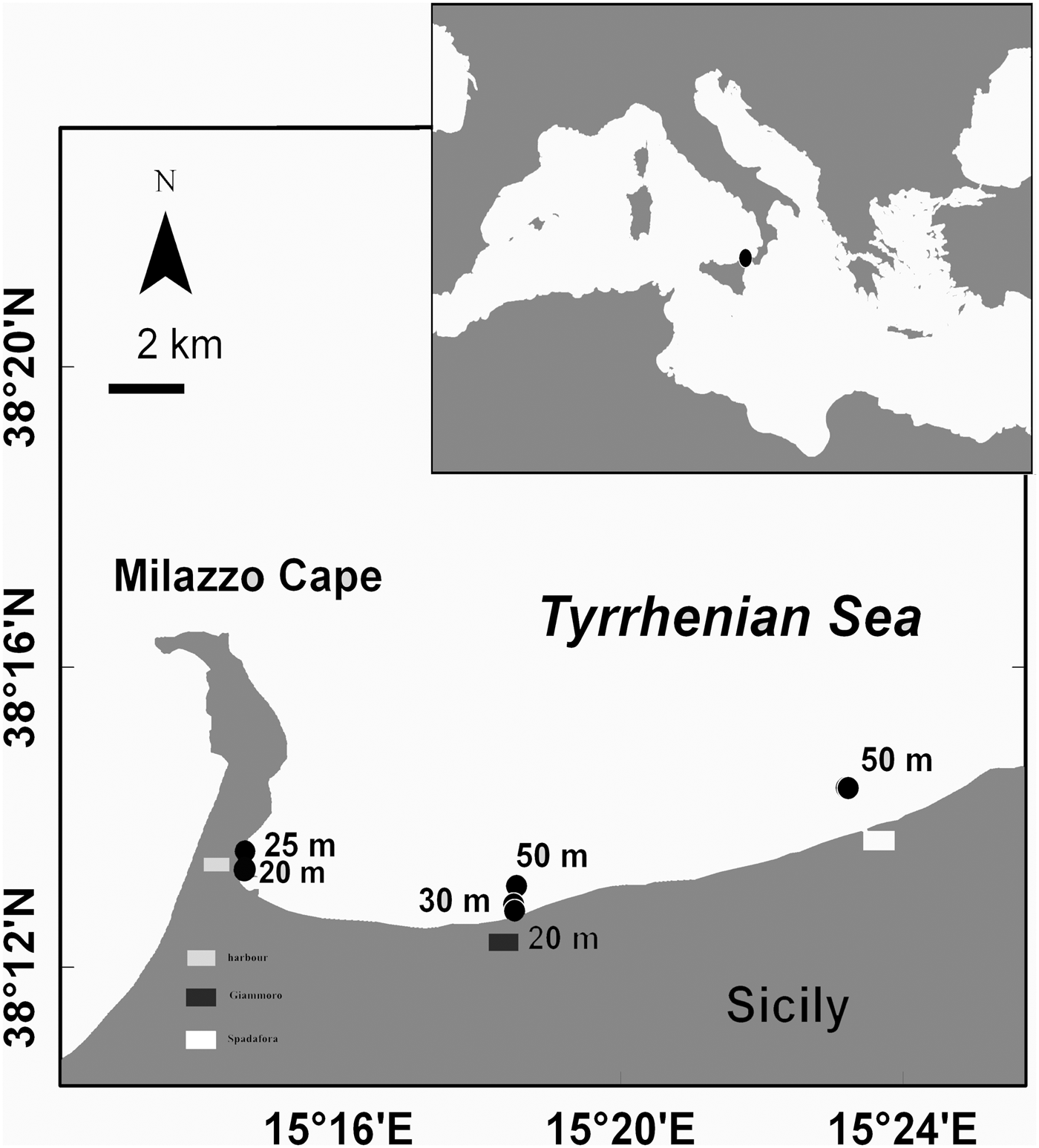
The Gulf of Milazzo, located in the Southern Tyrrhenian Sea (Central Mediterranean Sea), is a small part of the north-eastern coast of Sicily. It is a highly anthropized area which hosts many productive activities, such as oil refineries, power plants, steelworks, shipbuilding industry and a commercial and tourist harbour.
Sampling and sediment analysis
Macrofauna was studied from 63 sediment samples, collected with a 0.1 m2 Van Veen grab. Sampling sites were distributed along seven north–south transects perpendicular to the coastline at 20, 30 and 50 m water depths (four replicates per site, three for macrofaunal analysis and one for grain-size analysis). Sediment samples were washed on-board through a 0.5 mm mesh sieve, fixed with 4% neutralized formalin and, after 48 h, transferred for long term storage to 70% ethanol. Macrofauna was hand sorted and identified up to species level.
Particle-size analysis was carried out according to Buchanan & Kain (Reference Buchanan, Kain, Holme and McIntyre1971), using a sieve series with interval of 1Φ (Φ = −log2Ø (mm)) for particle size greater than 0.063 mm. Silt (4.0–8.0Φ) and clay (8.5–9.0Φ) percentages were obtained by column-dispersion method, and the Wentworth's scale (Wentworth, Reference Wentworth1922) was used for particle-size composition.
Morphological assessment
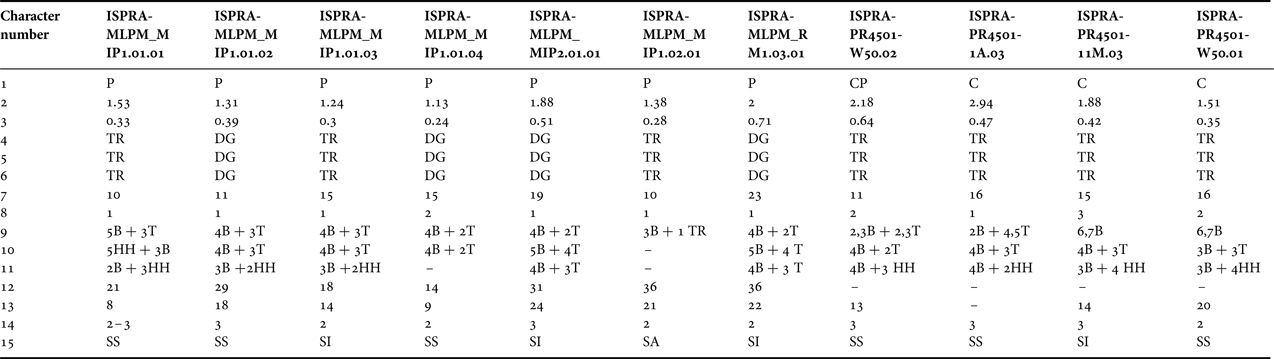
The description of the new species was based on the holotype; the main morphological variations were referred to some representative paratypes. Abyssoninoe bidentata sp. nov. was observed under a stereomicroscope equipped with micro-camera Axio-Cam vs40 v4.8.20, and also by optical microscope equipped with Optika Vision Lite 2.1 software for examination of chaetae, maxillae and mandibles. Taxonomic description was conducted on the basis of the following characters: (i) prostomial shape; (ii) shape of parapodia; (iii) type, number and distribution of the different kinds of chaetae; (iv) number and colour of aciculae; (v) shape of maxillae, carriers and maxillary formula; (vi) shape of mandibles; and (vii) shape of pygidium. Authors followed the nomenclature of Carrera-Parra (Reference Carrera-Parra2006b), designed for the genus Lumbrineris, but also commonly accepted for all Lumbrineridae genera. For each specimen the length from the prostomial tip to chaetiger 10 (L10 (mm)) and the width at chaetiger 10, excluding parapodia (W10 (mm)) were assessed. The main morphological and ecological characters of the specimens are reported in Table 2; all those invariant features, such as shape of anterior prechaetal lobes, colour of aciculae, number of maxillae, shape and number of teeth in the maxillary apparatus and shape of mandibles, are omitted.
The holotype and all paratypes are deposited in the Laboratory of Biodiversity, ISPRA Institute for Environmental Protection and Research (Messina, Italy).
RESULTS
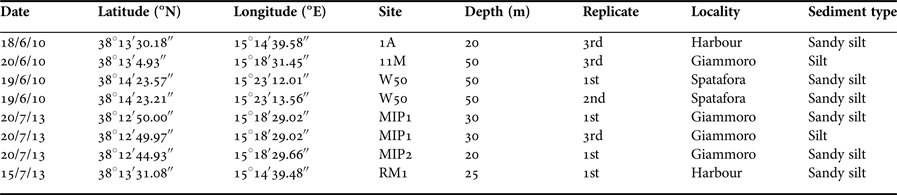
A total of eleven specimens of A. bidentata sp. nov. were found in eight samples (four specimens in 2010 and seven in 2013), collected in the Gulf of Milazzo from 20 to 50 m depth (Figure 1) in silt and sandy silt sediments (Table 1).
Study area: Gulf of Milazzo, black spots correspond to sites of Abyssoninoe bidentata sp. nov.

Sampling dates, coordinates, bathymetry, locality and sediment type of the study area.
SYSTEMATICS
Class POLYCHAETA Grube, 1850
Order EUNICIDA Dales, 1962
Family LUMBRINERIDAE Schmarda, 1861
Genus Abyssoninoe Orensanz, Reference Orensanz1990
Abyssoninoe bidentata sp. nov.
(Figures 2, 3)
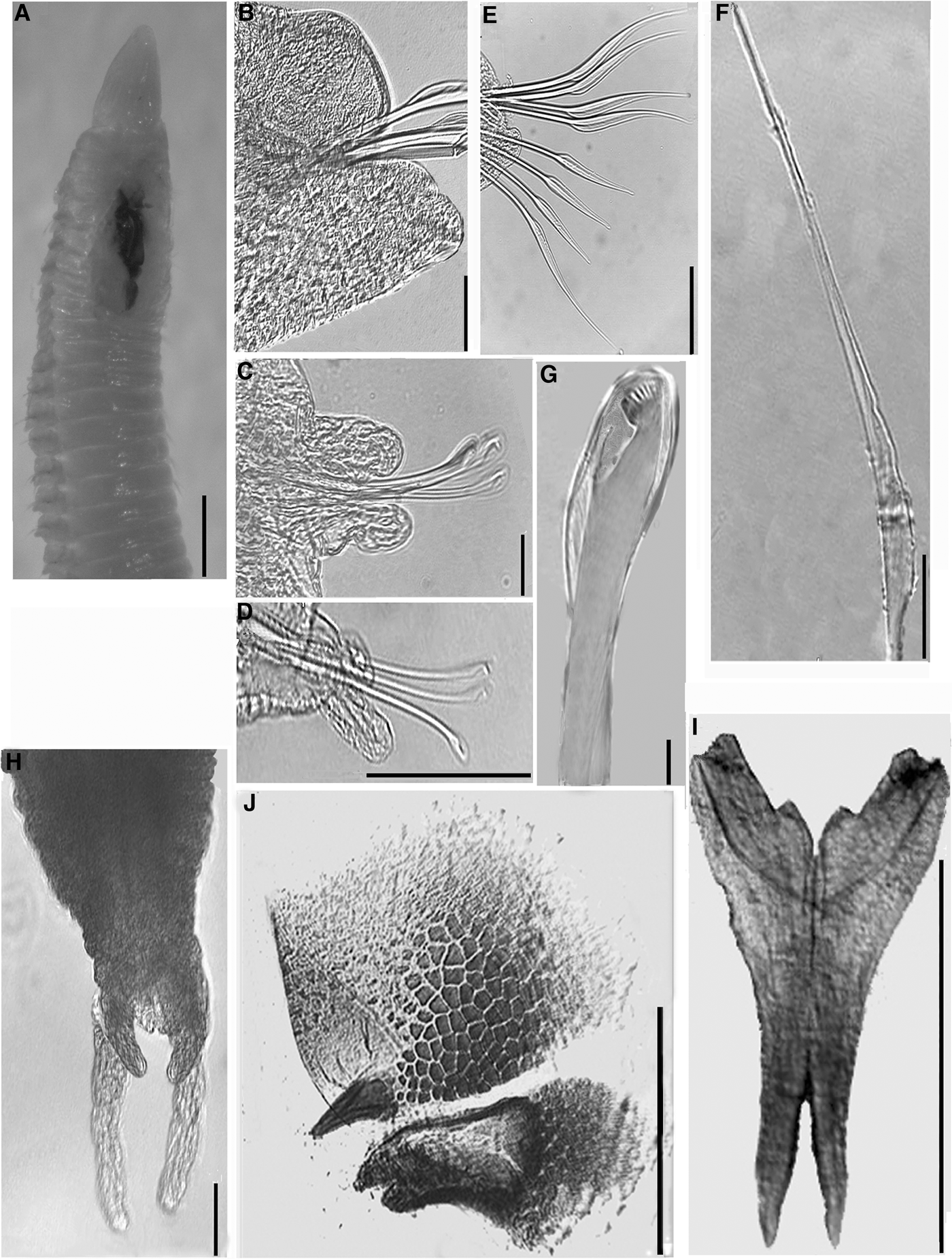
Abyssoninoe bidentata sp. nov. Holotype (ISPRA-MLPM_MIP1.01.01): (A) anterior end, dorsal view; (B) parapopium 10, frontal view; (C) parapodium 34, frontal view and chaetae; (D) parapodium 54, frontal view; (E) simple bilimbate capillary chaetae and truncate bilimbate hooked chaetae, in parapodium 9; (F) slender capillary chaetae; (G) simple multidentate hooded hooks, in parapodium 25; (H) pygidium, ventral view; (I) mandible, frontal view; (J) maxilla III and maxillae IV. Scale bar: A, 0.5 mm; B, 0.05 mm; C, 0.05 mm; D, 0.05 mm; E, 0.22 mm; F, 0.02 mm; G, 0.02 mm; H, 0.04 mm; I, 0.05 mm; L, 0.14 mm.
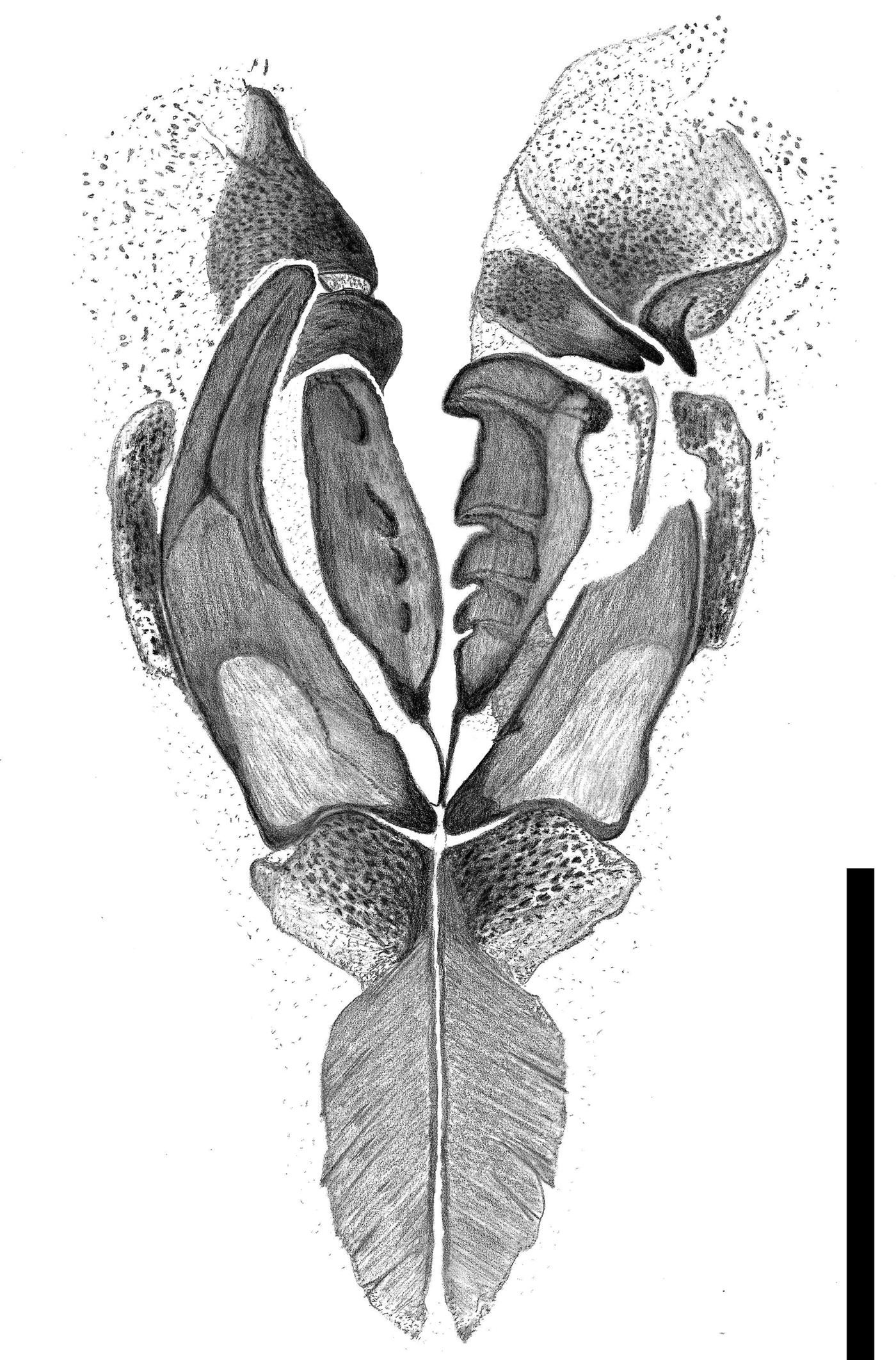
Maxillary apparatus of Abyssoninoe bidentata sp. nov. Right Mx-I has been removed to show Mx-II (left side on frontal view), with a peculiar gap between the third and fourth tooth, and clear ribs in the middle of each tooth. Scale bar 0.12 mm
TYPE MATERIAL
Holotype: complete with 64 chaetigers, total length 47.7 mm, code ISPRA-MLPM_MIP1.01.01, site MIP1 rep.1.
Paratypes: codes ISPRA-MLPM_MIP1.01.02, ISPRA-MLPM_MIP1.01.03 and ISPRA-MLPM_MIP1.01.04, site MIP1 rep. 1. ISPRA-PR4501-1A.03, site 1A rep. 3. ISPRA-PR4501-11M.03, site 11M rep. 3. ISPRA-PR4501-W50.01, site W50 rep. 1. ISPRA-PR4501-W50.02, site W50 rep. 2. ISPRA-MLPM_MIP1.03.01, site MIP1 rep. 3. ISPRA-MLPM_MIP2.01.01, site MIP2 rep. 1. ISPRA-MLPM_RIM1.01.03, site RIM 1 rep. 1.
DESCRIPTION
Holotype complete with 64 chaetigers, total length 47.7 mm, L10 = 1.53 mm, W10 = 0.33 mm. Prostomium pointed, longer than wide, without eyes or visible eyespots, without antennae (Figure 2A). Peristomium shorter than prostomium, biannulated with two rings of similar size. All parapodia well developed, first ten smaller than the following ones. In the anterior parapodia (1–10), prechaetal lobe inconspicuous, without distinct shape; postchaetal lobe small and sub-triangular (Figure 2B). From parapodium 11 to 31 both prechaetal and postchaetal lobes subequal, small triangular. From parapodia 32 to 44, prechaetal lobe small, triangular; postchaetal lobe digitiform in shape, slightly longer than prechaetal lobe (Figure 2C). In posterior parapodia, postchaetal lobe digitiform clearly longer than prechaetal lobe (Figure 2D). Chaetae of four types: simple bilimbate capillary chaetae (B) (Figure 2E), truncate bilimbate hooked chaetae (T) (Figure 2E), slender capillary chaetae (CC) (Figure 2F) and simple multidentate hooded hooks (HH) (Figure 2G).
In the anterior parapodia notopodium with four bilimbate capillary chaetae, neuropodium with one bilimbate chaeta and three truncate chaetae (Figure 2E). Dorsal limbate chaetae in chaetigers 1–21, ventral limbates in chaetigers 1–9. One slender capillary chaeta, slightly longer than bilimbate chaetae, from parapodia 17 to 21 (Figure 2F). Truncate chaetae from chaetigers 1 to 9. Clearly definite hooded hooks from chaetiger 10; anterior long-hooded hooks with 5–6 teeth, proximal tooth largest (Figure 2G). Two or three simple hooks in posterior parapodia with long shafts and short hoods (Figure 2D).
The chaetal formula is: 1st–9th, 5B + 3T; 10th–16th, 2B + 3HH; 17th–21st, 1CC + 3HH; 26th to the body end, 2–3HH. Aciculae yellow-pale, up to three in each anterior parapodium, decreasing in number in posterior segments, one of which with a thin tip projecting throughout parapodial lobe. Pygidium with four anal cirri, of which the dorsal pair is clearly longer than ventral pair (Figure 2H). Mandibles fused up to 3/4 length with a semicircular striation and slightly divergent distal ends (Figure 2J); each half of the cutting edge with a big triangular internal tooth and an external irregularly dentate and dark coloured tips (Figure 2J). Four pairs of maxillae; carriers as long as Mx-I, clearly constricted in the middle (Figure 3). Mx-I forceps-like, without internal teeth, with long connecting plates. Mx-II shorter than Mx-I, with four teeth, the two proximal are bigger with a clear separation between them. Mx-III clearly bidentate; two teeth sub-equal in size, but the distal pointed, the proximal slightly shorter and more rounded (Figures 2J, 3). Mx-IV/V fused forming a broad semi-circular plate with one straight pointed tooth in the inferior border (Figures 2L, 3). All maxillae are heavily chitinized. The maxillary formula is: Mx-I, 1 + 1; Mx-II, 4 + 4; Mx-III, 2 + 2; Mx-IV/V, 1 + 1. Preserved specimens whitish or pinky, without any distinctive colour pattern.
VARIATIONS/REMARKS
Material examined varied in L10 from 1.13 to 2.94 mm and in W10 from 0.24 to 0.71 mm. In some paratypes the prostomium is conical though less pointed; the transitional bilimbate chaetae started from the second or third chaetiger to chaetigers 9–22, and the first simple hooded hook appeared from chaetiger 10 to 23. One or two true capillary chaetae ranged from chaetiger 17 to 35. Table 2 reports the morphometric assessments for A. bidentata sp. nov.
Comparison of representative morphological and ecological characteristics of Abyssoninoe bidentata sp. nov. Legend: 1, shape of prostomium; 2, L10 (mm); 3, W10 (mm); 4, shape of anterior postchaetal lobe; 5, shape of median-posterior prechaetal lobe; 6, shape of median-posterior postchaetal lobe; 7, chaetiger with the 1st normal shaped hooded hooks; 8, chaetiger with the 1st truncated bilimbate chaetae; 9, chaetal formula of 1st parapodium; 10, chaetal formula of 10th parapodium; 11, chaetal formula of 16th parapodium; 12, chaetiger with the last dorsal chaetae; 13, chaetiger with the last ventral chaetae; 14, number of aciculae; 15, sediment typology. B, bilimbate; C, conical; CP, conical pointed; DG, digitiform; HH, hooded hook; P, pointed; SA, sand; SI, silt; SS, sand; T, truncated; TR, triangular; (–), not observed.
DISTRIBUTION
Southern Tyrrhenian Sea, central Mediterranean.
ETYMOLOGY
The name of the species refers to the bidentate shape of Mx-III, the main distinctive characteristic of the species.
ECOLOGY
Fine sand and silty sand in the upper sublittoral from 20 to 50 m depth.
DISCUSSION
Abyssoninoe bidentata sp. nov. differs from the other species of the genus in the strongly bidentate shape of Mx-III, while all the described species have unidentate Mx-III (Oug, Reference Oug2002). The only specimens of Abyssoninoe with Mx-III bidentate were reported as Abyssoninoe sp., from the South China Sea, by Al-Hakim & Glasby (Reference Al-Hakim and Glasby2004), but no other character is detailed in this record; therefore, at the present state of knowledge, it is not possible to ascertain whether this taxon corresponds to the Mediterranean A. bidentata sp. nov. or to a different species.
Abyssoninoe scopa shows the greatest morphological differences from A. bidentata sp. nov. in the distribution of the truncate (‘transitional’) chaetae, whereas in A. scopa range from chaetigers 1 to 20 (Fauchald, Reference Fauchald1974), while in A. bidentata sp. nov. are normally present from 1 to 10; true hooks start from 20–25 chaetigers in A. scopa, instead of 10–19 in A. bidentata sp. nov.; maxillae II with 4 + 5 (or 5 + 6) teeth in the former species, while it shows four teeth on each side in the latter species. Moreover, in the North Atlantic A. scope the posterior prechaetal lobes remain much shorter than ‘abruptly’ longer postchaetal lobes (George & Hartmann-Schöder, Reference George and Hartmann-Schöder1985).
Abyssoninoe hibernica differs from A. bidentata sp. nov. by having true hooded hooks starting from chaetiger 15–20 and prolonged digitiform prechaetal and postchaetal lobes of equal size in posterior parapodia (McIntosh, Reference McIntosh1903).
Abyssoninoe winsneseae has a mammiform prostomial tip not present in the new species; the chaetal distribution is similar to A. bidentata sp. nov. but median and posterior parapodia have both inconspicuous lobes or only a short postchaetal lobe; the shape of mandibles is different (Frame, Reference Frame1992).
Abyssoninoe abyssorum and A. galatheae are closest to A. bidentata sp. nov. in the chaetal formula, but both species have short conical postchaetal lobes in posterior parapodia (McIntosh, Reference McIntosh1885; Knox & Green Reference Knox and Green1972), unlike the well-developed digitiform lobes of the new described species.
ACKNOWLEDGEMENTS
This material was obtained from ISPRA projects on the topic of Coastal Zone Management and the Dual-Use Project of ISPRA with the crew of Military Marina. The authors thank PhD V. Esposito, for her useful advice, the crew of oceanographic research vessels of ‘Astrea’ and ‘Magnaghi’ and the Captain of Frigate ‘M. Grassi’ for their support during our research activity.