Stepwise surgery to a Fontan circulationReference Fontan and Baudet1,Reference Kanakis, Petropoulos and Mitropoulos2 in infants and children with univentricular heart defects has improved survival since the early 1970s. Today at least 80–90% of infants with these severe heart malformations are expected to reach adult life.Reference d’Udekem, Iyengar and Galati3,Reference Kverneland, Kramer and Ovroutski4 Children and adolescents with Fontan circulation have been extensively studied regarding physical capacity and measures of quality of life. Many studies have shown a reduced maximal physical capacityReference Hock, Reiner and Neidenbach5–Reference Muller, Christov, Schreiber, Hess and Hager7 and reduced quality of lifeReference Dulfer, Bossers and Utens8–Reference Uzark, Zak and Shrader11 in Fontan patients compared to healthy patients. Physical capacity is an important factor for perceived health-related quality of life in these patients.Reference Atz, Zak and Mahony12 In healthy patients, cardiac output increases 4–6 times during a maximal effort exercise test. During low-intensity exercise, both stroke volume and heart rate contribute to increased cardiac output, whereas at higher intensity and loads, heart rate becomes the main determinant of further elevation of cardiac output. Near maximal effort also increased oxygen extraction in muscles contributes to maximal physical performance.Reference Astrand and Rodahl13,Reference Higginbotham, Morris and Williams14 Almost all studies of physical capacity and performance in young Fontan patients have shown a reduced maximal heart rate, and many have suggested this to be a limiting factor for physical performance and tolerance.Reference Hebert, Jensen and Mikkelsen15–Reference Smas-Suska, Dluzniewska and Werynski17 Repeated heart surgery early in life has been suggested to injure the heart’s autonomous nervous system and impair sinoatrial response to exercise.Reference von Scheidt, Meier and Kramer18 A recent report with measurements of stroke volume during exercise in a small number of adult Fontan patients suggests that the main limiting factor for cardiac output and maximal exercise capacity is impaired diastolic filling and stroke volume by the ventricle rather than heart rate.Reference Claessen, La Gerche and Van De Bruaene19 Gewillig and others have in several publicationsReference Hebert, Jensen and Mikkelsen15,Reference Gewillig and Brown20–Reference La Gerche and Gewillig23 suggested that a limited increase in heart rate during exercise in Fontan patients may be an autonomous protective measure against a fall in cardiac output rather than a limiting factor of cardiac output per se.
We have previously published studies of quality of life,Reference Hedlund, Lundell, Villard and Sjoberg24 physical capacity and effects of endurance training,Reference Hedlund, Lundell, Soderstrom and Sjoberg25 and lung functionReference Hedlund, Ljungberg, Soderstrom, Lundell and Sjoberg26 in a cohort of young Fontan patients compared with a matched group of healthy children and adolescents. For detailed information about our Fontan cohort, control group, and methods used, we refer to those publications. The present study was made to evaluate the relationship between heart rate and level of physical effort (workload) and oxygen uptake during exercise. The hypothesis being that heart rate response to exercise in Fontan patients may be adequate in relation to the level of work exercised.
Material
Children with Fontan circulation born between 1990 and 2005 in the Stockholm region, N = 53, were considered for participation. Exclusion of 16 patients was made after hospital chart review. Exclusion criteria were neurodevelopmental disorder (n = 5), heart transplant (n = 2), acute myocarditis (n = 1), under investigation for further surgery (n = 1), muscle weakness (n = 1), moved to other geographical region (n = 2), short stature below 125 cm (n = 1), and pacemaker treatment due to sinus node dysfunction (n = 3). Ten patients declined participation for non-medical reasons. Each patient and their parents were asked to suggest a healthy peer of the same age and gender to serve as a healthy control. Nine patients could not suggest a healthy peer, so eight healthy unrelated matched control patients were also recruited from families and friends of hospital staff.Reference Hedlund, Lundell, Villard and Sjoberg24,Reference Hedlund, Lundell, Soderstrom and Sjoberg25 A matched control group for comparisons was considered important, in order to avoid comparisons with old reference material, since studies have shown a decline in physical activity and exercise performance in the general population over time.Reference Ortega, Konstabel and Pasquali27,Reference Raustorp, Pagels, Froberg and Boldemann28
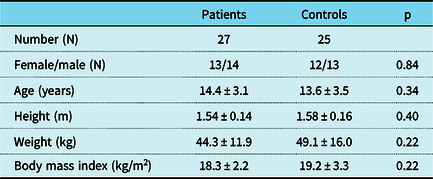
Thus, the study groups comprised 27 patients with Fontan circulation and 25 healthy control patients. Gender, age, height, weight, or body mass index did not differ between patients and controls (see Table 1). Fontan circulation was completed at median age 2.4 (1.1–6.4) years. Eighteen patients had an intra-atrial tunnel and nine patients had an extracardiac conduit. No fenestrations were present. All patients were on anticoagulation treatment with either aspirin or warfarin. Enalapril or captopril was prescribed for 19 patients. No patient was treated with betablockers.
Characteristics

Values are presented as mean ± 1SD.
Methods
Cardiopulmonary exercise testing
All patients performed symptom-limited exercise tests using a stationary, calibrated upright cycle ergometer (Monark Ergomedic 839E; Monark Exercise AB, Vansbro, Sweden) with a continuous increase in load, connected to a testing system (GE CASE Exercise testing system; Davis Medical Electronics Inc., Vista, California, United States of America). Start and increment of load during the test were chosen individually based on previous exercise tests and self-reported physical capacity and activity, in order for each individual to reach maximal exhaustion within approximately 10 minutes. Echocardiography was made on all individuals prior to the test in order to detect signs of thrombosis or significant valvular incompetence. The children were instructed to maintain a constant pedalling rate of 60 rpm and were actively encouraged throughout the test to continue to maximal exhaustion. Standard 12-lead electrocardiogram, blood pressure, and pulse oximetry were monitored before, during, and for 10 minutes after the test. Blood pressure was measured with cuff and radial artery Doppler signals during the test.
Breath-by-breath analyses of metabolic variables (V-max Encore; Viasys HealthCare Inc., Yorba Linda, California, United States of America), including oxygen uptake and respiratory parameters, were performed continuously throughout the test using a mouthpiece and a nose clip. The mass flow metre was calibrated with a fixed volume and the gas analyser with two reference gases prior to every test. Data were recorded as epochs by averaging every 20 seconds throughout each test and corrected for each individual’s weight in kilogram.
Heart rate was continuously recorded during exercise and for 10 minutes recovery time after maximal effort. Heart rate, load, and oxygen uptake were analysed at start (rest), at midpoint of exercise test as a measure of submaximal effort (mid) and at maximal effort (max). Also, heart rate in relation to load and oxygen uptake, respectively, was analysed. Heart rate reserve was analysed as the difference between maximal and resting heart rate. Chronotropic index was calculated as (peak heart rate – resting heart rate)/(220 – age – resting heart rate).Reference Paridon, Mitchell and Colan29,Reference Wilkoff and Miller30 Heart rate was also recorded during recovery at 2, 4, and 10 minutes after maximal effort. Oxygen pulse was calculated by dividing oxygen uptake by heart rate and has been shown to be a surrogate estimate of stroke volume during maximal exercise in healthy adolescents.Reference Unnithan and Rowland31
Statistical analyses
The statistical analyses between the groups were performed using t-tests and chi-square tests as appropriate. Statistical significance was set at p < 0.05. The statistical programme used was Statistica 12 (StatSoft Inc, Tulsa, OK, United States of America).
Results
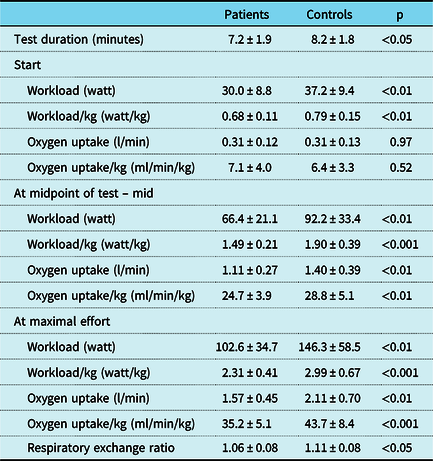
All patients and controls had sinus rhythm during the cardiopulmonary exercise tests and tolerated maximal exercise tests well, without any significant arrhythmias. Test duration to maximal exhaustion was shorter for patients than controls (7.2 ± 1.9 minutes versus 8.2 ± 1.8 minutes, p < 0.05). Oxygen saturation at rest was lower for patients than controls (94 ± 3% versus 98 ± 1%, p < 0.001). Oxygen saturation at maximal effort was also lower for patients than controls (91 ± 4% versus 98 ± 1%, p < 0.001). Respiratory exchange ratio at maximal effort was lower for patients than controls (see Table 2).
Results from cardiopulmonary exercise testing

Values are presented as mean ± SD.
Load at start was set lower for patients than controls (0.68 ± 0.11 watts·kg−1 versus 0.79 ± 0.15 watts·kg−1, p < 0.01). Increase of load during the tests was similar between patients and controls (0.24 ± 0.07 watts·min−1·kg−1 versus 0.27 ± 0.06 watts·min−1·kg−1, p = 0.06). Load at midpoint of exercise test (mid) and at maximal effort was lower for patients than controls (Table 2).
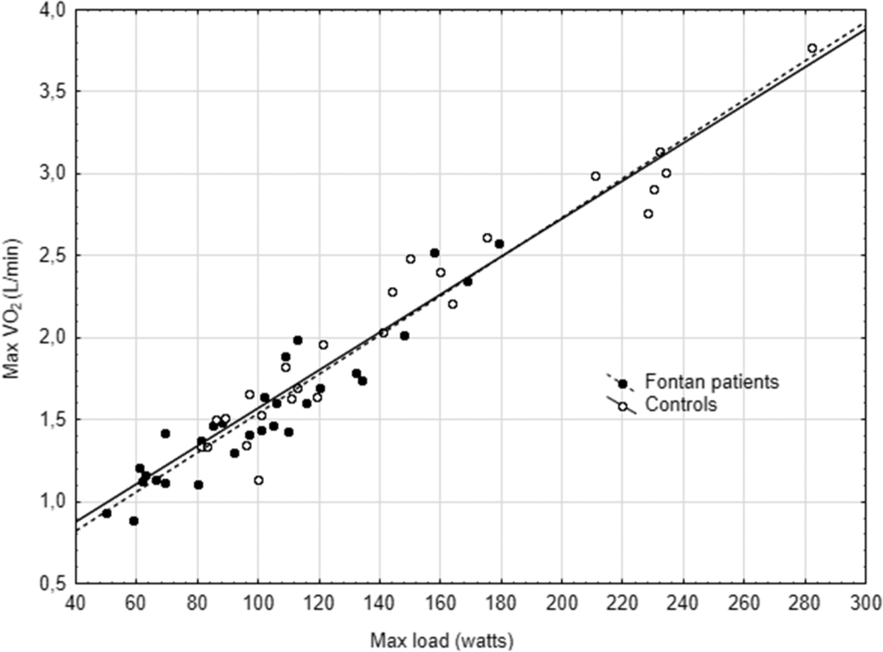
Oxygen uptake corrected for body weight was similar between patients and controls at start of exercise tests (7.1 ± 4.0 ml·min−1·kg−1 versus 6.4 ± 3.3 ml·min−1·kg−1, p = 0.52). At midpoint (mid) of exercise test, oxygen uptake was lower for patients than controls (24.7 ± 3.9 ml·min−1·kg−1 versus 28.8 ± 5.1 ml·min−1·kg−1, p <0.01). At maximal effort corrected, oxygen uptake was also lower for patients than controls (35.2 ± 5.1 ml·min−1·kg−1 versus 43.7 ± 8.4 ml·min−1·kg−1, p <0.001) (Table 2). Maximal oxygen uptake was closely correlated with maximal workload for both patients and controls (see Fig 1).
Maximal oxygen uptake, VO2, (litre·min−1) versus maximal workload (watts) for Fontan patients (y = 0.30 + 0.01*x; r = 0.95; p < 0.001) and controls (y = 0.42 + 0.012*x; r = 0.97; p < 0.001).

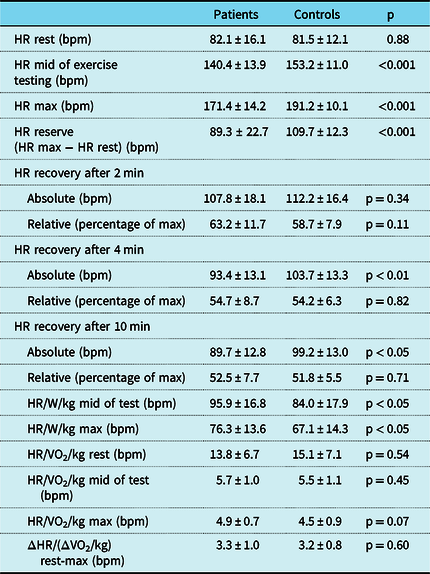
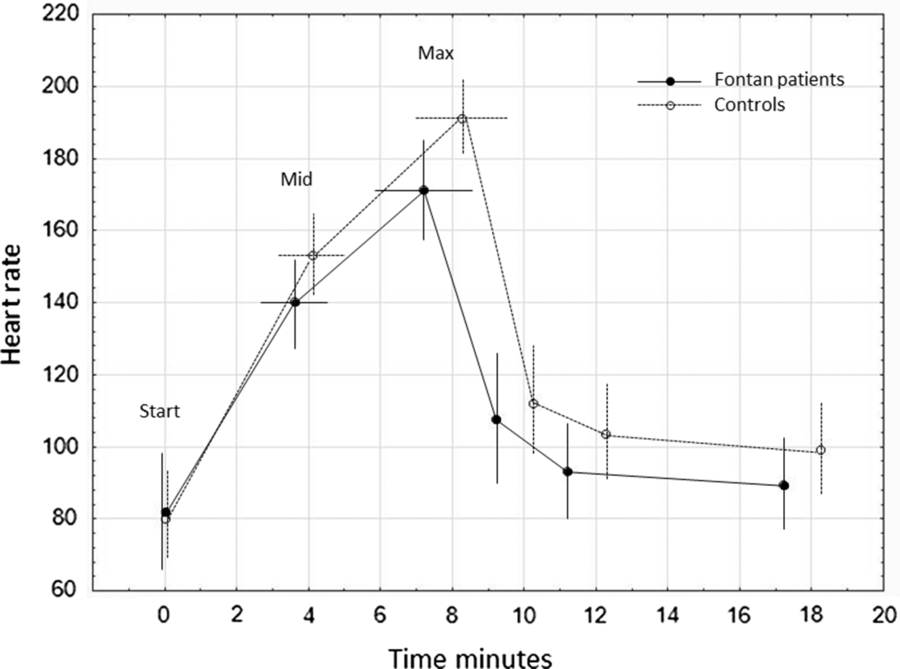
Heart rate at rest, midpoint, maximal effort, and during recovery time after the test are presented in Table 3. Heart rate at rest was similar between patients and controls. Heart rate at midpoint of the test and maximal effort was lower for patients than controls. Also, heart rate reserve was lower for patients than controls. Heart rate at 2 minutes after maximal effort was similar between patients and controls. Heart rate in absolute values was lower at 4 and 10 minutes after maximal effort for patients than controls. However, when heart rate was analysed in relation to maximal heart rate (relative, %), the two groups had similar heart rate recovery (Table 3, Fig 2).
Heart rate reactions during cardiopulmonary exercise testing

bpm = beats per minute; HR = heart rate; W = Watt.
Heart rate (beats per minute) at start, midpoint (mid), maximal effort, and during recovery at 2, 4, and 10 minutes after the test for Fontan patients and controls. Mean ± 1SD.

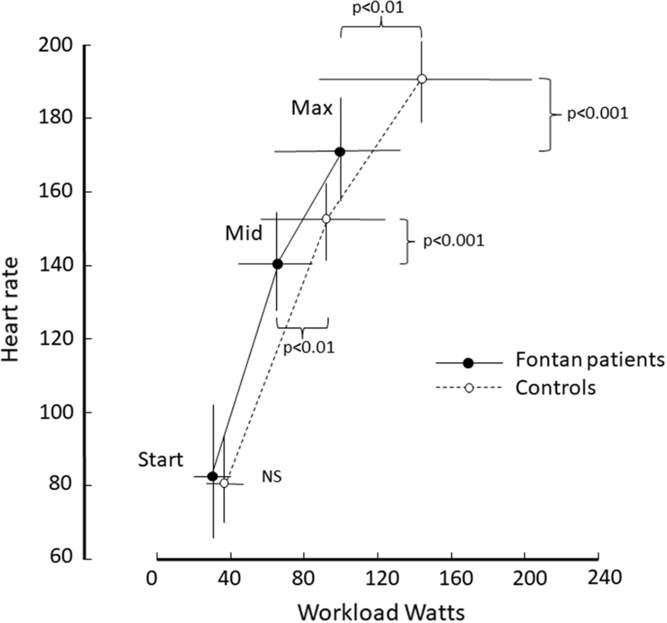
Furthermore, heart rate in relation to workload was higher for patients than controls at mid and maximal effort. The patients seemed to have a lower increase in heart rate at higher load and later in the exercise test compared with the healthy controls (Table 3, Fig 3).
Heart rate versus workload (watts) at start, midpoint (mid), and maximal effort for Fontan patients and controls. Mean ± 1SD. p-Values denote comparisons between groups.

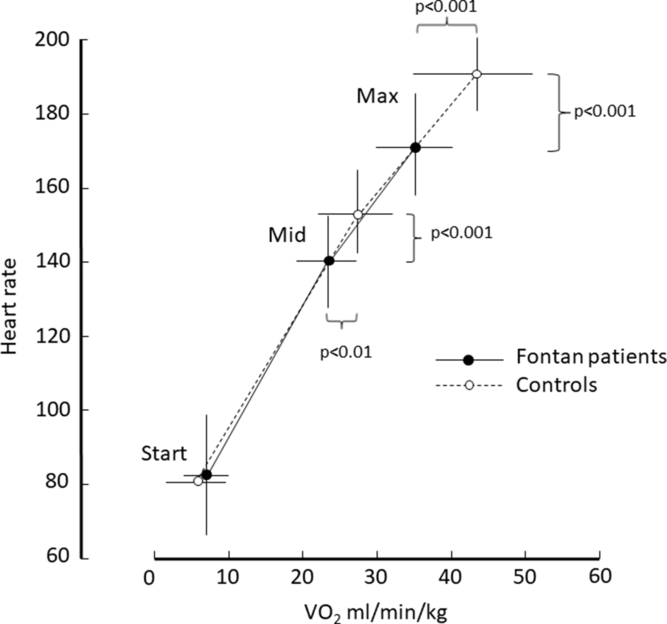
Also, heart rate in relation to oxygen uptake at start, midpoint, and maximal effort was similar for patients and controls (Table 3, Fig 4). Delta values for heart rate (ΔHR) in relation to delta values for oxygen uptake (ΔVO2) between rest and maximal effort were similar for patients and controls (Table 3).
Heart rate versus oxygen uptake, VO2 (ml·min−1·kg−1), at start, midpoint (mid), and maximal effort for Fontan patients and controls. Mean ± 1SD. p-Values denote comparisons between groups.

Chronotropic index was lower for patients than controls (0.72 ± 0.13 versus 0.88 ± 0.08, p < 0.001).
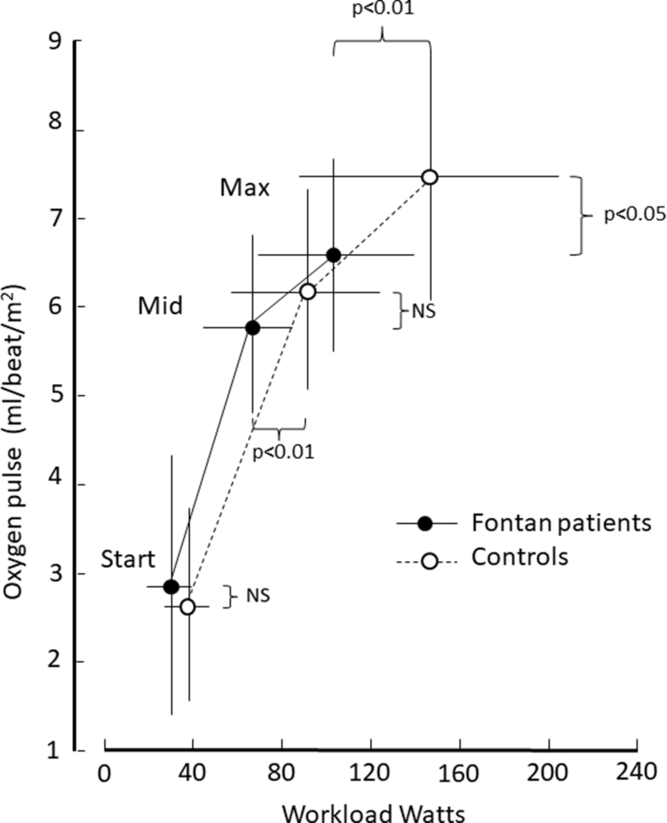
We found that oxygen pulse at start and midpoint of test was similar between patients and controls (data not shown). Oxygen pulse at maximal effort seemed to be smaller in our patients than in controls (9.3 ± 2.8 versus 11.0 ± 3.6 ml·beat−1, p = 0.05). When correcting oxygen pulse for body surface area, oxygen pulse was significantly smaller for patients than controls (6.6 ± 1.1 versus 7.5 ± 1.4 ml·beat−1·m−2, p < 0.05). Oxygen pulse increased significantly less from midpoint of exercise test to maximal effort for patients than controls (0.83 ± 0.66 versus 1.24 ± 0.69 ml·beat−1, p < 0.05) (Fig 5).
Oxygen pulse (ml·beat–1·m−2) versus workload (watts) at start, midpoint (mid), and maximal effort for Fontan patients and controls. Mean ± 1SD. p-Values denote comparisons between groups.

Discussion
In agreement with most similar studies, we found maximal heart rate to be reduced in our Fontan patients. However, in relation to workload exercised, heart rate was increased compared to healthy controls. Furthermore, increase in oxygen pulse seemed to level off at higher load and heart rate more than in controls. The reduced maximal heart rate may be an appropriate response to maintain stroke volume and cardiac output in the Fontan circulation.
The growing number of patients with a complex heart malformation and palliation with a Fontan circulation face limitations in daily life and have a high risk for cardiovascular complications. Many studies have reported a reduced quality of life.Reference Dulfer, Bossers and Utens8–Reference Uzark, Zak and Shrader11 It has been shown,Reference Atz, Zak and Mahony12 and there is a general consensus that reduced exercise capacity and tolerance is one major factor for reduced self-perceived health-related quality of life, especially in children and adolescents. Exercise capacity and tolerance have been reported to be reduced in most age groups of Fontan patients and long-lasting fatigue after exercise is a common complaint. Peak oxygen consumption and maximal work load are usually reported to be 60–70% of normal when corrected for age and weight.Reference Hock, Reiner and Neidenbach5–Reference Muller, Christov, Schreiber, Hess and Hager7 Furthermore, a low maximal heart rate is invariably recorded during exercise testing in Fontan patients.
Chronotropic incompetence is broadly defined as the inability to increase heart rate commensurate with increased physical activity or demand and often mentioned as a limiting factor for physical capacity in Fontan patients.Reference Claessen, La Gerche and Van De Bruaene19,Reference Brubaker and Kitzman32 The question is if limited maximal heart rate is a primary sinoatrial dysfunction or a secondary effect of the Fontan haemodynamics. In our study, chronotropic index was lower for patients than controls. Chronotropic incompetence can be defined as failure to achieve a chronotropic index of 0.8 or higher, but these data are derived from studies on healthy adults.Reference Wilkoff and Miller30 In a large cohort of children and adolescents with CHD, chronotropic index was lowest for patients with single-ventricle haemodynamics, but an index below 0.8 was a frequent finding even also in the control group. Thus, this index may not be a useful measure of chronotropic incompetence in children.Reference von Scheidt, Meier and Kramer18
Maximal physical capacity is determined by many variables already in healthy patients. Heart rate and stroke volume are indirectly both dependent of parasympathetic/sympathetic balance, catecholamine surge, venous return and atrial filling, systemic vascular resistance and blood pressure, and many other variables. In the Fontan circulation, the absence of a pumping subpulmonary ventricle with venous pooling of blood and limited atrial filling makes regulation of cardiac output even more complex especially during exercise. We focused our study on the relationship between heart rate and exercise capacity measured as load and oxygen uptake.
Our Fontan patients also had significantly lower maximal work load (77%), maximal oxygen uptake (81%), and maximal heart rate (90%) compared with the matched healthy control group. These numbers are somewhat higher than previously reported and may be explained by our selection of patients and controls. The 10 Fontan patients who choose not to participate may represent a subgroup with less physical capacity so that the study group represents a positive selection of Fontan patients. Furthermore, healthy control patients among peers of the Fontan patients may have resulted in selection of patients less active in sports and exercise than in the general population. Since we also made studies of quality of life and effects of training, we believe it was important to use control patients from similar socioeconomic background. It has also been reported that maximal physical capacity and oxygen uptake are falling in the general population and that children and adolescents live a more sedentary life than previously.Reference Ortega, Konstabel and Pasquali27,Reference Raustorp, Pagels, Froberg and Boldemann28 We therefore believed that it was important to use a contemporary healthy control group rather than population-based statistics and old reference material for comparison. The maximal oxygen uptake in our Fontan patients (35.2 ± 5.1 ml·min−1·kg−1) also suggests that they represent a group of physically capable Fontan patients although with a reduced quality of life which we have previously reported.Reference Hedlund, Lundell, Villard and Sjoberg24
Both the Fontan patients and the control patients showed a similar and close to linear relationship between maximal oxygen uptake and maximal load (Fig 1). This is expected and a good measure of the exercise testing procedure used. It also suggests that the muscular metabolic characteristics were similar in the two groups.
Heart rate during exercise was lower in the Fontan patients, both at midpoint and maximal effort as expected (Fig 2). The difference in heart rate during recovery is probably only reflecting the different preceding maximal heart rates. We did not follow heart rate recovery after 10 minutes, so we cannot say when this difference ceases.
When heart rate was related to workload for the two groups (Fig 3), an interesting observation was made. There were significant differences in heart rates and workloads between the two groups both at midpoint and at maximal effort (Table 2). The Fontan patients had a significantly increased heart rate response in relation to workload at midpoint and maximal effort compared to the controls. Both groups were exposed to a continuous and linear increase in load during the test, however, with different starting loads. Both groups also showed similar linear heart rate response to oxygen uptake corrected to weight (Fig 4). The increased or similar heart rate in relation to workload and oxygen uptake could suggest that heart rate during exercise in Fontan patients is adequate for the exercise performed. But, it is also likely that Fontan patients have a different heart rate in relation to workload at lower levels of work compared with higher levels of work, compared with healthy controls. We choose midpoint in time of exercise test for our measurements so we can only speculate when this shift in heart rate response occurs. It has been suggested that Fontan patients perform better at submaximal exercise level and that training should be designed accordingly.Reference Banks, McCrindle, Russell and Longmuir33 In a recent publication by Claessen et al,Reference Claessen, La Gerche and Van De Bruaene19 they reported Fontan patients with higher increase in heart rate relative to workload than in a control group. However, their control group was not matched regarding age or gender, and the exercise test was only submaximal with heart rates of 144–155 beats per minute, more corresponding to our midpoint values.
The limited maximal heart rate in Fontan patients has been attributed to sinoatrial injury from repeated heart surgery and disconnection of the caval veins. Resulting chronotropic incompetence has been suggested.Reference von Scheidt, Meier and Kramer18 Heart rate variability has also been reported to be reduced in Fontan patients and depending on surgical techniques.Reference Dahlqvist, Karlsson and Wiklund34 There were no differences in heart rate at rest, response during exercise, or recovery between our small subgroups of Fontan patients with intra-atrial and extracardiac systemic-to-pulmonary venous connections.
If sinoatrial function and heart rate are adequate to workload, there may be another explanation for the lower maximal heart rate. Stroke volume and cardiac output measured non-invasively were reported many years ago to increase less during exercise in Fontan patients compared with controls.Reference Gewillig, Lundstrom, Bull, Wyse and Deanfield35 Recently, cardiac MRI has been used to measure stroke volume and cardiac output during exercise in Fontan patients.Reference Claessen, La Gerche and Van De Bruaene19 An early reduction in stroke volume and a cardiac output plateau at submaximal heart rates were found. We had no direct measurements of central haemodynamics, but our calculation of oxygen pulse at maximal effort supports the concept of impaired stroke volume in the Fontan patients. It seems as our patients have a smaller oxygen pulse and cannot increase oxygen pulse at higher workloads as the healthy controls (Fig 5). Oxygen pulse has been shown to be a valid predictor of stroke volume during exercise in healthy non-athlete adolescents. Healthy adolescents have been shown to have an oxygen pulse of 13.3 ± 2.5 ml·beat−1 for males and 11.0 ± 1.7 ml·beat−1 for females,Reference Unnithan and Rowland31 corresponding well with our results. It was also shown by Hebert et alReference Hebert, Jensen and Mikkelsen15 that stroke volume index decreased significantly for Fontan patients near the end of exercise testing close to maximal effort. Hebert et alReference Hebert, Jensen and Mikkelsen15 also concluded that the low stroke volume index was the most important limiting factor for exercise capacity in these patients and the chronotropic response had a smaller impact. Impaired venous return and diastolic filling of the single ventricle at higher heart rates are likely to be secondary to the limited increase in pulmonary perfusion, in spite of systemic venous congestion, without a pumping subpulmonary ventricle.
Limitations
The patients who joined the study may represent a group of more physically active patients with better heart–lung function than those who declined participation. The peers selected by the Fontan patients may be less interested in sports and less physically capable than the average population. With these assumptions of a high-performance selection of Fontan patients and a low-performance selection of controls, the differences observed between Fontan patients and controls may have been underestimated.
Fontan patients have been reported less willing to perform exercise to maximal exhaustion. This is also supported by lower respiratory exchange ratio recorded in our patient group. However, we recorded higher maximal heart rate, loads, and oxygen uptake than in most previous studies and this we believe were indeed signs of near-absolute maximal efforts also in the Fontan group.
Midpoint of exercise was chosen as a measure of submaximal effort. Differences in heart rate and oxygen uptake response do of course not occur at midpoint but are more likely to be continuous and more gradual changes during exercise. More studies with continuous recording of heart rate, oxygen uptake, and, if possible, direct measurements of stroke volume are needed.
Conclusions
In summary, we have found an increased heart rate in relation to workload in young Fontan patients compared with healthy matched controls. At higher efforts, the Fontan patients have a limited ability to further increase heart rate which may be a protective autonomic measure to sustain maximal cardiac output and physical capacity. Impaired diastolic filling and stroke volume at higher heart rates may be an important limiting factor for maximal cardiac output, oxygen uptake, and physical performance in Fontan patients.
Acknowledgements
None.
Financial support
This research was financed by The Swedish Order of Freemasons, The Mayflower Charity Foundation for Children, The Samariten Foundation for Paediatric Research, Sällskapet Barnavård, and The Swedish Heart-Lung Foundation.
Conflicts of interests
None.
Ethical standards
The study was approved by the Ethical Review Board at Karolinska Institutet (DNR 2010/84-31/4), Stockholm.