Introduction
Integrated positron emission tomography-computed tomography (IPET-CT) treatment planning (TP) of locally advanced head and neck cancer (LAHNC) has gained acceptance because of its improved tumour coverage and increased sparing of normal tissues from radiation. With this innovative co-registration as a single image, the complementary strengths of functional (PET) and anatomic (CT) imaging are utilised. Although the impact of such radioimaging has recently been translated into a measurable improvement in patient survival, Reference Rothschild, Studer and Seifert1 our attention was drawn to three important questions: first, given that PET-CT is an imaging tool and not a form of treatment, how was the favourable result achieved? Second, because the impact on clinical outcome cannot be shown from PET-CT per se, what clinical factors bear prognosis predictive potential? Third, of these factors, which can be identified on PET-CT? The scarcity of information prompted this review of cases and the literature. The study had two objectives: first, to assess patient outcomes relative to PET-CT determined gross tumour volumes (GTVs) and tumour responses (TRs) in an attempt to find support for our TP scheme of image fusion, and second, to compare our findings to previously published subject data.
Methods
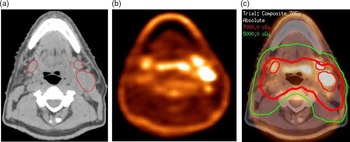
This clinical outcome study (no. 1146) was approved by the Institutional Review Board, and a retrospective review of medical records from 2010 to 2016 was performed. Only patients diagnosed with LAHNC who underwent PET-CT for TP of the disease condition completed radiochemotherapy and had follow-up information after treatment were included in this service audit. Twenty-nine consecutive individuals (24 men and 5 women with a median age of 53 years, range 33–63 years) were identified as the study participants. TP was performed with gross target volume (GTV) outlined under the guidance of PET-CT imaging (Figure 1). The bases for regional nodes tumour positivity on CT and malignant tumours on PET were according to those mentioned in our previous report. Reference Ampil, Previgliano, Porter, Richards and Takalkar2 GTVs were classified as small (≤36 cm3; 17 patients) or large (>36 cm3; 12 patients). Concurrent radiochemotherapy protocol consisted of three cycles of cisplatin (100 mg/m2 given on day 1 and day 15) and 5-fluorouracil (750 mg/m2 a day administered as continuous 96-hour intravenous infusion), and conventional fractionated megavoltage intensity-modulated radiotherapy administered 70 Gy for the gross primary tumour, 64–68 Gy for clinically involved lymph nodes, and 50 Gy for subclinical disease. The chosen endpoints of the investigation were tumour response (TR), failure patterns and crude survival rate (CSR). Survival was measured from the time of diagnosis of head and neck cancer to death or last contact.
Depiction of PET-CT fusion radiotherapy planning: (a) CT image with outlined regional lymph node metastasis; (b) PET image with detected malignant disease; (c) PET-CT findings co-registered as a single image.

Results
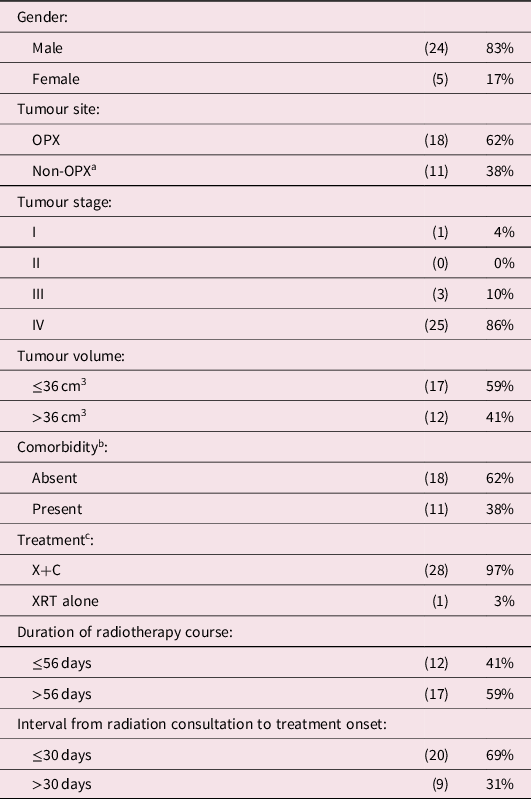
Table 1 shows that many individuals were male patients (24/29; 83%) who had advanced stage (25/29; 86%) oropharyngeal cancers (18/29; 62%) and were free of other comorbid illnesses (18/29; 62%). Management of the disease was mainly by radiochemotherapy (28/29; 97%) which was concurrently (24/28; 86%) administered. The interval from consultation to the onset of irradiation was not unduly prolonged in the majority (20/29; 69%) of the cases. The overall proportions of complete TR, 3-year CSR and failure (all types included) rate were (20/25) 80%, (12/29) 41% and (16/29) 55%, respectively. In many (11/16; 69%) of the people who experienced any type of failure, the course of irradiation was prolonged, and the interval from consultation to radiotherapy initiation was also extended in a few (5/16; 31%) subjects.
Demographic data

Notes: Number in parenthesis represents the number of patients.
OPX, Oropharynx; Non-OPX, non-oropharynx; X+C, radiochemotherapy; XRT alone, radiotherapy alone.
a Two patients with dual head and neck cancer or head and neck cancer with stage I lung cancer.
b Diabetes mellitus, hypertension, lung cancer.
c Concurrent radiochemotherapy (24 patients); sequential radiochemotherapy (4 patients); one patient underwent definitive surgery (for oral tongue cancer and synchronous second cancer in the maxilla) with adjuvant radiochemotherapy.
Regarding patients with smaller and larger GTVs, the rates of complete TR were (12/17) 71% versus (8/12) 67%, respectively (p > 0.80); the corresponding 3-year survival rates were (8/17) 47% versus (4/12) 33%, p > 0.30), and locoregional recurrence (LRR) rates were (6/17) 35% versus (5/12) 42%, p > 0.70). Of the 25 patients evaluable for TR following the non-operative combined therapy, the noted proportions of total resolution and non-disappearance of the neoplasm were (20/25) 80% and (5/25) 20%, respectively; the corresponding 3-year CSRs were (11/20) 55% versus (0/5) 0%, p > 0.05, and LRR rates were (3/20) 15% versus (4/5) 80%, p < 0.02).
Fourteen people were alive at last follow-up, which ranged from 24 to 90 months (median 62.5 months). The other 15 patients were deceased, and the median survival was 15 months (range 4 to 37 months). Treatment-associated acute toxicity (grade 3 mucositis, neutropenia) and late complication (tracheocutaneous fistula, oesophageal stricture, trismus, lung abscess or haemorrhagic pancreatitis) rates were 14% (4/29) and 24% (7/29), respectively. Several clinicopathologic variables (i.e., tumour site/volume/relapse/response, presence or absence of comorbidity, duration of the radiotherapy course, radiotherapy consultation to onset of treatment interval) were tested on univariate analysis for their possible prognostic relevance; from this, the significant (p < 0.001) predictor of an adverse prognosis was the occurrence of tumour relapse.
Discussion
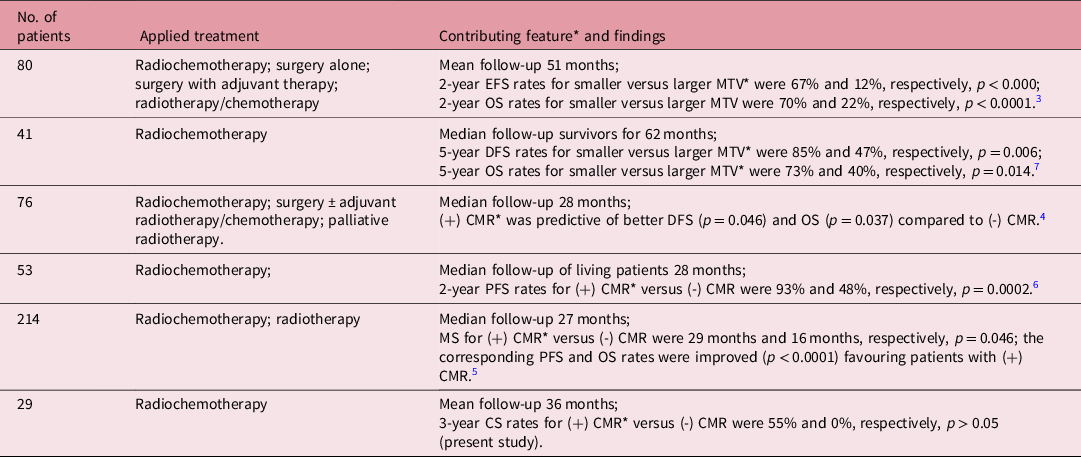
Accepting that there will be differences in patient characteristics between our study participants and those in published investigations, we found that, although the findings did not reach statistical significance, there was a positive relationship of smaller tumour volumes and complete resolutions of cancer to better prognosis (observations akin to the published treatment effects shown in Table 2 Reference Abgral, Keromnes and Robin3–Reference Xie, Yue, Zhao, Sun, Kong, Fu and Yu7 ). The shortcoming associated with these reports (the present account included), warranting cautious interpretation of the described observations, is that the results were mostly from studies retrospective in design. While we appreciate such reported information, the observed proportions of treatment failure (55%) and prognosis (41%) in our study remain a concern. We think that the conceivable explanations for these unfavourable results might reside in the prolongation of the radiotherapy course and delay in treatment initiation, which occurred in some of our study participants: these hypotheses appear in accord with the findings of other authors. Reference Morse, Judson and Husain8,Reference Yao, Jin and Wang9
Contribution to outcome of treatment planning integrated PET-CT for locally advanced head and neck cancer: literature review

Note: MTV, metabolic tumour volume; CMR, complete metabolic response/resolution; EFS, event-free survival; PFS, progression-free survival; CS, crude survival; OS, overall survival; MS, median survival.
Conclusion
In conclusion, we focused on the contribution of the application of TP IPET-CT in LAHNC to patient outcome but failed to definitively show the gain. Nevertheless, its precise value deserves further clarification. We call for more study with larger patient numbers because limited health care resources make it imperative to constantly review the worth of costly delivery systems in order to justify their continued utilisation.
Acknowledgements
None.