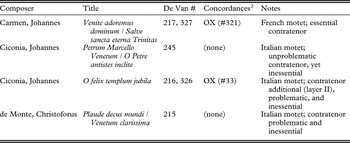
A problem that has troubled music historians studying the late medieval period has been the classification of contratenor parts in fifteenth-century manuscripts. A polyphonic line that is usually of secondary importance, the contratenor is most often inessential to the dyadic contrapuntal framework of fifteenth-century vocal polyphony and frequently demonstrates evidence of later addition. Proceeding from paleographic and codicological documentation, this study examines contrapuntal and stylistic features in contratenor parts from a selection of equal-cantus Italian motets from the manuscript Bologna, Museo Internazionale e Biblioteca della Musica di Bologna, MS Q.15 (hereafter Q15).Footnote 1 Although fourteen motets formed the initial basis for this investigation, four paradigmatic examples have been selected for presentation here as case studies (shown in Table 1).
Equal-cantus motets examined in this study

After establishing pertinent issues in the analysis of early music and the fifteenth-century contratenor, we will begin with the case study of an equal-cantus French motet, Johannes Carmen's Venite Adoremus, demonstrating how a contratenor can be an essential and integral component of the contrapuntal framework. Next, I will discuss two Italian motets by Johannes Ciconia with surviving contratenor parts, collating a lexicon of rules that govern their behaviour. This is followed by the analysis of an Italian motet by one of Ciconia's followers, Christoforus de Monte, and while acknowledging that this composer had his own unique compositional idiom, I will demonstrate the remarkably similar conventions regulating its contratenor as compared with those attributed to Ciconia's motets. The analyses that follow will be guided by several questions, such as: What is the contratenor's overall strategy and its contribution to the contrapuntal framework of each motet? Which general characteristics are normative and appropriate for a contratenor? And ultimately, is there a ‘Q15’ idiom or a consensus on contratenor behaviour inthis manuscript? This paper posits that studying contratenors can offer a unique perspective into fifteenth-century compositional thinking since these parts serve variable functions in this repertoire and many seem to have been added to pre-existing works by a later composer.
The Italian motet type in Bologna Q15
The motets analysed in this study are of Italian provenance and draw on the fourteenth-century motet type classified by Margaret Bent.Footnote 3 These works feature two texted upper parts in equal or nearly equal range (cantus I and II) and a voice labelled ‘tenor’ that is generally slower-moving and without text. The two cantus parts are equally important, both normally written in a high range (with C1 or C2 clefs), and they consist of the same kind of rhythmic motion, often trading motifs and imitation. Cantus parts may have the same or different texts and either can take the lead. Both cantus parts are contrapuntally essential and either part can form a grammatical dyadic cadence with the tenor by moving to the octave. Each motet is controlled by a dyadic cantus-tenor framework that is grammatically and contrapuntally complete (discussed in depth below). While one cantus part forms a dyadic cadence with the tenor, the two cantus parts will often move in parallel perfect fourths or fifths with one another. The accompanying tenor is often low in range (with C3 or C4 clefs) and usually lower than the cantus parts (but it may at times cross with them). Tenor parts are typically freely composed (not derived from chant), often in semibreves, with frequent leaps of perfect fourths and fifths. The tenor commonly contains rests while the upper parts continue unaccompanied, and the tenor may at times be involved in imitation with either or both of the cantus voices (such as in Ciconia's O virum omnimoda, #254). Many of these motets also include textless contratenor parts – like most late fourteenth- and early fifteenth-century French motets – but such parts are often later additions and usually grammatically inessential.Footnote 4 This fact attests to the French influence on the Q15 scribe, who converted some pieces in Italian notation to French, and both added and removed contratenors.Footnote 5
The contratenor defined
The term ‘contratenor’ had basically one meaning from its first appearance in the early fourteenth century up until its disappearance in the early sixteenth century: it is labelled as such in manuscripts to denote a voice ‘in the sound-space of the tenor, written against [contra] this leading bottom voice’.Footnote 6 The contratenor interacts with and orients itself contrapuntally towards the tenor to make a dyadic pairing, and contrary motion plays an important role in the proper conduct of these two voices usually operating in the same register. The contratenor is never a fundamental voice on its own; its very name implies the existence of a tenor for it to be ‘contra’. The most complete description of the term ‘contratenor’ occurs in the work of the fifteenth-century music theorist, Anonymous XI. If we interpret this author correctly, the contratenor was normally composed after the cantus–tenor pairing and added to a grammatically complete dyadic core.Footnote 7 This new voice could cross below the tenor, singing any consonance from the octave below to a tenth above the tenor. Additional characteristics of a typical contratenor include: the absence of text, a general lack of melodic decorum (unlike the profiles of cantus or tenor parts), a jagged rhythmic character, and at times large leaps (such as motion through a twelfth in the space of two or three breves) of often unvocal intervals (such as sevenths or ninths). As they approach cadences, contratenors most typically move in intervallic successions with the tenor of a major third to a perfect fifth in contrary motion (hereafter M3–5) while a cantus part makes a major sixth to an octave (hereafter M6–8) with the tenor. This often causes contratenors to arrive at cadences doubling a fifth or twelfth already present in a cantus voice. Another common cadential succession between contratenor and tenor is a minor third to a unison (hereafter m3–1), but contratenors will also occasionally provide a third between the perfect intervals of contrapuntally essential voices.
Since the contratenor itself is rarely essential to the contrapuntal framework of a piece, it may serve different functions in contrasting textures within a single composition. Signe Rotter-Broman has proposed that contratenors around 1400 were often ad libitum voices and their preservation in manuscripts demonstrates the existence of a living musical practice at that time. As she argues, the variable functions which contratenors serve can best be understood with the metaphor of ‘commentary’ upon the core cantus-tenor duet.Footnote 8 In terms of counterpoint, the contratenor is chiefly configured in relation to the tenor, but materially and structurally it is an interpreter of the cantus.Footnote 9 It adds to the texture, obeying a number of different contrapuntal and stylistic priorities depending upon a range of musical circumstances.
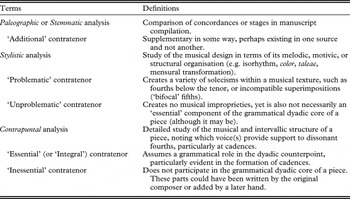
In order to determine the authenticity of a contratenor, we have three primary methods of investigation: paleographic, stylistic and contrapuntal analysis.Footnote 10 In a few cases, we are fortunate to have codicological anomalies that alert us to possible scribal emendations (such as discrepancies in layout, format, notation, texting, the absence of a contratenor in a concordance, etc.), thereby allowing us to determine the validity of a contratenor based upon paleographic (or stemmatic) criteria.Footnote 11 But where there is no external evidence to help us out one way or another, we must turn to the internal features of each contratenor and evaluate its stylistic and contrapuntal behaviour. Questions about stylistic features of contratenors include (but are not limited to): its participation in imitation, whether the part is structurally organised in a manner similar to the other voices (with methods of repetition by means of, e.g., isorhythmFootnote 12 or perhaps mensural transformation), whether the part clutters the texture, whether the contratenor acts as a harmonic or rhythmic filler that simply ‘marks time’, whether there are suspicious ‘holes’ in the texture which a contratenor was designed to fill, or whether the contratenor connects joins which may not have been ‘holes’ without it. Such questions will help us determine if a contratenor is stylistically ‘problematic’ or ‘unproblematic’. In studying the contrapuntal makeup of a contratenor, the most important question is whether it supports dissonant fourths above the tenor, particularly at cadences, which would thereby render the part grammatically ‘essential’. While some contratenors can seem to be conceptually integrated within a motet, they should nevertheless be considered ‘inessential’ if they do not participate in the grammatical dyadic counterpoint of the piece.Footnote 13 The distinctions among contratenor classes are summarised in Table 2.
Terminology in contratenor classification

These issues will form the basis of the case studies that follow and each piece will be evaluated in the three ways described above. Additionally, since the contratenors in this study often seem to be guided by stylistic conventions different from those of simple counterpoint with the tenor, it is also a goal of this paper to formulate and catalogue those rules.Footnote 14
Grammar, counterpoint and cadences
In ‘The Grammar of Early Music’ (1998), Bent demonstrates how we might recover the grammatical sense of early-fifteenth century music, invoking the term ‘grammar’ as an analogy for the interpretation and performance of under-prescriptively notated music. Bent argues that musical grammar around 1400 consists of a fundamentally dyadic core between cantus and tenor that is governed by the rules of counterpoint and articulated by the rules of musica ficta. It is important to remember, as the author points out, that ‘counterpoint’ is a procedure and a technique, rather than a general synonym for the musical fabric; counterpoint is what underlies composition and is centrally concerned with two-part ‘harmonic’ progressions rather than with lines.Footnote 15 Correct performance of dyadic progressions requires singers to keep perfect consonances perfect and approach cadential progressions correctly. The cadences are what the ear most readily grasps in this music and proper performance follows two principal rules: 1) the closure on a perfect interval should be a perfect unison, fifth or octave; and 2) a cadence should be approached by the nearest imperfect interval (a third or a sixth) of which one part moves by semitone while the other moves in contrary motion by tone. Intervallic quality is important in cadential successions: a major third expands to a perfect fifth (M3–5), a major sixth moves to an octave (M6–8), a minor third contracts to a unison (m3–1), and so on.Footnote 16 Cadences most commonly occur on the final of a piece (e.g. often on D or F), while medial cadences can be found throughout a work on secondary degrees (usually the second, third, fifth and sixth degrees above the final).
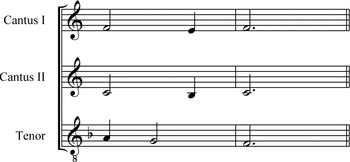
When another cantus voice is adjoined to the dyadic core, the ascending cantus voices move in contrary motion to the descending tenor at cadences, but in either parallel perfect fourths or fifths with one another. This tendency produces a cadence consisting of a simultaneous major third and sixth to perfect fifth and octave (6/3–8/5), otherwise known as the ‘double-leading-tone cadence’,Footnote 17 demonstrated in Ex. 1.
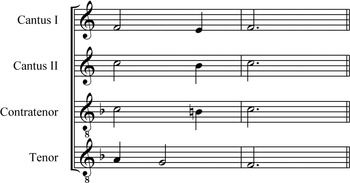
A fourth voice, the contratenor, is often a supplemental component of this framework. The contratenor is written chiefly in consideration of its relation with the tenor (contra–tenor), most commonly forming cadential successions with this part in contrary motion (usually M3–5). When added to the framework in Ex. 1 , this results in the contratenor doubling one of the cantus voices, either in unison or at the octave. This cadential structure is an entirely normative tendency in early fifteenth-century Italian motets, so much so that it has become known as the ‘Italian cadence’.Footnote 18 Ex. 2 demonstrates this cadence with cantus II sounding an octave above the contratenor.
Double-leading-tone cadence.

Notice the parallel fifths between the two cantus parts and their parallel octaves and fourths with the contratenor, all of which ascend in contrary motion to the stepwise descending tenor. Such parallelisms should not be considered dissonances in this repertoire; they are to be expected since the contratenor itself makes complete sense with the tenor, and the tenor makes perfect sense with the cantus parts. More precisely, dissonances occur at the surface level, often as the result of ornamentation or voice function. Moreover, the strict dyadic contrapuntal background cannot, by definition, contain dissonance.Footnote 19
Where harmonic considerations are concerned in adjoining additional parts to a dyadic core, the lowest voice (usually the tenor) takes priority while the other voices conform to it. On occasion, the tenor does not fulfil its normative role, sometimes moving in parallel motion with a cantus voice while another voice (often the contratenor) supplies the necessary contrary motion. In these circumstances, that voice which moves in contrary motion becomes grammatically ‘essential’ to the other voices and is thereby an integral component of the contrapuntal framework.Footnote 20 This concept will be a guiding principle throughout this paper as we consider the regulated relationships between each voice and the tenor, along with the deliberately un-regulated interactions among the other voices, and we will investigate situations in which the contratenor may serve as the essential voice.
‘Italian’ cadence.

Case study of an essential contratenor: Venite adoremus/Salve sancta eterna (Johannes Carmen; #217 and 327)Footnote 21
Venite adoremus represents a distinctly French motet style from the early fifteenth century.Footnote 22 Its composer, Johannes Carmen, belonged to the generation of composers active in Paris c.1400, where he was at one time associated with the Burgundian court and later served as the cantor of the church of St Jacques-de-la-Boucherie.Footnote 23Venite adoremus is a four-voice sacred motet in praise of God and the Trinity that makes reference to the papal schism (in the fifth stanza of the cantus II text); thus, the motet was written before 1417 (the official end of the schism), perhaps as early as the 1390s, and conceivably for the Council of Pisa in 1409.Footnote 24 The motet appears anonymously in OX, but is attributed to Carmen in Q15. There is evidence to suggest particular scribal attention to this motet since it appears in two places in Q15 from different stages in manuscript compilation.Footnote 25Venite adoremus contains a contratenor part that is grammatically essential to the counterpoint of the motet, a typical characteristic of early fifteenth-century motets with French provenance.
Venite adoremus has five notated voices: cantus I, II, tenor, contratenor and solus tenor. In all three surviving copies, the solus tenor replicates the mensurations of the upper voices and may be seen as a performance solution to the problematic tenor and contratenor parts.Footnote 26 The solus tenor is a kind of basso seguente, merging the lowest sounding notes of the tenor and contratenor parts. As Bent has proposed, solus tenors themselves may have constituted a stage in the compositional process, allowing the composer to control the sonority of the lower voices in a single voice.Footnote 27 Bent has revealed that these parts exist only for pieces with essential contratenors, never for those with inessential contratenors, and this fact attests awareness on the part of those who made or copied them of some fundamental differences between such motets.Footnote 28 This detail alone does not directly render essential the contratenor of Carmen's Venite adoremus, but the fact that a solus tenor part exists for this motet suggests such a probability. Nevertheless, it is important to evaluate the contrapuntal and stylistic behaviour of the contratenor part.
Contrapuntal analysis of Venite adoremus

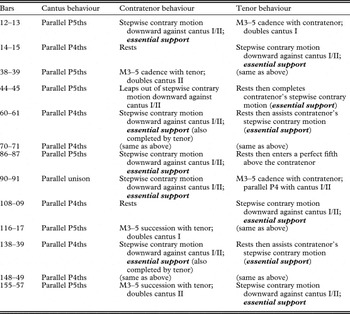
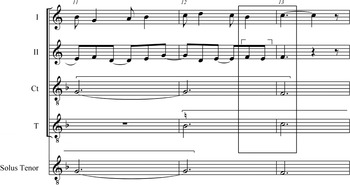
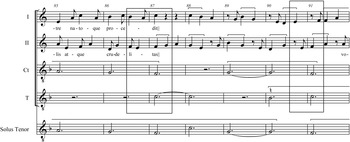
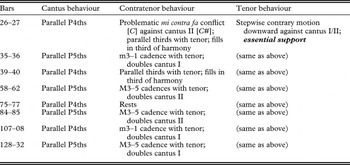
The contratenor's range and tessitura is notably small – only a sixth (F–d) – but this is roughly equal to the range of its tenor (F–c). Additionally, the rhythmic style of these parts (along with the solus tenor) is particularly static and constant, consisting of only longs and breves. The contratenor does not create dissonance or obscure imitation within the texture. There are numerous instances of parallel perfect fourths and fifths between the cantus voices in this motet, but both the contratenor and tenor together share the responsibility of providing contrapuntal support in each instance. Table 3 summarises the contrapuntal behaviour of each voice at these various moments, highlighting in italics the part providing essential support. The three occasions at which the contratenor is solely essential to the counterpoint occur in bars 12–13, 86–87 and 90–91; these are shown in Ex. 3a and 3b.
Essential contratenor of Venite adoremus: mm. 11–13.

Essential contratenor of Venite adoremus: mm. 85–91.

Additionally, there are less apparent circumstances in which the contratenor of Venite adoremus is nevertheless contrapuntally essential. As shown in Table 3, there are four instances (bars 60–61, 70–71, 138–39, 148–49) in which the contratenor and tenor together share the task of providing contrary motion below successive perfect consonances in cantus I/II; in each case, the tenor after resting enters on the note that completes the contratenor's stepwise descent. Observing all of these features in Venite adoremus, we can formulate the following rules that govern the contratenor's behaviour:
1 The contratenor begins and ends a perfect fifth above the tenor in consonance with the other parts.
2 The contratenor's range (F–d) is small and roughly equal to that of its tenor (F–c).
3 The contratenor forms normative M3–5 cadences against the tenor (even if this means doubling one of the cantus voices) whenever the tenor moves downward by step to cadence on the final or second degree above the final.
4 Since the two parts seem to have been conceived in tandem, the tenor forms normative M3–5 cadences against the contratenor (even if this means doubling one of the cantus voices) whenever the contratenor moves downward by step to cadence on the final.
5 The tenor rests, then enters in unison with the contratenor whenever the latter moves downward by step to cadence on the: (a) second degree above the final, (b) third degree above the final, and occasionally the (c) fifth degree above the final.
6 The contratenor forms m3–1 successions with the tenor to cadence in unison on the fifth degree above the final. When this tendency would cause dissonance between the lowest sounding voice and a cantus part, revealing rests occur.
7 When the tenor leaps by a perfect interval, the contratenor rests, then enters on a perfect consonance.
8 The contratenor notably does not engage in parallel motion or stepwise voice exchanges with the tenor.
9 The contratenor and tenor both rest frequently, together sharing the task of providing essential contrapuntal support for the cantus parts. Other discernible reasons for resting are the following:
a The contratenor rests: (i) when the other three voices already complete a 5/3 sonority, (ii) to avoid parallels with another voice, (iii) to avoid cluttering the texture, or (iv) after passing support to the tenor.
b The tenor rests: (i) when the other three voices already complete a 5/3 sonority, (ii) when the normative tendency to form m3–1 cadences with the contratenor on the fifth degree above the final would cause a dissonance with one of the cantus parts, (iii) to avoid dissonances or parallels with another voice, or (iv) to avoid cluttering the texture.
Equal-cantus motets by Johannes Ciconia and their contratenors
Johannes Ciconia (b. Liège, c.1370; d. Padua, between 10 June and 12 July 1412), a Franco-Flemish composer, was active principally in Italy, and his motet style is representative of a distinctively north Italian tradition of motet composition in the late fourteenth century.Footnote 29 The texture of his motets consists of two cantus voices with tenor and often an additional contratenor, and the most distinctive features of Ciconia's motet style are his use of rhythmic episodes, echo imitation and textural changes to delineate form.Footnote 30 Although six equal-cantus motets by Ciconia and their surviving contratenor parts formed the preliminary basis for this paper, the following two case studies represent the clearest demonstrations of contratenor classes in Ciconia's motets.
Petrum Marcello Venetum/O Petre antistes inclite (Johannes Ciconia; #245)Footnote 31
Ciconia's Petrum Marcello Venetum is an occasional motet written in honour of Pietro Marcello, the Venetian bishop of Padua from 1409–1428, and probably dates from his enthronement in September 1409, but was certainly written before 1412 (the year of Ciconia's death).Footnote 32 This motet contains a double-statement rhythmic structure and is Ciconia's only isorhythmic motet to employ rigorously and systematically controlled diminution.Footnote 33 Several compositional techniques such as these are unique to Petrum Marcello Venetum, and scholars have claimed that this is the least Italianate of Ciconia's surviving motets and the one most influenced by French style.Footnote 34 Part of this assumption has to do with the fact that the motet contains a tenor that bears certain hallmarks of cantus firmus technique and a contratenor that some scholars claim may have been part of the original conception of the work.Footnote 35 Additionally, the motet preserves ad longum versions of both the tenor and the contratenor parts – substitutions that simplify the notationally difficult compact versions – and these parts follow the cantus voices in the manuscript and immediately precede the canonic voices.Footnote 36
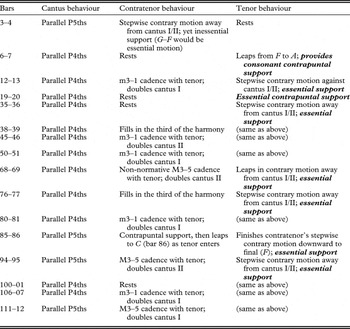
The contratenor and tenor engage in several exchanges and imitative passages in Petrum Marcello Venetum; together these parts share the role of supporting the upper voices whereby one often rests while the other is heard. Yet, as Samuel Brown has pointed out, the sense of melodic direction which marks the tenor of this piece is sometimes absent from the contratenor; he argues that the contratenor often seems to be a filler part and nothing more.Footnote 37 It is nevertheless important to point out the intrinsic connection between these two parts: the scribe has provided a tenor canon to lead the performer through the motet's complex rhythmic procedures and has indicated that the contratenor is to be performed ‘ad modum tenoris’ – in the manner of the tenor.Footnote 38
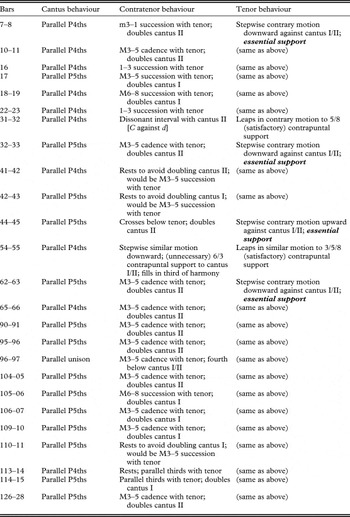
There are several instances of parallel perfect fourths and fifths between the cantus voices in this motet, but the tenor provides the requisite contrapuntal support in every instance. Table 4 summarises the contrapuntal behaviour of each voice.
It is difficult to establish other than on internal grounds whether the contratenor is ‘additional’ given that there are no known concordances for the motet. Since this contratenor creates no significant musical improprieties, yet is also not an integral component of the grammatical framework, we can nevertheless designate it as contrapuntally ‘inessential’ and stylistically ‘unproblematic’.
O felix templum jubila (Johannes Ciconia; #216 and #326)Footnote 39
Ciconia's O felix templum jubila is an occasional motet in honour of Stefano da Carrara (the illegitimate son of Francesco Carrara ‘il Novello’ and administrator of the Paduan See) and was probably composed between his induction as bishop of Padua on 10 April 1402 and the downfall of the Carrara dynasty in 1405.Footnote 40 Several notational anomalies suggest that this motet was originally conceived and written in Italian notation – like most, if not all, of Ciconia's motets – but the work appears in black French notation in Q15 and in black Italian notation in OX.Footnote 41 Additionally, there is substantial reason to suspect the Q15 scribe of major interference with this motet based upon the existing codicological evidence.Footnote 42 In the only concordant source for O felix templum (OX #33, fols. 22v–23), we find a three-voice work without contratenor. In Q15, three stages can be traced for the motet: without, with, and then again without the contratenor, and these stages are the only directly ascertainable reasons for its recopying.Footnote 43 Bent has proposed that the scribe recopied the motet in order to add a contratenor – perhaps one he composed himself – but for some reason he later recopied it again without the contratenor.Footnote 44 Cox has suggested two possible reasons for the omission of the contratenor in the third version: possibly the scribe knew that the contratenor was not genuine and omitted it,Footnote 45 or else there was not enough space on the new page to accommodate the contratenor part.Footnote 46
Contrapuntal analysis ofPetrum Marcello Venetum

Nevertheless, taking what we know about this suspicious contratenor as an extreme case, we will now investigate its internal stylistic traits. The contratenor's range (C♯–f) is noticeably larger than that of the tenor (D–e♭), a feature which distinguishes it from contratenors that can be attributed more securely to Ciconia. One can also observe a difference in function as the tenor participates in imitative passages with the cantus voices whereas the contratenor does not. The tenor and contratenor most commonly move in contrary motion, or often in parallel thirds, and the two share one moment of imitation. However, it is evident in several passages that the contratenor was written with more in mind than simply its relation to the tenor; when the tenor rests, the contratenor serves an inessential accompanimental role to the cantus parts, including voice exchanges and leaping contrapuntal support. Problematically, the contratenor's addition to the texture precipitates a significant amount of dissonance, often in the form of a pedal or drone. In particular, the contratenor has an idiomatic quality of its own, often filling the texture with contrasting rhythms, moving while the other voices sustain a harmony, or disjointedly leaping to fill in a sonority.
O felix templum includes several instances of parallel perfect fourths and fifths between the cantus voices at cadences, but it is the tenor alone that provides the requisite contrapuntal support in each circumstance, as shown in Table 5.
Contrapuntal analysis of O felix templum

To sum up: we know on paleographic grounds that the contratenor of O felix templum is ‘additional’ because of its complex stemmatic status. Second, the contratenor is stylistically ‘problematic’ (e.g. bars 26–27, shown in Table 5). And finally, since the tenor provides essential grammatical support at each cadence, we also know that the contratenor is contrapuntally ‘inessential’.
Normative rules in contratenors attributed to Ciconia
In addition to Petrum Marcello Venetum and O felix templum, this study has consulted four additional equal-cantus motets from Q15 by Ciconia with surviving contratenors for a more comprehensive classification of contratenor style: O virum omnimoda/O lux et decus/O beate Nicholae (#254), Ut te per omnes/Ingens alumnus Padue (#259), Doctorum principem/Melodia suavissima (#272), and Albane misse celitus/Albane doctor maxime (#273). After comparing the contratenors in these motets, there are several normative rules that govern their stylistic behaviour:
1 The contratenor begins and ends a perfect octave or fifth above the tenor in consonance with the other parts.
2 The contratenor's range is nearly equal to that of its tenor (roughly an octave or ninth).
3 The contratenor forms normative M3–5 cadences against the tenor (even if this means doubling one of the cantus voices) when the tenor moves downward by step to cadence on the final, as in the so-called ‘Italian’ cadence. Less common options include such cadences on the: (a) second degree above the final (Albane misse celitus and O virum omnimoda); (b) third degree above the final (Ut te per omnes); or (c) fifth degree above the final (O virum omnimoda).
4 The contratenor forms m3–1 successions with the tenor when crossing from below to converge upon a unison on the fifth degree above the final. Less common options include cadences on the: (a) octave above the final (Doctorum principem); (b) third degree above the final (Albane misse celitus); or (c) final (O felix templum).
5 When the tenor leaps by a perfect interval, the contratenor moves:
a In contrary motion, most commonly to a perfect consonance; notably, this will often create leaping voice exchanges in long succession. Ex. 4 demonstrates such behaviour in the opening of Ciconia's Doctorum principem.
Ex. 4Doctorum principem: mm. 1–5

b If such behaviour would create dissonance with another voice, the contratenor often moves to an imperfect consonance, usually by similar motion, but also by contrary motion.
6 Often when the tenor leaps by a perfect fourth, the contratenor forms a (non-normative) M3–5 succession (e.g. Petrum Marcello Venetum, Ut te per omnes, O felix templum).Footnote 47
7 The contratenor often uses certain strategies to provide musical material within the phrase, such as: (a) parallel thirds, or (b) stepwise voice exchanges.
8 The contratenor rests: (a) when its presence might obscure imitative activity in the other parts, (b) when its presence creates dissonance against the cantus parts, (c) to avoid parallel perfect motion with the tenor, or (d) when the other three voices already complete a 5/3 sonority.
9 When the tenor rests, the contratenor provides (inessential) contrapuntal support for the cantus parts, moving most commonly in contrary motion (such as stepwise voice exchanges).

Less common features in Ciconia's contratenors
The following characteristics are less normative in Ciconia's contratenors since they are not wholly consistent throughout the six motets examined in this study:
1 In O felix templum, the contratenor begins a perfect octave below the tenor; this is a notable exception to the rule that the contratenor begins and ends a perfect octave or fifth above the tenor.
2 The contratenor's range in O felix templum (an eleventh) is notably larger than that of its tenor (a ninth).
3 The contratenor of O felix templum does not consistently form M3–5 cadences against the tenor whenever the latter moves downward by step to a cadence. Other solutions to these situations include: (a) M6–8 successions, (b) dubious rests, (c) parallel motion to the third of a sustained harmony, (d) crossing below the tenor, and (e) leaping to avoid a mi contra fa conflict.
4 The contratenor of O felix templum forms 3–8 successions with the tenor by either: (a) leaping below the tenor, or (b) moving by step while the tenor crosses by leap.
5 The contratenor of O felix templum is more idiomatic than others attributed to Ciconia and includes the following strategies: (a) contrasting rhythms that fill the texture, (b) quasi-melodic material while the other voices sustain a harmony, and (c) disjointed leaps that fill in a harmony (also a feature of Doctorum principem).
6 The tenor and contratenor may share moments of melodic imitation (Ut te per omnes, O felix templum).
7 When the tenor has sustained notes, the contratenor may include quasi-melodic material (O virum omnimoda, O felix templum).
8 When the tenor rests, the contratenor of O felix templum provides (inessential) accompaniment to the cantus parts that includes idiomatic leaping contrapuntal support.
Summary of Ciconia's contratenors
The contratenor of Ciconia's O felix templum is by far the most problematic: it has the largest range, its stylistic character is peculiar and unlike that found in the other contratenor parts, and it introduces a significant amount of dissonance within the motet. It has a very complicated status based upon the existing external data and should be considered additional. Moreover, it is inessential since the tenor alone provides grammatical contrapuntal support.
The next most anomalous contratenor part is in the OX version of Ut te per omnes, which is also found in Q15 but without a contratenor. The OX contratenor contains several awkward dissonances with the cantus parts (which arise from its prioritisation of M3–5 cadences against the tenor), and its behaviour is often illogical and difficult to interpret. Despite its participation in imitation with the tenor, as well as providing accompaniment while the tenor rests, the contratenor is grammatically inessential and could have been a later addition to an original three-part piece.
Somewhat less problematic, although nevertheless inessential, are the contratenors of Doctorum principem and O virum omnimoda. The contratenor's addition to the musical texture of Doctorum principem creates several dissonances, and where the other voices move by stepwise motion towards cadences, the contratenor inexplicably leaps. The concordances for the contratenor of O virum omnimoda exhibit evidence of scribal attention to vertical quality, and yet its inclusion creates numerous problems in the texture, particularly superimposed (or ‘bifocal’) fifths.Footnote 48
The least problematic contratenor parts are those of Albane misse celitus and Petrum Marcello Venetum. The former contratenor is inextricable from the intrinsic structure of the piece because of its participation in isorhythm and isomelism.Footnote 49 Yet despite its overall organisation, the contratenor of Albane misse celitus is grammatically inessential and could have been a later addition. On the other hand, Petrum Marcello Venetum contains the most stable contratenor part, although it is contrapuntally inessential. Petrum Marcello Venetum notably bears features of French motet style and includes ad longum versions for both contratenor and tenor, which together present the possibility that the contratenor may have been part of Ciconia's original conception of the motet.
Beyond these observations, it is virtually impossible to speculate which of these contratenors were composed by Ciconia himself. From the evidence accumulated here, we can reasonably conclude that the contratenor parts with the highest probability of being an original component of the motet are the unproblematic contratenors of Albane misse celitus and Petrum Marcello Venetum. More importantly, however, I would emphasise that the surviving contratenors for Ciconia's motets are, for the most part, different from one another in degree rather than kind, and taking in mind the rules and characteristics collated above, we are now in a better position to examine the contratenors of the equal-cantus motets of Ciconia's followers.
A post-Ciconian motet and its contratenor
The next motet is demonstrative of the work of a closely tied group of composers, all of whom were active in a single geographical area – Padua, Venice, and Vicenza; all in the Veneto – at roughly the same time period (c.1400–1425), and who were for the most part members of the same generation.Footnote 50 Their origins, dates, subjects, forms and styles are closely related to one another. Their compositions adopt the style set forth by Ciconia and can be seen as a clear continuation of the fourteenth-century Italian motet. Seven equal-cantus motets with surviving contratenor parts formed the preliminary basis of this investigation: Christoforus de Monte's Plaude decus mundi/Venetum clarissima (#215) and Dominicus a dono (#220); Antonius Romanus's Carminibus festos/O requies populi (#206), Aurea flamigeri jam excedis (#219), and Ducalis sedes inclita/Stirps Mocinico (#243); Antonius de Civitate's Pie pater Dominice/O Petre martir/O Thoma lux ecclesie (#242); and Matheus de Brixia's [Brescia] Jesus postquam monstraverat (#221). The following single case study represents the most salient demonstration of contratenor classes in the motets of Ciconia's followers.
Plaude decus mundi/Venetum clarissima (Christoforus de Monte; #215)Footnote 51
Christoforus de Monte's Plaude decus mundi is a four-voice laudatory motet in honour of Francesco Foscari, doge of Venice, and was probably written soon after his investiture in April of 1423. Julie Cumming has established that the text of Plaude decus expresses the date of Foscari's election in astrological terms: first the year (1423), then the day of the month (the fifteenth, or thrice five), and last the month (April), associated with the astrological sign of Taurus, the bull.Footnote 52 Since the contratenor cannot be codicologically verified as additional, we must examine its internal features to determine its style and contrapuntal profile.
The motet begins with a short imitative introduction that is accompanied by the contratenor rather than tenor, yet it would perhaps be more musically convincing if the contratenor instead remained silent. Very often doubling the cantus parts, the contratenor of Plaude decus creates a significant amount of dissonance, and its irregular rhythms often blur the regular rhythmic patterns of the upper parts. Furthermore, the contratenor often does not integrate well during the melismatic hocket sections: it occasionally imitates the upper voices in such passages and at times only obscures the imitation.
There are numerous instances of parallel perfect fourths and fifths between the cantus parts in this motet, but the tenor alone provides the requisite contrapuntal support in each circumstance. This is summarised in Table 6.
Contrapuntal analysis of Plaude decus mundi

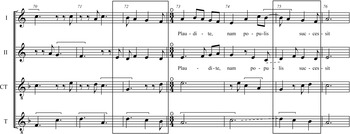
In addition, there are a few contrapuntal anomalies in this motet. A feature of Christoforus's unique compositional style is the use of parallel sequential motion between the tenor and cantus parts, but this technique occasionally results in parallel perfect fifths between these parts (e.g. bars 72 and 75, shown in Ex. 5). Such progressions would not be unusual in motets without a contratenor and these examples should be considered as phrase joins with displacement, exempting them from the parallel rule.Footnote 53 There are also two instances of parallel perfect consonances between tenor and cantus I/II (bars 23–24, 74–75), and although the contratenor provides stepwise contrary motion in both situations, these also occur within the context of displacement. In the latter case, tenor and cantus II are in unison (bars 74–75, shown in Ex. 5 with dotted lines), but the essential progression consists of parallel sixths between tenor and cantus I, with the contratenor's G as an ornamental under third. Here the cadence has been pushed back to produce the effect of parallel motion. Consequently, although the contratenor might seem to compensate for apparent stylistic irregularities in these examples, this part should be regarded as grammatically inessential to the counterpoint of the motet.
Plaude decus mundi: mm. 70–76.

Normative conventions in the contratenors of Ciconia's followers
Having evaluated the characteristics of the surviving contratenor of Plaude decus mundi – and along with those in motets by Christoforus de Monte, Antonius Romanus, Matheus de Brixia and Antonius de Civitate – we can now establish some stylistic conventions. Most generally, these contratenors obey the following priorities:
1 If the motet begins with an introduction between the cantus parts, the contratenor often rests to avoid obscuring the imitation.
2 The contratenor usually begins and ends a perfect fifth above the tenor, in consonance with the other parts.
3 The contratenor's range is roughly equal to that of its tenor.
4 The contratenor forms normative M3–5 cadences against the tenor (even if this means doubling one of the cantus voices moving in parallel perfect consonances), whenever the tenor moves downward by step to cadence on the: (a) final, or (b) (very often) second degree above the final.
5 The contratenor frequently crosses the tenor, leaping: (a) most commonly to a third below, but also to (b) a perfect fifth below, or (c) an octave below.
6 Whenever the tenor leaps by a perfect octave, the contratenor leaps in contrary motion to a perfect octave below.
7 When the tenor leaps by a perfect fourth or fifth, the contratenor: (a) most commonly moves to a perfect consonance in contrary motion, (b) moves to an imperfect consonance, usually in similar motion, or (c) rests to avoid a dissonance.
8 The contratenor may use certain strategies to provide musical material within the phrase, such as: (a) parallel thirds with the tenor, often elaborated by motion to unison, (b) stepwise voice exchanges, (c) parallel thirds or contrary motion with a cantus part, (d) quasi-melodic activity that mirrors another part, or (e) quasi-melodic transitions to the next passage while the other voices sustain a harmony.
9 The contratenor frequently fills in the third of sustained sonorities.
10 The contratenor rests: (a) to avoid parallel perfect motion with the tenor, (b) as part of its own idiomatic rhythmic configuration, (c) when the other three voices already complete a 5/3 sonority, (d) while exchanging imitative entrances with tenor, (e) to avoid dissonance with another voice, (f) to avoid obscuring imitative activity in the other parts, especially in an introduction section, or (g) to avoid parallels with a cantus voice.
11 When the tenor rests, the contratenor often: (a) provides (inessential) contrapuntal support for the cantus parts, or (b) rests along with the tenor to avoid cluttering the texture.
12 If the tenor never rests in a motet (e.g. Aurea flamigeri by Antonius Romanus), the contratenor does not serve an essential contrapuntal role to the cantus parts.
Summary of contratenors attributed to Ciconia's followers
Most of the motets of Ciconia's followers have inessential and problematic contratenor parts, such as those in Christoforus de Monte's Plaude decus mundi and Dominicus a dono; Antonius Romanus's Aurea flamigeri and Ducalis sedes inclita; Matheus de Brixia's Jesus postquam monstraverat; and Antonius de Civitate's Pie pater Dominice. Three of these motets contain overt codicological evidence that suggests scribal interference: Antonius Romanus's Aurea flamigeri has a contratenor added during layer II, Antonius Romanus's Ducalis sedes inclita includes a contratenor in Q15 that is not present in the concordant source (BU), and Antonius de Civitate's Pie pater Dominice contains a contratenor added during layer III. The least stylistically problematic of the contratenors is that in Antonius Romanus's Carminibus festos, but while there is no codicological evidence to suggest that it is additional, we should consider it as unproblematic yet inessential. Other problematic features of the contratenors in these motets include: obscuring imitative introductions with inessential accompaniment, adding contrapuntal dissonance to the musical texture, moving in disjointed intervals and dissonant leaps, obscuring normal cadential patterns, clouding the regular rhythms of the upper parts with irregular rhythms, overlapping and obscuring imitative statements, and doubling or moving in parallel perfect consonances with the cantus voices for lengthy passages.
Conclusion
One might argue that it is impossible to arrive at a single ‘contratenor style’ in repertoire that exhibits such remarkable differences of ‘cantus styles’, ‘tenor styles’ and overall ‘motet styles’. Moreover, there are numerous aspects that characterise any voice's behaviour – such as melodic and rhythmic shape, continuity and discontinuity, etc. – which furthermore are dependent upon the overall compositional structure of any given motet in its entirety. Yet since there is no consistent Ars contratenoris codified in the theoretical writings of the early fifteenth century, it is only by closely studying the musical texture that we will be able to gain a better understanding of the specific compositional thinking of the period. It is my contention that rigorous contrapuntal and stylistic analysis – coupled with thorough stemmatic and paleographic evidence – is the appropriate methodology inclined towards such a task. The Q15 manuscript is a particularly fitting locus of investigation for concerns such as these since it appears as though the scribe was no passive transmitter of the original intentions of a composer; he seems to have been himself actively involved in the creation of some of the contratenor parts.
The contratenors examined in this study often exhibit remarkably similar behaviour. In particular, the contratenors that are contrapuntally inessential and seem to have been later additions to original three-part pieces share several comparable features, such as 1) the tendency to form M3–5 cadences with the tenor whenever possible (which often creates parallels with a cantus voice or contrapuntal dissonance at other times), and 2) leaping in contrary motion to a perfect consonance whenever the tenor leaps by a perfect interval. The contratenor behaviour in these motets is remarkably consistent – we might even call it a ‘Q15 style’ – and the idiom is in general less problematic than the style of the contratenor in Ciconia's Ut te per omnes, found only in the OX manuscript. Nevertheless, it is impossible to speculate which of these parts may have been composed by the same later hand, such as that of the Q15 scribe. Instead, we will apply the lexicon of contratenor behaviour collated in this paper to delineate those features which could distinguish an original contratenor from a later one.
A contratenor written early in the compositional process would be tied principally to the behaviour of the tenor and conceptually integrated into the motet's musical fabric. In addition, it would likely exhibit the following tendencies: 1) when the tenor is absent, the contratenor would provide essential contrary contrapuntal motion for the cantus parts moving in parallel perfect consonances, 2) the contratenor would supply a contrapuntal foundation for other unsupported perfect fourths in the musical texture, 3) the contratenor would not obscure the overall texture of the motet, and perhaps even participate in imitation with the other voices, and 4) the contratenor would contain organisational features that are integral to the construction of the motet (a priori manipulations of form, such as isorhythm, color, talea, or diminution).
In contrast, a contratenor written later – perhaps a scribal addition to a pre-existing three-part piece – might exhibit some of the following characteristics. Evidence in the manuscript could reveal an inauthentic contratenor; for example, an anomaly in layout might suggest that a piece was copied from a different format, or a texting anomaly could indicate that text was either suppressed or added. In terms of its stylistic makeup, an inauthentic contratenor could still be rhythmically and conceptually tied to the tenor, but this would be its foremost priority, perhaps engaging in: 1) strict patterning with the tenor, 2) leaping voice exchanges, 3) extended parallel imperfect consonances (thirds, sixths), or 4) resting when the tenor rests. There would likely be less evidence of a relationship with the cantus voices in textural organisation (e.g. imitation or isorhythm) because the contratenor would act chiefly as a harmonic filler, often containing disjointed intervals or dissonant leaps. Such contratenor parts might inhabit an exceptionally wide range or clutter the musical texture, perhaps with contrasting rhythmic configurations or an altogether different stylistic idiom (such as moving while all other voices sustain a harmony). Most noticeably, a contratenor written later might run into the following types of problems: 1) mi contra fa conflicts, 2) dissonant additions to harmonies (ninths, sevenths) where not appropriate, 3) overlapping or obscuring imitation, such as in an opening section, 4) doubling or moving in extended parallel perfect consonances with another voice (most problematically the tenor), or 5) obscuring normal cadential patterns (often with superimposed, or ‘bifocal’, fifths). Such problems are often masked by: 1) rests that suspiciously occur at cadences in order to avoid dissonances, 2) rests that avoid parallel perfect consonances with the tenor (often occurring in situations where the other three voices already complete a 5/3 sonority), 3) disjointed leaps, 4) crossings below the tenor, or 5) filling in the third of a harmony.
To conclude, this study has compared the contratenors from a circumscribed group of musical works – early fifteenth-century equal-cantus motets from Q15 – in order to discern the rules by which these vocal parts operate. We are now in a better position to reconsider the issue of how these contratenors are attributed or not attributed to this repertory. Yet two additional questions remain: 1) whether and how such parts should be performed, and 2) why the contratenor was such an obvious concern for so many composers and performers in the early-fifteenth century. The first question surely will continue to be a matter of debate among performers of early music, but we might speculate why a composer would add a contratenor to a pre-existing three-voice motet. One purpose for their addition could reflect a change in stylistic practices and preferences; this is manifested, for example, in the Q15 scribe's Francophile tendencies. We know that he translated pieces originally conceived in Italian notation into French notation, and perhaps he added contratenors to make these works sound more French. Another explanation could be for celebratory purposes: perhaps a later composer wished to pay homage to his mentor or ‘update’ a favourite motet by composing a contratenor. Regardless of the reasons for their inclusion with these motets in Q15, I have argued that the majority of these contratenors should be considered additional, problematic and inessential. Whether or not the Q15 scribe was himself responsible for their composition, this paper has demonstrated that a concentrated study of contratenor parts can open a fascinating window into fifteenth-century notions of style, function and meaning in this body of music.