Internalizing problems are characterized by anxiety, depressed mood, social withdrawal, and somatic complaints. In contrast to externalizing behaviors, which are disruptive or harmful to others, internalizing problems are intropunitive and thus more difficult to detect in children. Still, childhood internalizing problems are a concerning mental health issue due to their continuity into adolescence and associated functional impairment (e.g., Bittner et al., Reference Bittner, Egger, Erkanli, Costello, Foley and Angold2007; Hammen & Brennan, Reference Hammen and Brennan2008; Tram & Cole, Reference Tram and Cole2006). Researchers have considered both parenting style and child temperament as important factors associated with individual differences in children's adjustment.
Although processes underlying the relations of parenting and temperament to internalizing problems are likely to vary across cultures, previous research has focused primarily on Western samples. The present study was conducted in Mainland China, a country that has historically espoused Confucian values, such as filial piety and the maintenance of group harmony. Children's internalizing problems have largely been neglected in traditional Chinese culture, wherein individual well-being is considered less important than the welfare and interests of the collective (Chen & Li, Reference Chen and Li2000). Nevertheless, several studies indicate that Chinese children and adolescents experience equal or higher levels of internalizing problems than do their counterparts in the West (Chen & Li, Reference Chen and Li2000; Greenberger, Chen, Tally, & Dong, Reference Greenberger, Chen, Tally and Dong2000; Liu et al., Reference Liu, Sun, Niederhiser, Uchiyama, Okawa and Rogan2001). Accordingly, this study sought to examine how parenting style and temperament might uniquely and/or interactively predict the development of internalizing problems in Chinese preadolescent children.
Authoritative and Authoritarian Parenting
Authoritative parenting is characterized by warmth and acceptance, respect for and encouragement of the child's autonomy, and discipline through the setting of reasonable limits on the child's behavior and the use of reasoning and induction. Authoritarian parenting is characterized by low warmth, restricting the child's autonomy, and frequent use of disciplinary strategies such as nonreasoning or punishment, verbal hostility, and physical coercion (Baumrind, Reference Baumrind1996; Maccoby & Martin, Reference Maccoby, Martin, Mussen and Mussen1983). Authoritative and authoritarian parenting are hypothesized to predict children's internalizing problems through several mechanisms, including children's emotion regulation, coping, self-efficacy, and cognitive style. Specifically, authoritative parenting is expected to predict low internalizing problems in children because parental warmth and use of reasoning and induction may facilitate the development of emotion regulation and model constructive coping (Brody & Ge, Reference Brody and Ge2001; Power, Reference Power2004). Parental encouragement of children's autonomy (another characteristic of authoritative parenting) may promote children's self-esteem and self-efficacy (Steinberg, Reference Steinberg2001), which in turn reduces the risk for internalizing problems (Bandura, Pastorelli, Barbaranelli, & Caprara, Reference Bandura, Pastorelli, Barbaranelli and Caprara1999; Chorpita & Barlow, Reference Chorpita and Barlow1998). By contrast, the hostile and punitive aspects of authoritarian parenting and the exclusive reliance on parental control of children's behavior may heighten negative arousal and undermine the development of emotion regulation skills (Eisenberg, Cumberland, & Spinrad, Reference Eisenberg, Cumberland and Spinrad1998; Hoffman, Reference Hoffman2000). Moreover, authoritarian parents are more inclined to model reactive forms of coping, such as emotional outbursts, sulking, withdrawing, or aggression (Rothbaum & Weisz, Reference Rothbaum and Weisz1994; Zeman, Cassano, Perry-Parrish, & Stegall, Reference Zeman, Cassano, Perry-Parrish and Stegall2006). Authoritarian parenting may also increase children's cognitive vulnerability to depression by providing negative feedback about stressful events (Mezulis, Hyde, & Abramson, Reference Mezulis, Hyde and Abramson2006). Thus, authoritarian parenting is considered a risk factor for internalizing problems. Consistent with these theories, in primarily European American samples, authoritative parenting has been negatively associated with children's and adolescents' internalizing symptoms, whereas the opposite pattern has been obtained for authoritarian parenting (e.g., Bayer, Sanson, & Hemphill, Reference Bayer, Sanson and Hemphill2006; Steinberg, Mounts, Lamborn, & Dornbush, Reference Steinberg, Mounts, Lamborn and Dornbusch1991; Williams et al., Reference Williams, Degnan, Perez-Edgar, Henderson, Rubin and Pine2009).
The relations of authoritative and authoritarian parenting to children's adjustment in families of Chinese background have been a topic of ongoing debate. Some researchers have questioned the generalizability of the authoritative and authoritarian parenting constructs to Chinese families and have instead called for the study of indigenous constructs of Chinese parenting such as Chiao shun (training) and guan (govern; Chao, Reference Chao1994; Chao & Tseng, Reference Chao and Tseng2002). Despite the tendency of Chinese parents to report lower scores on authoritative parenting (i.e., warmth/acceptance and democratic participation) and higher scores on authoritarian control (i.e., physical coercion) than their European American counterparts (Dornbusch, Ritter, Liederman, Roberts, & Fraleigh, Reference Dornbusch, Ritter, Leiderman, Roberts and Fraleigh1987; Wu et al., Reference Wu, Robinson, Yang, Hart, Olsen and Porter2002), researchers have consistently found that the relations of authoritative and authoritarian parenting to Chinese children's adjustment were in the same directions as those found for European American children. Specifically, authoritative parenting has been associated with fewer internalizing problems among Chinese children, whereas authoritarian parenting (especially the use of physical discipline) has been associated with higher internalizing problems (e.g., Chang, Schwartz, Dodge, & McBride-Chang, Reference Chang, Schwartz, Dodge and McBride-Chang2003; Chen, Liu, & Li, Reference Chen, Liu and Li2000; Eisenberg, Chang, Ma, & Huang, Reference Eisenberg, Chang, Ma and Huang2009; Fung & Lau, Reference Fung and Lau2009).
In our view, the above two perspectives are not contradictory to each other. The existence of indigenous parenting constructs does not necessarily refute the generalizability of the authoritative and authoritarian parenting constructs to Chinese families because cross-cultural similarities and differences coexist in parents' socialization goals and practices (Tamis-LeMonda et al., Reference Tamis-LeMonda, Way, Hughes, Yoshikawa, Kalman and Niwa2008). Given the paucity of longitudinal, within-culture studies examining individual differences in authoritative and authoritarian parenting and their relations to Chinese children's internalizing problems, further research on this topic is warranted.
Temperament Negative Reactivity and Effortful Control
Temperament describes relatively enduring individual differences in emotional reactivity and regulation that are influenced in part by hereditary and in part by experience (Rothbart & Bates, Reference Rothbart, Bates, Eisenberg, Damon and Lerner2006). Negative reactivity reflects a sensitivity to aversive stimuli that arouses involuntary somatic, autonomic, and endocrine responses, and produces a range of negative emotions, including anger and sadness (Rothbart & Derryberry, Reference Rothbart, Derryberry, Lamb and Brown1981). Some researchers have argued that different negative emotions are undergirded by distinct neurophysiological systems and relate differently to children's adjustment (Derryberry & Rothbart, Reference Derryberry and Rothbart1997; Gray & McNaughton, Reference Gray and McNaughton2000). Specifically, dispositional anger/frustration refers to the child's tendency to experience negative affect related to the interruption of ongoing tasks or goal blocking (Rothbart, Ahadi, Hershey, & Fisher, Reference Rothbart, Ahadi, Hershey and Fisher2001). Although anger/frustration is thought to reflect the function of the approach system and thus to be more directly related to aggression or externalizing problems (Derryberry & Rothbart, Reference Derryberry and Rothbart1997), it may also relate to internalizing problems through neurochemical systems that regulate both aggression and anxiety (e.g., the serotonergic system; Spoont, Reference Spoont1992). In addition, anger/frustration might relate indirectly to internalizing problems by impairing children's social relationships (Dougherty, Reference Dougherty2006), which can provoke anxiety or have downstream depressogenic effects. Consistent with these theories, empirical associations between anger/frustration or irritability and internalizing problems have been found in European American samples (Blumberg & Izard, Reference Blumberg and Izard1985; Eisenberg, Valiente, et al., Reference Eisenberg, Valiente, Spinrad, Cumberland, Liew and Reiser2009; Lengua, Reference Lengua2006; Morris et al., Reference Morris, Silk, Steinberg, Sessa, Avenevoli and Essex2002; Zeman, Shipman, & Suveg, Reference Zeman, Shipman and Suveg2002).
Sadness is thought to be a central emotion in internalizing problems and frequently has been related to them (Blumberg & Izard, Reference Blumberg and Izard1985; Eisenberg et al., Reference Eisenberg, Cumberland, Spinrad, Fabes, Shepard and Reiser2001; Eisenberg, Valiente, et al., Reference Eisenberg, Valiente, Spinrad, Cumberland, Liew and Reiser2009; Zeman et al., Reference Zeman, Shipman and Suveg2002). Although there is some conceptual overlap in measures of temperamental sadness (another dimension of negative reactivity) and internalizing problems, when overlapping items are removed, temperamental sadness is still positively related to internalizing problems (Lemery, Essex, & Smider, Reference Lemery, Essex and Smider2002; Lengua, West, & Sandler, Reference Lengua, West and Sandler1998). In addition to this direct linkage, children with high levels of dispositional sadness are likely to experience rejection and low social status or to show decreased motivation for engagement in goal pursuit, which in turn can exacerbate internalizing symptoms.
Effortful control reflects the efficiency of executive attention, including the ability to inhibit dominant responses and to activate subdominant responses (Rothbart & Bates, Reference Rothbart, Bates, Eisenberg, Damon and Lerner2006). Consequently, effortful control is theorized to play a key role in emotion regulation through the voluntary allocation of attentional resources (Eisenberg, Spinrad, & Eggum, Reference Eisenberg, Spinrad and Eggum2010). Specifically, high inhibitory control and attention focusing capacities can protect individuals against internalizing symptoms by enabling them to inhibit repetitive negative thoughts and redirect their attention toward neutral or positive material (Derryberry & Reed, Reference Derryberry and Reed2002). Negative associations between effortful control and internalizing problems have generally been found in European American children (Lemery et al., Reference Lemery, Essex and Smider2002; Lemery-Chalfant, Doelger, & Goldsmith, Reference Lemery-Chalfant, Doelger and Goldsmith2008; Lengua, Reference Lengua2006; Muris, Meesters, & Blijlevens, Reference Muris, Meesters and Blijlevens2007; Muris, Meesters, & Rompelberg, Reference Muris, Meesters and Rompelberg2006). However, some researchers have cautioned that co-occurring externalizing problems may inflate the magnitude of the observed relations between effortful control and internalizing problems (Eisenberg et al., Reference Eisenberg, Spinrad and Eggum2010).
Chen and French (Reference Chen and French2008) theorized that cultural norms and values might influence the development of temperament characteristics and their outcomes by shaping the social evaluations of, or responses to, children with certain temperament traits. Consistent with the Chinese cultural emphasis on group harmony and interdependence, Chinese children are socialized to refrain from expressing personal feelings and emotions, particularly negative emotions such as anger (Ho, Reference Ho and Bond1986; Kleinman & Good, Reference Kleinman and Good1985; Luo, Reference Luo1996). Chinese children with high dispositional anger/frustration might therefore be at increased risk for internalizing problems by way of two possible mechanisms. First, outward displays of anger could directly elicit disapproval from, or even conflict with, adults and peers, which may increase internalizing symptoms. Second, Chinese cultural display rules discouraging the expression of negative emotions may cause anger to be turned inward or suppressed, potentially leading to greater distress and depressive symptoms (Cheung & Park, Reference Cheung and Park2010; Saw & Okazaki, Reference Saw and Okazaki2010). Eisenberg et al. (Reference Eisenberg, Ma, Chang, Zhou, West and Aiken2007) found that dispositional anger was positively associated with internalizing problems in Chinese school-age children, but this relation was only assessed cross-sectionally.
Because the ability to control one's emotions and behaviors to act in a socially appropriate manner is integral to group-oriented cultures, Chinese children with high effortful control are likely to be perceived positively by adults and peers (Zhou, Lengua, & Wang, Reference Zhou, Lengua and Wang2009), which may buffer against internalizing problems. Consistent with this hypothesis, a negative cross-sectional association was found between effortful control and internalizing problems among Chinese school-age children (Eisenberg et al., Reference Eisenberg, Ma, Chang, Zhou, West and Aiken2007). However, the effortful control-internalizing association has not been tested longitudinally in a Chinese sample.
The Unique and Interactive Relations of Parenting and Temperament to Internalizing
To gain a more nuanced picture of how parenting and child temperament are involved in the development of internalizing problems, it is crucial to consider both their unique and interactive effects (Bates & Pettit, Reference Bates, Pettit, Grusec and Hastings2007). Considering the unique effects of parenting and temperament is important because of their frequent covariation, which may be due to shared genes between parent and child, bidirectional relations between temperament and parenting, and genotype–environment correlation (e.g., Collins, Maccoby, Steinberg, Hetherington, & Bornstein, Reference Collins, Maccoby, Steinberg, Hetherington and Bornstein2000; O'Connor, Deater-Deckard, Fulker, Rutter, & Plomin, Reference O'Connor, Deater-Deckard, Fulker, Rutter and Plomin1998; Sanson & Rothbart, Reference Sanson, Rothbart and Bornstein1995).
Using longitudinal data from the same sample used in the present study, we previously showed that authoritarian and authoritative parenting and anger/frustration (but not effortful control) uniquely predicted Chinese children's externalizing problems (Zhou et al., Reference Zhou, Wang, Deng, Eisenberg, Wolchik and Tein2008). Given that distinct parental socialization and temperament processes are likely to be involved in the development of externalizing and internalizing problems (e.g., Eisenberg et al., Reference Eisenberg, Cumberland, Spinrad, Fabes, Shepard and Reiser2001), it is important to also examine the unique relations of parenting and temperament to Chinese children's internalizing problems.
Considering how temperament and parenting interact to predict adjustment is equally important because children's temperament characteristics may serve to amplify or mitigate the effects of parenting in distinct ways. Although a comprehensive review of the Parenting × Temperament interaction in the literature is beyond the scope of this paper, one interaction pattern that has emerged across studies is that children with dysregulated or highly reactive temperaments tend to be more susceptible to the negative impact of aversive parenting (Morris et al., Reference Morris, Silk, Steinberg, Sessa, Avenevoli and Essex2002; Oldehinkel, Veenstra, Ormel, de Winter, & Verhust, Reference Oldehinkel, Veenstra, Ormel, de Winter and Verhust2006; for a review, see Rothbart & Bates, Reference Rothbart, Bates, Eisenberg, Damon and Lerner2006). For example, Morris and colleagues (Reference Morris, Silk, Steinberg, Sessa, Avenevoli and Essex2002) found that maternal psychological control (i.e., covert aggression and coerciveness) was associated with internalizing problems for children with high (but not low) levels of irritable distress. This pattern is consistent with the diathesis–stress model in the literature on Gene × Environment interactions (Putnam, Sanson, & Rothbart, Reference Putnam, Sanson, Rothbart and Bornstein2002), which states that individuals with certain genetic or biological predispositions are more likely to develop psychopathology in the context of highly stressful environments. We believe that the moderating influence of temperament on parenting may be particularly relevant in the Chinese context, wherein parents are likely to take a more authoritarian approach to discipline when their children demonstrate poor impulse control (Ho Reference Ho and Bond1986, Reference Ho and Bond1996).
The Present Study
The present study sought to prospectively examine the unique and interactive relations of authoritarian and authoritative parenting, and temperamental negative reactivity and effortful control, to Chinese school-aged children's internalizing problems. As the first longitudinal study to examine parenting, temperament, and internalizing problems in East Asian children, this study provides a unique opportunity to investigate the cross-cultural generalizability of theories regarding the etiology of internalizing problems. Based on our review of the literature, we hypothesized that authoritative parenting and temperament effortful control would negatively predict, and authoritarian parenting and temperament negative reactivity would positively predict, Chinese children's internalizing problems. Although we anticipated that parenting and temperament would be interrelated, we expected to find at least some unique relations of parenting and temperament to internalizing problems. We also hypothesized that negative reactivity and effortful control would moderate the relations of parenting to internalizing problems. Specifically, we hypothesized that children higher in anger/frustration and sadness, and lower in effortful control, would show greater vulnerability to internalizing problems when exposed to high authoritarian parenting or low authoritative parenting.
Because some studies suggest that the links of parenting or temperament to internalizing problems might vary by child sex (e.g., Lengua, Reference Lengua2008; Oldehinkel et al., Reference Oldehinkel, Veenstra, Ormel, de Winter and Verhust2006), we also tested the moderating role of child sex. In addition, because internalizing and externalizing problems often co-occur in children (Keiley, Lofthouse, Bates, Dodge, & Pettit, Reference Keiley, Lofthouse, Bates, Dodge and Pettit2003; Weiss & Catron, Reference Weiss and Catron1994), we controlled for externalizing problems when identifying parenting and temperament factors that may confer risk or resilience for “pure” internalizing problems.
Method
Participants
The current sample was obtained from a two-wave (3.8 years apart) longitudinal study of first- and second-grade children in Beijing, China (masked for blind review). At Wave 1 (W1, summer 2000), 425 children (55.5% girls, 49.4% first graders, M age = 7.7 years, SD = 0.6 years, range = 6.6–9.1 years) were recruited from two public elementary schools. Children were recruited from 14 classrooms comprising 25–40 students each. Ninety-one percent of the children had no siblings. Seventy-five percent of children came from two-parent families, 22% from extended families, and 3% from single-parent families. Monthly family income ranged from Chinese RMB 200 to 10,000 (M = 2456.3 RMB, SD = 1454.4). The currency exchange rate between the US dollar and the Chinese RMB was about 1:8.3 at W1.
Parental education was reported on the following scale: 1 = 9 or fewer years (middle school or lower), 2 = 10 to 12 years (high school), 3 = 13 to 16 years (college), and 4 = greater than 16 years (graduate school). Mean maternal and paternal education levels were 2.46 (SD = 0.66) and 2.49 (SD = 0.67), respectively (i.e., high school diploma to some college education). The sample represented primarily low- to middle-income families based on the local demographic statistics (National Bureau of Statistics of China, 2000).
At Wave 2 (W2, spring 2004), 89.9% of the children from W1 were reassessed (N = 382; 52.9% girls, M age = 11.6 years, SD = 0.6 years, age range = 10.1–12.9 years) while either in fifth or sixth grade (50% in each). There were no new participants enrolled at W2. In Chinese elementary schools, it is typical for children to stay with the same group/class of peers across grades. The children who were assessed at both waves (N = 382) were compared to those assessed at W1 only (N = 43) on W1 demographic, parenting style, and child temperament variables. Compared with those who were retained, children who only completed the W1 assessment came from families with higher maternal and paternal education, family income, and authoritative parenting, ts (dfs = 393, 383, 354, and 394) = –2.7, –3.3, –2.2, and –2.6, ps < .01, .01, .05, and .01. No significant differences were found between the two groups on authoritarian parenting or any of the child temperament variables. Most of the children who dropped out of the study (86%) could not be located because they had left the original school after W1. As is the case in many metropolitan cities in China, children in Beijing are assigned to public schools based on the location of their residence. For a higher tuition fee, however, some families can enroll their children in public or private schools outside their area of residence that are often of better quality or reputation. It is thus possible that the children from families of higher socioeconomic status (SES) were more likely to switch schools during the course of this study because their families had the financial resources to send them to better quality schools.
Procedure
An introductory letter and consent form were given to the parents of all first and second graders at W1 (N = 589) and to the parents of all eligible fifth and sixth graders who had participated in W1 at W2 (N = 387). Four hundred twenty-five parents (72%) gave their consent at W1, and 382 parents (99%) gave their consent at W2. Data were obtained through questionnaires completed by parents, teachers, and children. It was requested that mothers complete the parent questionnaires whenever possible. At W1 and W2, respectively, 78% and 82% of the parent questionnaires were completed by mothers, 16% and 12% by fathers, and 6% and 6% by other caregivers.
The head teachers (Ns = 14 at both W1 and W2; children had different head teachers at W1 and W2) completed the teacher questionnaires (return rates = 98.9% at W1 and 97.9% at W2). The child questionnaires were group administered in class by two research assistants after obtaining written assent. Adults were paid for their participation, and children were compensated with a small gift.
Measures
All instruments were administered in Chinese. At the time of data collection, most instruments selected for the present study, with the exception of the Behavior Problem Index (BPI; Peterson & Zill, Reference Peterson and Zill1986), were available in Chinese and had been used with Chinese-speaking samples by other research teams. The translation procedures for BPI included a forward- and a backtranslation performed by two bilingual researchers, as well as meetings between translators to identify and discuss any discrepancies between the two English versions.
Parenting styles (W1)
Parents completed two subscales of the Parenting Styles and Dimensions Questionnaire (Robinson, Mandleco, Olsen, & Hart, Reference Robinson, Mandleco, Olsen and Hart1995). The authoritative subscale consisted of four dimensions: warmth/acceptance (9 items), reasoning/induction (9 items), democratic participation (4 items), and easy-going/responsiveness (4 items). The authoritarian subscale consisted of four dimensions: nonreasoning/punitive strategies (4 items), corporal punishment (5 items), directiveness (4 items), and verbal hostility (4 items). The four dimensions of authoritative parenting were positively correlated with each other (rs = .51–.63, dfs = 394–401; ps < .01), as were the four dimensions of authoritarian parenting (rs =.38–.61, dfs = 394–400; ps < .01). Thus, items comprising various dimensions within each subscale were averaged to form composites of authoritative (24 items) and authoritarian (17 items) parenting, which yielded α values of 0.89 and 0.82, respectively, in the present sample. Cross-cultural comparative studies using the Parenting Styles and Dimensions Questionnaire have shown an invariant two-factor structure in samples of Chinese and US parents (Wu et al., Reference Wu, Robinson, Yang, Hart, Olsen and Porter2002).
Child temperament (W1)
Children's temperamental anger/frustration, sadness, and effortful control were assessed using parents' and teachers' report of the Children's Behavior Questionnaire (CBQ; Goldsmith & Rothbart, Reference Goldsmith, Rothbart, Angleitner and Strelau1991; Rothbart et al., Reference Rothbart, Ahadi, Hershey and Fisher2001). The CBQ is a widely used instrument for assessing a range of temperament dimensions in preschoolers and school-age children. In a cross-cultural study, mothers' reports of the CBQ demonstrated satisfactory alpha reliabilities in both Chinese and US samples, and considerable similarities were found in the factor structure of CBQ subscales across cultures (Ahadi, Rothbart, & Ye, Reference Ahadi, Rothbart and Ye1993; Rothbart et al., Reference Rothbart, Ahadi, Hershey and Fisher2001). Because the CBQ was originally designed for use by parents, the teacher version was adapted to be more appropriate for teachers by removing or modifying some items in the original version (see Eisenberg Et Al., Reference Eisenberg, Cumberland, Spinrad, Fabes, Shepard and Reiser2001, Reference Eisenberg, Spinrad, Fabes, Reiser, Cumberland and Shepard2004). In Previous Studies Of School-Age Children In North America And China, The Teacher-Report Cbq Scales (Especially Those Tapping Effortful Control) Have Been Associated With Parent Ratings, Lab Observation, And/Or Peer Ratings Of Temperament (E.G., Eisenberg Et Al., Reference Eisenberg, Cumberland, Spinrad, Fabes, Shepard and Reiser2001, Reference Eisenberg, Spinrad, Fabes, Reiser, Cumberland and Shepard2004, Reference Eisenberg, Ma, Chang, Zhou, West and Aiken2007; Eisenberg, Sadovsky, Et Al., Reference Eisenberg, Sadovsky, Spinrad, Fabes, Losoya and Valiente2005; Eisenberg, Zhou, et al., Reference Eisenberg, Zhou, Spinrad, Valiente, Fabes and Liew2005; Xu, Farver, Yu, & Zhang, Reference Xu, Farver, Yu and Zhang2009).
Four subscales of the CBQ were used in the present study: anger/frustration (11 items for both parents' and teachers' reports), which measures the child's negative affect related to interruption of ongoing tasks or goal blocking (e.g., “Has temper tantrums when s/he doesn't get what s/he wants”); sadness (11 items for both parents' and teachers' reports); effortful control, which comprises attention focusing (11 items for parents' reports, 11 items for teachers' reports); and inhibitory control (11 items for parents' reports, 9 items for teachers' reports). Parents and teachers rated each item using a Likert scale ranging from 1 (extremely untrue of my/this child) to 7 (extremely true of my/this child).
When checking the alpha reliabilities of scales, a few problematic items were dropped. One item from the teacher-reported sadness subscale (i.e., “Rarely becomes upset when watching a sad TV show,” reverse scored) was dropped because only 353 of the 420 (84%) teachers responded to it. At the time of data collection, most Chinese classrooms did not have TVs, and thus many teachers would not have had the opportunity to observe this behavior. Several items were dropped due to negative item-total correlations, including one item from parent-reported sadness (“Does not usually become tearful when tired,” reverse scored); one item from parent-reported anger/frustration (“Rarely protests when another child takes his/her belongings away,” reverse scored); one item from teacher-reported anger/frustration (“Rarely gets irritated when s/he makes a mistake,” reverse scored); one item from parent-reported inhibitory control (“Approaches places s/he has been told are dangerous slowly and cautiously”); and one item from teacher-reported attention focusing (“Has difficulty leaving a project s/he has begun”). Items with negative item-total correlations were reverse worded and might have been difficult for participants to interpret. After dropping these problematic items, the alpha reliabilities were satisfactory (except for parent report of sadness): αs = 0.69, 0.53, 0.77, and 0.64 for parents' reports of anger/frustration (10 items), sadness (10 items), attention focusing (11 items), and inhibitory control (10 items), respectively; αs = 0.85, 0.73, 0.93, and 0.89 for teachers' reports of anger/frustration (10 items), sadness (10 items), attention focusing (10 items), and inhibitory control (9 items), respectively.
Consistent with the argument that inhibitory control and attention focusing are two theoretically and empirically salient components of effortful control (Rothbart & Bates, Reference Rothbart, Bates, Eisenberg, Damon and Lerner2006), the inhibitory control and attention focusing subscale scores were moderately to highly correlated within reporters in this sample, rs = .40 and .82 (dfs = 401 and 419), for parents' and teachers' reports, respectively. Thus, following the procedures typically used in studies with European American samples (e.g., Eisenberg, Zhou, et al., Reference Eisenberg, Zhou, Spinrad, Valiente, Fabes and Liew2005; Olson, Sameroff, Kerr, Lopez, & Wellman, Reference Olson, Sameroff, Kerr, Lopez and Wellman2005), an effortful control composite was computed by averaging the items across the two subscales. The α values for the combined 21-item parent- and 19-item teacher-report effortful control scales were 0.78 and 0.95, respectively.
Child internalizing problems (W2)
Parent, teacher, and child reports of internalizing problems were gathered using the internalizing scale of parents' reports on the Child Behavior Checklist (CBCL; Achenbach, Reference Achenbach2001; 32 items, α = 0.82), teachers' reports on the Teacher Report Form (TRF; Achenbach, Reference Achenbach2001; 33 items, α = 0.84), and children's self-reports on the BPI (Peterson & Zill, Reference Peterson and Zill1986; 8 items, α = 0.70). The CBCL and the TRF internalizing scales each comprise three subscales that capture the following facets: anxious/depressed behaviors, withdrawn/depressed behaviors, and somatic complaints. The BPI items are represented in the CBCL and the TRF.
Child externalizing problems (W2)
Parent, teacher, and child reports of externalizing problems were gathered using the externalizing scale of the parents' reports of the CBCL (Achenbach, Reference Achenbach2001; 35 items, α = 0.85), teacher reports on the TRF (Achenbach, Reference Achenbach2001; 30 items, α = 0.91), and children's self-reports on the BPI (Peterson & Zill, Reference Peterson and Zill1986; 11 items, α = 0.76). The CBCL and the TRF externalizing scales each comprise two subscales that capture the following facets: rule-breaking behaviors and delinquent behaviors. The BPI items are represented in the CBCL and the TRF.
Results
Data analysis was conducted in the following steps. First, descriptive statistics and the relations between study variables and demographic variables (child age, sex, and family SES) were examined. Second, zero-order correlations among study variables were performed. Third, structural equation modeling (SEM) was conducted to examine the unique and interactive relations of parenting and temperament to children's internalizing problems.
Relations of study variables to child sex, age, and family SES
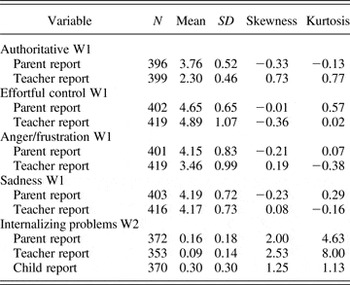
The means, standard deviations, skewness, and kurtosis for W1 parenting style and temperament, and W2 internalizing problems are presented in Table 1. We examined the correlations between the above variables and demographic variables. Child age was positively related to W1 teacher report of sadness and W2 teacher report of internalizing problems. Compared with boys, girls were rated as higher on W1 effortful control by both parents and teachers, lower on W1 anger/frustration by teachers, and lower on W2 internalizing problems by both parents and children. A composite index of family SES was calculated by first averaging maternal and paternal education levels, and then averaging the standardized scores of parental education and family income. Family SES was positively related to W1 authoritative parenting and negatively related to W1 authoritarian parenting. SES was also positively related to W1 child effortful control and negatively related to W2 child internalizing problems (for parents' reports only). Given the significant relations of age, gender, and SES to the predictor and outcome variables, these demographic variables were controlled for in the SEM analyses.
Means, standard deviations, skewness, and kurtosis for W1 and W2 variables

Note: W1, Wave 1; W2, Wave 2.
Correlations among parenting, child temperament, and internalizing problems
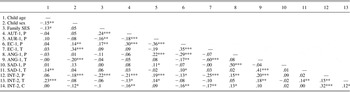
The zero-order correlations are presented in Table 2. Below we highlight the correlation results that are most relevant to our study hypotheses. First, significant and positive cross-reporter correlations were found between parent and teacher reports of effortful control at W1 and among parent, teacher, and child reports of internalizing problems at W2. By contrast, cross-reporter correlations for W1 anger/frustration and sadness were not significant. However, measures of anger/frustration and sadness were positively correlated to each other within reporter (rs = .41 to .50), suggesting consistency in the assessment of negative reactivity within reporter.
Zero-order correlations among variables
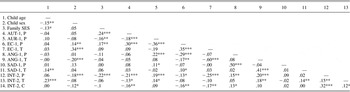
Note: Child sex: 0 = male, 1 = female; SES, socioeconomic status; AUT, authoritative parenting; AUR, authoritarian parenting; EC, effortful control; ANG, anger/frustration; SAD, sadness; INT, internalizing problems; P, parent report; T, teacher report; C, child report; 1, Wave 2; 2, Wave 2.
*p < .05. **p < .01. ***p < .001.
Second, measures of temperament and parenting were interrelated, although only within parent reports. For example, parent-reported effortful control was negatively related to authoritarian parenting and positively related to authoritative parenting. Both anger/frustration and sadness (parent report) were positively correlated with authoritarian parenting.
Third, significant cross-time and cross-reporter correlations were found in the expected directions between W1 parenting and child temperament and W2 internalizing problems. Specifically, authoritative parenting was negatively related to internalizing problems (for parent, teacher, and child reports). Authoritarian parenting was positively related to internalizing problems (parent and teacher reports). Effortful control (parent and teacher reports) was negatively related to internalizing problems (parent and child reports), whereas anger/frustration (parent and teacher reports) was positively related to internalizing problems (parent and teacher or child reports).
Testing the unique and interactive relations of parenting and temperament to internalizing problems: SEM
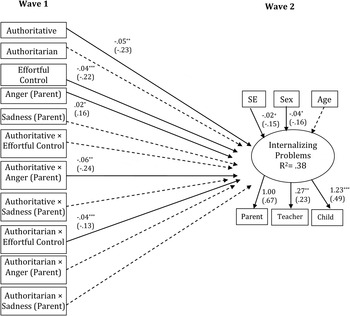
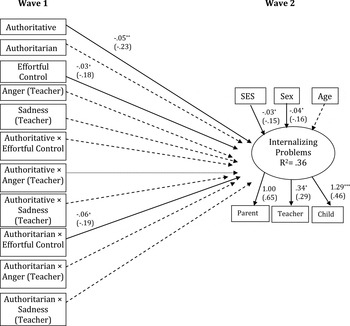
To examine the hypotheses that parenting and temperament uniquely and interactively predict children's internalizing problems, SEM was conducted. In the hypothesized models (Figure 1 and Figure 2), the latent factor of W2 internalizing problems was indicated by parent, teacher, and child reports. W2 internalizing problems was predicted by the following variables: (a) the covariates, including child age, sex, and family SES; (b) temperament variables, including anger/frustration, sadness, and effortful control; (c) authoritative and authoritarian parenting; and (d) the two-way interactions between temperament and parenting. Given that parents' and teachers' reports of W1 effortful control were positively correlated (r = .35), and to reduce the number of predictors in the model, an effortful control composite was formed by averaging the scores from parents' and teachers' reports and this composite was used in the subsequent SEM analyses. However, because cross-reporter correlations were nonsignficant for sadness and anger/frustration, two separate models were estimated by using parents' (Figure 1) and teachers' (Figure 2) ratings of negative reactivity. Predictors were mean centered prior to computing the interaction terms to minimize multicollinearity and to aid interpretation (Aiken & West, Reference Aiken and West1991).
The structural equation model predicting Wave 2 (W2) internalizing problems from Wave 1 (W1) parenting, temperament effortful control, and negative emotionality (parents' report), and their interactions. Solid lines indicate significant paths, and dotted lines indicate nonsignificant paths. The numbers above the parentheses are unstandardized loadings or path coefficients. The numbers inside the parentheses are standardized loadings or path coefficients. +p < .10. *p < .05. **p < .01. ***p < .001.

The structural equation model predicting Wave 2 (W2) internalizing problems from Wave 1 (W1) parenting, temperament effortful control, and negative emotionality (teachers' reports), and their interactions. Solid lines indicate significant paths, and dotted lines indicate nonsignificant paths. The numbers above the parentheses are unstandardized loadings or path coefficients. The numbers inside the parentheses are standardized loadings or path coefficients. +p < .10. *p < .05. **p < .01. ***p < .001.

The SEM analyses were performed using the maximum likelihood robust estimator in Mplus 5.2 (Muthén & Muthén, Reference Muthén and Muthén1998–2006), which corrects for nonnormality. Missing data were handled using the full information maximum likelihood estimation option. Because the children were clustered within school classrooms, we used the COMPLEX option, which takes into account the nonindependence of observations (Muthén & Muthén, Reference Muthén and Muthén1998–2006).
Model using parents' reports of negative reactivity
The model using parents' reports of anger/frustration and sadness (Figure 1) fit the data well, χ2 (df = 26, N = 425) = 31.2, p = .22, comparative fit index (CFI) = 0.96, root mean square error of approximation (RMSEA) = 0.02, standardized root mean square residual (SRMR) = 0.02. The model-estimated loadings for the indicators of internalizing problems were positive and significant, supporting the cross-informant convergence on the latent factor. Controlling for the covariates (child sex, age, and family SES), W1 authoritative parenting and effortful control negatively predicted, and W1 anger/frustration (parent report) positively predicted, W2 internalizing problems. Moreover, the two-way interactions of Authoritative Parenting × Anger/Frustration (parent) and Authoritarian Parenting × Effortful Control were significant.
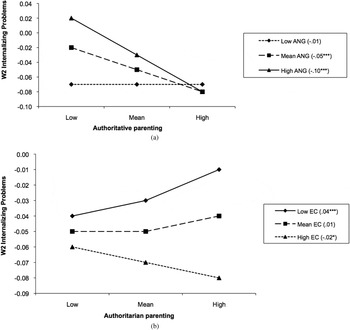
Following the procedures outlined by Aiken and West (Reference Aiken and West1991), simple slopes analyses were conducted to probe the two significant interactions (i.e., Authoritative Parenting × Anger/Frustration and Authoritarian Parenting × Effortful Control). In each simple slope analysis, the relations between parenting and internalizing problems were observed at three levels of temperament: mean level, 1 SD above the mean (“high”), and 1 SD below the mean (“low”), controlling for other predictors in the model. The criterion variable in the simple slopes analysis was the cross-reporter latent factor score for W2 internalizing problems estimated from the SEM. The interaction effect of Authoritative Parenting × Anger/Frustration was plotted in Figure 3a. Specifically, at high and mean levels of anger/frustration (parent report), authoritative parenting negatively predicted internalizing problems: unstandardized simple slopes = –0.10 and –0.05, ts (df = 313) = –9.8 and –8.0, ps < .001; at a low level of anger/frustration, authoritative parenting was unrelated to internalizing problems: unstandardized simple slope = –0.01, t (df = 313) = –0.72, p = .47. The interaction effect of Authoritarian Parenting × Effortful Control was plotted in Figure 2b. Specifically, at a low level of effortful control, authoritarian parenting positively predicted internalizing problems: simple slope = 0.04, t (df = 313) = 5.94, p < .01; at a mean level of effortful control, authoritarian parenting was unrelated to internalizing problems: simple slope = 0.01, t (df = 313) = 1.50, p = .13; at a high level of effortful control, authoritarian parenting negatively predicted internalizing problems: simple slope = –0.02, t (df = 313) = –1.99, p = .048.
Graphs of significant Parenting × Temperament interactions. ANG, anger/frustration; EC, effortful control. (a) The interaction between authoritative parenting and anger/frustration (parent report) in predicting W2 internalizing problems and (b) the interaction between authoritarian parenting and effortful control in predicting W2 internalizing problems. For both graphs, the criterion is the Wave 2 (W2) internalizing problem factor score estimated from structural equation models. The numbers in parentheses are unstandardized simple slopes.

Model using teachers' reports of negative reactivity
The model using teachers' reports of anger/frustration and sadness fit the data adequately (Figure 2), χ2 (df = 26, N = 425) = 34.0, p = .13, CFI = 0.93, RMSEA = 0.03, SRMR = 0.03. Controlling for the covariates, W1 authoritative parenting negatively predicted and W1 effortful control marginally and negatively predicted W2 internalizing problems. In addition, there was a marginally significant interaction of Authoritarian Parenting × Effortful Control.
The pattern of results obtained for the Authoritarian Parenting × Effortful Control interaction in the model using teachers' reports of negative emotionality was similar to that obtained for the model using parents' reports of negative emotionality (see Figure 3b). Simple slopes analyses showed that at low and mean levels of effortful control, authoritarian parenting positively predicted internalizing problems: simple slopes = 0.07 and 0.03, ts (df = 308) = 10.34 and 3.32, ps < .001 and .01; at a high level of effortful control, authoritarian parenting marginally and negatively predicted internalizing problems: simple slope = –0.01, t (df = 308) = –1.67, p = .10.
Testing for moderation by child sex
For both models tested in Figure 1 and Figure 2, we tested for the potential moderation by child sex using multiple-group SEM. In this approach, the baseline model was estimated simultaneously among boys and girls. Two types of models were compared: the model in which the path coefficients were constrained to be invariant across groups and the model in which the path coefficients were allowed to vary across groups. The chi-square difference test was used to determine whether the path coefficients differed significantly across groups. Results suggest that the paths did not vary by child sex.
Models controlling for concurrent externalizing problems
In order to examine the relations of parenting and temperament to “pure” internalizing problems (vs. co-occurring internalizing/externalizing problems), we conducted a second set of SEM analyses using the same predictors used in Figure 1 and Figure 2 and controlling for the latent factor W2 externalizing problems (indicated by parent, teacher, and child reports) as an additional predictor of W2 internalizing problems.
The model controlling for W2 externalizing problems using parents' reports of negative emotionality fit the data well, χ2 (df = 59, N = 425) = 85.7, p = .01, CFI = 0.96, RMSEA = 0.033, SRMR = 0.029. The model-estimated loadings for both W2 externalizing problems and W2 internalizing problems were positive and significant, supporting the cross-informant convergence on these latent factors. W2 externalizing problems had a significant and positive path on W2 internalizing problems (β = 0.67, p = .000). Controlling for W2 externalizing problems, authoritative parenting remained a unique and negative predictor of W2 internalizing problems (β = –0.15, p = .018). Moreover, the interactions of Authoritative Parenting × Anger/Frustration (parent report) and Authoritarian Parenting × Effortful Control remained significant (βs = –0.14 and –0.11, ps = .031 and .025).
The model controlling for W2 externalizing problems using teacher-reported negative emotionality fit the data adequately, χ2 (df = 59, N = 425) = 97.74, p = .001, CFI = 0.93, RMSEA = 0.039, SRMR = 0.036. After controlling for W2 externalizing problems, authoritative parenting remained as a significant and negative predictor of W2 internalizing problems (β = –0.14, p = .031). Moreover, the interaction of Authoritarian Parenting × Effortful Control remained as a marginally significant predicator of W2 internalizing problems (β = –0.18, p = .066).
In summary, when controlling for concurrent externalizing problems, the main effect of authoritative parenting and the interactive effects of Authoritative Parenting × Anger/Frustration (parent report) and Authoritarian Parenting × Effortful Control remained as significant predictors of W2 internalizing problems, whereas the main effects of W1 effortful control and anger/frustration (parent report) became nonsignificant.
The corresponding analyses predicting externalizing problems
Because in our previous paper focusing on predicting externalizing problems (Zhou et al., Reference Zhou, Wang, Deng, Eisenberg, Wolchik and Tein2008), the Temperament × Parenting interactions were not tested, we also ran the models in Figure 1 and Figure 2 with W2 externalizing problems as the criterion. Results indicated that W1 authoritarian parenting and W1 anger/frustration (both parent and teacher reports) positively predicted, and W1 effortful control negatively predicted, the latent factor of W2 externalizing problems. In addition, there was a significant interaction of Authoritative Parenting × Anger/Frustration (parent report). The pattern of interaction was similar to that found in predicting internalizing problems: at mean and high levels of anger/frustration, authoritative parenting negatively predicted externalizing problems, whereas at low level of anger/frustration, authoritative parenting was unrelated to externalizing problems.
Discussion
To our knowledge, this is the first longitudinal study to examine the additive and interactive relations of parenting style and temperament to internalizing problems in Chinese children. As such, it extends previous research on internalizing problems within this population, which has either utilized a cross-sectional design or has not simultaneously included parenting and temperament as predictors (Eisenberg et al., Reference Eisenberg, Ma, Chang, Zhou, West and Aiken2007; Eisenberg, Chang, et al., Reference Eisenberg, Valiente, Spinrad, Cumberland, Liew and Reiser2009; Liu et al., Reference Liu, Sun, Niederhiser, Uchiyama, Okawa and Rogan2001; Siu, Reference Siu2008; Zhou et al., Reference Zhou, Lengua and Wang2009). The most compelling findings of this study were the prospective and unique relations of authoritative parenting and temperament, and the interactive relations of Authoritarian Parenting × Effortful Control and Authoritative Parenting × Anger/Frustration, to internalizing problems. These relations were significant in the full structural equation model, which controlled for demographic variables (child age, sex, and family SES), two parenting dimensions (authoritative and authoritarian), multiple temperament dimensions (anger/frustration, sadness, and effortful control), and the Parenting × Temperament interactions. These findings did not vary by sex. Moreover, the unique prediction of internalizing problems by authoritative parenting and the two Parenting × Temperament interactions withstood control for externalizing problems, suggesting that these predictors explain unique variance in the internalizing cluster of symptoms and not merely internalizing problems that co-occur with externalizing problems.
Main effect of parenting and Parenting × Temperament interaction
Consistent with our hypothesis, Chinese children whose parents were high on authoritative parenting displayed fewer internalizing problems 4 years later than did their peers, suggesting that the benefits of authoritative parenting consistently observed in Western samples have some cross-cultural generalizability. Although the main effect of authoritarian parenting did not predict internalizing problems, the Authoritarian Parenting × Effortful Control interaction did. Specifically, for Chinese children with low levels of effortful control, authoritarian parenting predicted higher levels of internalizing problems 4 years later; for children with mean levels of effortful control, authoritarian parenting was unrelated to internalizing problems; and for children with high levels of effortful control, there was a tendency for authoritarian parenting to be negatively correlated with internalizing problems 4 years later. The Authoritarian Parenting × Effortful Control interaction is somewhat similar to results obtained in previous studies with European American samples, in which researchers found that children with difficult temperaments were more susceptible to the negative effects of aversive parenting than were children with easy temperaments (e.g., Morris et al., Reference Morris, Silk, Steinberg, Sessa, Avenevoli and Essex2002; Oldehinkel et al., Reference Oldehinkel, Veenstra, Ormel, de Winter and Verhust2006). It is possible that hostile, punitive, and rejecting discipline from parents evokes greater negative emotions, cognitions (e.g., rumination), and coping efforts (e.g., avoidance or venting) in children with poor self-regulatory capacities than in those with high self-regulation. These negative emotions, cognitions, and coping efforts may, in turn, elicit or aggravate children's internalizing symptoms. The negative association between authoritarian parenting and internalizing problems for children with high levels of effortful control was somewhat unexpected. Given that parental training of children's behaviors is highly valued in Chinese culture (Chao, Reference Chao1994; Chao & Tseng, Reference Chao and Tseng2002), however, it is possible that children with high self-regulatory skills might gain some benefits from authoritarian parenting (which is high on demandingness), such as higher academic performance, which can protect them from internalizing problems.
By contrast, the Authoritative Parenting × Anger/Frustration interaction showed a somewhat different pattern: children with high or mean (but not low) levels of temperament anger/frustration showed benefits from authoritative parenting. This interaction pattern is somewhat consistent with differential susceptibility or biological sensitivity to context theories (Belsky, Reference Belsky1997, Reference Belsky, Ellis and Bjorklund2005; Boyce & Ellis, Reference Boyce and Ellis2005). These theories extend the traditional diathesis–stress view to suggest that the same children who are most likely to be adversely affected by highly stressful environments, namely, highly reactive children, are also disproportionately more likely to benefit from supportive environments. However, in the present study, because the Authoritative Parenting × Anger/Frustration interaction was only significant in the model that included parents' (but not teachers') reports of temperament, it seems to be a less robust effect than the Authoritarian Parenting × Effortful Control interaction.
In examining Parenting × Temperament interactions, researchers have differed in their interpretation of results, with some treating temperament as moderating the effects of parenting and others treating parenting as moderating the effects of temperament. In this study, we chose to treat temperament as the moderator for two reasons. First, given that temperament is constitutionally based, it was conceptualized as operating temporally prior to parenting; second, views of temperament as a moderator of parenting are particularly useful for informing preventive efforts focused on parental sensitivity to children's dispositions in the choice of socialization techniques (Putnam et al., Reference Putnam, Sanson, Rothbart and Bornstein2002). In sum, our findings on Parenting × Temperament interactions are compatible with a small, but growing body of genetic research suggesting that individual differences in self-regulatory capacities, including effortful control, have a substantial heritable component (Goldsmith, Pollak, & Davidson, Reference Goldsmith, Pollak and Davidson2008) and that these underlying genes are likely to interact with environmental influences, including parenting (Kochanska, Philibert, & Barry, Reference Kochanska, Philibert and Barry2009; Voelker, Sheese, Rothbart, & Posner, Reference Voelker, Sheese, Rothbart and Posner2009).
Main effects of temperament
Higher levels of effortful control uniquely predicted fewer internalizing problems, but this finding did not withstand control for externalizing problems, suggesting that effortful control accounts for greater variance in co-occurring internalizing/externalizing problems than in internalizing problems per se. Eisenberg and colleagues similarly found a greater number of relations between aspects of effortful control and internalizing problems when children with co-occurring externalizing problems were included versus differentiated from children with “pure” internalizing problems (Eisenberg, Valiente, et al., Reference Eisenberg, Valiente, Spinrad, Cumberland, Liew and Reiser2009).
In the present sample, there were nonsignificant correlations between parents' and teachers' ratings of children's anger/frustration and sadness, and the alpha reliabilities of negative emotionality scales (especially parents' reports of sadness) were relatively low compared to measures of effortful control. Using similar measures, other researchers have also reported similar results in a longitudinal study of school-age children in North America (Eisenberg, Reference Eisenberg, Spinrad, Fabes, Reiser, Cumberland and Shepard2004; Eisenberg, Valiente, et al., Reference Eisenberg, Valiente, Spinrad, Cumberland, Liew and Reiser2009). Together, these findings suggest that the CBQ anger/frustration and sadness subscales might not be the most sensitive measures of negative emotionality in middle childhood. Compared to younger children, school-age children are better at masking their negative emotions, making it difficult for parents and teachers to observe these temperament traits reliably and consistently. Given these limitations, the relations between these negative reactivity variables and internalizing problems found in the present study, though in the hypothesized direction, were less robust. Specifically, parents' reports of anger/frustration uniquely and positively predicted internalizing problems, but teachers' reports of anger/frustration did not, which is probably because teachers' reports of anger/frustration were more strongly related to effortful control and thus had little unique relation to internalizing after controlling for effortful control. Parents' reports of anger/frustration became a nonsignificant predictor of W2 internalizing problems after controlling for concurrent externalizing problems, which is likely due to the covariation between anger/frustration and externalizing problems.
Neither parents' nor teachers' reports of sadness were unique predictors of internalizing problems. Although sadness in children has generally been understudied compared to other emotions, such as anger, shame, and fear (Zeman, Shipman, & Penza-Clyve, Reference Zeman, Shipman and Penza-Clive2001; for a review, see Lewis & Haviland, Reference Lewis and Haviland2000), in the few existing studies examining sadness in conjunction with internalizing, relations have not always been obtained, especially when different reporters provided information (Eisenberg, Sadovsky, et al., Reference Eisenberg, Sadovsky, Spinrad, Fabes, Losoya and Valiente2005; Zahn-Waxler et al., Reference Zahn-Waxler, Cole, Richardson, Friedman, Michel and Belouad1994). There are several possible reasons for this. First, children do not always express felt sadness, and this may be particularly true in the Chinese culture, wherein the outward expression of negative emotions is discouraged. Second, adults tend to differ considerably in their reports of sadness across settings (Eisenberg et al., Reference Eisenberg, Spinrad, Fabes, Reiser, Cumberland and Shepard2004; Goldsmith, Reiser-Danner, & Briggs, Reference Goldsmith, Rieser-Danner and Briggs1991). Third, sadness is only one aspect of internalizing problems, which also include shyness and social withdrawal, worry and anxiety, self-reproach, and somatic complaints.
It is worth noting that the sample means for both anger/frustration and sadness obtained from parents' reports were higher than those obtained from teachers' reports (and substantially so for anger/frustration). This may reflect the varying degrees to which negative emotions are acceptably expressed by children, and attended to by adults, across different contexts within the Chinese culture. Specifically, one would expect children to express anger/frustration more freely in their homes than in the large and highly structured Chinese classroom environment. Sadness is also more likely to be detected by Chinese parents, who typically have a single child, than by Chinese teachers, who are responsible for as many as 40 students at one time. In contrast, teachers' reports of anger/frustration and sadness had higher alpha reliabilities than those of parents' reports. Teachers were likely more consistent than parents in their responses to CBQ items because they provided ratings for multiple children (vs. parents who provided ratings for only one child).
Although the focus of the present paper was on predicting internalizing problems, we also performed the same set of analyses to predict externalizing problems. The results, which are consistent with what we reported in a previous paper (Zhou et al., Reference Zhou, Wang, Deng, Eisenberg, Wolchik and Tein2008), revealed that authoritarian parenting and anger/frustration uniquely predicted externalizing problems. This is in contrast to the findings that authoritative parenting and effortful control showed unique relations to internalizing problems. Thus, there appeared to be some specificity in the relations of parenting and temperament to children's externalizing and internalizing problems.
Strengths and limitations
The strengths of the study include its use of a longitudinal design, which provided a more stringent test of the relations of parenting and temperament to internalizing problems than that afforded by concurrent or cross-sectional studies. In addition, the use of multiple reporters of temperament (parent and teacher) and internalizing problems (parent, teacher, and child) minimizes concerns about subjectivity and shared method variance, and enables a more robust assessment of child variables by capturing them across different contexts.
This study also had several limitations. First, only questionnaire measures of temperament, parenting, and adjustment were collected across the 4 years of study, which raises the possibility that a different pattern of findings might have emerged with the use of multimethod assessments, including behavioral measures. Second, measures of internalizing problems were not collected at W1, and thus they could not be controlled for in the analyses. Nonetheless, anger/frustration and sadness were assessed at W1 and controlled for in the analyses. Third, Baumrind's (Reference Baumrind1967) typology of parenting styles also includes permissive parenting, and this dimension was not assessed in the present study. Thus, we could not examine the role of permissive parenting and its potential interaction with temperament in predicting Chinese children's adjustment. Fourth, because the study involved only Chinese children, cross-cultural similarities and differences were not explicitly examined. Fifth, because the present sample consisted of Chinese children from primarily working- to middle-class families in an industrialized metropolitan area, the results may not generalize to Chinese children from less developed rural areas. Specifically, education, income, and the relative sway of Confucian versus Western values may differ substantively between urban and rural contexts, influencing the extent to which different parenting styles and child behaviors are considered normative (Chauhan, Reference Chauhan1980; Li et al., Reference Li, Liu, Liu, Gui, Anme and Ushijima2000). Sixth, because the study used a school-based sample of children with a low prevalence rate of internalizing problems, these findings may not generalize to clinical populations in China. Seventh and finally, the low correlation between parents' and teachers' ratings of negative emotionality might be improved by having parents and teachers respond to somewhat different items because they might more comprehensively capture manifestations of children's negative emotionality in different settings (home vs. school).
In sum, the results of this study indicate that parenting and temperament operate additively and interactively to predict internalizing problems in Chinese children. Given evidence that undetected internalizing problems in middle childhood can intensify over time and develop into psychiatric conditions, such as depression and anxiety (Seligman & Ollendick, Reference Seligman and Ollendick1998), the risk and resilience factors identified in the present study may represent key targets for early intervention. Active prevention efforts may be particularly important in Chinese culture because of early academic pressures and display rules that encourage children to hide, mask, or suppress their negative emotions. Strategies aimed at enhancing authoritative and reducing authoritarian styles of parenting, as well as identifying children with poor effortful control for interventions that improve emotional self-awareness and foster self-regulation, may serve to promote adaptive outcomes during the transition to adolescence.