Introduction
Head and neck squamous cell carcinoma (SCC) is the sixth most common malignancy globally. For some subsites, such as the oral cavity and oropharynx, the incidence is on the rise, and patients are developing cancer at a younger age.Reference Chaturvedi, Anderson, Lortet-Tieulent, Curado, Ferlay and Franceschi1 At the same time, treatment techniques are improving meaning more patients survive, and more resources are needed for follow-up and survivorship issues.
Follow up of patients with head and neck SCC is important. Even stage I diseases recur, and among patients with locally advanced disease, more than 50 per cent develop locoregional or distant relapses.Reference Argiris, Karamouzis, Raben and Ferris2 Field cancerisation of the upper aerodigestive tract is the hallmark of head and neck SCC, and it contributes to a high risk of recurrent disease and also second primary cancers in this mucosal area.Reference Leemans, Braakhuis and Brakenhoff3 For recurrent disease, salvage surgery is considered the optimal treatment whenever possible; therefore, it is important to detect relapses early.
The American Society for Head and Neck Surgery and the Society of Head and Neck Surgery have published guidelines for follow-up protocol of patients with head and neck cancer.Reference Paniello, Virgo, Johnson, Clemente and Johnson4 These mandate that clinical follow up should: last a minimum of five years; be done every one to three months during the first year; every two to four months during the second year; every three to six months during the third year; every four to six months during the fourth and fifth years; and be done annually thereafter. The British Association of Head and Neck Oncologists has published a guideline that patients should be followed up for a minimum of five years with prolonged follow up for selected patients.Reference Simo, Homer, Clarke, Mackenzie, Paleri and Pracy5 The five-year follow-up period with variable intervals is routinely used in many clinics around Europe. Although widely accepted, the cost-effectiveness of this rigid protocol and the benefit for the patient are disputable. For this reason, using our patient population, we decided to investigate the rationale behind our present follow-up protocol, simply by analysing when and how the relapses were diagnosed and what the outcome was after detection of recurrent disease. We looked at the effectiveness of scheduled follow-up visits, the proportion of patient- versus physician-detected recurrences and how effective our salvage treatment was under these different scenarios.
Materials and methods
Study population
Clinical data were collected retrospectively for all patients diagnosed with new malignant disease of the head and neck during a 10-year time period (1999–2008) at the Department of Otorhinolaryngology – Head and Neck Surgery, Turku University Hospital, Finland. This is a tertiary care academic centre with a catchment area of about 750 000 residents.
Patients were selected using the search criteria for panendoscopy, which is a routine examination for every patient with new mucosal head and neck malignancy. Relapse was defined as a local recurrence, a regional or distant metastasis, or a second primary tumour. Histologically, only SCCs were included. Residual tumours were excluded, and all recurrences within three months after treatment were classified as residual tumours. Recurrences after five years were classified as new primary cancers and were excluded. Patients with previously treated malignancy of the head and neck were also excluded, even if the treatment was completed more than five years previously. Recurrence during unfinished primary treatment, tumours of the skin and lips, salivary gland tumours, changes in histological classification to non-SCC, incomplete data, or patient dropout from follow up were also exclusion criteria. Second or third recurrences were considered as a separate group, because it can be assumed that second or third recurrent disease is detected more easily by the patient.
Patients were divided into three groups based on the method of relapse detection. The first group comprised patients whose tumour was asymptomatic and discovered during a routine follow-up visit. The second group comprised patients who had reported symptoms at the routine follow-up visit. The third group was made up of patients who had contacted the hospital between routine follow-up visits because of emerging symptoms. Further, we analysed the location of the recurrent tumour and the method by which it had been exposed (physical examination, endoscopy or radiological imaging).
Treatment and follow-up schedule
The treatment was determined by a multidisciplinary head and neck tumour board with the patient present. A trained head and neck oncology nurse discussed the treatment plan with the patient again after the meeting, taking into account the patient's mental and physical condition. Treatment modalities were operating, radiation therapy, chemotherapy or a combination of these.
After definitive therapy, the patient's follow-up plan was adapted from the American Society for Head and Neck Surgery and the Society of Head and Neck Surgery guidelines as explained above. Typically, the surgeon in charge of the operation saw the patient on a predetermined schedule; in brief, every three months during the first year, every four months during the second year and every six months from the third to the fifth years.
However, patients were encouraged to contact the hospital if they experienced pain, any lumps, bleeding or other unusual symptoms in the head and neck area. In cases of suspected recurrent tumour, a biopsy specimen was obtained for histological analysis, and in cases with a suspicious palpable mass in the neck, fine needle aspiration biopsy was performed.
There was no systematic radiological imaging during the follow-up period, and the decision to image was made by the attending surgeon. Standard options were computed tomography (CT), magnetic resonance imaging (MRI), positron emission tomography (PET)-CT or chest X-ray. In cases of recurrent tumour, metastasis or a second primary tumour, the routine follow-up procedure started from scratch following treatment of the recurrence.
Analysis
The Pearson chi-square test was used to compare the proportions of symptomatic and asymptomatic outcomes. Fisher's exact test was used to calculate the correlation of the tumour identification method related to time. The level of statistical significance was set at p < 0.05. The material was compiled in Microsoft Excel® spreadsheet software, and analyses were performed with SAS® JMP statistical software (version 12.1).
Results
During the study period, a total of 456 patients were diagnosed with new malignancy in the head and neck area (233 in the oral cavity, 60 in the oropharynx, 21 in the hypopharynx, 98 in the larynx, 10 in the nasopharynx, 15 in the sinonasal area, 11 in the salivary glands and 8 unknown primary malignancies). Of these, 425 were treated with curative intent, and 23 were treated in palliative care. Data were missing for eight patients. The total number of suspected recurrent malignancies was 197 in 140 patients. After elimination based on the set exclusion criteria, the number of first relapses was 94 (Figure 1).
Flow-chart showing patient inclusion. SCC = squamous cell carcinoma

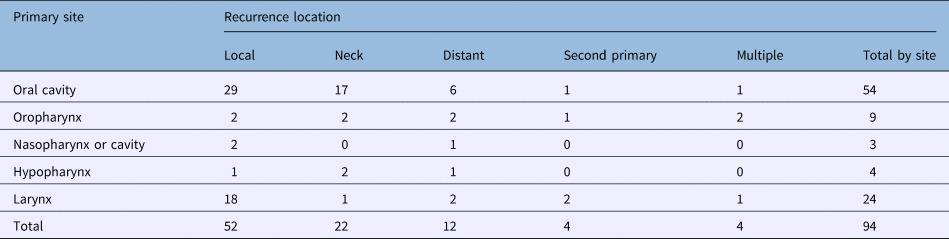
Of the 94 patients with recurrent disease: 52 (55 per cent) had recurrence at the primary site; 22 (23 per cent) had metastatic lymph nodes in the neck; and distant metastases were detected in 12 (13 per cent). Four (4 per cent) patients had a second primary cancer. Simultaneous recurrences at two or more sites were found in four (4 per cent) patients. The most common sites of local recurrence were the oral cavity and larynx. Metastases in the neck were most often found in patients whose primary site for the cancer was the oral cavity (Table 1).
Site of primary disease and tumour recurrence location

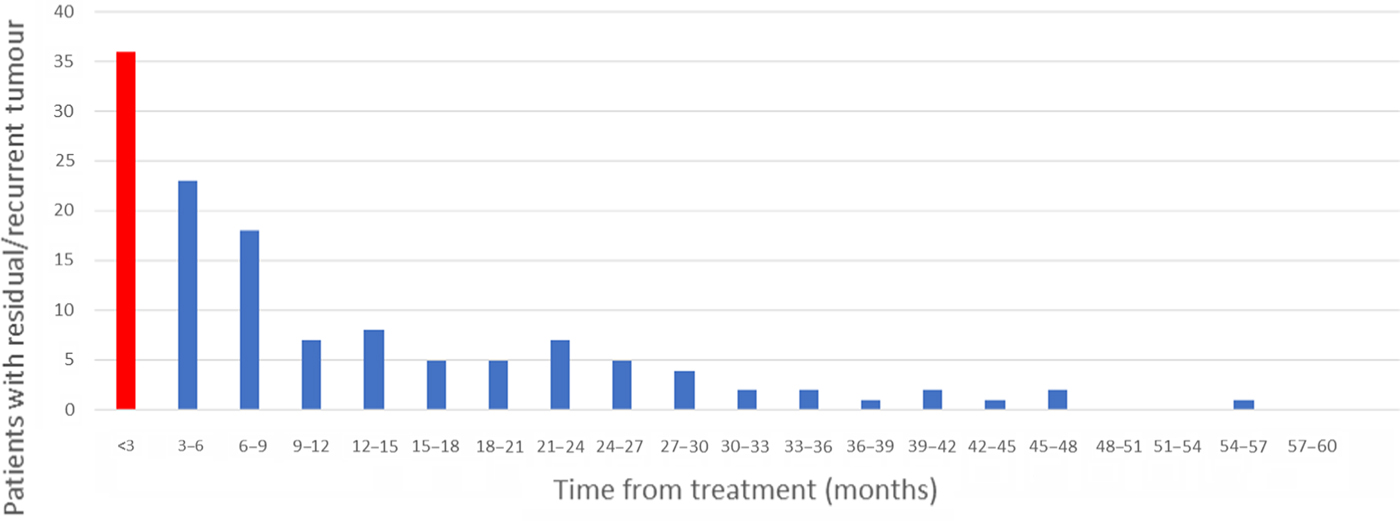
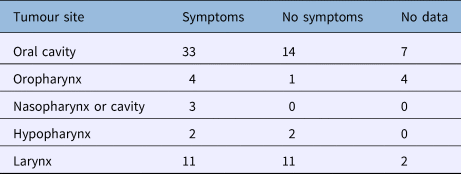
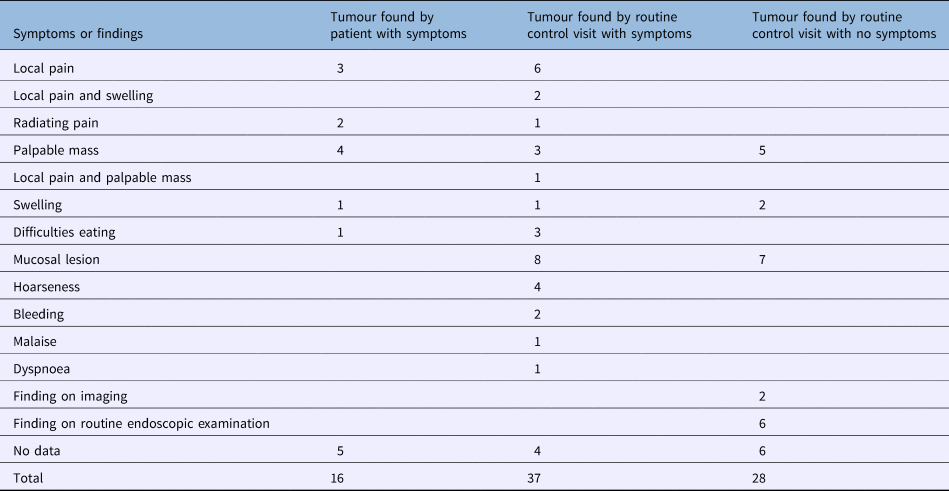
Sixteen (17 per cent) of the recurrences were reported by patients during extra follow-up visits, and 37 (39 per cent) recurrences were found in symptomatic patients during scheduled control visits. Only 28 (30 per cent) were found by routine follow-up without symptoms. In 13 patients (14 per cent), data on symptoms were insufficient to determine their relationship to the detection of recurrent disease (Table 2). Notably, 90 per cent of recurrences were found within 36 months (3 years) and 95 per cent within 42 months (3.5 years) after treatment (Figure 2). Second, all recurrent tumours found on routine follow up without symptoms were detected within 34 months after completion of treatment. There was no significant difference in time from treatment to manifestation of recurrent disease between these three patient groups (i.e. patients with no symptoms, patients with symptoms at routine visits or patients with extra follow-up visits) (p = 0.52). The symptoms reported by patients are listed in Table 3.
Graph showing number of diagnosed recurrences vs time after treatment. Note that the first column (red) represents cases classified as residual tumours because they were diagnosed less than three months after treatment.

Relationship between tumour sites and symptoms

Symptoms or findings on physical examination or imaging leading to diagnosis of recurrent tumour

Note that patients with tumours detected with imaging or endoscopy did not have suspicion of recurrence
Of the 94 patients with recurrence, 74 underwent imaging (mostly CT or MRI but also PET-CT) as part of the diagnostic analysis because recurrence was suspected. Recurrences were found or confirmed by imaging in 9 of 13 recurrences without any symptoms, and in 51 of 65 recurrences with symptoms or known recurrent tumours. In 18 cases, the tumour was not seen on imaging or there were only non-specific findings. In 14 of 65 symptom-related cases, the diagnosis of recurrent tumour was clear before imaging, and the purpose of the imaging was to define the stage of disease.
Patients with laryngeal or hypopharyngeal carcinoma had a distinct follow-up protocol that is not applied for other tumour locations. The follow-up time schedule was similar, but instead of office visits, the patients were seen in the operating theatre when arriving for endoscopic examination. In this group, 11 cases of recurrent disease were detected in asymptomatic patients. Of these, six were found on routine examination and five were found when the surgeon had a clinical suspicion of relapse. Eight of these 11 cases were laryngeal carcinomas.
Of the 94 recurrent cases, 64 were treated with curative intent: 41 patients were operated on, 3 had chemoradiation and 20 were treated with a combination of surgery and chemoradiation. In 12 patients, the curative intent proved unsuccessful during treatment. Four patients were found to have residual tumours after second-line treatment, and 26 had a new relapse during the 5-year follow up after treatment of the recurrent tumour. Treatment was curative in 22 of the 64 patients (34 per cent).
If the patient contacted the hospital between scheduled control visits, the survival rate was 13 per cent (2 of 15). If the patient had symptoms upon routine control visit, the survival rate was 29 per cent (11 of 38) and if the recurrence was found during a routine control visit without symptoms, the survival rate was 29 per cent (8 of 28). In the group where the method of finding the tumour could not be identified from the patient history, the survival was 8 per cent (1 of 13).
Discussion
As the number of human papilloma virus (HPV)-related oropharyngeal carcinoma cases continues to rise while the number of tobacco smokers drops, advancing treatment methods mean that in the future we will be facing more and younger survivors among patients with head and neck carcinoma.Reference Hussein, Helder, de Visscher, Leemans, Braakhuis and de Vet6 Thus, the importance of optimising resources for cancer patient follow up after treatment should not be underrated.
Traditionally, follow up has started with control visits every one to three months with increasing intervals up to five years, and many guidelines recommend yearly control visits beyond that timeframe. Yet the intensity of follow up is not related to survival, and the optimal interval remains an open question.Reference Roman, Goldenberg and Givi7,Reference Brennan, Hall, Owen, Griffiths and Peng8 As knowledge of the disease has advanced, more tailored follow-up protocols have been discussed, according to HPV status or the subsite of the cancer, for example.Reference Denaro, Merlano and Russi9 Although changes in protocol may hinder comparability to older studies and statistics, it is a fading issue. A fundamental aspect is quality of life, which can change drastically even after five years of follow up. It is essential to keep the door open so that patients can make contact beyond the official follow-up period if needed. In this study, we have analysed our own unselected patient population from 1999 to 2008, when systematic imaging was not included in the protocol and the schema was very rigid.
In our population of 456 patients with head and neck malignancy, 425 were treated with curative intent. We found that 36 patients had a residual tumour after treatment and 94 relapsed within 5 years of follow up. This gives 69 per cent disease-free survival and indicates that our treatment results are at a good international level.Reference Gatta, Botta, Sánchez, Anderson, Pierannunzio and Licitra10 Of the 94 disease relapses, 28 (30 per cent) were discovered on a routine control visit without any symptoms reported by the patient. However, in most cases the patient either reported symptoms at the control visit (39 per cent) or attended an unplanned extra visit because of symptoms (17 per cent). These findings emphasise the active and important role of the patient and are consistent with earlier studies on the same topic.Reference Flynn, Khaouam, Gardner, Higgins, Enepekides and Balogh11–Reference Boysen, Zätterström and Evensen13
More than two decades ago, de Visscher and Manni reported that 90 per cent of head and neck cancer recurrences were found within three years after completion of treatment, and that after three years of follow up, most of the diagnosed cancers were second primary cancers.Reference de Visscher and Manni12 This was also the case in our study: 90 per cent of recurrent diseases were found within 36 months, and nearly all (95 per cent) within 42 months following initial treatment. In particular, every recurrent tumour found by routine follow up without symptoms was detected within 34 months after completion of treatment. Only eight recurrent tumours were found after three years (6 per cent of recurrences and 2 per cent of the whole patient population), and all of these patients had symptoms.
Even though there was no statistical difference in the occurrence time of recurrent disease between the groups (symptoms vs no symptoms), there was a discernible trend, with asymptomatic recurrences being found on average 13 months after treatment and symptomatic recurrences being found on average 16 months after treatment. This is understandable given that in the beginning, possible symptoms caused by recurrent disease are impossible to discern from those caused by the healing process involving scar formation and function restoration in the head and neck area. Later on, when the situation is stable and patients are more familiar with the disease, it is easier for them to notice anything suspicious. In this regard, one can speculate on how useful scheduled follow-up visits are after three years, and whether this resource could be used more effectively. Our proposal for three-year follow up is outlined in Figure 3. This reduction of automatic follow-up visits beyond three years has been suggested by others as well.Reference Ritoe, de Vegt, Scheike, Krabbe, Kaanders and van den Hoogen14–Reference Gilbert, Devries-Aboud, Winquist, Waldron and McQuestion17
Timeline showing proposed follow-up schedule post-treatment: first year every third month, second year every fourth month and third year every sixth months. Shortened control intervals were used in specific cases, such as when there were uncertain margins and when guideline-concordant therapy could not be given, for example. After three years, patients would be allowed to get in touch any time there are symptoms. Mo = months

De Visscher and Manni found that the survival rate for patients with recurrent tumour found at routine visits was almost twice as good as when found at unscheduled visits based on new symptoms.Reference de Visscher and Manni12 On the other hand, Boysen et al. reported a better outcome after salvage therapy among oral cavity cancer and larynx cancer patients with self-reported symptoms.Reference Boysen, Zätterström and Evensen13
In our study, the outcome was marginally better if the recurrence was found upon routine control without symptoms (40 per cent). If patients had symptoms, the survival was 33 per cent after treatment of recurrent disease (p = 0.61). This is understandable, as tumours in the early stages do not necessarily cause symptoms, and salvage surgery is easier and gives better results when the volume of recurrent disease is smaller. As the probability of recurrent disease and the frequency of scheduled control visits lessen over time, it is important to remind patients of easy access to extra control visits when necessary.
In this patient population, radiological imaging was an efficient method for confirming suspicion of recurrent disease. The role of imaging in diagnosing otherwise non-detectable recurrent diseases remains unclear, as there were no routine imaging protocols in use during that time. Decisions were made by the attending surgeon in cases of suspected recurrence or symptoms. Our present protocol is surveillance with PET-CT for patients with head and neck carcinoma three months after major reconstructive surgery, or definitive or post-operative chemoradiation therapy.Reference Mehanna, Wong and Dunn18 Thereafter, any imaging is still done only when recurrent disease is suspected.
This study has all the limitations of a retrospective study, including some missing data on patient-reported symptoms when recurrent disease was detected. However, this population represents a real-world unselected head and neck cancer patient cohort of 10 years and thus gives a realistic overview of contemporary clinical practice. Our results challenge the efficacy of our present follow-up system and raise important questions. Could we give more freedom and responsibility to the patients? At the start of the follow-up period, physical and psychological rehabilitation both play an important role in the follow-up visits, but as the patient's condition stabilises and the risk of recurrent disease drops, could it be even more beneficial to let the patient contact the hospital if (s)he has problems or symptoms?
• Twenty-two per cent of head and neck squamocellular cancer patients relapsed during five-year follow up
• Ninety per cent of recurrences were found within three years
• All recurrent tumours without any patient-reported symptoms were found within 34 months after completion of treatment
• Routine follow up beyond three years is questionable
With three years of routine control visits and good instructions from the follow-up surgeon, patients would gradually learn to monitor their status and symptoms themselves. After recovery from pain and other disadvantages of treatments, it is easier for them to recognise new symptoms. Many patients report that follow-up visits are stressful and a reminder of the disease, even if everything is otherwise going well. It may even be that patients with symptoms postpone reporting them until the scheduled visit, which may cause a diagnostic delay of weeks or even months. Electronic patient-reported outcome has been tested in a cancer patient population during treatment, with encouraging results.Reference Basch, Deal, Dueck, Scher, Kris and Hudis19 Perhaps combining this type of technique with follow up would create a more effective and patient-friendly setup for cancer patient surveillance in the future.
Conclusion
In conclusion, despite several recommendations, there is no common consensus on the post-therapeutic surveillance of patients with head and neck cancer. Obviously, in the early stages of follow up, the need for rehabilitation plays an important role in addition to cancer control, but with time, the significance of scheduled routine control visits diminishes.
According to our patient data spanning a decade, the rationale for routine controls beyond three years after treatment is questionable, with only 2 per cent of patients having experienced a recurrence beyond this point. Furthermore, all of these late recurring patients were symptomatic, raising the prospect that easy access to extra follow-up visits when symptoms occur could well cover this need. Finally, comprehensive patient counselling and electronic patient-reported outcome platforms may well help and guide the need for targeted follow-up visits in the future.
Acknowledgements
This work was supported by the Kirsti and Tor Johansson Heart and Cancer Foundation and a grant by Merck KGaA, Darmstadt, Germany.
Competing interests
None declared