Introduction
Around 12,000 people of working age have a stroke in Australia each year (Hackett, Glozier, Jan, & Lindley, Reference Hackett, Glozier, Jan and Lindley2009) and, reportedly, this incidence will increase as the retirement age in Australia is raised to 67 years by 2023 (Australian Government Department of Human Services, 2012). Research has shown that returning to work is an important issue for people with stroke, due to financial concerns and the need to feel useful and productive (Vestling, Ramel, & Iwarsson, Reference Vestling, Ramel and Iwarsson2005). Therefore, it is essential that we understand the current paths used by people to return to work and the experiences of each path. For the purposes of this study, paths are defined as methods, services or processes (such as vocational rehabilitation or collaboration with a workplace rehabilitation co-ordinator) used by people with stroke in an attempt to return to work.
Incidence Rates for Return to Work after Stroke
Despite the quantity of research regarding return-to-work rates after stroke, facets of the return-to-work process and outcomes remain poorly understood. A recent American study found that approximately 63% of working age (30–65 years) people with stroke (n = 98) returned to work within 6 months after their stroke (O'Brien & Wolf, Reference O'Brien and Wolf2010). A systematic review including 70 studies established that rates of return to work ranged from 0 to 100% (Daniel, Wolfe, Busch, & McKevitt, Reference Daniel, Wolfe, Busch and McKevitt2009), while a previous review including 16 studies found return-to-work rates ranging from 19 to 73% (Treger, Shames, Giaquinto, & Ring, Reference Treger, Shames, Giaquinto and Ring2007). The wide range of incidence rates reported in studies are largely due to differing study parameters, such as culture, the availability of disability pensions within different countries, the inconsistent definitions of ‘work’ adopted (paid/unpaid) and the varying characteristics of people with stroke included in the studies (e.g., those deemed to be of working age or only those working immediately prior to their stroke) (Treger et al., Reference Treger, Shames, Giaquinto and Ring2007). The variations in return- to-work rates also suggest that there are potentially many factors that influence a person's ability to return to work successfully.
Factors Influencing Return to Work
A number of cohort studies have investigated the characteristics predictive of return to work following stroke. Several studies have suggested that a person's walking/running ability following stroke is the most meaningful predictor of successful return to work, while another study indicated that independence in activities of daily living (ADLs) may be a stronger predictor of return to work (Lindström, Röding, & Sundelin, Reference Lindström, Röding and Sundelin2009; Saeki & Toyonaga, Reference Saeki and Toyonaga2010; Vestling, Tufvesson, & Iwarsson, Reference Vestling, Tufvesson and Iwarsson2003). Conflicting findings have been documented regarding type of work as a predictor of return to work. Vestling et al. (Reference Vestling, Tufvesson and Iwarsson2003) proposed that being a white-collar worker was a significant predictor of return to work; however, Lindström et al. (Reference Lindström, Röding and Sundelin2009) indicated that type of work did not predict the success of return to work. Both of these studies were conducted in Sweden; however, the study by Lindström et al. had a larger sample size, including 1068 people who responded to a national survey. Lindström et al. (Reference Lindström, Röding and Sundelin2009) also described high socio-economic status and education level as positive predictors of return to work, and suggested that being self-employed may also be beneficial. People who had an optimistic view of the return-to-work process and recognised their limitations were more likely to experience a successful transition into the workplace (Culler, Wang, Byers, & Trierweiler, Reference Culler, Wang, Byers and Trierweiler2011; Lindström et al., Reference Lindström, Röding and Sundelin2009).
Residual disabilities are frequently reported as negatively impacting return to work status and experience (Alaszewski, Alaszewski, Potter, & Penhale, Reference Alaszewski, Alaszewski, Potter and Penhale2007; Corr & Wilmer, Reference Corr and Wilmer2003; Gustafsson & Turpin, Reference Gustafsson and Turpin2012; Lock, Jordan, Bryan, & Maxim, Reference Lock, Jordan, Bryan and Maxim2005). Residual disabilities can include physical impairments (weakness, fatigue, pain and mobility issues), difficulties understanding/expressing language (aphasia) and cognitive perceptual issues affecting memory, decision making and organisational skills (Corr & Wilmer, Reference Corr and Wilmer2003; Gustafsson & Turpin, Reference Gustafsson and Turpin2012; Koch, Egbert, Coeling, & Ayers, Reference Koch, Egbert, Coeling and Ayers2005; Lock et al., Reference Lock, Jordan, Bryan and Maxim2005). A qualitative analysis of one person's experiences of return to work after stroke highlighted that fatigue, along with other unseen cognitive impairments, had the greatest impact upon the perceived need for adjustments in the workplace (Gustafsson & Turpin, Reference Gustafsson and Turpin2012). This qualitative study highlighted the importance of including a person's experience of return to work, including perceived satisfaction, within any evaluation of return to work outcomes. Workplace discrimination, an unsupportive employer, inflexibility, and a lack of support services and information all contribute to a negative experience, indicating the need for a clear understanding of these issues and the development of suitable supports and processes to facilitate return to work (Corr & Wilmer, Reference Corr and Wilmer2003; Gilworth, Sansam, & Kent, Reference Gilworth, Sansam and Kent2009; Gustafsson & Turpin, Reference Gustafsson and Turpin2012; Morris, Reference Morris2011; Wolfenden & Grace, Reference Wolfenden and Grace2009).
Paths to Enable Return to Work
There is a lack of research, particularly in Australia, focusing directly on the paths utilised by people with stroke when returning to work; however, international studies have provided some preliminary insights. A qualitative study by Culler et al. (Reference Culler, Wang, Byers and Trierweiler2011) found that people who were given the opportunity to collaborate with a previous employer were supported to return to work, particularly when workplace modifications (relating to equipment and altering tasks) were negotiated. Vocational rehabilitation counselling may facilitate return to work by providing important information to the person with stroke and assisting collaboration with employers (Hartke, Trierweiler, & Bode, Reference Hartke, Trierweiler and Bode2011). However, there is some research to suggest that not all people with stroke receive assistance, due to the unavailability of services (such as vocational rehabilitation) or lack of knowledge regarding the available paths (Hartke et al., Reference Hartke, Trierweiler and Bode2011; Medin, Barajas, & Ekberg, Reference Medin, Barajas and Ekberg2006; Radford & Walker, Reference Radford and Walker2008; Sinclair, Radford, Grant, & Terry, Reference Sinclair, Radford, Grant and Terry2013).
Supporting factors for return to work and changes made to working habits after stroke have been briefly mentioned in several qualitative studies. Support mechanisms, such as a graduated return to work or a suitable duties programme, have been found to be effective in assisting people with stroke in the return-to-work process (Corr & Wilmer, Reference Corr and Wilmer2003; Gilworth et al., Reference Gilworth, Sansam and Kent2009; Koch et al., Reference Koch, Egbert, Coeling and Ayers2005). Several qualitative studies established that there was a link between information provision, emotional support (from health professionals, employers, family and friends) and returning to work (Culler et al., Reference Culler, Wang, Byers and Trierweiler2011; Gilworth et al., Reference Gilworth, Sansam and Kent2009; Koch et al., Reference Koch, Egbert, Coeling and Ayers2005). While these studies describe similar results, it is apparent that more research is required to draw adequate conclusions regarding the changes to work habits that will best support return to work.
Australian Context
At the time of this study in Australia, the Federal government provided Disability Employment Services, designed to support people who have a disability, injury or health condition that impacts upon their ability to find and retain employment (Department of Human Services, 2013). Services were dependent on eligibility, which was assessed on a case-by-case basis through Centrelink and, in most cases, required that the person received a Centrelink benefit. Centrelink is a government department in Australia that provides financial welfare support to Australian citizens. When a person was found to be eligible for assistance, he or she received services through a Disability Employment Services Provider, such as Commonwealth Rehabilitation Services (CRS Australia). Disability Employment Services providers offer a variety of services, including pre-work skills training, assistance in searching for a job (including support for completing a resumé and preparing for interviews), vocational training, workplace modifications and continued assistance once a person has started a job (Department of Human Services, 2013). Private vocational rehabilitation providers were also available to those people with stroke who had the means to self-fund.
Current Study
Given the limited research, the first aim of this study was to identify the paths used by working-aged people in Australia to return to work after stroke. The additional aims were to identify the problems commonly reported to impact upon working performance, and changes that were made to working routines following stroke. Finally, satisfaction before and after the stroke were examined to gain preliminary insights into the individuals’ perceived satisfaction with changes to work after a stroke.
Methods
This study was a descriptive, retrospective study, with ethical clearance obtained from the Behavioural and Social Sciences Ethical Review Committee (BSSERC) at The University of Queensland.
Participants
This study sought to include participants from around Australia and recruitment occurred via advertising in state and national-based newsletters, online forums and support groups for people with stroke. People were invited to participate in the study if they were of working age (18 years and above), had experienced a first-time cerebral vascular accident (stroke), were employed in paid work (full-time or part-time employment) at the time of the stroke, had returned to work after the stroke and were able to complete the study questionnaire. Participants were excluded from participating if they were not employed in paid work immediately prior to their stroke, were employed in work that was not paid (e.g., volunteer work), had not returned to work after stroke or had experienced a transient ischaemic attack (TIA). A total of 21 participants completed the questionnaire and the average age of participants was 48 years (SD 15.3, range 22–83 years). Seven (33%) participants were male and 14 (67%) were female. The majority of participants had a university degree (n = 15; 71.5%). The remaining participants had trade or vocational training (n = 2; 9.5%), year 12 (n = 2; 9.5%) or year 10 (n = 2; 9.5%) as their highest level of education. Participants’ average age at time of stroke was 43 years (SD 13.9, range: 21–78 years).
Questionnaire
Participants completed a purpose-designed questionnaire regarding their return-to-work experiences. The questionnaire was developed to elicit stroke-related demographics and to gather information from participants that has been highlighted as important from previous literature regarding return to work. The satisfaction questions were developed for the purposes of this study. The questionnaire was piloted with five health professionals and minor wording changes were made to the final questionnaire. The demographic data collected from participants included age, gender, highest level of education and whether they had expressive or receptive aphasia. Participants reported their age at time of stroke and length of stay in hospital. They also gave information on the amount of assistance required to perform everyday living activities (such as personal care activities, household chores, etc.) after stroke. Participants provided details of their pre- and post-stroke employment, including length of time in the job, number of working hours per week, and occupation as categorised using the Australian and New Zealand Standard Classification of Occupations (ANZSCO) (Australian Bureau of Statistics, 2009).
With respect to returning to work, participants indicated the timeframe between hospital discharge and work commencement, any services or supports that were accessed, and identified if, and how often, common impairments after stroke impacted their working performance. Participants were asked to indicate changes that were made to working habits following stroke via a provided list where multiple items could be chosen. The list included the following items: reduced work hours, fewer work tasks, different work tasks, different job, assistive equipment or devices, changes to the way work tasks are performed, physical or structural changes to the workplace. Participants were also invited to provide any additional changes that had occurred with an ‘other’ option. Participants also rated their pre- and post-stroke job satisfaction based on statements relating to job suitability (financially, physically and cognitively), support from supervisors and co-workers, and opportunities for improvement or further advancement. They indicated their level of agreement or disagreement with these statements, as well as one additional statement regarding work after stroke (I feel that my return to work has been successful), on a five-point Likert scale.
Procedure
Participants responding to the advertisements were e-mailed the participant information sheet and links to the online survey or, when requested, were sent hard copies of the study's documents with a postage-paid reply envelope. Participants completing a hard copy of the questionnaire were required to complete a consent form. Participants completing the online survey agreed that submission of the survey implied informed consent. All questionnaires were completed with no identifying information.
Data Analysis
Responses to items in the questionnaire were converted into numerical data where appropriate (e.g., responses coded on a scale from 1 to 5). The quantitative data were initially analysed descriptively (using the STATA 11 statistical package) to identify trends through tables and graphs. Descriptive statistics were calculated where appropriate to summarise the data. The Wilcoxon signed-rank test was used to determine whether statistically significant differences existed between the medians of the pre- and post-stroke job satisfaction statements (e.g., I earn enough money from this job to support my lifestyle, ranked from 1 (Strongly Disagree) to 5 (Strongly Agree)). The results were then tabulated. No further exploration of relationships or correlations between the data was conducted, due to the small sample size.
Results
Stroke-related Characteristics
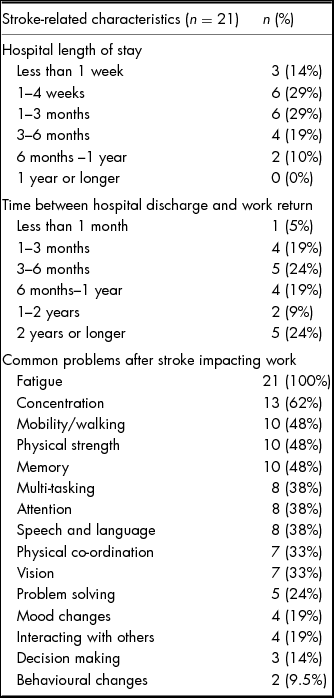
Table 1 outlines the stroke-related characteristics of the participants. Participants were commonly in hospital between 1 week and 3 months (n = 16). They were likely to be independent (or only require minimal assistance from others) in the majority of ADLs, with two requiring more assistance for mobility and communication; three requiring more assistance for basic self-care, community access and mobility; and five indicating that more assistance was required for domestic chores. All participants reported fatigue as a common problem impacting on their working performance following stroke. Concentration, mobility/walking, physical strength and memory were also indicated as a common issue by the participants. Only one participant reported having expressive aphasia.
Stroke-related Characteristics of Participants

Half of the participants (n = 10; 48%) reported that symptoms from their stroke sometimes impacted on their working ability, with six participants (28%) stating that symptoms regularly impacted and four (19%) indicating that symptoms always impacted on their ability to work. One participant (5%) did not respond.
Paths to Work
Half of the participants did not use formal vocational or rehabilitation services to assist them in returning to work (n = 10; 48%). Six participants (28%) used vocational rehabilitation through Centrelink and/or CRS Australia, and three participants (14%) had access to a rehabilitation co-ordinator from their workplace to organise changes. The remaining two participants (10%) reported to have used another method for returning to work, but neither specified further. Participants either found the services themselves (n = 10; 48%) or were referred by a health professional or Centrelink (n = 11; 52%).
Changes to Working Habits
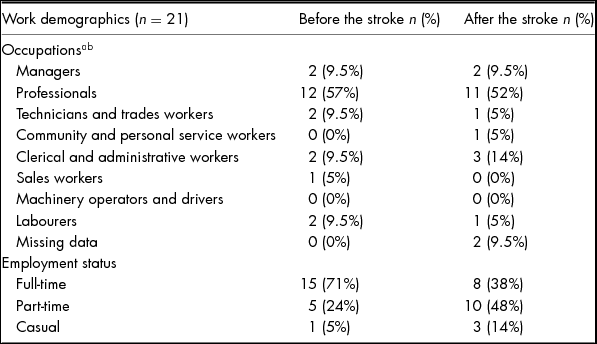
The majority of participants were classed as professionals (n = 12; 57%) in their pre-stroke job (according to the ANZSCO) and worked full-time prior to their stroke (n = 15; 71%). However, only eight participants (38%) worked full-time after their stroke (see Table 2). There were minimal shifts between participants’ pre- and post-stroke occupations as classified by the ANZSCO. The timeframe of return to work ranged from less than 1 month to over 2 years. Participants varied regarding how soon they attempted to work after the stroke (see Table 1).
Occupation and Employment Status Before and After Stroke
aAs classified by the Australian and New Zealand Standard Classification of Occupations (ANZSCO).
bOnly 19 participants reported their post-stroke occupation.
Ten (48%) participants returned to their previous job and, on average, participants had been working in their current job (before and after the stroke) for 121 months (approximately 10 years). The participants indicated, on a provided list, that the changes commonly made to working habits after stroke included: varying the way tasks were performed (n = 11, 52%), completing fewer work tasks (n = 10, 48%), different work tasks (n = 9, 43%), a different job (n = 9, 43%), physical or structural changes made to the workplace (n = 5, 24%) and the use of assistive equipment or devices (n = 4, 19%). One participant reported a change to working from home.
Change in Work Satisfaction Following Stroke
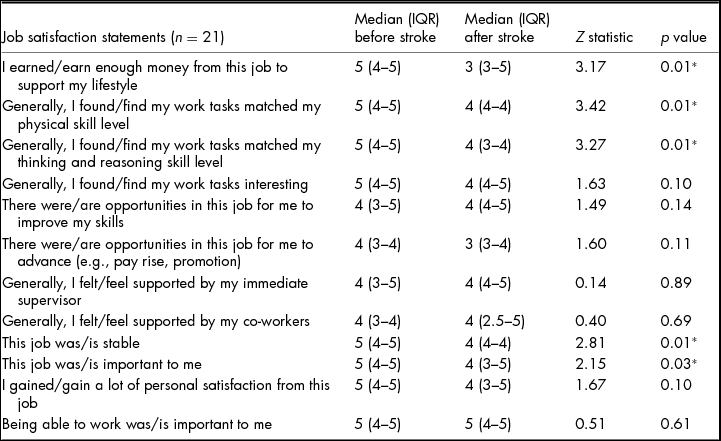
Table 3 shows the results of Wilcoxon signed-rank tests comparing pre- and post-stroke job satisfaction statements. Five of the 12 job satisfaction statements were found to have statistically significant differences (at the 0.05 significance level) between pre- and post-stroke scores. These results indicated that people were significantly less satisfied following stroke in relation to money, work skills (physical and cognitive), job stability and job importance. Fourteen (66%) of the participants agreed or strongly agreed that their return to work had been successful.
Wilcoxon Signed-rank Test Data Based on Pre- and Post-stroke Job Satisfaction Statements
*p < 0.05.
Discussion
The purpose of this study was to identify the paths taken by people with stroke in Australia as they returned to work. In Australia, vocational rehabilitation may be provided through government organisations such as CRS Australia to eligible people, or through private organisations. The findings from the current study demonstrated that although services were available from a recognised government provider, or private providers, half of the participants did not access formal vocational rehabilitation or support services to assist them in the return-to-work process. This occurred despite participants reporting impacts on work from residual disabilities, changes to working habits and reduced satisfaction for matching of work tasks to capabilities.
Several factors should be considered when discussing the findings; however, it is important to first acknowledge the study limitations. The study included a small sample size and data were not collected regarding the geographic location of the participants. The majority of participants had a university degree (71%) and were professionals (57%), therefore those who responded to the questionnaire may not be representative of the broader working population of people with stroke who return to work. Finally, the purpose of this questionnaire was to gather preliminary data and it does not identify why people did not access formal support services, nor did we collect in-depth qualitative data.
A UK-based study recently demonstrated that people with stroke did not regularly receive formal services to assist in the return-to-work process (Sinclair et al., Reference Sinclair, Radford, Grant and Terry2013). Indeed, Sinclair and colleagues (Reference Sinclair, Radford, Grant and Terry2013) identified that vocational rehabilitation paths for people with stroke generally lacked co-ordination and they advocated that referral to vocational rehabilitation services while in hospital may have prevented people with stroke from ‘falling through the net’. In our study, we found that although participants did not access formal return-to-work paths, such as those provided by CRS Australia, they commonly reported experiencing multiple residual disabilities that impacted on their work performance, including fatigue, concentration, mobility/walking, physical strength and memory. Fatigue has been highlighted as a significant issue after stroke and previous studies have drawn attention to the impact on return to work (e.g., Carlsson, Möller, & Blomstrand, Reference Carlsson, Möller and Blomstrand2009; O'Brien & Wolf, Reference O'Brien and Wolf2010). An important consideration for all people returning to work after stroke may be programmes and support to allow them to develop work patterns that support their performance despite the experience of fatigue.
Participants identified that they made changes to their work habits and routines during their return to work. However, this study did not explore how these changes were brokered for the participants who did not access formal support services. There is some literature to suggest that an understanding and flexible employer, who organises changes to working habits, enables people with stroke to return to work (Culler et al., Reference Culler, Wang, Byers and Trierweiler2011; Hartke et al., Reference Hartke, Trierweiler and Bode2011; Koch et al., Reference Koch, Egbert, Coeling and Ayers2005). Therefore some of the changes reported by participants, such as decreasing work hours, changing the way tasks were performed and reducing the number of work tasks required, may have been brokered directly with the employer.
The current study and previous findings have identified that people with stroke often return to work in part-time, lower-paid positions (Alaszewski et al., Reference Alaszewski, Alaszewski, Potter and Penhale2007; Culler et al., Reference Culler, Wang, Byers and Trierweiler2011). Ratings of job satisfaction were used in the current study to provide preliminary insights into the individuals’ satisfaction with the changes made. While 70% of participants in this study reported that their return to work had been successful, participants were actually less satisfied with their post-stroke job in relation to job suitability (physically, cognitively and financially), job stability and job importance. These results imply that, despite changes to work habits and routines, participants may have experienced a mismatch between their abilities (physical and cognitive) and the demands of their work tasks.
A qualitative study of one person's experiences of returning to work after stroke in Australia highlighted the impact of a mismatch between abilities and required work tasks, particularly when the employer was reluctant or not prepared to make the changes required by the employee (Gustafsson & Turpin, Reference Gustafsson and Turpin2012). This person with stroke noted great improvements in job satisfaction and experiences when he/she had an employer and workplace that made changes based on the employee's individual needs (Gustafsson & Turpin, Reference Gustafsson and Turpin2012). Therefore, an important consideration for the return to work process may be not just to broker adjustments, but also to understand the individual's experiences and satisfaction with these changes.
Reduced satisfaction with job salary, stability and security were highlighted in this study. Participants in the current study viewed their post-stroke job as less important than their pre-stroke job. A previous study has identified that people after stroke had reported changing their priorities to place less importance on their job, reduce work-related stress and focus more on improving health and wellbeing (Hartke et al., Reference Hartke, Trierweiler and Bode2011). Participants in the current study may have also experienced changing priorities, increasing the value they placed on activities outside of work (such as spending time with family). However, it is difficult to draw conclusions because the reasons for participants’ reduced work importance were not explored further.
This study has highlighted many additional questions about the return-to-work experience after stroke. Questions for exploration in subsequent studies include the availability and accessibility of services for people with stroke, and if there is a need for routine referral to services. In addition, it will be important to understand the outcomes from the perspective of the person with stroke, exploring his/her satisfaction with the outcomes and return-to-work experiences.
Conclusion
There are formal support services in Australia that aim to assist people in transitioning back to work after an accident or illness. However, the current small-scale study suggests that these services may not be accessed routinely by people with stroke. This gap in the continuum of recovery to vocational rehabilitation requires validation in a larger-scale, systematic study with exploration of key outcomes. This is an important area for future research, which should consider the availability and utilisation of formal return-to-work paths in Australia, and explore the effectiveness of changes made to working habits and routines from the perspective of the person with stroke.
Acknowledgments
This research received no specific grant from any funding agency, commercial or not-for-profit sectors. The researchers would like to acknowledge the National Stroke Foundation and Stroke Support Groups for their support with advertising the call for participants in this questionnaire, and thank the participants for their involvement. The researchers would like to acknowledge the contributions of Rebecca Banks who was involved with the initial questionnaire design.
Declaration of Interest
None.