

Introduction
Charismatic or flagship species may become critical pillars for conservation efforts (Welton et al. Reference Welton, Siler, Bennett, Diesmos, Duya, Dugay and Rico2010, Bennett et al. Reference Bennett, Maloney and Possingham2015). When charismatic species are also new to science, they may generate the essential momentum needed to raise awareness and funding for conserving their habitat. If properly planned, these actions may also contribute to preserving endangered ecosystems, which benefits less charismatic organisms and habitat specialists, making those charismatic species conservation umbrellas (sensu Roberge and Angelstam Reference Roberge and Angelstam2004).
The Blue-throated Hillstar Oreotrochilus cyanolaemus is a recently described hummingbird endemic to the southern Andes of Ecuador (Sornoza-Molina et al. Reference Sornoza-Molina, Freile, Nilsson, Krabbe and Bonaccorso2018), which could serve as a conservation umbrella for some of the last tracks of paramo grasslands in the region. This hummingbird is only known from the cordillera Chilla-Tioloma-Fierro Urco, a small mountain range isolated from the rest of the Andes by a rim of dryer and lower valleys. It inhabits paramo grasslands, where it is largely confined to stands of shrubby habitats with an important presence of Chuquiraga jussieui (Asteraceae) plants. Yet, the data available to date are insufficient for a proper assessment of its demography, natural history, and ecological requirements. This dearth of information has precluded planning and implementing sound and integral conservation actions.
The estimated geographical range of O. cyanolaemus is roughly smaller than 100 km2, and its population has been broadly estimated at 250–750 individuals (Sornoza-Molina et al. Reference Sornoza-Molina, Freile, Nilsson, Krabbe and Bonaccorso2018). The species is severely threatened by habitat loss and degradation caused by the transformation of paramo grasslands to cattle pastures, exotic tree plantations, and agricultural fields, and massive destruction by extensive fires during the dry season. Based on these threats, its small extent of occurrence, and its presumed small population size, Sornoza-Molina et al. (Reference Sornoza-Molina, Freile, Nilsson, Krabbe and Bonaccorso2018) proposed categorising it as “Critically Endangered”. This suggestion was backed up in the national Red Data List (Freile et al. Reference Freile, Santander, Carrasco, Cisneros-Heredia, Guevara, Sánchez-Nivicela and Tinoco2019) and the global Red Data List (BirdLife International 2022). However, basic natural history knowledge is still needed for better assessing its distribution and ecological requirements, population size, and trends.
Here, we significantly increase knowledge of the ecology, demography, and reproduction of O. cyanolaemus. We analyse encounter rates at three different regions, characterise the habitat use of males and females, as well as their preferred nectar sources, report on breeding ecology and reproduction success rates, and re-assess the potential distribution of the species. This information will be useful in designing and implementing specific conservation-oriented actions, and in moving forward towards more extensive monitoring efforts on population trends, reproduction success, phenology of resources, and habitat requirements.
Methods
Study site
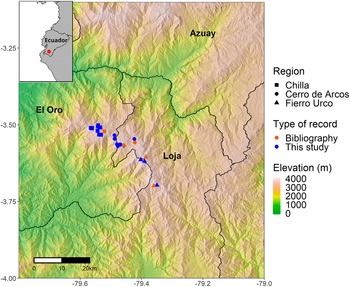
The cordillera Chilla-Tioloma-Fierro Urco is a small mountain range separated from the main Andean chain by the low and dry valleys of the rivers León and Jubones to the north and east, and Catamayo-Puyango to the south (Sornoza-Molina et al. Reference Sornoza-Molina, Freile, Nilsson, Krabbe and Bonaccorso2018). It is located within the provinces of Loja and El Oro, in southern Ecuador (Figure 1). This area is primarily covered by paramo grassland, with minor additional vegetation types including montane forests and shrublands. Plantations of the exotic Pinus patula tree and cattle pastures are also widespread throughout the study site. The climate is generally dry, with a marked drier and windier period in June–August, and a wetter period in January–April (Oñate-Valdivieso et al. Reference Oñate-Valdivieso, Fries, Mendoza, González-Jaramillo, Pucha-Cofrep, Rollenbeck and Bendix2018).
Study area and occurrences of Oreotrochilus cyanolaemus in three different regions in the cordillera Chilla-Tioloma-Fierro Urco. Occurrence records are overlaid on a digital elevation map. Symbols represent different regions within the cordillera, and colours depict if the occurrence records were obtained from published literature or from fieldwork carried out during this study.

Our study was conducted over two periods. In the first period, from November 2019 to March 2020, we performed bird surveys and gathered data on the ecology of the species. During the second period, from November 2020 to January 2021, we studied its breeding ecology.
Bird surveys and encounter rates
Previous knowledge about the preferred habitat and distribution of the species (Sornoza-Molina et al. Reference Sornoza-Molina, Freile, Nilsson, Krabbe and Bonaccorso2018, Molina et al. Reference Molina, Pacheco, Carrasco and Tinoco2021) was used to guide a series of expeditions throughout the cordillera Chilla-Tioloma-Fierro Urco, at elevations above 2,800 m. For logistical reasons, we divided the study area into three sections: west (hereafter called Chilla), centre (hereafter called Cerro de Arcos, a local name, in the Tioloma cordillera), and east (hereafter called Fierro Urco) (Figure 1). We visited sites with extensive coverage of paramo grasslands, patches of shrubby vegetation including C. jussieui, and areas with rocky outcrops considered potential nesting sites for the species. Given COVID-19 restrictions to mobility policies in Ecuador, sampling effort was irregular across the study period. In total, we were able to sample the region for 25 days: 9 at Chilla, 10 at Cerro de Arcos, and 6 at Fierro Urco. During each sampling day, two researchers walked over all available habitat types in the vicinity, keeping track of the distance covered using a handheld GPS unit, and recording the number of individuals observed or heard. The total distance covered was 161.6 km (65.06 km at Chilla, 51.21 km at Cerro de Arcos, and 45.33 km at Fierro Urco), with a daily mean of 6.4 km (range = 2.66–17.9). Encounter rates per sampling day were obtained as the number of individuals recorded per km.
Ecological observations and habitat characterisation
We obtained behavioural data of each observed individual for as long as the bird was in view during our walks and recorded the following activities: foraging for nectar, foraging for arthropods, perching, and interactions with other hummingbirds. We classified the foraging methods as hovering or clinging (i.e. the bird grabbed the flower with its feet) in the case of nectar foraging, and sallying or hover gleaning when the bird was foraging for invertebrates. We also noted the plant species where the activity occurred. Based on plumage characteristics, each observed individual was classified as male or female (Sornoza-Molina et al. Reference Sornoza-Molina, Freile, Nilsson, Krabbe and Bonaccorso2018). O. cyanolaemus acquires sexual dimorphism at the nestling stage (Molina et al. Reference Molina, Pacheco, Carrasco and Tinoco2021), a characteristic that aided our classification; however, we could not visually age the observed individuals.
We also gathered detailed information about the microhabitat around each observed individual when the site was accessible to the researchers. This information was taken by placing a 20-m radius circular plot, centred on the first observation point of the focal individual. The microhabitat was characterised in terms of vegetation height, the number of shrubs, vertical heterogeneity of the vegetation, and coverage of different vegetation types, based on a protocol used in bird surveys (James and Shugart Reference James and Shugart1970). Vegetation height was obtained by estimating the mode of the height above the ground of the shrub layer within the plot. To measure the abundance of shrubs, we placed four 20-m transects directed north, south, east, and west from the centre of the plot. Next, we counted all the shrub stems that touched the extended arms of a person walking along each transect (the same person always took the data at a height above the ground of c.1.5 m). Using the same transects, the vertical heterogeneity of vegetation was measured by obtaining a vertical profile of the vegetation at sampling points located every 4 m along each transect. At each sampling point, we noted the presence/absence of vegetation in vertical sections of 0.5 m, starting at ground level and up to the tallest vertical section covered by vegetation. Then, the vertical heterogeneity of the vegetation was represented as a Shannon diversity index, based on the distribution of counts of sections covered with vegetation. Finally, coverage of different vegetation types within the plot was obtained by estimating the main vegetation type intersecting sections of 4 m along each transect of the four transects located inside the plot; vegetation types included were shrubs, trees, mosses, grasslands, rocks, and bare soil. A percentage of each vegetation type covering the plot was obtained by counting the number of sections occupied by each vegetation type in relation to the total number of sections sampled in a plot (20 sections).
Breeding ecology
From November 2020 to January 2021, we searched for nests of the species in caves and rocky walls in Chilla and Cerro de Arcos. When we found a nest, we revisited the site periodically to collect information about nesting success. In these searches, we also looked for old inactive nests, identified using previous knowledge about the species’ nest (Molina et al. Reference Molina, Pacheco, Carrasco and Tinoco2021). We gathered data about nest location, height above the ground of nest, and if possible, nest morphology and materials (only in active nests). To inspect nests that were over 2 m above the ground we used climbing equipment.
Species distribution
We obtained occurrence localities from the literature (Sornoza-Molina et al. Reference Sornoza-Molina, Freile, Nilsson, Krabbe and Bonaccorso2018), and from the surveys performed in this study. To model the species distribution (see below), we obtained 21 environmental variables of the study area, all downloaded from Worldclim, at a 30-second (~1 km2) resolution. These variables are related to different aspects of monthly temperature and precipitation between 1970 and 2000 (Fick and Hijmans Reference Fick and Hijmans2017). We also acquired the normalised difference vegetation index (NDVI) from the MODIS terra satellite (Didan Reference Didan2015), at a 250-m resolution, for every 16 days, starting from 1 January 2018 to 31 December 2020. This time frame covers the annual variability in NDVI related to variations of the local weather. The NDVI is correlated with above-ground primary productivity, and we used it here to capture differences in the vegetation across the study site. All the NDVI layers were averaged to obtain a mean NDVI per pixel. All the environmental variables were aligned and re-scaled at a resolution of 250 m per pixel, using the raster package (Hijmans and van Etten Reference Hijmans and van Etten2012) in R version 4.2.1 (R Core Team 2021).
Statistical analysis
Encounter rates
We compared encounter rates among Chilla, Cerro de Arcos, and Fierro Urco areas using a generalised linear model with a Poisson distribution of residuals and a log link (Zuur et al. Reference Zuur, Ieno, Walker, Saveliev and Smith2009). The number of individuals encountered in each sampling day was used as response variable. To control for differences in sampling effort among days we used the distance covered each day as an offset. A post-hoc Tukey test was then used to test for pairwise differences between sampling areas.
Microhabitat and behaviour
We explored differences in the microhabitats used by individuals of different sexes. Significant variations in the coverage of vegetation types of microhabitats between sexes were evaluated with a chi-square test. We used single variate linear regression models to test for differences in the abundance of shrubs, the vertical heterogeneity of the vegetation, and vegetation height between microhabitats of males and females.
Differences in the species of flowers visited by males and females were determined with a chi-square test. To avoid non-independent observations of multiple foraging behaviours of a same individual, we only used the first foraging activity observed for the analysis (Hejl et al. Reference Hejl, Verner and Bell1990). Plant species were identified at a local herbarium, Herbario Azuay, at Universidad del Azuay. All visits to plant species with a single observation were grouped into a unique category named “Others”.
Species distribution model
To obtain a more precise estimate of the distribution range and area occupied by O. cyanolaemus we created a species distribution model (SDM). The spatial extent of the model was limited by a 50-km buffer around the minimum convex polygon of all occurrence points of O. cyanolaemus. We excluded from this spatial extent areas with potentially suitable environmental conditions for the species (Sornoza-Molina et al. Reference Sornoza-Molina, Freile, Nilsson, Krabbe and Bonaccorso2018), in which O. cyanolaemus has not been recorded despite considerable survey effort invested and good quality information compiled out of the known range of the species (e.g. Cajas National Park, Astudillo et al. Reference Astudillo, Tinoco and Siddons2015; Podocarpus National Park, Ordóñez-Delgado et al. Reference Ordóñez-Delgado, Ramón-Vivanco and Ortiz-Chalán2019). See Anderson and Raza (Reference Anderson and Raza2010) for the rationale of excluding such areas. Within that polygon, we removed areas below 2,800 m elevation. The lowest elevation record for the species is 3,200 m; however, given the incomplete knowledge of the ecology of O. cyanolaemus, we decided to be conservative, and used a less restrictive threshold in our polygon. Occurrence records for O. cyanolaemus were processed to select records that were not within 1 km from each other, applying the function “thin” in the R package spThin (Aiello-Lammens et al. Reference Aiello-Lammens, Boria, Radosavljevic, Vilela and Anderson2015), and chose the set of records that maximised the total number of occurrences. This filtering process reduced the potential autocorrelation of occurrence points (Aiello-Lammens et al. Reference Aiello-Lammens, Boria, Radosavljevic, Vilela and Anderson2015). With no information about the home range of the species, the distance of 1 km for filtering the occurrences was chosen based on our field observations of foraging.
We used the machine-learning algorithm Maxent through the ENMeval package in R (Muscarella et al. Reference Muscarella, Galante, Soley-Guardia, Boria, Kass, Uriarte and Anderson2014) to create the distribution model. Maxent is a machine-learning presence-only method that uses information of the environment at random background pixels, which are compared with the environment at pixels occupied by the focal species to produce a distribution model that maximises the entropy constrained by the known occurrences (Phillips and Dudık Reference Phillips and Dudık2008). We generated 10,000 pseudo absences randomly created from the background polygon and created different models by changing the regularisation multipliers and feature classes. Regularisation multipliers penalise the complexity of the model, and we used values from 0.5 to 5 in steps of 0.5. Feature classes regulate the flexibility of the response to the predictor variables, and we used the following classes: L, LQ, H, LQH, LQHP: where L = linear, Q = quadratic, H = hinge, P = product. Model performance was assessed using the jackknife approach; this method uses all the occurrence records minus one in each interaction to train the model, and employs the withheld record for testing (Muscarella et al. Reference Muscarella, Galante, Soley-Guardia, Boria, Kass, Uriarte and Anderson2014).
Model selection was based on Akaike’s Information Criterion corrected for small sample sizes (AICc), which favours the simplest models, and is robust to potential sampling bias in models with a low number of occurrence localities (Galante et al. Reference Galante, Alade, Muscarella, Jansa, Goodman and Anderson2018). Then, we evaluated model performance by calculating the area under the curve (AUC). These are methods that distinguish the ability of the model to discriminate between presence and background locations. Finally, we imposed a threshold to the continuous distribution model to create a map of presence/absence that allowed us to estimate the distribution range of the species. The threshold used was the 10 percentile value (i.e. 90% of the occurrence points contained within the predicted area), a somewhat conservative method but proper given the environmental complexity of the study area (Tinoco et al. Reference Tinoco, Astudillo, Latta and Graham2009, Guevara et al. Reference Guevara, Gerstner, Kass and Anderson2018).
Results
Relative abundance
Overall, we obtained 16 records of the species in Chilla, 19 in Cerro de Arcos, and 3 in Fierro Urco (Figure 1). Across the study area, the mean encounter rate was 0.35 (SE = 0.08) individuals/km. The encounter rate was higher in Cerro de Arcos and Chilla, compared with Fierro Urco (Figure 2, Table 1).
Mean and SE of encounter rates of Oreotrochilus cyanolaemus in different regions of its distribution. Different letters over the boxes indicate significant differences (P <0.05) among regions tested with a post-hoc Tukey test.

Results of a generalised linear model of encounter rates of Oreotrochilus cyanolaemus in different areas of the Chilla-Tioloma-Fierro Urco mountain range, southern Ecuador. The intercept in the model corresponds to Cerro de Arcos.

Habitat characteristics
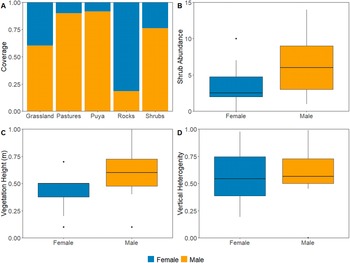
We obtained data for a total of 32 microhabitats (N males = 17, N females = 15). Males and females showed differences in the microhabitat used (Figure 3, Table 2). The microhabitat of males had a higher coverage of pastures, shrubs, and the ground bromeliad Puya species. (Bromeliaceae), while females used microhabitats with higher coverage of rocks (χ2 = 142.15, df = 4, P <0.01) (Figure 3A). In terms of the vegetation structure, microhabitats of males had a higher abundance of shrubs (Figure 3B), and taller vegetation (Figure 3D); vertical complexity was similar between the microhabitats of males and females (Figure 3C).
Microhabitat characteristics of female and male Oreotrochilus cyanolaemus individuals, measured inside 20-m radius circular plots, centred on the first observation point of focal individuals. (A) Frequency of the coverage of different vegetation types. (B) Abundance of shrubs. (C) Height of the vegetation. (B) Vertical heterogeneity measured by a Shannon diversity index.

Results of linear regression models that test for differences in microhabitat characteristics used by females (intercept of the models) and males of Oreotrochilus cyanolaemus in different areas of the Chilla-Tioloma-Fierro Urco mountain range, southern Ecuador.

Behaviour
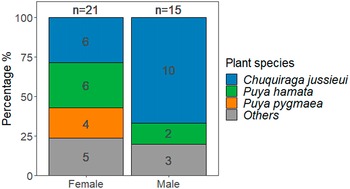
We obtained 36 observations of nectar foraging, 21 for females, and 15 for males. O. cyanolaemus was found visiting flowers of 11 plant species: C. jussieui (Asteraceae), Bomarea uncifolia (Alstroemeriaceae), Puya hamata (Bromeliaceae), P. pygmaea (Bromeliaceae), Brachyotum sp. (Melastomataceae), Disterigma empetrifolium (Ericaceae), Macleania rupestris (Ericaceae), Castilleja fissifolia (Orobanchaceae), Clinopodium taxifolium (Lamiaceae), Oreocallis grandiflora (Proteaceae), and Ribes lehmannii (Grossulariaceae). All those plants are native to the Ecuadorian paramo. The most frequently used resource was C. jussieui (16 visits); other important resources were P. hamata (eight visits) and P. pygmaea (four visits). All the other plant species were observed being used only once. There were some differences in resource use between females and males. In particular, males showed a higher proportion of visits to C. jussieui (66.6% vs. 28.57%), while females showed a more diverse diet, with a similar proportion of visits to C. jussieui, P. hamata, and P. pygmaea (Figure 4). However, the proportion of visits to the different plant species did not differ statistically between sexes (χ2 = 6.68, df = 3, P = 0.08), probably because of the small sample size. In all foraging for nectar observations birds fed by clinging to the flower, except one that was hovering. We only obtained three observations of foraging for insects, and all were males that hovered gleaning from foliage. Perching sites were located at a mean height of 3.34 m (N = 15; range 1–4), and included rocks, P. hamata, C. jussieui, Gynoxys sp. (Asteraceae), and the exotic tree P. patula.
Proportions of visits to flowers of different plant species of male and female Oreotrochilus cyanolaemus individuals.

Breeding
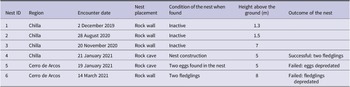
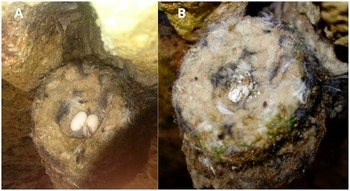
We found six nests, four in Chilla and two in Cerro de Arcos. Three of those nests were active and three were inactive old nests. Active nests were found between January and March. Four nests were placed in small ledges of rock walls, and two inside rocky caves (Table 3). The height above the ground of the nests ranged from 1.3 m to 8 m. The two nests found in Cerro de Arcos occupied the same rock cave and were at c.1.5 m from each other. All nests were cup shaped, and were constructed with similar materials: an outer layer of mosses, small leaves, and twigs; an inner layer containing Puya downy fibres, and small black and white bird feathers (Figure 5). We were only able to measure one nest; it had an external diameter of 7 cm, internal diameter of 4 cm, depth of the nest chamber of 2 cm, and a height of 14 cm.
Placement, contents, and fate of six nests of Oreotrochilus cyanolaemus found in Chilla-Tioloma-Fierro Urco mountain range, southern Ecuador.

Nest of Oreotrochilus cyanolaemus containing two eggs when found on 19 January 2021 (A), and then on 21 January 2021 showing only egg remains (B).

We observed three active nests that had either two eggs or two nestlings when found (Table 3). Only one was successful and produced two fledglings. The other two nests failed, one during the incubation period (indicated by egg remains) (Figure 5B), and in the second, fledglings were likely preyed upon (no remains found).
Distribution
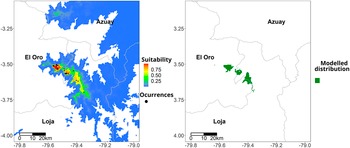
Overall, we obtained 43 occurrence records of O. cyanolaemus, 38 gathered during our field work, and five compiled from the literature (Sornoza-Molina et al. Reference Sornoza-Molina, Freile, Nilsson, Krabbe and Bonaccorso2018). All the occurrence records were at 3,250–3,800 m elevation, all within the Chilla-Tioloma-Fierro Urco range (Figure 1). However, only 19 records were used to model the species distribution after filtering out occurrences of sites closer than 1 km to each other. The best model was constructed with a regularisation penalty of 1.5 and a hinge feature class; this model had an AICc value of 327.53 (weighted AIC = 0.85) and an AUC value of 0.99. The SDM of O. cyanolaemus showed high suitability areas for the species exclusively in the Chilla-Tioloma-Fierro Urco mountain range, with a particular increase in suitability in its western and central region (Chilla and Cerro de Arcos) (Figure 6A). The final binary distribution model, depicting only areas with high suitability for the species (Figure 6B), indicated that O. cyanolaemus has a distribution range of 62.7 km2.
(A) Final model of suitable areas for Oreotrochilus cyanolaemus in south Ecuador. The predicted model was built using Maxent, with climatic variables and the normalised difference vegetation index (NDVI). (B) Binary map depicting the most suitable areas for the occurrence of O. cyanolaemus. This map was obtained after re-categorising the continuous suitability model using a threshold of 10 percentile value of pixels and it shows the estimated distribution range of the species.

Discussion
The successful and efficient conservation of a species is more likely accomplished if conservation actions are built upon sound science. Here we contribute basic information on the ecology and distribution of O. cyanolaemus, which can be used to guide conservation actions for this highly threatened species.
The differences in encounter rates among study areas indicated that O. cyanolaemus is more abundant in Cerro de Arcos and Chilla than in Fierro Urco. These differences could be related to low suitability of environmental conditions for the species in the eastern portion of its distribution. During our expeditions, we did not observe large shrubby patches, the main habitat for the species, in Fierro Urco. Thus, the populations of O. cyanolaemus are mainly concentrated in the western and central areas of the Chilla-Tioloma-Fierro Urco mountain range, with fewer individuals occupying Fierro Urco. It remains to be determined if the lack of shrubby habitats in Fierro Urco is natural or is the result of human disturbance. Such evaluation is critical to determine the potential value of that area for maintaining populations of the species. Yet, it is important to recall that our field surveys took place from November to March, leaving nearly six months unsampled. There could be potential seasonal movements of the species across its range that should be studied in the future.
Males and females used different microhabitats. Males occupied more shrubby microhabitats, with greater vegetation complexity compared with females, who used more open areas dominated by grasslands. Spatial segregation of habitats by sex is known in other species of Oreotrochilus (e.g. O. chimborazo, O. estella), in particular during the breeding period (Corley-Smith Reference Corley-Smith1969, Carpenter Reference Carpenter1976). However, habitat segregation by sex in O. estella is opposite to our findings, with females occupying shrubby habitats, and males using more open grasslands (Carpenter Reference Carpenter1976). A more detailed study, exploring habitat use across time and breeding periods, and comparing between Oreotrochilus species, is needed to better understand this result.
The flowers of C. jussieui, P. hamata, and P. pygmaea were the most frequently used by O. cyanolaemus. Chuquiraga species are important resources for Oreotrochilus species, especially in the northern distribution of the genus (Corley-Smith Reference Corley-Smith1969, Carpenter Reference Carpenter1976, Ortiz-Crespo and Bleiweiss Reference Ortiz-Crespo and Bleiweiss1982). C. jussieui is a shrub with terminal flowers, which grows as monospecific patches or as part of shrubby patches. The high levels of dependency of Oreotrochilus on Chuquiraga apparently resulted from coevolutionary relationships between these two groups that have undergone a process of parallel adaptation to the harsh environmental relationships that dominate the high Andes (Abrahamczyk et al. Reference Abrahamczyk, Poretschkin and Renner2017). We observed open flowers of C. jussieui throughout our study period, indicating that it can be a reliable food resource across the year. Nonetheless, phenological studies are needed to evaluate if there is seasonal variation in the phenology of C. jussieui, and if this variation could influence habitat use, movements, or reproduction of O. cyanolaemus.
Puya species have monocarpic arborescent rosettes with a terminal inflorescence (Varadarajan Reference Varadarajan1990, Jabaily and Sytsma Reference Jabaily and Sytsma2013) that provide key nectar resources for many hummingbird species in the Andes (Hornung-Leoni et al. Reference Hornung-Leoni, González-Gómez and Troncoso2013, Restrepo-Chica and Bonilla-Gómez Reference Restrepo-Chica and Bonilla-Gómez2017). P. hamata has a tall inflorescence that can reach up to 4 m in height, and flowers that produce abundant nectar (Woods and Ramsay Reference Woods, Ramsay and Ramsey2001). This species is well adapted to fires, with adults that can tolerate fires and seeds presenting high germination rates after paramo burning (García-Meneses and Ramsay Reference García-Meneses and Ramsay2014). This capacity to tolerate and even thrive after fires results in the development of Puya patches of different sizes within disturbed paramo grasslands (Miller and Silander Reference Miller and Silander1991, Rivadeneira et al. Reference Rivadeneira, Ramsay and Montúfar2020). Periodic paramo burning, used to stimulate regrowth of wild grasses for cattle ranching, is a common activity throughout the distribution range of O. cyanolaemus. Therefore, P. hamata might be a key resource for this hummingbird in human-altered areas. On the other hand, P. pygmea presents a short, single inflorescence c.50 cm tall. We could not find ecological information about this species, but our observations indicate that it is present in low densities, scattered in rocky areas. It is worth noting that Puya plants have well-defined flowering phases in different seasons of a year (Restrepo-Chica and Bonilla-Gómez Reference Restrepo-Chica and Bonilla-Gómez2017, Varadarajan Reference Varadarajan1990), suggesting that the use of Puya species by O. cyanolaemus might be seasonal. This study was not designed to assess temporal variation in resource use of O. cyanolaemus, and we suggest it as a research priority to better assess key plant species needed for sustaining viable populations of O. cyanolaemus.
Clinging was the main foraging for nectar behaviour, as has been reported for other Oreotrochilus species (Carpenter Reference Carpenter1976, Fjeldså and Krabbe Reference Fjeldså and Krabbe1990). Clinging for feeding saves energy, compared with hovering (Feinsinger and Colwell Reference Feinsinger and Colwell1978), which can be advantageous for hummingbird species occupying high elevations in the Andes; reduced air density and low oxygen partial pressure impose significant metabolic constraints (Altshuler and Dudley Reference Altshuler and Dudley2003). The long tarsi and hallux claw of Oreotrochilus hummingbirds are advantageous for clinging to flowers (Carpenter Reference Carpenter1976, Fjeldså and Krabbe Reference Fjeldså and Krabbe1990).
Only one of three active nests successfully produced two juveniles. The reproductive success of Oreotrochilus has been considered high as a result of low depredation pressure in the high Andes (Corley-Smith Reference Corley-Smith1969). For instance, 16 out of 18 nests of O. estella were successful in the Andes of Peru (Carpenter Reference Carpenter1976). In our study, the two nests that failed were likely attacked by predators (Table 3). Given the location of nests high in rocky walls, we suspect that avian predators were responsible. The Black-billed Shrike-Tyrant Agriornis montanus and the Great Thrush Turdus fuscater are nest predator species (Menezes and Marini Reference Menezes and Marini2017) that are common in our study area. In terms of nest placement and architecture, our nests were generally similar to those reported for other Oreotrochilus species (Dorst Reference Dorst1962, Langer Reference Langer1973, Carpenter Reference Carpenter1976, Areta et al. Reference Areta, Vila Moret, Mazar Barnett and Casañas2006), including a previous description of a O. cyanolaemus nest (Molina et al. Reference Molina, Pacheco, Carrasco and Tinoco2021). Like the nests we found, Oreotrochilus species nest in sites protected from harsh environmental conditions prevalent in the high Andes, such as caves and rock wall cracks (Dorst Reference Dorst1962, Carpenter Reference Carpenter1976, Bodrati et al. Reference Bodrati, Mérida and Montenegro2003, Areta et al. Reference Areta, Vila Moret, Mazar Barnett and Casañas2006). Some Oreotrochilus use human infrastructure as nesting sites, including buildings and bridges (Carpenter Reference Carpenter1976, Solano-Ugalde Reference Solano-Ugalde2008), increasing the availability of nesting sites in human-altered areas; we unsuccessfully searched for nests in such places, indicating that O. cyanolaemus may only use natural support. Overall, it remains to be determined which factors are involved in breeding success of O. cyanolaemus, how females select nesting sites, and if there is a strong competition for such sites. Lastly, all active nests were found during the rainy season (January–March), corresponding with previous observations on the species (Molina et al. Reference Molina, Pacheco, Carrasco and Tinoco2021), and similar to other bird species in the paramos of southern Ecuador (Ortiz-Crespo Reference Ortiz-Crespo2000, Carrasco-Ugalde et al. Reference Carrasco-Ugalde, Molina, Pacheco and Tinoco2022).
Our estimated geographical range of O. cyanolaemus is smaller than previously thought (Sornoza-Molina et al. Reference Sornoza-Molina, Freile, Nilsson, Krabbe and Bonaccorso2018), suggesting that finer resolution data and more locality records provide more accurate distribution estimations. The small distributional range of O. cyanolaemus, one of the smallest ranges in the Trochilidae occurring in mainland South America, is likely the result of a complex geological history that includes the uplift of Andean mountain ranges and the emergence of low valleys where drier climates prevail (Sornoza-Molina et al. Reference Sornoza-Molina, Freile, Nilsson, Krabbe and Bonaccorso2018). Our modelling provides evidence that environmental conditions are not even across the Chilla-Tioloma-Fierro Urco mountain range, and that the species is more likely found in the central and western portions of this range. The Chilla-Tioloma-Fierro Urco range might act as a barrier for humidity moving eastwards from the Pacific Ocean, resulting in rain-shadowed valleys to the east of this range (Oñate-Valdivieso et al. Reference Oñate-Valdivieso, Fries, Mendoza, González-Jaramillo, Pucha-Cofrep, Rollenbeck and Bendix2018). Consequently, its easternmost portion is influenced by the drier climate of the inter-Andean valley (Oñate-Valdivieso et al. Reference Oñate-Valdivieso, Fries, Mendoza, González-Jaramillo, Pucha-Cofrep, Rollenbeck and Bendix2018), which precludes the occurrence of optimal habitat for O. cyanolaemus. However, we want to highlight that our distribution range comes from a modelling procedure that has strengths and weaknesses (see Phillips and Dudik Reference Phillips and Dudık2008, Syfert et al. Reference Syfert, Smith and Coomes2013), and future studies, with refined modelling techniques (e.g. presence/absence models), should validate our findings. We also expect that data on new occurrence localities for the species, during months not covered by this study, will improve our knowledge of the distribution range and ecology of O. cyanolaemus.
Conservation
O. cyanolaemus is considered a “Critically Endangered” species at the national (Freile et al. Reference Freile, Santander, Carrasco, Cisneros-Heredia, Guevara, Sánchez-Nivicela and Tinoco2019) and international levels (BirdLife International 2022), the latter assessment based on an estimate of 80–110 mature individuals, living in one subpopulation, i.e. criterion C2a(ii). Although our field methods do not allow for calculations of absolute population size, we generally agree with that estimation. Given the extensive survey effort we performed across the entire known distributional range of the species, and the amount of remaining shrubby habitat in the paramo of the region, we do not expect that large new populations of O. cyanolaemus will be found. Moreover, our encounter rates and habitat suitability model indicate that the western and central portions of its distribution (Chilla and Cerro de Arcos areas) are likely the most important for the species, and conservation efforts should focus on those areas.
The species’ population is considered to be declining because of habitat loss. Long-term monitoring is desirable to understand the extent of this purported decline, and the effects that habitat loss and degradation have on the species survival. Likewise, immediate conservation actions are critical beyond land purchase and protection, as small preserves will not safeguard the entire range of the species, which is pivotal to prevent further population declines. Large-scale conservation planning involving local communities and promoting local pride for the species, i.e. using O. cyanolaemus as a conservation emblem for the region, as has already been done by local initiatives, is recommended, along with further studies of its ecology and its responses to habitat and climatic changes. Our observations on the habitat used by males and females, along with nesting microhabitat, will aid ongoing and future efforts to seclude shrubby habitat patches, and to control camping activities and fires in potential and known nesting sites. Further, our information on the main feeding plants can be crucial for habitat restoration efforts, both assisted restoration and natural regeneration, with the caveat that we still lack phenological information about plants and the temporal variations in visits by O. cyanolaemus. We suggest further ecological studies about this “Critically Endangered” species aiming to understand key questions like breeding success, population demography and trends, seasonal differences in habitat use, and its specific responses to habitat change.
Acknowledgements
We thank Monica Papes for her contribution on earlier spatial analysis of the study area, Bruno Paladines for coordinating funding by Naturaleza y Cultura International, and Michael Moens and José León from Fundación Jocotoco for coordinating funding and field expeditions. We also thank Felipe Humbser for his support using climbing equipment. This study was funded by Naturaleza y Cultura Internacional and World Land Trust under the project “Fierro Urco Water Protection Area”, Fundación Jocotoco, and Universidad San Francisco de Quito (COCIBA grants, HUBI-12266). BT was funded by Vicerrectorado de Investigaciones, Universidad del Azuay.