

Images depicting weapons and tools feature in many traditions of prehistoric rock art (Bettencourt et al. Reference Bettencourt, Santos-Estévez and Sampaio2021), but they have a restricted distribution in Britain, where most of them come from a single monument – Stonehenge (Field et al. Reference Field, Anderson-Whymark, Linford, Barber, Bowden, Linford and Topping2015, 141–3). Nearly all the others are in an Early Bronze Age cemetery in the west of Scotland where only one of the decorated cists has been studied in recent years (Needham & Cowie Reference Needham, Cowie, Cochrane and Jones2012). This paper takes that analysis further. It explores the additional information provided by photogrammetry and investigates these images in their local setting. How were those images formed? Did they adhere to a single scheme? And why were they created at this particular time and place?
KILMARTIN GLEN
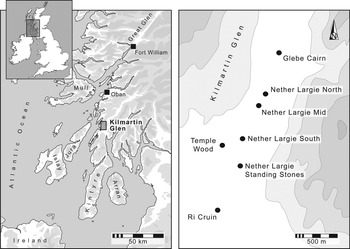
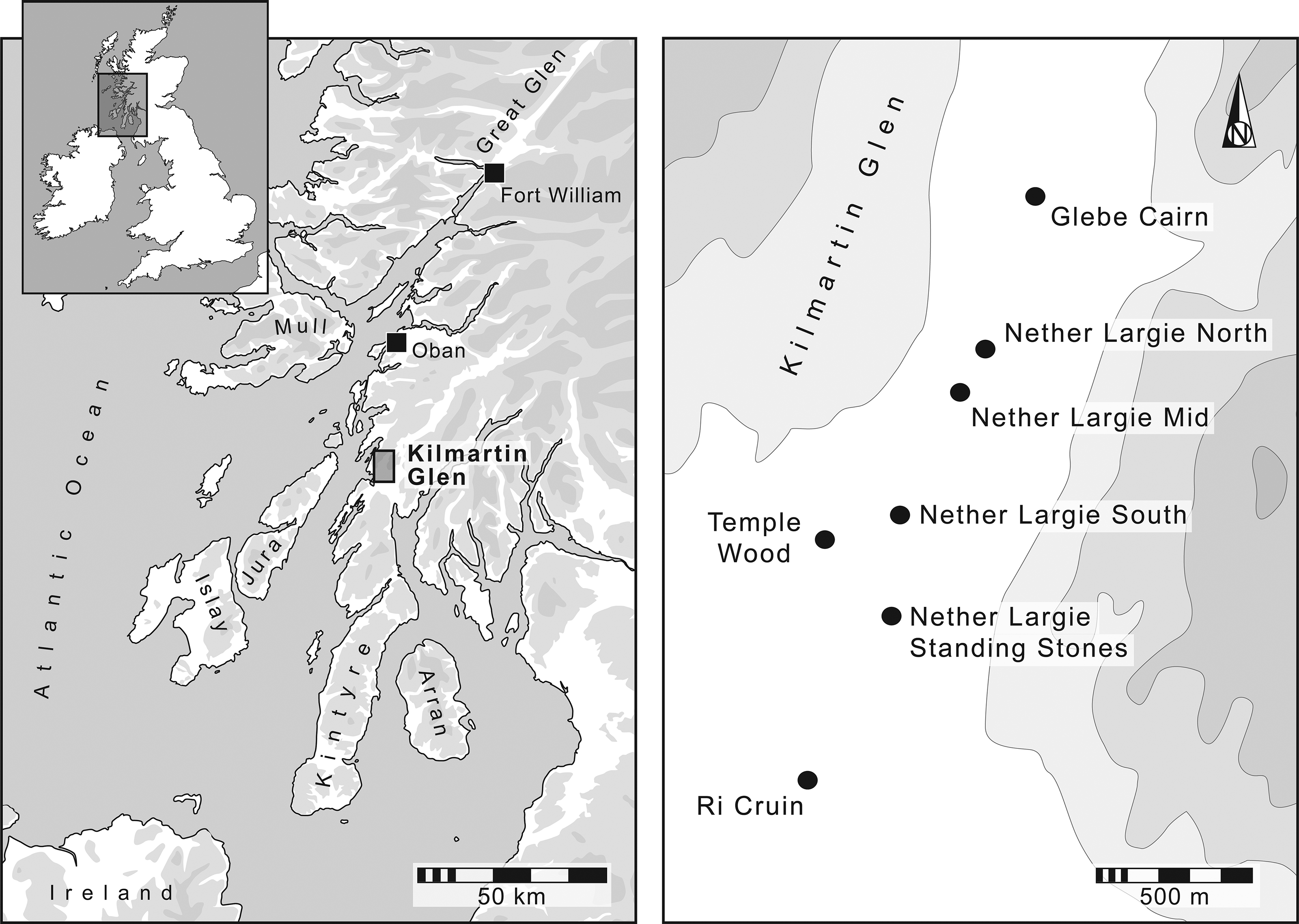
Kilmartin Glen, in Mid Argyll, is close to the west coast of Scotland and includes an exceptional range of prehistoric monuments, as well as numerous panels of rock art. It contains three cairns with cists featuring depictions of tools or weapons (Fig. 1). Nether Largie North and its neighbour, Nether Largie Mid, are parts of a linear cemetery comprising five monuments extending along the valley floor (Royal Commission on the Ancient and Historical Monuments of Scotland [hereafter RCAHMS] 1988, 67–70 & 72–4). They are constructed from waterworn boulders and were about 3 m high before they were excavated. Their diameters are between 19 m and 30 m and, in two cases, there are traces of an outer kerb. Six other cairns share similar proportions. The decorated cists at Nether Largie North and Nether Largie Mid are substantial features and seem to be ‘over-sized’ (Cook et al. Reference Cook, Ellis and Sheridan2010, 200). The same applies to the central burial inside the south stone circle at Temple Wood. Where information is available, they date between the 22nd and 19th centuries bc (Sheridan Reference Sheridan, Jones, Pollard, Allen and Gardiner2012, 175–8). Although these graves take similar forms, only three examples are embellished with depictions of early metalwork.
Location map showing Kilmartin Glen and the sites mentioned in the text
One decorated stone was used as a cover, and the others formed the ends or sides of each cist. In every case, the pecked designs were in the interior. Other petroglyphs – cup marks or circular motifs – had been recognised at two of these places, but their most striking features were the depictions of metal axes at Nether Largie and Ri Cruin, and an image interpreted as a halberd on the latter site.
The evidence is difficult to investigate. The cairn at Ri Cruin is badly damaged (Cowie Reference Cowie, Hunter and Sheridan2016), and the stone depicting an Early Bronze Age halberd no longer survives. A plaster cast provides the basis for a recent interpretation (Needham & Cowie Reference Needham, Cowie, Cochrane and Jones2012). The Nether Largie Mid cairn was also damaged and the images inside one of the cists were not recognised when the monument was investigated. The principal motif – an axehead – was first recorded by Marion Campbell and Mary Sandeman (Reference Campbell and Sandeman1962). Ronald Morris was unable to locate it and doubted whether it existed (Morris Reference Morris1977, 108). The new record confirms the axehead’s authenticity. Nether Largie North experienced even more drastic treatment. James Hewat Craw’s excavation involved the complete removal of the cairn, so that what is seen today is a 20th century reconstruction (Craw Reference Craw1931, 269–75). The central cist remains in its original position but is displayed within a modern shelter. The stone that covered it has been turned on its side so that the original upper surface is concealed.
This article considers the graves at all three sites in the light of new observations. In the past, these designs have been recorded by scale drawings, photographs, and rubbings. This paper supplements these records with the results of photogrammetry based upon an established workflow (see Gil-Docampo et al. Reference Gil-Docampo, Peña-Villasenín and Ortiz-Sanz2020). Photographs were captured using a 24-megapixel camera in consistent ambient light. Three-dimensional point clouds and polygon models were generated using Agisoft Metashape. The 3D models were analysed using visualisation software, including MeshLab (Cignoni et al. Reference Cignoni, Callieri, Corsini, Dellepiane, Ganovelli and Ranzuglia2008). Digital lighting, textures, and shaders were applied, including Radiance Scaling (Vergne Reference Vergne, Pacanowski, Barla, Granier and Schlick2010), revealing subtle features on the rock surface.
THE DECORATED STONE AT NETHER LARGIE NORTH
The best known of these monuments was Nether Largie North, and, until recently, it dominated any discussion of the decorated cists at Kilmartin. Craw’s excavation was thorough but comparatively uninformative. The cairn overlay a rubble enclosure and several subsoil features. One of them was associated with a decorated stone embellished with two pecked circles. The central burial contained a human tooth, charcoal, and a piece of ‘ochre’. It was covered by a massive capstone, decorated on its underside by cup marks and depictions of axes. The slab defining the northern end of the grave also featured axeheads. In Craw’s report, the motifs on the capstone were recorded by a rubbing (Craw Reference Craw1931, fig. 4), and more recently, the Royal Commission published excellent scale drawings of both the decorated surfaces (RCAHMS 1988, 69). Here they are reconsidered in the light of photogrammetry.
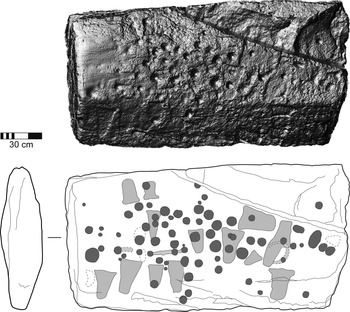
The grave was spanned by a single piece of schist which might have been removed from the top of a rounded erratic. Alternatively, it could have come from an outcrop shaped by glacial action. This would explain why the decorated surface is convex (Fig. 2). It has a laminar structure penetrated by fine cracks. For that reason, it would have been easy to detach from a larger rock. Its rounded profile seems to have been significant, but this feature is not so obvious when it is illustrated in two-dimensional drawings. The usual interpretation of the decorated surface is that the cup marks were overlain by the depictions of metalwork. This view was taken by Morris (Reference Morris1977, 109), who wrote that ‘the axe-heads were probably superimposed on the cup-marks that were already there’. Derek Simpson and John Thawley favoured a similar interpretation. Where figurative images of metalwork appear on cist slabs together with cups, they considered that the motifs were ‘scattered haphazardly over the surface of the stone rather than forming part of an integrated design’ (Simpson & Thawley Reference Simpson and Thawley1972, 98).
The entire decorated cist cover at Nether Largie North showing a photogrammetric model, a profile, and schematic interpretation of the carvings

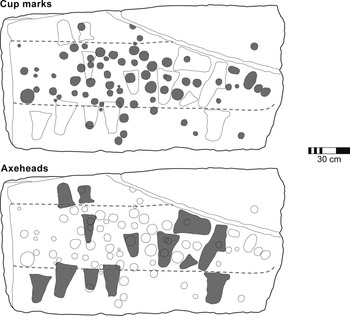
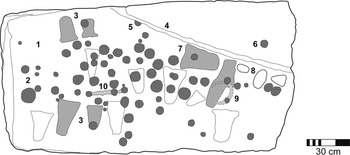
Photogrammetry raises the possibility of a more complex scheme. The main concentration of cup marks was restricted to the central panel delineated by subtle breaks of slope which cross the stone. The axeheads, however, were located on their sides and for the most part, they enclosed the distribution of those motifs; there was less overlap between them than Morris’s description implies (Fig. 3). They were organised so that the axes extended along both edges of the rock, with their blades facing inwards. In two cases towards its southern limit (the left-hand side in the illustrations), these images seem to have been organised in pairs, one opposite the other (Fig. 4). In these instances, a smaller depiction of an axehead was associated with a larger one: a relationship that is also evidenced on the end slab of the cist. Their forms were different from one another (but they might have been influenced by variations in the surface of the stone). Both Craw and Morris proposed that one of the artefacts had a handle, but they were not connected directly. It is more likely that the pecked line was meant to connect three of the cup marks.
The cist cover within Nether Largie North cairn showing how the distribution of cup marks complements the concentration of pecked axeheads. The cup marks are clustered within a central panel defined by breaks of slope on the rock surface, indicated by dashed lines. Several of the axe blades are aligned along the margins of this panel

The components of the decorated cist cover at Nether Largie North. Key: 1 – the eroded end of the stone; 2 – weathered cup marks on the eroded end of the stone; 3 – pairing between larger and smaller axeheads, with their blades facing one another across the decorated surface; 4 – the edge of the broken surface; 5 – possible truncated cup mark; 6 – cup mark on the fractured surface; 7 – pecked axehead aligned with the edge of the broken surface; 8 – oval or wedge-shaped hollows or ‘cups’; 9 – a faint ring intersecting with an ambiguous carving which might depict two conjoined axeheads; and 10 – pecked line associated with one of the axeheads or linking three of the cup marks

EVIDENCE OF SEQUENCE AT NETHER LARGIE NORTH?
The original design for the cist cover may have been modified when part of its surface spalled off (Fig. 4). It is impossible to say whether any motifs were lost, although a depression along the fracture may be a truncated cup mark. It is clear that the decorated end slab of the cist cannot be the missing piece. In fact, there are indications of a more extended sequence. When the piece became detached from the cover, it left a scar whose surface was marked by a prominent cup. At the same time, the orderly arrangement of pecked motifs broke down around the damaged area. The depictions of axes seem to be organised in relation to the line of the break, and one of the most prominent examples is at right-angles to their usual orientation. Other designs seem to be crowded together on the surviving part of the surface where several oval or wedge-shaped hollows similar to cup marks respect the broken edge. Craw (Reference Craw1931) thought that they represented artefacts, but the evidence is not convincing.
This does not mean that all the images were executed according to a single design. The southern end of the decorated stone has a distinctive character. It is more eroded than the remaining part (Bradley Reference Bradley1993, 91–3) and features several cup marks which have experienced a similar amount of weathering; their number has been increased using photogrammetry. The main concentration of cups begins just beyond this section. They are in fresher condition than the others. The contrast between these two zones is so striking that they could have had different histories. The simplest explanation is that the cover slab was previously used as a standing stone. One end was set in the ground where its base was modified by exposure to the subsoil; this is often observed on monoliths that have fallen. It would explain why the cup marks towards this end of the slab were more eroded than the others. This part of the stone features an axehead which is considerably better preserved, raising the possibility that the motif dates from a later phase.
How can these observations be combined? The form of the cover slab suggests that it was removed from the surface of a glacially modified rock. There is nothing to show whether the stone was decorated at this stage, but it is known that features of this kind in Argyll were embellished with cup marks or cups and rings (RCAHMS 1971, 52–61; 1988, 85–126). Their decorated surfaces were of similar extent to the capstone at Nether Largie North. At the same time, the striking difference between the southern end of this stone and the remaining part suggests that it was initially set upright. The weathered cup marks must have been present when that happened, and there may have been more above ground. Standing stones with clusters of these motifs are found in the Kilmartin area, including examples at Nether Largie (RCAHMS 1988, 135–7). Most of the standing stones on the mainland of Argyll are described as ‘slabs’ or ‘tall thin pillars’ (Swarbrick Reference Swarbrick2012, 50–2). This example would have taken a similar form.
At least one of the pecked axes could not have been created until that monolith had been removed from the ground, for it was near what would have been its base and did not show the weathering experienced by the cup marks on that part of the stone. At the same time, it conformed to a wider design, extending along both edges of the decorated surface and enclosing the densest concentration of cups. The scheme is well documented along the southern half of the cist cover but seems to have broken down towards its northern end, where a section of the surface was detached. It is not clear when that happened. Was part of the monolith lost while the stone was exposed to the elements, or could the mishap have occurred when it was taken down? There is no way of telling. Another possibility is that the stone fractured while the cist was being built. In that case, the grave cannot have been sealed immediately as the pecked decoration seems to have been reorganised after the damage took place.
One of the largest motifs is usually identified as an axehead. It abuts the broken part of the cist cover and extends at right-angles to the edge of the fracture (see Fig. 4). Again, it encloses a prominent cup mark. It is possible that in fact up to three different images were superimposed or combined: the butts of two axes facing in opposite directions, and a circular motif, identified by photogrammetry, which resembles the rings on another slab from Craw’s (Reference Craw1931, fig. 6) excavation and is the same size as the smaller example.
There is a further complication. It is usually said that the depictions of axes were superimposed on a series of cup marks, but their distributions were by no means the same. Although some of the cups would have been the earliest feature, others might have been created during later phases. It could have happened when the stone was set on end or even when it covered the burial. One feature has not been considered before. In four or five instances, the depictions of axes incorporate a prominent cup, either at the butt or along the centre of the blade. Were they put there in order to include existing motifs, or were these integral compositions? In either case, it is unlikely that the cup marks had lost their significance entirely. Although the earliest cup marks were older than the images of metalwork, their positions were taken into account when the stone was re-used.
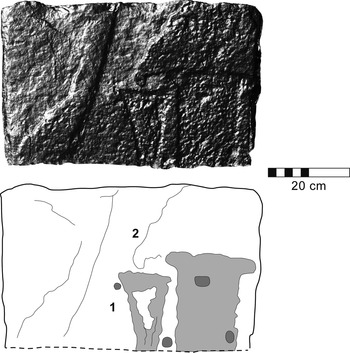
Photogrammetry sheds new light on the damaged slab that marks the north end of the cist (Fig. 5). Its main feature is a pair of pecked axes of contrasting sizes. They were similar to those on the cover slab. In one case, the outline of the entire object was drawn, but the interior was not completely pecked. Again, their outlines and positions were partly shaped by existing features of the rock. This slab also included cup marks, two of them integrated within the axehead carvings.
Photogrammetric model and schematic interpretation of the northern end-slab of the cist at Nether Largie North. Key: 1 – the interior of the left-hand axehead is not fully pecked; 2 – a natural feature, shown as an open line, appears to have determined the size and position of the two axeheads. Cup marks are shown in a darker shade of grey. The lower section of the panel is obscured by a gravel fill, indicated as a dashed line

DATING THE AXEHEADS AT NETHER LARGIE NORTH
It is difficult to date the images at Nether Largie North. As Stuart Needham and Trevor Cowie (Reference Needham, Cowie, Cochrane and Jones2012, 98) say, they are very stylised. They are ‘not especially well matched among the Chalcolithic and Early Bronze Age series of copper/alloy axeheads’. They appear to show flat axes, at least two of them with an abruptly expanded cutting edge. Their proportions are consistent with those of artefacts in Scotland and Ireland. The shape of the butt may be more informative than that of the blade. A square form was preferred for Irish examples, but on the cist cover they are more rounded like those of Scottish finds (Harbison Reference Harbison1969, pls 1–36; Schmidt & Burgess Reference Schmidt and Burgess1981, pls 1–15). Andrew Jones (Reference Jones, Skoglund, Ling and Bertilsson2015) has compared the depictions of axes at Nether Largie with the open moulds used by smiths. Their shapes might also be compared with those of ‘axe-ingots’ (Matthew Knight pers. comm.). Knight raised the possibility that they ‘could pre-date the axe-mould tradition and represent early axes, linked with copper blanks that had to be hammered into shape’. The argument would not apply to the examples with an expanded cutting edge.
NETHER LARGIE MID CAIRN AND RI CRUIN
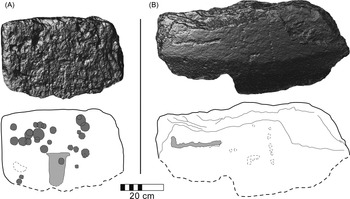
The evidence from the Nether Largie Mid cairn has always presented a problem. The monument was associated with two cists, but both were empty. The cairn covered a single cup-marked slab. Long after the excavation took place, pecked motifs were identified on one edge of the southern cist which is located just inside the kerb of the monument (Campbell & Sandeman Reference Campbell and Sandeman1962). They are catalogued as ‘at least one recognisable cup mark and … a pecked marking of a bronze axehead’ (RCAHMS 1988, 68). Later researchers have expressed doubts about these images but their authenticity is confirmed by photogrammetry, which shows that, in fact, the north side of the cist did feature a depiction of a large axehead (Fig. 6). In size and form, it was strikingly similar to those beneath the North cairn on the same site. It has not been illustrated in print before. Where the summary account referred to a single cup mark the new analysis shows that it was accompanied by an array of these motifs, some of them overlapping one another. There may have been others on the western side of the grave but far more striking is the discovery on the south-east end-slab of a motif that may depict a hafted artefact (Fig. 6). It is reminiscent of the halberd identified at Ri Cruin but is only half its size. The Ri Cruin halberd is depicted in an upright position, while the motif at Nether Largie Mid is shown on its side. This end-slab faced the axehead opposite and is also embellished by a line of small cup marks.
Photogrammetric models and schematic interpretations of decorated end-slabs in the southern cist at Nether Largie Mid. A – the north-western end-slab showing cup marks and pecked axehead. B – the south-eastern end-slab showing a possible pecked hafted artefact and an alignment of small features. The lower section of these panels is obscured by a gravel fill, indicated as a dashed line

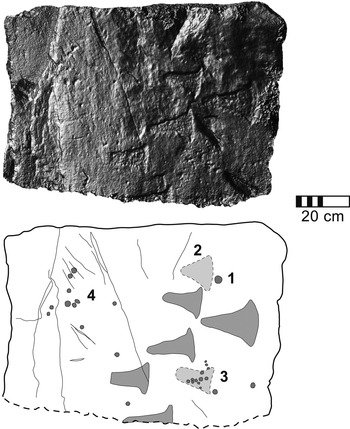
The cairn at Ri Cruin shares some features with Nether Largie Mid (Cowie Reference Cowie, Hunter and Sheridan2016). It may have been built in stages, and the only decorated cist was just outside the remains of a kerb. There were three such structures. One contained cremated bone, but there is no record of any grave goods. The ends of the decorated cist featured different designs from one another. The panel portraying a series of axes is already well known. It faced a stone that has been described as a ‘halberd pillar’ (Needham & Cowie Reference Needham, Cowie, Cochrane and Jones2012). Photogrammetry supplies additional information on the axeheads visible above the modern gravel fill within the cist. A natural depression towards the top of the panel appears to have been modified by pecking to suggest the form of an axehead that shares the same orientation as its neighbours (Fig. 7). There is also a cluster of small cups and peck marks lower down the panel which overlap with a faint axehead observed by Needham and Cowie (Reference Needham, Cowie, Cochrane and Jones2012, fig. 7.6).
Photogrammetric model and schematic interpretation of the western end-slab of the southern cist at Ri Cruin. Key: 1 – a small cup mark; 2 – a natural feature that appears to have been enhanced by pecking; 3 – a faint axehead is the focus for a cluster of pecked marks and small cups; and 4 – an area of small cups. The lower section of the panel is truncated by a gravel fill, indicated as a dashed line

DATING THE MOTIFS AT NETHER LARGIE MID AND RI CRUIN
The chronology of Ri Cruin presents fewer problems than Nether Largie North. Most of the axes were of a distinctive form. They are axes of Killaha type which are found in Ireland and to a smaller extent in Scotland (Harbison Reference Harbison1969, 24–32 & pls 19–36; Schmidt & Burgess Reference Schmidt and Burgess1981, 33–5 & pl. 5). They should date between about 2200 bc and 2000 bc (Needham Reference Needham, Shepherd and Barclay2004). The same estimate could extend to the halberd and its newly discovered counterpart in the Nether Largie Mid cairn (Needham Reference Needham2015). The axeheads depicted on the cist cover at Nether Largie North are less diagnostic. Compared with surviving artefacts, they seem exceptionally big, but this may be deceptive. It has always been acknowledged that they are of different sizes. The new study shows that they sometimes feature in pairs. Depictions of axeheads at both Nether Largie and Ri Cruin incorporated natural features in the surface of the stone.
THE SHARING OF OTHER ELEMENTS
Other carved elements are shared by these sites. At Nether Largie North the decorated stone had probably been introduced from another location where it had stood upright. The pecked motifs were made at intervals over a period of time, and the design seems to have developed incrementally. The same interpretation applies to Ri Cruin. The stone described as a halberd pillar was probably incomplete. ‘The slab was originally longer and perhaps derived from some other monumental setting’ (Needham & Cowie Reference Needham, Cowie, Cochrane and Jones2012, 100). Analysis of the pecked motifs is equally revealing, for the surviving cast suggests that the design developed in three stages. The halberd was the latest element. Its shaft cut across an older image that resembles another axehead.
Less can be said about the decorated cist at the Nether Largie Mid cairn, but if the identification of a small, hafted artefact is accepted, it differs from the halberd at Ri Cruin, which is portrayed in a vertical orientation. This example seems to be on its side. The simplest explanation is that it is not in its original position. On all three sites, at least some of the decorated stones were introduced from other structures.
The re-used fragments were arranged with a certain order. At Nether Largie North the placing of cup marks and axeheads conform to a simple scheme, and in Nether Largie Mid it now seems as if a large axehead faced the depiction of a hafted artefact on the opposite side of the cist. Exactly the same arrangement has been identified at Ri Cruin. The connections between the three sites are more striking following photogrammetry. The main points are summarised in Table 1.
THE MAIN CHARACTERISTICS OF THE DECORATED CIST SLABS, WITH THEIR PRINCIPAL FEATURES HIGHLIGHTED IN BOLD

THE WIDER CONTEXT
As the new records show, the decorated cists at Kilmartin share several features. All these structures were part of an alignment of cairns. Its layout was influenced by the local topography, but the original point of reference was probably Nether Largie South which was a Neolithic chambered tomb before it was rebuilt during the Chalcolithic or Early Bronze Age periods. Although the edge of the first monument has never been defined, its chambers extended from north-east to south-west. The row of round cairns conformed to the same orientation. Three of them – Glebe Cairn, Nether Largie North, and Nether Largie Mid – covered ‘over-sized’ cists (Cook et al. Reference Cook, Ellis and Sheridan2010, 200). It seems possible that some of the material had been taken from older monuments, including the northern stone circle at Temple Wood (Sheridan Reference Sheridan, Jones, Pollard, Allen and Gardiner2012, 177).
Another feature shared between the decorated cairns was a paucity of grave goods. Two Food Vessels and fragments of a jet necklace were deposited within cists beneath the Glebe Cairn at the north end of the cemetery but the remaining monuments contained very few artefacts: a feature that applies to other cairns in the vicinity. Instead, there were the depictions of metalwork considered here. Their presence raises a problem. They cannot have been intended as substitutes for the actual objects because halberds are by no means common in burials. The same applies to axes which usually occur in hoards (Needham Reference Needham1988). Where they can be compared with surviving artefacts, the evidence suggests a date between about 2200 bc and 2000 bc. This was when metal was brought to Britain from Ross Island in south-west Ireland.
Relations with Ireland must have been important. Kilmartin Glen is near a sheltered harbour, and Alison Sheridan (Reference Sheridan, Jones, Pollard, Allen and Gardiner2012, 175–8) suggests that the depictions of early metalwork referred to links across the water. The pottery in the graves emphasises the same connection and includes lavishly decorated Irish Bowls whose dates extend from 2160 bc to 1920 bc (Brindley 2007, 238–51). The metalwork portrayed in the cists has the same chronology. After 1900 bc, relationships across the water became less important, and when copper extraction ended at Ross Island the ‘golden age’ of Kilmartin was over (Sheridan Reference Sheridan, Jones, Pollard, Allen and Gardiner2012).
Other relationships were with monuments in another part of Scotland. There was a linear cemetery of large cairns at Balnuaran of Clava, near Inverness. Again, it extended from north-east to south-west. The use of both complexes overlapped between 2100 bc and 1900 bc, and both areas were connected by the movement of metal from the Atlantic coast through the Great Glen to an area where early moulds and hoards are recorded (Needham Reference Needham, Shepherd and Barclay2004, fig. 19.19). The distribution of Clava Cairns straddles this route, and pieces of already-decorated stone were used in building the monuments (Bradley Reference Bradley2000, 217–18). Although Clava Cairns are considered as a regional phenomenon, a comparable structure has been excavated at Kintraw, only 6 km from Nether Largie (Simpson Reference Simpson1967).
Among the Clava Cairns there are passage graves whose architecture could have been inspired by the remains of Neolithic monuments in northern Scotland, some of which were re-used during the Chalcolithic and Early Bronze Age (Bradley Reference Bradley2000, 221–4). The influence of the local past may have been equally powerful at Kilmartin. The principal Neolithic monument at Temple Wood was reconstructed, and the use of massive cists may have been inspired by ruined Clyde Cairns. There is equally striking evidence for the recycling of decorated stones. Older monoliths were incorporated in new structures at Nether Largie North and Ri Cruin, and panels of Neolithic rock art were re-used as cist slabs at Badden and Cairnbaan (Sheridan Reference Sheridan, Jones, Pollard, Allen and Gardiner2012, 177).
This concern with a distant past is most apparent at the Neolithic Clyde Cairn, Nether Largie South. The end chamber of the original monument contained a later cist which was probably the source of a scatter of Beaker pottery dated to 2300 bc (Greenwell Reference Greenwell1866, 341–7; Sheridan Reference Sheridan, Jones, Pollard, Allen and Gardiner2012, 175). There were barbed and tanged arrowheads of the kind often used as grave goods and similar sherds were found in the other chambers, as well as those of a Food Vessel. They seem to have been associated with burnt and unburnt bones. A second change was when the existing monument was rebuilt as a circular cairn. It was similar to its neighbours but may have been larger than either of them. The new structure was associated with two cists, one of them built from particularly big slabs. It did not include any artefacts, but the other example was associated with a ‘decorated urn’ that no longer survives; to judge from Greenwell’s description, it was another Irish Bowl (Greenwell Reference Greenwell1866, 341–2). The sequence is not entirely clear, but the Neolithic structure might have been re-used before the monument was extended. The Beaker deposit in the end chamber could have been older than the secondary cairn. Comparison with Nether Largie Mid and North suggests that the new construction dates from the Early Bronze Age.
These changes are consistent with other developments in the surrounding landscape. Towards the end of the 3rd millennium bc, the communities who used the monuments in Kilmartin Glen seem to have forged a distinctive identity for themselves. They did this in three different ways: by evoking connections with distant areas through the use of an Irish style of pottery; by depicting exotic items of metalwork inside three decorated cists; and by referring to an imagined past in the structures they built. The images recorded in this paper illustrate these concerns, but they can only be understood in relation to local practices and ideas.
Depictions of tools and weapons can be found in several parts of prehistoric Europe, but outside one region of Portugal, they are unusual inside Bronze Age cists (Bettencourt et al. Reference Bettencourt, Santos-Estévez and Sampaio2021). The examples studied in this paper have always appeared anomalous. Perhaps that is because they were made in such special circumstances. They were an exceptional component of an exceptional group of monuments, and they need to be studied in those terms.
Acknowledgements:
We are grateful to Tertia Barnett, Matthew Knight, Stuart Needham, Alison Sheridan, Joana Valdez-Tullett, Sharon Webb, and an anonymous referee for helpful comments on an earlier draft of this article.