Posttraumatic stress disorder (PTSD) manifests as prolonged and maladaptive responding to traumatic events (American Psychiatric Association, 2013). Cognitive models implicate biased attentional processing of threat-related information in the disorder, suggesting that the attentional system of patients with PTSD may be distinctively sensitive to or biased in favor of such stimuli (Brewin & Holmes, Reference Brewin and Holmes2003; Buckley, Blanchard, & Neill, Reference Buckley, Blanchard and Neill2000; Chemtob, Roitblat, Hamada, Carlson, & Twentyman, Reference Chemtob, Roitblat, Hamada, Carlson and Twentyman1988; Ehlers & Clark, Reference Ehlers and Clark2000; Foa, Steketee, & Rothbaum, Reference Foa, Steketee and Rothbaum1989; Litz & Keane, Reference Litz and Keane1989). Eye-tracking methodology has been increasingly used to explore attention patterns in PTSD, with results consistently implicating increased sustained attention on threat in participants with PTSD, with little-to-no support emerging for enhanced threat detection or attentional avoidance (for a review, see Lazarov et al., Reference Lazarov, Suarez-Jimenez, Tamman, Falzon, Zhu, Edmondson and Neria2019; more recently, Mekawi et al., Reference Mekawi, Murphy, Munoz, Briscione, Tone, Norrholm and Powers2020; Powers et al., Reference Powers, Fani, Murphy, Briscione, Bradley, Tone and Jovanovic2019). Such findings point to sustained attention on threat as a potential target for cognitive bias modification interventions in PTSD (Gober, Lazarov, & Bar-Haim, Reference Gober, Lazarov and Bar-Haim2020; Lazarov et al., Reference Lazarov, Suarez-Jimenez, Tamman, Falzon, Zhu, Edmondson and Neria2019).
A more in-depth examination of findings from extant eye-tracking research (for a systematic review, see Lazarov et al., Reference Lazarov, Suarez-Jimenez, Tamman, Falzon, Zhu, Edmondson and Neria2019) shows that increased sustained attention on threat has been consistently shown when comparing PTSD participants with healthy participants with no trauma exposure (Armstrong, Bilsky, Zhao, & Olatunji, Reference Armstrong, Bilsky, Zhao and Olatunji2013; Lee & Lee, Reference Lee and Lee2012, Reference Lee and Lee2014; Matlow, Reference Matlow2013; Thomas, Goegan, Newman, Arndt, & Sears, Reference Thomas, Goegan, Newman, Arndt and Sears2013), with similar results emerging when comparing PTSD participants to trauma-exposed healthy participants (Armstrong et al., Reference Armstrong, Bilsky, Zhao and Olatunji2013; Kimble, Fleming, Bandy, Kim, & Zambetti, Reference Kimble, Fleming, Bandy, Kim and Zambetti2010; Lee & Lee, Reference Lee and Lee2012, Reference Lee and Lee2014; Powers et al., Reference Powers, Fani, Murphy, Briscione, Bradley, Tone and Jovanovic2019). Comparing trauma-exposed healthy participants with healthy participants who did not experience a traumatic event, aiming to clarify the effects of trauma-exposure per-se on attention allocation, shows elevated threat-related sustained attention in the trauma-exposed group (Lee & Lee, Reference Lee and Lee2012, Reference Lee and Lee2014; Thomas et al., Reference Thomas, Goegan, Newman, Arndt and Sears2013; cf. see Armstrong et al., Reference Armstrong, Bilsky, Zhao and Olatunji2013). Taken together, it has been recently suggested that trauma exposure in itself may be sufficient to bias attention toward trauma-relevant stimuli, manifesting in sustained attention on threat cues, with PTSD symptomology further amplifying this bias (Lazarov et al., Reference Lazarov, Suarez-Jimenez, Tamman, Falzon, Zhu, Edmondson and Neria2019).
Despite these promising findings, extant eye-tracking research in PTSD carries some key limitations slowing the progress in converting the understandings of attention biases into novel intervention targets. First, all studies to date used small stimulus set-sizes. More complex, ecologically-valid visual displays are needed to enhance generalizability (Armstrong & Olatunji, Reference Armstrong and Olatunji2012; Richards, Benson, Donnelly, & Hadwin, Reference Richards, Benson, Donnelly and Hadwin2014). Second, most studies used small sample sizes, limiting power and generalizability. Third, the reliability of eye-tracking-derived indices in PTSD has yet to be examined, which is a vital step in increasing confidence in obtained findings (Lilienfeld & Strother, Reference Lilienfeld and Strother2020). Finally, only a few studies incorporated both trauma-exposed and non-trauma-exposed healthy participants as control participants within the same study to tease apart the effects of trauma exposure from those of clinical symptoms (Armstrong et al., Reference Armstrong, Bilsky, Zhao and Olatunji2013; Lee & Lee, Reference Lee and Lee2012, Reference Lee and Lee2014; Thomas et al., Reference Thomas, Goegan, Newman, Arndt and Sears2013).
The current study aimed to address the above-outlined limitations by adapting a well-established free-viewing task assessing attention allocation (Lazarov, Abend, & Bar-Haim, Reference Lazarov, Abend and Bar-Haim2016; Lazarov, Ben-Zion, Shamai, Pine, & Bar-Haim, Reference Lazarov, Ben-Zion, Shamai, Pine and Bar-Haim2018) to PTSD, hoping to identify a relevant and reliable target for intervention. Hence, here, patients with PTSD, trauma-exposed healthy control (TEHC), and healthy control (HC) participants freely viewed visual displays comprised of 16 faces, half negatively-valenced and half neutral, while their gaze was continuously recorded. Negatively-valenced faces included angry, fearful, and sad expressions, three key emotions implicated in the clinical presentation of PTSD (American Psychiatric Association, 2013), and found to be PTSD-relevant in extant attentional research (Armstrong et al., Reference Armstrong, Bilsky, Zhao and Olatunji2013; Badura-Brack et al., Reference Badura-Brack, Naim, Ryan, Levy, Abend, Khanna and Bar-Haim2015; Beevers, Lee, Wells, Ellis, & Telch, Reference Beevers, Lee, Wells, Ellis and Telch2011; Lee & Lee, Reference Lee and Lee2014; Mekawi et al., Reference Mekawi, Murphy, Munoz, Briscione, Tone, Norrholm and Powers2020; Powers et al., Reference Powers, Fani, Murphy, Briscione, Bradley, Tone and Jovanovic2019). Internal consistency and 1-week test-retest reliability were also evaluated, for the entire sample and within groups.
Based on extant research in PTSD described above, we predicted that patients with PTSD would dwell longer on negatively-valenced faces over neutral faces, relative to both HC and TEHC participants. In addition, based on prior studies comparing TEHC and HC participants, it was further hypothesized that TEHCs would dwell longer on negatively-valenced faces compared with HCs. As previous attentional studies in PTSD have utilized different negatively-valenced faces (Lazarov et al., Reference Lazarov, Suarez-Jimenez, Tamman, Falzon, Zhu, Edmondson and Neria2019), we also explored possible differences between groups with regard to the three chosen negatively-valenced emotions. Finally, in accord with customary practices in eye-tracking research (Armstrong & Olatunji, Reference Armstrong and Olatunji2012; Chen & Clarke, Reference Chen and Clarke2017; Suslow, Hußlack, Kersting, & Bodenschatz, Reference Suslow, Hußlack, Kersting and Bodenschatz2020), we analyzed first-fixation variables, namely, first-fixation location, latency, and dwell time.
Methods
Participants
Participants were recruited via online advertisement, local media, and community postings; 37 with clinically diagnosed PTSD, 34 TEHCs, and 30 HCs with no trauma exposure, matched on age, sex, and race. Demographic and psychopathological characteristics by group are presented in Table 1, and described more fully along with group differences analyses in the Supplementary Material. All participants in the two trauma-exposed groups met DSM-5 criterion A for a traumatic event of an interpersonal nature (Forbes et al., Reference Forbes, Lockwood, Phelps, Wade, Creamer, Bryant and O'Donnell2014; Kelley, Weathers, McDevitt-Murphy, Eakin, & Flood, Reference Kelley, Weathers, McDevitt-Murphy, Eakin and Flood2009; Kessler & Üstün, Reference Kessler and Üstün2004), determined using the Life Events Checklist for DSM-5 (LEC-5; Weathers et al. Reference Weathers, Blake, Schnurr, Kaloupek, Marx and Keane2013b). We chose to include only participants who experienced an interpersonal traumatic event to maximize the relevance of facial stimuli as trauma-relevant cues. Indeed, prior research has shown the emotional effect of viewing negative facial expressions in PTSD (Armony, Corbo, Clement, & Brunei, Reference Armony, Corbo, Clement and Brunei2005; Rauch et al., Reference Rauch, Whalen, Shin, McInerney, Macklin, Lasko and Pitman2000), also more specifically in those with a history of an interpersonal trauma (Fonzo et al., Reference Fonzo, Simmons, Thorp, Norman, Paulus and Stein2010; Garrett et al., Reference Garrett, Carrion, Kletter, Karchemskiy, Weems and Reiss2012; Lee & Lee, Reference Lee and Lee2014). In addition to a primary diagnosis of PTSD, patients also scored ⩾25 on the Clinician-Administered PTSD Scale-5 (CAPS-5; Weathers et al. Reference Weathers, Blake, Schnurr, Kaloupek, Marx and Keane2013a, Reference Weathers, Blake, Schnurr, Kaloupek, Marx and Keane2013b). TEHCs had no current/past diagnosis of PTSD coupled with a CAPS-5 score <10. HCs had no current/past diagnosis of any psychiatric disorder. See Supplementary Material for detailed inclusion/exclusion criteria.
Demographic and psychopathological characteristics by group

PTSD, posttraumatic stress disorder; TEHC, trauma-exposed healthy control; HC, healthy control; CAPS, Clinician-Administered PTSD Scale; HAM-D, Hamilton Rating Scale for Depression; HAM-A, Hamilton Anxiety Rating Scale.
Asterisks indicate significant differences between groups. Different superscripts indicate significant pair-wise differences between groups.
The study adhered with the ethical guidelines of the Declaration of Helsinki and was approved by the New York State Psychiatric Institute (NYSPI) Institutional Review Board. After receiving explanations about the study, participants provided written informed consent. Participants were compensated $70 for participation.
Measures
All participants were assessed for primary and co-morbid psychiatric diagnoses using the Structured Clinical Interview for DSM-5 (SCID-5; First, Williams, Karg, & Spitzer, Reference First, Williams, Karg and Spitzer2015), a well-validated interview for DSM-5 diagnoses, conducted by an independent clinical assessor, a Ph.D.-level psychologist trained to 85% reliability with a senior clinician on all used measures. All participants were also administered the clinician-rated Hamilton Rating Scale for Depression (HAM-D; Hamilton, Reference Hamilton1960) and Hamilton Anxiety Rating Scale (HAM-A; Hamilton, Reference Hamilton1959). Finally, PTSD and TEHC participants underwent a full assessment of trauma exposure using the LEC-5 (Weathers et al., Reference Weathers, Blake, Schnurr, Kaloupek, Marx and Keane2013a, Reference Weathers, Blake, Schnurr, Kaloupek, Marx and Keane2013b). CAPS-5 (Weathers et al., Reference Weathers, Blake, Schnurr, Kaloupek, Marx and Keane2013a, Reference Weathers, Blake, Schnurr, Kaloupek, Marx and Keane2013b) was administered to PTSD and TEHC participants to determine the severity of posttraumatic symptoms in reference to the traumatic event identified by each participant on the LEC-5 as bothering them the most. See Supplementary Material for a full description of used measures.
Free viewing eye-tracking task
Gaze patterns were assessed using an established eye-tracking task with acceptable psychometric properties in both depression and anxiety (Chong & Meyer, Reference Chong and Meyer2020; Klawohn et al., Reference Klawohn, Bruchnak, Burani, Meyer, Lazarov, Bar-Haim and Hajcak2020; Lazarov et al., Reference Lazarov, Abend and Bar-Haim2016; Lazarov et al., Reference Lazarov, Ben-Zion, Shamai, Pine and Bar-Haim2018; Lazarov, Pine, & Bar-Haim, Reference Lazarov, Pine and Bar-Haim2017) adapted for the current study. The task was designed and executed using the Experiment Builder software (version 2.1.140; SR Research Ltd., Mississauga, Ontario, Canada).
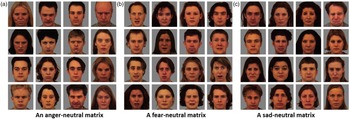
The free viewing eye-tracking task comprised of three separate blocks delivered in a counterbalanced manner across participants in each group, each focusing on a different negative emotion-neutral contrast with theoretical relevance for PTSD. One block consisted of angry and neutral facial expressions, one of fearful and neutral expressions, and one of sad and neutral expressions. For each block, color photographs of eight male and eight female actors, each contributing an emotional and a neutral facial expression (for a total of 32 pictures; 16 male and 16 female), were taken from the Karolinska Directed Emotional Faces database (KDEF; Lundqvist, Flykt, & Öhman, Reference Lundqvist, Flykt and Öhman1998), with each actor appearing in only one of the blocks. We selected faces in which teeth were not exposed, or were barely visible, to reduce the effects of lower-level factors on gaze patterns (Lazarov et al., Reference Lazarov, Abend and Bar-Haim2016). Each block consisted of 30 different 4-by-4 matrices, with each matrix consisting of eight negative emotional (angry, fearful, or sad) and eight neutral facial expressions. Each individual face extended 225-by-225 pixels, including a 10-pixel white margin frame, for an overall size of 900-by-900 pixels (see Fig. 1 for a matrix example of each block). Each single face appeared randomly at any position on the matrix while ensuring that: (a) each actor appeared only once in a matrix; (b) each matrix contained eight male and eight female faces; and (c) half the faces were emotional and half were neutral, a ratio that was also kept for the four inner faces of the matrix. Each single facial expression had the same appearance prevalence within the block, that is, each facial expression appeared exactly 15 times per block.
An example of a single matrix for (a) the angry-neutral block; (b) the fear-neutral block; and (c) the sad-neutral block. In each block, the eight emotional faces comprise the angry/fearful/sad area of interest (AOI) and the eight neutral faces comprise the neutral AOI.

Each trial began with a centrally-presented fixation-cross necessitating a 1000 ms fixation for the next display to appear. Then the matrix appeared for 6000 ms, followed by an inter-trial-interval of 2000 ms. Participants were instructed to look freely at the matrix until it disappeared. A 2 min break was introduced between blocks to reduce fatigue. Each block was preceded by a five-point eye-tracking calibration followed by a five-point validation procedure. The task/block did not ensue unless a visual deviation below 0.5° was achieved for each point on both the X and Y axes.
Eye-tracking measures
Eye-tracking data were processed using EyeLink Data Viewer software (version 3.1.246; SR Research Ltd.). Fixations were defined as at least 100 ms of stable fixation within 1-degree visual angle. For each presented matrix, we defined two areas of interest (AOIs), one including the eight negatively-valenced faces (angry, fearful, or sad; the negative AOI) and one including the eight neutral faces (the neutral AOI). Total dwell time per AOI was calculated by averaging the total dwell time on each AOI across the 30 matrices of the block. First-fixation latency was calculated by averaging the latency to first fixations, in milliseconds, for each AOI. First-fixation location was measured by counting the number of times the first fixation was in each AOI. First-fixation dwell time was computed by averaging first-fixation duration, in milliseconds, for each AOI. Finally, for complementary correlational analyses (see Data analysis), we followed previous research (Lazarov et al., Reference Lazarov, Abend and Bar-Haim2016, Reference Lazarov, Pine and Bar-Haim2017, Reference Lazarov, Ben-Zion, Shamai, Pine and Bar-Haim2018) and quantified percent dwell time on the negatively-valenced AOI (DT%) in each block as the total dwell time on the negatively-valenced AOI out of the total dwell time on both AOIs.
Apparatus
Eye movements were recorded using a remote high-speed Eyelink 1000+ eye tracker (SR Research Ltd.), with a sampling rate of 500 Hz. Operating distance to the eye-tracking monitor was 60–65 cm. The stimuli were presented on a 24-inch monitor with a 1920 × 1080 pixel screen resolution.
Procedure
Participants were tested individually at the Anxiety Disorders Clinic, NYSPI. They were told that they are going to participate in an eye-tracking study examining gaze patterns. After providing informed consent, participants were seated in front of the eye-tracking monitor and told that during the experiment, they would be presented with different matrices of faces, appearing one after the other. They were also told that before the appearance of each matrix, a fixation cross will appear at the center of the screen, on which they should fixate to make the matrix itself appear. Participants were instructed to look freely at each matrix until it disappeared. Upon completion of the task, participants were scheduled to take part in a second session, held approximately 1 week later (M days = 7.35, s.d. = 4.44), which was identical to session 1 using new matrices from the same set of actors. Four PTSD participants and one TEHC failed to attend session 2.
Data analysis
Eye-tracking data
We powered our study to detect a group-by-AOI interaction using a two-tailed α = 0.05, with 0.85 power, and an effect size of η 2p = 0.12, an effect size estimate derived from previous studies using the same task and study design in other disorders (Lazarov et al., Reference Lazarov, Abend and Bar-Haim2016, Reference Lazarov, Ben-Zion, Shamai, Pine and Bar-Haim2018), as well as in a previous eye-tracking study in PTSD exploring similar groups (Armstrong et al., Reference Armstrong, Bilsky, Zhao and Olatunji2013). This resulted in a required sample of 87 participants, for a minimum of 29 participants per group. We decided to recruit a minimum of 30 per group as a precaution. Power analysis was performed using G*Power 3.1.9.4 (Faul, Erdfelder, Lang, & Buchner, Reference Faul, Erdfelder, Lang and Buchner2007).
One-way analyses of variance (ANOVAs) compared between-group descriptive characteristics, including HAM-D and HAM-A scores, with χ2 tests used to compare groups on gender and ethnicity ratios. An independent sample t test was also used to compare the trauma-exposed groups on CAPS-5 scores. Follow-up analyses for significant one-way ANOVAs included independent sample t tests and χ2 tests for gender ratio and ethnicity.
We examined group differences on the eye-tracking measures by performing a three-by-two-by-three mixed-model ANOVAs with group (PTSD, TEHC, HC) as a between-subjects factor and AOI (threat, neutral) and negative emotion (anger, fear, sad) as within-subject factors. Because the three groups differed in the number of years of education, this variable was introduced as a covariate in all analyses. Complementary correlational analyses examined the possible association between scores on different psychopathology measures (i.e. CAPS-5, HAM-D, and HAM-A) and attention allocation, quantified as percent dwell time on the negatively-valenced AOI (DT%; see measures above). For CAPS-5 analyses, only PTSD and TEHC participants were included.
Reliability was assessed for three variants of the total dwell time measure: total dwell time on negatively-valenced faces, total dwell time on neutral faces, and percent dwell time on negatively-valenced faces (DT%). Internal consistency was examined for the entire sample and separately by group, using Cronbach's α while treating each trial (i.e. each matrix) as a single item. Test-retest reliability was computed using Pearson correlations.
Statistical analyses were conducted using SPSS (IBM; version 25.0) and were two-sided, using α of 0.05. Effect sizes are reported using η 2p values for ANOVAs and Cohen's d for mean comparisons. Bonferroni correction was applied to multiple comparisons.
Results
Sustained attention (total dwell time)
The omnibus ANOVA of group × block × AOI was not significant, F (2,97) = 0.41, p = 0.66. However, a significant group × AOI emerged, F (2,97) = 16.83, p < 0.001, η 2p = 0.26, indicating differential dwell time patterns of the three groups for the negatively-valenced and the neutral AOIs. We therefore collapsed across blocks for the remaining analyses by computing mean total dwell time for a negative-valence AOI (total dwell time on anger, fear, and sad faces) and a neutral AOI (mean total dwell time on neutral faces from all three blocks; see Fig. 2).
Mean averaged total dwell time (in seconds) by area of interest (AOI) and group. Higher values indicate higher mean average dwell time. Error bars denote standard error of the mean. HC, healthy controls; PTSD, posttraumatic stress disorder; TEHC, trauma-exposed healthy control.

Follow-up analyses comparing the PTSD and HC groups indicated a significant group-by-AOI interaction, F (1,64) = 21.15, p < 0.001, η 2p = 0.25. Follow-up independent t tests per AOI revealed that the PTSD group (M = 2403 ms, s.d. = 399) spent significantly more time fixating on the negatively-valenced AOI compared with the HC group (M = 1961 ms, s.d. = 635), t(65) = 3.48, p = 0.002, Cohen's d = 0.83, and significantly less time fixating on the neutral AOI (M = 1952 ms, s.d. = 341) compared with the HC group (M = 2665 ms, s.d. = 819), t(65) = 4.81, p < 0.001, Cohen's d = 1.14. A significant group-by-AOI interaction also emerged when exploring the PTSD and TEHC groups, F (1,68) = 10.83, p = 0.002, η 2p = 0.14, with the PTSD group spending significantly more time fixating on the negatively-valenced AOI compared with the TEHC group (M = 2189, s.d. = 373), t(69) = 2.33, p = 0.04, Cohen's d = 0.55. No group differences were noted for the neutral AOI (TEHC; M = 2006, s.d. = 304), t(69) = 0.70, p = 0.49. Finally, comparing the TEHC and HC groups also yielded a significant group-by-AOI interaction, F (1,61) = 12.84, p = 0.002, η 2p = 0.17. Follow-up t tests revealed that the HC group spent significantly more time fixating on the neutral AOI compared with the TEHC group, t(62) = 4.36, p < 0.001, Cohen's d = 1.07, with no group differences for the negatively-valenced AOI, t(62) = 1.78, p = 0.16. Exploratory within-block analyses and results can be found in the online Supplementary Material and Fig. S1.
Examining within-group differences between the two AOIs using paired-samples t tests indicated a significant difference for the PTSD group, t(36) = 5.03, p < 0.001, Cohen's d = 1.21, and the TEHC group, t(33) = 3.87, p < 0.001, Cohen's d = 0.54, favoring the negatively-valenced AOI. Conversely, for the HC group, a significant difference also emerged but favoring the neutral AOI, t(29) = 2.69, p = 0.02, Cohen's d = 0.96.
Analyzing data from session 2 yielded a similar results pattern to that observed in session 1, revealing a significant group-by-AOI interaction, F (2,92) = 15.49, p < 0.001, η 2p = 0.25. Detailed follow-up analyses, corresponding to those reported for session 1, are reported in the Supplementary Material.
First-fixation measures
For first-fixation latency, a non-significant group × block × AOI interaction, F (2,97) = 1.09, p = 0.34, emerged, with no other significant findings. Similar null results were obtained for first-fixation location, F (2,97) = 1.05, p = 0.35. For first-fixation dwell time, while the omnibus group × block × AOI was not significant, F (2,97) = 0.71, p = 0.49, a significant group × AOI emerged, F (2,97) = 6.06, p = 0.009, η 2p = 0.11. Hence, we once again collapsed across blocks for the remaining of our analyses (see Fig. 3). Results of within-block exploratory analyses can be found in the Supplementary Material and Fig. S2.
Averaged first-fixation dwell time (in milliseconds) by area of interest (AOI) and group. Higher values indicate higher average dwell time. Error bars denote standard error of the mean. HC, healthy controls; PTSD, posttraumatic stress disorder; TEHC, trauma-exposed healthy control.

For first-fixation dwell time, comparing the PTSD and HC groups indicated a significant group-by-AOI interaction, F (1,64) = 9.89, p = 0.009, η 2p = 0.13, which was also evident when comparing the TEHC and HC groups, F (1,61) = 5.02, p = 0.04, η 2p = 0.08. However, unlike total dwell time (see above), comparing the PTSD and TEHC groups did not reveal a significant group-by-AOI interaction, F (1,68) = 1.41, p = 0.24. Detailed follow-up analyses, including descriptive statistics, for first-fixation dwell time are reported in the online Supplementary Material.
Analyzing data from session 2 showed similar results, namely, a non-significant omnibus group × block × AOI interaction, F (2,92) = 0.55, p = 0.58, but a significant group × AOI interaction for first-fixation dwell time only, F (2,92) = 4.92, p = 0.03, η 2p = 0.10. Detailed follow-up analyses, corresponding to those reported for session 1, are described in the Supplementary Material.
Correlation analyses
Percentage of total dwell time spent on the negatively-valenced AOI (DT%) was positively correlated with CAPS-5 scores, r(71) = 0.29, p = 0.04, and with the HAM-D scores, r(101) = 0.34, p < 0.001, but not with HAM-A scores, r(101) = 0.17, p = 0.24. No correlations emerged for first-fixation mean dwell time. Results of within-block exploratory analyses are described in the Supplementary Material.
Internal consistency and test-retest reliability
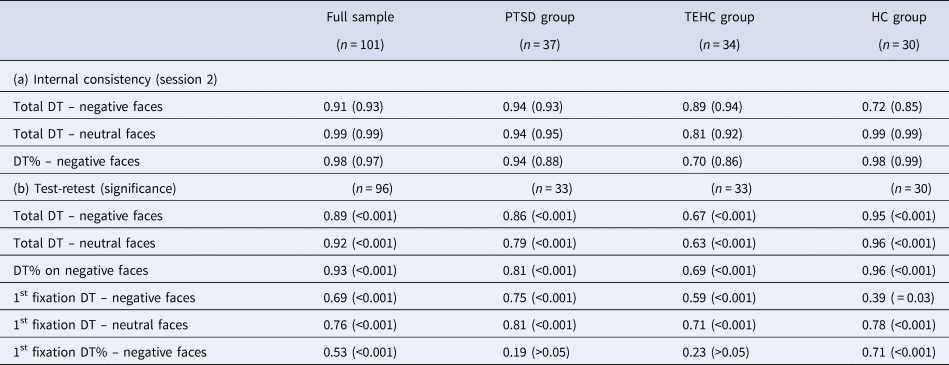
Internal consistency and test-retest reliability for total dwell time on each AOI, and for DT%, were high for the full sample and within groups. See Table 2 for detailed results, including test-retest for first-fixation dwell time.
Internal consistency and test-retest reliability

DT = dwell time; DT% = the percentage of total dwell time on negative-valenced faces out of total dwell time spent on both types of faces.
Discussion
The present study compared the gaze patterns of patients with clinically diagnosed PTSD, trauma-exposed healthy participants, and healthy participants with no trauma exposure when viewing different negatively-valenced and neutral cues. Our main finding differentiates groups' attention allocation patterns, as reflected in sustained attention, with PTSD participants found to dwell longer on negatively-valenced stimuli compared with both control groups. This increased dwell time on negatively-valenced stimuli in PTSD corroborates and extends prior eye-tracking studies in the field (Armstrong et al., Reference Armstrong, Bilsky, Zhao and Olatunji2013; Kimble et al., Reference Kimble, Fleming, Bandy, Kim and Zambetti2010; Lee & Lee, Reference Lee and Lee2012, Reference Lee and Lee2014; Mekawi et al., Reference Mekawi, Murphy, Munoz, Briscione, Tone, Norrholm and Powers2020; Powers et al., Reference Powers, Fani, Murphy, Briscione, Bradley, Tone and Jovanovic2019), and has been previously linked to several possible theoretical explanations. First, increased dwell time may reflect an attentional component of trauma-related rumination – the repetitive and perseverative thinking about trauma-related issues (Echiverri, Jaeger, Chen, Moore, & Zoellner, Reference Echiverri, Jaeger, Chen, Moore and Zoellner2011; Ehring, Frank, & Ehlers, Reference Ehring, Frank and Ehlers2008; Michael, Halligan, Clark, & Ehlers, Reference Michael, Halligan, Clark and Ehlers2007). Second, it may be seen as the attentional manifestation of harm-preventing heightened monitoring related to hypervigilance symptoms (American Psychiatric Association, 2013; Kimble, Fleming, & Bennion, Reference Kimble, Fleming and Bennion2013). Alternatively, elevated dwelling on negatively-valenced stimuli may reflect deficient attention control (i.e. the capacity to execute voluntary and effortful goal-directed attentional deployment), which has been shown to moderate the association between posttraumatic symptoms and attention biases (Bardeen & Daniel, Reference Bardeen and Daniel2017; Bardeen & Orcutt, Reference Bardeen and Orcutt2011; Bardeen, Daniel, Gordon, Hinnant, & Weathers, Reference Bardeen, Daniel, Gordon, Hinnant and Weathers2020; Bardeen, Tull, Daniel, Evenden, & Stevens, Reference Bardeen, Tull, Daniel, Evenden and Stevens2016). Thus, reduced ability to disengage and shift attention away from negatively-valenced stimuli at will may reflect a particular case of reduced attention control in PTSD. While the present study did not assess attention control, future studies could explore this possibility as it pertains to the present task.
A closer examination of present results shows that both trauma-exposed groups (PTSD, TEHC) demonstrated an attention allocation pattern favoring negatively-valenced stimuli over neutral stimuli, with a greater bias noted in the PTSD group than in the TEHC group. Conversely, the HC group showed the opposite pattern, favoring neutral stimuli. Considered concurrently, these results suggest that traumatic exposure is sufficient to induce lasting alterations to one's attentional system such that negatively-valenced stimuli become prioritized over neutral stimuli (as reflected in the differences between the TEHC and HC groups), and that these alterations are even more pronounced in PTSD (as reflected in the differences between PTSD and TEHC participants). These results are in line with previous eye-tracking studies showing differences between HC and TEHC participants (Lee & Lee, Reference Lee and Lee2012, Reference Lee and Lee2014; Matlow, Reference Matlow2013; Thomas et al., Reference Thomas, Goegan, Newman, Arndt and Sears2013) and between PTSD and TEHC participants (Armstrong et al., Reference Armstrong, Bilsky, Zhao and Olatunji2013; Kimble et al., Reference Kimble, Fleming, Bandy, Kim and Zambetti2010; Lee & Lee, Reference Lee and Lee2012, Reference Lee and Lee2014; Powers et al., Reference Powers, Fani, Murphy, Briscione, Bradley, Tone and Jovanovic2019) on sustained attention on threat. Moreover, the suggested effects of traumatic exposure on one's attentional system echo the results of numerous fear-conditioning studies showing that learned fear associations are sufficient to capture and hold attention even if one tries to resist, enhancing the sensory processing of fear-conditioned stimuli (Mulckhuyse, Crombez, & Van der Stigchel, Reference Mulckhuyse, Crombez and Van der Stigchel2013; Nissens, Failing, & Theeuwes, Reference Nissens, Failing and Theeuwes2017; Preciado, Munneke, & Theeuwes, Reference Preciado, Munneke and Theeuwes2017; Schmidt, Belopolsky, & Theeuwes, Reference Schmidt, Belopolsky and Theeuwes2015). Taken together, the present results suggest that increased sustained attention to negatively-valenced stimuli may be conceptualized as a consequence of exposure to a traumatic event, and as a correlate of PTSD symptomology. On a more speculatively note, present results may also implicate sustained attention as an etiological contributor to PTSD following trauma exposure. While the present study cannot fully differentiate these possibilities, future studies could build on current results and methodology to more clearly address them by, for example, employing longitudinal study designs using the present task (Beevers et al., Reference Beevers, Lee, Wells, Ellis and Telch2011; Wald et al., Reference Wald, Shechner, Bitton, Holoshitz, Charney, Muller and Bar-Haim2011, Reference Wald, Degnan, Gorodetsky, Charney, Fox, Fruchter and Bar-Haim2013).
Akin to previous eye-tracking studies in PTSD, no group differences emerged for first location or latency, lending no support for facilitated detection of negatively-valenced stimuli (for a review, see Lazarov et al., Reference Lazarov, Suarez-Jimenez, Tamman, Falzon, Zhu, Edmondson and Neria2019). Yet, the present study was the first to also examine first-fixation dwell time, reflecting difficulty in initial attention disengagement from negatively-valenced stimuli, once detected, with findings showing a group-by-AOI interaction similar to that observed for sustained attention. Thus, the observed initial difficulty to disengage attention from negatively-valenced stimuli may be viewed as a ‘gate-way’ leading to sustained attention on these stimuli. Interestingly, however, unlike total dwell time, here PTSD and TEHC participants did not differ. Considering both sets of results (i.e. total dwell time and first-fixation dwell time; Figs 2 and 3, respectively) gives rise to the tentative possibility that, from an attentional standpoint, the resilience characterizing TEHC participants might be related to what transpires after the first encounter with a negatively-valenced stimulus. Put differently, while both groups demonstrate the same biased attention allocation pattern once a negatively-valenced stimulus is detected (as compared with HC participants), as ‘contact’ persists, only TEHC participants manage to break away and ‘stay afloat’ attention-wise, while patients with PTSD become increasingly biased, eventually differing from TEHC participants on sustained attention.
The present study did not find differences between the three negatively-valenced emotional stimuli, suggesting a general bias toward negatively-valenced stimuli, with no specificity of discrete emotions. If one is to consider the three negative emotions (anger, fear, sadness) tested here as PTSD-relevant, this finding is not surprising as it replicates substantial prior research in PTSD (for a review, see Lazarov et al., Reference Lazarov, Suarez-Jimenez, Tamman, Falzon, Zhu, Edmondson and Neria2019; also Mekawi et al., Reference Mekawi, Murphy, Munoz, Briscione, Tone, Norrholm and Powers2020; Powers et al., Reference Powers, Fani, Murphy, Briscione, Bradley, Tone and Jovanovic2019). This is also in line with the phenomenology of PTSD per DSM-5 implicating all three emotions in the disorder (American Psychiatric Association, 2013). Conversely, if one is to regard fearful and/or sad faces as general negative stimuli, rather than trauma-specific ones, then lack of differences in sustained attention per emotion could reflect over-generalization from an attentional standpoint (Lee & Lee, Reference Lee and Lee2014). For fear faces, this conundrum is not a new one, as some researchers have considered fearful faces as trauma-relevant stimuli (Armstrong et al., Reference Armstrong, Bilsky, Zhao and Olatunji2013), whereas others as general threat stimuli not specifically trauma-related (Lee & Lee, Reference Lee and Lee2014). While research examining the generalization of threat-related attentional bias is scarce, preliminary evidence does imply that it might be more prominent when comparing PTSD to HC participants than to TEHC individuals (Kimble et al., Reference Kimble, Fleming, Bandy, Kim and Zambetti2010; Lee & Lee, Reference Lee and Lee2012, Reference Lee and Lee2014; Thomas et al., Reference Thomas, Goegan, Newman, Arndt and Sears2013). Our exploratory within-block analyses (see Supplementary Material) supports the conceptualization of fear faces as general negative stimuli, as this was the only block on which PTSD and TEHC participants did not differ on sustained attention. Still, this should be taken with caution as these were exploratory post-hoc analyses.
The present study is first to examine the psychometric properties of the task used to explore attention patterns in PTSD. For our main outcome measure, sustained attention, results show acceptable test-retest reliability and internal consistency, across participants and within groups, which are echoed by the highly similar results emerging in session 2 (i.e. the re-test session). Current results are in line with research showing sound psychometric properties of eye-tracking attentional indices (In-Albon & Schneider, Reference In-Albon, Schneider, Hadwin and Field2010; Sears, Quigley, Fernandez, Newman, & Dobson, Reference Sears, Quigley, Fernandez, Newman and Dobson2019; Skinner et al., Reference Skinner, Hubscher, Moseley, Lee, Wand, Traeger and McAuley2017), especially for those computed over long presentation duration (i.e. sustained attention), and less so for early stage-indices reflecting vigilance (Skinner et al., Reference Skinner, Hubscher, Moseley, Lee, Wand, Traeger and McAuley2017; Waechter, Nelson, Wright, Hyatt, & Oakman, Reference Waechter, Nelson, Wright, Hyatt and Oakman2014; Wermes, Lincoln, & Helbig-Lang, Reference Wermes, Lincoln and Helbig-Lang2017). This latter proposition is resonated by the null findings of first-fixation latency and location, and by the reduced psychometric properties of first-fixation dwell time. Finally, the task's sound psychometrics replicate previous research employing different versions of the task in social anxiety disorder (Lazarov et al., Reference Lazarov, Abend and Bar-Haim2016), depression (Klawohn et al., Reference Klawohn, Bruchnak, Burani, Meyer, Lazarov, Bar-Haim and Hajcak2020; Lazarov et al., Reference Lazarov, Ben-Zion, Shamai, Pine and Bar-Haim2018), problematic drinking behavior (Soleymani, Ivanov, Mathot, & de Jong, Reference Soleymani, Ivanov, Mathot and de Jong2020), and pediatric anxiety (Abend et al., Reference Abend, Bajaj, Matsumoto, Yetter, Harrewijn, Cardinale and Pine2020; Chong & Meyer, Reference Chong and Meyer2020). Importantly, reported psychometrics are striking compared with reaction-time-based attention indices, which show poorer reliability (Rodebaugh et al., Reference Rodebaugh, Scullin, Langer, Dixon, Huppert, Bernstein and Lenze2016; Waechter et al., Reference Waechter, Nelson, Wright, Hyatt and Oakman2014).
The present study is not without limitations. First, we did not include positive-valenced emotional stimuli (e.g. happy faces), and hence cannot determine whether the observed enhanced sustained attention is specific to negatively-valenced emotions or alternatively, to all emotions (i.e. the emotionality hypothesis). While no previous eye-tracking study has supported the emotionality hypothesis in PTSD (Armstrong et al., Reference Armstrong, Bilsky, Zhao and Olatunji2013; Bardeen et al., Reference Bardeen, Daniel, Gordon, Hinnant and Weathers2020; Lee & Lee, Reference Lee and Lee2012, Reference Lee and Lee2014; Thomas et al., Reference Thomas, Goegan, Newman, Arndt and Sears2013), future research may wish to also incorporate happy-neutral matrices. Second, the present study examined attention allocation patterns to negatively-valenced faces as done in prior eye-tracking research in PTSD (Armstrong et al., Reference Armstrong, Bilsky, Zhao and Olatunji2013; Lee & Lee, Reference Lee and Lee2012; Mekawi et al., Reference Mekawi, Murphy, Munoz, Briscione, Tone, Norrholm and Powers2020; Powers et al., Reference Powers, Fani, Murphy, Briscione, Bradley, Tone and Jovanovic2019). However, other studies have used more trauma-specific stimuli such as pictures (Armstrong et al., Reference Armstrong, Bilsky, Zhao and Olatunji2013; Bryant, Harvey, Gordon, & Barry, Reference Bryant, Harvey, Gordon and Barry1995; Felmingham, Rennie, Manor, & Bryant, Reference Felmingham, Rennie, Manor and Bryant2011; Kimble et al., Reference Kimble, Fleming, Bandy, Kim and Zambetti2010; Lee & Lee, Reference Lee and Lee2012; Matlow, Reference Matlow2013). Still, given that we only included participants for whom DSM-5 criterion A was of an interpersonal nature, we think that faces may be highly relevant stimuli (Armstrong et al., Reference Armstrong, Bilsky, Zhao and Olatunji2013; Fonzo et al., Reference Fonzo, Simmons, Thorp, Norman, Paulus and Stein2010; Garrett et al.,Reference Garrett, Carrion, Kletter, Karchemskiy, Weems and Reiss2012; Lee & Lee, Reference Lee and Lee2014). Third, as face stimuli were chosen from the KDEF database, only White actors were used in the task, which may have had different effects on White and Black participants (Dickter & Bartholow, Reference Dickter and Bartholow2007). Future research should rectify this shortcoming by using more racially diverse face stimuli. Fourth, the present study ascertained interpersonal trauma exposure using the LEC-5 and assessed PTSD symptoms related to the traumatic experience indicated by each participant as most distressing (Weathers et al., Reference Weathers, Blake, Schnurr, Kaloupek, Marx and Keane2013a, Reference Weathers, Blake, Schnurr, Kaloupek, Marx and Keane2013b). However, we did not more fully code data regarding the number of traumatic experiences endorsed by each participant, either of an interpersonal nature or across other non-interpersonal traumatic events (e.g. natural disaster). As previous research on trauma exposure has shown that multiple exposure to traumatic events is associated with higher levels of symptoms and distress, also specifically for interpersonal trauma (Green et al., Reference Green, Goodman, Krupnick, Corcoran, Petty, Stockton and Stern2000), and in light of the emergent positive association between CAPS-5 scores and DT% in the present study, it is possible that current findings were affected by participants' number of traumatic experiences. Future research should address this interesting possibility by, for example, comparing the attention allocation of single-trauma v. multiple-trauma groups using the present task. Finally, due to safety concerns, severe depression and suicidality were exclusionary in the present study, potentially reducing the generalizability of findings, especially as co-morbid depression in PTSD is high (Brady, Killeen, Brewerton, & Lucerini, Reference Brady, Killeen, Brewerton and Lucerini2000). Future studies could apply less stringent inclusion/exclusion criteria.
Notwithstanding the above-mentioned limitations, current results show a clear and stable aberration in the attention allocation patterns of patients with PTSD when faced with negatively-valenced stimuli, implicating heightened sustained attention on such stimuli. Thus, sustained attention may serve as a potential target for intervention, possibly through the development of PTSD-adapted gaze-contingent treatments (Lazarov et al., Reference Lazarov, Pine and Bar-Haim2017; Shamai-Leshem, Lazarov, Pine, & Bar-Haim, Reference Shamai-Leshem, Lazarov, Pine and Bar-Haim2020). A randomized controlled trial in patients with PTSD could determine the therapeutic value of modifying one's attention away from negatively-valenced stimuli and toward neutral ones. This could be done using either a combination of all included negative emotions or by targeting a specific emotion such as anger.
Supplementary material
The supplementary material for this article can be found at https://doi.org/10.1017/S0033291721000581
Financial support
This work was supported by the Israel Science Foundation, Grant number 374/20, Irving Institute for Clinical and Translational Research, Imaging Pilot Award, Grant number UR002611, and the National Institute of Mental Health T32-MH020004 (Amit Lazarov); the National Institute of Mental Health K01MH118428 (Benjamin Suarez-Jimenez). The funding agencies had no role in the study design; in the collection, analysis, and interpretation of data; in the writing of the report; or in the decision to submit the article for publication.