Implications
World wine production entails the generation of huge amounts of by-products. These residues are used for composting or discarded in terrestrial and aquatic ecosystems, potentially causing environmental problems and economical losses. Grape pomace, a winemaking by-product, containing high level of polyphenols and dietary fibers, could be used as feed additive in animal nutrition. This study has demonstrated that grape pomace supplementation in diets for pigs indicated beneficial effects on performance, fatty acid profile of meat and welfare. Thus, the valorization of grape pomace could provide the pig industry with inexpensive alternative feed ingredients while contributing to the agricultural economy.
Introduction
In the recent years there is a growing interest of feeding animals with innovative feedstuffs, particularly ones rich in antioxidant compounds providing potential health benefits to both animal and consumers. The inclusion of agro-industrial by-products in the diets of farm animals is considered important because they are available for use as animal feeds at competitive prices. Moreover, the valorization of these by-products may also be beneficial for the environment, as their deposition in ecosystem leads to serious pollution problems. Grape pomace (GP), a winemaking by-product, contains high level of polyphenols, dietary fibers and fructooligosaccharides (Agte et al., Reference Agte, Khetmalis, Nilegaonkar, Karkamkar and Yadav2010). Several studies have shown that the phenolic compounds of GP exhibit important biological antioxidant properties (Parry et al., Reference Parry, Li, Liu, Zhou, Zhang and Ren2011). In addition, GP supplementation of animals’ diet improves performance and meat quality (Yan and Kim, Reference Yan and Kim2011). Our research group has performed several in vivo and in vitro studies showing that extracts from GP and grape stems improved antioxidant capacity in different cell lines (Goutzourelas et al., Reference Goutzourelas, Stagos, Spanidis, Liosi, Apostolou, Priftis, Haroutounian, Spandidos, Tsatsakis and Kouretas2014, Reference Goutzourelas, Stagos, Demertzis, Mavridou, Karterolioti, Georgadakis, Kerasioti, Aligiannis, Skaltsounis, Statiri, Tsioutsiouliti, Tsatsakis, Hayes and Kouretas2015a and Reference Goutzourelas, Stagos, Housmekeridou, Karapouliou, Kerasioti, Aligiannis, Skaltsounis, Spandidos, Tsatsakis and Kouretas2015b) as well as in lambs (Kafantaris et al., Reference Kafantaris, Kotsampasi, Christodoulou, Kokka, Kouka, Terzopoulou, Gerasopoulos, Stagos, Mitsagga, Giavasis, Makri, Petrotos and Kouretas2016). Many studies have shown that animal welfare and productivity may be affected by oxidative stress (Lykkesfeldt and Svendsen, Reference Lykkesfeldt and Svendsen2007). Thus, the aim of this study was to investigate the effects of feed supplemented with GP on piglets’ productivity, redox status, microbiota and meat quality. Our hypothesis was that there might be a potential beneficial effect of feed supplemented with GP: (i) on animal health, by enhancing various antioxidant mechanisms in piglets’ blood and tissues, as well as by improving the balance between probiotic and potentially pathogenic microorganisms, (ii) on animal productivity by improving performance and (iii) on meat quality, by improving intramuscular fatty acid (FA) composition.
Material and methods
Winery by-product and silage preparation
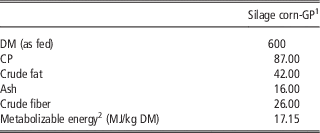
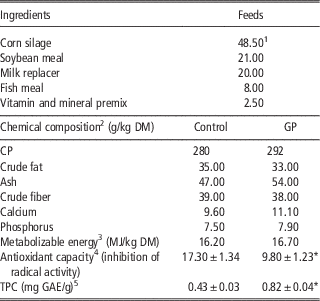
Red GP (Vitis vinifera L. var. Moschato) was obtained from a winery in Tyrnavos (Larissa, Greece) in September 2014. GP was added in piglets’ feed as silage. The silage contained corn, GP, water and lactic acid bacteria. Based on a previous study, the proportion of the ingredients was such that the final silage contained 60% solids and 40% of moisture (Gerasopoulos et al., Reference Gerasopoulos, Stagos, Krouezas, Karaveli, Barda, Gkika, Mitsiou, Petrotos, Goulas and Kouretas2015a). The chemical composition of GP silage (which has been patented) is presented in Table 1. The difference between the control and experimental silage was that the solids in the latter contained, apart from corn, 9% GP solids (Table 2). Standard commercial formulation (11CFT; Pioneer, Buxtehude, Germany) of lactic acid bacteria was used for the lactic fermentation of corn and the preparation of corn silage. The lactic acid bacteria had been dissolved in water (10% w/v) by stirring and warmed to 40 °C in order to be activated before their mixing with corn. After activation, lactic acid bacteria were mixed with corn (1 g of bacteria with100 kg of corn). The resulting silage was placed into vacuum bags and just before feed administration was mixed with other ingredients for preparing the final piglets’ feed (Table 2).
Chemical composition (g/kg) of silage corn-grape pomace (GP) (per dry matter-dry matter (DM) basis except as noted)

1 Values represent duplicate assays of two samples for each material.
2 Calculated from equations of Noblet and Perez (Reference Noblet and Perez1993).
Ingredients (% w/w), chemical composition (g/kg dry matter (DM)), antioxidant capacity and total polyphenolic content (TPC) of the diets

GP=grape pomace.
The results are presented as mean ± SEM.
*Statistically significant different compared with control feed (P<0.05).
1 Corn silage contained 60% of corn solids and 40% of moisture in the control feed; 51% corn solids, 9% GP solids and 40% of moisture in the experimental feed.
2 Feeds were analyzed for DM, CP, crude fat, crude fiber and ash according to the AOAC (1990). All other values were calculated from NRC (2012) values.
3 Calculated from equations of Noblet and Perez (Reference Noblet and Perez1993).
4 Concentrations (mg/ml) that caused 50% (IC50) scavenging of 2,2-diphenyl-1-picrylhydrazyl radical.
5 Gallic acid equivalents as measured by Folin Ciocalteau assay.
Animals and diets
All experimental procedures were in accordance with the Guide for the Care and Use of Laboratory Animals, National Research Council (1996). In all, 24 piglets of Landrace×Large White – Duroc – Pietrain breed, were selected from the pigsty of the Technical Education Institute of Thessaly (Larissa, Greece). The piglets were housed under controlled environmental conditions (12-h light/dark cycle, temperature 27 °C to 33 °C, humidity 50% to 70%) in standard single cages (for each group). All the newborn pigs were fed exclusively with breast milk for 20 days. Then, the piglets were separated into two groups (12 piglets/group) as follows: (i) Control group fed with basal diet and (ii) GP group fed with diet containing GP silage (Table 2). However, up to 35 days post birth (i.e. feeding with diet for 15 days) the piglets of two groups were fed with both breast milk and the respective diet. Starting from 20 days post birth, the piglets were separated from their sows for 8 h/day during the 1st week and were fed with the diets ad libitum, whereas during the 2nd week the piglets were separated from their sows for 10 h/day. The sows were fed with standard diet without having access to the diet supplemented with GP. After the 35 days post birth, the piglets were fed only with diet for 15 days. During the experimental trial, piglets were weighed individually weekly and the intake of feeds was also recorded on daily basis. Average daily gain (ADG, kg/day), average daily feed intake (ADFI, kg feed intake/day) as well as feed conversion ratio (FCR) were calculated. Feed conversion ratio was calculated by dividing ADFI by ADG. The diets for piglets were formulated according to the recommended values from National Research Council (NRC, 2012) and the chemical composition was determined according to methods of Association of Official Analytical Chemists (AOAC, 1990) (Table 2).
Blood, tissues and fecal collection
Blood samples were collected at four different time-points at days 2, 20, 35 and 50 days post birth. The first two blood samplings were performed in order to determine the redox status at a very young age before the administration of the diets. In particular, at 2 and 20 days, blood samples were collected from four piglets (at each time point), at 35 days from 12 piglets (i.e. six piglets from each group) and at 50 days from 12 piglets (i.e. six piglets from each group). Tissue collection was also performed at the same time-points that blood samples were drawn. The collection and processing of blood samples as well as the collection and homogenization of tissues (i.e. brain, heart, kidney, liver, lung, quadriceps muscle, pancreas, spleen and stomach) were performed as described previously (Gerasopoulos et al., Reference Gerasopoulos, Stagos, Petrotos, Kokkas, Kantas, Goulas and Kouretas2015b). Fecal samples were collected by specialized personnel at two different time-points at 35 and 50 days post birth from six piglets from each group (at all time-points the samples were collected from the same animals). The procedure of fecal collection was performed as described previously (Kafantaris et al., Reference Kafantaris, Kotsampasi, Christodoulou, Kokka, Kouka, Terzopoulou, Gerasopoulos, Stagos, Mitsagga, Giavasis, Makri, Petrotos and Kouretas2016).
Determination of total polyphenolic content and radical scavenging activity of the diets
The preparation of the extracts and the determination of total polyphenolic content (TPC) of the diets were performed as described previously (Kafantaris et al., Reference Kafantaris, Kotsampasi, Christodoulou, Kokka, Kouka, Terzopoulou, Gerasopoulos, Stagos, Mitsagga, Giavasis, Makri, Petrotos and Kouretas2016). The results are expressed as gallic acid equivalents (GAE) (mg GAE/g) using the standard curve (absorbance v. concentration) prepared from authentic gallic acid. The 2,2-diphenyl-1-picrylhydrazyl (DPPH) radical scavenging activity of the experimental diets was evaluated as described previously (Kafantaris et al., Reference Kafantaris, Kotsampasi, Christodoulou, Kokka, Kouka, Terzopoulou, Gerasopoulos, Stagos, Mitsagga, Giavasis, Makri, Petrotos and Kouretas2016). In order to compare the radical scavenging efficiency of the diets, the IC50 value showing the concentration that caused 50% scavenging of DPPH radicals was calculated from the graph plotted inhibition percentage against extract concentration. All experiments were carried out in triplicate and at least on two separate occasions.
Oxidative stress biomarkers methods
Reduced glutathione (GSH), catalase activity (CAT), total antioxidant capacity (TAC), thiobarbituric acid reactive substances (TBARS), protein carbonyls (CARB) and H2O2 decomposition activity were measured as described previously (Makri et al., Reference Makri, Kafantaris, Stagos, Chamokeridou, Petrotos, Gerasopoulos, Mpesios, Goutzourelas, Kokkas, Goulas, Komiotis and Kouretas2017).
All reagents were purchased from Sigma-Aldrich (Munich, Germany). All measurements were conducted on a Hitachi U-1900 ratio beam spectrophotometer (serial no. 2023-029; Hitachi, Tokyo, Japan).
Microbiological analysis of fecal microbiota
For each sampling day (i.e. 35 and 50 days post birth) the average values of six individual animals and the standard deviation for each microbial population (Enterobacteriacae, sulfite-reducing Clostridia, Campylobacter jejuni, Bifidobacterium spp., lactic acid bacteria and Escherichia coli) were estimated. In addition, the fecal samples were tested for the presence of Salmonella. Microbiological analysis of fecal microbiota was performed as described previously (Kafantaris et al., Reference Kafantaris, Kotsampasi, Christodoulou, Kokka, Kouka, Terzopoulou, Gerasopoulos, Stagos, Mitsagga, Giavasis, Makri, Petrotos and Kouretas2016). The results were expressed as log colony forming units (CFU)/g of fresh sample.
Fatty acid methyl esters synthesis
The meat samples for the determination of FA profile, were collected at 50 days post birth from 12 piglets. The method of fatty acid methyl esters (FAME) synthesis (Gerasopoulos et al., Reference Gerasopoulos, Stagos, Kokkas, Petrotos, Kantas, Goulas and Kouretas2016) was applied as follows: in 0.5 ml of homogenized tissue (quadriceps muscle), 1 ml methanolic solution of tridecanoid acid (C13 : 0) was added at a concentration of 600 μg/ml, as an internal standard. Subsequently, 10 N 0.4 ml KOH (potassium hydroxide) and 2.7 ml of pure methanol were added. For proper hydrolysis of samples, the tubes were placed in a water bath at 55°C for a period of 1.5 and every 20 min vigorous stirring followed. For the correct composition of FA methyl esters, 0.3 ml 24 N H2SO4 were added and the tubes were placed in a water bath at 55°C for a period of 1.5 h, followed by vigorous stirring every 20 min. Finally, 3 ml hexane were added as solvent and the samples were stirred at vortex for 3 min. Then, placed in the centrifuge 6000×g, 15 min at room temperature and the supernatant, placed in gas chromatography vials of 2 ml and stored at −20°C until GC/MS analysis. Fatty acid methyl esters were analyzed using an GC-MS Varian CP-3800 chromatography apparatus (Varian Inc., Palo Alto, CA, USA) and a capillary column Agilent J&W 112-88A7: 804.11246 HP-88 250°C: length 100 m×internal diameter 0.25 mm and film thickness 0.25 μm (Agilent, Frankfurt, Germany). The various FAs were identified by comparison with standard FAs methyl esters from Supelco (Bellefonte, PA, USA): 37 Component FAME Mix (product no. 47885-U) and PUFA 2 (product no. 47015-U). For the identification of the FAME, the National Institute of Standards and Technology database was used.
Statistical analysis
Data were analyzed by one-way ANOVA followed by Dunnett’s test. The level of statistical significance was set at P<0.05. All results are expressed as mean±SEM. Data were analyzed using SPSS, version 22.0 (SPSS Inc., Chicago, IL, USA).
Results
Determination of total polyphenolic content and evaluation of antioxidant capacity of the diets
The results from the assessment of the TPC revealed that the diet supplemented with GP exhibited an increase in TPC (almost 2-fold) compared with control (Table 2). The antioxidant capacity of the experimental diets was evaluated using the method of DPPH radical scavenging assay. The IC50 values for scavenging of DPPH radical were 17.3 and 9.8 mg/ml for control and GP experimental diet, respectively (Table 2). The results showed higher (at least 2-fold) (P<0.05) antioxidant capacity of the ration supplemented with GP than the control ration.
Growth performance
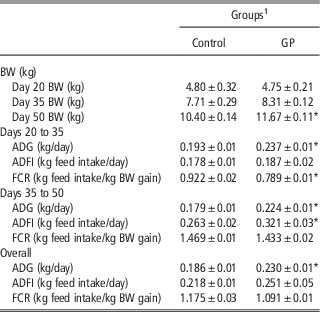
The feed supplemented with GP improved significantly the ADG. In particular, before weaning period ADG was increased in GP group by 22.79% (P<0.05) compared with control group. After weaning period, ADG was also increased in GP group by 25.13% (P<0.05) compared with control group. In the overall period ADG was increased by 23.65% (P<0.05) compared with control group (Table 3). Furthermore, GP inclusion resulted in significantly higher values of ADFI (days 35 to 50) and significantly lower values of FCR (days 20 to 35) compared with control group (Table 3).
Body weight, average daily gain (ADG), average daily feed intake (ADFI) and feed conversion ratio (FCR) in growing piglets

GP=grape pomace.
All data were expressed as the mean ± SEM.
*Significantly different from values of control group (P<0.05).
1 Control: standard diet, GP: diet supplemented with GP. Piglets/group=12.
Assessment of oxidative stress markers in blood and tissues
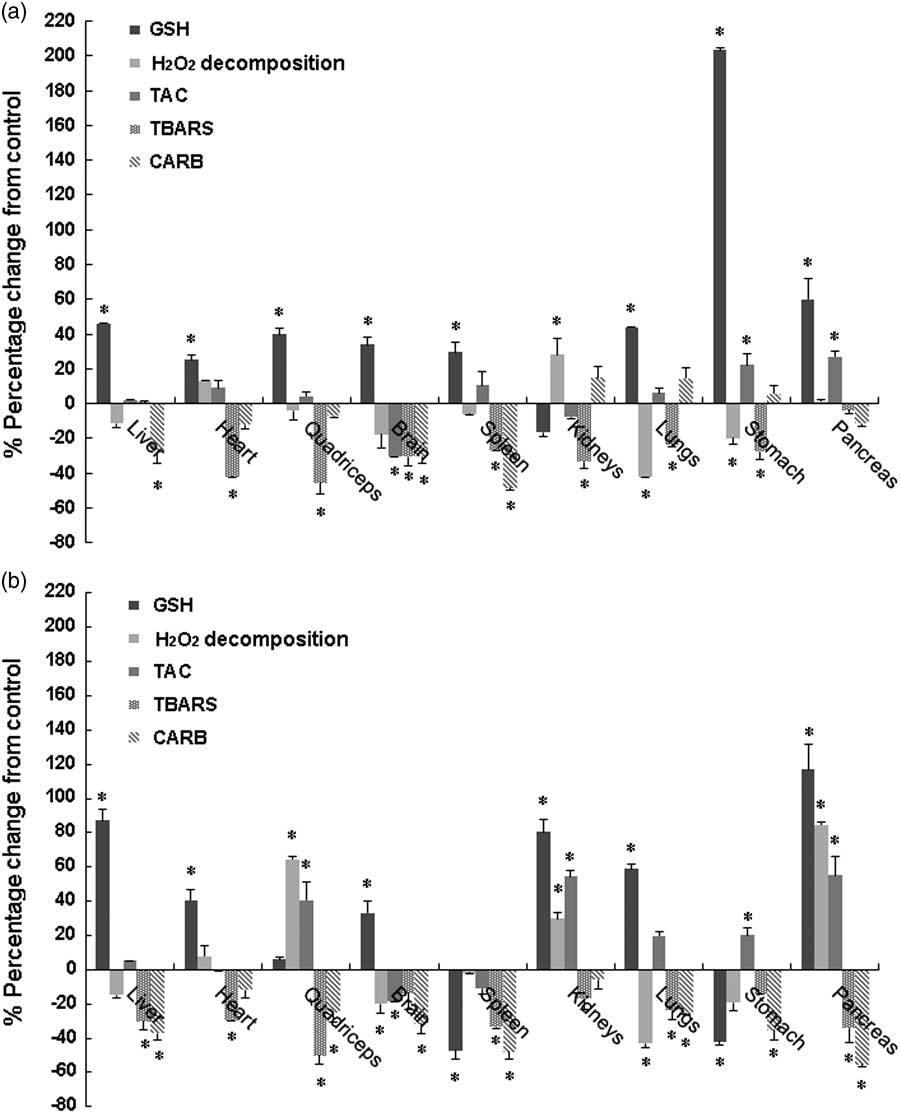
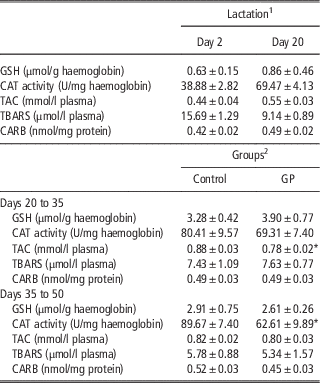
The results from the assessment of oxidative stress biomarkers in blood showed that CAT activity was decreased significantly by 30.17% (P<0.05) in erythrocytes of GP group at 50 days compared with control group (Table 4). Total antioxidant capacity levels were decreased significantly at 35 days by 11.12% (P<0.05) in plasma of GP group (Table 4). However, GSH levels in erythrocytes as well as CARB and TBARS levels in plasma did not exhibit any significant differences (P>0.05) in group fed with the experimental diet enriched in GP compared with the control group (Table 4). The feed supplemented with GP enhanced the antioxidant mechanisms and improved the redox status in piglets in almost all the tested tissues. In particular, CARB levels were decreased significantly (P<0.05) in GP group compared with control group at 35 days, in brain by 30.63%, in spleen by 48.62% and in liver by 27.39% (Figure 1a). Protein carbonyl levels were also decreased significantly (P<0.05) in GP group at 50 days post birth in liver by 37.19%, in quadriceps muscle by 25.31%, in brain by 31.53%, in spleen by 47.87%, in lungs by 25.58%, in stomach by 35.36% and in pancreas by 55.38% compared with control group (Figure 1b).
Effects on reduced glutathione (GSH), H2O2 decomposition activity, total antioxidant capacity (TAC), thiobarbituric acid reactive substances (TBARS) and protein carbonyls (CARB) in tissues of piglets fed with diet supplemented with grape pomace (GP) for (a) 15 days (i.e. at 35 days post birth) and (b) 30 days (i.e. at 50 days post birth). The results were expressed as the percentage difference from control group. All data were expressed as mean ± SEM. *Significantly different from values of control group at the same sampling time (P<0.05).

Effects on oxidative stress markers (reduced glutathione (GSH), catalase activity (CAT) activity, total antioxidant capacity (TAC), thiobarbituric acid reactive substances (TBARS), protein carbonyls (CARB)) in blood samples of piglets

GP=grape pomace.
All data were expressed as the mean ± SEM.
*Significantly different from values of control group (P<0.05).
1 Piglets (at each time point n=4)
2 Control: standard diet, GP: diet supplemented with GP. Piglets/group n=12.
Like CARB, TBARS levels were decreased significantly in most of the tested tissues in GP group compared with control group. Thus, at 35 days, TBARS levels were decreased significantly (P<0.05) in GP group, in heart by 41.86%, in quadriceps muscle by 45.56%, in brain by 30.51%, in spleen by 26.6%, in kidneys by 33.42%, in lungs by 23.36% and in stomach by 27.71% compared with control group (Figure 1a). At 50 days post birth, TBARS levels were also decreased (P<0.05) in GP group, in liver by 30.16%, in heart by 29.52%, in quadriceps muscle by 50.35%, in spleen by 33.34%, in lungs by 23.55% and in pancreas by 34.02% compared with control group (Figure 1b).
Total antioxidant capacity levels were increased significantly (P<0.05) in GP group at 35 days post birth, in pancreas by 27.05% and in stomach by 22.12%. However, at 35 days post birth, TAC levels were decreased significantly (P<0.05) in brain by 30.63%, in GP group compared with control group (Figure 1a). At 50 days, TAC levels were increased significantly (P<0.05) in quadriceps muscle by 40.77%, in kidneys by 54.45%, in lungs by 19.81%, in stomach by 20.17% and in pancreas by 55.11%, whereas in brain they were decreased significantly (P<0.05) by 18.15% in GP group compared with control group (Figure 1b).Reduced glutathione levels were increased in almost all tested tissues in GP group compared with control group. In particular, at 35 days, in GP group, GSH levels were increased significantly (P<0.05) in liver by 46.30%, in heart by 25.16%, in quadriceps muscle by 40%, in brain by 33.92%, in spleen by 29.46%, in lungs by 44%, in stomach by 203.2% and in pancreas by 60%, compared with control group (Figure 1a). At 50 days post birth, in GP group, GSH levels were increased significantly (P<0.05) in liver by 87.28%, in heart by 40.74%, in brain by 33.33%, in kidneys by 80.51%, in lungs by 59.09% and in pancreas by 116.86%. However, at 50 days post birth, GSH levels in GP group were decreased (P<0.05) in spleen and stomach by 47.18% and 41.83%, respectively, compared with control group (Figure 1b).
Finally, at 35 days post birth in GP group, H2O2 decomposition activity was increased significantly (P<0.05) in kidneys by 28.29%, whereas it was decreased significantly (P<0.05) in lungs and stomach by 42.24% and 19.70%, respectively, compared with control (Figure 1a). At 50 days, in GP group, H2O2 decomposition activity was increased significantly (P<0.05) in quadriceps muscle, in kidneys and in pancreas by 64.34%, 29.94% and 84.74%, respectively, whereas it was decreased significantly (P<0.05) in brain and in lungs by 20.16% and 43.03%, respectively, compared with control group (Figure 1b).
Microbiological analysis in fecal samples
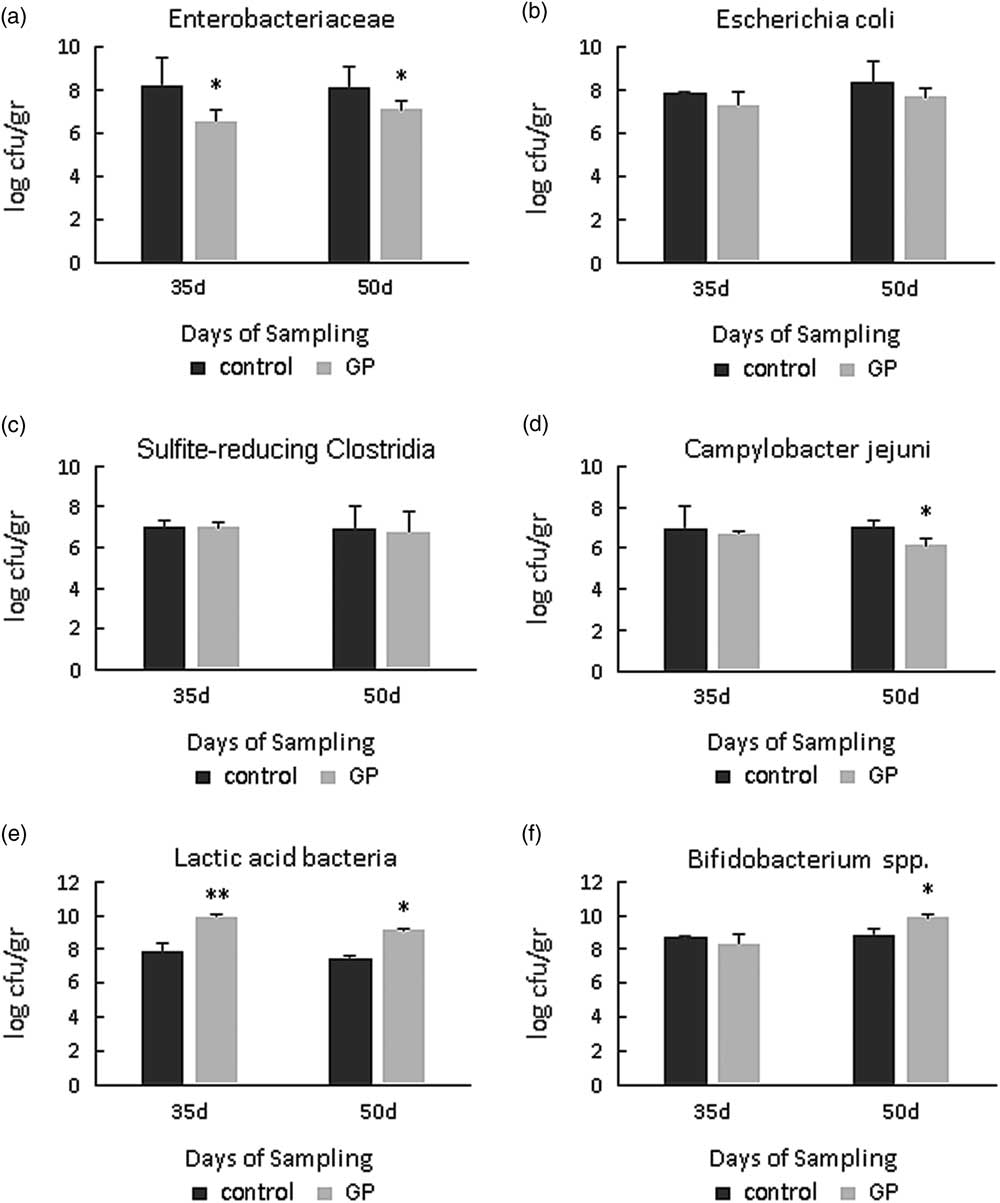
The results from the microbiological analysis in fecal samples showed that the population of Enterobacteriaceae was reduced significantly (P<0.05) in GP group both at 35 and 50 days post birth compared with the control group, by up to 1.8 log CFU/g (35 days), indicating a potential inhibitory effect of GP upon growth of Enterobacteriaceae species in the gut (Figure 2a). However, this inhibitory effect was less pronounced in the case of E. coli, which was only slightly reduced after consumption of GP (Figure 2b). No differences (P>0.05) between the control and the GP group were observed regarding the population of sulfite-reducing Clostridia during the sampling period (Figure 2c), whereas Salmonella was absent in 10 g of feces of the experimental groups. In contrast, the population of C. jejuni was significantly lower (P<0.05) after administration of GP at 50 days (by up to 1.0 log CFU/g). (Figure 2d). Interestingly, the population of lactic acid bacteria in the feces exhibited a significant increase (by up to 2.0 log CFU/g) at 35 days (P<0.001) and at 50 days (P<0.05) after consumption of GP (Figure 2e). In a similar manner, the levels of Bifidobacterium spp. were increased significantly (P<0.05) at 50 days (by up to 1.2 log CFU/g) in the GP group compared with the control group (Figure 2f).
Populations of Enterobacteriacae (a), Escherichia coli (b), sulfite-reducing Clostridia (c), Campylobacter jejuni (d), lactic acid bacteria (e) and Bifidobacterium spp. (d) in fecal samples of piglets at 35 days (n=6 from each group) and 50 days (n=6 from each group) post birth (at all time-points the samples were collected from the same animals). The results are presented as log colony forming units (CFU)/g of fresh sample. All data were expressed as mean ± SEM. *Significantly different from values of control group at the same sampling time (P<0.05). **Significantly different from values of control group at the same sampling time (P< 0.01).

Assessment of fatty acids in piglets’ meat
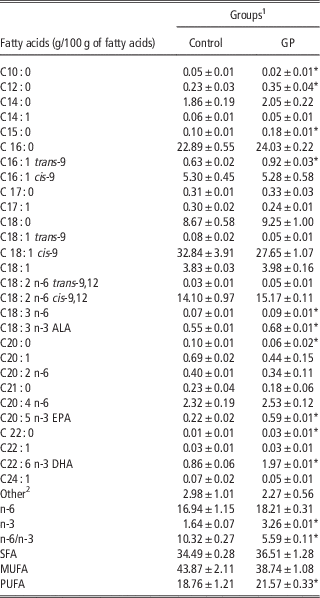
The effect of GP inclusion on the FA composition in piglets’ meat is summarized in Table 5. Dietary GP supplementation increased significantly (P<0.05) the content of lauric acid (C12 : 0), pentadecanoic acid (C15 : 0), palmitelaidic acid (C16 : 1 trans-9), γ-linolenic acid (C18 : 3n-6), α-linolenic acid (ALA; C18 : 3n-3), EPA (C20 : 5n-3), behenic acid (C22 : 0) and DHA (C22 : 6n-3) whereas, the content of capric acid (C10 : 0) and arachidic acid (C20 : 0) was decreased significantly (P<0.05) in GP group than in control group. Interestingly, the contents of n-3 FAs and PUFA were increased significantly (P<0.05), whereas n-6/n-3 ratio was decreased significantly (P<0.05) in GP group compared with control group.
Fatty acid profile of quadriceps muscle

ALA=α-linolenic acid; GP=grape pomace; SFA=total saturated fatty acids; MUFA=total monounsaturated acids; PUFA=total polyunsaturated fatty acids.
*Significantly different from values of control group (P<0.05).
1 Control: standard diet, GP: diet supplemented with GP. Piglets/group=6. Meat samples were collected at 50 days post birth.
2 Represents other known and unidentified fatty acids.
Discussion
Growth performance
In our study, growth performance was increased in GP group compared with control group. Accumulating evidence has indicated that reactive oxygen species (ROS) oxidize and damage cellular biological molecules, and consequently cause a variety of impairments to the intestinal membrane integrity (Payne and Southern, Reference Payne and Southern2005). Thus, the beneficial effects of GP on growth performance may be due to their antioxidant properties by scavenging ROS, reducing intestinal membrane damage, and consequently by improving guts’ functionality. Interestingly, in a previous study we have shown that supplementation of lambs’ feed with GP decreased pathogenic microorganisms and increased probiotic bacteria (Kafantaris et al., Reference Kafantaris, Kotsampasi, Christodoulou, Kokka, Kouka, Terzopoulou, Gerasopoulos, Stagos, Mitsagga, Giavasis, Makri, Petrotos and Kouretas2016). The inclusion of GP silage in the diet may also be an important factor for the increased performance, as the presence of fermentable fiber in the diet stimulates microbial fermentation in the hindgut, generating lactic acid and volatile FAs, which are capable of inhibiting some intestinal pathogens (e.g. E. coli and Salmonella spp.) (Montagne et al., Reference Montagne, Pluske and Hampson2003). Yan and Kim (Reference Yan and Kim2011) have also reported that the supplementation of fermented GP in pigs’ diet increased significantly growth performance.
Effect of grape pomace on piglets’ redox status
The experimental feed enriched with GP increased significantly GSH in almost all the tested tissues both at 35 and 50 days post birth. Similarly, we have shown in other studies that administration of polyphenols from GP to lambs (Kafantaris et al., Reference Kafantaris, Kotsampasi, Christodoulou, Kokka, Kouka, Terzopoulou, Gerasopoulos, Stagos, Mitsagga, Giavasis, Makri, Petrotos and Kouretas2016) as well as polyphenols from olive mill wastewater (OMWW) to piglets resulted in increased levels of GSH in blood erythrocytes and in several tissues (Gerasopoulos et al., Reference Gerasopoulos, Stagos, Petrotos, Kokkas, Kantas, Goulas and Kouretas2015b). However, the feed enriched with GP decreased GSH in spleen and stomach at 50 days post birth compared with control group. This result may be explained by the fact that endogenous levels of GSH in spleen and in stomach of piglets at 50 days were high, and so the administration of GP’s polyphenols not only increased the biochemical mechanisms responsible for the GSH synthesis but decreased them. Interestingly, we have shown (Kafantaris et al., Reference Kafantaris, Kotsampasi, Christodoulou, Kokka, Kouka, Terzopoulou, Gerasopoulos, Stagos, Mitsagga, Giavasis, Makri, Petrotos and Kouretas2016) that administration of GP decreased GSH levels in lambs’ liver with high GSH. Moreover, DeLeve and Kaplowitz (Reference DeLeve and Kaplowitz1990) have reported that elevated GSH levels may inhibit its synthesis, through inhibition of glutamate–cysteine ligase, one of the major enzymes responsible for its synthesis (Aquilano et al., Reference Aquilano, Baldelli and Ciriolo2014).
Apart from increase in GSH, the administration of feed supplemented with GP increased H2O2 decomposition activity, especially at 50 days post birth. In particular, H2O2 decomposition activity was increased in quadriceps muscle, kidney and pancreas in GP group, compared with control group. Similarly, we have shown in other studies that administration of polyphenols from OMWW to piglets resulted in increased H2O2 decomposition activity, especially after 30 days of feeding. Moreover, Núñez et al. (Reference Núñez, Fernández, Benítez, Arija, Viveros, Brenes and Ovilo2016) have reported that the administration of GP in chickens increased CAT gene expression in breast muscle. Importantly, a recent study has shown that resveratrol, a phenolic compound of GP increased CAT expression in kidneys in diabetic rats, through activation of the FOXO1 transcription factor (Wu et al., Reference Wu, Zhang, Ma, Zhang and Qin2012).
The administration of the experimental feeds supplemented with GP increased TAC in some of the tested tissues, indicating an enhancement of the piglets’ total antioxidant mechanisms. This increase was more profound after administration of the experimental feeds for 30 days in GP group, as there was a significant increase in TAC in four out of nine tested tissues compared with the control group. The slight decrease in TAC in brain of GP group did not seem to indicate pro-oxidant effect, as CARB and TBARS levels at the same time were also decreased. The decrease in TAC may be explained by the fact that the increase in some antioxidant molecules caused as a compensation effect, the decrease of other antioxidant molecules (e.g. GSH in brain and heart of GP). It seems that the polyphenols of GP act in a tissue specific manner and this effect may also be attributed to the different antioxidant content of each tissue.
The enhancement of piglets’ antioxidant mechanisms seemed to protect them from oxidative stress-induced damage. In particular, lipid peroxidation shown by TBARS levels was significantly decreased in several tissues (in seven out of nine tested tissues) especially after 30 days of feeding in GP group compared with control group. In a previous study, we have also shown that feed supplemented with polyphenols from OMWW in chickens and piglets (Gerasopoulos et al., Reference Gerasopoulos, Stagos, Krouezas, Karaveli, Barda, Gkika, Mitsiou, Petrotos, Goulas and Kouretas2015a and Reference Gerasopoulos, Stagos, Petrotos, Kokkas, Kantas, Goulas and Kouretas2015b) and in lambs (Kafantaris et al., Reference Kafantaris, Kotsampasi, Christodoulou, Kokka, Kouka, Terzopoulou, Gerasopoulos, Stagos, Mitsagga, Giavasis, Makri, Petrotos and Kouretas2016) reduced lipid and protein oxidation in blood and tissues. Furthermore, we have reported (Goutzourelas et al., Reference Goutzourelas, Stagos, Housmekeridou, Karapouliou, Kerasioti, Aligiannis, Skaltsounis, Spandidos, Tsatsakis and Kouretas2015b) that grape stem extracts reduced TBARS concentration in endothelial and muscle cells. Moreover, other studies have shown that administration of polyphenols from GP reduced lipid peroxidation in chickens (Goñi et al., Reference Goñi, Brenes, Centeno, Viveros, Saura-Calixto, Rebole, Arija and Estevez2007).
Similarly, the administration of winery by-products had a protective role and reduced protein oxidation as shown by the decrease in CARB levels in many of the tested tissues compared with control. The results showed that the effect was more profound after 30 days of feeding with the diet enriched with GP. Moreover, in many tissues the reduction of protein oxidation was time dependent, as the percentage decrease in CARB levels was higher after 30 days of feeding in GP group than after 15 days of feeding. Moreover, other studies have also reported beneficial effects of winery by-products on protein oxidation in animals. For example, the antioxidant activity of grapevine leaf extracts protected from protein oxidation in rat liver (Schaffer et al., Reference Schaffer, Wohlenberg, Medeiros, Martins, Agostini, Funchal and Dani2016). In addition, Yan and Kim (Reference Yan and Kim2011) revealed that GP supplementation had beneficial effects on meat quality in pigs. Thus, our results suggested that the supplementation of pigs’ feed with GP improves the quality of meat, increases its oxidative stability, and consequently may lead to high added value products for the consumers.
Effect of grape pomace on piglets’ fecal microbiota
Based on the results of the fecal microbiota, it seems that at 35 and 50 days post birth, there is a statistically significant reduction in the population of Enterobacteriaceae after consumption of GP. A similar effect was also observed in one of our recent studies (Kafantaris et al., Reference Kafantaris, Kotsampasi, Christodoulou, Kokka, Kouka, Terzopoulou, Gerasopoulos, Stagos, Mitsagga, Giavasis, Makri, Petrotos and Kouretas2016), where a group of lambs fed diet supplemented with GP had decreased levels of Enterobacteriaceae in their feces. In addition, at 50 days post birth, there is a statistically significant reduction in the population of C. jejuni after consumption of feed supplemented with GP. Although this inhibitory effect was not observed in the case of E. coli, it was important that GP supplementation may affect the levels of Enterobacteriacae, which includes potentially pathogenic bacteria to humans, such as Salmonella, E. coli, Shigella, Yersinia and Proteus (Brewer et al., Reference Brewer, Xiong, Anderson and Carlson2013). Furthermore, the levels of beneficial lactic bacteria were increased significantly in GP group. Similarly, the beneficial and probiotic Bifidobacteria reached a significantly higher level (at 50 days post birth) after consumption of GP compared with the control. These results are in line with our previous study (Kafantaris et al., Reference Kafantaris, Kotsampasi, Christodoulou, Kokka, Kouka, Terzopoulou, Gerasopoulos, Stagos, Mitsagga, Giavasis, Makri, Petrotos and Kouretas2016), where lambs’ feed supplemented with GP enhanced the levels of Bifidobacterium species in gut. Furthermore, Fiesel et al. (Reference Fiesel, Gessner, Most and Eder2014) have shown that grape by-products had beneficial effects on fecal microbiota of piglets. Our results suggested the supplementation of pigs’ feed with GP for boosting the population of beneficial bacteria in the gut. The observed stimulatory effect of feed supplemented with GP upon lactic bacteria and Bifidobacteria in the gut could be attributed to the presence of prebiotic substances such as fructans and grape skin polysaccharides in GP (Agte et al., Reference Agte, Khetmalis, Nilegaonkar, Karkamkar and Yadav2010). Moreover, Viveros et al. (Reference Viveros, Chamorro, Pizarro, Arija, Centeno and Brenes2011) have also reported an increased lactic acid bacteria population in the gut of broilers fed with GP.
Effect of grape pomace on fatty acids composition
The chemical profile analysis revealed that GP supplementation of the pigs’ diet affected the long-chain n-3 FA and consequently n-6/n-3 ratio. In particular, the administration of feed supplemented with GP to pigs increased significantly EPA, DHA and ALA FAs in GP group compared with control group. The significantly increased levels of ALA FA in GP group could be explained by the fact that GP acted as probiotic (Agte et al., Reference Agte, Khetmalis, Nilegaonkar, Karkamkar and Yadav2010). Moreover, several studies have shown that the inclusion of a probiotic compound in animals’ diet had health benefits on intestinal microbiota and affected FA profile in meat by increasing mainly ALA FA (Ross et al., Reference Ross, Nieuwenhove and González2012). Interestingly, in a previous study we have shown that GP supplementation of lambs’ feed reduced pathogenic microorganisms and increased probiotic bacteria (Kafantaris et al., Reference Kafantaris, Kotsampasi, Christodoulou, Kokka, Kouka, Terzopoulou, Gerasopoulos, Stagos, Mitsagga, Giavasis, Makri, Petrotos and Kouretas2016). As PUFA are important for human nutrition and health (Simopoulos, Reference Simopoulos2009), their increase in pigs’ meat indicated the beneficial effect on meat quality due to the inclusion of GP in animal diet. Furthermore, the supplementation of pigs’ feed with GP had a beneficial effect on meat quality as n-6/n-3 ratio was significantly lower in GP group compared with control. This may be mainly due to the increased levels of EPA and DHA FAs. The EPA acts as a precursor for the biosynthesis of eicosanoids such as prostaglandin-3, an inhibitor of platelet aggregation, thromboxane-3, an antithrombotic and vasodilator, and leukotriene-5, an enhancer of cellular communication. These molecules also function as hormones and mediators of inflammation (Calder, Reference Calder2010). The DHA is essential for the development and function of the brain and retina (Lauritzen et al., Reference Lauritzen, Hensen, Jorgensen and Michaelsen2001) and is derived directly from the diet or from the conversion of its respective dietary precursor ALA in the liver (Rapoport et al., Reference Rapoport, Rao and Igarashi2007). In a previous study, we have also shown that feed supplemented with polyphenols from OMWW decreased n-6/n-3 ratio and improved the FA profile of several tissues (Gerasopoulos et al., Reference Gerasopoulos, Stagos, Kokkas, Petrotos, Kantas, Goulas and Kouretas2016). In addition, Habeanu et al. (Reference Habeanu, Lefter, Ropota, Chedea, Gheorghe, Toma, Ciurescu and Dragomir2015) showed recently that the administration of feed supplemented with dried GP affected FA composition of longissimus dorsi muscle in finishing pigs, especially there was increased amounts of the n-3 FA, ALA and EPA.
In conclusion, the present study indicated that the administration of feed supplemented with GP to weaned piglets, enhanced antioxidant mechanisms, prevented oxidative stress damage to lipids and proteins and improved the gut barrier function and health, thus suggesting beneficial effects for animal welfare. In addition, GP inclusion in the diet of piglets, improved growth performance by increasing BW and showed a significantly beneficial effect on meat quality by enriching animals’ meat with n-3 polyunsaturated FAs. The valorization of winery by-products for farm animals’ feeds would also provide ecological benefits by reducing the waste disposal as well as the environmental footprint of these industries.
Acknowledgments
This research project was coordinated and funded by the Hellenic Agricultural Organisation ‘DEMETER’ (NSRF 2007-2013). The present work was funded in part by the MSc programs ‘Biotechnology-Nutrition & Environment’ and ‘Toxicology’ in the Department of Biochemistry and Biotechnology at the University of Thessaly.