Home-based health care in North America is often comprised of a mix of publicly and privately financed services. Whereas the publicly financed sector of home-based care includes government funded services such as nursing and personal support, the privately financed component consists of out-of-pocket expenditures by care recipients and family members for medications, supplies, and travel as well as time costs. Time costs, represented by a dollar value, denote the time that care recipients and their family caregivers dedicate to receiving or providing care (Reference Guerriere, Tullis and Ungar18). This time represents foregone opportunities and productivity losses, because it could have been devoted to other activities such as market labor, leisure, or household work (Reference Coyte and Young9;Reference Yates40).
Time costs incurred by care recipients and their family caregivers are one component of costs that can potentially vary between and within different healthcare programs and settings of care. In the home setting, care recipients require and/or choose to have their friends and family members provide care because the environment in which publicly financed services are delivered is characterized by financial constraints, human resource shortages, and complex care. Most studies assessing home-based care costs have measured costs associated with publicly financed resources (1;7;11;20), and those that have studied private resources focus primarily on care recipients' out-of-pocket expenditures. Very few have assessed time lost from market and nonmarket labor for care recipients and caregivers (2;4;18;32;34;38;39). As a result, time costs are currently inconsistently and infrequently included in economic evaluations (Reference Krauth, Jalilvand, Welte and Busse23;Reference Van Den Berg, Brouwer and Koopmanschap36). Time taken by both care recipients and caregivers from unpaid labor and leisure have not been recognized or studied with equal rigor (Reference Van Den Berg, Brouwer and Koopmanschap36). It has been observed that time costs can account for the majority of the total cost of healthcare programs (17;18;25;31).
Despite the necessary role that family caregivers provide, their contribution is rarely considered and very little empirical attention has been given to time valuation methods. Current approaches emphasize losses from paid labor without equal consideration of losses from unpaid labor and leisure. The deliberations surrounding time cost valuation have spurred a large theoretical debate within the economic literature. One perspective in particular, the human capital approach, has received attention because of its ease of implementation and relative simplicity (12). This approach uses average earnings by age and gender to value lost time. Although there are variations within this approach, none of the methods have been empirically tested to determine the effect of varying the valuation methods on total time costs. Theoretically, it has been criticized because it relies on potential earnings rather than actual earnings, which may overestimate or underestimate time lost from paid labor.
Thus, recognizing these gaps, the purpose of this study was to compare the methods of valuation for time losses within the human capital approach with a cohort of adults with cystic fibrosis (CF). Specifically, methods used to value time devoted to caregiving and time devoted to household work as well as methods for valuing time lost from market labor and nonmarket labor were compared to determine the affect on overall costs. The comparison of methods is essential to determine how time devoted to caregiving and homemaking activities should be valued. The CF population was chosen because the treatment of this illness is not only resource intensive, but time intensive as well (10;26;28;30;35;38). The valuation approach used in the study was grounded in human capital approach and developed in response to perceived limitations of the approach.
METHODS
Time cost data were collected within the context of a larger study that assessed the economic burden of care for adults with CF from a societal perspective (Reference Guerriere, Tullis and Ungar18).
Study Sample
Adults with CF attending a clinic at St. Michael's Hospital (SMH) in Toronto, Ontario, comprised the study sample. The clinic serves over 270 adults who represent over 70 percent of the CF population in Ontario (Reference Corey, Edwards, Levison and Knowles8). Care recipients were eligible if they (i) had a medical diagnosis of CF based on elevated sweat chloride levels or presence of two CF mutations on genetic analysis, and characteristic clinical findings such as pancreatic insufficiency or a positive family history (Reference McCance and Huether27); (ii) were fluent in English; (iii) were 18 years of age or older; and (iv) visited the clinic on a regular basis (once every 3 to 4 months).
Data Collection
The Ambulatory and Home Care Record (AHCR (c)Coyte & Guerriere, 1998) (Reference Guerriere, Ungar and Corey16) was used in this study to obtain time cost data from the study participants. The AHCR (Reference Guerriere, Ungar and Corey16) is a self-administered survey that measures the total cost of illness from a societal perspective. Testing of the psychometric properties of the AHCR has shown agreement between participants’ reports and administrative data (κ value ranging from 0.41 to 1.00) (Reference Guerriere, Ungar and Corey16). For this study, only the components of the AHCR, which assess time costs, were used for data analysis. A 4-week data collection period was selected to capture the entire episode of care associated with an exacerbation and to capture the variability in resource use by all care recipients. Participants were asked to provide information about the total number of hours they received care, the number of hours their family members/friends provided care and engaged in household labor, and whether or not they or their family caregivers missed time from paid employment or unpaid labor and leisure and sick leave time. Participants were asked to complete the AHCR daily for 28 days.
Data Analysis
The unit of analysis was the care recipient–caregiver dyad. Number of hours devoted to receiving care and to providing care and/or household work for caregivers was summed to obtain a total for each care recipient–caregiver dyad over the 28-day period. Values applied to units of time varied according to who incurred the loss, the type of activity, and cost category of activity. Three types of cost categories were considered and varied: time lost from paid labor, time lost from unpaid, and employers' lost time. A base-case analysis was conducted followed by a sensitivity analysis consisting of three variations from the base case.
Base-Case Analysis
In the base-case analysis, time taken from paid employment was valued by applying age- and sex-adjusted earnings from the 1996 Canadian Census. The hourly wages were adjusted to account for earnings growth from 1996 to 2005 (13). Subsequent to adjustment for earnings growth, the hourly wages were increased by 20 percent to account for employee benefits (Reference Chan, Coyte and Heick6) and multiplied by 52/46 to account for vacation days (4 weeks) and statutory holidays (2 weeks). If time lost from paid labor was unpaid, this was considered a time loss from the perspective of the care recipient or the caregiver. Conversely, if the time loss from paid labor was paid (eg, sick pay), this loss was considered a loss to the employer. To calculate costs to employers, time losses equaled the sum of hours of sick leave (paid leave) taken per participant per day over the study period and then valued using the same approach as time lost from paid labor.
Time taken from unpaid labor and leisure was valued using a replacement cost approach. Specifically, the hourly wages of homemakers, as derived from the 1996 Canadian Census, were used. In 2005, the average hourly wage of a homemaker was $15.69CAD/hr. This wage was multiplied by 7.8 percent to reflect employer paid fringe benefits (14;15). In turn, the wage was multiplied by a factor of 52/48 to account for holidays (2 weeks) and vacation time (2 weeks).
Sensitivity Analyses
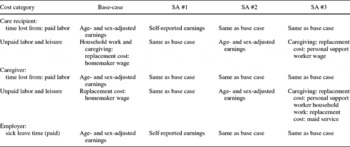
To assess the appropriateness of the methods used for valuing time in the base-case analysis, three sensitivity analyses were performed around the wages used to value time lost from paid labor and time lost from unpaid labor and leisure. Each valuation method used in the sensitivity analyses was compared with base-case valuation method, and these methods are summarized in Table 1.
Valuation Methods for Time Costs in Base-Case and Sensitivity Analyses (SA)

In the first sensitivity analysis (SA #1), care recipients' lost time from paid labor was valued using care recipients' self-reported earnings. This analysis addressed the concern that valuation with age- and sex-based earnings estimates could be inaccurate if the average annual earnings of CF care recipients were higher or lower than Canadian Census earnings estimates for the broader population. Furthermore, using earnings data for a particular year can introduce inaccuracies related to business cycle effects specific to that year. In SA #1, time loss from unpaid labor and leisure was not varied, and, therefore, was valued using the same method as in the base-case.
In the next sensitivity analysis (SA #2), time taken from unpaid labor and leisure was valued using average age and sex-adjusted Census earnings. SA #2 compared the valuation of time taken from unpaid labor and leisure using average age and sex-adjusted Census earnings, rather than using one replacement cost to value all participants' time, which was the method used in the base-case. Paid labor was valued using the same method as the base-case method.
In the final sensitivity analysis (SA #3), time taken from unpaid labor and leisure was valued using two replacement wages: time that had been dedicated to caregiving activities; and time that had been devoted to unpaid labor. Caregiving time was valued using the average hourly rates and percentage of benefits for a personal support worker ($24.76CAD/hr + 20 percent benefits in 2005) (33). The average wage of a personal support worker ($24.76CAD/hr) from the North York Community Care Access Centre was used to value caregiving activities (29). The average hourly cost of a professional maid service ($26.00CAD/hr) was used to value time unpaid labor time. Using two different wages addressed the potential for underestimation in the base-case when valuation was performed using the homemaker wage from the Canadian Census for both caregiving and unpaid labor tasks. Paid labor was valued using the same method as the base-case.
Statistical Analyses
The SAS statistical software program version 8.02 was used for all analyses. Analyses determined the representativeness of the study population. The physical and demographic characteristics of study participants were compared with the two nonparticipant populations, and those who agreed to participate but subsequently failed to complete the AHCR. Similar comparisons were also made between study participants and the national Canadian CF population.
Three differences were computed for each care recipient–caregiver dyad and then averaged within each of the cost categories. The difference in total time costs reported under the base-case and of each the SA #1, SA #2, and SA #3 was computed. The SAS univariate procedure (sign rank test) was used to test the null hypothesis that the average difference between the base-case and each of SA #1, SA #2, and SA #3 was equal to 0 within each of the cost categories. A p value of less than .05 was considered statistically significant.
RESULTS
No significant differences between the participant and nonparticipant populations in terms of demographics and disease severity were identified. The mean age of participants was 31.1 years, 57.3 percent of the study participants were male, and the mean FEV1_k was 56.9 percent. FEV1_k is the measurement of percent of predicted FEV1 (forced expiratory volume in 1 second). These results demonstrated that the study group was representative of the Canadian population of CF care recipients (5;Reference Guerriere, Tullis and Ungar18).
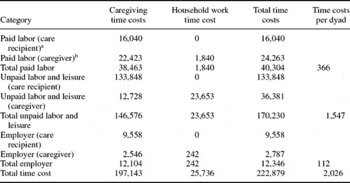
Using the base case analysis, the total time costs across all care recipient–caregiver dyads for the study period (of 28 days) were $222,877CAD, which represented a mean cost of $2,026CAD per care recipient–caregiver dyad (see Table 2). The majority (88 percent) of time losses was due to caregiving or receiving and was valued at $197,143CAD. Total time spent on household activities was valued at $25,736CAD, which represented 11.0 percent of total time costs. Time lost from unpaid labor and leisure was consistently the source of the greatest time costs. The total value of time taken from unpaid labor and leisure was $170,230CAD (or $1,547CAD per dyad) and represented 76 percent of total time costs. Within this category, care recipient time losses were valued at $133,848CAD (78 percent) and caregivers’ time losses were valued at $36,381CAD (22 percent).
Total Time Costs derived from Base-Case Analysis, Per Cost Category for the Study Period (28 days) ($CAD; 2005)

a n = 110.
b n = 48.
Time taken from paid labor represented the next largest source (18 percent) of total time costs with 95 percent of these costs attributable to time associated with the receipt and provision of care due to illness (versus household work time). A mean cost of $366CAD was incurred per care recipient–caregiver dyad due to time lost from paid labor. In contrast to unpaid labor and leisure time, costs accrued to caregivers in the paid labor category were greater than those accrued to care recipients. The value of total time taken from paid labor accrued to caregivers was $24,263CAD, which represented 60 percent of total time costs in this category.
Total time costs incurred by employers were $12,346CAD and represented 6 percent of total time costs. Time taken to receive or provide care was the source of the majority of costs (98 percent).
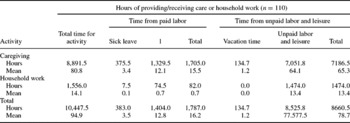
Table 3 provides the total number of hours spent either receiving/providing care or performing household tasks. The majority of time taken to receive/provide care was lost from unpaid labor and leisure. Furthermore, the majority of time was taken to receive/provide care, as opposed to provide household assistance.
Total Number of Hours (n = 110) Devoted to Receiving/Providing Care or Household Work

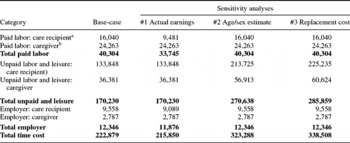
Table 4 presents time costs in the base case and the three sensitivity analyses. In SA #1, actual earnings data were used to value time taken from paid labor. The analysis resulted in a 3.3 percent reduction in total time costs to $215,850CAD, with the reduction greater for care recipients than for employers. SA #2 used age- and sex-based earnings to value unpaid labor and leisure time and led to a 45.1 percent increase in costs to $323,288CAD. When alternate replacement wages were applied to unpaid labor and leisure time in SA #3, a 51.9 percent increase in costs compared with the base-case was observed ($338,507CAD versus $227,879CAD). The pronounced increases observed in SA #2 and SA #3 were explained by the higher wages used in comparison to the wage rate used in the base-case.
Comparison of Time Costs from Base-Case and Sensitivity Analyses ($CAD; 2005)
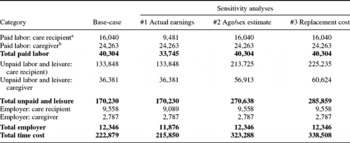
a n = 110.
b n = 48.
The findings from analyses comparing each of the three sensitivity analyses to the base-case results are presented in Supplementary Table 1 (available online at http://www.journals.cambridge.org/jid_thc). In each of the cost categories, the mean difference of total costs per subject (care recipient–caregiver dyad) between each SA and that in the base-case was calculated. The valuation of time taken from unpaid labor and leisure was sensitive to the valuation methods used. Valuation using both SA #2 and SA #3 resulted in significant increases in time costs for both care recipients and caregivers (p < .0001). On average, SA #2 increased the value of time taken from unpaid labor and leisure activities by $913CAD for each care recipient–caregiver dyad, whereas SA #3 increased such costs by $1,051CAD. Time lost from paid labor by care recipient (p = .0877) and time costs accrued to employers (p = .6627) were not significantly sensitive to the valuation method used.
DISCUSSION
This study used the human capital approach to value care recipient and caregiver time devoted to receiving and providing care for adults with CF. Despite the importance of the time devoted by care recipients and family caregivers to receiving care, particularly in relation to labor-intensive illnesses such as CF, very little empirical work focusing on the measurement and valuation of time costs has been done. Three sensitivity analyses were performed by varying wages used to value time lost from paid labor and time lost from unpaid labor and leisure, and compared with a base-case valuation method to determine how these variations affected overall time costs.
SA #1 valued care recipient time taken from paid labor with actual reported earnings and resulted in a 3.3 percent decrease in total time costs over the base-case. The decrease was not statistically significant illustrating that, in this study sample, age- and sex-based census estimates were good proxies for actual earnings. Of interest, in SA #1, time costs incurred by care recipients decreased from $16,040CAD (base-case) to $9,481CAD (SA #1), while time costs accrued to employers due to care recipients absences decreased from $9,558CAD to $9,089CAD. Thus, the decrease incurred by care recipients was far greater than that experienced by employers; the estimates by Census greatly overestimated the wages of those who took unpaid leave from their employer, whereas the same estimates only slightly overestimated the earnings of those who took sick leave. Thus, this observation may indicate that care recipients with higher incomes were more likely to take sick leave from their employers rather than unpaid leave.
SA #2 varied the valuation of time taken from unpaid labor and leisure, by both care recipients and caregivers, using Census estimate. Valuation using Census estimates led to a 45.1 percent increase in total time costs compared with costs calculated in the base-case. Thus, unlike the valuation of paid labor, the valuation of unpaid labor and leisure time was sensitive to the valuation methods. There may be two reasons for this finding. First, compared with the valuation of time taken from paid labor, varying the valuation of unpaid labor and leisure time losses involved a greater quantity of time costs. Second, unlike wages used to value time lost from paid labor, the alternate wages used to value unpaid labor and leisure time were significantly different from one another. The Census earnings used to value time losses in SA #2 were higher than the homemaker replacement wage used in base-case. However, in the valuation of time from paid labor, age- and sex-based earnings estimates were good proxies (approximately equal) for participants' earnings.
Similar to SA #2, SA #3 varied the valuation of time taken from unpaid labor and leisure activity. In SA #3, instead of the single replacement cost used in the base-case (homemaker wage), two different replacement wages were used to value time losses: (i) the wage of a personal support worker was used to value time taken to receive or provide caregiving, and (ii) the hourly rate of a professional maid service was used to value time devoted to unpaid labor activities. This analysis assessed whether a homemaker's wage was an appropriate value to place on such time losses. SA #3 resulted in 51.9 percent increase in total time costs. The large increase was attributed to the large proportion of time losses incurred in this cost category (unpaid labor and leisure) and the magnitude of the wages used in this SA compared with the base-case.
The finding that unpaid labor and leisure time costing results were sensitive to the valuation approach used contributes to the theoretical debate surrounding the valuation of leisure time. As such, although cost of illness studies have been undertaken for CF (19;21;24;28;38), most have not comprehensively measured time costs. One that did report the cost of CF, emphasized the costs that accrue to care recipients due to labor losses (Reference Guerriere, Tullis and Ungar18). In 2002, Nielsen and Gyrd-Hansen (Reference Nielsen and Gyrd-Hansen28) valued time losses of CF care recipients and their parents from paid labor and unpaid labor in Denmark and published data that are, in part, comparable to the results of this study. They determined that the annual cost of production losses per care recipient was equivalent to $12,741CAD. If the total time costs calculated within this study (see Table 2) were adjusted to reflect the annual cost per care recipient, annual cost estimates of $24,306CAD per care recipient–caregiver dyad would be derived. The results presented herein are comparable to those of Nielsen and Gyrd-Hansen once adjusted for purchasing power between Denmark and Canada. Although the two results are similar, the greater costs reported in our study are explained by the inclusion of the cost of time taken from leisure and because costs were reported per dyad as opposed to per care recipient.
Limitations
One limitation of this study is that data were collected using self-reports and, thus, the reporting of time losses could not be validated. Unpaid caregiver literature indicates that individuals may have difficulty reporting time losses, and distinguishing the origin of such losses, if providing unpaid care has become routine (Reference Van Den Berg, Brouwer and Koopmanschap36). Furthermore, participants might have had varied perceptions on which activities were to be considered “caregiving” versus an enjoyable leisure activity. Second, although grounded in human capital theory, valuation approaches were chosen and allocated to sensitivity analyses somewhat arbitrarily. Finally, before our results may be generalized, the methods require replication in populations that vary according to illness/condition, demography, and length and intensity of treatment. However, it is recognized that, because the study site was the main referral clinic for CF care recipients in Ontario, the study sample was a good representation of the provincial population of persons with CF.
CONCLUSION AND POLICY IMPLICATIONS
This study was unique in that it measured the time lost from paid labor, unpaid labor, and leisure activities in a sample of care recipients and caregivers. In many studies that report the economic burden of care recipients and caregivers, costs are frequently not comprehensively measured as costing is limited to out-of-pocket costs, and time costs are excluded (Reference Guerriere, Tullis and Ungar18). Moreover, when time costs of care recipients and caregivers are measured, time costing has traditionally emphasized losses from paid labor over losses from unpaid labor and leisure (Reference Guerriere, Tullis and Ungar18).
Comprehensive measurement of time costs is imperative to identify the appropriateness of caregiving allowance and other forms of caregiver support. The results of this study demonstrate that the origin of time losses was, primarily, time taken from unpaid labor and leisure activities. Time devoted by caregivers played an important role in managing CF. Within the CF literature and the broader health economics literature, there remains a gap in empirical research of unpaid caregiver time costs and losses incurred from unpaid labor and leisure. Results reported herein reiterate and support the need to expand research in these areas and provide a conceptual approach to comprehensive time costing. Applying values to time losses, time from paid labor should be valued with actual earnings when available, whereas time from unpaid labor and leisure should be valued with the appropriate replacement cost. Sensitivity analyses around the chosen replacement wage can be used to address concerns of underestimation and inaccuracy. Resolution of the methodological discrepancies surrounding time valuation, will help to ensure that the time costs of care recipients and caregivers will be consistently and comprehensively estimated.
CONTACT INFORMTATION
Denise N. Guerriere, PhD (denise.guerriere@utoronto.ca), Assistant Professor, Health Policy, Management and Evaluation, University of Toronto, 155 College Street, Suite 425, Toronto, Ontario M5T 3M6, Canada
Jennifer E. Tranmer, MD, MSc (jtranm@interchange.ubc.ca), Resident, Department of Family Medicine, University of British Columbia, 2329 West Mall, Vancouver, British Columbia V6T 1Z4, Canada
Wendy J. Ungar, MSc, PhD (wendy.ungar@sickkids.ca), Associate Professor, Health Policy, Management & Evaluation, University of Toronto, 155 College Street, Suite 425, Toronto, Ontario M5T 3M6, Canada; Senior Scientist, Child Health Evaluative Sciences, The Hospital for Sick Children, 555 University Avenue, Toronto, Ontario M5G 1X8, Canada
Venika Manoharan, HBSc (venika.manoharan@utoronto.ca), Research Assistant, Peter C. Coyte, PhD (peter.coyte@utoronto.ca), Professor, Health Policy Management and Evaluation, University of Toronto, 155 College Street, Suite 425, Toronto, Ontario M5T 3M6, Canada
The authors would like to acknowledge funding from CHSRF/CIHR (Grant no. 37883).