Worldwide, ancient figurines have fascinated archaeologists since the dawn of the discipline (see Bailey Reference Bailey2005:2). Bailey (Reference Bailey2005:6) argues that this fascination is due to their materiality, to figurines as “expressive material culture,” and to their miniaturization. As Shōnagon (Reference Shōnagon and McKinney2006) wrote in tenth century Japan, “All things small, no matter what they are, all things small are beautiful.” Miniatures naturally draw in those who interact with them, and Aztec figurines are no exception. The scholarly interest that these figurines attract is amplified by their ubiquity in Postclassic central Mexican houses—any excavator will likely encounter them and nearly all Aztec museum collections include figurines. Yet most research on Aztec figurines has failed to explore the experience of using figurines and the physical characteristics that facilitate that experience and draw us in today, as they would have in the past. Until recently, most works have been typological (Barlow and Lehmann Reference Barlow and Lehmann1956; Cook Reference Cook1950; Kaplan Reference Kaplan1958; Millian Reference Millian1981; Parsons Reference Parsons, Spence, Parsons and Parsons1972), descriptive (Otis Charlton Reference Otis Charlton, Stocker and Charlton2001; Smith Reference Smith2005), or have focused on production (Charlton et al. Reference Charlton, Nichols and Charlton1991; Otis Charlton Reference Otis Charlton, Hodge and Smith1994; Otis Charlton et al. Reference Otis Charlton, Charlton, Nichols, Santley and Hirth1993; see also Brumfiel Reference Brumfiel and Wright1996).
Recent years have seen the application of new theoretical approaches—such as embodiment and materiality—to figurine studies, leading to novel insights into figurine use and figurine representations (Bailey Reference Bailey2005; Clark Reference Clark2009; Halperin et al. Reference Halperin, Faust, Taube and Giguet2009; Joyce and Meskell Reference Joyce and Meskell2003; Meskell Reference Meskell, Renfrew and Morley2007; Nakamura and Meskell Reference Nakamura and Meskell2009; Nanoglou Reference Nanoglou2005). In Mesoamerica, applications of theories of embodiment, or how bodily experience shapes identity and culture, has resulted in attention to hollowness and interior spaces as social discourse, for example (Joyce Reference Joyce, Boric and Robb2008; Brumfiel and Overholtzer Reference Brumfiel, Overholtzer, Halperin, Faust, Taube and Giguet2009). Scholars using theories of materiality, defined as the mutually constitutive relationships between people and things, have considered such topics as the material characteristics of Mesoamerican figurines (Klein and Victoria Lona Reference Klein, Lona, Halperin, Faust, Taube and Giguet2009) as well as their life histories (Overholtzer and Stoner Reference Overholtzer and Stoner2011). These works all emphasize the active role of figurines as material culture in the constitution of society.
This article follows in that trend, presenting a case study of a subtype of Aztec figurine: the rattle type labeled as Type I by Kaplan (Reference Kaplan1958, Reference Kaplan2006), Type I-A by Parsons (Reference Parsons, Spence, Parsons and Parsons1972), and Group I by Millian (Reference Millian1981). It builds upon previous studies of the iconography of Aztec rattle figurines, contributing an interpretation of rattle figurine use based on ethnohistoric and archaeological evidence and an understanding of the embodied experience of that figurine use based on a multisensory analysis. This analysis, following Bailey (Reference Bailey2005), MacGregor (Reference MacGregor1999), and Ouzman (Reference Ouzman2001), is used to explore the tactile, auditory, visual, and physiological aspects of the ritual use of rattle figurines. The multisensory analysis is applied to a corpus of 116 rattle figurines from three collections: the Phoebe A. Hearst Museum of Anthropology in Berkeley, California; the local museum at the Postclassic central Mexican site of Xaltocan; and excavated collections from Xaltocan. The excavated collections, which are housed and were analyzed in the local cultural center, include all figurines recovered in excavations directed by Elizabeth Brumfiel, Enrique Rodríguez-Alegría, and the author between 1990 and 2010. Using the iconographic, textual, archaeological, and multisensory lines of evidence in combination, I suggest that women used rattle figurines in household healing rituals aimed at effecting reproductive health. Additionally, during their production, exchange, and usage, these figurines would have served as potent visible reminders of the crucial role of mothers and midwives in the production and reproduction of society, playing a role in the negotiation of women's status in Postclassic central Mexican society.
RATTLE FIGURINES
Aztec figurines are small (10–20 cm) mold-made ceramic representations of the human form that were mass produced by craft specialists and distributed through an extensive market system (Charlton et al. Reference Charlton, Nichols and Charlton1991, Reference Charlton, Charlton, Neff, Nichols, Pool and Bey2008; Otis Charlton Reference Otis Charlton, Stocker and Charlton2001). These figurines represent a wide variety of human and supernatural beings, including ordinary women, warriors, and agricultural deities, such as Chalchiutlicue and Tlaloc. Since Aztec figurines are often found in domestic activity areas or trash middens and rarely in burials or as offerings, they were likely used in household activities (Brumfiel Reference Brumfiel and Wright1996:146). Ethnohistoric accounts further specify their use in household ritual (Durán Reference Durán, Horcasitas and Heyden1971:235, 419, 452, Reference Durán and Heyden1994:161–162, 350–351; Motolinía Reference Motolinía1969; Sahagún Reference Smith1950–1982). Diego Durán (Reference Durán, Horcasitas and Heyden1971:419–420), for example, mentions that figurines would be hung over corn fields, presumably to summon deities to protect crops, and that they would be worn by children to avoid illness and harm. Based on the iconographic subject matter and the textual evidence from colonial sources, scholars have argued that Aztec figurines, in general, were used in rituals relating to fertility, both human and agricultural, and health and well-being (Brumfiel Reference Brumfiel and Wright1996; Cook Reference Cook1950; Evans Reference Evans1990; Millian Reference Millian1981; Morss Reference Morss1952; Parsons Reference Parsons, Spence, Parsons and Parsons1972; Smith Reference Smith and Plunket2002, Reference Smith2005). One type of figurine—the rattle—features a narrower range of iconographic representations centered on human fertility and health, the most common of which are representations of adult women, some of whom are pregnant or holding one or two smaller figures that have often been interpreted as children or figurines. This article suggests a more specific use—in healing rituals pertaining to successful human reproduction—for these rattle figurines in particular.
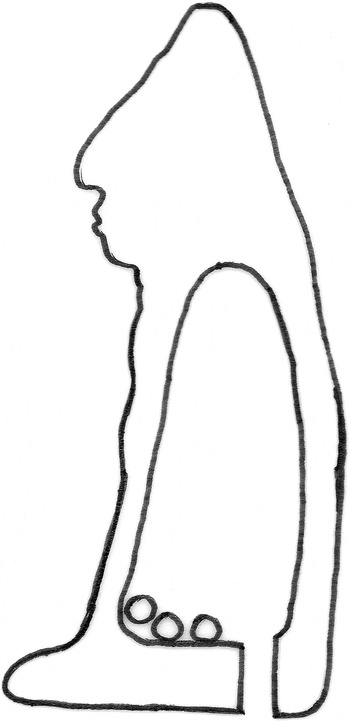
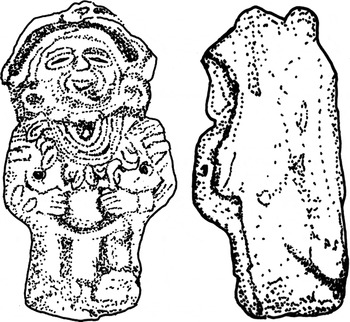
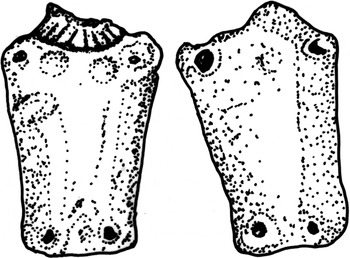
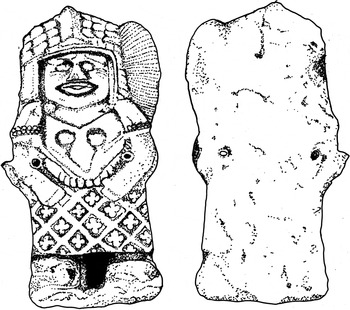
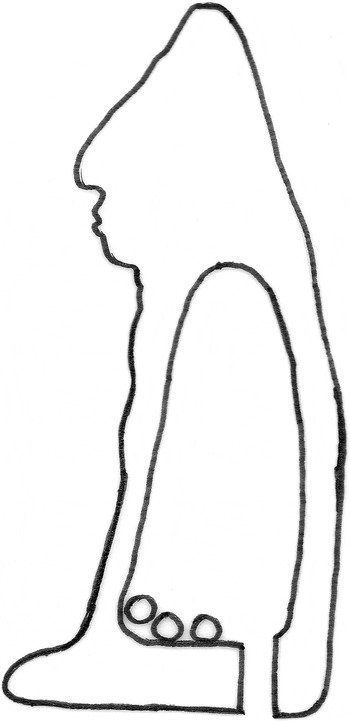
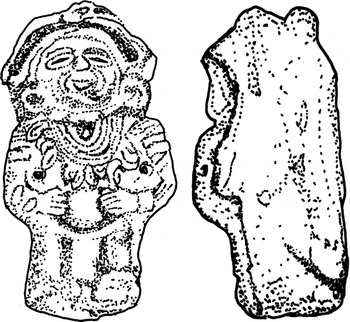
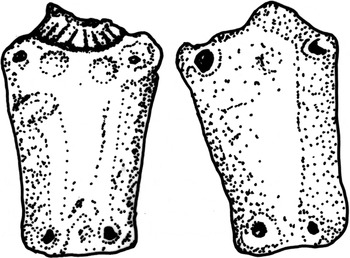
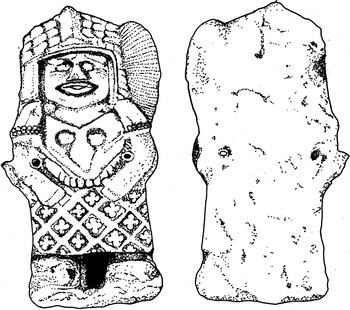
Rattle figurines have thick, solid heads and hollow bodies containing one or two small ceramic balls that facilitate their use as musical instruments (Figures 1 and 2). Figurine producers made the figurines in two-piece molds and placed vent holes in the bottom for stability in firing. This complex form differentiates the Type I rattle from other types. Other forms include jointed, puppet-like figurines with moveable arms and legs (Figure 3) and thin, flat plaque-like figurines (Figure 4), called Types II and III, respectively (Parsons Reference Parsons, Spence, Parsons and Parsons1972). There are two main subtypes of Type I rattle figurines: Type I-A and Type I-B. The less common Type I-B subtype, which depicts Macuilxochitl, the god of song, accounts for 12% of the sample studied by Parsons (Reference Parsons, Spence, Parsons and Parsons1972), 6% of Kaplan's sample (1958, 2006), 2% of Millian's sample (1981), and 8% of Otis Charlton's sample (2001). The more common rattle subtype, called Type I-A, portrays adult women and accounts for the remaining percentage (between 88% and 98% in those published samples). This subtype is the subject of this study. Excavations of domestic contexts (Brumfiel and Overholtzer Reference Brumfiel, Overholtzer, Halperin, Faust, Taube and Giguet2009; Olson Reference Olson, Gonlin and Lohse2007; Smith Reference Smith2005) indicate that the Type I-A rattle subtype appeared in the Basin of Mexico and other parts of central Mexico in the Middle Postclassic period. It was most common during the Late Postclassic period, and continued to be used briefly in the early Colonial period. Recent excavations of Middle and Late Postclassic and early Colonial period houses at Xaltocan recovered 75 figurines of this subtype from midden and fill contexts, accounting for 15% of the total figurine sample from these contexts.
Cross-section drawing of rattle figurine. Drawing by Juan Joel Viveros Sánchez.
Type I rattle figurine from the Phoebe A. Hearst Museum. Drawing by Tom Quinn.
Type II jointed figurine from the Phoebe A. Hearst Museum. Modeled arms and legs would have been attached with string or cord to the holes at the corners of the figurine. Drawing by Tom Quinn.
Type III flat-backed figurine from the Phoebe A. Hearst Museum. Drawing by Tom Quinn.
The Type I-A figurine exhibits highly standardized iconography and aesthetics, suggesting a narrower range of use, centralized production within the Basin of Mexico, and perhaps, therefore, indigenous conceptions of a “kind” of figurine. Kaplan (Reference Kaplan1958, Reference Kaplan2006), Parsons (Reference Parsons, Spence, Parsons and Parsons1972), Millian (Reference Millian1981), and Otis Charlton (Reference Otis Charlton, Stocker and Charlton2001), examining large sample sizes of 242, 96, 162, and 372 rattle figurines and figurine fragments, respectively, have detailed their representational attributes. Otis Charlton (Reference Otis Charlton, Stocker and Charlton2001) has additionally described the paste and manufacturing techniques of the figurine type.
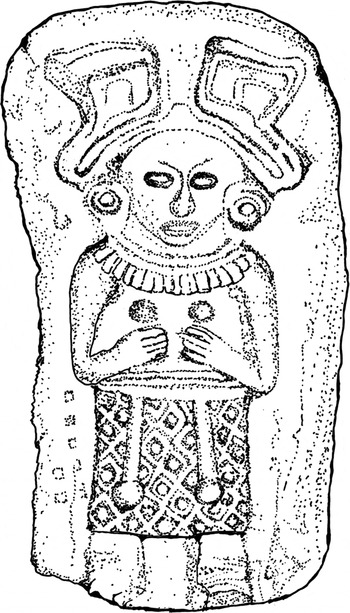
According to these scholars, Type I-A figurines often have red slips, in contrast with the white slip featured on most other Aztec figurines. Type I-A rattle figurines also differ in that they commonly having additional details such as facial features, headdress and clothing elements, and fingers emphasized and retouched with incision after molding (Otis Charlton Reference Otis Charlton, Stocker and Charlton2001:28). Producers fired rattle figurines at a higher temperature than other types, and scholars describe the paste as being nearly vitrified (Kaplan Reference Kaplan1958:37). Kaplan (Reference Kaplan1958) suggests that rattle figurines were made throughout the Basin of Mexico of the same clay used for Aztec Black-on-Orange pottery. All Type I-A figurines represent women who wear some variation on the double side-loop headdress with two top projections, sometimes called the “two prong” headdress (Figures 5 and 6). This headdress has been interpreted as representing a braid that goes from the center of the head to above the ears and loops back onto the head. This hairstyle was not worn until adulthood (Arvey Reference Arvey and Miller1988:183) and may even be an indication of motherhood (McCafferty and McCafferty Reference McCafferty, McCafferty and Sweely1999:106). Type I-A figurines all feature incised eyes with a raised ring of clay and a rimmed, open mouth. All wear round earspools and necklaces, the latter most commonly made of bands with vertical incisions underneath. This necklace type is confined to rattle figurines, including those subtypes representing adult women and Macuilxochitl. Women are depicted standing or kneeling, with hands resting underneath the breasts or on the thighs (usually when the figure is kneeling). Most women wear skirts, some of which are decorated with a diamond pattern, border, belt, and/or copal bags. Attributes such as skirt type, headdress type, body position, and hand position seem to appear in nearly all possible combinations, except when copal bags are present, in which case the figurine always features a standing woman wearing a plain skirt and holding a smaller figure who wears a triangular poncho or quechquemitl (Parsons Reference Parsons, Spence, Parsons and Parsons1972:85–86).
Figurine mold showing a woman wearing two-prong hairstyle. Drawing by Tom Quinn.

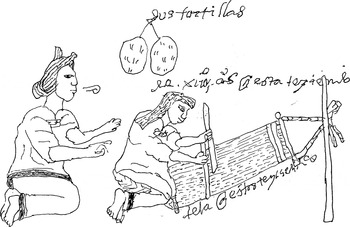
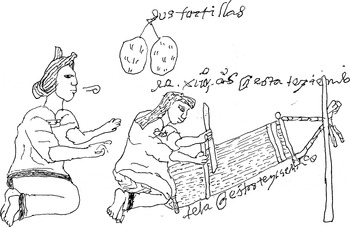
Two-prong hairstyle worn by adult women in Postclassic central Mexican society. Redrawn from the Codex Mendoza (Berdan and Anawalt Reference Berdan and Anawalt1992).
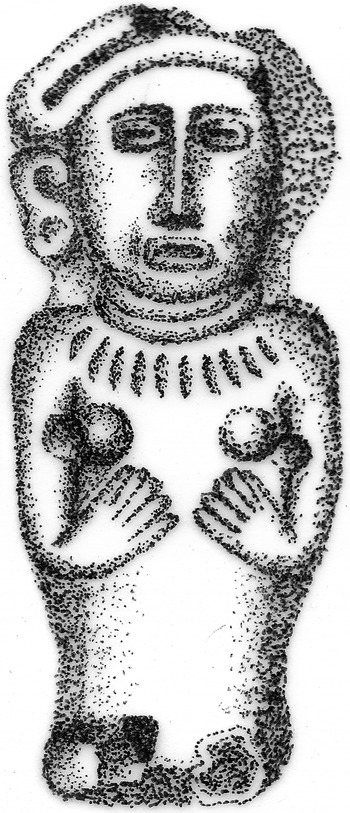
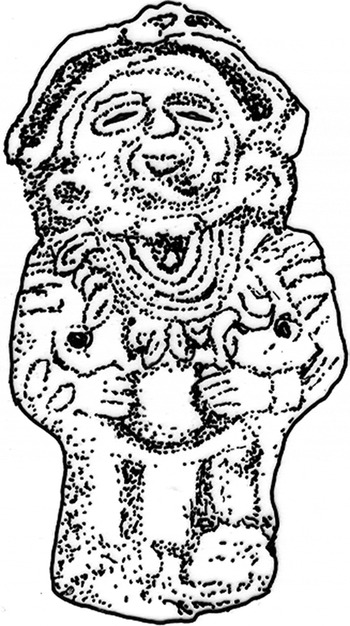
Inspection of this group of figurines reveals that rattle figurines selectively portray a very narrow range of society, specifically women who appear to be of reproductive age. All represent young women with perky breasts (Figure 7).; some of these women are pregnant, as indicated by a large, protruding abdomen (Figure 8), and others carry one or two smaller figures commonly interpreted as either children or figurines (Figure 9). Because of the fragmentary nature of the figurines from most collections, it is difficult to quantify the percentages of figures that were pregnant or carrying smaller figures; the appropriate portion (the torso or arm) must be preserved to make such a distinction. An estimate can be made, however, by including only those fragments that include some portion of the torso. In Kaplan's sample of 184 rattle figurine body fragments (1958), 18% (n = 33) featured smaller figures and 3% (n = 6) were pregnant. Unfortunately, because of their fragmentary condition we cannot tell how many of the 184 figurines would have featured women that were neither pregnant nor holding smaller figures. These percentages thus significantly underestimate frequencies of the different subtypes. The Parsons (Reference Parsons, Spence, Parsons and Parsons1972) and Millian (Reference Millian1981) publications do not enumerate those subtypes for their samples. Of the 75 rattle figurines with some portion of the torso preserved from the Xaltocan and the Phoebe A. Hearst Museum of Anthropology collections that were studied for the multisensory analysis of this paper, 9% (n = 7) were holding smaller figures and 3% (n = 2) were pregnant. Additionally, six figurines (8%) were complete enough to discern that the woman was neither pregnant nor holding a smaller figure.
Rattle figurine depicting a young adult woman of reproductive age, from Xaltocan Museum. Drawing by Juan Joel Viveros Sánchez.

Rattle figurine depicting a pregnant woman, from the Phoebe A. Hearst Museum. Drawing by Tom Quinn.
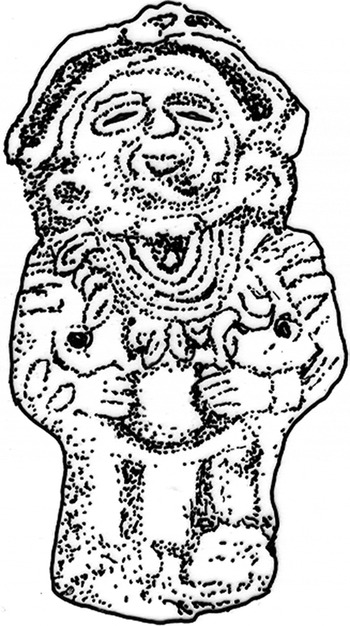
Rattle figurine depicting a woman grasping a smaller figure at the torso in her right hand, from the Phoebe A. Hearst Museum. Drawing by Tom Quinn.
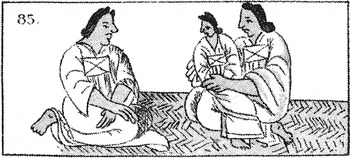
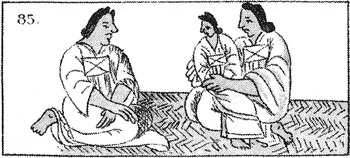
If identified as a child, the smaller figure would imply that the larger figure is a mother; if identified as a figurine, it would suggest that that larger figure is a figurine user—perhaps a healer or a housewife, for example. When a single figure is held, it is always a miniature representation of a female adult, complete with breasts and the two-prong headdress. Colonial codices sometimes depict Aztec children as miniature adults, wearing adult garb and the adult hairstyle (Figure 10), and thus figurine producers may have represented children in the same fashion. But the female miniature consistently exhibits an erect, rigid posture and is grasped by the torso in the hand of the adult female, rather than being held in her arms (in Figure 9, the adult hand is only visible from the side view, not shown; see Figure 11 where adult right hand is visible from the front). This posture lends support to the figurine interpretation.
Rattle figurine depicting a woman holding child represented as miniature adult (from Sahagún [Reference Sahagún, Dibble and Anderson1950–1982:X:Figure 85]).
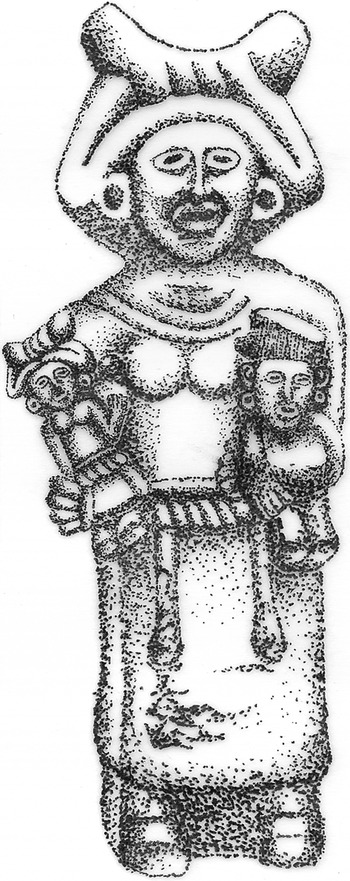
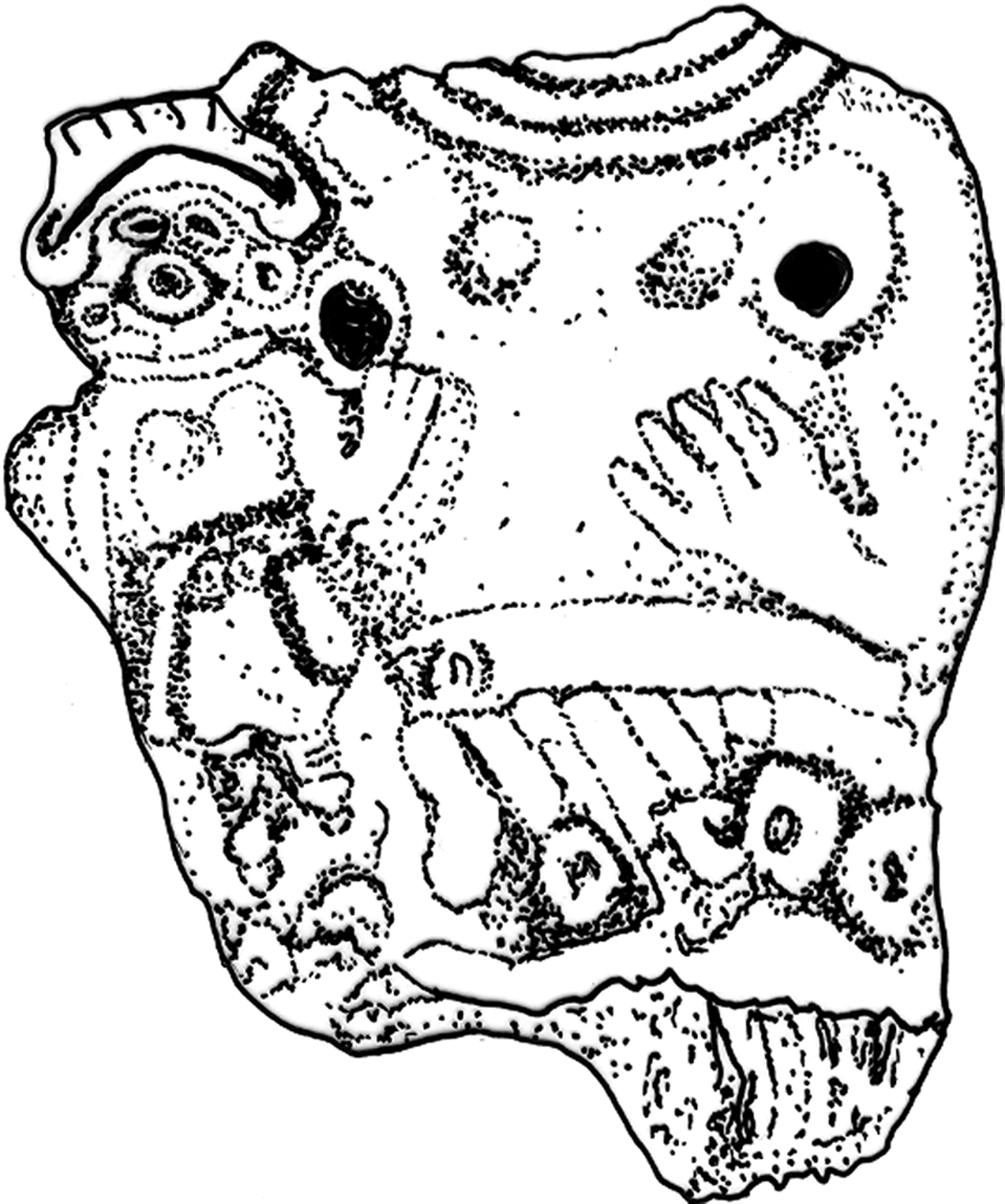
Rattle figurine depicting a female grasping a smaller figure in her right hand and with a second smaller figure slumped over her arm on her left side, from the National Museum of Anthropology in Mexico City. Drawing by Juan Joel Viveros Sánchez.
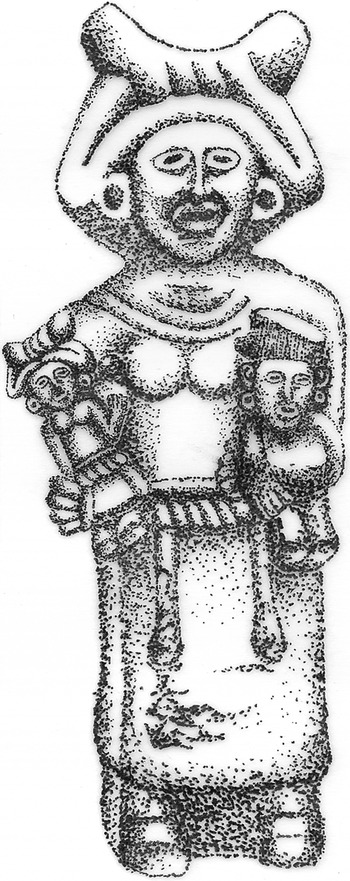
Less commonly, a figurine depicts a woman holding two smaller figures. Two examples, including one from the Musée de l'Homme in Paris (Brumfiel Reference Brumfiel and Wright1996:148) and one exhibited at the National Museum of Anthropology in Mexico City (Figure 11), each depict a woman holding the same miniature female in her right hand and a different figure wearing a slanted headdress in her left arm. The female figure held on the right is erect in posture and grasped by the hand, but the figure held on the left is slumped over the woman's arm, with feet dangling forward. The flexible posture of the figure on the left indicates that a living child, and not a solid, ceramic figurine, might be represented. The positioning of the body over the arm obscures the torso, where breasts, loincloths, and other sex- and gender-specific characteristics would be visible, suggesting that age, and not gender, may have been the primary characteristic emphasized. Thus, Aztec rattle figurines likely depict women holding both figurines and children, with figurines appearing more commonly. The existence of figural representations of women holding figurines indicates that women were likely the principal users of rattle figurines (Smith Reference Smith and Plunket2002:103). Moreover, the existence of women holding figurines and children would imply that women used rattle figurines for healing purposes, possibly for children.
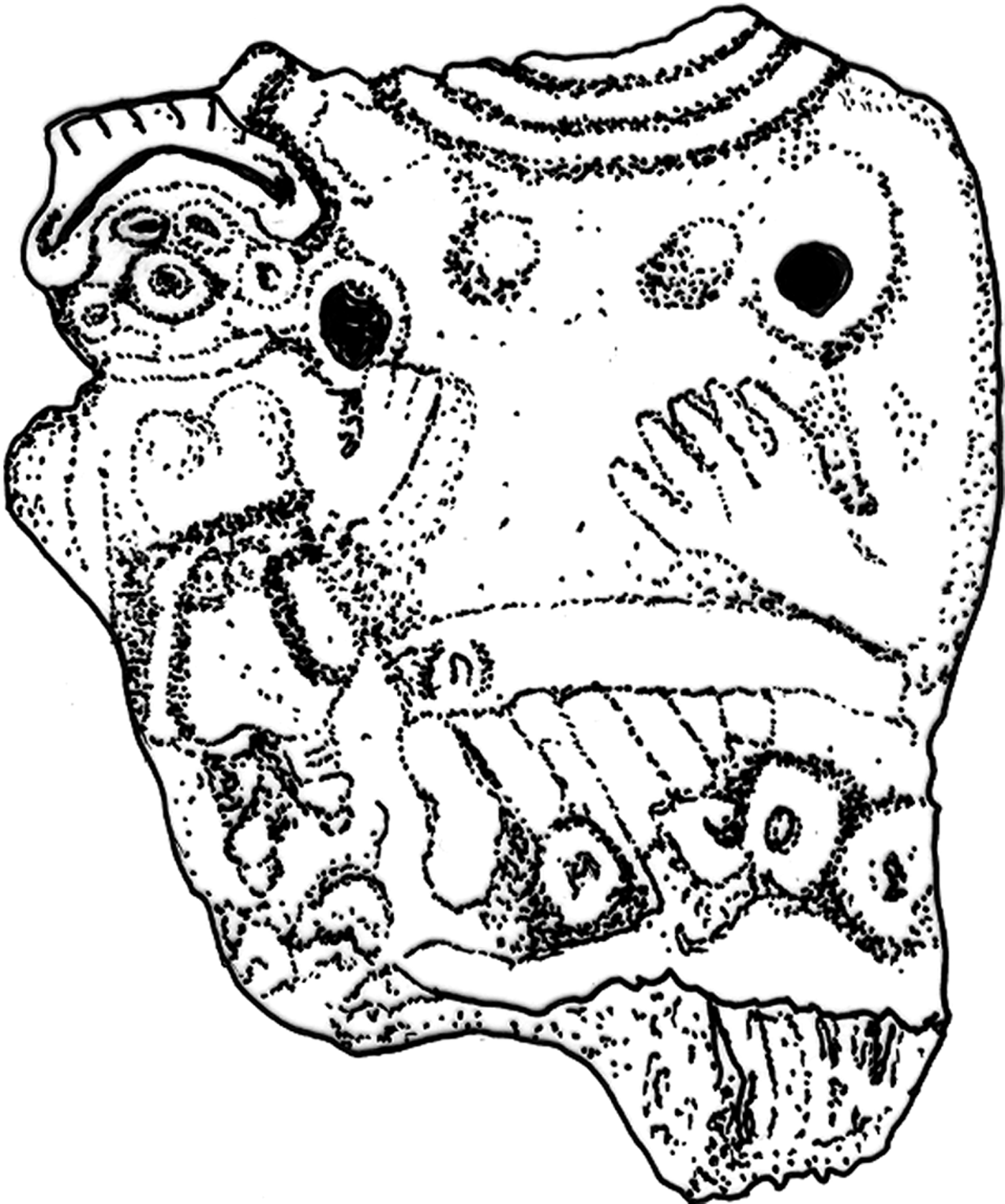
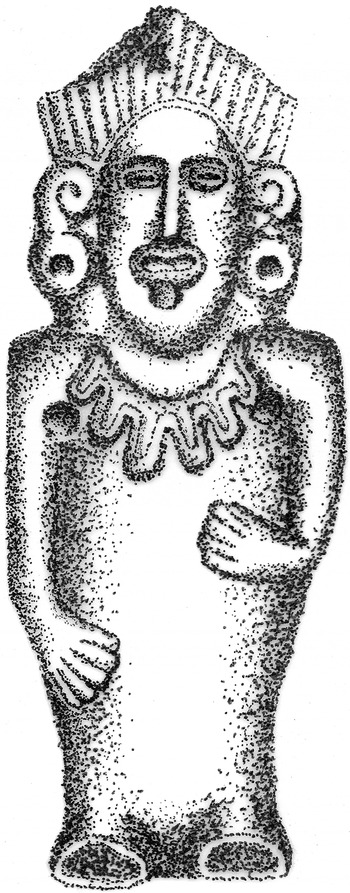
Additional insight is offered by a rattle figurine in the local museum at the Aztec site of Xaltocan, Mexico, that is unlike any figurines described in previous publications. This figurine (Figure 12), which was donated by a local resident who found it on his property, shows striking similarities to the smaller figure shown slumped over the left arm of women in other figurines. The Xaltocan museum figurine appears to be a full-scale version of the smaller figure that wears a slanted headdress. It represents a standing individual who lacks breasts and wears a lip plug. The lip plug worn by the larger Xaltocan museum figurine suggests that the individual is a male, since lip plugs were male accoutrements (Joyce Reference Joyce2000).Footnote 1 Curiously, however, no loincloth is depicted, even though the torso is visible, and thus the figure is somewhat ambiguously gendered. Given the resemblance of this figurine to the smaller figure held by women, this figure may be tentatively identified as a child, possibly male. Thus, we may add children to the iconographic corpus of rattle figurines.
Rattle figurine depicting a child, possibly male, from the Xaltocan Museum. Drawing by Juan Joel Viveros Sánchez.

Rattle figurines, therefore, likely represent women of reproductive age, pregnant women, mothers, midwives, healers, and children. Together, this material imagery can be seen as reflecting a concern with reproduction and maternal health. This group, which represents a narrow representative range of human society, is somewhat similar to Middle Formative period figurines from Chalcatzingo studied by Cyphers Guillén (Reference Cyphers Guillén1993), perhaps reflecting common concerns. In these figurines, “the fertile stages of the female life cycle are emphasized with representations of puberty, stages of pregnancy, and childrearing” (Cyphers Guillén Reference Cyphers Guillén1993:213). The Formative figurines studied by Cyphers Guillén (Reference Cyphers Guillén1993:220) suggest use in rites of passage associated with these stages in the life cycle. Other scholars examining Olmec human figurines have distanced themselves from earlier abstract fertility interpretations. Instead, they have argued for their use as tools for the supplication of animate forces or deities for assistance in health, reproduction, and production (Tway Reference Tway2004:134–135) and for their active use in curing and healing rituals performed by women (Follensbee Reference Follensbee2000:87, Reference Follensbee, Halperin, Faust, Taube and Giguet2009:89). Ethnographic studies (Álvarez Reference Álvarez1980:10–12; see also Follensbee Reference Follensbee2000; Tway Reference Tway2004) suggest that pregnancy and childbirth may have been considered illnesses to be treated through ritual figurine use in ancient Mesoamerica. Similarly, some figurines found in domestic contexts at Teotihuacan illustrate a theme of pregnancy and infancy; Barbour (Reference Barbour1975) suggests that these figurines were used in curing or healing rituals relating to female reproduction and childbirth. The representations of midwives and the reproductive life cycle in Aztec figurines seem to show a similar concern with healthy reproduction, as well as with the product of that process—the child.
When one considers that reproduction is only successful when the child reaches reproductive age, reproduction comes to be understood as a much longer process than typically conceived of in modern Western societies. Ginsburg and Rapp (Reference Ginsburg and Rapp1995) have convincingly argued that human biological reproduction cannot be divorced from the more comprehensive concept of social reproduction, defined by feminist scholars as the work, activities, relationships, and attitudes related to the continuation of current and future generations of human life. Physical reproduction is not isolated from broader social and political processes, but rather “is always, everywhere, a politically and culturally constituted practice” (Stephens Reference Stephens, Ginsburg and Rapp1995:286). Reproduction is not confined to a physical procreative act. Rather, it is an extended, multivalent process that necessitates various kinds of physical, medical, cultural, and spiritual work, such as those practices using the rattle figurines explored here. Furthermore, the study of social reproduction allows us to understand how societies are produced, reproduced, and contested over time as people create and nurture the next generation (Ginsburg and Rapp Reference Ginsburg and Rapp1995:1).
ARCHAEOLOGICAL EVIDENCE FOR USE
Deposition contexts lend additional support to the argument that rattle figurines were used in healing rituals forming social reproduction work. Most Aztec figurines have been found through survey or “collecting,” or are found in secondary contexts such as refuse deposits and fill (Brumfiel and Overholtzer Reference Brumfiel, Overholtzer, Halperin, Faust, Taube and Giguet2009; Olson Reference Olson, Gonlin and Lohse2007), offering little contextual information about their use. Excavations directed by Susan T. Evans at Cihuatecpan, a site in the Teotihuacan Valley, however, present a unique opportunity to look at use context. Evans (Reference Evans1990) recovered 90% of the 44 figurines from good behavioral contexts in habitation rooms or in courtyards with sweat baths (temazcalli sing.). Furthermore, she specifies that the figurines found in sweat bath areas are the kind with the “two-prong hairdo” (Evans Reference Evans, Inomata and Houston2001:259). Sahagún (Reference Sahagún, Dibble and Anderson1950–1982:VIII:47) describes women's hairdos in a way similar to the representations in figurines: “the hair [twisted with black cord and] wound about the head.” McCafferty and McCafferty (Reference McCafferty, McCafferty and Sweely1999) argue that this hairstyle, which was worn in life by adult women, referenced Xochiquetzal and represented Mexica women's assertion of a connection to the goddess. This is significant since Xochiquetzal was the patroness of sexuality and fertility and the “ideological figurehead” for healers and midwives (McCafferty and McCafferty Reference McCafferty, McCafferty and Sweely1999; see also Durán Reference Durán, Horcasitas and Heyden1971:238–247; Nicholson Reference Nicholson, Ekholm and Bernal1971; Sullivan Reference Sullivan and Boone1982). This two-pronged hairdo found in sweat bath contexts is generally confined to rattle figurines.
The presence of rattle figurines near sweat baths further implies a link between figurines and female reproduction and health, since sweat baths were often used for ritual cleansing and healing (Brumfiel Reference Brumfiel and Wright1996:147; Evans Reference Evans1990). For example, the Florentine Codex specifically mentions the use of the sweat bath at three or four months of pregnancy and upon the onset of labor so that the pregnant woman would give birth quickly (Sahagún Reference Sahagún, Dibble and Anderson1950–1982:VI:152, 159). If, after a day, the woman had not given birth, she was put into the sweat bath with the midwife again (Sahagún Reference Sahagún, Dibble and Anderson1950–1982:VI:160). The sweat bath played a crucial role in successful childbirth, and by extension, the sweat bath context of rattle figurines suggests their active role in childbirth rituals.
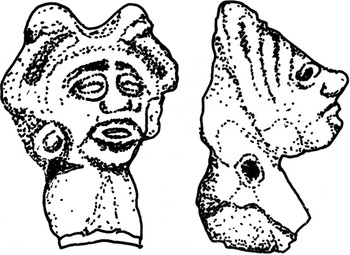
Another indication of use context is the piercing of a hole laterally through the neck to allow for suspension. Two hollow rattle figurines—one at the Hearst Museum and one recovered from excavations at Xaltocan—are pierced in this way (see Figure 13). Similar suspension holes are common in small Playa de los Muertos figurines of Formative period Honduras, and larger figurines demonstrate their probable use: they depict individuals wearing what Joyce (Reference Joyce2003:252) interprets as symbols of small figurines around a necklace. For the Aztecs, Diego Durán (Reference Durán, Horcasitas and Heyden1971:420) wrote that upon successful completion of the fasting and feast of the third month (Tozoztontli), all children under 12 years of age wore figurines on thread around the neck, and young girls wore figurines on the wrists “not just for their adornment but because of heathen ideas.” With the wearing of figurines, the children were told that “they could avoid illness and that no evil would befall them” (Durán Reference Durán, Horcasitas and Heyden1971:420). Durán (Reference Durán, Horcasitas and Heyden1971:419–420) also states that figurines were suspended over cornfields to ensure health and fertility. These lateral suspension holes are not the only kind of holes in figurines. Central holes running from front to back near the armpits occur in most Aztec figurines. Thus, rattles might have been one of several kinds of figurines that would have been worn or strung on the body for protection or fertility, thereby representing social reproduction work. However, unlike other holes, which did not always completely perforate the figurine and might have been made to prevent breakage during firing (Parsons Reference Parsons, Spence, Parsons and Parsons1972:83), the function of lateral holes is clearer. These holes would have facilitated suspension with the figure facing forward and might have actually increased the likelihood of breakage because they would have made the neck, which was already structurally weak, even more fragile.
Front and side view of rattle figurine, showing suspension hole pierced laterally through neck, from the Phoebe A. Hearst Museum. Drawing by Tom Quinn.
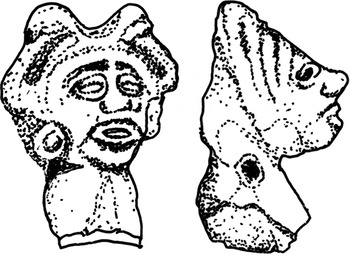
Combined with the behavioral context of habitation rooms and sweat baths for figurines at Cihuatecpan, this morphological evidence suggests that rattle figurines were worn by people for rituals relating to female social reproductive practices and the healing of the product of the fertility cycle: children.
TEXTUAL EVIDENCE FOR USE
Textual evidence corroborates the use of figurines in reproductive rituals and further suggests their function was apotropaic, serving to ward off evil or bad fate. The Florentine Codex describes the precautions a pregnant woman should take “so that the baby not be formed like a pottery rattle, so that it not result as a gourd rattle, so that it not sicken” (Sahagún Reference Sahagún, Dibble and Anderson1950–1982:VI:157). Bernardino de Sahagún's translation into Spanish offers a hint at the meaning of the metaphor used here because he was more interested in a cultural translation than in an accurate Spanish equivalent of the text (Arvey Reference Arvey and Miller1988:191). Sahagún writes, “porque no se halle la criatura en bacio, o aya alguna vacuydad, o falta de sangre, o humor necessario, y asi resciba algun daño.” “So that the child is not found hollow, or that there be any emptiness, or lack of blood or necessary humor, and in that way receive some harm” (Sahagún Reference Sahagún, Dibble and Anderson1950–1982:VI:157; author's translation). The undesirable characteristics emphasized here are dryness, emptiness, hollowness, and a lack of blood. A baby produced like a pottery rattle or a gourd rattle would probably be born gravely ill or stillborn.
It is noteworthy that the scribe of the passage from the Florentine Codex metaphorically linked the production of a child to the production of pottery and gourd rattles and specifically with the drying aspect of that production that is crucial for the formation of both gourds and ceramics. The authors could have written about avoiding dryness or emptiness without referencing rattles; that they did is significant. The two references to rattles suggest an important link here. The Aztecs understood rattles, whether made of pottery or of gourds, to be empty, hollow, dry, and without blood, the essential life force. López Austin's (Reference López-Austin, de Montellano and de Montellano1988:1:168) work on the ideology of the human body corroborates the fact that this characteristic would have been undesirable in a baby. He writes (López Austin Reference López-Austin, de Montellano and de Montellano1988:1:168)
The function of blood was to strengthen people and make them live and grow by keeping the muscles moist. Sahagún's texts are clear: Blood,…our gushing forth, our growth, our life is blood,…thick, fat, animating, our life; it reddens, moistens, drenches, fills all the flesh with mud, it gives it growth, it surges to the surface, it covers people with earth… It strengthens people, it fortifies people greatly.
This condition—a baby formed like a pottery rattle—might have indicated dryness or a lack of blood in the uterus, the site of the child's biological production. Like other hollow places linked to birth and origins, such as caves—considered by many cultures to be the womb of the earth—and sweat baths—artificially constructed caves, and thus wombs—uteruses were understood to be moist (Heyden Reference Heyden and Benson1981; Milbrath Reference Milbrath and Miller1988; Monaghan Reference Monaghan and Klein2001). A dry womb, and therefore a dry baby, would have had disastrous consequences.
This textual evidence suggests that rattle figurines used in curing and reproductive rituals served an apotropaic function for pregnancy and childbirth. The hollow and dry rattle may have substituted for any possible emptiness in the baby and/or womb. In using a materialization of the undesired characteristic (hollowness and dryness) in the womb of a rattle in order to avoid such a result in the woman's womb, this apotrope would have functioned in a counterintuitive manner. Examples of similar apotropaic substitutions are evident in other aspects of Aztec culture, such as imperial rhetoric of sacrifice—where the blood of a few was offered so that all would not suffer or perish (Brumfiel Reference Brumfiel1998). Like this and other Aztec apotropes recorded by colonial chroniclers, rattle figurines may have served as tools for protection against harm for fetuses, infants, and children during their development.
In Postclassic period central Mexican society, childbirth was a difficult and dangerous process, and childhood mortality is thought to have been high. Postclassic houses excavated at Xaltocan all had several child or infant burials underneath them, confirming high juvenile mortality (Brumfiel Reference Brumfiel2005; De Lucia Reference De Lucia2010). In Aztec Tenochtitlan, 22% of children died in the first three years of life, and another 16% died before reaching adulthood (Camargo Valverde and Partida Bush Reference Camargo Valverde, Bush, Morfín and León1998:88).
A third of Book VI of the Florentine Codex is devoted to pregnancy, childbirth, and early childhood, even though their authors were primarily male. Fear of stillbirth, the death of infants and children, and death of the mother during childbirth pervade the texts. Included are pages of advice given to pregnant women at various stages so that the baby would not abort or be stillborn and so that the labor would progress rapidly. The texts also specify actions a midwife could take, such as massage, administration of herbs, and surgical abortion, if labor was not going smoothly. Even after a successful birth, however, the child had not escaped all danger. Parents were advised that perhaps the lord of the nigh “will unclasp from you his precious necklace, his precious feather” (Sahagún Reference Sahagún, Dibble and Anderson1950–1982:VI:182). Fear and danger of an offspring's death extended past birth and into childhood. The Aztecs personified the danger to mother and child in the form of deities, both those who were dangerous, and those who assisted. Dangerous deities who might cause harm to children included the cihuateteo goddesses and Xolotl (McCafferty and McCafferty Reference McCafferty, McCafferty and Sweely1999:120; Millian Reference Millian1981:83). Deities who were asked for assistance during childbirth included Xochiquetzal, Yoalticitl, and Cihuacoatl (McCafferty and McCafferty Reference McCafferty, McCafferty and Sweely1999:103; Sahagún Reference Sahagún, Dibble and Anderson1950–1982:VI:Chapter 27).
Rattles may have been used to ward off deities who might cause harm by creating drying forces in the womb during the production of the baby or to invoke deities who might assist. Or, rattles may have physically substituted for the potentially dry and hollow mother's womb and baby when harmful forces could not be averted. This practice would have been similar to other actions taken after birth as described in the Florentine Codex, such as the invocation of Chalchiutlicue while bathing to avoid harm. While washing the baby, the midwife said, “Wheresoever thou art which hath caused harm to my child, here is our mother Chalchiutlicue (referring to the water). Leave [the child]. Flow away. Disappear” (Sahagún Reference Sahagún, Dibble and Anderson1950–1982:VI:206). The use of rattles would have been but one of many actions taken by women to ensure reproductive success.
MULTISENSORY ANALYSIS
The iconographic, archaeological, and textual evidence discussed thus far has offered substantial insight into the ritual use of these figurines. However, it has shed less light on the human experience of that use because it has relied exclusively on the sense of sight. A multisensory analysis of rattle figurines contributes further detail about the bodily experience of their use in reproductive rituals. Twenty-three rattle figurines curated at the Phoebe A. Hearst Museum of Anthropology, 88 rattle figurines recovered in excavations at the Postclassic period site of Xaltocan, Mexico (see Brumfiel and Overholtzer Reference Brumfiel, Overholtzer, Halperin, Faust, Taube and Giguet2009), and five rattle figurines exhibited at the Xaltocan site museum were analyzed. While, admittedly, this is a small sample, comparison with published archaeological and museum collections (Baer Reference Baer1996; Kaplan Reference Kaplan1958, Reference Kaplan2006; Millian Reference Millian1981; Parsons Reference Parsons, Spence, Parsons and Parsons1972) suggests that it is representative of Type I-A figurines, and it includes a number of complete artifacts that enable a full multisensory analysis.
Ouzman (Reference Ouzman2001) and MacGregor (Reference MacGregor1999) have criticized an over-reliance in archaeology on the sense of sight for interpreting lived experience. Ouzman (Reference Ouzman2001:237) suggests that this over-reliance naturally follows from a culturally ingrained post-Enlightenment emphasis in Western society on the visual aspect. Common sayings such as “seeing is believing,” “it is apparent that,” and “the evidence shows” demonstrate the prominence of sight in modern Western culture (2001:238). Ouzman argues for an archaeology that includes consideration of other senses, particularly hearing and touch. MacGregor (Reference MacGregor1999:263–264) likewise encourages an analysis of non-visual sensory perception, such as touch and smell.
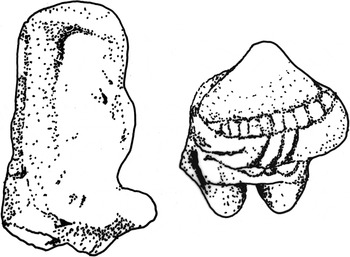
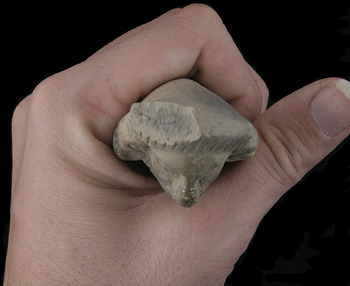
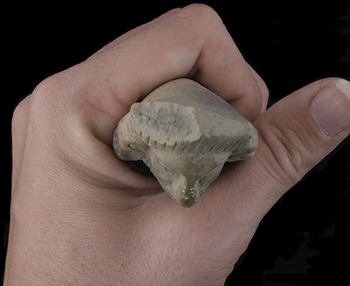
Rattle figurines exhibit several characteristics that demand a more well-rounded sensory analysis. The first is three-dimensionality: they are sculpted in the round, using two-piece molds instead of one-piece molds, as is characteristic of other types (Figures 14 and 15). MacGregor (Reference MacGregor1999:264) writes, “The tactile perception of a three-dimensional object is usually an active encounter involving information on touch, texture, temperature.” He calls this experience “haptic perception” (MacGregor Reference MacGregor1999:264). It seems clear that these three-dimensional rattle figurines would have been handled and moved around through space in ritual, the hand wrapping comfortably around the figurine and encountering no sharp edges. The form of the figurine as seen from above is somewhat triangular in shape and fits nicely into the hand, with the triangular projection on the back of the figurine resting in the space of the first knuckle (Figure 16). This form demonstrates a critical element of touch in the use of the figurine.
Top and back view of rattle figurine, showing its three-dimensionality, from the Phoebe A. Hearst Museum. Drawing by Tom Quinn.
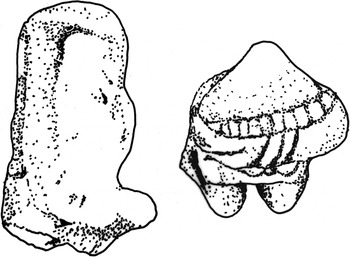
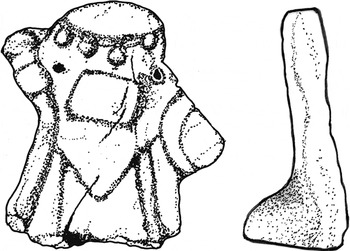
Front and side view of flat-backed figurine, showing its two-dimensionality and large base that allowed it to stand. Front view drawing by Tom Quinn; side view drawing by author.
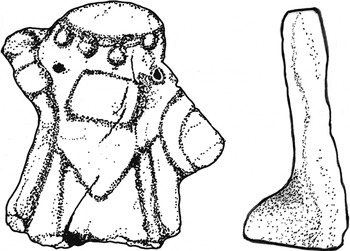
Photo of rattle figurine held in hand.
Additionally, rattle figurines were the only figurines, with one notable exception, to be burnished. Burnishing creates not only a sheen or shiny appearance but perhaps more importantly a certain texture, a smooth surface to touch. Within the large Teotihuacan Valley archaeological collection of 372 rattle figurine fragments analyzed by Otis Charlton (Reference Otis Charlton, Stocker and Charlton2001), 34% (n = 128) showed evidence of burnishing. The other kind of figurine commonly burnished is Parson's Type II, the jointed figurines with moveable arms and legs. This type is the only other kind of figurine that demonstrates movement and handling. The presence of burnishing on other types of ceramics designed to be held, such as flutes and pipes, confirms the association between handling and burnishing.
This pattern stands in striking contrast to the flat-backed Type III figurine, for example. Type III figurines are unburnished and two-dimensional, having been made in a one-piece mold. They also have a plain and undecorated posterior side and a large base which enabled them to stand. These figurines were clearly made to sit on an altar and be seen and not touched.
Movement, handling, three-dimensionality, and a smooth texture seem to go hand in hand, and, as Bailey (Reference Bailey2005:38) asserts, “the difference between looking and touching is important.” Touching is an active, tactile experience involving a different relationship with an object, and rattle figurines, in particular, seem to have been created for such a practice.
Another form of sensory experience—that of hearing—is demonstrated by the function of rattle figurines as percussive musical instruments. The four intact examples in the collections examined show a difference in tone and volume of sound. A smaller figurine from the Hearst museum representing a pregnant woman holding her abdomen has smaller pellets inside and emits a higher pitched and softer sound when shaken. A larger rattle from the Hearst Museum depicting a kneeling woman has larger pellets and produces a lower pitched and louder sound. Two equally sized larger figurines from the Xaltocan Museum, one depicting a standing female and one depicting a standing male, also have larger pellets and produce a lower pitched and louder sound. These figurines have between one and three ceramic balls inside; the human ear cannot detect a significant difference in the sounds produced from this variation, however. The difference in pitch and sound noticed between the smaller and larger rattle figurines might reflect musicality or perhaps inclusion or exclusion of individuals in the sensory experience. If a musical instrument is quiet and small, one must be closer in order to hear and see it. While additional research considering figurine size, degree of firing, and number of ceramic balls inside would help us to better understand the auditory experiences of rattle figurines, the attributes of three-dimensionality, burnishing, and rattles among these objects affirm a figurine ritual experience that drew heavily on tactile, visual, and auditory senses.
Given the apotropaic use discussed earlier, the figurines' multisensory attributes have intriguing implications for the use of rattles in Aztec society in childbirth. Needham (Reference Needham1967) first drew attention to the cross-cultural use of percussive instruments in shamanic practices designed to communicate with or repel spirits, suggesting a link between percussion and transition or the passage from one status to another. Of the San's use of percussive sound in shamanism, Ouzman (Reference Ouzman2001:242–244) writes,
Repetitive percussive sound can induce a heightened state of reality. Feelings of general euphoria as well as…disassociation from one's body can result from the combination of percussive sound with strenuous physical activity…Percussive sound acts as an analgesic by blocking or overriding pain. The medicine dance's percussive rhythms approach the 10-hertz alpha cycle of the brain and help induce a state qualitatively different from a waking state of reality.
The visual environment of the San trance dance also contributed significantly to the experience of its participants by focusing participant attention on the aural realm: “The flickering firelight of the dance serves to hide more than it reveals and the importance of ordinary vision decreases and aural aspects are ascendant” (Ouzman Reference Ouzman2001:243).
The medicinal use of rattles in sweat baths for Aztec women in labor might have functioned similarly, as the environmental conditions are analogous. Aztec women in labor clearly experienced prolonged strenuous physical activity while in labor, as in the San case study. And the sweat bath, in which water was poured on glowing hot stones to create dense steam, likewise produced an environment in which visual capabilities were reduced and participants thereby focused on other senses such as sound. Rattles, as percussive instruments, may have had physiological effects for Aztec women in labor and helped with the birthing process, especially by alleviating pain and causing feelings of disassociation from the body. Indeed, some modern Western midwives use hypnotic trance to decrease perception of pain (Mongan Reference Mongan2005). Commonly practiced modern Lamaze (Reference Lamaze1956) breathing techniques, which ask expectant mothers to focus on breathing patterns and thus results in a narrowing of attention, work to distract those in labor from physical pain. The use of rattles within sweat baths—which would have focused laboring mothers' attention on percussive sound, distracting them from pain and perhaps inducing a different state of consciousness—might be seen as a comparable strategy enacted by midwives in Postclassic central Mexican society. Alleviating pain would have allowed the woman in labor to relax, facilitating a more rapid progression of labor and dilation and more productive contractions, effectively decreasing the risk of delivery complications.
Additional insight into the effect and experience of using a rattle figurine in reproductive rituals can be gained from studying figurines as miniatures. As Lévi-Strauss (Reference Lévi-Strauss1966:23) notes, “All miniatures seem to have an intrinsic aesthetic quality.” He (Lévi-Strauss Reference Lévi-Strauss1966:23) suggests that the appeal of miniatures is not simply “a matter of economy in materials and means,” but rather because of a real difference in the way the object is perceived and understood. A smaller object is simplified, less intimidating, and more easily intelligible. Lévi Strauss (Reference Lévi-Strauss1966:23–24) explains:
In the case of miniatures, in contrast to what happens when we try to understand an object or living creature of real dimensions, knowledge of the whole precedes knowledge of the parts. And even if this is an illusion, the point of the procedure is to create or sustain the illusion, which gratifies the intelligence and gives rise to a sense of pleasure which can already be called aesthetic on these grounds alone.
Drawing on the work of Lévi-Strauss and others, Bailey (Reference Bailey2005:33) further details the effects of miniaturism on the user:
miniaturism empowers the spectator. It allows physical control over a homologue of a thing; intellectually, it facilitates a better understanding. […]By reducing the world-at-large's reality, a miniature provides a way of making sense of that world. Literally, it makes the world manageable. Furthermore, miniaturism comforts the spectator. By providing the better understanding and physical control over a thing, miniaturism suggests security and thus brings pleasure. By creating a world in which the human scale matters most and dictates all spatial relationships, miniaturism reassures and liberates the viewer. In doing so and in making the viewer powerful and all-knowing, a miniature object makes the viewer free to indulge in flights of fantasy.
Stewart (Reference Stewart1993:54) further remarks on the “daydream of the microscope,” as she writes, “That the world of things can open itself to reveal a secret life—indeed, to reveal a set of actions and hence a narrativity and history outside the given field of perception—is a constant daydream that the miniature presents.” Using a figurine in a dangerous, largely unknown situation where the participants did not have complete control, such as reproductive practices including childbirth, would have perhaps created a sense of control and reassured participants that a positive outcome was likely. Bailey (Reference Bailey2005:34) writes that miniatures' most important power is “the ability to create and allow access to alternative worlds and realities.” Stewart (Reference Stewart1993:69) suggests, “The miniature, linked to nostalgic versions of childhood and history, presents a diminutive, and thereby manipulatable, version of experience.” All practices aimed at improving social reproduction would have tried to create an alternative reality, one in which children were conceived, born, and raised to be healthy adults. Individuals using miniatures such as figurines might have literally enacted a desired reality. Bailey (Reference Bailey2005:42) argues that compression and distillation, characteristics of miniatures, makes those objects more powerful and more significant. As miniatures, Aztec figurines may have been more productive tools in creating the desired alternative reality of successful reproduction.
Aztec figurines might also have been effective instruments because of another psychological effect of miniatures: time compression. Studies conducted by architects at the University of Tennessee indicate that people's perceptions and experiences of time are affected by reduced-scale or miniature environments (DeLong Reference De Long1981, Reference De Long1983, see also Bailey Reference Bailey2005:36; Stewart Reference Stewart1993:66). More specifically, smaller scale environments tend to compress the experience of temporal duration, speeding up the central nervous system and therefore an activity's perceived duration. Stewart (Reference Stewart1993:66) observes that this temporal transformation “serves to skew the experience of the social by literally deferring it.” Time-compression would be desirable in times of danger, such as active labor or during a child's serious illness. DeLong's research (Reference De Long1981, see Bailey Reference Bailey2005:37–38) further indicates that when miniaturization takes place in three dimensions, the effects of time compression are magnified. Aztec figurines as three-dimensional miniatures might have helped people to deal with dangerous or stressful experiences related to childbirth by lessening the perceived severity and duration.
VISIBILITY OF RATTLE FIGURINES
Rattle figurines appeared abruptly in the Middle Postclassic period and were in widespread use across the Valley of Mexico until not long after the Spanish conquest. These figurines would have been clearly visible within the various communities in which they were produced, traded, and used. Their sheer presence and visibility created what Bailey (Reference Bailey2005:199) describes as a second, deeper meaning that is crucial for understanding the lived social realities of the communities: “the position of the figurine as an unintentional, but potent, manifestation of the body.” The female body featured in rattle figurines would have been visible in many contexts not limited to their household use, such as in figurine workshops, while in transit, at the market, and in the household while not in use. He argues that this meaning is not related to the intended or actual use of the figurine. However, the intentional presentation of the feminine human body in Aztec rattle figurines cannot be divorced from their purpose. Rattles specifically made in the form of female figures would have served as a reminder of the importance of women in the production and reproduction of the household and the society.
It would have been widely known—at the very least among women, figurine producers and vendors, and medical practitioners—that rattle figurines were used in reproductive practices as tools for the active manipulation of reality. Because of such knowledge, the physical presence of rattle figurines during the various stages of their life histories would have implicitly referenced social reproductive processes and would have alluded to women's knowledge and skills in this realm. These processes would have also been explicitly referenced by the way in which the female body was presented iconographically. Representational imagery is always selective, and miniaturization necessitates further selection (Bailey Reference Bailey2005:32). What is chosen for representation is then concentrated, distilled, enriched; as Bailey (Reference Bailey2005:33) argues, “At the same time as miniaturism reduces elements and properties it multiplies the weight of the abstracted reminder.” As Lévi-Strauss (Reference Lévi-Strauss1966:24) remarks, miniatures “are not just projections or passive homologues of the object: they constitute a real experiment with it.”
The selection of elements for inclusion in rattle figurines yields representations that are not realistic and that show a deliberate manipulation of imagery. For example, all female rattle figurines show women with exposed, perfectly-round and perky breasts. One could argue that the representation of breasts as youthful represents an ideal, but the same argument cannot effectively be sustained for the absence of a blouse. According to Anawalt's (Reference Anawalt1981:34) analysis of representations of dress in codices, women in the Valley of Mexico always wore an upper-body garment of some kind. I suggest that figurine producers deliberately depicted women without blouses to draw attention to their breasts; anatomical features that were key in their role as mothers.
Breastfeeding was a vital practice of women in the household. Breast milk was understood to be life-sustaining, said to strengthen (Sahagún Reference Sahagún, Dibble and Anderson1950–1982:VI:214). Warm milk was called the “incomparable of her breasts” (Clendinnen Reference Clendinnen1995:187). Supplementation of breast milk and subsequent weaning would have been a dangerous time for children in Postclassic period Mexico. In the classic weanling diarrhea syndrome, infants whose diets begin to be supplemented suffer gastrointestinal illness associated with contaminated food and water, leading to higher than expected mortality levels (Knodel and Kintner Reference Knodel and Kintner1977). Clendinnen (Reference Clendinnen1995) notes that the absence of other animal milks would have made this transition even more difficult. The large number of infants and children buried under houses in the Basin of Mexico attests to this difficulty (Brumfiel Reference Brumfiel2005; De Lucia Reference De Lucia2010; Smith Reference Smith1992). Breast milk continued to figure very prominently for ancient Mexican children even after death. Women whose children died would bury them with breast milk or drip breast milk on their graves (Alva Reference Alva, Sell, Schwaller and Homza1999:85). Young children who died were destined to sit, heads tipped back and mouths open to receive breast milk dripping from breast-shaped fruits hanging from a large tree (Codex Ríos Reference Corona Núñez1964:III:16–17). Breastfeeding, and therefore breasts, were seen as crucial for successfully raising children. The representation of women in rattle figurines as bare-chested may index women's role in that domain.
Aztec rattle figurines were not just tools created to ensure household or societal reproduction; they were also images that actively communicated a particular vision of womanhood—a vision of women as integral actors in reproducing society. Women were shown in the various phases of the reproductive cycle. They were depicted with life-sustaining breasts. And they were portrayed as knowledgeable healers, ensuring the health of those children who would perpetuate society.
This vision of womanhood in Postclassic period central Mexico, disseminated and perpetuated through visibility in the craft workshop, in the market, in the home, and in active use in ritual, would have emphasized women's control over reproduction. McCafferty and McCafferty (Reference McCafferty, McCafferty and Sweely1999:117) argue, “Since bearing children was an important way for women to gain prestige within pre-Columbian society, control over reproduction was an arena for the negotiation of power in gender relations.” They cite the “metaphorical blending of sexual symbolism with spinning and weaving” in material culture such as spindle whorls and weaving battens as evidence that women were consciously manipulating control over sexual reproduction and domestic production in order to assert power and status (McCafferty and McCafferty Reference McCafferty, McCafferty and Sweely1999:117). Aztec rattle figurines may have served as another form of material culture through which women ensured control over sexual and social reproduction.
A number of ethnoarchaeological and archaeological studies have documented contexts in which women negotiate social status and exert power through control over reproduction vis-à-vis material culture and representational imagery (Braithwaite Reference Braithwaite and Hodder1982; Donley Reference Donley and Hodder1982; Hodder Reference Hodder1986:105–115; Hugh-Jones Reference Hugh-Jones1979; Okely Reference Okely and Ardener1975). Ian Hodder (Reference Hodder, Miller and Tilley1984), for example, argues that this was the case in Neolithic Europe. Because labor, and not land, was the limiting factor in competition between groups, control over reproduction was crucial, and women's reproductive roles would have been central in such competition (Hodder Reference Hodder, Miller and Tilley1984:62). During this time, domestic architecture and material culture became more elaborate as a part of these negotiations:
Through the late 5th and early 4th millennia all aspects of material culture from pottery and houses to figurines and settlement organization demonstrate attempts to use materials to naturalise and mark out the position of women in the domestic context. In this way the central importance and power of women as reproducers and as the nodes of links to other lineages was emphasized […] The multivalent, ambiguous nature of material culture was played to the full. (Hodder Reference Hodder, Miller and Tilley1984:62)
While Postclassic period central Mexico is dissimilar to Neolithic Europe in many ways, one key parallel exists: simple technology and non-commoditized land meant that labor was the limiting factor in agricultural productivity (Sanders and Santley Reference Sanders, Santley, Vogt and Levanthal1983). Endemic warfare in the Middle Postclassic and the high labor cost of Aztec imperial expansionist campaigns in the Late Postclassic placed additional strain on human resources. Labor shortages in Postclassic central Mexico were thus widespread (Hicks Reference Hicks, Marcus and Zeitlin1994:75). Control over reproduction would have held a more important role in society as a consequence. It is in this milieu that women would have used figurines actively in household rituals to control social reproduction. Figurines would have acted as potent symbolic representations of the important role of women in the reproduction of society and would have served as constant reminders of women's status and power.
CONCLUSION
The multiple lines of evidence presented here—archaeological, ethnohistoric, iconographic, and multisensory—indicate that Aztec hollow rattle figurines represent mothers, midwives, healers, and children, and that they were used in household healing rituals aimed at affecting social reproduction. Furthermore, they suggest an intimate bodily engagement of rattle figurines during use: children wore them on threads wrapped around the body, and midwives shook them in their hands to create sound while assisting in childbirth in sweat baths. The hollowness of these figurines may have been apotropaic, serving to prevent illness and bodily harm by warding off malicious spirits or by summoning helpful ones. These reproductive tools, as selective representational imagery visible in daily life, would have communicated an image of powerful, knowledgeable women who played important roles in the maintenance and reproduction of society as midwives and mothers.
Such analysis also reveals ancient Mexican discourses on the human body and experimentation with bodily representation in terms of scale, form, and, in particular, material. Not only are ceramic rattle figurines miniatures, but some of them also feature representations of miniatures in the form of images of people carrying figurines. These miniature bodies would have been worn on human bodies and held in hands, visually establishing relationships between bodies on multiple scales. In addition, these miniatures were hollow and three-dimensional, indicating play with concepts of interiority and interior spaces analogous to the human body (see Brumfiel and Overholtzer Reference Brumfiel, Overholtzer, Halperin, Faust, Taube and Giguet2009). Finally, we see a real link between bodies made of different materials: ceramic and biological. In distinction to the modern Western human, object binary, ancient Mexican texts and material culture point to metaphorical, embodied connections between bodies in different media. The process of the production of children was likened to the production of gourd and ceramic rattles, much as Sahagún's texts (Reference Sahagún, Dibble and Anderson1950–1982:VI:116, 181) describe children as precious feathers, bracelets, greenstones, and as the chips and flakes of their ancestors.
RESUMEN
Este artículo explora la materialidad de las figurillas sonajeras aztecas para llegar a entender los rituales domésticos en la Cuenca de México en el posclásico. Al examinar las evidencias iconográficas, arqueológicas y etnohistóricas, sostengo que se usaban estas figurillas en rituales domésticos con respeto a la reproducción social exitosa. La mayoría de las figurillas sonajeras son representaciones de mujeres, algunas embarazadas y algunas agarrando figurillas y/o niños, sugiriendo una conexión con la reproducción. Las evidencias arqueológicas apoyan esta hipótesis; en excavaciones de hogares en Cihuatecpan, 90% de las figurillas en contextos de uso se encontraron en salas de habitación y en temazcales, ambos contextos de rituales y el segundo el contexto de rituales curativos. La evidencia etnohistórica además sugiere que su uso era apotropaico, o sea, para prevenir daño al feto o niño. Los informantes del fray Bernardino de Sahagún describen acciones que la mujer tomaba “para que el niño no se forme como un sonajero de barro, para que no se enferme” (Sahagún Reference Sahagún, Dibble and Anderson1950–1982:VI:157). Interpreto esta pasaje como una falta de sangre, de humedad, y sugiero que se usaban el cuerpo hueco y seco de las figurillas sonajeras para sustituir el cuerpo del niño si hubiera una fuerza o espíritu maligno.
Además, detallo la experiencia física del uso ritual de las figurillas al estudiar los aspectos visuales, táctiles, auditivos y fisiológicos de estas figurillas. Específicamente, las figurillas sonajeras son tridimensionales, tienen una textura muy lisa y suave al tacto por ser bruñidas y son instrumentos musicales; estas tres características sugieren un uso activo, es decir que se agarraban las figurillas en los rituales de curación de fetos y niños. Si se usaban en rituales asociados con el parto, las figurillas sonajeras como instrumentos musicales de percusión podrían haber tenido efectos fisiológicos en las mujeres y haberlas ayudado en el parto, sobre todo aliviando el dolor. Utilizando las teorías de los efectos de miniaturas, las figurillas sonajeras podrían haber sido instrumentos más productivos en la creación de la realidad alternativa deseada, es decir, la reproducción social exitosa. A través de la compresión del tiempo, una característica del uso de miniaturas, las figurillas sonajeras podrían haber ayudado a las mujeres a superar las experiencias peligrosas y estresantes relacionadas con la reproducción, disminuyendo su severidad o la duración percibida.
Sostengo que la visibilidad de estas figurillas como equipo de rituales de curación en los talleres, los mercados y el hogar presentó una imagen del cuerpo femenino que reforzó la importancia del papel de la mujer en la producción y reproducción del hogar y la sociedad. Sostengo que la representación de mujeres en figurillas sonajeras con pechos desnudos, una representación poco realista, es un índice del papel femenino en la reproducción social. Esta visión de las mujeres en el México central del posclásico, diseminada y perpetuada por la visibilidad en el taller, en el mercado, en la casa, y en el uso activo en el ritual, habrían resaltado la importancia del papel de la mujer en la reproducción social.
Finalmente, el análisis de este artículo revela los discursos antiguos de los mexicanos sobre el cuerpo humano y la experimentación con la representación del cuerpo en términos de escala y miniaturización, forma y atención a espacios interiores y materiales. Sobre todo, destaca una conexión activa entre los cuerpos biológicos y los de cerámica en el uso de las figurillas sonajeras.
ACKNOWLEDGMENTS
This research was supported by the Summer Undergraduate Research Fellowship at the University of California. The Phoebe Apperson Hearst Museum of Anthropology, the local museum in Xaltocan, and Elizabeth Brumfiel provided access to the collections. Rosemary A. Joyce and José Rabasa provided critical support and feedback during the research process. Elizabeth M. Brumfiel and Mary Weismantel graciously gave feedback on drafts of the paper, and the comments of several reviewers helped strengthen the paper. All remaining errors and shortcomings, however, are my own. Figure 10 was reproduced with permission from the University of Utah Press.