





Major depressive disorder (MDD) is a heterogeneous condition with highly variable presentations and patterns of treatment response, probably reflecting multiple underlying pathophysiological mechanisms. Despite decades of research, most proposed clinical subtypes of mood disorders show only modest differences in prognosis or treatment response. Reference Kessing and Bukh1 Consequently, international treatment guidelines largely emphasise dimensions such as severity, persistence or recurrence, Reference Malhi, Bell, Bassett, Boyce, Bryant and Hazell2,3 often resulting in repeated trial-and-error prescribing of common antidepressants. Reference Pigott, Kim, Xu, Kirsch and Amsterdam4 Earlier detection of distinct illness pathways could enable more effective personalised interventions at earlier clinical stages.
Proposed circadian subtype of depression
Accumulating evidence implicates circadian disruption as a pathophysiological mechanism causing depressive symptomatology. Reference Smith, McGlashan, Gottlieb, Meyer and Jones5 Circadian disruption has been proposed as a marker for a distinct profile, termed ‘circadian depression’, Reference Carpenter, Crouse, Scott, Naismith, Wilson and Scott6 which has garnered attention as a clinical construct. Reference Wescott, Hasler, Foust and Roecklein7 This cross-cutting profile is proposed to preferentially capture cases in which individuals have a circadian pathophysiology as a core contributor to their mental disorder. Reference Carpenter, Crouse, Scott, Naismith, Wilson and Scott6 Phenotypically, this circadian subtype is proposed to be characterised by disrupted 24-h sleep–wake cycles, reduced daytime activity, low energy and weight gain during episodes Reference Carpenter, Crouse, Scott, Naismith, Wilson and Scott6 and to be associated with early age at onset, bipolar-like features, poor response to common antidepressants (e.g. selective serotonin reuptake inhibitors (SSRIs)) and cardiometabolic/inflammatory comorbidities. Reference Godin, Henry, Leboyer, Azorin, Aubin and Bellivier8 Objective markers of circadian dysregulation have been reported in emerging mood disorders displaying such circadian-like clinical features. Reference Arns, Kooij and Coogan9–Reference Carpenter, Crouse, Park, Shin, Tonini and Guo11 Actigraphy-derived circadian measures are heritable, Reference Gehrman, Ghorai, Goodman, McCluskey, Barilla and Almasy12 and genetic risk for bipolar disorder (BD) and MDD has been linked to delayed circadian rhythms. Reference Hennion, Scott, Martinot, Godin, Marie-Claire and Bellivier13 Circadian gene variants also seem to contribute to the development of mood disorders, Reference Etain, Milhiet, Bellivier and Leboyer14 and evening chronotype (a proposed feature of the circadian subtype) has been tied to poorer response to SSRIs and serotonin–noradrenaline reuptake inhibitor (SNRIs). Reference Crouse, Park, Byrne, Mitchell, Chan and Scott15
Current study
We leveraged a nationwide genetically informative study of >10 000 adults with depression and aimed to (a) construct a circadian phenotype using a selection of circadian-associated self-reported markers; (b) investigate the correlates of this circadian subtype, including symptoms, clinical course and self-reported treatment response to common antidepressants; and (c) examine associations between this circadian subtype and genetic risk for relevant mental disorders, physical health and sleep/circadian traits. We proposed that the circadian subtype would be associated with more severe features (e.g. earlier age at onset), poorer response to conventional antidepressants, and higher genetic risk for bipolar and metabolic and inflammatory markers, relative to a ‘non-circadian’ subtype (residual cases) of depression. Our overarching goal was to examine whether this construct could be a valid and clinically useful phenotype that could guide clinical future stratification efforts. This study represents an initial exploration of a provisional set of circadian criteria for definition of a circadian subtype of depression.
Method
Participants
Participants were from the Australian Genetics of Depression Study (AGDS), a nationwide cohort study exploring genetic and psychosocial factors influencing the aetiology of depressive disorders and antidepressant response. The cohort profile has been described elsewhere. Reference Byrne, Kirk, Medland, McGrath, Colodro-Conde and Parker16 Participants were recruited by (a) invitations sent from the Australian government Department of Human Services to individuals on the basis of prescription medication records in the past 4.5 years (obtained through the nationwide Medicare Benefits Scheme or the Pharmaceutical Benefits Scheme); or (b) a media publicity campaign targeting adults who had experienced clinical depression. Individuals who had been diagnosed with depression at some point in their lifetime were eligible. Data from the first freeze (September 2016 to September 2018) were analysed. Ethical approval was granted by the Human Research Ethics Committee of the Queensland Institute of Medical Research Berghofer Medical Research Institute in Brisbane, Australia (HREC EC00278, protocol P2118). Written informed consent was obtained.
Participants completed an online survey comprising a core module on depressive symptomatology and experiences with common antidepressants, and additional modules including one on sleep and circadian-related behaviours. Participants were also asked whether they had ever been diagnosed with any of a set of other mental disorders (e.g. BD). The Composite International Diagnostic Interview Short Form was used to assess MDD according to DSM-5 criteria. The AGDS cohort predominantly comprises adults with severe, recurrent depressive disorders; only 4% reported having had a single depressive episode, with a median of 6 episodes and a median worst-episode duration of 12 weeks. Reference Byrne, Kirk, Medland, McGrath, Colodro-Conde and Parker16 In addition, 65% of the cohort reported lifetime suicidal ideation and 31% reported at least one suicide attempt. Here, we only included participants of genetically inferred European ancestry with complete data on polygenic risk scores (PGS) and on at least three circadian criteria (as described below). A total of 11 380 participants (75% female; mean age 43.8 ± 15.3 years) were included in this study (see Supplementary Fig. 1 available at https://doi.org/10.1192/bjp.2026.10798 for the participant selection process and Supplementary Table 1 for comparison with the excluded sample). Results of sensitivity analyses restricted to participants with complete data on all six circadian criteria (n = 8728) are presented in Supplementary Fig. 5 and Supplementary Table 7.
Circadian criteria
To identify participants with a circadian subtype, the following criteria were selected on the basis of availability, domain knowledge and clinical expertise.
-
(a) Seasonality, which has been proposed as a marker of sensitivity of the circadian system to photoperiodic changes in day length and is associated with mood disorders. Reference Geoffroy and Maruani17 We calculated the Global Seasonality Score (GSS) using the Seasonal Pattern Assessment Questionnaire. Reference Rosenthal18 The GSS is composed of six items assessing seasonal change in usual behaviour across sleep length, social activity, mood, weight, appetite and energy. Each item is scored from 0 (‘no change’) to 4 (‘extremely marked change’). Items are summed to calculate the GSS. Following validated cut-offs, Reference Kasper, Wehr, Bartko, Gaist and Rosenthal19 a GSS ≥ 11 was coded as indicating seasonality.
-
(b) Delayed sleep midpoint, the halfway point (clock time) between sleep onset and waking up, is an expression of evening chronotype (the preference for sleep–wake timing) and is influenced by genetics Reference Jones, van Hees, Mazzotti, Marques-Vidal, Sabia and van der Spek20 but also by behaviour (e.g. work schedules). Participants reported what time they had usually gone to bed at night and got up in the morning for the majority of the nights and days in the past month. First, sleep midpoint on free (non-working) days was calculated. Then, age-adjusted cut-offs, calculated as the average sleep midpoint of the age group plus one standard deviation, were applied to determine delayed sleep midpoint as follows: for 18- to 24-year-olds, sleep midpoint later than 6 am; for 25- to 34-year-olds, sleep midpoint later than 5:30 am; for 35- to 64-year-olds, sleep midpoint later than 5 am; and for 65-year-olds and older, sleep midpoint later than 4:30 am.
-
(c) Social jetlag represents the mismatch between biological time and social time and is a marker of circadian disturbance. Reference Roenneberg21 First, sleep midpoint was calculated on free (non-working) days and on working days. Next, the difference between sleep midpoint on free days and on working days was calculated. Given the wide age range in the AGDS cohort (18–90 years) and the fact that sleep timing changes with age, age-adjusted thresholds for social jetlag were calculated as the average sleep midpoint of the age group plus one standard deviation: for 18- to 24-year-olds, sleep midpoint on free days ≥2.5 h later than on working days; for 25- to 34-year-olds:,sleep midpoint on free days ≥2.25 h later than on working days; for 35- to 64-year-olds, sleep midpoint on free days ≥2 h later than on working days; and for 65-year-olds and older, sleep midpoint on free days ≥1.25 h later than on working days.
-
(d) Evening chronotype, where chronotype is the genetically influenced preference for daily timing of sleep, waking and other phenomena and is associated with mood disorders. Reference Daghlas, Lane, Saxena and Vetter22,Reference Merikanto, Lahti, Kronholm, Peltonen, Laatikainen and Vartiainen23 Chronotype was defined using item 19 of the Morningness–Eveningness Questionnaire. Reference Horne and Ostberg24 Reflecting on their usual behaviour, those reporting being ‘Definitely an “evening type”’ were coded as having an evening chronotype.
-
(e) Hypersomnia is a common symptom of mood disorders and may plausibly stem from circadian disruption (e.g. weakened circadian signal of alertness leading to increased sleepiness). Reference Landzberg and Trotti25 Using the DSM-5 MDD criterion, those endorsing the item ‘sleep much more than usual’ during the period in which their feelings of depression were the worst were coded as having hypersomnia.
-
(f) Morning tiredness, relating partly to the construct of sleep inertia, has been proposed as an indirect marker of waking during the biological (circadian) night. Morning tiredness was defined using item 8 of the Morningness–Eveningness Questionnaire. Reference Horne and Ostberg24 Reflecting on their usual behaviour, those reporting being ‘very tired’ in the first half-hour after waking in the morning were coded as having morning tiredness.
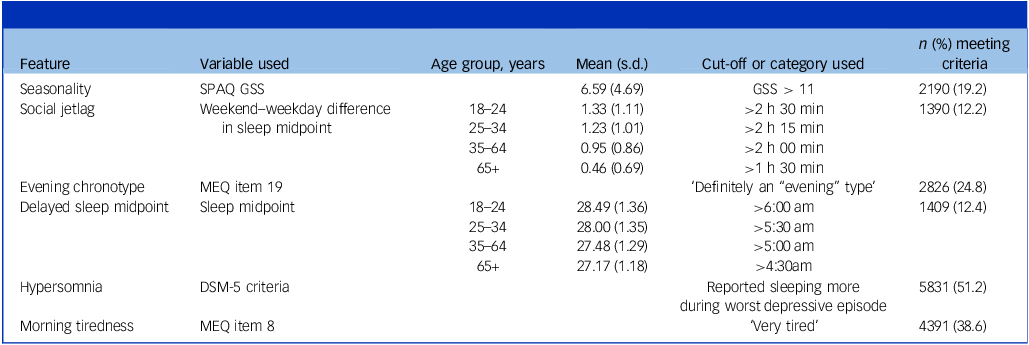
Table 1 reports the numbers and proportions of participants meeting these circadian criteria. The sum of all criteria was computed and those meeting at least three of the six criteria were coded as the ‘circadian subtype’ group; those meeting fewer than three were coded as the ‘non-circadian group’. The ≥3 circadian criteria cut-off was selected as an optimal balance of a criteria-based set that most closely matched the clinical estimates from our prior actigraphy and controlled chronobiological studies Reference Carpenter, Robillard, Hermens, Naismith, Gordon and Scott26,Reference Carpenter, Crouse, Shin, Tonini, Hindmarsh and de Haan27 and to provide appropriate subgroup sizes that would support statistical power for large-scale clinical research. Further refinement of this provisional subtype in future work may support alternative cut-offs or reweighted and/or additional criteria. Exploratory analyses of clinical correlates by number of circadian criteria are presented in Supplementary Figs. 4 and 10.
Circadian features in the whole sample (N = 11 380)

Table 1 Long description
A table with six rows and seven columns summarizing circadian features in a sample of 11,380 participants. The columns are Feature, Variable used, Age group, Mean (s.d.), Cut-off or category used, and n (%) meeting criteria. The features include Seasonality, Social jetlag, Evening chronotype, Delayed sleep midpoint, Hypersomnia, and Morning tiredness. Each feature is associated with specific variables, age groups, mean values with standard deviations, cut-off or category used, and the number and percentage of participants meeting the criteria. For example, Seasonality uses the SPAQ GSS variable, with a mean of 6.59 (s.d. 4.69) and a cut-off of GSS > 11, with 2,190 participants (19.2 percent) meeting the criteria. Social jetlag is assessed by the weekend-weekday difference in sleep midpoint, with age-specific cut-offs and varying percentages meeting the criteria across different age groups. Evening chronotype is determined by MEQ item 19, with 2,826 participants (24.8 percent) identifying as ‘Definitely an evening type’. Delayed sleep midpoint is calculated based on sleep midpoint on free days, with age-specific cut-offs and varying percentages meeting the criteria. Hypersomnia is identified using DSM-5 criteria, with 5,831 participants (51.2 percent) reporting sleeping more during their worst depressive episode. Morning tiredness is assessed by MEQ item 8, with 4,391 participants (38.6 percent) reporting being ‘Very tired’ in the morning.
SPAQ, Seasonal Pattern Assessment Questionnaire; GSS, General Seasonality Score; MEQ, Morningness–Eveningness Questionnaire.
Assessments
Clinical variables
Information about demographics, age at onset and clinical course were assessed by self-report questionnaires, including (hypo)manic-like experiences, psychotic-like experiences, psychological and somatic distress, and suicidal ideation. Details on assessments are provided in the Supplementary Materials.
Antidepressants, efficacy and side-effects
Participants’ subjective experiences with ten of the most commonly prescribed antidepressants in Australia at the time of the survey were assessed. Efficacy was rated ordinally (0 = not at all well; 1 = moderately well; 2 = very well), excluding ‘I don’t know’ responses, and compared across two major classes: SSRIs (sertraline, escitalopram, citalopram, fluoxetine and paroxetine) and SNRIs (venlafaxine, desvenlafaxine and duloxetine), as well as two additional antidepressants (amitriptyline and mirtazapine). In the case of different ratings for antidepressants within the same class, the highest efficacy rating was used as the class-level rating. Side-effects while taking antidepressants were assessed as a binary variable (0 = no; 1 = yes) across 25 possible (predetermined) symptoms, including rash, runny nose, muscle pain, constipation, diarrhoea, drowsiness, agitation, fatigue, suicidal thoughts, dry mouth, blurred vision, difficulty getting to sleep, weight gain, sweating, vomiting, shaking, increased anxiety, attempted suicide, headache, reduced sexual desire, dizziness, nausea, weight loss and other side-effects. Participants reported side-effects only for antidepressants they had taken.
Polygenic risk scores
DNA samples were collected using saliva kits, genotyped using the Illumina Global Screening Array V.1.0, GSAMD V.1.0 or V.3.0 depending on batch, and processed using standardised quality control measures. Pre-imputation quality control was done using PLINK 1.9 Reference Purcell, Neale, Todd-Brown, Thomas, Ferreira and Bender28,Reference Chang, Chow, Tellier, Vattikuti, Purcell and Lee29 and involved removal of single nucleotide polymorphisms (SNPs) with a minor allele frequency <0.01, a SNP call rate <95%, and Hardy–Weinberg equilibrium (P < 1 × 10⁻⁶). Genotypes were imputed using 1000 Genomes, HRC v1.1 and the TopMed r2 reference panel. Reference Taliun, Harris, Kessler, Carlson, Szpiech and Torres30 Ancestry was inferred using the first two principal components, by projecting principal components on 1000 Genomes data using smartpca from EigenSoft 7.2.1. Reference Price, Patterson, Plenge, Weinblatt, Shadick and Reich31 Samples within six standard deviations of the principal components of each ancestry in 1000 Genomes were assigned as the same ancestry. The latest publicly available genome-wide association study results for mental disorders and sleep, circadian, metabolic and inflammatory traits were used as weights in the calculation of each PGS (Supplementary Table 2). Where applicable, leave-one-out summary statistics were used for genome-wide association studies that included AGDS participants to avoid overestimation. SBayesRC was used to generate allele weights for each PGS. Reference Zheng, Liu, Sidorenko, Wang, Lin and Yengo32 The posterior SNP effects for each disorder and/or trait were used to generate PGS for each participant using the PLINK score function. Reference Purcell, Neale, Todd-Brown, Thomas, Ferreira and Bender28 Each PGS was standardised with the sample. Effect sizes were interpretable per standard deviation unit increase in the AGDS PGS.
Statistical analyses
Analyses were conducted in RStudio (version 2024.9.1.394 for Windows; Posit Team, Boston, Massachusetts, USA; http://www.posit.co/) (R version 4.3.0). Demographic and clinical characteristics of circadian versus non-circadian depressive profiles were compared using Welch’s t-test for age, analysis of covariance (adjusting for age and sex) for continuous variables and Pearson’s chi-squared (χ 2) test for categorical variables. Clinical significance was assessed using Cohen’s d for Welch’s t-test, partial eta-squared (η 2p) for analysis of covariance and Cramér’s V for chi-squared test.
Logistic regression was used to estimate (a) associations between 28 PGS (mental health, physical health, and circadian and sleep-related PGS) and the circadian subtype, adjusting for age, sex and the first four genetically inferred ancestry principal components; and (b) associations between antidepressant efficacy and side-effects and the circadian subtype, adjusting for age and sex. To control for multiple testing, Bonferroni correction was applied at the following threshold and significance level: P = 0.05/28 = 0.00179, accounting for seven mental health PGS, 16 physical health PGS, and five sleep and circadian-related PGS. For antidepressant efficacy, the Bonferroni threshold was 0.0125 (P < 0.05/4), and for side-effects, the Bonferroni threshold was 0.002 (P < 0.05/25).
The following sensitivity analyses are reported in the Supplementary Material: (a) primary analyses controlling for weight gain during depressive episodes to explore clinical overlap with the atypical depression subtype, Reference Shin, Crouse, Lin, Byrne, Mitchell and Lind33 which is also partially defined by hypersomnia (Supplementary Table 4); (b) analyses controlling for employment status to account for the potential influence of psychosocial circumstances (Supplementary Table 9); (c) analyses of associations between each binary circadian criteria and PGS and antidepressant efficacy (Supplementary Figs. 6–9); and (d) primary analyses restricted to participants meeting MDD criteria (Supplementary Tables 10 and 11).
Results
Distribution of circadian criteria
Of 11 380 participants with non-missing data for ≥3 circadian criteria, a subset of 2604 participants (80% female; mean age 37.87 ± 13.62 years) were classified as having a circadian subtype. Hypersomnia was the most frequently endorsed criterion among participants with the circadian subtype (n = 2182; 84%), followed by morning tiredness (n = 2143; 83%), evening chronotype (n = 1774; 68%), delayed sleep midpoint (n = 1099; 42%) and seasonality (n = 1071; 41%). The least commonly endorsed criterion was social jetlag (n = 914; 35%). The most common combinations of these criteria involved hypersomnia, morning tiredness and evening chronotype (n = 481; 18%). The distributions of these criteria are shown in Fig. 1. The numbers of criteria met in the whole sample are reported in Supplementary Fig. 2.
Distribution of circadian criteria among participants with the circadian subtype of depression (N = 2604). UpSet plot of intersection between circadian criteria. Each row represents one circadian criterion, and each column indicates a specific combination of criteria. Filled dots denote which criteria were included in each intersection. The bar height above each column shows the number of participants meeting that combination of criteria. The pie chart illustrates the relative proportion of each circadian criterion.

Demographics and clinical characteristics of participants with the circadian subtype
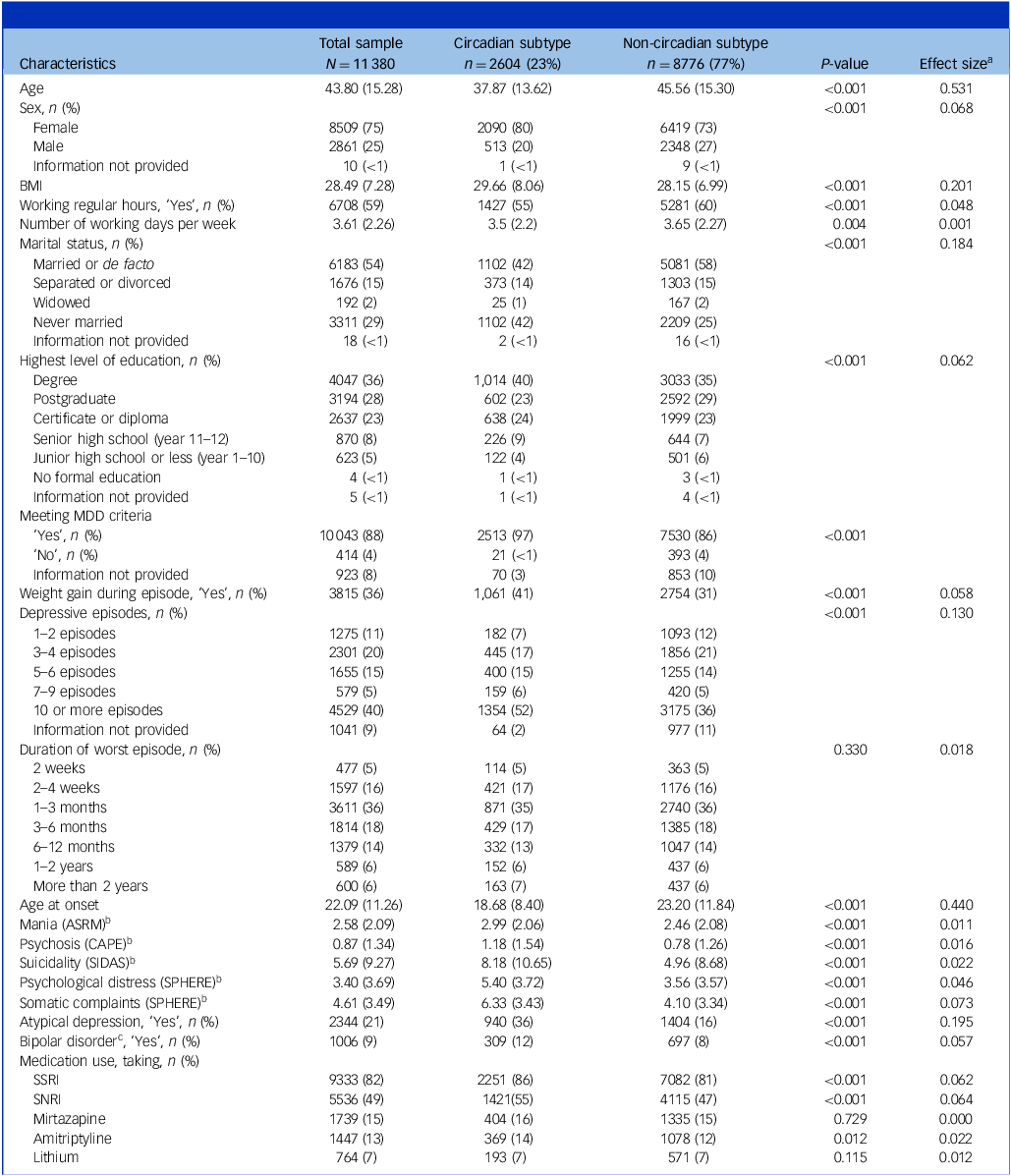
As shown in Table 2, compared with those with the non-circadian subtype of depression (n = 8,776), participants with the circadian subtype were younger (37.87 ± 13.62 v. 45.56 ± 15.30 years; P < 0.001) and more often female (80 v. 73%, P < 0.001). Additionally, participants with the circadian subtype reported an earlier age at onset of depression (18.68 ± 8.40 v. 23.20 ± 11.84 years, P < 0.001), and greater severity of (hypo)manic-like experiences (2.99 ± 2.06 v. 2.46 ± 2.08, P < 0.001), psychotic-like experiences (1.18 ± 1.54 v. 0.78 ± 1.26, P < 0.001), suicidal ideation (8.18 ± 10.65 v. 4.96 ± 8.68, P < 0.001), psychological distress (5.40 ± 3.72 v. 3.56 ± 3.57, P < 0.001) and somatic distress (6.33 ± 3.43 v. 4.10 ± 3.34, P < 0.001). The largest effect sizes were observed for age (Cohen’s d = 0.531) and age at onset (Cohen’s d = 0.440). Twelve per cent of those with the circadian subtype self-reported having received a diagnosis of BD, compared with 9% in the non-circadian group (the full list of self-reported diagnoses is summarised in Supplementary Table 8).
Demographic and clinical characteristics of the analytic sample

Table 2 Long description
A table comparing demographic and clinical characteristics of a sample population. The table has 11 rows and 7 columns. Column headers are Total sample, Circadian subtype, Non-circadian subtype, P-value, and Effect size. Row labels include Age, Sex, BMI, Working regular hours, Number of working days per week, Marital status, Highest level of education, Meeting MDD criteria, Weight gain during episode, Depressive episodes, Duration of worst episode, Age at onset, Mania (ASRM), Psychosis (CAPE), Suicidal ideation (SIDAS), Psychological distress (SPHERE), Somatic complaints (SPHERE), Atypical depression, Bipolar disorder, and Medication use. Each row provides mean values, percentages, and other relevant data for the total sample, circadian subtype, and non-circadian subtype. Notable trends include differences in age, sex distribution, BMI, education level, and various clinical characteristics between the circadian and non-circadian subtypes.
BMI, body mass index; MDD, major depressive disorder; ASRM, Altman Self-Rating Mania Scale; CAPE, Community Assessment of Psychic Experiences; SIDAS, Suicidal Ideation Attributes Scale; SPHERE, Somatic and Psychological Health Report; SSRI, Selective serotonin reuptake inhibitor; SNRI, serotonin–noradrenaline reuptake inhibitor.
All characteristics are presented as mean (s.d.), unless otherwise specified.
a. Effect sizes were calculated using Cohen’s d for age and age of onset, partial eta-squared (η 2p) for continuous measures and Cramér’s V for categorical measures.
b. Comparisons of clinical scores were corrected for the effect of age and sex.
c. Participants self-reported receiving a diagnosis of bipolar disorder.
Genetic profile of individuals with the circadian subtype
PGS for mental disorders
As shown in Fig. 2a and Supplementary Table 3, the circadian subtype was associated with higher genetic risk (PGS) for attention-deficit hyperactivity disorder (ADHD) (odds ratio 1.11, 95% CI [1.06, 1.17]; Bonferroni-corrected P-value (P Bonf) < 0.001), major depression (odds ratio 1.11, 95% CI [1.06, 1.16]; P Bonf < 0.001), anxiety (odds ratio 1.10, 95% CI [1.04, 1.15]; P Bonf < 0.001) and BD (odds ratio 1.09, 95% CI [1.04, 1.14]; P Bonf = 0.005). The circadian subtype was also associated with higher schizophrenia PGS (odds ratio 1.07, 95% CI [1.02, 1.13]; P = 0.006; P Bonf = 0.162); however, this association did not survive Bonferroni correction. Neither neuroticism PGS (odds ratio 0.98, 95% CI [0.93, 1.03]; P = 0.419; P Bonf = 1.000) nor the autism PGS (odds ratio 1.04, 95% CI [0.99, 1.09]; P = 0.105; P Bonf = 1.000) was associated with the circadian subtype.
Associations between the circadian subtype and (a) polygenic risk scores (PGS) for mental disorders; (b) PGS for medical conditions; (c) PGS for metabolic markers; (d) PGS for inflammatory-related markers); (e) PGS for sleep and circadian-related measures; and (f) treatment response (n = 2604 [23%] for circadian cases; n = 8776 [77%] for non-circadian cases). Results shown are from separate logistic regression models for each variable for the circadian subtype, with covariates of age and sex for all models, and also the first four genetically inferred ancestry principal components for PGS models. Significance levels are indicated as follows: green, Bonferroni-corrected (at alpha level P < 0.0019 [0.05/28] for seven mental disorder PGS, 16 physical health PGS, and five sleep and circadian-related measures PGS; and at alpha level P < 0.0125 [0.05/4] for treatment response); yellow, uncorrected (P < 0.05); red, not significant. Error bars represent 95% confidence intervals. ADHD, attention-deficit hyperactivity disorder; BMI, body mass index; SNRI, serotonin–noradrenaline reuptake inhibitor; SSRI, selective serotonin reuptake inhibitor.

PGS for physical health
As shown in Fig. 2b–d and Supplementary Table 3, the circadian subtype was associated with higher PGS for BMI (odds ratio 1.09, 95% CI [1.05, 1.14]; p Bonf = 0.003), triglycerides (odds ratio 1.10, 95% CI [1.06, 1.16]; P Bonf < 0.001), interleukin-6 (IL-6) (odds ratio 1.08, 95% CI [1.03, 1.13]; P Bonf = 0.038) and insulin resistance (odds ratio 1.08, 95% CI [1.04, 1.13]; P Bonf = 0.011). The circadian subtype was associated with lower PGS for high-density lipoprotein (odds ratio 0.93, 95% CI [0.89, 0.98]; P = 0.003; p Bonf = 0.078) and higher PGS for migraine (odds ratio 1.07, 95% CI [1.03, 1.12]; P = 0.002; P Bonf = 0.054), C-reactive protein (odds ratio 1.06, 95% CI [1.02, 1.11]; P = 0.008; P Bonf = 0.209), type 2 diabetes (odds ratio 1.07, 95% CI [1.02, 1.13]; P = 0.006; P Bonf = 0.158), coronary artery disease (odds ratio 1.05, 95% CI [1.00, 1.10]; P = 0.048; P Bonf = 1.000) and fasting insulin (odds ratio 1.05, 95% CI [1.01, 1.11]; P = 0.023; P Bonf = 0.617); however, these associations did not survive Bonferroni correction. The PGS for IL-10, IL-1β, IL-12, fasting glucose, tumour necrosis factor alpha and glycated haemoglobin (HbA1c) were not associated with the circadian subtype (all P > 0.159; P Bonf = 1.000).
PGS for sleep and circadian traits
As shown in Fig. 2e and Supplementary Table 3, the circadian subtype was associated with lower PGS for chronotype (i.e. higher liability for eveningness) (odds ratio 0.68, 95% CI [0.65, 0.71]; P Bonf < 0.001) and higher PGS for insomnia (odds ratio 1.08, 95% CI [1.03, 1.13]; P Bonf = 0.043) and sleep midpoint (i.e. higher liability for later sleep midpoint) (odds ratio 1.15, 95% CI [1.10, 1.21]; P Bonf < 0.001). The circadian subtype was associated with higher PGS for low relative amplitude (i.e. higher liability for weaker behavioural rest–activity amplitude) (odds ratio 1.06, 95% CI [1.02, 1.11]; P = 0.008; P Bonf = 0.225) and lower sleep duration (odds ratio 0.95, 95% CI [0.91, 0.99]; P = 0.029; P Bonf = 1.783); however, these associations did not survive Bonferroni correction.
Treatment response outcomes
Finally, as shown in Fig. 2f and Supplementary Table 3, the circadian subtype was associated with lower efficacy of SSRIs (odds ratio 0.88, 95% CI [0.82, 0.94]; P Bonf < 0.001) and SNRIs (odds ratio 0.89, 95% CI [0.83, 0.97]; P Bonf = 0.023) but not with efficacy of mirtazapine (odds ratio 0.96, 95% CI [0.82, 1.12]; P = 0.608; P Bonf = 1.000) or amitriptyline (odds ratio 0.97, 95% CI [0.81, 1.16]; P = 0.722; P Bonf = 1.000). Within-class comparisons of antidepressant efficacy are reported in the Supplementary Materials. The circadian subtype was associated with a broad profile of self-reported antidepressant side-effects, including runny nose, muscle pain, blurred vision, constipation, drowsiness, diarrhoea, fatigue, difficulty sleeping, sweating, agitation, attempted suicide, shaking, dry mouth, headache, weight gain, suicidal thoughts, anxiety, reduced sexual desire, dizziness and nausea. No significant association was found with self-reported ‘rash’, ‘other side-effects’, ‘no side-effects’ or ‘weight loss’ (Supplementary Fig. 3 and Supplementary Table 5).
Discussion
In a large genetically informative cohort of adults with severe recurrent forms of depressive disorders, 23% of participants were classified as having a ‘circadian subtype’ of depression. These participants were younger, more commonly female, had an earlier age at onset, and reported a more severe clinical profile in terms of number of depressive episodes and severity of symptom dimensions. The circadian subtype was associated with lower reported efficacy of SSRIs and SNRIs and more side-effects, suggestive of its clinical utility. As greater depression severity is typically considered to be a predictor of enhanced response to antidepressant medications, Reference Malhi, Bell, Bassett, Boyce, Bryant and Hazell2,3 our finding of the opposite may be of clinical significance and supportive of the hypothesis of this circadian subtype being underpinned by a unique pathophysiological mechanism, in contrast to other forms of severe or persistent depressive disorder. Genetically, circadian cases had higher genetic risk for some neurodevelopmental conditions (ADHD) and mood disorders (major depression, anxiety and BD); sleep–wake cycle phenotypes including delayed sleep midpoint, insomnia and evening preference; and metabolic (insulin resistance, BMI, triglycerides) and inflammatory (IL-6) markers. These clinical, treatment response and genetic findings support the notion that a circadian subtype represents a distinct and clinically relevant profile of depressive disorders.
The increased genetic risk for ADHD, major depression and BD in circadian cases warrants further exploration. Delayed phase of circadian markers, such as dim-light melatonin onset, sleep–wake timing and evening chronotype are common in individuals with ADHD. Reference Coogan and McGowan34 Specific circadian SNPs have been linked to ADHD symptoms, Reference Korman, Palm, Uzoni, Faltraco, Tucha and Thome35 and genetic risk of dysregulation of melatonin seems to be correlated with ADHD. Reference Takahashi, Nishimura, Okumura, Harada, Iwabuchi and Rahman36 In addition, another study conducted in the AGDS cohort observed an association between the ADHD PGS and increased likelihood of having an earlier age at onset, greater recurrence of depressive episodes and atypical depression. Reference Mitchell, Campos, Whiteman, Olsen, Gordon and Walker37 Circadian disruption is also a hallmark of BD, Reference McCarthy, Gottlieb, Gonzalez, McClung, Alloy and Cain38 often preceding the onset of episodes, Reference Geoffroy and Maruani17 and has been potentially implicated in the switch between depressive and manic states. Reference Hickie, Merikangas, Carpenter, Iorfino, Scott and Scott39 Shared genetic pathways further support circadian involvement in BD, with dysregulated clock genes in BD Reference Yegin, Sarisoy, Erguner Aral and Koc40 and BD PGS predicting later timing of circadian activity peaks. Reference Hennion, Scott, Martinot, Godin, Marie-Claire and Bellivier13 In addition to higher PGS for BD, we observed greater enrichment for self-reported lifetime diagnoses of BD in the circadian cases but noted that ∼700 cases of BD were assigned as non-circadian cases.
The circadian subtype was also associated with genetic risk for metabolic and inflammatory markers. This was consistent with evidence linking circadian disruption to metabolic dysregulation and chronic inflammation Reference Zielinski and Gibbons41 ; for example, adolescents with delayed sleep–wake cycles exhibit metabolic abnormalities, Reference Toyoura, Miike, Tajima, Matsuzawa and Konishi42 and insulin resistance has been linked to abnormal melatonin sleep timing. Reference Kumar, Chauhan and Devi43 Circadian disruption may contribute to cardiometabolic dysfunction, Reference Ansu Baidoo and Knutson44 with genetic vulnerability in metabolic and inflammatory pathways worsening outcomes and potentially leading to treatment resistance. The circadian subtype was also associated with higher PGS for later sleep midpoint, insomnia and evening chronotype; these findings provide suggestive evidence that the circadian subtype captures a biologically meaningful subset, as opposed to these features being epiphenomena. Clinically, individuals in circadian cases reported lower SSRI and SNRI efficacy and more side-effects, consistent with evidence that circadian misalignment may respond less favourably to standard pharmacotherapies Reference Crouse, Park, Byrne, Mitchell, Chan and Scott15 or the notion that conventional antidepressants do not adequately correct sleep–wake/circadian disturbance.
Other proposed subtypes of depression, such as atypical depression, immunometabolic depression and bipolar depression, share some features with the circadian subtype of depression. Notably, atypical depression, which is defined by mood reactivity, weight gain, somatic symptoms and hypersomnia and was initially linked to preferential response to monoamine oxidase inhibitors, Reference Henkel, Mergl, Allgaier, Kohnen, Möller and Hegerl45 also shows poorer response to SSRIs and SNRIs and includes sleep-related features (i.e. hypersomnia) in its definition. However, its strong reliance on weight gain during episodes or longitudinally as a criterion is likely to conflate heterogeneous and potentially unrelated factors, including anxiety and neuroticism, alongside circadian characteristics. We note that although our circadian subtype was enriched for cases that also met criteria for atypical depression, ∼1400 cases with atypical depression were assigned to the non-circadian subtype group (Table 1). This indicates that these phenotypes are partly overlapping but separable constructs. In another AGDS study, Reference Coogan and McGowan34 we showed that when the definition of atypical depression was restricted to reliably reported features (i.e. weight gain and hypersomnia), important differences emerged compared with the circadian subtype, notably higher PGS for neuroticism (the full comparison is reported in Supplementary Table 6). By contrast, our circadian phenotype was defined specifically by 24-h sleep–wake and circadian-related markers, arguably providing stronger specificity to circadian disturbance as an underlying pathophysiology. Similarly, immunometabolic depression is characterised by a cluster of energy-related depressive symptoms and related biomarkers, including systemic low-grade inflammation and metabolic abnormalities. Reference Penninx, Lamers, Jansen, Berk, Khandaker and De Picker46 Immunometabolic depression is also characterised by a poor response to standard psychopharmacology, and evidence suggests that interventions targeting inflammation, metabolism or lifestyle factors may prove more effective. Reference Drevets, Wittenberg, Bullmore and Manji47 However, immunometabolic depression may result from a range of different and confounding factors, including age, chronicity of illness, weight gain, medication exposure and other comorbidities. Reference Berk, Köhler‐Forsberg, Turner, Penninx, Wrobel and Firth48 Thus, at this stage of research, immunometabolic depression has limited utility with respect to early identification of and intervention in emerging depressive disorders.
Circadian disruptions have also been reported in bipolar depression, Reference Tonon, Nexha, Mendonça da Silva, Gomes, Hidalgo and Frey49 alongside mixed efficacy of SSRIs and SNRIs Reference Gitlin50 and probable metabolic–inflammatory factors. Reference McElroy and Keck51 However, around half of BD cases initially present with depressive episodes that are difficult to distinguish from unipolar depression, with (hypo)manic episodes often emerging after several depressive episodes. Reference O’Donovan and Alda52 This renders early identification of bipolar depression challenging. Reference Rolin, Whelan and Montano53 Other common subtypes of depression include treatment-resistant depression, with limited utility to guide preferential first treatment priority by definition, and melancholic depression, which can be regarded as a marker of severe or difficult-to treat MDD conditions. Reference Dold, Bartova, Fugger, Kautzky, Mitschek and Fabbri54 Overall, distinctions between depressive phenotypes are key to informing different treatments approaches, notably first-line interventions. Compared with other depressive subtypes, our proposed circadian subtype demonstrates clear genetic, clinical and treatment (self-rated) correlates, which support formal evaluation of a stratification approach based on circadian factors to guide early intervention strategies. In addition, circadian disturbances have been associated with transition to more severe clinical stages, suggesting predictive value for illness progression in early intervention. Reference Iorfino, Scott, Carpenter, Cross, Hermens and Killedar55
Overall, we argue that our proposed circadian subtype of depression is a transdiagnostic phenotype that encompasses a subset of individuals currently classified as having other depressive, bipolar or somatic disorders, in which circadian disturbances may be the primary pathophysiological mechanism. From a clinical perspective, defining a circadian subtype of depression may support more personalised care options. Specifically, we propose that individuals with the circadian subtype may benefit preferentially from chronotherapies, that is, behavioural or pharmacological treatments that explicitly target the circadian system. Reference Crouse, Carpenter, Song, Hockey, Naismith and Grunstein56 There is growing evidence that daytime light exposure, reduced night-time light, regular sleep–wake timing, or melatonin or melatonergic-targeted agonists may benefit individuals with depression and circadian disturbances. Reference Kang, Kim and Kim57
Limitations and future work
Several limitations need to be acknowledged. First, the data were collected through a self-report survey; although this approach allowed richer access to the lived experience of depression, it may have been subject to biases (e.g. recall bias). For example, a subset of cases did not meet self-rated criteria for MDD and comprised a less clinically severe group; whereas sensitivity analyses excluding these cases attenuated three genetic and one treatment outcome finding (no longer being significant under Bonferroni correction), the pattern of results was otherwise unchanged. Second, the data presented were cross-sectional, rendering causal inferences challenging. Third, although the ten most commonly reported antidepressants were recorded, their classification in broader categories may have masked important sources of heterogeneity. Fourth, individuals in this sample were limited to those of genetically inferred European ancestry, which may limit generalisability. Fourth, although the self-reported nature of these circadian criteria represented an advantage for investigation in large-scale studies, the criteria did not directly capture internal physiological circadian markers (e.g. phase, amplitude, misalignment). Fifth, the circadian subtype was conceptualised as a trait-like vulnerability; accordingly, most criteria were assessed as habitual (trait-like) behaviours. Hypersomnia was the single exception, as it was assessed during the episode, and was selected as a criterion on the basis that circadian disruption may predispose individuals to episodic hypersomnia; Reference Moderie and Boivin58 we therefore interpreted it as a state expression of the same underlying circadian vulnerability rather than a distinct construct. Overall, we expect the selected features to be largely traits, although they may also be exacerbated during a depressive episode. As traits, we expect that these features reflect (largely) an underlying neurobiological vulnerability, with some genetic determinants, and not simply non-specific perturbations that emerge during the depressive episode. Sixth, the provisional circadian criteria examined in this study were exploratory rather than definitive. Accordingly, all criteria were weighted equally, and no prespecified cut-offs were applied. Further work, including replication in other independent data-sets and exploration of weighted solutions, is needed to validate our criteria. The findings should therefore be interpreted as an initial exploration. Seven, although ‘morning tiredness’ was used as a label for one of our criteria, in the future, a construct more closely resembling sleep inertia (and capturing people more likely to have woken in their biological night and thus have a problem with misalignment) would be of strong relevance to our proposed circadian subtype of depression.
Despite these limitations, this study strengthens the evidence base for a circadian subtype of depression as a biologically valid and clinically useful phenotype of depression associated with differential treatment response, clinical course characteristics and genetic profile. Future studies are needed to replicate our findings in diverse samples, to investigate whether the phenotype has predictive utility, and to explore whether the circadian subtype indeed preferentially captures cases with circadian disruption as a major pathophysiology.
Supplementary material
The supplementary material is available online at https://doi.org/10.1192/bjp.2026.10798
Acknowledgements
We thank all the AGDS participants for giving their time to contribute to this study. We also thank all the people who helped with conception, implementation, beta testing, the media campaign and data cleaning, as well as the research participants and employees of the 23andMe Research Institute for making this work possible. Artificial Intelligence use: No artificial intelligence tools have been used in the research or writing process for this manuscript.
Data availability
The data that support the findings of this study are available on request from the corresponding author, E.T. The data are not publicly available owing to their containing information that could compromise the privacy of research participants. The analytic code used in this study is available upon request from the corresponding author.
Author contributions
E.T., J.J.C., M.S., J.S.C. and I.B.H. conceptualised the study and formulated the research questions. E.T. formally analysed the data, generated visualisations, and drafted the first and subsequent versions of the manuscript. E.M.B., S.E.M., R.P., N.R.W., I.B.H. and N.G.M. designed the AGDS study. S.J.H., T.T., A.S., A.H. and A.T. provided lived experience expertise. B.L.M. generated the PGS. E.T., J.J.C., M.S., J.S.C., B.L.M., E.M.B., P.A.L., S.D.G., R.P., S.J.H., T.T., A.S., A.H., A.T., E.S., J.S., K.R.M., N.R.W., N.G.M., S.E.M. and I.B.H. critically reviewed the first version of the manuscript and provided approval for the final version.
Funding
The AGDS was primarily funded by grant 1086683 from the National Medical Health and Research Council (NHMRC) of Australia. This work was further supported by philanthropic donations from families who are affected by mental illness (who would like to be left anonymous) awarded to M.S.; NHMRC EL1 Investigator Grants awarded to J.J.C. and B.L.M. (GNT2008196 and GNT2017176, respectively); a Wellcome Trust Mental Health Award (227089/Z/23/Z); NHMRC L1 and L2 Investigator Grants (APP117291, APP2025674) awarded to S.E.M.; and an NHMRC L3 Investigator Grant (GNT2016346) awarded to I.B.H.
Declaration of interest
I.B.H. is the Co-Director of Health and Policy at the Brain and Mind Centre, University of Sydney, Australia. The Brain and Mind Centre operates early intervention youth services at Camperdown under contract to headspace. I.B.H has also previously led community-based and pharmaceutical industry-supported (Wyeth, Eli Lily, Servier, Pfizer, AstraZeneca, Janssen Cilag) projects focused on the identification and better management of anxiety and depression. He is the Chief Scientific Advisor to and a 3.2% equity shareholder in InnoWell Pty Ltd., which aims to transform mental health services through use of innovative technologies.



 Open access


eLetters
No eLetters have been published for this article.