




Introduction
Clinical Psychology has highlighted how early experiences are important for child development and how these occur mainly in the context of parent-child relationships. Negative parental affective states, particularly depression and anxiety, have an adverse impact on parent-child interactions and child development. Thus, offspring of postnatally depressed mothers evidence child attachment insecurity, negative affective outcomes in childhood (assessed at 8 years) and adolescence (assessed at 13 and 16 years), and compromised cognitive and behavioural development (Murray et al., Reference Murray, Arteche, Fearon, Halligan, Goodyer and Cooper2011). Infants of anxious mothers show heightened stress responses, lower social engagement, and are twice as likely to develop anxiety as children of non-anxious mothers (Lawrence et al., Reference Lawrence, Murayama and Creswell2019).
Early parenting interventions have been shown to improve child outcomes. For example, parent-child play and shared reading interventions enhance children’s cognitive and linguistic skills as well as their social-emotional development, and reduce externalizing behaviours at 36 months (Weisleder et al., Reference Weisleder, Cates, Harding, Johnson, Canfield, Seery, Raak, Alonso, Dreyer and Mendelsohn2019). Far less is known, however, about the impact of such programmes on parents, and particularly their mental state. Although a meta-analysis of shared reading programmes involving parents and children aged 0–6 years old concluded that they may have some positive impact on parents’ psychosocial functioning, only three of the included studies assessed parental depression, and none identified a benefit (Xie et al., Reference Xie, Chan, Ji and Chan2018).
A structured parent-child shared reading intervention principally directed at improving children’s cognitive development in early childhood was developed by Murray and Cooper (Cooper et al., Reference Cooper, Vally, Cooper, Radford, Sharples, Tomlinson and Murray2014), the ‘Dialogic Book-Sharing’ (DBS) programme. This intervention has been evaluated in several countries including South Africa with children aged 23 and 27 months (Dowdall et al., Reference Dowdall, Cooper, Tomlinson, Skeen, Gardner and Murray2017), Lesotho with 1–5 years old children (Tomlinson et al., Reference Tomlinson, Skeen, Marlow, Cluver, Cooper, Murray, Mofokeng, Morley, Makhetha, Gordon, Esterhuizen and Sherr2016), Brazil with children aged between 30 and 42 months (Murray et al., Reference Murray, Santos, Bertoldi, Murray, Arteche, Tovo-Rodrigues, Cruz, Anselmi, Martins, Altafim, Soares, Andriotti, Gonzalez, Oliveira, da Silveira and Cooper2019), and England with children between 28 and 45 months of age (Murray et al., Reference Murray, Jennings, Mortimer, Prout, Melhuish, Hughes, Duncan, Holmes, Dishington and Cooper2018) with positive effects on both parenting and children’s development. A consistent finding across all the studies is significant benefits for caregiver-child interactions during book-sharing, particularly in terms of parental sensitivity (appropriate and warm responsiveness to the child) and parent-child reciprocity.
DBS creates a special ‘intersubjective’ space (Murray et al., Reference Murray, Rayson, Ferrari, Wass and Cooper2022) where both parent and child share visual focus in close proximity, fostering shared physiological and emotionally positive states (Waters et al., Reference Waters, West, Karnilowicz and Mendes2017). The emotional cues transmitted by the caregiver during these interactions help imprint the relational experience in memory, and can play a role in fostering secure attachment between parent and child (Bus and Van IJzendoorn, Reference Bus and Van IJzendoorn1997). Despite evidence for benefits to caregiver-child interactions, there is limited research on whether this positive impact extends to caregivers more broadly, including their mental state. However, notwithstanding the aforementioned meta-analytic evidence that did not demonstrate benefit for parental depression (Xie et al., Reference Xie, Chan, Ji and Chan2018), more recent evidence points to potential for shared reading to have positive effects on parent outcomes. For example, in a mediation analysis examining a pathway from shared reading to child outcomes via parent psychosocial functioning, Weisleder et al. (Reference Weisleder, Cates, Harding, Johnson, Canfield, Seery, Raak, Alonso, Dreyer and Mendelsohn2019) found significant effects of a DBS intervention on parent stress about the parent-child relationship, and on maternal depressive symptoms. Further, in a longitudinal secondary analysis of data from an RCT, Canfield et al. (Reference Canfield, Miller, Shaw, Morris, Alonso and Mendelsohn2020) found that levels of observationally assessed DBS quality at 6-months were associated with higher relational health (indicated by parental warmth and sensitivity) and lower parenting stress at 18-months. Taken together, there is a conceivable mechanism by which DBS may improve parent-child relations and parenting stress, and that this may in turn positively impact parent mental health outcomes.
Given the limited evidence for DBS’s effects on parent mental health outcomes to date, the Observatory of Perinatal Clinical Psychology of the University of Brescia examined the application of the DBS in Italy using a randomized controlled trial (RCT) to assess the effects of this intervention on infant development, the quality of the parent-child relationship, and parental mental state. In the current paper we report on the impact of a DBS programme delivered to parents on parental symptoms of anxiety and depression.
Materials and methods
Study design
This RCT is part of a larger project in Italy (Cena et al., Reference Cena, Trainini, Murray, Cooper, Calza and Belluardo2024) promoted by the Observatory of Perinatal Clinical Psychology. Health, educational and maternal-child centres in Italy took part in a multicentre, two parallel arms, single blinded randomized controlled superiority trial, with a 1:1 arms allocation ratio on the impact of a DBS training provided to parents. Information from a centre in each of 10 cities (Brescia, Bergamo, Milan, Mantua, Como, La Spezia, Florence, Rome, Naples, Salerno) comprise the data set.
The intervention
The core feature of the DBS programme is showing parents how to support their child’s interest and active engagement, rather than simply ‘reading’ to their child. Responsiveness is emphasized that is sensitive to the child’s developmental capacity and experience, as well as the importance of a positive encouraging approach. The intervention was delivered by local staff who had been trained to act as facilitators over a two-day course (run by MB). Facilitators received ongoing supervision from LM in remote sessions that ensured fidelity with programme delivery. The intervention programme was delivered within each Centre in Italian, using Powerpoint slides and embedded demonstration videos. The programme was structured into four, weekly, meetings of the parents lasting 90 minutes each, which took place at the maternal-child/educational centres. The sessions were conducted with groups of up to six parents (mothers and fathers), during which children were cared for in an adjoining play space by Centre staff. Group sessions were followed by a brief period of one-to-one discussion between the facilitator and each parent (together with their child). Four illustrated wordless books were used. Parents were encouraged to apply the session’s techniques during the following week in their daily life with their children.
Participants and ethics
Recruitment took place on a voluntary basis in the aforementioned centres by local staff. Inclusion criteria were: being able to speak and read Italian; and having a child aged 14–20 months. The exclusion criteria were: parent having a diagnosed medical condition that could compromise their ability to participate in the intervention programme; or child having a diagnosed physical or intellectual impairment.
At each centre, parents were randomly assigned to either the intervention or the control condition using a random blocks algorithm. The intervention group received the DBS training immediately, while the control group received no input from the research team, apart from the assessment (controls received the DBS training after the final study assessment).
Data were collected one week before the intervention for baseline assessments and one week after the intervention period for follow up assessments. Local staff, not involved in the DBS delivery, blinded to group allocation, collected data before randomization and again after DBS delivery.
A total of 200 parents were invited by centre staff to take part in the study. Sixty-eight (34%) accepted. The reasons for non-acceptance were mainly lack of time, work commitments, and difficulties in family organization.
An Information Sheet with a description of the aims of the study was given to participants. To participate, the parent was asked to sign an Informed Consent Form. The protection of their privacy was ensured by the assignment of a code to the participants. The research followed the APA Ethical Principles of Psychologists and Code of Conduct.
The study was approved by the Institutional Ethics Board of the ASST Spedali Civili of Brescia, Italy (reference number NP5205 27.09.2022). All procedures performed in this study are in accordance with the ethical standards of the Institutional Ethics Board of the ASST Spedali Civili of Brescia, Italy and with the 1964 Declaration of Helsinki and its later amendments.
Instruments
A self-report questionnaire for parents taking approximately 15 minutes to complete was used for the assessment. It included:
-
– Socio-demographic information Form: sociodemographic data, and information about pregnancy and the post-partum period.
-
– HADS Hospital Anxiety and Depression Scale (Zigmond and Snaith, Reference Zigmond and Snaith1983): a 14-item self-report questionnaire assessing symptoms of anxiety and depression. Cronbach’s alpha was 0.7 for the anxiety scale and 0.6 for depression scale.
Statistical analysis
Independent t tests and Chi square tests (or Fisher exact tests) were used to compare groups at baseline. Repeated measures ANOVAs were used to assess differences between the intervention and control groups over time; subsequently, non-independent post hoc t tests were used to assess change within each of the two groups across the two assessment points (the non-parametric Wilcoxon test was applied when normality assumptions were not met). All tests were two-tailed with p < .05.
Results
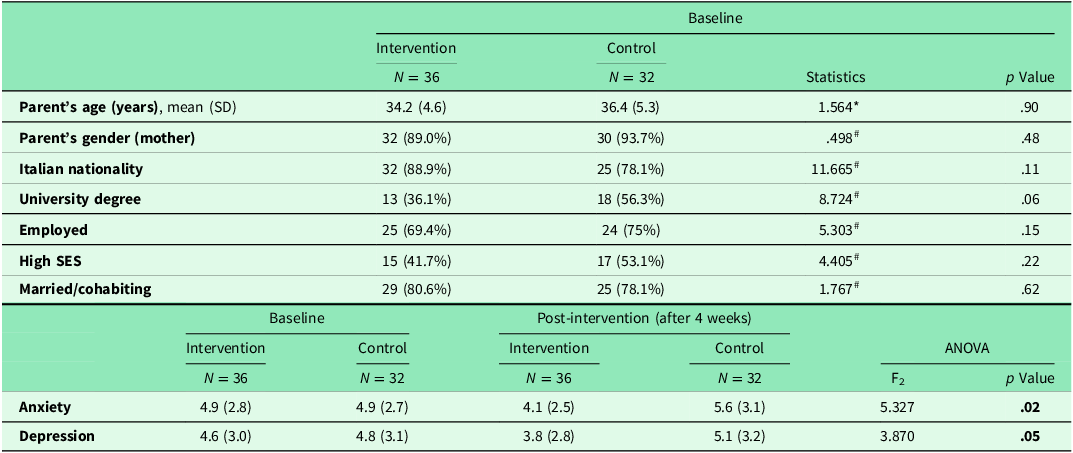
Sixty-eight parent-child dyads (36 experimental group and 32 control group) were recruited in the study and completed assessments at both baseline and follow up. No statistically significant differences were found between the two groups at baseline: they were similar with regard to demographic features, and were generally at low socio-economic risk (see Table 1). Baseline and post-intervention scores for the parental questionnaires are also shown in Table 1, together with statistical comparisons.
Comparison between Index and Control groups scores

Table 1. Long description
A table comparing demographic features and scores of parental questionnaires for intervention and control groups at baseline and post-intervention. The table has two main sections: Baseline and Post-intervention. The Baseline section includes demographic features such as parent’s age, gender, nationality, university degree, employment status, high socio-economic status (SES), and marital status. The Post-intervention section includes scores for anxiety and depression. The table has 10 rows and 7 columns. Column headers are Intervention N = 36, Control N = 32, Statistics, and p Value for the Baseline section, and Baseline, Post-intervention (after 4 weeks), and ANOVA for the Post-intervention section. Row labels include Parent’s age (years), mean (SD), Parent’s gender (mother), Italian nationality, University degree, Employed, High SES, Married/cohabiting, Anxiety, and Depression. Notable trends include similar demographic features between the two groups at baseline and a decrease in anxiety and depression scores in the intervention group post-intervention.
*T test; #Chisquare.
For parental anxiety symptoms, the ANOVA revealed a significant group/time interaction effect (F2 = 5.327, p = .02, η 2 = .09). There was a similar finding of an interaction effect for parental depressive symptoms which fell just short of conventional statistical significance (p = .05, η 2 = .06). Post hoc within group analyses showed a significant decline in the intervention group for both anxiety anxiety (p = .018; r = 0.5) and depression (p = .033; r = 0.4); the change in scores in the control group, by contrast, was not significant for either measure (anxiety p = .816 and depression p = .940).
Discussion
Intervention and control groups differed from each other over time in their symptoms of anxiety and depression. For parents in the DBS intervention group, levels of both anxiety and depression showed a significant decrease from the week prior to the intervention to the week after the intervention was completed. The symptoms of parents in the control group, by contrast, showed no significant change over the same period.
The hypothesized mechanisms for this effect is that positive experiences improve parent-child relations and reduce stress, which is mood elevating for the parent.
This study had some limitations that should be acknowledged. First, the sample was composed predominantly of mothers, with relatively limited participation of fathers. As such, the findings may not fully capture potential differences in how parenting interventions affect maternal versus paternal mental health. Second, participants were generally at low socio-economic risk: this may limit the generalizability of the findings.
Although our study was small and therefore requires replication, our finding of a benefit to parents of DBS with their children is encouraging and adds to previous research showing that the DBS intervention carries benefits to parent-child interactions and child development. DBS in early childhood is simple, practical, and inexpensive, making it suitable for widespread implementation in early childhood social and educational services. It can readily be integrated into educational programmes, providing valuable support for both parents and children. In sum, this evidence suggests that DBS is a suitable programme to not only promote child development, but also parental well-being. Future research on the effects of DBS should measure parent mental health outcomes, and should facilitate mediation analysis to examine the hypothesized pathway to promoting parent mental health via the reduction of parenting stress and the improvement of parent-child relationships.
Data availability statement
The data that support the findings of this study are available from the corresponding author upon reasonable request.
Acknowledgements
We would like to thank the facilitators who were trained in the DBS intervention and the Directors who authorized its application in their health, educational and maternal-child centres in the Italian territory. We are also extremely grateful to all the parents and children who took part in this study.
Author contributions
Conceptualization, Loredana Cena and Lynne Murray; Data curation, Alice Trainini; Formal analysis, Chiara Buizza; Software, Chiara Buizza; Supervision, Lynne Murray and Mauro Belluardo; Writing – original draft, Loredana Cena and Alice Trainini; Writing – review & editing, Hal Cooper and Lynne Murray. All authors have read and agreed to the published version of the manuscript.
Funding statement
This work was funded by the Observatory of Perinatal Clinical Psychology (https://www.unibs.it/it/node/988) of the Department of Clinical and Experimental Science, University of Brescia (Italy).
Competing interests
The authors declare no conflicts of interest.
Institutional review board statement
The Study was reviewed and approved by the Institutional Ethics Board of the ASST Spedali Civili of Brescia, Italy (reference number NP5205 27.09.2022). All procedures performed in this study are in accordance with the ethical standards of the Institutional Ethics Board of the ASST Spedali Civili of Brescia, Italy and with the 1964 Declaration of Helsinki and its later amendments.
Informed consent statement
Before taking part in the study, all parents receive oral and written information about the intervention content and the assessment procedure. Informed consent was obtained from all subjects involved in the study.

 Open access

