Infections with multidrug-resistant organisms (MDROs) are a serious threat to critically ill patients, leading to increased morbidity and mortality.Reference Lambert, Suetens and Savey 1 , Reference Brusselaers, Vogelaers and Blot 2 Gastrointestinal colonization with MDROs increases patients’ risk of infection, and colonized patients are the major reservoir for MDRO transmission to other hospitalized patients.Reference Donskey 3 One potential strategy to prevent MDRO colonization is to use probiotics to promote healthy intestinal flora, but data on probiotics in intensive care unit (ICU) patients are limited. We conducted a prospective, randomized controlled pilot study to determine whether Lactobacillus rhamnosus GG could safely prevent intestinal colonization with MDROs in a critically ill population.
METHODS
This study was conducted at Barnes-Jewish Hospital in St. Louis, Missouri, a 1,250-bed university-affiliated hospital, from February 2012 through October 2013 and was approved by the Washington University Human Research Protection Office. The primary outcome was the acquisition of gastrointestinal MRDO colonization. The secondary end points were safety and loss of MDRO colonization.
Inpatients aged at least 18 years admitted to the medical or coronary ICUs with anticipated length of stay greater than 48 hours were eligible. Exclusion criteria included pregnancy, immunosuppression, human immunodeficiency virus infection with CD4 less than 200 cells/mcL, absolute neutrophil count less than 500 K/mm3, transplant recipients, ongoing chemotherapy, prosthetic valve or valvuloplasty, vascular graft, left ventricular assist device, balloon pump, cardiac arrest, cardiac trauma, pancreatitis, endocarditis, history of rheumatic fever, congenital cardiac abnormality, tracheostomy, gastrointestinal bleeding or injury, esophageal varices, oropharyngeal mucosal injury, diarrhea, and unwillingness or inability to consent.
Subjects were randomly assigned to the probiotic or standard of care (SOC) group in a 1:1 ratio using permutation blocks (4 per block) by Acute Physiology and Chronic Health Evaluation II scores. Study assignment was not masked. Subjects randomized to the probiotic group received 1 capsule containing 1×10¹⁰ cells of L. rhamnosus GG (Culturelle; i-Health) twice a day. If subjects were unable to swallow owing to intubation or presence of a nasogastric tube, the probiotic was administered in a saline slurry via syringe through the tube after removal of the gelatin capsule. Subjects in the probiotic group received probiotic for 14 days or until study exit (death or hospital discharge), whichever came first.
Stool samples or rectal swab samples were obtained at study enrollment (prior to the first dose of probiotic), study day 3, and every 3 days until study exit. Study exit was defined as death or day 14 after enrollment, whichever came first. Patients were included in outcomes analyses if they had at least 3 samples. Acquisition of MDRO was defined as negative culture results on enrollment and positive culture results on day 3 and/or at study exit. Loss of MDRO colonization was defined as positive culture results on enrollment and negative culture results on day 3 and study exit.
Selective media were used to isolate MDROs as follows: for carbapenem-resistant Enterobacteriaceae, HardyCHROM CRE Agar (Hardy Diagnostics); for vancomycin-resistant Enterococcus (VRE), ChromID VRE Agar (bioMérieux); for extended-spectrum beta-lactamase (ESBL), HardyCHROM ESBL Agar (Hardy Diagnostics); and for Pseudomonas, HardyCHROM ChromID Pseudomonas Agar (bioMérieux). Cycloserine-cefoxitin mannitol broth with taurocholate lysozyme cysteine (Anaerobe Systems) was used for Clostridium difficile culture as previously published.Reference Hink, Burnham and Dubberke 4 Organisms recovered from selective media were identified using the Vitek MS matrix-assisted laser desorption ionization–time of flight mass spectrometry system, IVD version 2.0 (bioMérieux).
Data collected included demographic characteristics, medical history, Acute Physiology and Chronic Health Evaluation II scores, length of stay, type of ICU, inpatient medication exposures, ventilation status, hospital mortality, and diagnosis of infections due to L. rhamnosus GG. The χ2 test, univariate logistic regression, and Mann-Whitney test were performed as appropriate. P≤.05 was considered significant. SPSS, version 21 (IBM), was used.
RESULTS
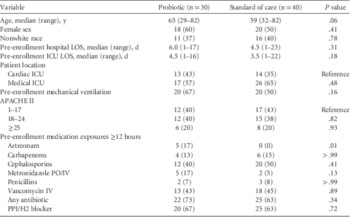
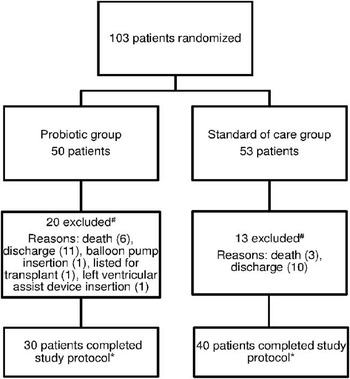
One hundred three patients were enrolled and randomized to probiotics or SOC. Seventy patients had at least 3 specimens available for analyses: 30 (43%) in the probiotic group and 40 (57%) in the SOC group (Figure 1). There were no significant differences between groups in demographic characteristics, pre-enrollment length of stay, or severity of illness (Table 1). There was a trend towards older age in the probiotic group (median age, 65 vs 59 y; P=.06). Patients in the probiotic group were more likely to have received aztreonam before enrollment (17% vs 0%; P=.01) (Table 1).
Pre-enrollment Patient Characteristics

NOTE. Data are no. (%) of subjects unless otherwise indicated. APACHE II, Acute Physiology and Chronic Health Evaluation II; H2 blocker, H2 receptor antagonists; ICU, intensive care unit; IV, intravenous; LOS, length of stay; PO, by mouth; PPI, proton pump inhibitor.
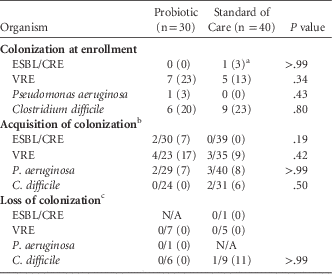
Colonization status throughout enrollment is summarized in Table 2. There was no significant difference in colonization with any MDROs on enrollment (43% of probiotic group vs 33% of SOC group; P=.35). Only 1 subject was colonized with an ESBL and 1 with Pseudomonas aeruginosa at enrollment. More patients were colonized with VRE and C. difficile, and rates were similar between groups (P=.34 and P=.80, respectively).
There was no significant difference in overall acquisition of any MDROs between the 2 groups (10% of probiotic group vs 15% of SOC group; P=.72). Two patients (7%) in the probiotic group acquired ESBL colonization (P=.19). Seventeen percent of the probiotic group vs 9% in the SOC group acquired VRE (P=.42). Seven percent of the probiotic group and 8% of the SOC group acquired P. aeruginosa (P>.99). No patients in the probiotic group and 6% in the SOC group acquired C. difficile (P=.50).
The single patient colonized with an ESBL-producing Enterobacteriaceae on enrollment (SOC group) remained colonized throughout hospitalization. No patients in any group lost colonization with VRE or P. aeruginosa. One SOC patient lost C. difficile colonization (P>.99).
All 103 patients were included in the safety assessment. There were no significant differences between probiotic and SOC patients in the number of patients who died (22% probiotic group vs 21% SOC; P=.88). There were no infections due to probiotic or clinical cultures positive for L. rhamnosus GG in either group. No adverse events associated with the probiotic occurred.
DISCUSSION
No differences in acquisition or loss of MDRO colonization between the probiotic and SOC group were identified in this study. These results may indicate that either our sample size was not large enough to detect a difference between groups, our study duration was too short, or that L. rhamnosus GG at the dose used did not affect MDRO colonization. There were no infections related to probiotics, suggesting that probiotics may be safe in a select cohort of critically ill patients, with care to minimize probiotic contamination when administered by tube.
Previous studies evaluating probiotics have had conflicting results.Reference de Regt, Willems and Hene 5 – Reference Plummer, Weaver and Harris 8 A meta-analysis found that probiotics in critically ill adults did not significantly reduce mortality but did reduce ICU-acquired pneumonia and ICU length of stay.Reference Barraud, Bollaert and Gibot 9 Another meta-analysis indicated probiotics were associated with reductions in infectious complications but had no effect on mortality or length of stay.Reference Petrof, Dhaliwal and Manzanares 10 These differences may be due to varying sample size, rates of MDRO carriage, types and doses of probiotic used, or the underlying complexity of the microbiome.
This study has limitations, including small sample size, duration of follow-up, and inclusion of a single type and dose of probiotic. We did not survey for gastric or upper airway colonization, which may be an important site for MDRO colonization. Finally, our extensive exclusion criteria may limit the generalizability of this study.
There are unresolved controversies regarding probiotics, including the type of patients who may benefit most from probiotics, the ideal probiotic organism(s), and the dose. The effect of prolonged probiotic administration on the gut microbiome is an area for further investigation. Larger studies are needed to evaluate the effectiveness of probiotics in preventing intestinal colonization due to MDROs in critically ill patients.
Flowchart of study protocol.
#Submitted <3 samples.
*Submitted ≥3 samples.

Colonization Status Throughout Enrollment

NOTE. CRE, carbapenem-resistant Enterobacteriaceae; ESBL, extended-spectrum beta-lactamase; N/A, not applicable; VRE, vancomycin-resistant Enterococcus.
a This was ESBL.
b Negative culture results on enrollment and positive culture results on day 3 and/or study exit, excluding those colonized at day 0.
c Positive culture results on enrollment and negative culture results on day 3 and/or study exit.
ACKNOWLEDGMENTS
Financial support. CDC Prevention Epicenter (grant U54CK000162). The probiotic Lactobacillus rhamnosus GG (Culturelle) was provided free by iHealth. iHealth took no part in study design, data collection, management, analysis, interpretation, presentation of data, description of findings, or final manuscript.
Potential conflicts of interest. C.-A.D.B. reports that she has received grants from bioMérieux, Cepheid, and Accelerate Diagnostics, and personal fees from bioMérieux, Thermofisher, and Nanosphere, outside the submitted work. V.J.F. reports that she has received grants from the CDC and nonfinancial support from iHealth during the conduct of the study. All other authors report no conflicts of interest relevant to this article.