Introduction
In both critical and academic discourse, the term ‘concept album’ is used to describe long-playing records or, more recently, compact discs that are marked by narrative unity and large-scale musical structure. Emerging in the late 1960s within the field of rock music, concept albums eschewed the commodified three-minute-or-less singles that dominated AM format radio in favour of longer compositions and extended improvisations. These invited more focused attention from listeners and were better suited for FM radio stations, which were less bound by commercial considerations (Martin Reference Martin1998, pp. 41–2; Montgomery Reference Montgomery2002, pp. 33–7, 177–8). Furthermore, many of the artists and groups that worked with the concept album format achieved economic and creative independence from the studio systems that dominated the production of popular music through the 1960s, and built upon the efforts of such recording pioneers as Les Paul, Norman Petty and Sam Phillips to transform the recording studio from a place to document their work into an additional tool in the compositional process. As rock musicians increasingly gained control over the composition, recording and distribution of their work, and as they worked to create more unified, large-scale musical compositions, the concept album became a musical and physical symbol of rock's anti-commercial rhetoric and artistic aspirations.
While many rock artists embraced the creative potential of the concept album, contemporaneous country musicians were slower to respond to the new format. All of the major country labels – RCA Victor, Columbia, Decca and Capitol – used the long-playing record (LP) to collect and distribute songs by a single artist by 1950 but, as Joli Jensen and Diane Pecknold have observed in their respective work on the development of the Nashville Sound, albums were of secondary interest to Music Row because AM format radio, the primary means of audience exposure to new music, demanded singles that clocked in at three minutes or less (Finson Reference Finson1979; Jensen Reference Jensen1998, pp. 45–6; Pecknold Reference Pecknold2007, pp. 143–52). As RCA Victor president Steve Sholes remarked in a 1956 article in the trade newspaper Country Music Reporter, the LP was an unreliable but potentially lucrative way to repackage singles in a budget-friendly product (Sholes Reference Sholes1956, pp. 1, 9). Although LPs were quite popular among audiophiles and classical music aficionados, country audiences have always exhibited a reluctance to purchase full-length albums. Thus, while notable examples such as the Reference Robbins1959 Marty Robbins album Gunfighter Ballads and Other Trail Songs indicate that some Nashville producers explored the LP's potential to collect thematically related songs, the unifying factor driving the majority of country albums released in the 1960s and 1970s was simply that all of the songs were recorded by the same artist (Butts Reference Butts1988, pp. 92–3).
Music Row's production practices made it difficult for country artists to experiment with narrative and musical unity in their albums. Decisions regarding the repertoire to be recorded in a session and the order in which songs would appear on an album often rested squarely in the hands of label executives, producers and A&R representatives, limiting the opportunities that the musicians had to shape large-scale narratives and musical structures over the course of an entire album (Denisoff Reference Denisoff1983, p. 184; Jensen Reference Jensen1998, p. 82; Patoski Reference Patoski2008, pp. 247–50).Footnote 1 Moreover, sessions seldom lasted more than three hours and were expected to yield four songs, so country artists had little opportunity to explore new recording practices or to compose in the recording studio (Levy Reference Levy, Wolfe and Akenson2000, pp. 23–4). But perhaps most importantly, rock's artistic and intellectual pretensions stood in direct opposition to Music Row's constructions of country music as an approachable, unassuming and ‘downhome’ musical tradition and of its artists as common people who enjoyed entertaining people just like themselves (Ellison Reference Ellison1995, pp. xvi–xvii). The rock vision of the concept album, therefore, challenged all of the aspects of Music Row's control over commercial country music from production and distribution to marketing and, as a result, had a limited impact on the genre during the second half of the 1960s.
Although the core of Nashville's country music community did not embrace the concept album, a few artists who were working on the fringes of country music – and who, notably, aligned themselves with the countercultural images and attitudes of the time – did begin to experiment with the format in the first years of the 1970s. Chief among these was Willie Nelson who, by the dawn of the 1970s, was on the verge of breaking away from Music Row to seek more lucrative opportunities in Texas. Born in Abbott, Texas on 30 April 1933, Nelson began his career as a young boy playing in a Czech dance band, and by the late 1950s he had developed a significant following in the dance halls of Fort Worth, Dallas and Houston (Nelson Reference Nelson and Shrake1988, pp. 59–60; Patoski Reference Patoski2008, pp. 58–103). Seeking to extend his reach beyond the borders of the Lone Star State, Nelson moved to Nashville in 1960, where he signed a songwriting contract with publisher Pamper Music, enjoying substantial success writing such songs as ‘Crazy’, ‘Funny How Time Slips Away’ and ‘Night Life’. He achieved hits with popular singers Faron Young, Billy Walker and, most notably, Patsy Cline (Nelson Reference Nelson and Shrake1988, p. 140; Patoski Reference Patoski2008, pp. 104–18). By 1965, Nelson had become a highly respected member of the Nashville music community, having demonstrated his prowess both as a first-class songwriter and a strong guitarist in the vein of Django Reinhardt. That year, Nelson signed a recording contract with RCA Victor and was invited to become a member of the Grand Ole Opry, the venerable radio barn dance broadcast over Nashville's clear-channel radio station WSM (Opry n.d.). Over the course of Nelson's six-year relationship with RCA Victor, producers Chet Atkins and Felton Jarvis attempted to market Nelson in a variety of ways, showcasing his songwriting talents in Country Willie: His Own Songs (Reference Nelson1965), as a magnetic live performer in Country Music Concert (Reference Nelson1966) and as an interpreter of familiar pop and country songs in Texas in My Soul (Reference Nelson1968) and Both Sides Now (Reference Nelson1970).
Despite RCA Victor's efforts, Nelson's recording career was, by their accounts, a lacklustre one, and Nelson's recordings had little impact on country radio charts outside Texas. In his 1988 autobiography, Nelson remarked that one important factor in his failure to achieve success as a recording artist could be traced to his own resistance to the Nashville music industry. For Nelson, Nashville was simply ‘where the store was. If I had anything to sell, it must be taken to the store. Nashville, New York and L.A. were the big stores …’ (Nelson Reference Nelson and Shrake1988, p. 140). Moreover, upon his arrival in Nashville, he began to realise that Music Row's understanding of country music was much more conservative than the definition he had formed while working in the dance halls and honky tonks of Texas:
I enjoyed fooling around with the phrasing [of the songs I sang], but it made my sound noncommercial for all those Nashville ears who were listening for the same old stuff and misunderstood anything original. They didn't know what to do with me. I wasn't country like Roy Acuff was country. If a song had more than three chords in it[,] there was a good chance it wouldn't ever be called country, and there was no way you could make a record that wasn't called country in Nashville at that time. (Nelson Reference Nelson and Shrake1988, p. 140)
Nelson's music continued to make inroads in Texas, however, and he found himself making regular trips to the state to perform before large and enthusiastic Texan audiences, even to the detriment of his membership in the Grand Ole Opry, which stipulated that he commit potentially lucrative Saturday nights to the broadcast, which paid only the union scale. On 23 December 1969, when Nelson's Nashville home burned to the ground, he decided to return permanently to Texas, leaving with the only two possessions he retrieved from the flaming home, his prized Martin guitar and two pounds of marijuana (Nelson Reference Nelson and Shrake1988, pp. 163–4).
Upon his return to Texas, Nelson continued his arduous schedule of touring the many dance halls that dotted the landscape of the Lone Star State, but he quickly discovered that the demographic makeup of his audience was changing rapidly, becoming increasingly younger and comprising a growing segment of long-haired hippies. Nelson himself had begun to explore the emergent counterculture as early as 1965, when he and fellow Texan singer-songwriter Johnny Bush began studying the mystic faith Astara and, by 1970, experimenting heavily with hallucinogenic drugs such as LSD and peyote (Nelson Reference Nelson and Shrake1988, pp. 205–6; Bush Reference Bush2007, p. 131; Patoski Reference Patoski2008, pp. 170–73). Following the release of Merle Haggard's 1969 hit ‘Okie from Muskogee’, country music become increasingly associated with conservative white resistance to the youth counterculture (Rodnitzky Reference Rodnitzky1971, p. 46; Denisoff Reference Denisoff, Denisoff and Peterson1972, p. 24; King Reference King1974, p. 31, LaChapelle Reference LaChapelle2007, pp. 187–194). For the growing population of politically and socially liberal young people who resided in the rapidly modernizing Sun Belt, the sounds of country music evoked more ambivalent feelings (Kemp Reference Kemp2004, pp. 20–34). For them, country music had been an important part of the soundscape of their youth and, despite its political associations, musicians and audiences sought ways to merge the musical practices of country music with their own, often rock-influenced, musics, creating hybridised styles that were, in many ways, reflective of the complexity of their own experiences. The results of this project were the wide variety of musical styles that can be categorised generally as ‘country–rock’, including the Bakersfield-tinged sounds of The Byrds and The Flying Burrito Brothers in southern California, the blues-driven music of southern rock groups such as Lynyrd Skynyrd, the Charlie Daniels Band and the Marshall Tucker Band in the southeast, and the Texas-born blend of western swing, honky tonk, blues, Cajun, zydeco and conjunto music that became known as ‘progressive country’.
Record labels continued to release much of this music as singles in an attempt to gain airplay on AM radio, the radio format that marketed country music directly to white, middle-class suburbanites – the so-called Silent Majority who resisted the youth counterculture (Pecknold Reference Pecknold2007, pp. 221–6). The 45-rpm single thus offered the potential to spin as many as 20 songs per hour and allowed programme directors to present a broad musical overview of the format in each broadcast hour. Moreover, the frequent breaks between songs facilitated the insertion of the non-musical elements that characterised each station's distinctive sound. The audience for country format radio was, therefore, accustomed to listening to singles and purchasing full-length albums only occasionally. But, among the youth counterculture, the long-playing record was by far the preferred medium for country–rock hybrids, as the format allowed artists and listeners alike to break down social, cultural and musical boundaries, much as they wished to do themselves (Montgomery Reference Montgomery2002, pp. 36–7, 177–8). Furthermore, whereas the commercial demands of AM format radio required a supply of three-minute singles that could be interspersed among commercials, disc jockey commentary and news and weather announcements, the less commercial FM radio stations that were popular within the counterculture could afford to play album-length compositions with minimal interruptions (Ganzert Reference Ganzert1997, p. 57; Montgomery Reference Montgomery2002, p. 72; Sterling and Keith Reference Sterling and Keith2008, pp. 127–36). Record labels, especially those that hoped to appeal to both segments of the country audience, needed to generate product – released as both singles and LPs – that was at once suitable for AM radio airplay and that offered the artistic and social value sought out by the country–rock audience.
At the same time as his popularity with young people was growing, Nelson's recording career was floundering. After fulfilling his recording contract with RCA Victor in 1971, Nelson teamed up with manager Neil Reshen, who also managed jazz trumpeter Miles Davis and fellow RCA Victor country recording artist Waylon Jennings, and set out to find a record label that would allow Nelson to develop his distinctive voice as a songwriter and interpreter and that would also devote energy and funding to promote Nelson's music to his increasingly diverse audience. Signing first with Atlantic Records' new country division in 1972 and, following the label's collapse in 1974, with Columbia Records, Nelson gained greater autonomy from the production and distribution practices of Nashville's Music Row. He recorded in studios in Dallas, New York and Muscle Shoals, Alabama, wrote and interpreted songs that defied easy genre classification, and built a reputation as a country music ‘outlaw’ (Patoski Reference Patoski2008, pp. 248–50, 291–3).
It was during this period of transition in his recording career and public image that Nelson wrote and recorded three concept albums that suggest he was working to create a distinctly ‘country’ approach to the concept album: Yesterday's Wine (1971), Phases and Stages (1974) and Red Headed Stranger (1975). Having written for the seven-inch single during the 1960s, Nelson had developed an ability to capture the psychological torment of the honky-tonk lifestyle in a three-minute-or-less single. The concept album's extended length permitted him to develop these powerful vignettes into compelling narratives that not only depicted the immediacy and volatility of a character's emotions, but allowed for the creation of more dynamic characters and dialogues depicting the complexities of love and loss with greater nuance than the single permitted (Nelson Reference Nelson and Shrake1988, p. 166). Nelson's approach to the concept album did not, however, forsake the single; rather, his albums united the compact songwriting structures that had characterised his earlier work and the extended forms of the rock concept album to create both a highly unified large musical composition and a series of singles that were suitable for format radio. Like such commonly cited rock predecessors as the Beach Boys' Pet Sounds (1966) and the Beatles' Sgt. Pepper's Lonely Hearts Club Band (1967), Nelson's simultaneously integrated and disintegrated concept albums thus complicate their unity and invite further investigation of the techniques that Nelson used to reinforce the albums' narrative and musical integrity.
Conceived as both a collection of singles and as a unified artistic statement, therefore, concept albums allowed artists like Nelson to simultaneously support both his conservative country audience and his growing countercultural audience with a single release. Focusing on his early efforts with the concept album, this article explores the ways that Willie Nelson, as a songwriter, bandleader and producer, developed an approach to the concept album that at once explored the compositional possibilities afforded by the extended length and physical attributes of the LP and yet yielded concise songs that were suitable for radio airplay. Drawing upon extensive discographical information and close musical and lyrical analysis of his first three concept albums, this article suggests that Nelson developed an approach to composition and recording that was informed by the product-oriented attitudes of Music Row and that subverted the notion put forth by many contemporaneous rock musicians that concept albums necessitated greater freedom in the recording studio and an increased capital investment from their record labels. As such, Nelson's work complicates many commonly held beliefs about the concept album that are drawn from progressive rock, including especially the necessity of musical and narrative unity and the concept album's symbolic transcendence of the commercial music industry.
Yesterday's Wine: from vignettes to narratives
Nelson's first efforts to create a concept album began during the winter of 1969–1970 when, during a stay at a dude ranchFootnote 2 near Bandera, Texas, he began devising the narrative and composing songs for what would become 1971's Yesterday's Wine, his final recording project for RCA Victor.Footnote 3 During his stay in Bandera, Nelson, who had abstained from hard drug use during his tenure in Nashville, experimented with a variety of drugs including marijuana and LSD and continued to read the works of psychic Edgar Cayce and poet Kahlil Gibran. Nelson conceived of Yesterday's Wine as an exploration of Gibran's assertion that, in Nelson's gloss, ‘life on earth is a quest for returning to God’ (Nelson Reference Nelson and Shrake1988, p. 165; Patoski Reference Patoski2008, pp. 213–14). He composed a series of vignettes depicting a protagonist at various stages in this quest, creating a story ‘about a guy – imperfect man – watching his own funeral and reviewing his life’ that he intended to record as his first concept album, which he defined as ‘an album that tells a story’ (Nelson Reference Nelson and Shrake1988, p. 166).
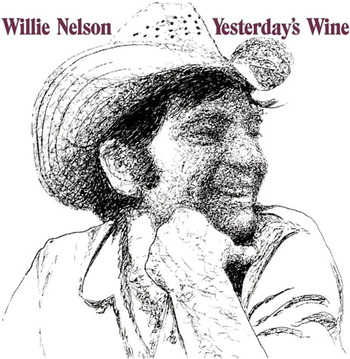
Although the narrative possibilities of the concept album stood among the primary reasons that Nelson was attracted to the format, the structure of the album encouraged listeners to hear little more than the gathering of singles that characterised most country LPs. With the exception of two medleys that introduce and conclude the album's A side, each of the songs is musically and lyrically independent from the rest of the songs on the album. To outline and reinforce the narrative that Nelson had created, therefore, he joined with songwriter Dee Moeller and RCA Victor producer Felton Jarvis to explicate the concept on the album's record jacket, exploiting the full potential of the LP as a physical object. The front of the jacket features a pen and ink drawing of a relaxed and smiling Nelson (see Figure 1), continuing the common practice of depicting the artist and presenting the title of the album. The jacket's reverse, however, presents two versions of the album's narrative. The first, which is situated in the center of the jacket, is a rambling meditation on Nelson's composition and the meaning of life written by Dee Moeller. Describing the album as ‘the story of a man – from birth to death’, Moeller's commentary suggests a narrative structure through the format of the text. Each paragraph begins with an idea followed by an ellipsis and a reflection on it. Even a quick glance down the left margin demonstrates that these separated words reveal the protagonist's return to God: ‘God’, ‘difficult times’, ‘love’, ‘remembering sets in’, ‘friends’ and ‘the thread’. Moeller makes the connection between her exegesis and the songs on Nelson's album clear by paraphrasing the song titles in the sleeve notes. In the third paragraph, for instance, Moeller alludes to the first two compositions on the album's B side, ‘Summer of Roses’ and ‘December Day’: ‘love … summer roses; such a fleeting thing, reach out and catch it, hold tight, roses only last a short season, too soon it's a december day.’Footnote 4 This technique is repeated in an ‘Editor's note’ at the bottom of the record jacket: ‘This album is the story of a man from birth to death. Each song recalls different incidents of his life – gathering around the Family Bible as a child … a Summer of Roses, of love, followed by a December Day … the bitterness of reflecting, Yesterday's Wine … and finally, full cycle – back to God – a time for Goin’ Home'. Thus, for the record buyer who sought to engage with Yesterday's Wine as both a physical object and a medium for the transmission of recorded sound, the record jacket offered new insights into the proposed meaning of the album and suggested that country music could, in fact, have grander artistic aspirations than the single afforded.
Willie Nelson, Yesterday's Wine (1971), used with permission.

These prose reflections were essential elements of the construction of a large-scale narrative, as the recordings themselves do little to articulate narrative unity. Nelson did attempt, however, to express the profound spirituality of the album in the opening cut, which foreshadowed the journey described in the sleeve notes. Titled simply ‘Intro – Willie Nelson and Band’, the track features a conversation between Nelson, God and an unknown spirit in which the three discuss the reason that Nelson must be born:
GOD: You do know why you're here. …
NELSON: Yes. There's great confusion on Earth, and the power that is has concluded the following: perfect man has visited Earth already, and his voice was heard; the voice of imperfect man must now be made manifest, and I have been selected as the most likely candidate.
GOD: Yes. The time is April, and therefore, you – a Taurus – must go.
UNKNOWN SPIRIT: To be born under the same sign twice adds strength.
GOD: And this strength, combined with wisdom and love, is the key.
Alluding to both Nelson's readings of Cayce and the influence of the counterculture's spiritualist rhetoric, the introduction to Yesterday's Wine at once marked a continuation of Nelson's extensive exploration of the human psyche and the complexities of human relationships and signaled a break from country music's focus on real-life situations.
Chet Atkins, then vice-president of RCA Victor's country music division, was concerned that the overtly spiritual content of the album and its unified structure would be difficult to market to Music Row's AM radio audience. As Nelson recalled: ‘[The album] scared a lot of people. … RCA's reaction was “Who's gonna play this?” They started thinking about AM radio. My whole idea was playing the album all the way through. It was a spiritual album’ (quoted in Patoski Reference Patoski2008, p. 220). Because Atkins could not afford to sacrifice AM radio airplay, which provided much of the label's revenue, the album received little support from RCA. As Nelson explained, ‘Yesterday's Wine was regarded by RCA as way too spooky and far out to waste promotion money on’ (Nelson Reference Nelson and Shrake1988, p. 167). RCA did, however, release one single from the album in an attempt to promote the record on AM radio, ‘Yesterday's Wine’ b/w ‘Me and Paul’ (RCA Victor 74-0542), yet the single had little impact, reached number 62 on Billboard's ‘Hot Country Singles’ chart (Whitburn Reference Whitburn2002, p. 244), and, like Nelson's 13 previous RCA Victor releases, Yesterday's Wine was, by all accounts, a commercial failure (Patoski Reference Patoski2008, pp. 220).
Nelson's insistence that Yesterday's Wine be approached as a complete and unified musical and narrative expression is mirrored in the speed with which the album was recorded. The recording artist and the session musicians were expected to create arrangements on the fly and to perform their roles with relative flawlessness. Nelson, who had become accustomed to this method of recording after years of experience in Nashville, took advantage of the professional environment of the recording studio to essentially record Yesterday's Wine in only four sessions. Unlike his rock contemporaries who were beginning to treat the recording studio as a compositional space, Nelson treated the studio as a place to document a fully formed work.
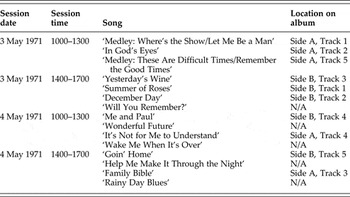
On 3 and 4 May 1971, Nelson was joined by many of Nashville's ‘A-list’ session players, including pianist Hargus ‘Pig’ Robbins, fiddler Buddy Spicher and bassist Roy ‘Junior’ Huskey to record all of the album's 10 tracks, as well as five songs that would be released on several later RCA Victor albums. As Richard Weize has shown, each of the four sessions produced between three and four finished recordings, recording directly to tape with no overdubs (Weize Reference Weize and Kienzle1998, p. 59). Weize's discography also reveals that Nelson and the assembled studio musicians did not record the album from beginning to end, as he would do in his subsequent concept albums (to be discussed below). Rather, as Table 1 demonstrates, the songs were recorded with little regard for their eventual location on the album. This evidence suggests, therefore, that Nelson was directly involved in the sequencing of the tracks on the album, a task that was typically left to the record producer. Thus, while Nelson and many of his contemporaries in Nashville (including especially Waylon Jennings) railed against the controlling influence of Music Row's producers and executives, the Yesterday's Wine sessions indicate that such commentaries may have been overdrawn. The sessions instead reveal that Nelson was given great liberty to compose a work that reflected his changing musical and intellectual interests, despite the expenses that RCA Victor could not expect to recoup from radio airplay and record sales.
Songs recorded in Yesterday's Wine sessions, RCA Victor Studio A, 3–4 May 1971.

Source: Weize Reference Weize and Kienzle1998, p. 59.
Further discographical research reveals that Nelson revived two compositions that he had written much earlier in his career and indicates that he viewed the LP as a tool to create a large work from smaller compositions. ‘Family Bible’, which Nelson wrote in 1957 or 1958, was the first song that he sold as a professional songwriter, signing over his rights to the song to Houston guitarist Paul Buskirk for $50 in 1959. Recorded for Houston-based D Records in 1960 by singer Claude Gray, who paid Buskirk $100 for a share of the song, ‘Family Bible’ quickly rose to the top of the country charts and provided the confidence that Nelson needed to continue forging a career as a songwriter (Nelson Reference Nelson and Shrake1988, p. 118; Nelson Reference Nelson2002, p. 47; Patoski Reference Patoski2008, pp. 99–100). Nelson is not credited with its composition on the record jacket of Yesterday's Wine, as an explanatory note makes clear: ‘With the exception of Family Bible [sic], all songs were written by the artist, Willie Nelson.’ Nelson recorded the second song, ‘December Day’, for RCA Victor on 12 December 1967, and it was released on 1968's Good Times (RCA LSP-4057). While the 1971 recording features a slightly larger instrumentation and a more reverberant treatment of Nelson's vocal than the 1967 recording, both versions are remarkably similar in tempo, texture and instrumentation.
By including these songs with minimal musical changes in the Yesterday's Wine project, Nelson seems to suggest that his compositions could enjoy a dual existence as singles and components of a large-scale musical work and that, more importantly, both versions communicated something of value to his audience. Thus, while many contemporaneous progressive rock artists were demanding greater focus from their listeners and promulgating a musical aesthetic that, as Edward Macan has described, ‘combine[d] the classical tradition's sense of space and monumental scope with rock's raw power and energy’ (Macan Reference Macan1997, p. 40), Nelson created an equally viable musical aesthetic that allowed listeners to engage with his compositions at the scale of both the album and the single. This decision reflected not only the generic standards of Nashville's country music recording industry of the late 1960s and early 1970s, which required singles for radio airplay and jukebox distribution, but also a conscious awareness of the changing demographics of his audience which, as Chet Flippo remarked of Nelson's live audience in a Rolling Stone article just a few months following the release of Yesterday's Wine, ‘was almost evenly divided between young, long-haired listeners and middle-aged country fans’ (Flippo Reference Flippo1972, p. 68). Nelson's core country constituency would become familiar with his music through ‘Yesterday's Wine’ b/w ‘Me and Paul’ (RCA 74-0542), a radio-friendly single that did not betray his metaphysical interests, while the increasingly album-oriented youth audience had full access to Nelson's reflections on the meaning of life and humankind's place in the universe. Because RCA Victor perceived album sales of country music as a secondary and inconsistent revenue stream and because Nelson was reaching the end of his faltering recording career with the label, he was permitted the freedom to experiment with a new compositional approach that allowed him to penetrate the emerging countercultural country audience. At the same time, RCA Victor's decision to neglect Yesterday's Wine allowed Nelson's countercultural fans to recast him as an outcast, and later as an ‘outlaw’, in Nashville (‘Honky tonk heroes’ 1975, pp. 30–31; Ward Reference Ward1976, p. 18) and to enact a critique of the Music Row culture industry and its core audience through their consumption of Nelson's albums.
Phases and Stages: the concept album and character development
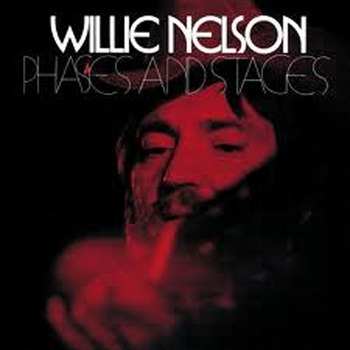
After parting with RCA Victor in 1972, Nelson signed with Atlantic Records which, under the guidance of producer Jerry Wexler, was attempting to establish a Nashville branch. During his brief tenure with the label, which left Nashville in 1975, Nelson recorded three albums, the first two of which were released. Phases and Stages, Nelson's second Atlantic release, marked his return to the concept album format and exhibits his increasing awareness of the possibilities that the two-sided structure of the LP offered (Figure 2). Released as Atlantic SD 7291 in March 1974, the album presents a meditation on divorce and recovery, from the perspectives of both the husband and the wife. The A side of the album offers a sensitive portrayal of the woman's journey from heartbreak to recovery, while the B side presents a more stereotypically hostile male reaction to his ex-wife's newfound empowerment. Examination of the album as a physical object reveals that Nelson exploited the dual-sided format of the long-playing record as a plot device and used the accompanying packaging to outline the narrative. Moreover, Phases and Stages uses several musical techniques, including large-scale key structure and the use of refrains, to unify the work musically. Perhaps most importantly, portions of Phases and Stages were recorded in five different sessions over four years, and the resulting discographical evidence grants rare insight into Nelson's visions for the album. As such, Phases and Stages offers the best documentation of Nelson's compositional approaches and stands as a paradigmatic example of his approach to the concept album during the early 1970s.
Willie Nelson, Phases and Stages (1974), used with permission.

Nelson had devised Phases and Stages' two-act structure early in the process. On 25 April 1972, he entered RCA Studio B for his penultimate session for the label with bassist Dan ‘Bee’ Spears and drummer Paul English, both members of his road band. In this three-hour session, the three musicians recorded five songs that he had been testing in concert performances throughout Texas: ‘Phases, Stages, Circles, Cycles and Scenes’, ‘Pretend I Never Happened’, ‘Sister's Coming Home’, ‘Down at the Corner Beer Joint’ and ‘I'm Falling in Love Again’. The master numbers for the session indicate that the songs were recorded in the same order that they would appear on the final Atlantic release nearly two years later, suggesting that Nelson may have conceived of these songs as a unified whole from the very beginning of the project (Weize Reference Weize and Kienzle1998, p. 58). This hypothesis is confirmed by the fact that, when Nelson entered Muscle Shoals Sound in the fall of 1973 to record the album for Atlantic, he recorded the entire project in only one day, often needing only one take for each song (Atlantic Record Discography 1973; Patoski Reference Patoski2008, p. 276).Footnote 5
Fewer documented versions of the album's B side exist, but the husband's first two songs were recorded during Nelson's tenure at RCA. ‘Bloody Merry Morning’ [sic] is the earliest recorded component of Phases and Stages, having been recorded for RCA Victor on 12 November 1969 and released on the album Both Sides Now, and ‘No Love Around’ was recorded on 27 April 1972, two days after Nelson recorded the songs that would form the album's A side (Weize Reference Weize and Kienzle1998, p. 59). Although there is no known early recording of the complete B side, Nelson recalled in his 1988 autobiography that the entire album was in place by October 1972, a full year before the Atlantic Phases and Stages session in Muscle Shoals. During CMA Awards week that year, Nelson performed the entire Phases and Stages cycle at a songwriters' gathering at songwriter Harlan Howard's home, where Wexler was in the audience. As Nelson recounted: ‘I climbed on the stool with my old Martin and sang all the songs I had written for a new album I called Phases and Stages. … The song I started off with that night was “Bloody Mary Morning”’ (Nelson Reference Nelson and Shrake1988, p. 168).Footnote 6 Although Nelson did not go on to recount the exact set list from that evening, the fact that he remembered beginning with ‘Bloody Mary Morning’ provides a great deal of insight into Nelson's conception of the album as having two distinct parts, each of which filled one side of an LP. Moreover, by beginning with the first song on the second side of Phases and Stages, he demonstrated an even more nuanced understanding of the possibilities and limitations of the long-playing record. That is, despite directions on the record label, listeners can begin with either the A side of the record or the B side. As such, Nelson's decision to contain the male and female perspectives on respective sides allows listeners to engage with the narrative without accidentally beginning in the middle. Furthermore, Nelson's own experiences with cheating, divorce and reconciliation may have taught him that there are two equally valid sides to every situation, and, as a result, he chose not to privilege either perspective.
While Nelson may have conceived of Phases and Stages as two distinct but related acts, he also employed several techniques to convince listeners that the album was a cohesive whole. The sleeve notes outline the narrative concept even before record buyers listen to the album. Like the ‘Editor's note’ of Yesterday's Wine, the sleeve notes to Phases and Stages paste together the titles of all of the songs to summarise the story told on the album. But, for Phases and Stages, Nelson expanded upon the precedent of Yesterday's Wine by weaving extended quotations from the lyrics into this narrative as well.
The individual songs on the album are linked not only through the narrative outlined in the sleeve notes and the two-act structure, but also through a short refrain entitled ‘Phases and Stages (Theme)’. Excerpted from his 1972 RCA Victor single ‘Phases, Stages, Circles, Cycles and Scenes’, this refrain permits Nelson to serve both as an omniscient narrator and a Greek chorus whose commentary reinforces the narrative and offers a hermeneutic framework within which to interpret it. As the narrator, Nelson explains that the tale we are about to witness is representative of the eternal conflict between men and women: ‘Phases and stages, / Circles and cycles, / Scenes that we've all seen before. / Let me tell you some more.’ Between the April 1972 RCA Victor sessions and the October 1973 Atlantic sessions, Nelson inserted the refrain into the A side twice and into the B side three times, perhaps indicating that he felt the need to refocus the listeners' attention on the narrative throughout the album. Moreover, the refrain also functions to outline overarching musical structures that parallel the musical structures devised by Nelson's rock contemporaries. The album's tonal center is D and, in four of its five iterations, ‘Phases and Stages (Theme)’ is heard in D minor. But, in its first statement on the B side, the refrain is heard in A major, suggesting a large-scale tonal structure that is resolved in the final statement of the refrain. Perhaps more importantly, the album's tonal structure allowed Nelson to reinforce the album's gendered narrative by mimicking the vocal ranges of both speakers, presenting the husband's voice a perfect fourth lower than the wife's.
Despite the narrative design Nelson proposed in the album's sleeve notes, the ubiquity of Nelson's nasal baritone complicates, and at times confounds, his performance of the female lead on Side A. An excellent example of Nelson's complication of the album's gender narrative is ‘(How Will I Know) I'm Falling in Love Again?’. This, the concluding song of Side A, depicts the female protagonist as she grapples with the decision to move on with her life and forge a new romantic relationship following the collapse of her marriage. The whole-note articulations of the first three syllables of each verse, combined with the melody's downward trajectory, the addition of chromatic neighbour chords and the song's ponderously slow tempo, serve to emphasise the emotional torment she experiences as she makes these decisions. But Nelson's use of first-person pronouns, his failure to identify the gender of the second-person character and, most importantly, the presence of his noticeably male voice undermines the emotional power of this moment in the album's narrative. Close examination of the other two songs sung by the female protagonist – ‘Walkin’' and ‘Pretend I Never Happened’ – yields similar results and demonstrates that, despite Nelson's proposed portrayal of both parties, his obviously male voice and the songs' gender-neutral lyrics destabilise the female voice in Side A of Phases and Stages and, as a result, necessitated the creation of a musical metastructure that reinforced the gendered narrative that Nelson sought to depict. Moreover, this issue suggests that country music's emphasis on first-person narrative revealed a significant limitation of the concept album format that, while a familiar problem in the 19th-century Liederkreis that provided the model for many early progressive rock concept albums (Solie Reference Solie and Scher1992, pp. 219–40; Macan Reference Macan1997, p. 13; Muxfeldt Reference Muxfeldt2001, pp. 27–48), was relatively uncommon in the rock field, which tended toward third-person narratives and wholly instrumental compositions.
If Side A of Phases and Stages represents an emotionally and musically complicated attempt to depict the female protagonist's perspective on separation and divorce, the B side, which addresses the male perspective, is significantly less so. The issues that arose from Nelson's voice on Side A are not present in the male-voiced B side. But, more importantly, unlike the wife whose emotional journey is carefully documented, the husband ‘loses himself in self-pity and then assumes the façade of honky-tonk bravado’ (Flippo Reference Flippo1974, p. 61).
The emotional roller-coaster that the male protagonist experiences is perhaps best exemplified by the contrast between the song that opens Side B, ‘Bloody Mary Morning’, and ‘It's Not Supposed to Be That Way’, the fourth cut on Side B. After at least three songs discussing the male character on Side A, ‘Bloody Mary Morning’ marks the first occasion in which the male character gets to speak for himself. The listener finds him on a flight from Los Angeles to Houston, fleeing from the site of his infidelity and of what he perceives as his wife's betrayal of their marriage. The musical setting amplifies the anger that the husband feels toward his wife and, more importantly, seems to imply that he has lost control of his emotions. ‘Bloody Mary Morning’ features the album's densest textures, augmenting the core honky-tonk instrumentation of lead guitar, electric bass guitar and drums with banjo and piano. Furthermore, Roger Hawkins' steady kick drum accents combine with the banjo and piano to add an almost frenetic energy to the song, underscoring further his desire to get as far away from his problems as possible.
In stark contrast to ‘Bloody Mary Morning’, ‘It's Not Supposed to Be That Way’ presents the male character after his initial ire has cooled and as he begins to reflect on the circumstances of his wife's estrangement. Here, the protagonist does not place the blame on himself, but instead posits that his wife was simply acting ‘like the other little children’ by ‘play[ing] with fireflies’ til they're gone'. He warns, however, that his wife should ‘be careful what you're dreamin’ / Or your dreams'll be dreamin' you', implying that, although her dreams of liberation from her marital obligations may be perfectly natural, those same dreams may well result in the sullying of her reputation. Set amid lush reverb and Nelson's sparse finger-picked guitar, the husband's vitriol is all the more pointed, as it indicates that his words have been deliberately chosen to belittle his wife's emotionally fraught decisions. Nelson's development of this character is, therefore, markedly different from his development of the female protagonist of Side A. Thus, while the wife is portrayed as a dynamic character who carefully considers the implications of the possibilities afforded her, her husband is decidedly static, remaining resolute in his belief that his wife's reasons for leaving were trivial and unjustified. Although Nelson later claimed that he wrote the song from the perspective of ‘a father talking to his daughter’ about the changes in their family (Nelson Reference Nelson and Shrake1988, p. 251), this interpretation, offered 15 years after the initial release of Phases and Stages, casts the song not as a constituent element of an entire album but as a single, coherent entity, further revealing the rich, if occasionally problematic, meanings made possible through the song's dual existence.
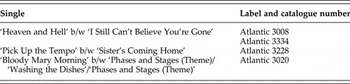
Although Nelson had conceived of the album as a unified whole from the beginning of the project, and although he used several musical and extramusical techniques to reinforce that unity, Atlantic's extensive promotion of the album through the release of singles complicates the album's musical and narrative integrity in a way that RCA Victor's limited promotion of Yesterday's Wine did not. While a few ‘progressive’ country stations such as Austin's KOKE-FM dedicated blocks of airtime for Nelson's concept albums (Gracey, pers. commun., 2007), format country radio demanded singles.Footnote 7 Atlantic Records, which opened its Nashville branch little more than a year before the release of Phases and Stages, needed mainstream radio airplay in order to make the label's country experiment a success. Atlantic released three singles from Phases and Stages (Table 2). Unlike their album counterpart, these singles bear few traces of their context within the album. The release of ‘Heaven and Hell’ b/w ‘I Still Can't Believe You're Gone’, both of which were excerpted from the album's B side, demonstrates that singles need not present the album's balanced perspectives. Moreover, while the release of ‘Phases and Stages (Theme)’ as part of the B side of Atlantic 3020 might appear to be a nod to the album's refrain, the release actually replicates RCA Victor's release of ‘Phases, Stages, Circles, Cycles and Scenes’, which included ‘Washing the Dishes’ in its entirety. Finally, the Phases and Stages singles were released in simple paper sleeves that prevented the publication and dissemination of the sleeve notes that articulated the album's narrative concept. While the disintegration of Phases and Stages into a series of discrete singles – neither of which broke into the top ten on Billboard magazine's ‘Hot Country Singles’ chart (Whitburn Reference Whitburn2002, p. 244) – might be construed as the destruction of an organic whole, the dual existence of Phases and Stages as a long-playing album and as three singles suggests rather a continuation of the dual-release approach that had sustained country and pop labels since the advent of the two formats, creating products that could be marketed to audiences listening to AM country radio and to the album-oriented countercultural audiences that Nelson was drawing in Austin and other parts of Texas.
Singles released from Phases and Stages.

Red Headed Stranger: synthesis and apotheosis
Phases and Stages marked the end of Nelson's relationship with Atlantic Records, since the label's Nashville offices closed shortly after the album's release, and by 1975 Nelson had signed a contract with Columbia Records. He bypassed Columbia's Nashville office, which had a long history of success in the country market, and chose to negotiate directly with executives in New York. In 1975, Columbia subsidiary CBS Records released Red Headed Stranger, Nelson's most ambitious concept album to date (Figure 3). Drawing upon the musical, narrative and extramusical techniques that he had developed in his earlier concept albums, Red Headed Stranger marked the culmination of Nelson's nearly half-decade exploration of the compositional possibilities afforded by the LP and demonstrates Nelson's mastery of the format. Moreover, whereas his earlier albums had been created under the auspices of studio system, Nelson eschewed professional recording studios altogether, challenging the aesthetics of professional studios and offering an alternative path for country musicians to create music according to their own aesthetic ideals rather than those of a professional producer. As a result, the story of Red Headed Stranger's composition, recording and reception has taken on an almost mythic status and has become a key moment in Nelson's biography, explaining how and why his early career as a recording artist in Nashville was not successful and representing a fundamental shift in Music Row's working methods. Furthermore, by rejecting the sounds and practices of Nashville, Nelson firmly established his artistic credibility among the countercultural audiences in his adopted home of Austin and among rock journalists, both of whom situated him as a rebel who transcended genre and social boundaries.
Willie Nelson, Red Headed Stranger (1975), used with permission.

Nelson composed Red Headed Stranger while driving home to Austin, Texas from a ski trip in Steamboat Springs, Colorado in January 1975. As Patoski has recounted, Nelson's wife Connie suggested that the song ‘Red Headed Stranger’, which Nelson had sung since the 1950s, had the potential to be expanded into ‘a nice story album, like a cowboy movie on record’ (Patoski Reference Patoski2008, p. 294). Assembling several popular country songs and composing some new material, Nelson expanded Edith Lundeman and Carl Stutz's composition into what journalist Noel Coppage described as ‘an adult, love-and-death western in song’ (Coppage Reference Coppage1975, p. 83). Set in the Rocky Mountain West of 1901, the album depicts the journey of a preacher who, after murdering his wife and her lover, wanders through the mountains with his wife's horse in search of solace and redemption. After killing another woman for touching the horse, the preacher arrives in Denver, where he finds love with another woman who helps him forget his pain.
Whereas Nelson's previous concept albums were comprised exclusively of his own compositions, Red Headed Stranger consists primarily of songs that had been written by commercial country songwriters who had been active a full generation or more prior to the start of Nelson's career as a professional songwriter (Table 3). That is, Nelson selected several songs that had enjoyed long histories prior to their inclusion in the Red Headed Stranger project and created an opportunity for listeners to make associations with more familiar versions of the songs that could have complicated any of Nelson's attempts to create musical or narrative unity in the album. The waltz ‘O'er the Waves’, for instance, had been long associated with carousels, circuses and parks and was a familiar sound in films and cartoons throughout the 20th century (Magdanz Reference Magdanz2007, pp. 301–40), while Fred Rose's ‘Blue Eyes Crying in the Rain’ – the only single released from the album – had been recorded by several country recording artists, including Roy Acuff, Ferlin Husky and Conway Twitty.
Songs and songwriters presented in Red Headed Stranger.

To overcome these previous associations, Nelson refined the unifying techniques that he had developed in Yesterday's Wine and Phases and Stages to create a concept album that transcended its sources and cemented Nelson's public image as an ‘outlaw’. First, as in Phases and Stages, Nelson composed a quasi-refrain titled ‘Time of the Preacher Theme’. According to the lyric sheet that the Willie Nelson Music Company deposited with the US Copyright Office, Nelson initially conceived of ‘Time of the Preacher’ as a four-stanza strophic composition that completely outlined the album's narrative (‘Time of the Preacher’ 1975). As it appeared on the album, however, Nelson divided the song into three refrains that served to move the narrative forward through time. Moreover, the refrain appears only on the album's A side, which documents the Red Headed Stranger's pain and quest for redemption, and is conspicuously absent from the album's B side, which depicts the protagonist as he finds love with another woman. As such, Red Headed Stranger combines Nelson's awareness of the dramatic possibilities afforded by the bipartite nature of the LP and his concern for large-scale narrative unity to create a narrative of love, loss and deliverance. Moreover, as in the previous concept albums, the back of the record jacket presents a summary of the plot through excerpted lyrics, but in addition to this synopsis, the jacket features a storyboard drawn by Monica White that retells the story visually. Modeled on Nelson's own image, the Red Headed Stranger effectively becomes Nelson, a misunderstood, lonesome and unpredictable character who simply seeks to be understood.
While Red Headed Stranger integrated many of the unifying practices that Nelson had developed in his earlier efforts with the concept album, the textural sparseness that characterises the album offers an additional unifying factor that was not found in its antecedents. Nearly all of the songs on the album situate Nelson's plaintive baritone and the hollow sounds of his nylon-string guitar at the front of the mix, while the rest of the band provides occasional fills in the recording's middle ground. The album's spare textures give the impression of an empty and boundless physical space and underscore the speaker's loneliness. Furthermore, the stripped-down accompaniment makes the overdubbed vocals on the phrase ‘we'll stroll hand in hand again’ stand out as the dramatic climax, the moment when the wandering Red Headed Stranger imagines the bliss of being reunited with his murdered love. This emptiness is also present from the very outset of the album, as the opening bars of ‘The Time of the Preacher’ feature a descending melodic line played in octaves on a nylon-string guitar and an electric bass guitar. Red Headed Stranger's plot, therefore, is situated in an empty sonic landscape, both evoking the visual imagery of the Rocky Mountain West and reinforcing the protagonist's profound sadness and feelings of solitude.
The album's sparseness can be traced to the nature of the sessions in which the album was recorded. Recorded at Autumn Sound Studio, an advertising studio in Garland, Texas, the album marked the first occasion that Nelson had recorded in a non-label studio since he signed with RCA in 1965. Although he had booked three days in the studio, Nelson drew upon his previous experiences as a Nashville recording artist to make efficient use of the time and recorded the entire album in five days at the cost of $4,000 (Patoski Reference Patoski2008, pp. 296–8). As harmonica player Mickey Raphael recalled, the pace of the session was so fast that the band did not have time to rehearse the songs or to devise anything more than a quick head arrangement. The sparseness, Raphael suggests, ‘was there because we were just really hearing it [the album] for the first time’:
We didn't know the songs! We were listening. He was playing it to us for the first time. So it's like you're listening and you're learning to the song. And he never told anybody what to play. That's one thing he never did, so we were just listening to the tune, and we'd come in and play when we felt like it was necessary. … That was all cut live. … If Willie was happy with his voice, that was it. That was the take. And if you played, you did. If you didn't, move on to the next song (Raphael, interview with author, 2007)
Furthermore, as recording engineer Phil York recalled, Nelson demanded that York avoid excessive frequency equalization of his vocal tracks and omit the addition of reverberation because ‘that's what Nashville did to me’ (Patoski Reference Patoski2008, p. 297).
When Nelson took the tapes to executives at CBS Records, the album's stripped-down instrumentation and low fidelity purportedly led one executive to observe that the tapes represented a good start but would require more work before they would be ready for release. CBS released the album without any alteration of the masters, however, and as such Red Headed Stranger took its place in both the country and rock pantheons. As CBS Records Nashville president Rick Blackburn remarked, ‘Red Headed Stranger was a hit for all the wrong reasons. It didn't follow the formula, the fashionable mix of the day. There were 1,000 reasons that record should not be a hit. But the Red Headed Stranger project took on Willie's personality and became a hit for all the right reasons – because it was Willie Nelson. It was Willie's statement’ (quoted in Nelson Reference Nelson and Shrake1988, p. 79). Although none of the songs on Red Headed Stranger contained the sonic markers characteristic of the ‘hot country singles’ played on country radio stations, CBS decided to promote the album to the country audience, releasing Nelson's ‘Blue Eyes Crying in the Rain’, a song that was already a proven country hit, with ‘Bandera’ as the single's B-side. To the surprise of nearly everyone, the single reached the number one position on the Billboard ‘Hot Country Singles’ chart, a first for Nelson (Whitburn Reference Whitburn2002, p. 244). The album, too, was received with great acclaim among the youth audience, as evidenced by critic Paul Nelson who, in his Rolling Stone review of the album, compared Nelson with countercultural icons Bob Dylan and Robert Altman and remarked bemusedly, ‘I can't remember when a record has taken such a hold on me’ (Nelson Reference Nelson1975, p. 70). Similarly, in his review for Stereo Review, Noel Coppage reflected on the album's artistic depth, describing it as ‘an album to be taken one note at a time. The more I listen, the more I find in it. Sneaky album’ (Coppage Reference Coppage1975, p. 85). And, in his home-base of Austin, Texas, Joe Nick Patoski noted the intense national focus on Nelson, as evidenced by mentions in such publications as Viva, The Village Voice and the Los Angeles Times, and suggested that ‘Willie and his band are our Dead, embodying all of the mythic qualities our town supposedly offers. Only instead of acid tabbing and mysticism, it's skinny dipping and Lone Star sippin’. But, Willie's even better than the dead, because he has a real and unique past to fall back on when experimentation and fusions play out' (Patoski Reference Patoski1975, pp. 17, 19). Thus, Red Headed Stranger became a statement that imbued Nelson with a countercultural authority that was rooted simultaneously in his musical prowess and his public resistance to the national music industry. Canonised in the Library of Congress' National Recording Registry in 2009, Red Headed Stranger was quickly transformed from an unviable commercial release into an album that ‘resonated with an audience weary of the elaborate production techniques associated with Nashville studios, setting a new course for country and popular music’ (National Recording Registry 2009).
Conclusion
Willie Nelson wrote and recorded his concept albums at a moment in the history of country music in which several artists – especially those purveying what cultural critic Barbara Ching has labeled ‘hard country’ music (Ching Reference Ching2001, pp. 5–7) – began to work on the margins of the country music industry to create music that was more overtly expressive of personal loss and hardship and that challenged the boundaries of country music's sonic and lyrical generic identity. But, perhaps more importantly, the work of these country music ‘outlaws’ interfaced well with definitions of authenticity that had been emerging in the field of rock music since the middle of the 1960s, in which artists were expected to write songs that plumbed the depths of the human experience, demonstrate an auteur-like control over the recorded soundscapes they created in their albums, and exert control over the means of record production and distribution from the hands of corporate record executives. Nelson's concept albums, along with the work of his colleagues Waylon Jennings, Tompall Glaser and David Allan Coe, resonated with the broadly defined American rock audience and particularly with young men in the American South, opening up their brand of country music to those audiences who might be sceptical of Nashville's careful control over the production of country music.
Musicologist Mark Katz has argued that, ‘although we often respond to technology within a context of limited options not of our own making, we must remember that in the end, recording's influence manifests itself in human actions’ (Katz Reference Katz2004, p. 3, emphasis in original). As a recording artist and songwriter, Willie Nelson was presented with two distribution technologies, the 45-rpm single and the long-playing record, that presented inherent compositional limitations and possibilities and that, through nearly three decades of marketing efforts by the American music industry, were associated with two distinct audiences, both of which Nelson hoped to reach. As the foregoing analysis demonstrates, Nelson developed a compositional approach that effectively merged the two formats and resulted in musical expressions that appealed to a broad audience.
Yet, while Nelson's concept albums were created during a period in his career in which he became increasingly affiliated with younger audiences and began to work outside the strict studio system of Nashville's Music Row, these albums demonstrate that he did not simply adopt the experimental practices of his rock contemporaries. Rather, his concept albums represent an attempt to extend narratives and character development beyond the limits of a three-minute single while also creating singles that would be suitable for radio airplay. Notably, Nelson did not attempt to link the albums together (say, in the form of a trilogy) to create a still larger narrative space, creating each work within the space of a single LP. As such, Nelson's approach reveals that, while ‘the concept album was one of the most prominent and distinctive manifestations of rock's “art” impulse in the late 1960s and early 1970s’ (Holm-Hudson Reference Holm-Hudson2008, p. 8), many musicians did not ignore – or, at least, did not oppose – the commercial imperatives of the recording industry. As the foregoing analysis demonstrates, more investigation into the complex relationship between the long-playing record and the seven-inch single is needed, as it pertains to both the composition and marketing of popular music. Although, as Colin Escott has observed, ‘country music remained singles-driven into the era when singles as such had almost ceased to exist’, these singles have coexisted alongside album-length releases since the end of the so-called ‘battle of the speeds’ in 1950 that pitted RCA's 45-rpm record against Columbia's 33 1/3-rpm long-playing disc (Escott Reference Escott and Kingsbury1998, p. 468). Thus, while many executives on Music Row may have viewed the LP as little more than an additional marketing tool for more lucrative, radio-friendly singles, Nelson's concept albums suggest that some songwriters and recording artists saw distinctive compositional challenges in each format and worked to create music that was potent in both settings. As such, the preceding analysis suggests that further investigation into the specific ways in which musicians engage with distribution media is needed to understand the complex dialectic between musicians and the industrial structures within which they create.