India reported a total of 12 million COVID-19 cases till March 2021. However, in April 2021 alone, nearly 7 million cases were added, making her 1 of the worst affected countries due to the second wave of the pandemic 1
CovishieldTM, a viral vector-based vaccine and CovaxinTM, a whole virion inactivated vaccine, are mostly being used in India’s COVID-19 vaccination programme. Even after having an ongoing vaccination programme, scarcity of hospital beds and life-saving oxygen due to the rapid upsurge of cases have made more prominent headlines this time around. 1,Reference Ghosh2 Currently, India shares nearly 12% of the global case load. 1
To halt the spread of COVID-19, India imposed international travel restrictions and later, a nationwide lockdown in 2020. 3 A lockdown is an emergency protocol that prevents people from leaving a given area and usually requires a person to stay inside their homes. Only essential activities and supplies are allowed during the entire period.
Tackling any health emergency is a challenge especially in the developing world, due to critical gaps in capacities that are difficult to address. Preparedness against health emergencies is linked to a country’s ability to allocate domestic resources towards health and related sectors. India is known to have resource constraints and an under-developed, poor public health care system.
West Bengal (WB), situated in eastern India, is India’s fourth-most populous state (91 million). 4 It shares borders with 5 other Indian states. Bangladesh, Bhutan, and Nepal are its international neighbours. The Bay of Bengal is in the south. Gross State Domestic Product of WB is estimated at Rs 14.44 trillion (US$ 206.64 billion) in 2020-21. 4 Poll bound WB remains ill-affected, contributing nearly 5% and 4% to India’s COVID-19 morbidity and mortality burden respectively. In Kolkata, the capital city, alternate individuals getting tested are positive amidst the second wave. As a control measure, several states have already declared another lockdown and some are in the process of doing so. However, WB is yet to declare a complete lockdown, though it remains imminent. Possible links between culture and disaster risk perception, disaster management, and disaster risk communication are being explored. In contrast to various countries, in India, as well as in the state of WB, wearing masks in daily practice is not the usual culture.
The success of a tough measure like a lockdown depends largely on the perception of the public and their wholesome support. Previous lockdowns brought misery to a large section of Indians. Millions of jobs were lost; both the manufacturing and service sectors were affected. Educational institutes remained closed, movement restrictions were imposed, and many were left stranded. It may be important therefore, to gauge public attitude before such measures are implemented.
The Research Questions for the study were:
-
What is the public perception about current pandemic situation?
-
What is their attitude towards a new impending lockdown?
-
How prepared are they if a new lockdown is declared?
The study objectives were to assess among attendees of a COVID-vaccination centre in Kolkata:
-
Perception towards current pandemic situation
-
Attitude and preparedness towards a new impending lockdown
Material and methods
This observational, cross-sectional study was conducted during the period between April 5 TO 24, 2021 at a COVID-vaccination centre of a Medical College in Kolkata. Using the formula n = z2pq/e2, considering prevalence (p) of favourable attitude towards new lockdown as 50.0%, q = 100 - p, and e = 10% of p, sample size (n) was 384. Prevalence (p) was taken as 50.0% since there is scarcity of similar data on public favourability towards lockdowns. However, as many willing participants as possible were included for maximizing information. Therefore, all attending the centre were approached for participation (census method). Those willing to participate by written informed consent and without any known mental morbidity were finally included. Participants unable to answer all questions were excluded from the analysis.
A 2-part data collection physical questionnaire was used. The first part asked about socio-demographic details. The second part assessed a participant’s perception of the current stage of the pandemic and their attitude and preparedness towards an impending lockdown.
Completed forms were analysed using Statistical Packages for Social Science (SPSS)® version 16.0 (SPSS Inc., Chicago, USA). Results were reported as ratios and proportions. Variables showing statistical significance with attitude towards lockdown (P < 0.1) by logistic regression analysis individually, were further tested by multi-variable logistic regression; a P - value equal to or less than 0.05 was considered as statistically significant (P ≤ 0.05).
The Institutional Ethics Committee for Human Research of Medical College, Kolkata gave necessary permissions (Ref:MC/KOL/IEC/NON-SPON/1072/04/2021). Anonymity of all respondents was ensured.
Results
Analysis was performed on 839 completed forms.
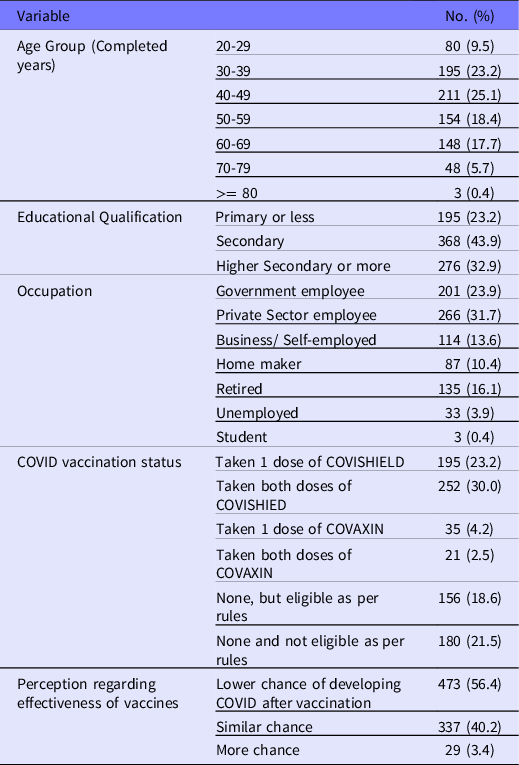
Table 1 reflects the socio-demographic background, vaccination status, and perception towards vaccine effectiveness. Of the participants, 25.1% were aged between 40 - 49 years and majority (64.2%) were males. Most were educated up to Secondary level (43.9%); 31.7% were engaged in private service. Most (72.0%) were non-health or non-frontline workers. Among the participants, 53.2% and 6.7% had received at least 1 dose of CovishieldTM and CovaxinTM vaccine respectively; 78.4% had at least 1 elderly family member. Majority (56.4%) perceived that the available vaccines reduce the risk of contracting COVID-19.
Sociodemographic characteristics, vaccination status and perception towards vaccine effectiveness among the study participants (n = 839)

Perception about current pandemic situation
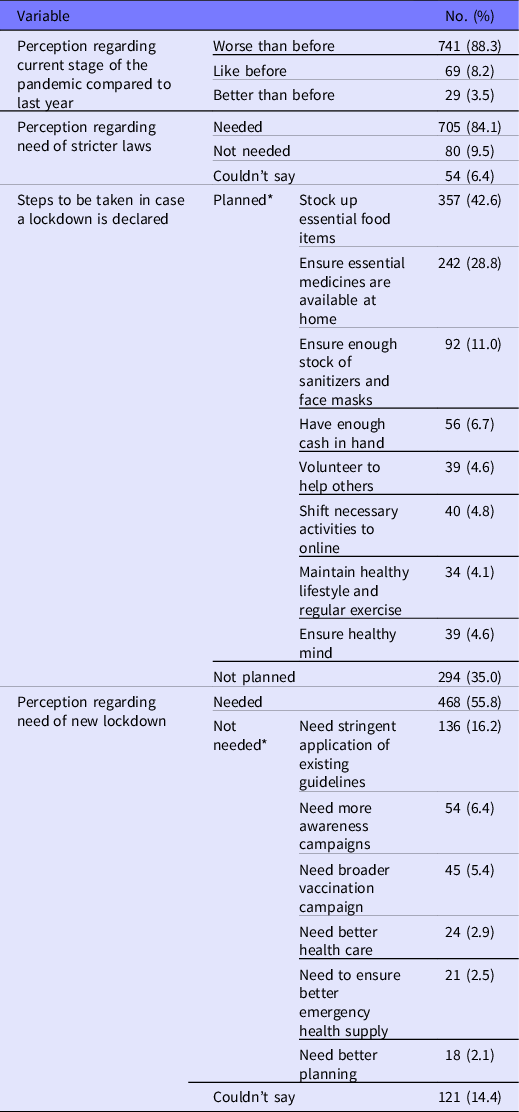
Of the participants, 88.3% perceived the current stage to be worse than last year and 88.4% favoured stricter laws to tackle the current pandemic. Majority perceived regular hand washing (89.5%), wearing face masks while stepping out (91.4%), and maintaining social distancing (90.3%), to be vital in bringing down the surge in the number of cases. Most (53.5%) viewed the government’s response as adequate (Table 2).
Lockdown preparedness among respondents (n = 839)

* Multiple Response.
Attitude towards a new impending lockdown
Majority (55.8%) favoured a new lockdown in WB, gauging the present situation; 29.8% were against it, while the rest (14.4%) didn’t opine. Of those against a new lockdown, 54.4% wanted more stringent application of existing guidelines to control the case-surge, 21.6% suggested more intensive awareness-campaigns, and 18.0% favoured gearing up the vaccination services. (Table 2)
Preparedness towards a new lockdown
Most (69.1%) had faced hurdles during the last lockdown. Among them, feeling mentally down (54.3%) and financial crises (40.5%) were the commonest issues, followed by hitches in getting medical attention (31.8%). Struggle in reaching workplace and home were reported by 22.8% and 22.4% respectively. Some complained about food crisis (12.6%). In case of a new lockdown, 42.6% said they would stock up necessary food and 28.8% wanted to ensure that medicines lasted them during restrictions; 4.6% would pursue hobbies for mental fitness, and 4.1% would try maintaining a healthy lifestyle. Some (35.0%) remained undecided (Table 2).
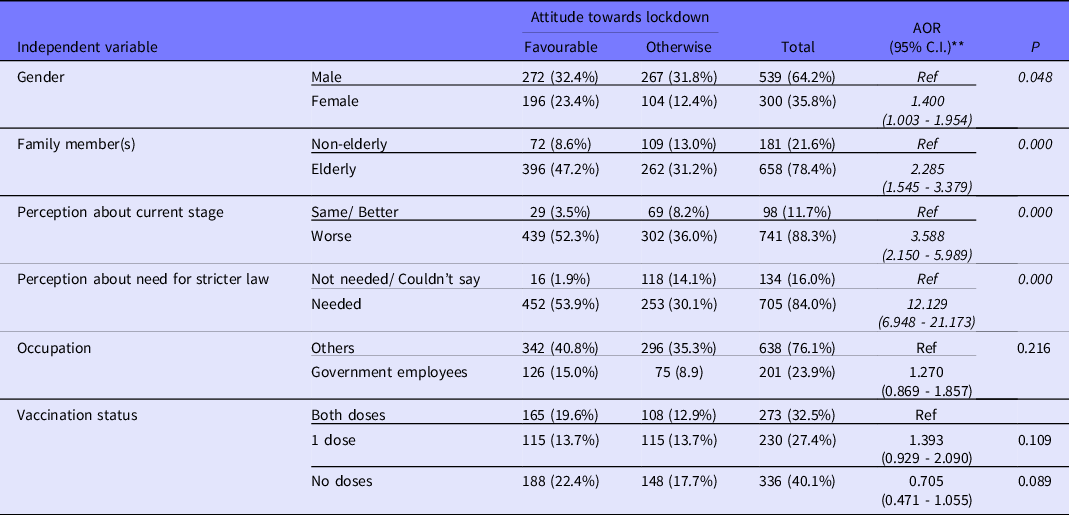
Table 3 summarizes the results of logistic regression analysis. The dependent variable was attitude (favourable or non-favourable) towards a new lockdown. Participant’s gender, type of occupation, vaccine doses taken, age of other family members, perception of current situation, and opinion about strict pandemic-related laws significantly predicted a favourable attitude towards a new lockdown individually by logistic regression. On applying multi-variable regression analysis on these selected variables, participants who were females, having elderly family members, perceiving the current situation to be worse, and in favour of stricter pandemic-related laws were observed to have a favourable attitude towards probable lockdown. Nagelkerke’s R2 and Cox & Snell’s R2 for the model was found to be 0.275 and 0.205 respectively. The Omnibus test of model coefficient was significant (P = 0.000) and the Hosmer–Lemeshow test result was non-significant (0.053). Correct prediction was made in 68.9% of cases.
Variables predicting favourable attitude towards probable lockdown in future (n = 839)

** Adjusted Odds Ratio with 95% Confidence Interval.
Discussion
India has already declared the pandemic as a ‘National disaster.’ The country and its states, including WB, have constituted multi-disciplinary task-forces to tackle the situation. 3 Epidemic and Disaster related acts have been invoked. Entry and exits have been restricted including intra-country travel limitations. 3 Educational institutions and work places were shut down. Religious and social aggregations were restricted. The Central and the State Governments including WB, have taken emergency financial steps to deal with the circumstances. 3 Preventive and treatment guidelines were released along with necessary Standard Operating-Procedures. Laboratory services were scaled up and made competent to detect COVID-19 cases. 3 Community surveillance was started along with awareness campaigns. Supply of protective equipment and medical devices was revamped using local resources. 3
However, India is 1 of the worst affected due to the second wave with daily death-tally crossing 2000: indicative of the case-surge overwhelming the health system. 1 Questions on the Indian healthcare sector’s capacity in handling large number of COVID-patients have often been raised. Augmenting bed strength and allocating beds dedicated to COVID care has also been a steep challenge due to India’s unprepared healthcare resources and other vulnerabilities, including limited employment security and health protection, inadequate health awareness, and care access. 3,Reference Christopher, Isaac and Thangakunam5,Reference Chetterje6 Increasing expenditure to strengthen the health system and creating a public health cadre have been recommended, along with steps to overcome stigmatization. Reference Chetterje6
Lockdowns significantly reduce case growth and increase case-doubling time. Reference Lau, Khosrawipour and Kocbach7 At the time of writing, several Indian states are under lockdown, but not WB. About 55% of our participants favoured lockdowns to tackle the pandemic. This was because majority perceived the current situation to be worse than the previous year and favoured stricter rules. Many felt that persisting with safe and hygienic practices could safeguard against the disease at this juncture. Existing research has shown that an individual’s behaviour has significant impact on the effect brought about by lockdowns. Reference Ferchiou, Bornet, Lhermie and Raboisson8 However, such studies regarding public attitude towards lockdowns are rare in the public domain.
People fleeing hospitals or quarantine during previous lockdowns were reported. Reference Chetterje6 Mass gatherings were observed, possibly due to public inability to fathom the need for restrictions. Reference Singh and Misra9 Our study reveals that perception of the current situation being worse and preference towards the need for stricter pandemic-related laws tended to make participants favour a probable lockdown. Also, respondents with elderly family members favoured a new lockdown; women were more in favour too. Eight Organization for Economic Co-operation and Development countries showed large gender differences in COVID-19 related beliefs and behaviours: women being more likely to perceive the pandemic as a serious health problem and agree to comply with restraining measures. Reference Galasso, Pons, Profeta, Becher, Brouard and Foucault10
It is necessary to make lockdowns less destructive yet retain effectiveness. A modified monetary, fiscal, and social policy to alleviate costs of following government health advice in the short term is needed. This would also bring the country’s economy back into growth trajectory. The roadblocks in implementation of existing social-welfare schemes need reduction. Door-to-door delivery facilities of essential goods can be useful; WB is already developing such schemes. It is also imperative to overcome the social injustice that healthcare workers, COVID-patients, and their families continue to face. Therefore, raising awareness and ensuring strict punitive action against wrong doers is needed. More 24x7 helpline numbers to address public needs and queries can be created, spreading vital awareness in the process. Surveillance teams for rumour management may also be created.
A transparent and robust reporting system and case-detection protocol is important in tackling rising cases. Reference Lau, Khosrawipour and Kocbach7 Ensuring that tests for COVID-19 are carried out to the fullest capacity is vital too. Strong health surveillance efforts and stringent action as per ‘Test, Track, Treat’ strategy will have to continue. Ensuring adequacy of beds and emergency hospital supply like Medical Oxygen is also essential. Private and non-governmental players must be encouraged to work towards balancing these shortfalls. Corporations in India can be encouraged to help build a robust health infrastructure as a part of their Corporate Social Responsibility.
Conclusion
While a new lockdown might be highly probable and even a necessity to tackle the huge upsurge in COVID-cases, it does have limitations. Lots of people will invariably plunge into poverty due to stoppage of regular income, and many will find it difficult to gather necessities because of restrictions. Strong political goodwill and adequate policies with their implementation is needed to alleviate undesirable outcomes. Further moves to strengthen awareness, shortening response time in dealing with emergencies, improving the common people’s sensitivity to the issue, and teaching them the importance of protecting themselves need to be ensured. Strengthening the health sector is vital along with safety of health care and frontline workers. There should be a state-backed mechanism for availability of medical insurance for everyone.
Author contributions
Shibaji Gupta: Conceptualization, Data curation, Formal Analysis, Methodology, Project administration, Investigation, Visualization, Writing – original draft; Abhishek De: Conceptualization, Methodology, Project administration, Writing – original draft; Rudradeep Banerjee: Data curation, Project administration, Investigation, Visualization, Writing – original draft; Sharmistha Sinha Gupta: Conceptualization, Supervision, Resources, Writing – review and editing; Arup Chakraborty: Methodology, Supervision, Software, Writing – review and editing.
Funding
This research received no specific grant from any funding agency in the public, commercial, or not-for-profit sectors.
Conflicts of interest
The authors have no conflicts of interest.