

Introduction
Sialoendoscopy is an efficient yet simple method of treatment for major salivary gland obstructions, strictures, sialoliths and salivary gland infections, and it can be performed under local anaesthesia in the out-patient clinic.Reference Katz and Fritsch1 The procedure is well tolerated by patients. In the immediate post-operative period, significant swelling of the affected gland is usually observed in almost all patients, as a consequence of the irrigation technique. Complications are very rare, and include temporary lingual nerve paraesthesia, post-operative infection, post-operative bleeding, development of traumatic ranula and ductal strictures.Reference Nahlieli, Nakar, Nazarian and Turner2, Reference Nahlieli and Baruchin3
We report a case of an unusual upper airway obstruction, previously unreported in the literature, caused by a massive swelling of the tongue following successful sialoendoscopy, performed for treatment of submandibular sialolithiasis under general anaesthesia.
Case report
A 22-year-old woman presented to our department for assessment of sialoadenitis of the left submandibular gland, characterised by regional pain and hyperthermia.
Magnetic resonance imaging sialography (3-mm, T2-weighted, fast spin-echo slices in the sagittal and axial planes) revealed a large salivary calculus in the main duct of the gland.
After obtaining written, informed consent from the patient, we performed sialoendoscopy of the left submandibular gland under general anaesthesia. As per standard technique, a multifunctional sialoendoscope (Marchal sialoendoscope; Karl Storz, Tuttlingen, Germany) was introduced into the gland through its natural orifice (orifice dilatation can be achieved with a lachrymal probe and dilator). The main duct was filled with isotonic saline solution in order to create an optical cavity, and the endoscope was moved forward by a gentle push of saline. A large sialolith (5 mm in diameter) was seen to completely obstruct the main duct. Extraction was performed with combined use of a holmium laser lithotripter (K Storz), wire basket and mini grasping forceps extraction. A larger amount of continuous pressure with the syringe was used to enlarge the lumen of the duct, as the sialolith was lodged in a portion of the duct due to its irregular shape.
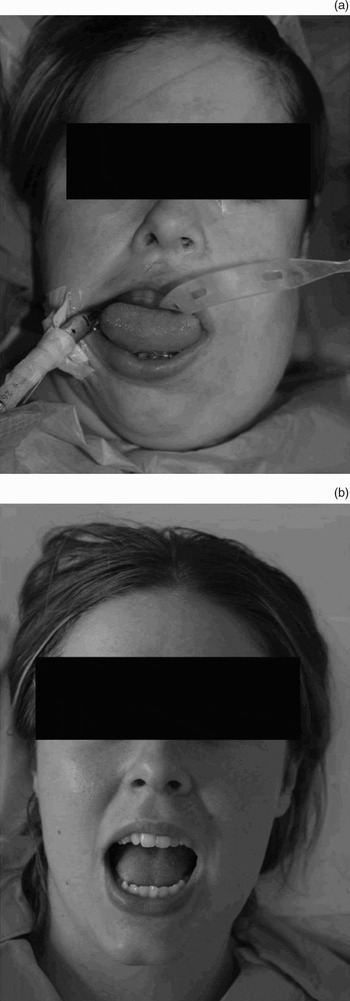
On completion of the procedure, we noted severe swelling of the patient's tongue (Figure 1a), which contraindicated immediate extubation. On discussion with the anaesthetist, it was decided to nurse the intubated patient in the intensive care unit. After six hours, the swelling had spontaneously reduced, and the patient was extubated without complication (Figure 1b).
(a) Massive oedema of the tongue at the end of the surgical procedure. (b) Tongue volume has reverted to normal, six hours after the procedure.

The patient was discharged free of swelling on the second post-operative day.
Discussion
Sialoendoscopy has gained popularity and is now an accepted method for the diagnosis and treatment of most inflammatory conditions of the major salivary glands. Such treatment has a great potential for cure, especially for submandibular gland pathology; the removal of obstructions from the submandibular ductal system is usually curative, even for long-standing calculi.Reference Katz and Fritsch1–Reference Nahlieli and Baruchin3 Sialoendoscopy can be performed as an out-patient procedure under local anaesthesia and is not usually associated with significant complications (such as damage to the facial or lingual nerves, gross haemorrhage, or major canal wall perforations). Previous authors have observed that minor canal wall perforations can lead to swelling of the floor of the mouth.Reference Marchal and Dulguerov4 However, massive, life-threatening oedema of the tongue has not previously been reported.
In our patient, irrigation with isotonic saline solution caused relatively high pressure in the main duct in the presence of a large (5 mm) stone, with consequent minor canal wall perforations and spread of saline solution into the tissues of the floor of the mouth and tongue. Therefore, we suggest that, in the presence of larger stones (>4 mm) of the submandibular gland, interventional sialoendoscopy should be performed under general anaesthesia with optimal airway control, in order to manage the major risk of perforations and ductal lesions allowing spread of saline solution into the mouth tissues, with consequent life-threatening swelling of the floor of the mouth and tongue.
• Sialoendoscopy has gained popularity and is an accepted method for diagnosis and treatment of most inflammatory conditions of the major salivary glands
• This paper describes a case of an unusual, previously unreported upper airway obstruction caused by massive swelling of the tongue following successful sialoendoscopy
• The authors suggest that, in the presence of larger stones (>4 mm) of the submandibular gland, interventional sialoendoscopy should be performed under general anaesthesia with optimal airway control
In the future, as more studies are performed, new findings and innovations will emerge and will surely add to the effectiveness and safety of sialoendoscopy.