Introduction
Among the booming intra-Asian trade study relative to works on the economic history of some particular country within East Asia, Kazuo Hori has worked on the intra-Asian trade of the Japanese empire,Footnote 2 but has not covered the economic relationships between Taiwan and Hong Kong, or between the Pacific and Atlantic oceans. Hamashita Takeshi has pointed out the financial network of Shanxi banks to Korea and Japan in the late-nineteenth century.Footnote 3 This paper observes the leading role of Taiwanese merchants during the Japanese colonial period in the triangle of remittance transactions among merchants in Hong Kong, South China and Taiwan, which was more powerful than the Shanxi bankers. Furuta Kazuo observed that overseas Chinese in Kobe helped the sale of British textiles from Shanghai to this port in the late-nineteenth century.Footnote 4 By contrast, this paper will describe the competition between the overseas Chinese, in both Hong Kong and Taiwan, the Taiwanese, and between the Japanese merchants and the British merchants for the Taiwan–Hong Kong trade. It will also reflect the rise of the Pacific powers relative to China and England in Asia in the 1900s–1940s.
Paul M. Kennedy gave 1897 as the turning point from the zenith to the fall of Pax Britannica in 1945. More and more England relied upon Japan, and then America, for naval support in the Far East. Japan gradually eclipsed the British commercial power in China.Footnote 5 Study of the economic relationship between Taiwan and Hong Kong during the period 1895–1945, reveals a lively local chapter for this shift.
Taiwan studies by John Shepherd and Emma Teng describe how Taiwan became China's periphery in the Qing period.Footnote 6 The introduction in the May 2005 issue of the Journal of Asian Studies entitled ‘Taiwan: A Periphery in Search of a Narrative’, focused on the history of Taiwan. The ‘periphery’ relates to ‘Taiwan as the periphery of China’ or ‘the east periphery of Taiwan.’ This paper, however, will describe how Taiwan was transformed from a ‘periphery of China’ into a periphery of Japan, or, from a more structural perspective, a periphery of the Asia-Pacific world in the Japanese colonial period. Taiwan's periphery role for the Asia-Pacific world in the post-1950 cold war period has been discussed by political scientists or diplomatic historians.Footnote 7 This paper explores its pre-1945 role.
Research materials for this paper have come from a number of countries, including the archives of the Japanese Foreign Ministry, reports on commerce from Japanese Consulates, China's Customs Service reports, the Commercial Gazetteer dating from the late Qing period, British consular reports, and reports of the Taiwan Government-General and the Bank of Taiwan during the Japanese colonial period. The Taiwan Daily (Taiwan nichinichi shinpō), the most widely read newspaper in Japanese colonial-era Taiwan, and various biographies compiled during this era have also been much used.Footnote 8
The first section of this paper relates to the growth of Pacific shipping lines with the decline of trade relations between Taiwan and Hong Kong in terms of its percentage in Taiwan's total external trade and in comparison with the late Qing situation. Section Two will connect the relative decline of the Taiwan-Hong Kong relation with Japanese colonial policies and other factors. Section Three describes how Taiwanese merchants, together with Japanese merchants, made inroads on the British and Chinese merchants at Hong Kong for the remaining business between Taiwan and Hong Kong, and for selling Japanese goods to South China. The paper concludes by exploring the implications of this study for the history of intra-Asian relations and the relations between Asia and the rest of the World.
From the Suez Canal to the Panama Canal
After the opening of its harbour in 1842, following the Opium War, Hong Kong developed rather gradually. In the 30–40 years following the opening of the Suez Canal in 1869, however, along with England's adoption of a free trade policy in this harbour, the pace of development increased markedly,Footnote 9 turning Hong Kong into a major centre for East Asian trade, migration and financial remittances. The single act of opening the Suez Canal decreased the distance between London and Hong Kong by 26 per cent,Footnote 10 and significantly stimulated the expansion of steamship transportation. This is also because the route through the Suez Canal required passage through the Red Sea, where winds were unfavourable for sailing vessels.Footnote 11 In 1870, most of the world's merchant ships were wooden sailing vessels. By 1914 metal-hulled steamships became dominant. Between 1890 and 1914, England possessed two-thirds of the world's steamships, and Hong Kong was England's largest steamship harbour in the Far East. The number of ships using Hong Kong's harbour equalled those using London's harbour.Footnote 12 In 1913, Hong Kong ranked highest among East Asia's main ports in value of trade, being twice as high as Shanghai, and five times that of Taiwan's ports.Footnote 13 In 1916, Hong Kong had become the world's largest port in terms of volume of tonnage imported and exported, particularly when the First World War ruined the business of many important harbours.Footnote 14
Hong Kong's trade consisted mainly of trans-shipping goods from Japan, China, Southeast Asia, India, Europe and America.Footnote 15 In the case of Japan, after the Tokugawa opened up to foreign trade, European and American shipping companies established lines linking Japan with Hong Kong. During the years 1885–1887 the port of Kobe shipped most of its goods to Hong Kong, followed by London, Shanghai, and San Francisco. In 1880, most of the foreign ships entering Kobe were British.Footnote 16 The rise of the European and American lines shipping between China, Japan, Hong Kong, Southeast Asia, and the Pacific, turned Hong Kong into the pivotal point of the network, linking Asia with the rest of the world. Many trading firms and other business organizations benefitted by the availability of shipping, and developed using Hong Kong as their headquarters. A major example was Taiwan's largest Western firm, Jardine, Matheson and Company Ltd, which established its main office in Hong Kong, and only branch offices at Tianjin, Shanghai, Hankou, Fuzhou, Xiamen, Kobe, Yokohama, Hakata, Shimonoseki, Nagasaki, Jakarta, London, and New York.Footnote 17
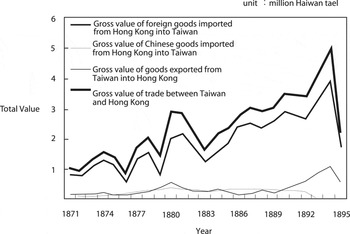
These developments helped cement Hong Kong's commercial relationship with Taiwan prior to 1895. Chart 1 shows that during the years 1871–1895, the final years of Qing rule over Taiwan, the gross value of trade between Taiwan and Hong Kong was increasing, especially in the import of Western goods via Hong Kong. The Taiwan Daily, in an 1899 issue, stated, ‘It used to be that Taiwan, Hong Kong, and Xiamen (Fujian Province) were inseparably interdependent in commercial development’.Footnote 18 During the late Qing period, between 1868 and 1895, 93 per cent of Taiwan's outbound camphor shipments were transferred through Hong Kong en route to other markets. The remaining 7 per cent went through Xiamen. Taiwan sugar sold to Europe, America and Australia was transferred through Hong Kong. Western goods imported into Taiwan were primarily transferred through Hong Kong and partly through other ports in China. Between 1884 and 1894, 78 per cent of Western goods brought into northern Taiwan came through Hong Kong; 18 per cent through other ports in Mainland China, and only 1.4 per cent were directly imported from England. Of the Western goods brought into southern Taiwan, 86 per cent came through Hong Kong, 13 per cent from other ports in China, and only 0.27 per cent and 0.12 per cent respectively were brought directly from Japan or England.Footnote 19
Gross value of trade between Taiwan and Hong Kong, 1871–1895

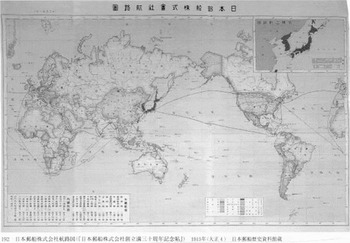
After 1905, Japan's development of shipping lines in the Pacific slowly lessened the reliance on Hong Kong by Japan and Taiwan. Japanese steamship transportation, begun in 1870, had been restricted to domestic coastal shipping routes such as those between Tokyo and Osaka. In late 1884, the Mitsui Company and the Kyōdō Shipping Company were competing to monopolize Japanese coastal shipping. In 1885, the two companies merged to form the Japan Post Shipping Company, which operated abroad to China, Korea, and part of Russia. In 1890, the Osaka Commercial Shipping Company, a domestic coastal company, expanded to include a Korean line. Many other Japanese shipping companies started up after the 1905 Russo-Japanese war. Japan extended its steamship lines across the Pacific only in 1896, much later than America (1867), China (1870s), England (late-nineteenth century), or Canada (1891).Footnote 20 Also in 1896, the Japan Post Shipping Company set up shipping lines across the Pacific,Footnote 21 (see Map 1) and by 1911, it had become one of the world's major shipping companies.Footnote 22
The Pacific shipping lines of the Japan Post Shipping Company

After the Russo-Japanese War, development of Japan's Pacific lines, and the American westward extension and expansion into the Pacific, reshaped the relationship between Asia and the rest of the world.Footnote 23 The following chronological list reveals the pace of American developments which effected the expansion of transportation across the Pacific:
• 1849: California was declared a State;
• 1854: a ‘clipper ship’ rounded the tip of South America and arrived at Hong Kong in 118 days;
• 1869: America's continental railroad was completed;
• 1898: Hawaii was annexed and the Philippines occupied;
• 1903: Panama was made independent and was brought under American control;
• 1905: planning for the Panama Canal began;
• 1914: the Panama Canal was completed.Footnote 24
The outbreak of World War I in Europe further enhanced the development of shipping across the Pacific, particularly Japanese shipping.Footnote 25 Before the war, Japan was in seventh or eighth place in the world, but by the end of the war Japan was the second or third largest nation in shipping. In shipping volume, Japan came after England and the United States of America, but in terms of actual business value it took second place.Footnote 26 In 1919 it was even observed, ‘The Pacific Ocean is the Japanese merchant fleet's sphere of influence’. Footnote 27 In 1938, over half the regular shipments between East Asia, Panama, and New York were Japanese.Footnote 28 By 1943, Japan was vying with America and England for domination of the Pacific.Footnote 29
Expansion of shipping on the Pacific reconfigured the relationships between Asia and the rest of the world. When Japan just expanded its Pacific shipping, many Japan-owned shipping lines still passed through Hong Kong on their way to San Francisco.Footnote 30 More and more, however, Kobe and Osaka were becoming top ports for shipping in the Pacific. In 1935–1936 Hong Kong was seventh among the world's top fifteen in ship tonnage; while the five top ports, in sequence, were: New York, London, Kobe, Rotterdam and Osaka.Footnote 31
Along with the growth of Japanese shipping lines in the Pacific, Taiwan's direct trade with Southeast Asia, Japan, and America grew and slowly took over part of Hong Kong's transfer trade.
Direct exports from Taiwan to Southeast Asia gradually increased after the Taiwan-Southeast Asian steamship route was opened by Japan in 1911.Footnote 32 In the early Japanese colonial period, Taiwan's baozhong tea (a kind of green tea with a flowery fragrance) was still shipped from Danshui (Tamsui) in northern Taiwan to Xiamen, and then onwards to Hong Kong, where it was trans-shipped to Java, Bankok, and other Southeast Asian cities for the overseas Chinese market. It was in 1911 that the Japanese government first subsidized the Kobe–Southeast Asia route, shipping a portion of Taiwan baozhong tea (a blend scented with flowers) to Southeast Asia via Jilong (Keelung, a port in Northern Taiwan) and Hong Kong. In 1913 the Japanese government opened direct shipping from Jilong to Java.Footnote 33
Expanded shipping strengthened the trade between Taiwan and Japan. In particular, the Osaka Commercial Shipping Company and the Japan Post Shipping Company agreed to lower prices for shipping between Japan and Taiwan and along Taiwan's coast. Most significantly, they agreed to halve the price for special products from Taiwan, such as camphor, camphor oil, sugar, seaweed, salt, and oolong tea (a blend between green and black tea).Footnote 34 The shipping-cost reduction for Taiwanese goods to Japan made this route preferable over the old route through Xiamen. The shipping cost for Taiwanese tea bound for America sent through Xiamen was 1.33 times the cost through Kobe.Footnote 35 The opening of steamship navigation between Taiwan and Japan also played a major role in the export of Japanese products to Taiwan.Footnote 36
Pacific shipping lines also strengthened trade relations between Taiwan and America, it being the largest consumer of Taiwan oolong tea and camphor, and Taiwan-imported American products such as petroleum, iron ore, rails, construction lumber, and machinery. In 1899, the volume of trade between Taiwan and America was not even one per cent of Taiwan's gross total of foreign trade (not including Taiwan's actual trade with Japan). By 1903 the percentage had risen to 10 per cent, and by 1907 it exceeded 20 per cent, accompanied by a decline in Taiwan's trade with China and Hong Kong. This proportion had been as high as 23 per cent in 1915, and as low as 9 per cent in 1919. Factors influencing trade between Taiwan and America included the construction of Taiwan's railroads and sugar-processing industries, as it needed to import most of the materials from there. Also, the increase in direct, rather than indirect, trade was a major reason for the rapid growth of trade between Taiwan and America.Footnote 37
From 1899 onward, part of Taiwan's tea originally forwarded by Hong Kong to America began to be forwarded by Japan,Footnote 38 the Japanese government encouraging Japanese shipping firms to facilitate that route change.Footnote 39 Hong Kong's Chamber of Commerce requested the British consulate in Tokyo to protest against these changes, and the text of the letter of protest was published in the Hong Kong Times. Japan, however, responded that it had not violated any treaties or agreements, and continued to implement their new shipping policies.Footnote 40
In 1901, a portion of Taiwan tea was trans-shipped in Japan, one reason being that in 1900 the Taipei-Jilong railway had expanded its business for shipping products to Japan. A second reason was that shipping through Xiamen and Hong Kong would have taken more time. A third reason was that it was more convenient to ship by the Osaka Commercial Shipping Line.Footnote 41
Before the Japanese took over Taiwan, Taiwan tea had been mostly carried for American or English merchants through Xiamen from Danshui, a situation that lasted until 1910.Footnote 42 At this time, two routes connected Xiamen and America:, an approximately 65-day trip via the Suez Canal, or a 26–27-day transit via the Pacific to Seattle or Tacoma, and then overland shipment to New York.Footnote 43 Late in the Qing era, when Xiamen was the port through which Taiwan oolong tea would travel to America, tea was being sold only to America's East Coast. In 1900, New York was still the main destination for Taiwan's oolong tea shipped via Kobe, but San Francisco had also become a destination for Taiwan tea.Footnote 44
In 1902, when the Jilong's outer harbour gained capacity to anchor large ships, American firms once based in Yokohama such as Smith Baker & Company, and Samuels Company went to Jilong and began shipping Taiwan tea from there directly to America. In 1909, long-time, Xiamen-based foreign firms, including Tait & Company, and Ellis & Company, moved most of their operations to Taiwan. Increasingly firms were shipping Taiwan tea to America through Jilong via the Pacific instead of the Xiamen–Hong Kong–Suez route. Moreover, increasingly Hong Kong and Xiamen firms were shipping via the Pacific. International ships transporting Taiwan tea via the Pacific outnumbered those shipping through the Suez.Footnote 45
Pacific shipping lines also changed the direction of Taiwan's camphor exports. Between 1899 and 1900, the amount of camphor that the Taipei-based Daidō Company shipped from Danshui to Hong Kong dropped by 25 per cent. Very quickly, firms such as the Taiwan Trading Company, the Daidō Company, and the Komatsu Camphor Company started in 1899 to ship camphor from Jilong to Kobe.Footnote 46 In 1906, the amount of Taiwan camphor exported through Danshui decreased, while the amount shipped through Jilong increased, because Jilong could ship directly to America.Footnote 47 A secret report by Mitsui Company in 1919 concluded that after Japan had taken Taiwan, the centre of the East Asian camphor market shifted from Hong Kong to Kobe.Footnote 48 In the late Qing period, Germany was Taiwan's largest market for camphor, but during the Japanese colonial period, America's was the largest.Footnote 49
With the availability of Japanese shipping, Taiwan developed more trade with Korea and Manchuria. In 1908 Tainan's coarse salt began to be sold to Korea. At first Taiwan's trade with Korea was conducted through Shimonoseki or Moji, but in June 1928 direct shipping routes between Taiwan, Korea, and Manchuria were established. The primary purpose of establishing Taiwan–Korea routes was for the sale of Taiwanese fruit, molasses, and alcohol to Korea.Footnote 50 Between 1932 and 1939, far more goods were imported into Taiwan from Manchukuo and Guandongzhou than from Hong Kong. Taiwan's exports to Hong Kong, which before 1933 still came ahead of exports to Manchukuo and Guandongzhou, afterwards fell below these.Footnote 51
The development of Taiwan's shipping also led to direct trade between Taiwan and England after 1907, with no stop in Hong Kong.Footnote 52
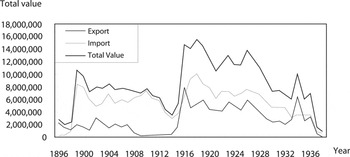
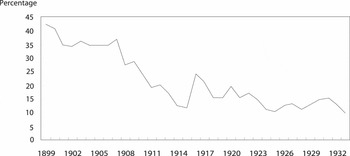
Following the expansion of Taiwan's trade not through Hong Kong, as Chart 2 shows, by contrast with the ever-increasing trend in Chart 1, there was a decreasing trend in gross trade value between Taiwan and Hong Kong from the second year after Japan began to rule Taiwan, with an exceptional spike during the years from World War I to 1927, partly caused by Japan's inflation.Footnote 53Chart 3 also shows that the proportion of Taiwan–Hong Kong trade in Taiwan's foreign trade value exhibited a long term declining trend: in 1899, during the early period of Japanese rule in Taiwan, Taiwan–Hong Kong trade constituted 42 per cent of Taiwan's foreign trade value. By 1934, this share did not even constitute 10 per cent.
Gross trade value between Taiwan and Hong Kong, 1896–1939.
Sources:
1. 1896–1921: Taiwan sōtokufu zaimukyoku, Taiwan bōeki (Taiwan's trade) (Taipei: the editor, 1935), 35, 36, 41, 42, 47, 48; Taiwan bōeki yonjūnen hyō (A table of Taiwan's trade for forty years) (1896–1935) (Sept. 1936), 9, 19.
2. 1921–1925: Taiwan tai Shina Honkon oyobi Nan'yō hōmen bōeki ichiran (A glance over Taiwan's trade with China, Hong Kong, and Southeast Asia), comparing 1921 and 1920; Taiwan sōtokufu zaimukyoku. Taiwan bōeki (Taipei: the editor, 1935), 35, 36, 41, 42, 47, 48; Taiwan bōeki yonjūnen hyō, 9, 19.
3. Taiwan tai Shina Honkon oyobi Nan'yō hōmen bōeki ichiran, comparing 1936 with 1935. Taiwan sōtokufu zaimukyoku, Taiwan bōeki (Taipei: the editor, 1935), 35, 36, 41, 42, 47, 48. Taiwan bōeki yonjūnen hyō, 9, 19.
4. 1927–1930: Shōwa ninen Taiwan bōeki gairan (A glance over Taiwan's trade, 1927), 31, 38, 52, 56. Shōwa sannen Taiwan bōeki gairan (A glance over Taiwan's trade, 1928), 38, 45, 29, 63. Shōwa gonen Taiwan bōeki gairan (A glance over Taiwan's trade, 1930), 36, 45, 58, 62. Taiwan sōtokufu zaimukyoku. Taiwan bōeki (Taipei: the editor, 1935), 35, 36, 41, 42, 47, 48. Taiwan bōeki yonjūnen hyō, 9, 19.
5. 1931–1939: Taiwan sōtokufu zaimukyoku, Taiwan tai Nanshi nan'yō bōeki hyō. Appendix of middle China, north China, Manchukuo, Guandongzhou (Taipei: the editor, 1935), 2, 6. Taiwan sōtokufu zaimukyoku, Taiwan no bōeki (Taipei: the editor, 1935), 35, 36, 41, 42, 47, 48. Taiwan bōeki yonjūnen hyō, 9, 19.

Proportion of trade with Hong Kong in Taiwan's overall foreign trade

Japanese Colonial Policies
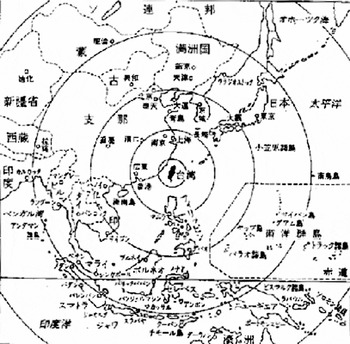
Two main policies of the Japanese colonial empire led to cooler relations between Hong Kong and Taiwan. The first of these was the use of Taiwan as a base to expand Japanese economic influence in East Asia and Southeast Asia. The second was still to make use of Hong Kong as a transit shipping port. Map 2 puts Taiwan at the centre of Japan's Greater East Asian Co-Prosperity Sphere. Although this map was published in 1944 by the Asahi Shimbun, Japan had put forward this concept as early as 1910.
Taiwan at the centre of the Greater East Asian Co-Prosperity Sphere

In 1919, the Taiwan Government-General looked forward to Taiwan becoming a transit point for Japan, from which Taiwan's coal could be exported to Southeast Asia.Footnote 54 In 1922, at the Conference of Japanese Consuls, the Bangkok Consul Matsumiya said, ‘It is necessary to use Taiwan as a transit point’. Singapore Consul Fuda also suggested that ‘The Taiwan Government-General should shift the centre of its shipping routes from Hong Kong to Jilong’.Footnote 55 The overseas travel investigation report in 1922 by members of Kobe's Senior High Commercial School recommended using Jilong to replace both Hong Kong and Shanghai as transit points for Japanese goods being sold to South China, and that Kobe should replace Hong Kong.Footnote 56 In 1926, the Taiwan Governor-General pointed out:
The Taiwan Governor-General supports the reconstruction of the Sun Moon Lake power plant and lowered the costs of rail transport and other production costs, so as to expand foreign trade. On this foundation, we will strive to develop Taiwan's transit trade so that Taiwan can gradually replace Hong Kong. This is one of Taiwan's missions, and it is a long term plan for the nation in the next hundred years.Footnote 57
In 1930 an additional piece of writing advocated to use Taiwan as a transit point in Japan's expansion into Southeast Asia. It considered not only Taiwan's geographical position, but also ethnic factors:
The backbone of the Southeast Asian economy is the overseas Chinese; most of them come from Guangdong or Fujian. These peoples share the same language and customs as the Taiwanese, and the overseas Chinese registered as Japanese at Taiwan have already been successful in the Southeast Asia.Footnote 58
On 11 June, 1934, Amoy Consul Tsukamoto Hatatsu sent a letter to the Taiwan Governor-General's chief of general affairs, Hiratsuka Hiroyoshi, suggesting a simplification of custom procedures to facilitate foreigners and Chinese to enter Taiwan and to lead to Taiwan's prosperity and help it to take Hong Kong's place as a trans-shipping point.Footnote 59
In 1938, both the number of ships and total tonnage carried to Taiwan was the greatest of all Japan's coastal shipping, not including shipping within Japan itself.Footnote 60 In other words, not even Korea or Manchuria shared the same flourishing shipping relationship with Japan as did Taiwan.
The Japanese concept of using Taiwan to compete with Hong Kong subtly contained a plan to compete as an empire with the British Empire. The Tainan Daily (Tainan shinpō) reporter, Kawakami Sōson, wrote in his travel account,
England obtained Hong Kong to use it as a base of operations to command China. In the annual reports of China's trade, England's products always rank first. Japan, too, is using Jilong as a transit point through which to sell Japanese goods to China. Jilong is the port for delivering Japanese goods to Xiamen and Shantou’.Footnote 61
After establishing rule over Taiwan, Japan used several systems to influence trade between Taiwan and Hong Kong, not only by subsidies for Japanese merchants, but also through customs duties, monopolies, banks, currency, and shipping. Like China, prior to 1895 Japan had been tied by Western Powers to a five per cent ad valorem customs duty. With prestige gained by victory over China in 1895, in 1899 Japan succeeded, through negotiations, to triple its import duty rate. In 1911, Japan completely abrogated the ‘unequal treaties’ that had governed Japan's customs duties, and raised duties even higher. By this means, when foreign products were imported into Taiwan, the duties were higher than those levied on Japanese products. Thus Taiwan's rice, sugar, or tea exported outside of Japan carried export duties which were not charged for those exported to Japan.Footnote 62 Even though Hong Kong was a free port, goods leaving Taiwan to Hong Kong, or goods from Hong Kong to enter Taiwan, had to face a higher tariff than in the late Qing period or those between Japan itself and Taiwan.
Japanese colonial government's monopolies of opium and camphor also had a great influence on Hong Kong, which previously imported great amounts of opium to Taiwan and was the crucial transit point for Taiwan's camphor sent to Europe and America. Establishment of the Bank of Taiwan also replaced much of the loan and remittance business in Taiwan previously performed by foreign firms based in Hong Kong. The Japanese colonial empire adopted the gold standard, which made it difficult for Taiwan in its dealings with silver-based China and Hong Kong, and further reinforced Taiwan's trade with Japan.Footnote 63
A result of these machinations by Japan was that the foreign firms in southern Taiwan closed, one by one. By 1902, only a handful of firms remained. Some foreign merchant houses closed and some reorganized.Footnote 64 Similarly, as duties increased, the number of foreign firms in northern Taiwan that had been engaged in the Hong Kong transit trade dwindled. For example, until Japanese rule in Taiwan, Jardine, Matheson and Company Ltd had imported refined sugar to Taiwan from Hong Kong. By 1905, however, ‘Because of the customs duties,’ reported the Taiwan Daily that year, ‘there is no longer a trace of Hong Kong refined sugar on the island’.Footnote 65 The newly-imposed Japanese customs duty policy left one of Jardine, Matheson and Company Ltd's capable managers at his wits end as his business in sugar, cement, petroleum, coal, and cotton withered, leaving only his business in the tea trade. For this he took the blame and resigned. The next manager had no choice but to cooperate with the Japanese firms, Mitsui, Takada, and Ōkura.Footnote 66
The direct export of Taiwanese tea to America, bypassing Hong Kong, was related also to the Japanese government's customs policy. From 1899 onwards, the Taiwan Governor-General levied a tax of 1.6 yen per picul of processed Taiwan tea shipped through Hong Kong to America or Europe, while no tax was levied on trade between Taiwan and Japan, because the two territories were regarded as parts of the same country.Footnote 67
In terms of shipping, the process of displacing Hong Kong in favour of Taiwan was clearest in the moves to drive out of Taiwan the Hong Kong-based British firm, Douglass Company. Starting in 1871, for 30 years Douglass Company monopolized steamship shipping between Hong Kong and Taiwan. However, because the Taiwan Governor-General subsidized the Osaka Commercial Shipping Company so that it could compete by offering lower freight rates than Douglass Company, and due to maligning by local newspapers,Footnote 68 the Douglass Company backed out of the Hong Kong–Taiwan shipping business in 1905.Footnote 69
On the other hand, the Japanese government still used Hong Kong as a transit point. In 1935 at the Conference of Consuls in Taiwan, it was discussed whether to use Hong Kong as a transit point or to turn Gaoxiong (Kaohsiung, i.e. ‘Takao’ in southern Taiwan) into a free port.Footnote 70
In 1899, 1900, and 1911, in terms of the tonnage of ships entering and exiting Hong Kong, British ships ranked first; second was Germany, followed by Japanese ships. In the years 1919–1925, Japan even outranked Britain.Footnote 71 Of all the types of Japanese companies in Hong Kong, shipping companies had the most capital.Footnote 72
About 90 per cent of the value of Japanese goods imported and exported through Hong Kong was coal, which was also the most important product that Taiwan exported to Hong Kong. And, Hong Kong was the largest market for Taiwan's exported coal.Footnote 73 The remaining Taiwan–Hong Kong relations or Japan–Hong Kong relations still developed around Hong Kong's fundamentally unique role as a shipping centre.
Other than the rise of the Pacific shipping lines and the effects of Japanese colonial policies, boycotts of Japanese goods in Hong Kong and in the South China hinterland, and shortages of capital due to civil wars and increased taxes on trade in China, also lessened Taiwan–Hong Kong ties.Footnote 74 The British government's shift from appeasement to confrontation towards Japan in 1940 worsened the relationships between Taiwan and Hong Kong. Footnote 75
Shifts in the Power of Merchants
The rise of Pacific shipping, Japanese policies, and the anti-Japanese policies from China and England also affected the shift of power of merchants from Japan and Taiwan versus merchants from England and China for the remaining Taiwan–Hong Kong trade.
During the latter part of the Qing period major imports and exports between Taiwan and Hong Kong were managed by Western firms. For example, the main office of Jardine, Matheson and Company Ltd, was located in Hong Kong, and its branches in Xiamen and Taipei managed trade in tea, sugar, and petroleum.Footnote 76 After Japan colonized Taiwan, Taiwan's Japanese refined sugar companies competed with Hong Kong's refined sugar companies run by the British company, Butterfield & Swire Company, for the China market.Footnote 77 The Taiwan–Hong Kong trade, even though its importance declined, still comprised an average 22 per cent of Taiwan's foreign trade between 1899 and 1933 (calculated from statistics in Chart 3). After Japanese rule on Taiwan began, the Taiwan–Hong Kong trade network underwent a clear shift, from being led by Chinese and British merchants to being led by Japanese and Taiwanese merchants.
The most successful Japanese firm involved in the Hong Kong–Taiwan trade was Mitsui Company. Mitsui was one of the seven exporters of Taiwan's coal to Hong Kong—the top export item to Hong Kong from Taiwan during the period of Japanese rule.Footnote 78 After World War I, Mitsui handled 40 per cent of the Taiwan cane sugar sold in Hong Kong.Footnote 79 From 1911 onwards, Taiwan's salt was sold to Hong Kong, and Mitsui engaged in the trade from 1917. After 1925, Mitsui managed all of Taiwan's salt exports to Hong Kong.Footnote 80 Mitsui's sundries division branch in Hong Kong was the only Japanese firm that marketed Taiwan's citrus fruits to Hong Kong.Footnote 81 In 1929, Mitsui signed a contract with a British pure sugarcane and molasses company, with its main office in England and branches in Hong Kong, to sell Taiwan's excess molasses at this port.Footnote 82
Before the Japanese government monopolized Taiwan's camphor, primarily German and Indian merchants, and some Chinese merchants, imported several thousand piculs of camphor yearly from Taiwan to Hong Kong.Footnote 83 Between 1899 and 1908, the Taiwan Government-General's Monopoly Bureau sold Taiwan's camphor entirely to a British merchant. Following this, the Taiwan Government-General gave the export monopoly to Mitsui, and the government also sent officials to London and New York to supervise this business.Footnote 84
After invading Hong Kong on 25 December, 1941, Japan instituted control over the volume and prices of Hong Kong's trade. On 8 October, 1942, the Hong Kong Trade Union was set up primarily to oversee the importing of food and daily essentials. Through December 1943, Mitsui's branch manager in Hong Kong was the Chairman of the Board of the 95-member Union.Footnote 85
In addition to Japanese merchants and the Japanese government, Taiwanese merchants also entered Taiwan–Hong Kong trade during the Japanese colonial period.
Some Taiwanese merchants worked for the Japanese merchants for such trade. For example, Osaka Commercial Shipping opened a shipping line between Hong Kong and Taiwan and signed a comprador contract with Taiwanese merchant Lin Guanying in Taipei for cooperation.Footnote 86
Some Taiwanese merchants based their business in Hong Kong because of its importance to Taiwan's camphor export trade during the late Qing period.Footnote 87 After the Japanese government implemented the camphor monopoly in Taiwan, Zhang Shunzheng went to Hong Kong and became one of the leading Taiwanese or Fujianese merchants in Hong Kong. Zhang previously had been Lin Chaodong's subordinate involved at the Hong Kong end of the camphor trade. Lin Chaodong of the Lins of Wufeng at central Taiwan assumed a monopoly on the camphor trade during the late Qing period, while Lin cooperated with Taiwan Governor, Liu Minchuan.Footnote 88 During 1911–1924, Zhang Shunzheng was chosen by Taiwan magnates Lin Xiongzheng (of the Lins of Banqiao) and Gu Xianrong (who had greeted the Japanese Army's entry into Taipei) to be the Hong Kong branch manager of their Zhennan [literally, ‘promoting the south’] Company.Footnote 89 In 1920, Zhang entertained visiting Tainan Daily reporter, Kawakami Sōmura, at an evening party at the Orchid Club for prestigious Hong Kong people. Chen Wangzeng (who held an Imperial Degree in Qing-era Taiwan) also hosted Kawakami Sōmura. Lin Lietang of the Lins of Wufeng, his son, and others also received Kawakami in Hong Kong.Footnote 90
In 1940, several powerful Hong Kong Chinese merchants held Japanese nationality, including, Zhang Shunzheng, Wang Tian, and also Tongfu Hao (an import-export firm), Hengfengtai (a medicine firm), Jinchang (a sugar firm), Siyi (a mining firm), and Fuhexing (a grain and sugar firm).Footnote 91 The Jinchang firm was established in Hong Kong by Guo Chunyang, a Chinese merchant from Indonesia with Japanese nationality obtained in Taiwan.Footnote 92 In 1941, several more Taiwanese merchants with Japanese nationality did business in Hong Kong, including the Lin family of Wufeng—often described as an ‘anti-Japanese family’ in post-war Taiwan's historiography.Footnote 93 Aside from doing business in Hong Kong, Taiwanese merchants also carried on trade with Hong Kong from Taiwan and Japan.Footnote 94
However, the areas in which Taiwanese merchants particularly succeeded in replacing Chinese merchants in Hong Kong were the forwarding of Japanese goods onto South China and the financial remittances business among Taiwan, South China and Hong Kong.
The real power within Hong Kong's large import-export trade was held by Chinese wholesale merchants. These merchants managed commission–based on the rice, sugar, and seafood markets—and they organized into two associations: one for selling goods from coastal areas of northern China and South China, the other for the two per cent commission charge for intermediating between the exchanges.Footnote 95
Before Japan ruled Taiwan, Chinese merchants of Kobe sold Japanese matches to Hong Kong and Chinese merchants in Hong Kong, who, in turn, sold them on to South China, Taiwan, and Southeast Asia. These Chinese merchants also dominated sugar imports from Taiwan for Japan. By the late Qing period, the hold of Chinese merchants was gradually eroded by Western firms. For example, Butterfield & Swire Company set up a sugar-processing factory in Hong Kong, using unrefined sugar from Taiwan, with the refined product then being exported to Japan.Footnote 96
Prior to 1895, Japanese merchants had to go through Chinese merchants in order to purchase or sell goods in Hong Kong or throughout East Asia. After the Sino-Japanese War of 1894–1895, and especially after the Russo-Japanese war of 1904–1905, Japanese merchants increased direct sales as they developed their own shipping lines. Their need to ship through Hong Kong therefore decreased, and the ‘middleman’ Chinese merchants lost out.Footnote 97
Before Japan took over Taiwan, South China's large demand for Japanese goods was met by Chinese merchants in Kobe and Yokohama, who were shipping through Hong Kong for distribution all over China.Footnote 98 After Japan took over Taiwan, the largest volume of Japanese goods shipped through Taiwan was sent to South China.Footnote 99 Destinations for the Japanese goods shipped through Taiwan included, in order of volume, Xiamen, Fuzhou, Shantou, Hong Kong and Canton. The largest transit port in Taiwan for Japanese goods to South China was Jilong, followed by Danshui and then Gaoxiong.Footnote 100
The proportion of transit trade in Japanese goods shipped through Taiwan to South China in Taiwan's total imports and exports decreased in some years after the end of World War I. It increased from 1924 to 1929 and, despite declines during the depression from 1929–1934, there was another increase in 1934, the average increase for the whole period from 1912 to 1934 being 20 per cent.Footnote 101
In terms of remittances business among Taiwan, Hong Kong, and South China, Taiwan held the lead. The most important Xiamen native bank (qianzhuang) that performed remittances with Shanghai, Hong Kong, Taipei, and Fuzhou in 1906 was that of the leading Taiwan family, the Lins of Banqiao—who ‘possessed’ Chinese, Japanese, British, and French nationalities.Footnote 102 In 1930 alone, the Lin family deposited a sum of over 3 million yen into the Hong Kong and Shanghai Banking Corporation.Footnote 103 Lin Jishang, a Sun Yat-sen follower, historically described as an ‘anti-Japanese person’ of the Lins of Wufeng, was the manager of the Trust Bank for this remittance business, for which Lin Erjia, the head of the Lins of Banqiao had supplied capital.Footnote 104 Some Taiwanese with Japanese nationality were involved with other native banks and remittance shops (piaohao), including Zhou Ziwen and Cai Huinan, but most of the original Shanxi banks were too insignificant for this business.Footnote 105 Lin Jingren (of the Lin family of Banqiao) was among the Taiwanese who set up remittance shops on the Taiwan side,Footnote 106 and some Hong Kong merchants set up remittance shops in Taiwan.Footnote 107 Taiwanese merchants also cooperated with Chinese merchants in Hong Kong to develop trade between Taiwan and Hong Kong.Footnote 108
Taiwan or Taiwanese merchants played the intermediary role between the Japanese empire and the Chinese commercial world.
Conclusions
The ever-increasing trade between Taiwan and Hong Kong since the 1870s to 1895 was made possible by the opening for Western trade of Taiwan due to the regulations of the Tianjin Treaty—signed mainly to solve the military conflicts between Qing China and England, and with France. However, it was the United States of America which asked for the opening of Taiwan's ports for Western trade—the most-favoured clause. American proposals to purchase Taiwan, made before the outbreak of its Civil War, showed the increasing interest of America in Taiwan after it became a Pacific country in the mid-nineteenth century.Footnote 109 The mid-nineteenth-century opening for Taiwan's Western trade did not minimize Taiwan's peripheral position to China, as Taiwan's increasing Western trade was channelled through Hong Kong and China's other coastal ports, so the trade between Taiwan and Chinese mainland also increased.Footnote 110 Before Taiwan's colonization by Japan, over 50 per cent of Tainan's (southern Taiwan) external trade had been conducted with Chinese mainland, followed by Hong Kong, England, and British India. Tainan's exports were sent only to Chinese mainland and Hong Kong.Footnote 111 Much of Taiwan's Western trade went through the Hong Kong–Atlantic Ocean route, particularly through British merchants. Japan's Western trade also relied heavily on Hong Kong and on British merchants.
During the Japanese colonial period, the percentage of Taiwan's trade with Hong Kong in Taiwan's total foreign trade decreased, as did the trade between Japan and Hong Kong in Japan's total foreign trade. Between 1900 and 1930, Japan's trade with Hong Kong comprised an average 5.45 per cent of Japan's total foreign trade value.Footnote 112
In contrast, from 1896 to 1938, the proportion of trade between Hong Kong and China in the total value of China's foreign trade dropped from 44 per cent to 14 per cent, with an average for the whole period of 26.19 per cent. The value of trade between Japan and Hong Kong for this period took many dips, while China's trade with Hong Kong was stable over the long term, except for a post-1931 dip.Footnote 113 A report by the Taiwan Government-General in 1937 pointed out that Hong Kong's economy was deeply influenced by China. Most of its daily food was provided by China, its important trades were linked to China, it was an important warehouse for goods traded between South China and the rest of the world, and 97 per cent of its population came from South China—mostly Guangdong province.Footnote 114 Clearly, in the early twenty century, Hong Kong's trade relationship with China was more important than its relationship with Japan.
After Japan began ruling Taiwan, their relations became much stronger. The levels of trade between Taiwan and China had been steady for the seven years since 1895, but after that date Japan took China's place in the relationship. From 1902 through to 1937, the trade value between Taiwan and Japan was 16 times the trade value between Taiwan and China, and four times the value between Taiwan and all other countries.
From 1937, because of the outbreak of war between China and Japan, all trade between Taiwan and China under Chiang Kai-shek's rule ceased, and trade with other countries also declined.Footnote 115 In the early-twentieth century, both Taiwan and Japan severed their previous trade ties with Hong Kong and China.
The rise of Japan's Pacific steamship lines from the end of the Russo-Japanese War, and the opening of the Panama Canal in 1914, markedly reshuffled the ranking of ports within Asia. With the development of trans-Pacific shipping, the tonnage of ships anchoring at Kobe and Osaka had by 1936 already exceeded tonnage of ships anchored at Hong Kong—which had been the top harbour of East Asia in the 1910s.Footnote 116 Pusan, the Korean port opposite Japan, grew into a major harbour in the Japanese colonial period.Footnote 117 The port of Japan-influenced Dairen also replaced the Chinese port of Yingkou in the growing trade between Taiwan and Manchukuo.Footnote 118 After Japanese ships began coming to the northern port of Jilong, the trade between Jilong and Japan essentially replaced the trade once carried on between Tainan and Hong Kong, mainly via British ships.Footnote 119 It was against this background that Taiwan turned from a periphery of China, or an Atlantic-bound place, into a periphery of Japan, or a Pacific-bound place.
Like many other borderlands around the world that Michel Baud compared,Footnote 120 Taiwan played some central roles whilst being a periphery of the Asia-Pacific world. Along with Japanese merchants, and the Japanese government which replaced the British merchants for the Taiwan–Hong Kong trade, Taiwanese merchants replaced Chinese merchants from Hong Kong as trans-shippers of Japanese goods into South China. Some Southeast Asian overseas Chinese merchants, like Guo Chunyang, acquired Japanese nationality in Taiwan and became active in Hong Kong. The baozhong tea business, which had originally been shipped by Chinese merchants through Xiamen and Hong Kong in the late Qing period, became dominated by Taiwanese merchants from Taiwan during the Japanese colonial period.Footnote 121 In the late Qing period, Taiwan relied on capital from China, including that of the Shanxi banks or British merchants in Hong Kong.Footnote 122 Although Japan colonized Taiwan, Taiwanese merchants themselves continued to play the leading role in the remittance business between Taiwan, Hong Kong, and South China.
Taiwanese merchants (including some individuals who were, as Chinese nationalist literature lauds, staunch anti-Japanese patriots) took advantage of Japan's state power in the form of Japanese steamships, its customs system, its monetary system, its monopoly system, and its policy of promoting Taiwan as a replacement for Hong Kong as a trans-shipping centre. Therefore, by straddling the rising Japanese empire, and the Chinese commercial world, the Taiwanese merchants played an important intermediary role.
The outbreak of the Korean War of 1950–1953 gave rise to the Asia-Pacific anti-Communist line. To counter this, America used Taiwan as a middle station to placate the anti-Japanese overseas Chinese in Southeast Asia and Japan. This paper has provided some historical background regarding the role of Taiwan, from its pre-war shift as a periphery of China, or an Atlantic-bound place, to a periphery of the Asia-Pacific world, or a Pacific-bound place.Footnote 123