INTRODUCTION
The primary reasons for group formation in mammals are suggested to be environmental variables such as protection and prey resources (Alexander, Reference Alexander1974). Female grouping patterns tend to be more directly related to these parameters, while male social strategies are more related to mate access (Trivers, Reference Trivers and Campbell1972; Connor et al., Reference Connor, Wells, Mann, Read, Mann, Connor, Tyack and Whitehead2000).
Infanticide by males, or the killing of dependent offspring by males, is considered one of the most conspicuous expressions of sexual conflict between males and females in mammalian societies (Hrdy, Reference Hrdy1979; Palombit, Reference Palombit2015). It is regularly observed in primates, equids, rodents, carnivores and cetaceans (van Schaik, Reference van Schaik, van Schaik and Janson2000). These are species in which lactation is longer than gestation and females experience lactational amenorrhea, so postpartum mating does not occur (van Schaik, Reference van Schaik, van Schaik and Janson2000). Males, therefore, benefit from killing a female's offspring if they are not the sire, if they can mate with the female when she returns to oestrous, and if they have a chance of siring her next offspring (i.e. the sexual selection hypothesis; Hrdy, Reference Hrdy1979). This would suggest, therefore, that adult males who have not invested time and energy toward rearing the offspring may carry out infanticide and gain the chance to mate with the newly receptive female whose infant has been killed.
Bottlenose dolphins have relatively long inter-birth periods during which time young are dependent on the mother (Mann & Smuts, Reference Mann and Smuts1998). If a female loses her offspring prematurely, she soon becomes sexually receptive, reducing time between births (Hrdy, Reference Hrdy1979). The first description of infanticide by common bottlenose dolphins (Tursiops truncatus, Montagu 1821), and by any cetacean species, was done by Patterson et al. (Reference Patterson, Reid, Wilson, Grellier, Ross and Thompson1998) from post-mortem examinations of stranded specimens in the Moray Firth (Scotland). Direct observations of this behaviour at sea are rare, which makes it difficult to understand the context or the cause of such infanticide. To date, only three cases of observed or suspected infanticide have been witnessed in long-term studies of common bottlenose dolphins. The most detailed and compelling description of calf-directed aggression by males in the field was recorded by Robinson (Reference Robinson2014) during a long-term study on T. truncatus at Moray Firth, in Scotland, where several adult males directed an attack towards an adult female and her male infant; after intense fighting, the infant was severely injured. Two other additional cases of suspected infanticide attacks have also been reported for T. truncatus by Kaplan et al. (Reference Kaplan, Lentell and Lange2009) off the coast of Florida and Perrtree et al. (Reference Perrtree, Sayigh, Williford, Bocconcelli, Curran and Cox2016) in Georgia (USA). All these observations were considered an attempt of infanticide based on the nature of the attacks; nonetheless the calf did not die suddenly after the attacks. In all these cases the causes of the death of the calves were not supported by post-mortem examinations because it was not possible to recover the carcasses.
Although reported previously in this species, cases of infanticide and associated epimeletic behaviour are very rare and their socio-behavioural context remains poorly understood (Reggente et al., Reference Reggente, Alves, Nicolau, Freitas, Cagnazzi, Baird and Galli2016). Epimeletic behaviour, care or attention giving, can be associated with an infanticide episode. This assistance is generally conducted by a healthy adult dolphin (presumably the mother) swimming with a dead or incapacitated calf, helping it to stay floating at the surface, or maintaining it away from an apparent source of danger (Cockcroft & Sauer, Reference Cockcroft and Sauer1990; Connor & Smolker, Reference Connor, Smolker, Leatherwood and Reeves1990; Harzen & dos Santos, Reference Harzen and Santos1992; Fertl & Schiro, Reference Fertl and Schiro1994; Félix, Reference Félix1994; Ritter, Reference Ritter2007; Moura et al., Reference Moura, Rodrigues and Siciliano2009).This type of behaviour may be considered generally adaptive for the survival of possibly genetically related individuals within specific groups (Cockcroft & Sauer, Reference Cockcroft and Sauer1990), particularly for dolphins that appear to be dependent on group structure for survival (Norris & Dhol, Reference Norris, Dhol and Herman1980).
Here, we provide evidence of infanticide and associated epimeletic behaviours in free-ranging bottlenose dolphins along the NW coast of Spain. After describing the observed events, we include a complete description of the post-mortem examinations (where the carcasses were recovered) in order to confirm the cause of the death. Furthermore, we discuss the potential factors that may help explain the observed behaviours and the implications for understanding dolphin socioecology.
MATERIALS AND METHODS
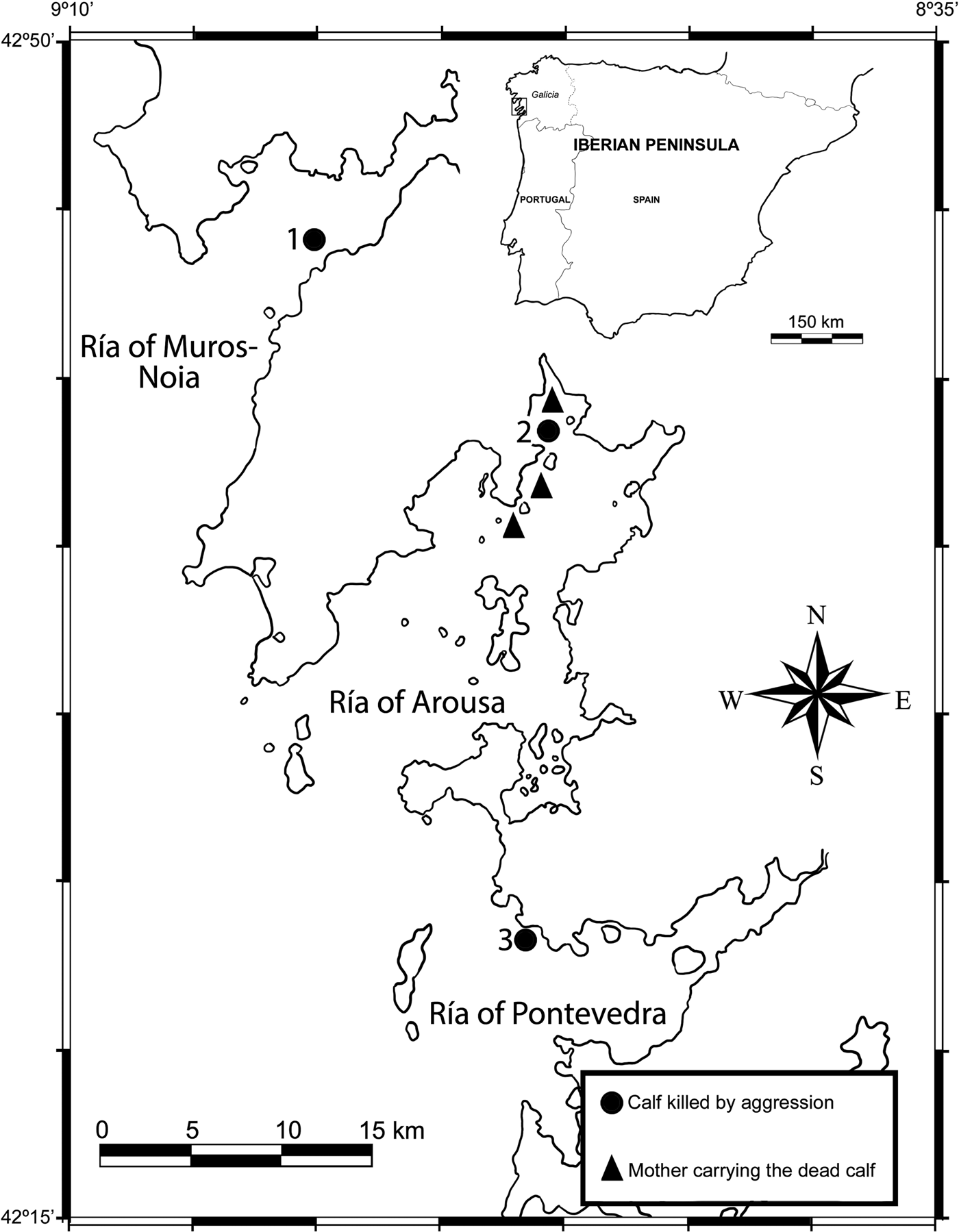
Data for this study were collected as part of a longitudinal study of common bottlenose dolphins inhabiting the Galician coast, Spain (Figure 1). Galicia is a region situated in the north-west of the Iberian Peninsula with 1195 km of coastline, where there are a series of ancient drowned tectonic valleys that were taken over by the sea (also referred to as ‘rías’) (Evans & Prego, Reference Evans and Prego2003).
Geographic locations of the three reported cases of calf-directed aggression carried out by adult common bottlenose dolphins (represented by circles) and cases of observed epimeletic behaviour (one reported and two anecdotal cases represented by triangles), in Galicia (NW Spain).

Systematic recording of stranded cetaceans along the Galician shoreline commenced in 1990 with the establishment of the NGO Coordinadora para o Estudio dos Mamiferos Mariños (CEMMA), a group which records strandings, conducts boat and land-based surveys, carries out necropsies and provides samples for biological studies (López, Reference López2003; Santos et al., Reference Santos, Fernández, López, Martínez and Pierce2007; Pierce et al., Reference Pierce, Caldas, Cedeira, Santos, Llavona, Covelo, Martinez, Torres, Sacau and López2010; Fernández et al., Reference Fernández, Santos, Pierce, Llavona, López, Silva, Ferreira, Carrillo, Cermeño, Lens and Piertney2011; Louis et al., Reference Louis, Viricel, Lucas, Peltier, Alfonsi, Berrow, Brownlow, Covelo, Dabin, Deaville, de Stephanis, Gally, Gauffier, Penrose, Silva, Guinet and Simon-Bohuet2014). Since 2014, as a result of the cooperation between the CEMMA and the Bottlenose Dolphin Research Institute (BDRI), regular year-round boat surveys were conducted as part of a multi-year mark–recapture study along Galician waters, improving the photo-identification work carried out by the CEMMA (Fernández et al., Reference Fernández, Torrado, Pérez, Garci, Rodríguez, Evans, Vella and Stockin1996; Vázquez et al., Reference Vázquez, Caldas, Guzmán, López, Olondo, Lago, Covelo and Kuklik2006; López et al., Reference López, Covelo, Vázquez, Martínez, Caldas, Lago, Llavona and Alonso2011). Individuals were identified by photo-identification based on the distinctive characteristics of their dorsal fins and surrounding area as unique natural markers (Würsig & Jefferson, Reference Würsig and Jefferson1990). Sex was determined primarily by observations and photographs of the genital region. Digital photographs and videos were taken using DSLR cameras equipped with telephoto zoom lenses.
This study reports three cases, provided by the Galician Marine Mammal Stranding Network (coordinated by the CEMMA), of free-ranging bottlenose dolphin reactions to dead calves and the results of the necropsy examinations. The described field observations are presented chronologically, as observed, filmed and photographed from two motor vessels (cases 1 and 3) and the BDRI research vessel (case 2). Onboard the BDRI research vessel, six observers monitored the bottlenose dolphins, either with the naked eye or with binoculars, in order to collect behavioural data and to record changes in group composition. During these observations, continuous data (Altmann, Reference Altmann1974) were collected on the behaviour and occurrence of affiliative and agonistic interactions between the participants, including the identities of actors and recipients and the time of onset and termination for each bout.
In two of the three observed cases (cases 2 and 3), the carcass of the calf was recovered immediately after the field observations, and necropsied within 24 h according to a standard protocol defined by the European Cetacean Society (Kuiken, Reference Kuiken and Kuiken1996). Photographs of the necropsy were taken. Dead calves were measured, weighed, sexed and classified following Smithsonian Condition Codes (Geraci & Lounsbury, Reference Geraci and Lounsbury2005). The carcasses received a complete standard necropsy with systematic examination of all organ systems. Necropsies were attended by experienced personnel of the CEMMA.
RESULTS
– Case 1. Ría of Muros, 14 July 2014.
Field observations
Opportunistic observers in a motor boat reported to the CEMMA the observation of one group of bottlenose dolphins in the Ría of Muros (42°44.29′N 009°00.22′W; UTM 29T, x 499,700, y 4,731,740, Figure 1). The observation supported by photographs began at 17:00 h UTC and lasted around 30 min.
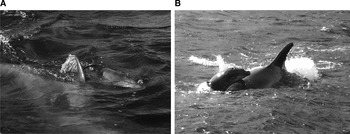
At 17:00 h a group of bottlenose dolphins were seen moving hurriedly close to the shore. An adult bottlenose dolphin accompanied by a neonate in echelon position (Figure 2A) were observed, together with at least six other bottlenose dolphin adults circling around. For the next 20 min, the adults were seen harassing the adult-neonate pair in an apparently coordinated manner, with some perpetrators sandwiching the pair while others rammed and separated the neonate from the accompanying adult (presumably the mother) and occasionally tossed the neonate out of the water (Figure 2B). Subsequently, surface activity increased with tail slaps, after which an adult resurfaced with the calf lying motionless on its head. During the next minutes it was possible to observe the accompanying adult (presumably the mother) lifting the corpse above the surface.
Photographs authenticating the attempted infanticide of the newborn bottlenose dolphin calf observed on 14 July 2014 in the Ría of Muros (NW Spain). (A) Image of an adult bottlenose dolphin accompanied by a neonate in echelon position. The foetal folds and furled dorsal fin are still evident. (B) Image of the calf being abducted by one adult that rises partially out of the water and slaps the neonate with its front upper body and rostrum. Photographs: Miguel Prado.

The adult individuals present in the observed group were not identified from previous encounters by the authors. Opportunistic observers confirmed the death of the neonate by the observation of the body floating motionless at the surface of the water. Unfortunately, it was not possible to retrieve the body of the dead calf but the cause of death was likely to be related to the aggressive interactions.
– Case 2. Ría de Arousa, 11 September 2016.
Field observations
At 11:30 UTC on 11 September 2016, the Galician stranding network was notified of a dead newborn bottlenose dolphin floating in the Bay of Rianxo at 42°36.98′N 008°49.91′W (UTM 29T, x 520,300, y 4,694,349), 9.4 m depth, and ~0.4 nautical miles from the coast (Figure 1). Upon the arrival of the BDRI's research vessel at 13:00 h, local fishermen related having observed other bottlenose dolphins swimming around the carcass. According to the local fishermen, the dolphins were continuously pushing the carcass away from their boat and towards the surface with their rostrum and other parts of their bodies.
The behavioural activities of the group of dolphins were monitored continuously from the arrival of the researchers, between 13:09 and 15:25 h (UTC). The research vessel remained in the same position (at a distance of around 100 m from the dolphins) to minimize the effect of the observers’ presence on the dolphins’ behaviour. The following events are presented chronologically, as observed, filmed and photographed from the research vessel.
13:09 UTC – A group of bottlenose dolphins was observed swimming between mussel rafts in close formation at ~400 m from the shore in the inner part of the Ría of Arousa. The presence of a dead newborn was confirmed together with two adult bottlenose dolphins swimming around the carcass. Both adults were identified by direct observation of their dorsal fins (one male known as ID#A9 and one female known as ID#C7). The female (ID#C7) was keeping the dead calf afloat, while the male (ID#A9) circled around them in an anticlockwise direction.
13:20 UTC – All at once, the two adult individuals became notably more active. Suddenly the large adult male dolphin (ID#A9) rapidly emerged pushing the body of the newborn calf underwater.
13:26 UTC – The male (ID#A9) began circling energetically with continuous tail stock dives with abrupt changes in direction. The mother then positioned herself between the calf and male (ID#A9) as he circled around them.
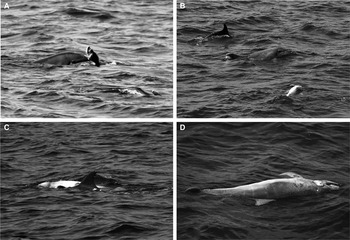
13:28 UTC – The mother held the dead calf on her rostrum while swimming (Figure 3A). A second male dolphin (ID#C9) was spotted swimming 80 m away from the other individuals.
Photographs of the epimeletic and infanticide behaviour observed in the Ría of Arousa (NW Spain) on 11 September 2016. (A) The female carried the carcass on its rostrum and repeatedly blocked the male (ID#A9) from reaching the dead neonate. (B) The mother doing sequences of regular dives followed by tail stock dives as she circled around the male (ID#A9) and the newborn. The foetal folds are still evident. (C) The mother (ID#C7) surfaced with her calf lying motionless across her back; she lifted the corpse above the surface. (D) The carcass of the calf before its recovery hours after the first sighting of the group.

13:40 UTC – The male (ID#A9) launched itself directly into the mother-calf pair, driving his body between the two animals and forcing them apart. Thereafter, the same male breached and charged towards the body of the infant, holding the calf beneath the water from above.
13:46 UTC – The male aggressor (ID#A9) rammed the calf with his peduncle with enough impact that the carcass was tossed into the air 2–3 m high and flipped on its side.
13:51 UTC – The mother was observed doing sequences of regular dives followed by tail stock dives as she circled around the male (ID#A9) and the dead newborn (Figure 3B).
14:03 UTC – Followed by the male (ID#A9), the mother (ID#C7) surfaced with her dead calf lying across her back. Afterwards, the mother (ID#C7) lifted the corpse above the surface during several seconds (Figure 3C).
14:09 UTC – The female (ID#C7) was seen repeatedly trying to come in between the body of the calf and the adult male (ID#A9).
14:19 UTC – The male (ID#A9) continued his aggressions, charging towards the calf hard from one side, and with such velocity that the newborn was launched clear out of the water.
14:21 UTC – The female carried the carcass on its rostrum and repeatedly blocked the male (ID#A9) from reaching the dead neonate.
14:28 UTC – The dead calf was pushed away from the immediate area by the male aggressor (ID#A9). Then, the mother, after a sequence of tail stock dives, got closer to the carcass and the adult (ID#A9) that was pushing it. During these social bouts, both adult dolphins exhibited rapid movements including sudden changes in direction and compact circling behaviour with repeated tail stock dives.
14:40 UTC – Over the course of several minutes the female's response, with rapid movements and tail stock dives, became gradually less vigorous. The female always remained close to the body of the calf, but was never seen in physical contact with the male aggressor (ID#A9).
14:49 UTC – After a tail stock dive and subsequent long dive period, the female – male (ID#A9) pair was observed heading south-west leaving the carcass of the newborn calf 200 m away. This pair of dolphins was swimming on a consistent course, spaced within a few body lengths of each other, and with rhythmic surfacings followed by shallow dives.
14:56 UTC – The second male dolphin appeared thereafter (known as ID#C9) and started to regroup around the female dolphin. At this point the male (ID#A9) was observed swimming on a consistent course (south) with regular dives and short ventilations.
15:02 UTC – The male (ID#A9) stayed 100 m away from the other two individuals (ID#C7 and ID#C9) swimming slowly (less than ~1 knot), with shallow dives and floating. This dolphin did not engage in any other activities during this apparently resting behaviour.
15:10 UTC – The second male (ID#C9) and the female (ID#C7) were seen exhibiting long dives and changes in direction with repeated tail stock and flukes up dives. The carcass of the calf was adrift by the swell 600 m away from the position of the adult dolphins.
15:25 UTC – All three dolphins (ID#A9, ID#C7 and ID#C9) were observed swimming on a consistent course (south), spaced within a few body lengths of each other and with synchrony ventilations followed by shallow dives. The carcass of the calf was adrift by the swell 900 m away from the position of the adult dolphins.
15:30 UTM – The research vessel moved towards the position of the dead calf to recover the carcass (Figure 3D).
All three adult individuals present during the encounter (ID#C7, ID#C9 and ID#A9) were well-known due to a long-term study of the T. truncatus population in this location by the authors, including data on the sex, reproductive history and associations of the animals reported since 2014. The known female detailed in the present report (ID#C7) was seen eight times in the area since first recorded by the authors in May 2014. Between May and September 2014 the female was observed four times in company of a 2–3-year-old calf, so we can assume that she was not a first-time mother. Mother–newborn pair was sighted for the first time during the reported encounter on 11 September 2016. The two adult males detailed in the present report (ID#A9 and ID#C9), were re-sighted 14 times and 7 times in the study area, respectively. Both the female (ID#C7) and the male (ID#C9) were seen three times together since 2014. The adult male (ID#A9) was never seen previously with the female (ID#C7).
During the period of most likely conception of the infant (between August and October 2015) a total of 58 encounters with bottlenose dolphins were done in the Ría of Arousa (N = 27 days at sea). While the female (ID#C7) was not seen during any of these encounters, both males were observed in the area during this period (ID#A9 was seen on 5 different days and ID#C9 was seen on 2 different days). Following the reported field observations on 22 September 2016 and during photo-identification surveys in the Ría of Arousa, the female (ID#C7) and the male (ID#C9)) were seen swimming in association as part of a group of bottlenose dolphins in which the male (ID#A9) was not present. This male (ID#A9) was sighted in two different groups of dolphins (23 September and 27 October) where the second male (ID#C9) and the female (ID#C7) were not present.
Summary of necropsy data
The bottlenose dolphin neonate was a male weighing 32 kg and measuring 150.5 cm from the tip of the rostrum to the tail notch. From its length, evident foetal folds, marginal papillae, rostral hairs, un-erupted teeth, and furled flukes and dorsal fin, it was estimated to be within its first days of life and therefore would still be dependent (Mead & Potter, Reference Mead, Potter, Leatherwood and Reeves1990). The animal was assessed to be in good body condition, and the preservation of the carcass was determined to be between codes 2 and 3 (Geraci & Lounsbury, Reference Geraci and Lounsbury2005).
The regularly spaced, parallel lacerations observed on the skin of this neonate were characteristic of rake marks produced when an adult bottlenose dolphin slides its teeth across a cutaneous surface. These lesions, mainly involving the epidermis, were organized in parallel groups of 2–4 regularly spaced lacerations on both sides of the thorax with inter-tooth distances between 11 and 13 mm.
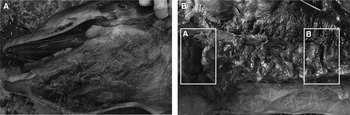
The individual exhibited multiple, internal, ante-mortem injuries including bruising around the head and thorax, rib fractures with associated haemorrhage, large bruise on its lower jaw (Figure 4A), atlanto-occipital dislocation (Figure 4B), and the thoracic vertebrae (T-6) fractured and luxated with a concomitant severed spinal cord (Figure 4B). Rib fractures occurred only on the left side of the thorax in a linear pattern involving 1st and 2nd adjacent ribs in correspondence with the position of the scapula. Other findings included occipital haematoma, abdominal haemorrhage, liver lacerations and contusions and multiple soft tissue contusions. Soft tissue contusions and bruises were bilateral, separate and discrete.
Post-mortem photographs of the wounds inflicted on the neonate male common bottlenose dolphin recovered in Ría of Arousa (NW Spain) where the cause of death was diagnosed to be blunt-force trauma. (A) Large bruise on the neonate calf's lower jaw. (B) Atlanto-occipital dislocation (box A), and the thoracic vertebrae (T-6) fractured and luxated with a concomitant severed spinal cord (box B).

Gross necropsy findings indicated severe blunt-force trauma was the cause of death which is consistent with the aggressive behaviours seen during our field observation. The pattern of bilateral, multiple fractures and discrete soft tissue injuries, suggests repeated trauma and trauma inflicted from multiple directions.
– Case 3. Ría de Pontevedra, 12 September 2016.
Field observations
On 12 September 2016, in Raxó, Poio (42°24.07′N 008°45.20′W; UTM 29T, x 520,300, y 4,694,349), local fishermen observed a dead bottlenose dolphin calf. Moments before the carcass was recovered, people related having observed other bottlenose dolphins swimming in the vicinity and around the carcass. When one of the observers was confident that the calf was dead, the body was recovered for further examination of the carcass in the laboratory. When they carried the body to the shore the other dolphins went very close to the coastline and became notably more active with continuous tail stock dives and full leaps with abrupt changes in direction. It was not possible to identify the adult individuals present during the encounter.
Summary of necropsy data
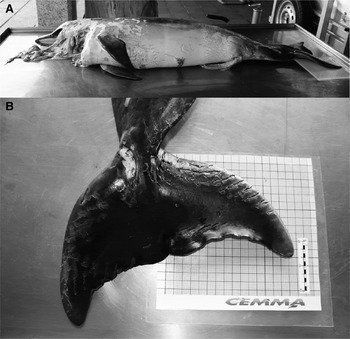
The bottlenose dolphin neonate was a female weighing 28 kg and measuring 128 cm from the tip of the rostrum to the tail notch. The animal was assessed to be in moderate decomposition, and the preservation of the carcass was determined to be code 3 (Geraci & Lounsbury, Reference Geraci and Lounsbury2005). The calf had external evidence of injury with a large wound across the lower jaw region (Figure 5A). From its length, evident foetal folds, un-erupted teeth, and furled flukes and dorsal fin, it was estimated to be within its first days of life and therefore would still be dependent (Mead & Potter, Reference Mead, Potter, Leatherwood and Reeves1990).
Post-mortem photographs of the wounds inflicted on the neonate female common bottlenose dolphin recovered in Ría of Pontevedra (NW Spain) where the cause of death was diagnosed to be blunt-force trauma. (A) Body of the calf with an external evidence of injury with a large wound across the lower jaw region. (B) Numerous rake marks are present on the fluke region (grid 1 × 1 cm).

The skull presented several fractures and the lower jaw and inner ears were absent. Multiple superficial cutaneous lacerations were present on the left flank, belly and flukes of the animal (Figure 5B). These lesions (rake marks), mainly involving the epidermis, were organized in parallel groups of 3–8 regularly spaced lacerations with inter-tooth distances between 12 and 13 mm.
The individual exhibited multiple, internal, ante-mortem injuries including bruising around the head and thorax, disarticulated ribs on both sides of the thorax in a linear pattern involving adjacent ribs, large bruise around the thoracic vertebrae (T-5) fractured and luxated. Other findings included multiple soft tissue contusions and bruises bilateral, separate and discrete. Gross necropsy findings indicated severe blunt-force trauma was the cause of death.
DISCUSSION
Because observing and interpreting social interactions among wild dolphins is difficult, it is likely that the best opportunity for recognizing epimeletic and infanticide behaviours lies in documenting field observations and, whenever is possible, the associated post-mortem findings.
Here we provide for the first time evidence for infanticide and associated epimeletic behaviour along the NW coast of Spain. Epimeletic behaviour in bottlenose dolphins has been recognized for some time (Caldwell & Caldwell, Reference Caldwell, Caldwell and Norris1966), however this type of behaviour is rarely observed in the field during sightings or strandings research (Reggente et al., Reference Reggente, Alves, Nicolau, Freitas, Cagnazzi, Baird and Galli2016). While there are previous accounts of epimeletic behaviour in bottlenose dolphins in relation to the death of a calf (e.g. Cockcroft & Sauer, Reference Cockcroft and Sauer1990; Connor & Smolker, Reference Connor, Smolker, Leatherwood and Reeves1990; Harzen & dos Santos, Reference Harzen and Santos1992; Fertl & Schiro, Reference Fertl and Schiro1994), these studies did not confirm the causes of the death of the neonate.
In two cases presented in this study (cases 2 and 3), the reports involved calves that were dead when the observations were made and in both cases the cause of the death was confirmed by further post-mortem examinations. In both cases, we conclude that purposeful violent dolphin interaction was the cause of the death of the bottlenose dolphin neonates. With evidence of blunt trauma in both of these cases, the hypothesis that emerged from field observations during the first case (that the calf was intentionally killed by adult individuals) is supported.
The aggressive interaction that we observed between adult bottlenose dolphins and the neonate during the first and second cases bears a strong resemblance to the behaviours seen in the intra- and inter-specific interactions in other parts of the world (Ross & Wilson, Reference Ross and Wilson1996; Cotter et al., Reference Cotter, Maldini and Jefferson2012; Robinson, Reference Robinson2014; Perrtree et al., Reference Perrtree, Sayigh, Williford, Bocconcelli, Curran and Cox2016). Moreover, in the last two cases, the traumatic lesions observed in addition to the rake marks on the body of the calves were consistent with lesions reported by Ross & Wilson (Reference Ross and Wilson1996), Jepson & Baker (Reference Jepson and Baker1998), Dunn et al. (Reference Dunn, Barco, Pabst and McLellan2002), Barnett et al. (Reference Barnett, Davison, Deaville, Monies, Loveridge, Tregenza and Jepson2009), Cotter et al. (Reference Cotter, Maldini and Jefferson2012) and Robinson (Reference Robinson2014), in attacked bottlenose dolphin calves and harbour porpoises (Phocoena phocoena, Linnaeus 1758).
These observations provide a new and plausible explanation for earlier reports of interspecific interactions in Galician waters, NW Spain. A comparison of the post-mortem findings in the observed cases with traumatic injuries described in one stranded harbour porpoise (López & Rodríguez, Reference López and Rodríguez1995) and one striped dolphin (Stenella coeruleoalba, Meyen 1833) (Alonso et al., Reference Alonso, López, González, Santos, Evans, Pitt-Aiken and Rogan2000) in Galicia, revealed remarkable similarities. Therefore, the cases presented here provide the evidence that attacks of adult bottlenose dolphins may also lead to the stranding and death of other small cetaceans in Galician waters (NW Spain).
The regularly spaced, parallel lacerations observed on the skin of the neonates were characteristic of rake marks produced when an adult bottlenose dolphin slides its teeth across a cutaneous surface with intertooth distances between 10.97 and 12.32 mm (Ross & Wilson, Reference Ross and Wilson1996). The presence of these marks on the body of the examined neonates can be related with purposeful violent dolphin interaction and/or the epimeletic behaviour of the mother. The presence of rake marks as a result of the epimeletic behaviour of the mother is supported by: (i) neonate carcasses had tooth marks on the thorax and (ii) during field observations the mother had tried to keep the body of the neonate afloat with her rostrum. Di Beneditto et al. (Reference Di Beneditto, Ramos and Lima2001) attributed conspecific tooth marks on the body of Pontoporia blainvillei (Gervais & d'Orbigny 1844) specimens accidentally caught on the northern Rio de Janeiro coast to rescue attempts by one or more members of the group. In addition, the calves or young dolphins that have been the subject of care-giving behaviour have exhibited fresh parallel scratches on their bodies from the adults’ teeth (Félix, Reference Félix1994; Cremer et al., Reference Cremer, Hardt and Junior2006; Moura et al., Reference Moura, Rodrigues and Siciliano2009). The damage to the head of case 3 (mandible detached) might be related to the moderate degree of autolysis and water pressure, as the dead calf was carried by the mother/group, rather than being a ‘wound’ inflicted pre-mortem. Two more anecdotal observations of adult bottlenose dolphins insistently trying to keep the body of a neonate carcass afloat were also reported to the CEMMA in Galician waters.
In the Galician population, infanticidal events may be orchestrated by one male (as the aggressive attacks seen in case 2) or by several cooperating individuals at once (as seen in case 1). Nonetheless, all reported events essentially involve the same prolonged chasing, compact circling behaviour, repeated ramming, tossing out of the water, and pushing the body of the targeted neonates. Robinson (Reference Robinson2014) and Perrtree et al. (Reference Perrtree, Sayigh, Williford, Bocconcelli, Curran and Cox2016) reported similar coercive strategies associated with infanticide behaviours used by common bottlenose dolphins towards newborn calves in Moray Firth (Scotland) and in Georgia (USA) respectively. The circumstances under which infanticide occurred at our site fit the conditions proposed under the sexual selection hypothesis (e.g. Hrdy, Reference Hrdy1979). First, the observed newborns were still nursing and potentially vulnerable to infanticide by males (Mann & Smuts, Reference Mann and Smuts1998). Moreover, during the two month period following the second case, one of the males involved in the aggression was observed in close association with the mother, reinforcing the hypothesis that an infanticidal male may gain the chance to mate with the newly receptive female whose infant has been killed (Hrdy, Reference Hrdy1979).
This study adds new information on infanticide and associate epimeletic behaviour for T. truncatus. Documented events of such cases are scarce and their socio-behavioural context remains poorly understood (Reggente et al., Reference Reggente, Alves, Nicolau, Freitas, Cagnazzi, Baird and Galli2016). The difficulties for researchers to observe this type of behaviour in the field and to find carcasses in good enough condition to determine the cause of death, emphasizes the importance of this type of study.
ACKNOWLEDGEMENTS
We would like to thank the BDRI students and volunteers who assisted with field observations, stranding response and necropsies. Thanks also to Miguel Prado and all people that contacted the Galician stranding network and provided valuable information about these cases. We would like to thank the anonymous reviewers for their valuable comments and insightful suggestions.
FINANCIAL SUPPORT
Field observations carried out during this work are part of a long-term study supported by funding from the Bottlenose Dolphin Research Institute (BDRI). The Galician stranding network is supported by the regional government Xunta de Galicia (cofinanced with European Regional Development Funds ERDF/FEDER), and the Dirección General de Sostenibilidad de la costa y del mar – Ministerio de Agricultura, Alimentación y Medio Ambiente (Spain). One of the authors Alfredo López, is supported by a postdoctoral grant from the Fundação para a Ciência e Tecnologia (SFRH/BPD/82407/2011) due for the financial support to CESAM (UID/AMB/50017), to FCT/MEC national and FEDER funds, within the PT2020 Partnership Agreement and Compete 2020.