Andrea Pozzo's dizzying fresco, The Worldwide Mission of the Society of Jesus, covering the nave ceiling of S. Ignazio in Rome and carried out between 1691 and 1694, is the ‘go-to’ image for any publisher, author or lecturer who wants a striking icon of the making of Roman Catholicism as a world religion in the early modern period.Footnote 1 Indeed, its creator, himself a Jesuit, described it as follows:
My idea in the painting was to represent the works of St Ignatius and of the Company of Jesus in spreading the Christian faith worldwide. In the first place, I embraced the entire vault with a building depicted in perspective. Then in the middle of this I painted the three persons of the Trinity; from the breast of one of which, that is the Human Son, issue forth rays that wound the heart of St Ignatius, and from him they issue, as a reflection spread to the four parts of the world depicted in the guise of Amazons . . . . These torches that you see in the two extremities of the vault represent the zeal of St Ignatius – who in sending his companions to preach the Gospel said to them: ‘Go and set the world alight (Ite, incendite, infiammate omnia), verifying in him Christ's words (Luke 12: 49): ‘I am come to send fire on the earth; and what will I but that it be kindled?’ (Ignem veni mittere in terram, et quid volo nisi ut accendatur).Footnote 2
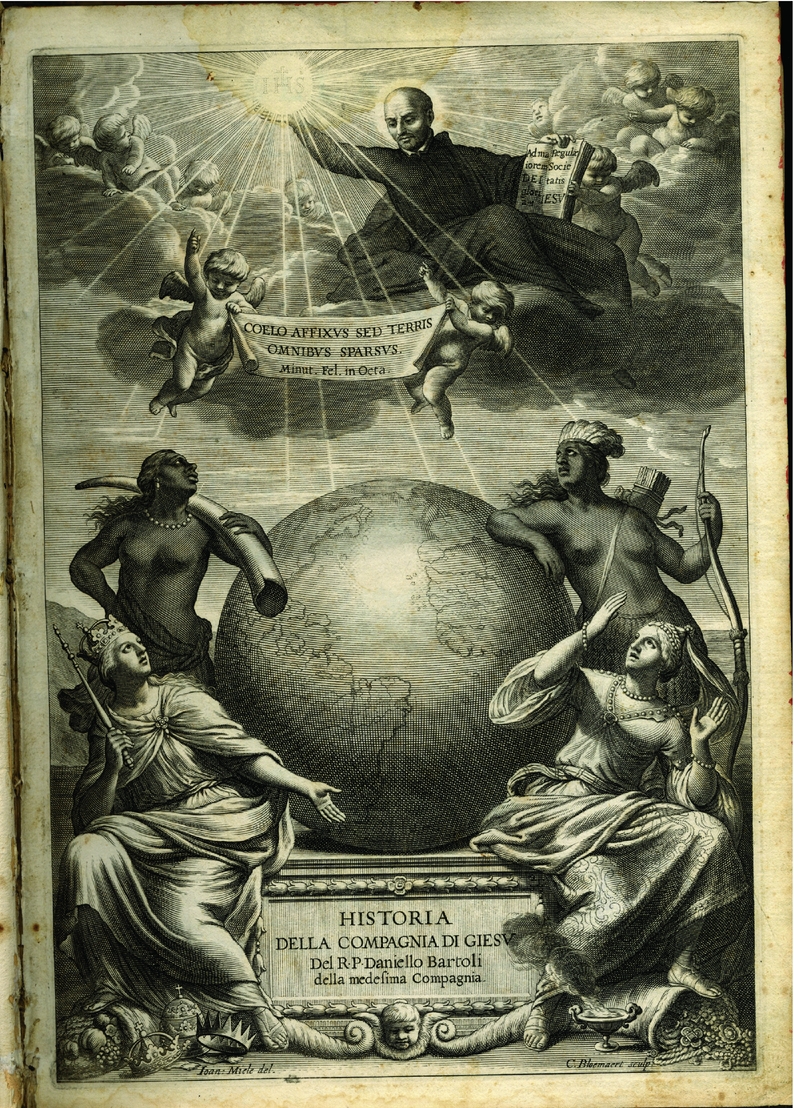
By this period in the history of the Society of Jesus, its founder had come to stand for the order as a whole, as can be seen from the frontispiece to the Jesuit Daniello Bartoli's life of Ignatius (1650), which the author, under official commission from the Jesuit father general, regarded as the first part of what became a multi-volume, though incomplete, history of the society as a truly global phenomenon. Notice here Ignatius's role as intermediary who deflects divine light so that it spreads through the whole world, represented by the four personifications of Africa, America, Europe and Asia (Fig. 1).
Cornelis Bloemart after Jan Miel, frontispiece to Daniello Bartoli, Della vita e dell'Istituto di S. Ignatio, fondatore della Compagnia di Gesù (Rome, 1659). Reproduced by courtesy of the Archivium Romanum Societatis Iesu.

I
Although Roman Catholicism might have reached all four then-known continents by the time Pozzo came to paint this fresco, it had had limited impact in two of them (Asia and Africa), had been creatively reinterpreted in a third (the Americas), and expelled from significant parts of the fourth (Europe). Moreover, the fiercely defended royal monopoly over ecclesiastical appointments in the Portuguese and Spanish overseas empires – known respectively as the padroado real and patronato real – meant that the papacy was in no position to assert full jurisdiction over the missions until well into the twentieth century.Footnote 3
As I have noted elsewhere, if one were to make an honest appraisal of world geopolitics c.1500, the subsequent global spread of Roman Catholicism would seem highly unlikely.Footnote 4 To begin with, Columbus had famously failed to find what he was looking for – a short cut to the East (which from the time of the collapse of the Roman Empire down to the mid-nineteenth century was unquestionably the wealthiest part of the globe), rather than the discovery of a ‘New World’. The promise and potential of the Americas as a fertile field of Christian conversion or for economic exploitation had yet to make its impact. Save for such relatively isolated communities as the Syriac ‘Thomas’ Christians of south-western India, the Syriac Maronite Church of Antioch, the minority Coptic Church of Egypt and the Coptic kingdom of Ethiopia, Christendom was boxed into the western extremity of the Eurasian landmass by considerable Islamic powers, notably the Ottoman Empire to the east and the Mamluk sultanate of Egypt to the south-east. In north Africa, from Morocco to Tunis, Portuguese and Spanish influence was precarious and restricted to the coastline. Furthermore, on the coasts of Sicily and the Italian peninsula, the inhabitants were careful to locate their settlements in secure locations inland, a curious and inconvenient detail which still puzzles enterprising beach-lovers who holiday in remote parts of Sicily, Calabria and Puglia. However, this did little to protect the local population from countless raids made by Barbary corsairs, even if the numbers of those thereby cast into white slavery do not compare with the numbers of their black counterparts who would later be brutally transported across the Atlantic.Footnote 5
In East Asia, Islam had been enjoying a wave of continuous expansion ever since the ruler of the Malay port of Melaka decided sometime between 1409 and 1436 to adopt Islam and thereby plug his economy into a flourishing trading network that stretched via Bengal and Hormuz to Cairo and Istanbul.Footnote 6 The pace of conversion was to accelerate from c.1500, in parallel with, and not unrelated to, the arrival of Christianity.Footnote 7 In the Americas, the Aztec and Inca kingdoms had reached their apogee. In China, the Confucian Middle Kingdom of the Ming had admittedly abandoned its early fifteenth-century practice of sending gargantuan armadas on flag-waving voyages as far as East Africa, but this was not in response to hostile reception but because of their perceived irrelevance to China's continental concerns as Asia's most considerable power. In 1501 Shah Esmā’īl (1487–1524) seized Tabriz and inaugurated the Safavid Empire, which unified Iran and under Shah ‘Abbas the Great (1587–1629) reached the climax of its power. In the territory represented by modern-day Afghanistan, Zahir ud-din Babur (1483–1530), the great-great-great-grandson of Tamerlane, was poised to invade the Indian subcontinent. He would establish what came to be known as the Mughal Empire, in which a Muslim minority ruled successfully for more than two centuries over a Hindu majority.
If the early modern period, as has been argued recently, was in global terms an ‘age of empire’, then the West had but a single contestant: the Habsburgs, who managed to unite their various Burgundian, Austrian and Spanish patrimonies with the title of Holy Roman Emperor for just a little under four decades (1519–56).Footnote 8 To borrow Gibbon's famous remark that, had it not been for Charles Martel's victory over the Arabs at the battle of Poitiers in 732, ‘the interpretation of the Koran would now be taught in the schools of Oxford . . . [and her pulpits] might demonstrate to a circumcised people the sanctity and truth of the revelation of Mahomet’, one might with no less justification remark that had it not been for the need for the Ottomans repeatedly to turn their attention to the Safavid threat on their south-east border, the 137-metre high steeple of Vienna Cathedral would merely have been the first such spire in the city to provide the muezzin with a substitute for his usual minaret from which to call the faithful to prayer.Footnote 9
The ‘triumph of the West over the Rest’ would have to wait until the late nineteenth and even early twentieth centuries. Even then, it was a ‘victory’ expressed in terms of economic and political, and not religious, dominance. The Scottish explorer and missionary to Africa David Livingstone famously converted just two Africans to Christianity (one of whom subsequently apostatized). So it is perhaps not such a surprise to learn that there was not a single African in attendance at the landmark World Missionary Conference which met in Edinburgh in 1910.Footnote 10 Indeed, the ‘Christian century’ in Africa had not then begun and is still very much in progress. While in 1950 only about 15 per cent of the population of sub-Saharan Africa was Christian, by 2010 it had risen to over 60 per cent, and just under 24 per cent of the world's 2.2 billion Christians lived in the continent. By 2050, according to the latest figures from the Pew Research Center, this proportion will rise to 38 per cent, which will represent a sea-change in the regional distribution of Christianity in the world: as recently as 2010 there were equal numbers of Christians in Europe, Latin America and Africa, representing some 75 per cent of the world's total (at around 25 per cent each).Footnote 11 It has been speculated that by 2050 one in four Christians in Europe and North America will be from the ‘Christian’ South.
Historians are usually warned that we should forget the future and try to view the period we study, as far as possible, in its own terms. Hindsight is seen as a hindrance. However, it can also be a help, which, I believe, is the case here. We need to appreciate that Christianity, let alone Roman Catholicism, was not yet a world religion even by the dawn of the twentieth century. Although the nineteenth century, that third ‘heroic’ chapter in global missions, was more successful, numerically speaking, than either of its predecessors (i.e. the early spread of Christianity, mainly through the Roman Empire, and the early modern ‘Age of Discovery’), in that the proportion of the world's population that was Christian increased from a little over a fifth in 1800 to over a third in 1900 (from 22.2 to 36.6 per cent); between 300 and 500 the proportion of Christians increased from 7 to 20 per cent, while from 1500 to 1750 there was a decidedly smaller increase, from 18.5 to 21.5 per cent. It is only in our own time that the global shift south is taking place. Moreover, the proportion of Christians as a percentage of world population actually fell during the twentieth century from 33.6 to 33.3 per cent.Footnote 12 All this should help us recalibrate our understanding of what was actually achieved during the phase of extra-European mission that coincided with the so-called ‘Age of Discovery’.
II
Before going any further, it is essential to move beyond the view of the communication of the Christian message simply in terms of the active broadcaster – passive receiver model. Of course, this is not to deny that the evidential record is very much weighted in favour of the broadcasters over the receivers, which encourages historians, in turn, to measure reception of the message in terms of degrees of distortion from the ideal. It is for this very reason that we need to heed the ‘excursus against influence’ offered by the art historian Michael Baxandall. Instead of positing a model whereby A influences B, he proposed that we invert the relationship and look at how B might act upon A. For Baxandall, ‘to think in terms of influence blunts thought by impoverishing the means of differentiation’.Footnote 13 By contrast, if we make use of the richer palate of active verbs (such as: draw on, resort to, avail oneself of, appropriate from, have recourse to, adapt, misunderstand, refer to, pick up, take on, engage with, react to, quote, differentiate oneself from, assimilate oneself to), we stand a better chance of retrieving the scope for action possessed by those – both clerics and laypeople – on the receiving end of papal and episcopal instructions or of Christian catechesis. However, this approach, which seeks to restore agency to those working on the ground – both missionaries and missionized – is not without its methodological challenges, since the weight of surviving evidence reflects, first and foremost, the view and agenda of the missionaries rather than that of their potential converts.
Another obstacle, ironically, has been the work of those pioneers, who sought, in the 1960s and early 1970s, to recover the ‘visions of the Vanquished’ of the missionized in the New World.Footnote 14 The emphasis such authors placed on the trauma of catastrophic destruction and disease – both physical and psychological – was not only rooted in the historical record but also framed in terms of the postcolonial polemic as forged in the white heat of anger by such authors as the Martinique-born doctor and psychiatrist Frantz Fanon, in his classic denunciation of colonialism, The Wretched of the Earth, written at the height of the Algerian war of independence from France and published in 1961.Footnote 15
While such historians have undoubtedly had the beneficial effect of forcing us to modify our view of the misleadingly triumphant ‘spiritual conquest’ narrative of Christian missions in the Age of Discovery, I would argue that they have also had the effect of making us underestimate both the role of non-Christian rulers in the expansion of Christianity and the capacity of the latter for material as much as linguistic translation into indigenous idioms.Footnote 16 It should not be forgotten that the largest-scale conversion of indigenous peoples to Christianity, after that of the duchy of Lithuania in the late fourteenth century and before those of the nineteenth, took place in the kingdom of the Kongo,Footnote 17 as a consequence of the baptism of its ruler Nzinga a Nkuwu in 1491. Taking the Christian name of João in honour of the then king of Portugal, Nzinga soon tired of his new faith, developing a particular objection to the uncompromising Christian line on polygamy. However, his son Nvemba Nzinga, who succeeded his father in 1506 and took the name Afonso, was very different; indeed, he has been called ‘one of the greatest lay Christians in African Church history’.Footnote 18 At the time of Afonso's death in 1543, it is estimated that some two million people, about half the kingdom's population, had been baptized.Footnote 19 The degree of success the king had in rooting his sacral legitimacy in Roman Catholic rites and rituals was mirrored by the degree to which the noble ruling class sustained a commitment to the new religion. The centrality of ritual to the role of Roman Catholicism in Kongolese society may be best appreciated if we consider the symbolic focus offered by churches in the rebaptized town of São Salvador (formerly Mbanza Kongo). The main Christian feasts were integrated into the royal ritual cycle and the king's presence at such ceremonies was seen to enhance monarchic mystique and power. For much of the sixteenth century, there was hardly another priest in the country; São Salvador was only created a bishopric in 1596 and by that time there were still only about a dozen functioning churches in the whole kingdom, served by African or Afro-Portuguese clergy.Footnote 20 This only served to impart added significance to the actions of this Christian nganga, whose very title he shared with pagan priests. In the words of Adrian Hastings: ‘It was a meeting between two societies and even two religions rather less different from one another than we are inclined to believe’.Footnote 21 In both Kongo and Portugal of the late fifteenth century, religion was more about ritual than doctrine; more about adoring sacred images, relics and fetishes than reading and expounding holy texts; more about the propitiation of interfering, vengeful demons or demanding spirits than the worship of a transcendent deity. In Kongo, as in so much of pre-Reformation Europe, the translatability of Christianity consisted of the repurposing of objects and rituals rather than the introduction of new texts, although the translation of the latter was itself far from being a straightforward process, as we shall now see.
The traditional Italian coupling traduttore, traditore (‘translator, traitor’) should be enough to disabuse anyone who still thinks, thanks to Paul Ricoeur, that the so-called ‘hermeneutic of suspicion’ was invented during the nineteenth and early twentieth centuries by the likes of Marx, Nietzsche and Freud.Footnote 22 Concern with language and meaning had been put on a new footing by humanists such as Lorenzo Valla and Desiderius Erasmus – both of whom published revised Latin translations of the gospels, with polemical intent – before the Reformation provoked a wave of new, no less polemical, vernacular translations of the entire Bible.Footnote 23 The Lutheran and Calvinist reformations, on the one hand, and the Counter-Reformation, on the other, saw unprecedented attempts at censorship of both written and oral culture by both positive and negative means. In the Roman Catholic world, this was at least partially achieved by the issue of standard ‘Roman editions’ of key religious texts, which included not only the so-called Sixto-Clementine Vulgate (1592) but also liturgical service books such as the breviary (1568) and the missal (1570). Revealingly, the first of these ‘Roman editions’ was the Roman Catechism, which was issued in 1566, soon after the official edition of the Canons and Decrees of the Council of Trent. These editions were accompanied by the publication of a series of indexes of prohibited books, not only by Rome. In the sixteenth century thirty-two editions were published, of which only six were printed in Rome, no more than the number of editions published in the space of just twelve years (1544–56) by the Sorbonne.Footnote 24 By means of these lists the authorities sought, with only qualified success, to exert control over the circulation of heterodox opinions. Rome followed up its efforts by founding a curial standing committee, the Congregation of the Index, in 1571 to supplement the Holy Office, which had been founded in 1542.Footnote 25 However, my focus in this article lies elsewhere, since I have deliberately chosen to understand ‘translation’ in its broadest sense: so as to include pilgrimage (both physical and virtual), conversion and the movement of relics, as well as the rendition of texts in another language from the original.
III
In his presidential address to the American Catholic Historical Association, delivered in December 1990 and published the following year in the Catholic Historical Review, the Jesuit historian John O'Malley memorably pointed out that, not only in his early years, Loyola's ‘eyes were set on Jerusalem, not Wittenberg’.Footnote 26 O'Malley's doctoral work on the Augustinian eschatological preacher Giles of Viterbo (1472–1532) would have made him all too aware of the enduring power down to the Renaissance (and beyond) of the idea of Rome as New Jerusalem. Giles compared the Tiber to the River Jordan and saw ‘Etruria’ as the new Holy Land. Here the friar was simply building upon the patristic idea that Christ's baptism marked the passing from the law of the old dispensation to the new, Christian faith of redemption.Footnote 27 O'Malley calls us to avoid identifying Loyola exclusively with the ‘Counter-Reformation’. Instead, we should remember, not so much Ignatius's physical pilgrimage to the Holy Land, where he so embarrassed and irritated the Franciscan Guardians of the Holy Places with his clumsy attempts to court martyrdom that they bundled him onto a ship back to Europe, but his mental evocation of the Holy Land in the Spiritual Exercises – unforgettably described by Outram Evennett as that ‘shock tactic spiritual gymnastic to be undertaken and performed under guidance’ (rather than simply read).Footnote 28
As recent studies have demonstrated, this practice of ‘imagined’ or ‘virtual’ pilgrimage, whereby the devout were able to translate themselves in their imagination to the Holy Land, was still flourishing at the end of the fifteenth century.Footnote 29 It was undertaken particularly by those, such as nuns and other devout women living in the world, who had few opportunities to make the physical journey. Through works such as the Sionpilger by the fifteenth-century Observant Dominican Felix Fabri, who visited the Holy Land twice – once in 1480 to Jerusalem and then again in 1483–4, when he made the further pilgrimage to St Catherine's monastery in Sinai – the nuns in his spiritual charge in the German city of Ulm were encouraged to evoke in mental prayer the places where Christ walked, talked, suffered, was crucified and rose from the dead in order to intensify their apprehension of the Passion story.Footnote 30 Similar practices were also encouraged in one of the most widely disseminated texts of the pre-Gutenberg age, Thomas à Kempis's Imitation of Christ, which charged its readers and listeners to accompany Christ in every detail of his life.Footnote 31
This virtual translation of the Holy Places as a way of structuring meditation had its counterpart in the physical re-creation in Western Europe and the Iberian and Lusitanian colonies of places associated with Christ's life and Passion. As Christianity is a religion built upon an avowedly historical event, it can be no surprise that such copies date back almost as far as the events they commemorate. To consider just a single western example: the origins of the building complex of S. Stefano in Bologna – referred to locally as St Jerusalem or the Seven Churches – is dated to the fifth century CE.Footnote 32 Moreover, the Ethiopian Orthodox priests of Lalibela claim that, according to a tradition, the layout of their famous rock-hewn churches is a symbolic representation of Jerusalem, and their construction was prompted by Saladin's retaking of the Holy City in 1187.Footnote 33 However, the number of these so-called ‘Passion Parks’ or miniature replicas of Jerusalem (or of key buildings within it) increased markedly in the sixteenth century and later and may be found from Brazil to Bologna, and from Granada in Andalucia to Görlitz near the Polish border.Footnote 34 Perhaps the most famous manifestation of this phenomenon is the series of sacri monti (holy mountains) which formed a kind of confessional cordon sanitaire or string of watchtowers along the borders of Piedmont and Lombardy with the Reformed cantons of Switzerland. Overseen by Observant Franciscans, who also had responsibility for the Holy Places in Palestine, these included a mini-Jerusalem at Varallo (much favoured by that model Counter-Reformation prelate, San Carlo Borromeo), which was the first to be begun in 1491, and the string of fourteen chapels dedicated to the Mysteries of the Rosary at Varese dating from 1605. All were populated by numerous brightly painted full-scale figures who recreated scenes from the life, suffering and death of Christ or Mary, or (in the single exception of the Sacro Monte on Lake Orta) the life of St Francis of Assisi.
The translation of the topography of Jerusalem could also be imposed on an existing urban landscape. In 1659 the North Italian Somaschan priest Lorenzo Longo published a twenty-four-page booklet entitled Gerusalemme piacentina, or, to give it its full title, The Places of Piacenza corresponding to the Holy Places of Jerusalem which may be visited by the faithful and devout Servants of God [so that they might] meditate on the most holy Life, Passion, Death and Resurrection of our Saviour Jesus Christ with . . . great spiritual Profit.Footnote 35 In the preface, Longo compared his grafting of the topography of Jerusalem onto this small town, situated on the river Po some seventy kilometres south of Milan, with the presence of models of the Holy House of Loreto in the nearby cities of Alessandria and Como. He then mentioned the various places in Piacenza where there were already particular scenes from the life of Christ (overwhelmingly evocations of the Holy Crib). In order to emphasize the convenience afforded by his guide, he mentioned how the capture of the Holy Places (by the Ottomans in 1517) had made physical pilgrimage very difficult.Footnote 36 It is at this point that Longo also mentioned the Sacro Monte at Varallo, which was less than a hundred kilometres from Piacenza. Before taking the reader – or listener – through the streets of Piacenza, Longo argued that the whole of Lombardy and Piedmont – for which he used the classical Roman label Gallia Cisalpina – might be considered to be a kind of virtual Palestine, with Tortona standing in for Gaza, Como as Tyre, Monza as Caesarea, Milan as Jaffa and the Adda as the River Jordan. The fact that all this information was delivered in the form of a poem suggests that Longo probably intended it to be memorized by the dutiful pilgrim and recited before the local counterparts to the key sites of the Passion story. The pamphlet closed with a careful enumeration of the spiritual bounty which pilgrims would gain for their labours in the form of a list of the indulgences.
IV
This brings us to what linked all these practices. They enabled all, and not only those who journeyed all the way to the Holy Land, to benefit from the generous indulgences which such an act of piety brought with it. Of course indulgences have not had a very good press, particularly since 1517, but, as Elizabeth Tingle has reminded us, the triumphant revival of the cult of saints and of Catholic devotions more generally in the Counter-Reformation Church would have been inconceivable without indulgences: they were the mortar which held the whole edifice together.Footnote 37 Furthermore, they collapsed devotional distance by making possible global cults of such relics closely associated with Rome as the icon of the Blessed Virgin Mary held in the Roman basilica of S. Maria Maggiore and known sometimes as Madonna of the Snows, after the alleged miracle of an August snowfall which was caused by the Virgin to indicate where she wanted the basilica in her honour to be built on the Esquiline Hill, and sometimes as the Saviour of the Roman People (Salus populi romani), owing to her alleged role in bringing about the end of the plague in the city at the time of Pope Gregory the Great at the close of the sixth century.Footnote 38
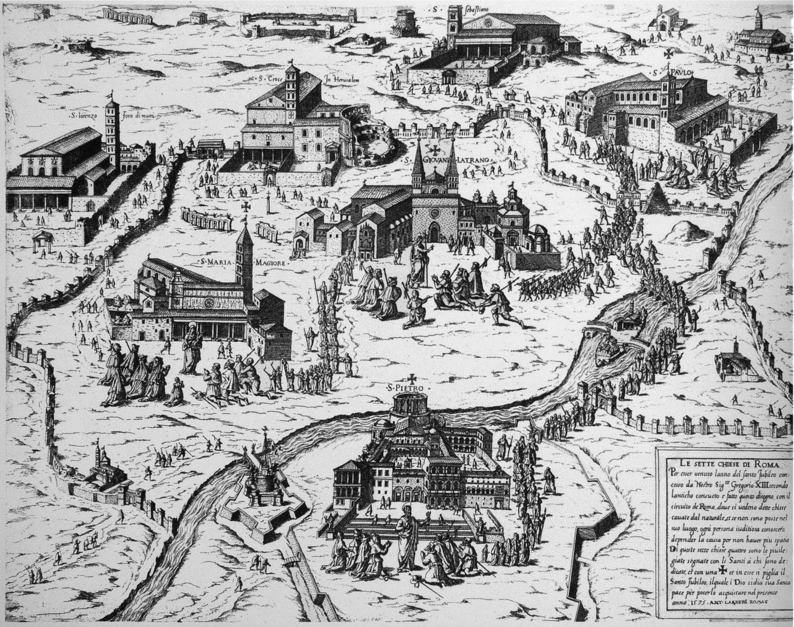
A famous print, attributed to Stefano Du Pérac, was published by the French-born adoptive Italian engraver Antonio Lafréry in time for the holy year of 1575, which with its 400,000 pilgrim visitors saw the relaunch of Rome as capital of a world religion. It depicts, in very much idealized terms, pilgrims processing between the seven major basilicas of the Eternal City (Fig. 2). As Barbara Wisch observes: ‘No earlier maps of the city had ever “populated” the city in quite this way’.Footnote 39 Here Rome is not simply ‘represented’ but shown ‘in action’. Such prints would have been bought by pilgrims to take home with them as souvenirs of their visit to the city and this one should be seen, in Wisch's words, ‘[as] a kind of didactic memory guide for reliving the Holy Year experience or transforming the potential pilgrim into an actual one’.Footnote 40
Stefano Du Pérac (attrib.), Le sette chiese di Roma (Rome, 1575), etching 39.7 x 50.9 cm. Reproduced courtesy of the Metropolitan Museum, New York, Rogers Fund, Accession number 41.72 (1.12), <http://www.metmuseum.org>.

Du Pérac's print also conveys Rome's claim to have become a New Jerusalem, as it was home to so many physical testimonies to the apostolic origins of Christianity. These comprised not only buildings but also bones: the relics of the early Christian martyrs, whose number was to increase exponentially only three years after the 1575 jubilee for which Du Pérac's print was conceived. In 1578, the so-called Catacombs of Priscilla were discovered under an orchard just north east of the city walls, and a pious identification of all those buried within them as victims of Roman imperial persecution followed. This discovery of what one contemporary authority described grandiloquently as a ‘subterranean city’Footnote 41 ushered in the biggest boost in relic traffic since the dramatic rise in the circulation of relics consequent on the so-called Fourth Crusade in 1204.Footnote 42 In 1635 (rather than the 1632 announced on the title page), after not inconsiderable delay owing to its extensive illustrations, the first atlas of this subterranean New World was published in Rome, Roma sotterranea, by the Maltese Antonio Bosio.Footnote 43 As the extended title of this work makes clear, it was intended also to be a gallery displaying a visual testimony to the sufferings and martyrdom of the early Christians whose priceless relics lay beneath the soil of the Roman campagna outside the city walls.
The next three hundred years were to see Roman catacomb relics translated throughout the Catholic world. A recent survey has calculated that no fewer than fourteen thousand relics from this source (many of which were whole bodies) were distributed throughout the world between 1578 and 1870.Footnote 44 Unsurprisingly, they were exported particularly to frontier zones in both the Old and New Worlds. In Europe, the Upper Rhine Palatinate, which changed faith more than once during the century after the Reformation and where the Wittelsbach dukes of Bavaria replaced holy bodies destroyed during the Thirty Years’ War (1618–48), was a territory particularly favoured. It is reckoned that over a thousand catacomb saints were translated from Rome into this area during the long seventeenth century (c.1580–c.1750).Footnote 45 Much less well known until very recently, however, has been the translation of such relics to the New World. Their entry into Mexico City on 2 November 1578, for example, was given a particularly magnificent treatment in the form of a pageant entitled Triumph of the Saints.Footnote 46 The distribution and processing of relics was a long-established Christian practice dating back at least to the time of St Augustine, who in the last book of City of God talked with guarded approval of St Stephen's wonder-working relics, which had just recently ‘come on stream’, as a result of the discovery of his tomb at Kafr Gamala, Palestine, in 415.Footnote 47 However, the advent of the Reformation considerably intensified the significance of the practice, since the cult of saints and the adoration of the eucharist had become the two most visible markers of Roman Catholicism.
In a letter from Québec dated 16 October 1666, the Ursuline nun Marie L'Incarnation (1599–1672) thanked her son for the ‘fine present of saints’ relics’, which he had sent her community, and which were now venerated ‘in a place set aside for the purpose’, whence they were taken to be displayed on feast days in four reliquaries. Marie, who had joined the order after being widowed at a relatively young age, described an event of a magnificence that she never dared to imagine seeing in New France, ‘where, since I arrived, I have seen nothing that was not uncivilized and barbarous’.Footnote 48 This was the translation of the bodies of two saints from the Roman catacombs, Flavian and Felicity, which had been given to the colony by the pope. The ceremony, which took in all four of the city's existing churches, lasted over six hours, with accompanying music, and involved no fewer than forty-seven ecclesiastics as well as the governor of New France, Daniel de Rémy de Courcelles.
However, the traffic was two-way, for Rome also imported relics, notably from the Holy Land, as exemplified in the Sancta Sanctorum, which had been the pope's private chapel in the old Lateran palace and was the repository of some of Rome's most sacred relics, including an Acheiropoeton or icon of Christ allegedly not painted by [human] hands but channelled by divine guidance through St Luke. Previously inaccessible to the public, Sixtus V had the scala sancta – the flight of stairs allegedly originating from Pilate's palace in Jerusalem which Christ had therefore climbed – moved from the north wing of the medieval Lateran palace, which the pope had demolished, to form a new public entrance to the Sancta Sanctorum facing the basilica of S. Giovanni in Laterano.Footnote 49
This ‘connectedness’ of Rome with the wider Roman Church – which may also be expressed in terms of Rome as particular place as a counterpart to Rome as universal idea – was also achieved by ‘translating’ the sacred topography of post-Tridentine Rome onto its heroic, early Christian prototype. It is surely no coincidence that a particularly powerful act of such spatio-temporal translation was carried out by Gregory Martin, the main translator of the Douai-Rheims Bible, the Roman Catholic translation of the Vulgate into English. Martin, who had spent eighteen months in Rome between December 1576 and June 1578, was also author of Roma sancta, which seemed on the surface a conventional enough pilgrim's guide to the Eternal City: its title harked back to the perennial genre of the mirabilia urbis Romae.Footnote 50 However, for Martin, Rome was an agent of the ultimate expression of translation in the Europe in the age of reformations: conversion. Although Roma sancta was to remain unpublished in its full form until 1969, extracts from it were published in English c.1597 – rather than the 1583 on its title page – under the title A treatyse of Christian peregrination.Footnote 51 Here, as in the full version, Martin liberally studded his text with quotations from the early Church fathers. One of Martin's favourite writers was the one-time archbishop of Constantinople, St John Chrysostom (c.347–407), whose letter to the Romans – Chrysostom here was consciously modelling himself on St Paul – Martin quoted at some length, before saying:
As often as I read it, I am ready to melte for joye. But marke . . . the cause of his affection towards Rome: to wite the bodies of the Apostles lying there, and why the bodies? Because they carried the markes of the Church. This is it that causeth Pilgrimage. This consideration, for the love of Christ and the honour of him, inflamed the Godly father and all the best Christians in the Primitive Church to love sacred monuments, to be desirous to see them, to go farre and neere unto them, to touch, to kisse, to licke them, to weep in the place, to concieve such a lyvely imagination of things done there by Christ and his saynts and withall such a sensible feeling of heavenly devotion that it was a payne to remove from thence, a death to dwell farre of[f].Footnote 52
Martin's Treatyse of Christian Peregrination was published together with several letters including one to his sisters: ‘married to Protestants and themselves trained up in heresy’. In this context, I do not think it is too far-fetched to argue that the space and place of Rome – and the emotion the city evoked in the mind of the devout, orthodox Catholic – was considered by Martin to be a persuasive agent of conversion. Such a notion is reinforced by the following passage from Roma sancta:
And if any where a man stand nigh to these tombes, he perceaveth his sence by and by ravished with this sayd force, for the sight of the coffin entring into the hart, pearceth it, stirreth it up, and moveth it in such a maner, as if he that lyeth there dead, did pray with us, and were visibly present to be seen.Footnote 53
For Martin, meditation on material remains which had borne witness to the most heroic age of Christian history could transport a person with the right interior disposition to early Christian Rome itself, thus collapsing time and space.
V
But what of the ‘little Romes’ which emerged in the wake of the conquistadores from Cartagena to Cuzco, Mexico to Manila: those settlements which, by means of Roman relics and rituals, identified themselves closely with the New Jerusalem on the Tiber? One was located in the indigenous settlement of Carabuco, on the shores of Lake Titicaca, in the Spanish colony of Audiencia de Charcas, which fell within the viceroyalty of Peru (modern Bolivia). Specific interest focuses on the church's baptistery, whose fresco decorations were commissioned by the local cacique (native chief), Agustín Siñani, after the partial collapse of the building in 1763.Footnote 54 As a counterpart to the baptism of Christ, there is a depiction of the baptism of Agustín's ancestor, Fernando, who was the first in his line to be baptized and was shown resplendent in his Inca tunic, the uncu. In the foreground is a crown which rests on a cushion in front of him. This detail is picked up in the fresco the opposite wall which shows the Emperor Constantine being baptized by Pope Sylvester, who is easily identifiable wearing the papal tiara. According to Hiroshige Okada, the model for this pair of compositions was most probably an engraving of the design by Rubens for the scene of Constantine's baptism, part of a six-piece set of tapestries depicting the story of Constantine, woven in Paris 1623–7, and given by Louis XIII of France, son of Henry IV (who in the light of his conversion(s) to Catholicism was sometimes referred to by contemporaries as ‘a second Constantine’), to Cardinal Francesco Barberini, nephew of Urban VIII (1623–44).Footnote 55 Both scenes are framed by spiral, corkscrew columns which not only border the scene itself but are also deployed elsewhere in the baptistery's decoration. These allude to the columns from the Temple of Solomon, a set of which, so a tradition dating from the twelfth or thirteenth centuries ran, Constantine had transported from Jerusalem to decorate the high altar and presbytery of the Old St Peter's.Footnote 56 The Solomonic column had become a prominent feature of the Latin American baroque owing, originally, to the associations made by the first wave of mendicant missionaries of the Americas with the lands of Ophir and Tarshish, where the mines of Solomon were located.Footnote 57 In the seventeenth century Bernini carefully relocated them in pairs to frame several of the basilica's most precious relics, including the Veronica and pieces from the holy lance and the cross of Christ at the crossing of the new St Peter's. Bernini then reused the spiral column motif on a spectacular scale in the baldacchino over the tomb of St Peter, thereby dramatically reasserting the translation of the true religion from Jerusalem to Rome. Okada has argued that this pairing of Constantine with the Incan cacique was quite possibly inspired by the late sixteenth-century Los comentarios reales de los Incas (Lisbon, 1609), composed by the mestizo humanist Garcilaso de la Vega (1539–1616), son of a Spanish conquistador and an Inca princess.Footnote 58 Garcilaso had made a direct comparison of the Inca and Roman empires, referring to Cuzco as ‘another Rome’ and casting the Inca indigenous as ‘new gentiles’ (nuevos gentiles) whose prototype was the Romans or ‘old gentiles’ (antiquos gentiles).Footnote 59 In this way the significance of the conversion of the Inca Empire to Christianity was paired – and by implication placed on a par – with that of the Roman Empire over a thousand years earlier.Footnote 60
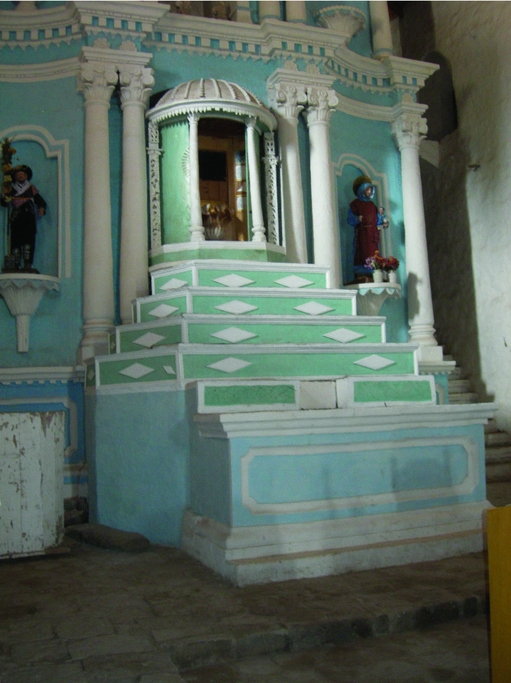
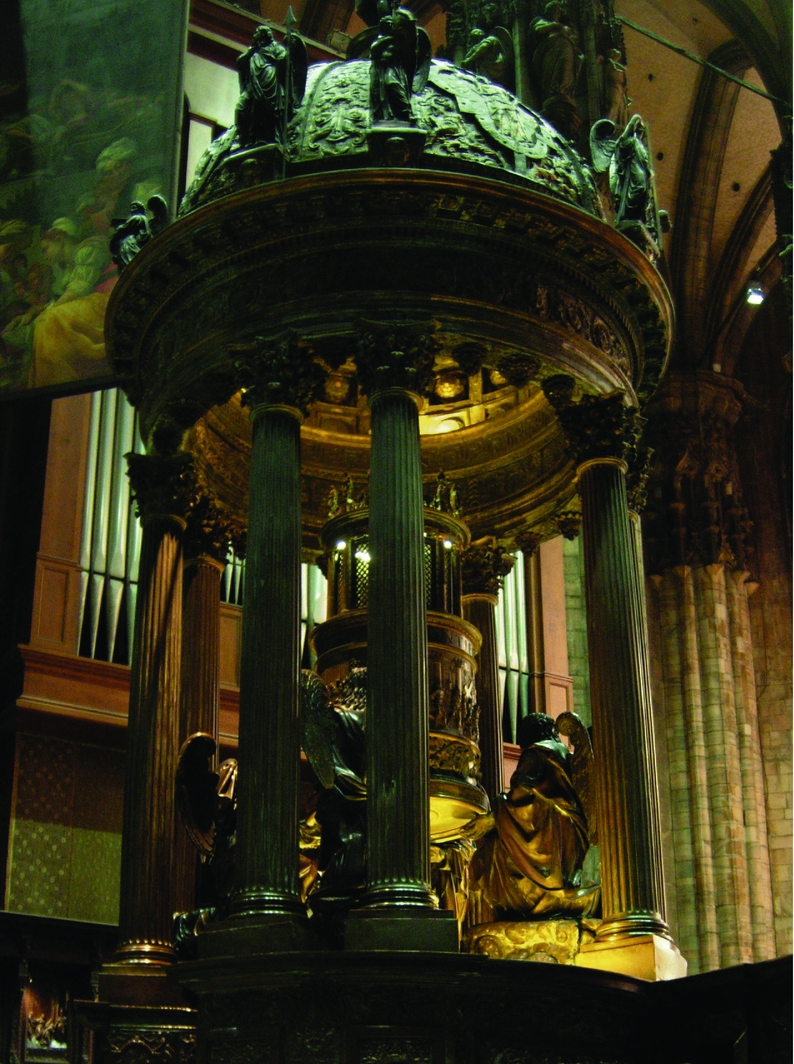
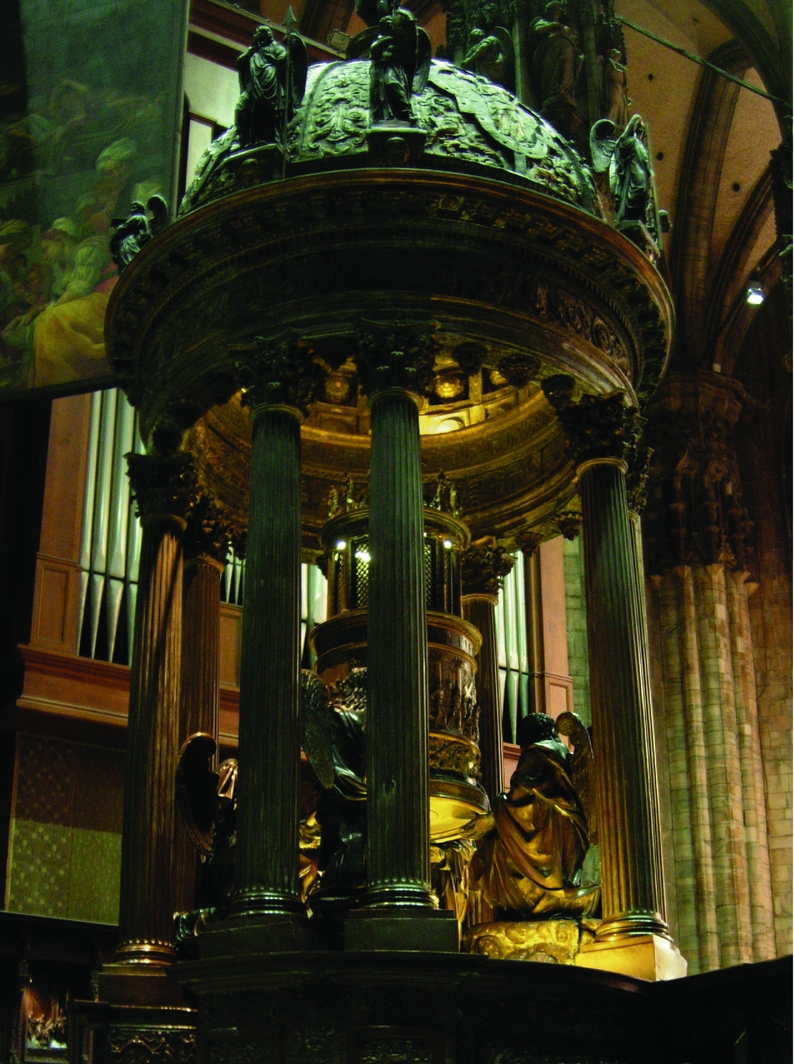
However, even more important than such typological references is the evidence for the means by which Christianity was ‘translated’ from the Old to New Worlds offered by the tabernacle holding the host over the high altar of the small church dedicated to St James the Great in the hamlet of Coporaque, some two hundred kilometres west of Lake Titacaca in Peru. This tabernacle, placed in a church even humbler than that in Carabuco, reproduces the tabernacle from the high altar of the Duomo of Milan dating from 1561 (Figs 3a, 3b). It is immediately apparent that both high altars – albeit on very different scales – have been specifically designed to provide a secure and prominent place for the display and storage of the consecrated, transubstantiated host which, owing to its significance as, ultimately, the most important symbol of what made post-Reformation Roman Catholicism distinctive, became the signifier of embattled orthodoxy. This can be seen from Carlo Borromeo's ‘Instructions for the Building and Outfitting of Churches’ (1577), contained in the 1583 edition of the Acts of the Milanese Church, the most widely diffused ‘handbook’ for bishops showing them how to apply the decrees and canons of the Council of Trent.Footnote 61
Interior of Santiago Apostol Coporacque. ©Hans Roegele.

High Altar Tabernacle, Duomo, Milan. ©Richard Schofield.
Another prominent and ubiquitous visual detail to be found in even the humblest churches of the Iberian overseas empire is that of the confession box, also an emphatically Borromean innovation The centrality of both these elements of church furniture to the pastoral vision of that pre-eminent model bishop of the Counter-Reformation, Carlo Borromeo, may be seen from their prominent treatment in his handbook instructions. The Acts of the Milanese Church, which contained the ‘Instructions’, was no dry collection of synodal legislation but was designed to supply hard pressed, busy prelates with practical advice about how to govern their dioceses, preach sermons, train priests and build and outfit churches. As such it should be considered the practical counterpart to the theory enshrined in the Canons and Decrees of the Council of Trent, the complete set of which had been published in 1564. Its popularity was such that Borromeo's counterparts as reforming prelates in Central and South America came to consider the archbishop of Milan as their model and prototype. Moreover, at least one near contemporary drew a direct comparison between Borromeo and Toribio de Mogrovejo, archbishop of Lima from 1581 until his death from overwork in 1606, who summoned what historians still consider to have been ‘The Trent of the Americas’, the Third Provincial Council of Lima of 1582–3.Footnote 62
Just as penance was the master-key of Borromean spirituality, so for the Jesuit José de Acosta (1539/40–1600), one of the four theologians in attendance at the Council of Lima, mutual intelligibility in the confession box between the indigenous penitent and his or her confessor was of paramount importance.Footnote 63 Acosta is credited with overseeing translation into two of the pre-eminent languages of the former Inca Empire, Quechua and Aymara, of both a short catechism for lay instructors to repeat with their pupils and a longer one for more advanced converts; he also wrote a confession manual and a collection of sermons, which at the specific behest of the Third Council of Lima were to constitute an important pastoral resource in their Quechua and Aymara versions.Footnote 64
For Acosta, as outlined in his famous missionary manual On procuring the Salvation of the Indians (De procuranda indorum salute), which was already complete by 1576 although it was not published until 1588, after his return to Spain, the sine qua non of the effectiveness of the missions was the capacity of the missionaries to communicate in the Indians’ own languages:Footnote 65 ‘For me, the priest that accepts the office of párocco without knowing the language of the Indians – and I have believed this for a long time and I keep on affirming it – that person is just ruining his soul.’Footnote 66
Acosta went on to explain how this was true in the very basic sense that ‘if he does not know what the Indian is confessing’, a priest could not administer the sacrament of penance; ‘nor will the Indian be able to understand what is commanded of him’.Footnote 67 Acosta went on to praise the Incas for their ‘wisest’ use of the device of a general language (lengua general) of Quechua which was spoken and understood, at least by the elite if not by the common people, throughout the extensive lands of their empire.Footnote 68 However, for him, the most effective way to negotiate what he referred to as the ‘veritable jungle of languages’ (idiomatum tam multiplex sylva sit) was to make cautious yet concerted use of the (at least) bilingual offspring of Spanish fathers and Indian mothers, the mestizos.Footnote 69 But such a strategy was far from foolproof.
Attempts to identify a ‘general language’ in which to communicate the teaching of Christian doctrine were inevitably the imperfect, artificial fruit of compromise. Nowhere can this be seen more clearly than in the case of New Granada. Unlike New Spain and Peru, where the political hegemony of the Aztec and Inca empires made the adoption of Nahuatl and Quechua, respectively, practical and reasonably effective (if somewhat oversimplified) options, the absence of a correspondingly dominant indigenous power in New Granada resulted in an outcome which was singularly unsatisfactory. The only candidate for the status of ‘general language’ was that referred to in contemporary sources as ‘Mosca’ and known today by the names of ‘Muisca’ or ‘Chibcha’. However, it was only spoken in the immediate environs of Santafé. As a solution to this fragmented linguistic landscape the city's archbishop, Zapata de Cárdenas, author of the first vernacular (Castilian) catechism for New Granada in 1576, attempted – in the words of Juan Cobo Betancourt – ‘to ordain the secular church [of New Granada] out of its crisis’ by creating some 124 priests to send to indigenous parishes; of these, no fewer than 22 were mestizos and 39 criollos.Footnote 70 Although it was to be reasonably expected that the mestizo priests would be bilingual and that their creole counterparts might have at least a basic grasp of the indigenous tongue of the community in which they had grown up, the question was ‘which language’? As the archbishop himself admitted: ‘in this kingdom every valley or province has a different one, and it is not like Peru and New Spain, where there are different languages but one general language, which is used throughout the land’.Footnote 71 The eventual solution, if this word is appropriate for such an untidy and contingent process, was a simple one, according to Cobo Betancourt. His painstaking examination of the remaining records from Archbishop Arias de Ugarte's marathon five-year visitation of his province (1619–24) strongly suggests that local priests were expected to translate the catechetical material which had been issued to them – that is, that approved by the Third Council of Lima, but only in Castilian – into the language of their parishioners.Footnote 72
Acosta insisted that the Indian languages, though multiple, were not that difficult to learn when compared to, say, Hebrew, or even Latin and Greek. However, he was not blind to their qualities:
Yet in their uncultured barbarity they have some ways of saying things that are so beautiful and elegant, and other expressions that are so admirably concise that they say many things in one, that give us such delight, and when we wish to express in Latin or in Spanish all the power of one of these words we would have to employ many and yet we would scarcely cover all the meaning.Footnote 73
However, when it came to spiritual or philosophical matters, the Indians’ languages were found wanting, so that, in Acosta's opinion, it did not make sense to attempt to translate such key Christian concepts as ‘faith, cross, angel, virginity and marriage’, which should rather be left in Spanish.Footnote 74 Here Acosta might well have had in mind the initial error made just a few decades earlier by his confrère Francis Xavier in Japan where, misadvised by his guide and interpreter, the Japanese pirate Anjiro, the Jesuit missionary had first used the Japanese concept Dainichi, the pantheistic deity revered by the Buddhist Shingon sect, to translate ‘God’, before realizing his error and reverting to the use of Latin, or at least to Latinate words, slightly adapted so as to work better when spoken by the Japanese.Footnote 75
A more difficult challenge to the efficacy of missionary work, Acosta believed, was provided by the ‘most truly barbarous’ pronunciation characteristic of many Indian tongues which meant that their speakers ‘appeared to be gargling in their throats rather than talking’.Footnote 76 The key thing here was to overcome any sense of shame and embarrassment when attempting to deliver sermons in the Indian languages. As Acosta pithily put it: ‘we have to make many mistakes to learn not to make any mistakes’.Footnote 77 He concluded this chapter with an emphasis on the importance of simplicity and repetition, a strategy that he noted had been used with particular effectiveness by Francis Xavier with the simple fisherfolk of the Malabar coast, and with an evocation of a practice he believed to have been widespread in the primitive Church, that of reading out sermons in native tongues which had been written by others but which were accompanied by guidance so as to ensure that the correct intonation and pronunciation were employed.Footnote 78 The importance of correct pronunciation to the accurate communication of meaning was also an obsession of the Jesuit Horacio Carochi, the author of what is still the most comprehensive grammar of the Mexica language of Nahuatl, published in 1645:
And let no one think that it matters little whether one does or does not take care with these accents and with the length of the syllables, because aside from the fact that a badly pronounced language greatly offends hearers, in this one there will be mistakes at every step and one thing will be said for another, if there is neglect with the pronunciation.Footnote 79
VI
But what does this slow, somewhat messy and far from conclusive attempt to translate the Christian message to at least two of the four parts of the then known world during the early modern period add up to? According to the Gambia-born former Muslim, now Roman Catholic, Lamin Sanneh (b. 1942), it has been precisely the ‘triumph of the translatability’ of Christianity, by means of which indigenous peoples have been able to appropriate the Bible in myriad forms and make it work for them, that has made it the world religion that we have today.Footnote 80 However, Sanneh's uplifting narrative has its origins in a distinctly nostalgic, ultimately essentialist treatment of ‘African Christianity’ and its indigenous agency, somehow mysteriously independent of extra-continental influence. As Joel Cabrita points out, such a model singularly fails to account for the South African (Ibandia Iama) Nazaretha Church, founded in 1910 and today with over four million members, which, deeply influenced by transnational Evangelical literary culture (with North American rather than African roots), has taken upon itself the task of writing further scriptures – a new Bible if you like – which recount the miraculous deeds of its founding prophet, Isaiah Shembe (1865?–1935).Footnote 81 Furthermore, recent work on networks of carriers of religion across the globe: whether it be the trade diaspora of Sephardic Jewish merchants, Sufi brotherhoods in South Asia or members of the Society of Jesus, has ‘overturn[ed] the stereotype of a lone missionary or remote merchant carting his beliefs overseas by highlighting the role of solid but imperfect networks tied together by movement and faith’.Footnote 82 These were networks, furthermore, that were more often than not regional and unmediated by a single centre; as Luke Clossey has demonstrated in his study of the global Jesuit mission, which traces a vector of movement of missionaries from Germany to China via Mexico: here Rome was not so much a place as a state of mind.Footnote 83
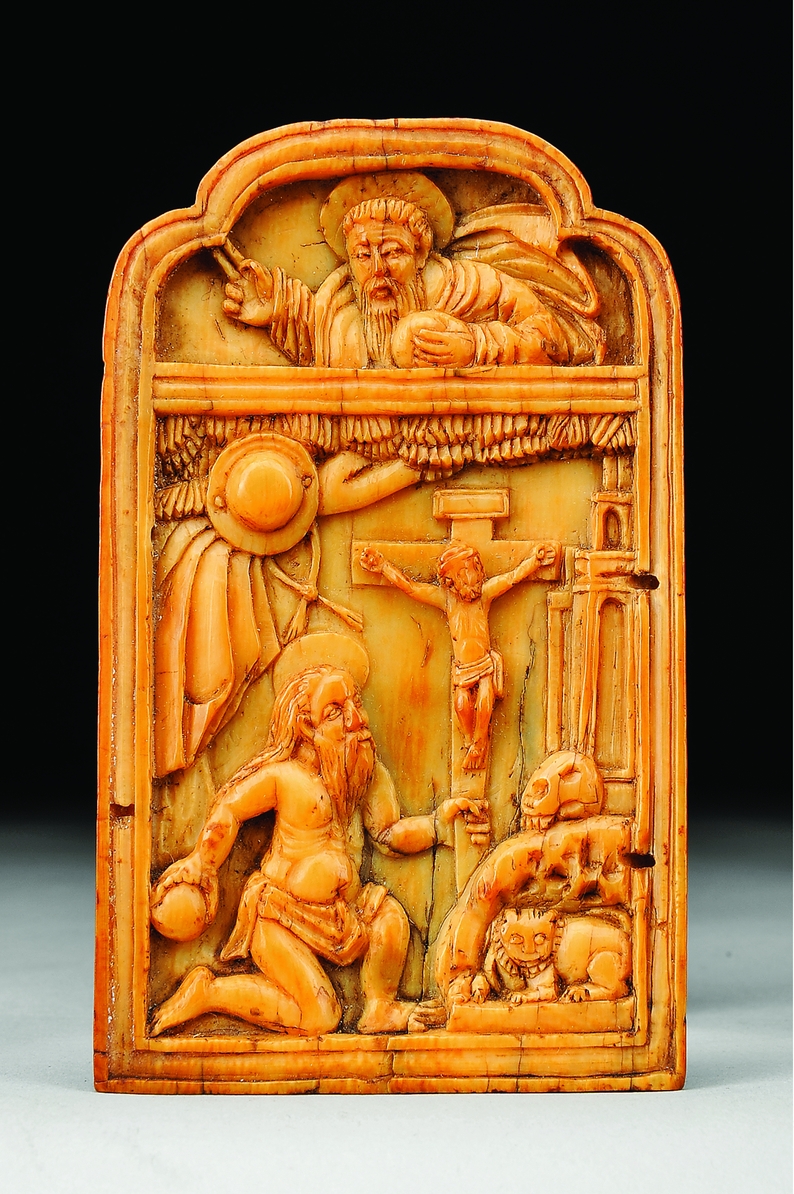
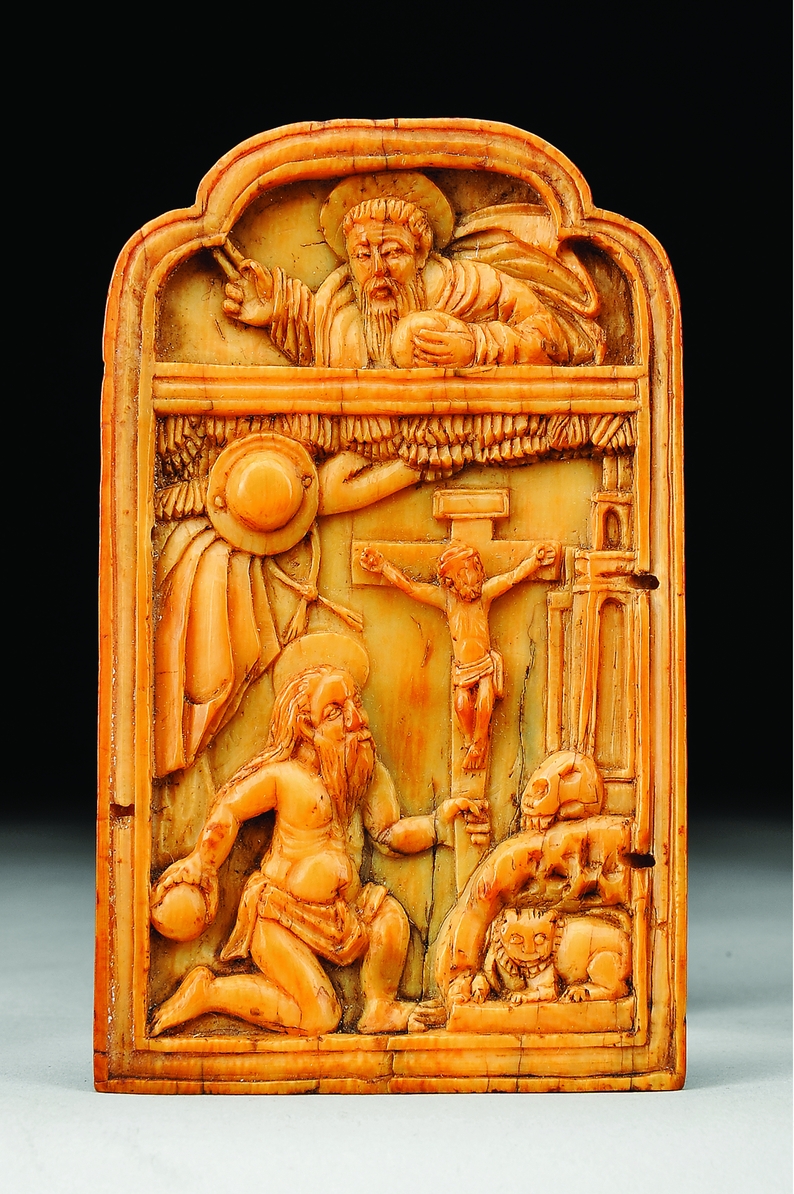
I would therefore like to close this article on the theme of translation in an age of reformations with a regrettably all too brief consideration of an object which, owing to the almost complete absence of contemporary documentation, resolutely resists being pinned down geographically. It is very small, measuring just over nine centimetres in height and little more than five in breadth. Made of (Indian or African, but possibly Siamese or Cambodian) ivory, it was carved sometime in the seventeenth century, copying a lost Flemish prototype (more likely based on an engraving originating in Antwerp rather than an ivory original), probably on mainland China near Macau (although Manila is another possible candidate), by quite possibly unconverted Chinese craftsmen specifically for an overseas market.Footnote 84 Having travelled first across the Pacific on a Spanish galleon from Manila to Acapulco, where it might have been bought by a Brazil-based merchant before crossing the Atlantic at some unspecified time, it ended up being auctioned in Lisbon, where it was bought recently by a private collector. It depicts a near-naked St Jerome in the desert kneeling before and holding a cross with Christ crucified upon it. Immediately before the saint is a mound on which a skull has been prominently placed and before which sits his attribute, a tame lion. The whole scene is overseen by God the Father who blesses both the scene below and the viewer (Fig. 4). This small, exquisitely portable object of devotion is a fitting one with which to bring this selective survey of the global circulation of Roman Catholicism in the early modern period to a close, since it serves to remind us that, for all its slow, incomplete and halting nature, it was above all the portability (and tradability) of such devotional objects – in other words, its material rather than linguistic translatability – that enabled Roman Catholicism to become the first world religion.
Plaque with St Jerome, Macao, China, 17th century, Ivory, 13.5 x 8.5 cm. Cobral Moncada Leilões, Auction 139, lot 421. Reproduced courtesy of Cobral Moncada Leilões – Art Auctioneers, Lisbon, Portugal, <http://www.cml.pt>.