Globalization, foreign intervention, and failed states have drawn new attention to theoretical issues of how political orders and communities can be legitimately founded, and what it means for a people to be self-governing. Political founding is part of what goes on in the international rebuilding of post-conflict societies, as in Darfur or East Timor; in the emergence of new political structures beyond the nation-state, as in the EU (European Union) or the UN; and in the involvement of third parties in the shaping of new states or constitutions partly by force, as in Kosovo or Iraq. In perhaps less visible ways, there is a politics of founding involved also in transnational developments, such as migration and the rise of stakeholder forums or religious networks. In different ways, these processes all bear the potential of contributing to the making of new political orders and communities.
How then should political foundings proceed in order to be legitimate? The last decades have seen a growing interest in democracy as a source of legitimacy in politics beyond the nation-state (e.g. Held, Reference Held1995; Bohman, Reference Bohman2007; Archibugi, Reference Archibugi2008; Macdonald, Reference Macdonald2008). In relation to the issue of founding, however, political theorists have so far provided very pessimistic answers: democracy does not lend itself to support any kind of political founding. There are different variants of the argument, but a common assumption is that the notion of democratic founding is paradoxical because of the difficulty or even inability of the people to decide democratically on who they are (e.g. Whelan, Reference Whelan1983: 41; Michelman, Reference Michelman1999: 33–42; Mouffe, Reference Mouffe2000: 43–45; Näsström, Reference Näsström2003: 808; Rousseau, Reference Rousseau2003: 27; Doucet, Reference Doucet2005: 137–155; Benhabib, Reference Benhabib2006: 35; Honig, Reference Honig2007: 2–3; Kalyvas, Reference Kalyvas2008: 197–198; Bartelson, Reference Bartelson2009: 25). Since democracy means rule by the people, there can be no democracy prior to the delimitation of a people; and since there can be no democracy prior to the delimitation of a people, the delimitation of the people cannot itself be democratically decided, according to this argument. Some conceive of the founding paradox as a productive force in politics (e.g. Näsström, Reference Näsström2007) or a reason to continually negotiate the conflict between included and excluded people (e.g. Benhabib, Reference Benhabib2006). Others think that it threatens the possibility of constitutional democracy (e.g. Olson, Reference Olson2007, who believes that the paradox can be avoided however) or that it limits the legitimacy even of existing democratic states (e.g. Whelan, Reference Whelan1983).
In any case, I will argue in this article that the notion of democratic founding is not in itself paradoxical, and that the founding of new political orders is not necessarily undemocratic. That which is problematic in founding decisions according to the paradox argument, namely that some people are excluded from the politics of deciding who the people are, is not a logical predicament inherent in all founding decisions. It is a condition that emerges only where they who will be excluded from the political order once founded are not allowed to influence the boundary drawing in the same ways as are they who will be included. Hence, a political order or community founded through procedures which provide equal participation to people who will live within as well as beyond the political order once founded is not created in any perplexing opposition to the concept of democracy from which the paradox of founding emanated in the first place. The paradox of founding may be a serious problem as long as our reasoning is informed by nationalist or republican assumptions that some people should or must be excluded at the moment of founding new political orders or communities. The truth, however, is that we need not exclude anyone. The founding of political orders or communities is democratic if and only if decided in procedures that give equal opportunities of participation to people who will live within as well as beyond the boundaries inherent in the foundation.Footnote 1 In short, the paradox of founding does not exist in global democracy.
This argument is directed against the claim that democratic founding is paradoxical in the sense of a logically mistaken concept. It does not challenge the related views that legitimate institutions must be based on a public spirit, or a common good, which itself presupposes legitimate institutions (e.g. Rousseau, Reference Rousseau2003: 27), or that legitimate laws originate from within a constitution whose own legitimacy is either simply presupposed or derived from a non-constitutional source (as disagreed over, for instance, by Kelsen and Schmitt, see Dyzenhaus, Reference Dyzenhaus2007: 131–34).Footnote 2 The problem addressed in this paper, by contrast, is one of inclusion and exclusion. Theorists concerned with the paradox of founding in democratic theory have suggested, for instance, that ‘the boundaries of democracy cannot themselves be democratically legitimated’ (Näsström, Reference Näsström2003: 808) or that ‘democracies cannot choose the boundaries of their own membership democratically’ (Benhabib, Reference Benhabib2006: 35). As noted, some conceive of this argument as limiting the legitimacy of democratic states or constitutions already founded: ‘however impeccable democratic decision-making may be within a given community, the outcomes are in a sense determined by the previous and inescapably undemocratic decision that defined the community in the first place’ (Whelan, Reference Whelan1983: 41). Since the paradox is unavoidable, others emphasize that we should recognize what it does to our understanding of politics rather than making vain attempts to avoid it: the paradox is the very ‘condition in which we find ourselves when we think and act politically’ (Honig, Reference Honig2007: 2).
According to these formulations, the paradox arises equally in the founding of new states, with new delimitations of territory or citizenry, and the founding of new constitutions in existing states, without any significant changes in existing territory or citizenry. Before a people can govern itself democratically, there can be no democratic decision that this people – rather than some other – should govern itself. And once people govern themselves democratically, their procedures will operate on an undemocratic policy of exclusion. In short, the founding of democracy – in new states as well as in new constitutions in existing states – is a paradox. Democracy is possible only when we do not consider its founding in the past, and when the moment of founding cannot be forgotten – because a new state is being created here and now – war and irresolvable conflict is a permanent risk, according to the paradox argument.
My rejection of this line of thought is part of an ideal theory of democracy. Based on democracy, it does not speak to those who prefer some sort of autocracy to democratic rule (although opponents of democracy will find it useful to see how democratic theory suggests that they be treated in relation to political founding). Defining descriptive and normative ideals, moreover, it provides no straightforward recommendation for action in a non-ideal world, where many people will remain unconvinced by the argument or fail to comply with it for other reasons. Still, opening one’s eyes to the ignored theoretical possibilities of procedural democracy has significant consequences for thinking about real-world politics. To illustrate this capacity of ideal theory, I will toward the end of this paper consider another alleged paradox in democratic theory and International Relations, namely that imposition of democracy from the outside of a country by force is impossible or itself undemocratic (e.g. Barzun, Reference Barzun1986: 25; Habermas, Reference Habermas2003: 369; Lang, Reference Lang2006; Archibugi, Reference Archibugi2008: 224; Beetham, Reference Beetham2009: 443; cf. Dryzek, Reference Dryzek2006: 103). In a critical response to this view, I will spell out and defend in greater detail my overall conclusion that whatever the obstacles that are faced in attempts at bringing democracy to a country from the outside by force, those obstacles include neither any logical incapacity of states or constitutions to emerge in ways themselves democratic nor any necessity of founding a democratic state by the powers of its future citizens alone. Ideal theoretical as they are, such considerations are very much a part also of real politics.Footnote 3
The structure of the paper will be as follows. In the first part, I will review earlier attempts at solving the democratic paradox and conclude that nationalist, contractualist, and ‘substantialist’ theories of self-founding have been unsuccessful in this regard. The second part elaborates my proposal as to why global democracy does not produce a founding paradox. The third part will specify some implications for democratic interventions of the way in which the democratic paradox has been solved. I conclude by relating the different parts of the argument to each other.
Earlier attempts at solving the democratic paradox
A normative resource in the concept of the nation is that it captures something that can exist before and independently of the state. The question of who should participate in the making of a democratic state will then have an obvious answer: members, and only members, of the nation (Sieyès, Reference Sieyès2003: 136–137; Smith, Reference Smith2008: 139–141; cf. Yack, Reference Yack2001: 531–532). Nationalism can therefore be invoked both as a solution to the founding paradox of democratic theory and as an explanation of why impositions of democracy from the outside of a particular nation are impossible.
However, the nationalist theory of legitimate founding only pushes the question of the democratic paradox one step back in the chain of concepts and historical events. Rather than a paradox in the founding of democratic states, we would be faced with an equivalent difficulty in the founding of nations. Is there any democratic legitimacy in the founding of a particular nation? Since the nationalist strategy for circumventing the democratic paradox consists in stipulating that the nation is historically prior to the founding of democracy, it must answer this question in the negative. But if a nation has not been democratically founded, how could it confer such legitimacy on a state? Once again, we would be stuck in the difficulty of deriving democratic legitimacy either from an entity whose foundation is undemocratic, or from a democratic state which did not yet exist at the moment when democratic legitimacy was at stake. On a closer inspection, therefore, nationalism offers no solution to the founding paradox of democratic theory, and for the same reason it cannot be invoked as an explanation of why the founding of states by involvement of foreigners is particularly problematic from a democratic point of view.
One may notice that the problematic premises of nationalism are very much alive in those interpretations of deliberative democracy which presume that individuals alter their preferences in view of their collective identity. While much work on deliberative democracy sets out a conception of legitimacy according to which preferences change on the basis of general principles rather than bounded collective identities, the practical relevance of collective identities is generally admitted. According to Habermas (Reference Habermas2001a: 107), for instance, any ‘democratic community’ must ‘distinguish between members and non-members’ and form ‘a collective identity, in the sense that it interprets and realizes [democratic constitutional] principles in light of its own history and in the context of its own particular form of life’. As long as a collective identity presumes the existence of boundaries between groups of human beings, a democratic theory which suggests that legitimacy derives from the formation and realization of preferences in view of a particular collective identity will be unable to explain the legitimacy of those boundaries (for a contribution to deliberative democratic theory which is clearly not susceptible to this objection, see Cheneval, Reference Cheneval2006).
In the vision of social contract theory, the founding of legitimate, or even democratically legitimate, states has been seen to consist in a unanimous vote among the contracting parties. The reason for resorting to unanimous voting is that majoritarian democratic procedures appear insufficient. If people are born free, why should the majority decide and force its will on the minority? The only condition under which this can be right, Rousseau (Reference Rousseau2003: 8) argued, is that every individual has agreed to the use of majority voting ‘on one occasion at least’. Since a unanimous vote guarantees that no person is forced by another, according to this argument, it implies a democratic foundation.
However, adherence to unanimous voting does not address the objection that the group of people who were permitted to participate in the unanimous decision could and perhaps should have been composed in some other way – most importantly that someone who was in fact excluded should actually have been included. This would perhaps not trouble the prospective citizens of the state, all of whom must have agreed with the ways in which the people were delimited for the state to be founded in the first place, but it will be a devastating objection against the legitimacy of the state in the views of all others. People on the outside of the state will simply have no reason to accept its coming into being by a process from which they were excluded. This does not pose a serious problem as long as states are isolated from each other, as they might have been for early contractualists. Today, however, there are no isolated states.
A more sophisticated version of the contractualist position adds to the idea of unanimous voting that of a voluntary association (Nozick, Reference Nozick1974: Ch. 10; Habermas, Reference Habermas1996: 124–126 et passim; Locke, Reference Locke2003: 141–142). A democratic founding of states modeled on that principle implies that all individuals are free to initiate other associations (states) than those in which they find themselves in the status quo, and that everyone is allowed to migrate to all other associations (states) that are willing to accept him or her as a member.
From the perspective of democracy as equality in power among people, this is an insufficient criterion, however. Not only does the principle of voluntary association risk leaving many people outside of all associations, but more seriously it will bias the politics of founding toward the associations which exist in status quo. Since voluntary associations are free to decline applications for membership (Nozick, Reference Nozick1974), the conditions for changing the composition of existing voluntary associations will be set by the associations which exist already, rather than by everyone subject to the reproduction of their boundaries. That is, the principle of voluntary association has no means for addressing an objection that decisions regarding what people will be included in a particular state are themselves premised on a controversial policy of exclusion. The normative flaws in the principle of voluntary association become visible in particular when applied to the founding of territorial states, rather than say sport clubs or labor unions, as it will then determine people’s access to natural resources and accumulated wealth (Beitz, Reference Beitz1979: 109). But in any case, it is undemocratic to delimit the people through a political process which begins with the exclusion of some people.
Moreover, even if someone would come up with a doctrine of voluntary association stipulating (in clear opposition to liberal theory) the right of all individuals to join every existing political association, there would not be a democratically justifiable solution. The practical difficulties of such an adapted doctrine apart, the founding of the political communities wanted by the people would come into being only through migration – and to impose migration as a condition for exerting influence in the politics of founding is surely not supported by any theory of democracy. Hence, the ideas of voluntary association and unanimous voting do not overcome the founding paradox in democratic theory (and as a consequence, not observing the principle of voluntary association – as a democratic intervention would surely not do – does not violate a successful democratic theory of political foundation).
What may for lack of a better term be referred to as ‘substantialist’ solutions to the founding paradox of democratic theory consist in defending a substantive position on what people should be included in a particular state. In contrast to the nationalist and contractualist strategies, the ‘substantialist’ position does not imply that impositions of democracy from the outside are impossible: it makes an argument about the desired result, not about the procedures through which to get there. But as a proposed solution to the democratic paradox, ‘substantialism’ is worth considering in its own right. Different variants of the position may suggest that democratically legitimate states include those whose interests are potentially affected by their decisions (Goodin, Reference Goodin2007), those whose identities have been significantly shaped by these states (Smith, Reference Smith2008), those whose inclusion contributes most to the autonomy of everyone inside and outside the boundaries of the state (Agné, Reference Agné2006), or those whose inclusion creates or restores conditions for appropriate principles of justice (Beitz, Reference Beitz1979: 112; Buchanan, Reference Buchanan2004).
Substantialist arguments are undoubtedly important when deciding on alternative delimitations of a people. However, as solutions to the paradox of founding in democratic theory, they are ultimately insufficient. The aim of democratic theory, as imbued in the paradox of foundation, is not to identify what decision should be made, but to identify procedures for dealing with the pluralist predicament of politics that people will often disagree over what should be done, and that they will consequently have to make their decision by means of political procedures. The democratic paradox does not imply any impossibility at furnishing morally grounded views about what people should compose the citizenry of a particular state; it consists in an alleged impossibility of determining which people should make that decision in case of persisting disagreement about who should be included. The distinction is important because not only philosophers, but citizens in general, may diverge across substantive moral positions like those listed above as well as the terms of their empirical application. A solution to the democratic paradox must therefore explain the availability of a democratic procedure for defining the people of a state, not the availability of a decision alternative that is allegedly superior to all others and that is supposed to make political procedures superfluous. That is, a convincing solution to the problem of inclusion can, within a pluralist society, make no recourse to a ‘transparent objectivity of ultimate moral insights’.Footnote 4
To sum up, neither nationalism nor contractualism or substantialism provides any solution to the paradox of founding in democratic theory. However, the very existence of these theories suggests that the paradox is not necessarily inescapable. Moreover, in view of the specific failure of both nationalism and contractualism to account for the interests of people beyond particular states, it is worth examining whether some alternative theory can explain the possibility of democratic founding in global politics. I turn to that question in the next section.
A global principle of democratic founding
When the boundaries of a state are about to be decided, the first option is to make the decision at a political level that is agreeable to people within and beyond the boundaries about to be decided. This can be a national level, a regional level, or some other territorial level. However, if there is permanent division over who should make the decision, we must identify a political procedure whose democratic legitimacy is safe from objections that the procedure operates on an illegitimate policy of exclusion. A reasonably safe way of observing this criterion would be to decide on the founding of territorially delimited states democratically at the global level, that is, to include humanity as a whole in the politics of founding either a world state or a territorially or functionally delimited state (see Bartelson, Reference Bartelson2008 for a similar argument). Inclusion in the global demos is then taken to imply a right, not an obligation, to participate in the making of collective decisions, as well as an obligation to comply with the globally made decisions.
Inclusion of humanity as a whole is theoretically attractive in part because it does not produce a boundary problem equivalent to that of other foundational categories, for example, particular nations or classes. Even the most related ontological domains beyond mankind – which in addition to animals and plants might perhaps be conceived of as including, for instance, angels, gods, unidentified flying objects, and self-operating units of artificial intelligence – do not include entities that can themselves engage in political contestation (noticing their potential existence is important nonetheless; see Wendt and Duvall, Reference Wendt and Duvall2008). Human beings may have moral obligations to take non-human interests into consideration, but in relation to the paradox of foundation in democratic theory we are not primarily concerned with moral responsibility but with the procedural issue of who are in fact able to participate in politics. And in that respect human beings are unique. Hence, the reason for including humanity as a whole in the politics of founding is not that biological humanness is particularly valuable, but that everyone has a right to contest political decisions.
But why should the term everyone refer to all human beings rather than to all members of some other group? Perhaps inclusion of humanity is just another proposal in an endless debate about who should be included in the legitimate political community (Näsström, forthcoming). However, there is a critical difference here. Humanity is not just another group of human beings. It is all of them together. By defining the founding category as inclusive of the whole world, no one will be excluded. By defining the founding category as one among many discrete groups constituting the world, the rest of the world will be excluded. So while grounding political rule in a community of all human beings can be as politically controversial as proceeding on alternative assumptions, it alone can fulfill a criterion derived from democratic theory, namely to exclude exclusion.Footnote 5 From a democratic viewpoint, the legitimacy of such procedures does not presuppose any prior decision on inclusion and exclusion, since they imply no exclusion in need of justification to begin with. The ‘move to define the relevant community for deciding boundary issues as the global community of humanity’ (to cite an anonymous reviewer of this manuscript) is therefore justified at the very moment when this move is taken.
From a more practical perspective, the usefulness of the criterion to include humanity as a whole in the politics of founding presupposes that the boundaries of humanity are themselves not severely contested. Understood as an assumption about what differences politically capable entities can in fact recognize, this is not a controversial view: whether an entity should be classified as a human being is today politically contested only in rare and marginal cases. This is an empirical observation, not an intervention in the controversy over the possibility and appropriateness of defining man. Perhaps most forcefully, the ability of political subjects to recognize human beings can be illustrated by their ability to do so even when they think humans act in a ‘non-human’ way. For instance, there appears to be no difficulty in deciding who out of the following four disasters that are human beings and can as such be prosecuted for crimes against humanity: Hermann Göring, Cancer, Malaria, and Omar Al Bashir. This point, that the boundaries of humanity are not politically contested, is not denied even by leading critics of the concept of humanity in political theory. For instance, the popular view that politics in the name of humanity implies treating political enemies as non-humans (Schmitt, Reference Schmitt2007: 53–58) actually supports the assumption needed here. That is, human beings can be identified empirically even in cases when we fear that they will not be treated as such.
More specifically then, I will defend in the remainder of this section the view that a state is founded in accordance with democratic principles if and only if the foundational decision is made by those who will live within as well as beyond the boundaries once founded and if each individual has the same opportunity to influence such politics of founding. This global principle of democratic founding (GPDF) will be seen to have both constructive and destructive implications. Its destructive contribution consists in an emphasized denial of the legitimacy of territorially delimited states founded by their citizens alone. As shown in an earlier section, a state founded by a particular nation or a voluntary association is indeed not founded on a democratic decision. But as I will argue that GPDF is successful, this conclusion does not point to a necessary limitation in democratic theory but to a violation of democracy in practice, which could indeed be rectified.
The main constructive contribution of the principle, however, is an explanation of why democracy is a potential reality rather than a necessarily unrealizable dream. In short, democracy is possible because the paradox of democracy does not arise under the circumstance identified in GPDF. If humanity as a whole is equally included in the foundational decisions of territorially delimited states, there is no political exclusion on the basis of which these foundational decisions can be contested. The individuals who are excluded from the political procedures of a particular state, and who may on that basis contest and undermine the legitimacy of a foundational decision made by the internal procedures of this state, will, under GPDF, be included in the foundational political process and for that reason be capable of voicing their concerns.
Non-voluntary exclusion
The ability of GPDF to explain the possibility of legitimate foundings as an outcome of democratic procedures, without falling into paradoxes, is a theoretical virtue in itself; it provides for a more widely applicable theory of procedural democracy. However, usefulness in democratic theory presupposes not only logical possibility but also normative justifiability. In this and the following section, I will therefore demonstrate the normative attractiveness of the solutions GPDF provides for what can be referred to as the problem of non-voluntary exclusion (this section) and the problem of non-voluntary inclusion (next section).Footnote 6
Non-voluntary exclusion occurs when a state is founded through political procedures that exclude people who want to be included in that procedure. The solution to this problem supplied by GPDF is straightforward: include everyone who wants to be included. In substantive terms, this group may include for instance those who are significantly affected by the decision, also if affected only in the moral sense of believing that they should be included (for more on substantive dimensions, see Agné, Reference Agné2008). In any case, why should we give a right to everyone to influence the founding of territorially limited states everywhere? And why should we provide equal influence to everyone? Shouldn’t, for instance, people in the bordering areas of a prospective state have a greater say than people on the other side of the world?
To answer these questions in some detail, let me separate the reasons for inclusion of three groups of people: (1) those who seek inclusion as citizens in a prospective state; (2) those who do not seek inclusion as citizens but who still make some claim to resources that will be held within the prospective state, for instance through trade or private visit; (3) those who do not seek inclusion as citizens and who do not make any claim whatsoever to resources within the territory of the state once founded.
In the first case, the reason for inclusion in the founding process – as distinct from the state itself – would appear to be very strong. If someone wants to join a prospective citizenry, and is willing to take on whatever responsibilities that requires, the other prospective citizens cannot simply reject his or her claim to inclusion. Such a rejection would presuppose, contrary to the situation at hand, that the composition of the citizenry had already been decided. Since it is a presupposition of my analysis in this paper that political disagreement is about the very boundaries of the group, everyone who wants to be included must be treated equally for the resolution of the disagreement to gain democratic legitimacy. This argument for inclusion applies most evidently to people in the bordering areas of prospective states, whose inclusion in the state is a realistic possibility. With some extension, however, it applies also to people elsewhere in the world. A cosmopolitan in Africa who fights for a world state may contest the division of European states into smaller ones because it moves his or her world in the wrong direction. A nationalist in Asia may for inverted reasons contest regional integration in the Americas. While people with like inclinations can be wrong about what decisions favor their long-term interests, and unlikely ever to achieve their aims, those are no reasons for reducing their political influence in comparison with people whose preferences might be empirically better grounded and more likely to be realized.
In the second case, where people do not seek inclusion as citizens in the prospective state but still make claims to resources held in the territory, different arguments for inclusion are available. One theory here is that territory is part of what all inhabitants of the world own together. This assumption of joint-world ownership (JWO) does important work in several kinds of justice theories not generally related to international relations (see Vallentyne and Steiner, Reference Vallentyne and Steiner2000 for a survey). The central proposition of JWO is that authors like Locke and Nozick were wrong when they assumed that property emerges when persons mix their self-owned bodies with yet unappropriated nature through labor. Instead, appropriation of nature or, more precisely, external resources is a matter of negotiation between persons who own the world jointly to begin with. In any case, applied to the politics of founding, JWO would suggest that because one group of people has agreed to let another decide within its own state on issues of, say, transportation and public welfare, the first group need not unconditionally have surrendered all power over resource exploitation within the territory of the latter. Instead, the support of the first group for the founding of the latter’s state can have been justifiably conditioned on, for instance, the possibility to trade and engage in cultural exchange with people in the proposed state. With this possibility in mind, the founding of new states as well as the contesting of existing ones is a right shared by all human beings together.
However, for the purpose of supporting GPDF, the argument based on JWO may appear too strong. With just a minor slide, it presupposes what needs to be proved, namely that humanity as a whole has a right to decide on the distribution of territory among delimited groups of people. A more satisfactory way of defending GPDF should take as its starting assumption not the right of all human beings to decide on territory together, but that democratic principles should inform the politics of founding. The latter criterion, on the other hand, is fulfilled by the following argument.
Normatively speaking, the politics of founding takes place in a state of nature, that is, in the absence of state authority or in areas where a prior founding of an existing state is contested. In such a state of nature, any territory can be claimed by any group of people without any group, or any territorial claim, being treated as primary to any other group or claim. To settle in a democratic way conflictual claims to territory among groups, or conflictual claims to inclusion of people in different groups, one must then count all people equally and be ready to extend the group of people until the paradox of foundation no longer arises, that is, when all possible contesters of the foundational decision have been included. Hence, the ultimate political inclusion of humanity as a whole in the politics of foundation is a consequence, not a premise, of democratic reasoning under the state-of-nature conditions presupposed by the politics of founding. To emphasize, this defense of GPDF builds on weaker premises than does the argument derived from JWO. More than a theory of collective ownership, it resembles a Kantian argument that prior to the establishment of a political order there are no property rights at all consistent with equal autonomy of persons. According to Kant, this follows because ‘in order for a right to impose an obligation on others, it must be a publicly imposed right, rather than a privately imposed right based on one person’s idea of what justice requires’ (Stilz, Reference Stilz2009: 200).Footnote 7 Likewise, prior to the founding of states and international order, or when a prior founding of states and international order is contested, no claim to territory, or to group belongings, is primary to any other claim; and under such conditions democracy implies that all persons be counted equally and be included in the first place.
The arguments considered so far are sufficient to justify inclusion of everyone who wants to be included in the politics of founding. However, equally important reasons for GPDF do not require that people beyond the prospective state themselves seek inclusion. Their inclusion can be motivated solely by the solving of problems within the state to be founded. These are the reasons for inclusion in the third case (3) distinguished above. To sum up some of the earlier reasoning, and to add this final layer in the argument, a more detailed yet stylized picture of political constellations is useful.
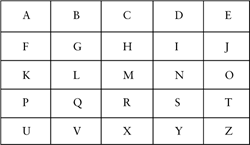
Say that each letter in Table 1 is the name of a state, and that each line represents a territorial boundary.
Illustrating territorial boundaries
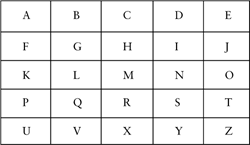
Assume further that the people of U and V want to constitute a new state, U/V. The legitimacy of this proposed act of founding might be contested, for instance, by X, for fear of being bordered by a state that is doubling its size (perhaps one might think here of the reunification of Germany in 1990). X (perhaps France can serve as an illustration) might demand either to be included in U/V, thus proposing to establish U/V/X (here, one might perhaps think of the European Monetary Union allegedly requested by France in order to gain control over the currency of the new Germany), or that U and V remain as separate states (notice that in both cases X makes a claim to be part of the constituent power, that is, the creative power, of future U, V, U/V, and U/V/X). This move of X will activate the paradox of founding in democratic theory and eliminate the legitimacy of U/V in the eyes of X. That is, democratic principles provide no guidance as to whether X should be included in the founding of U/V/X (contrary to the interest of U and V) or whether X should be excluded from the founding of U/V (contrary to the interest of X). Before agreement has been reached on who should be included in what politics, there is no democratic reason for rejecting X’s claim to inclusion in the politics of founding U/V. That is the essence of the democratic paradox. What U and V can do, however, is to suggest that still other countries, P, Q, R (think here, for instance, of the other central members of the European Community in 1990) should be included in the politics of founding U/V.
This last move can be normatively justified in different ways, for instance as a means toward more neutral arbitration of existing conflicts (e.g. Honig, Reference Honig2001; Archibugi, Reference Archibugi2008). This provides for a different kind of political community, where some constituents will judge territorial conflicts that they have no direct claims in themselves while others will benefit from legitimate political decisions on conflicts that they cannot themselves resolve in democratic ways. However, the legitimacy of the new political order, this time inclusive also of P, Q, and R, is not less vulnerable to the paradox of democracy than are the earlier constellations; it can be activated, for instance, by X thinking that an even more inclusive community will provide for a more neutral judgment of the conflict at hand. (The inclusion of P, Q, and R can of course be questioned also by any other state, like A or B. However, this requires that A or B wants to be included at least in the procedure of founding the new state, and in that case there are other arguments, explained above, which speak more directly to their inclusion.) This process of contestation can go on for long but not forever. When the whole alphabet has been included, there can be no further charges of illegitimate exclusion. Hence, in order to overcome the paradox of founding in relation to a single state (U/V), structures that allow for the inclusion of the whole world will indeed be necessary.Footnote 8
Non-voluntary inclusion
The problem of non-voluntary inclusion arises when some people are part of a state, or a global political order, from which they want to be excluded. The solution to this problem implied by GPDF is that everyone has a right to the same opportunities of participation as everyone else but that no group has rights to unilateral self-exclusion. Is this implication of GPDF normatively sound? Why shouldn’t at least groups of people who are unanimous and peaceful have a unilateral right to exclude themselves from a world political community?
Secessionists, by definition, seek exclusion from an existing political order. However, this does not mean that secessionists seek exclusion also from the constituent power of the political order in question. Constituent power is the capacity of determining the particular form of the definitional characteristics of a political order, such as its territory, decision procedures, and citizenry. For instance, the qualification of some Québécois as secessionists implies that they have some very firm positions on who should be part of the Canadian citizenry (not the Québécois!), about who should be allowed to influence this particular decision on secession from Canada (only the Québécois!), and about the territory of Canada (some of the presently Canadian territory should be controlled by the Québécois!). As these claims all refer to definitional characteristics of the Canadian state (i.e. the very identity of the Canadian state is affected by its particular citizenry, constitutional procedures, territory, etc.), we can safely conclude that people who are non-voluntarily included in the state of Canada may still be voluntarily included in the constituent power of Canada. Notice that this holds even if we deny Canada the privilege in theory of existing already. Prior to the founding of Canada, the qualification of the Québécois as ‘secessionists’ (whatever that means prior to the founding of Canada) would have implied preferences on their part equivalent to those held under the contrary and factual condition (namely: Canada should not be founded in ways that include the Québécois in its citizenry; Canada should not be founded in ways that deprive the Québécois of their wanted territory, etc).
The distinction between political order and constituent power serves to delimit and diminish the problem of non-voluntary inclusion: in many cases, secessionists seek exclusion only from their political order, not from its constituent power, and GPDF is concerned only with legitimacy in the latter. However, the distinction does not solve the problem of non-voluntary inclusion altogether. Secession might be wanted also in a stronger and more radical sense. That is the case when secessionists demand not only a political order, but also constituent power, of their own. Since the founding of political order, or the exercise of constituent power, will always consume territory and population otherwise available for other political orders, this more radical secessionist claim can be described more completely as (i) a claim to self-exclusion from an existing political order and (ii) a claim to exclusion of others, ultimately against their own will, from political influence over the allocation of some particular territory and population. Such forceful exclusion of others from constituent power does not strengthen the normative attractiveness of the more radical secessionist position, but it may still be adopted. Why, then, is the implication of GPDF (that people can be forcefully included in a democratic politics of founding at the global level) a normatively preferable alternative?
Since the aim here is for a procedural theory of democratic founding, the answer should not be based on standard substantive arguments that unilateral rights to secede exist only in response to gross violation of basic human rights (e.g. Buchanan, Reference Buchanan2004). Instead, the method should once again be to derive implications from the concept of democracy as applied to the conditions of political founding. The basic argument then is that, in a politics of founding, none of the competing positions on what political communities exist or should exist must be privileged by the political procedure itself; otherwise, the procedure would not observe the democratic criterion of neutrality between alternatives (for further discussion on this point, see section ‘Global democracy and the problem of institutions’ below). The reason why even radical secessionists must, if committed to democracy, be ready to accept this conclusion is that their perception of themselves as constituting a separate political community should be given equal status, neither higher nor lower, as against the contrary perception of their opponents that they are all part of the same political community.
At first sight, the denial of unilateral rights to self-exclude might seem unreasonable to liberals, who believe that persons can and should be able to choose their identities and social belongings without negotiation with others. At closer inspection, however, this liberal intuition gives little or no support for the case of radical secessionists. Political communities are not analogous to individual human beings. The identity of an individual has a biological basis (genes) and origin (birth) which political communities don’t (see Wendt, Reference Wendt1999: 221–224 for a further critique of anthropomorphizing political communities). The identity and boundary of prospective political communities is much more a matter of contestation and negotiation with others than is the identity and boundary of an individual human being. A claim to existence of a particular political community may for this reason be contested not only by people who are recognized as members of the political community by this claim, but also by people who this claim excludes as members of the community. It is for the democratic resolution of such political conflicts that individuals of either conviction should be counted equally; and for that to be possible all groups, regardless of size, must be included to begin with.
But how far does this principle protect the interest of people who – in opposition to deciding majorities – still conceive of themselves as constituting a political community with an identity of their own? Basically, GPDF gives to everyone the right to live under democratic rule but no right to live on a territory cleansed from unwanted people. The model of democracy, which it presupposes, is not one of identification between the rulers and the ruled (Schmitt, Reference Schmitt2008: 264) but one of tolerating cultural diversity and protecting individual rights. It presumes, in my view correctly, that democratic rights (such as freedom of speech and political assembly, equality in political and legal procedures) are not violated by people having to share territory with others they hate.
The way in which this model of global democracy balances the relationship between the majority and minorities is not in all respects different from how the same problem is treated in domestic politics. However, the partial absence of a global demos sufficient for the legitimate settling of political, social, and cultural conflicts (Zürn, Reference Zürn2000; List and Koenig-Archibugi, Reference List and Koenig-Archibugi2010) will give a global majority much stronger incentives to let dissenting minorities follow political directions of their own than majorities within national systems generally have. For instance, there is no apparent prohibition in GPDF to allow the founding of a state where some orthodox Muslims can practice their preferred kind of theocratic rule, given that such rule is actually what the people in question want and that their equal opportunities to contest the founding of the state remain even in the future (proving these assumptions will pose some challenge for theocrats though). Perhaps the oppression implied by the theocracy is not greater or more painful than that of living as a permanent and fundamentally opposed minority under a liberal democratic constitution. Diverging preferences across these and other constitutional alternatives will surely reduce the likelihood of a world state (contra Wendt, Reference Wendt2003) and might ultimately explain why humanity can allow the segregation of itself even into such powerful political orders as today’s territorial states. Moreover, GPDF implies no obligation to intervene in authoritarian states even if they are contested by their own populations. Just like democracy in domestic politics can be balanced against other values, like national security or public welfare, GPDF involves no requirement to push for democratization at all costs. The next section, however, will defend in some parts the right of foreign powers to intervene for democracy.
Implications for democratic intervention
Recall that GPDF strikes at two arguments at the same time: first, that democratic foundings are paradoxical or impossible; second, that political foundings are democratic if and only if decided exclusively by the people of the political community about to be delimited. A previous section scrutinized two theories in support of the latter argument, nationalism and contractualism, and highlighted the ways in which both fail to justify political foundings in view of people who will remain at the outside of the political orders once founded. Nevertheless, different versions of these theories are commonly relied upon by political theorists critical of democratic interventions, that is, the forceful involvement of foreign powers in the shaping of democratic states, or democratic constitutions within existing states. Logically, in view of nationalist and contractualist theories of legitimate founding, critics have suggested that promotion of democracy from the outside of a country by force is a paradox or itself undemocratic.Footnote 9
More specifically, it has been argued for instance that ‘if the basic idea of democracy is that of self-determination … then it is self-contradictory to try to initiate that through a violation of their self-determination by a forcible invasion and occupation’ (Beetham, Reference Beetham2009: 446; see also Archibugi, Reference Archibugi2008: 224). The assumption of self-determination relied upon in this view reflects the contractualist theory, rejected above, namely that an existing state is legitimate if founded and sustained by an agreement to do so among the people of the state. Resounding of nationalist presumptions, equally rejected above, is the argument that democratic interventions are impossible because democratic institutions must reflect the unique historical experiences of a unique people: ‘The parts of the [democratic] machine are not detectable; the organism is in fact indescribable, and what keeps it going, the “habits of the heart”, as Tocqueville called them, are unique and undefinable. In short, we cannot by any conceivable means “show them how to do it” ’ (Barzun, Reference Barzun1986: 25; for an application of this argument to the US-led war against Iraq, see Habermas, Reference Habermas2003: 369).
Let me in response to these views of democratic intervention as constituting yet another paradox consider some issues associated with the contrary implication of GPDF, namely that the obstacles that are faced in attempts at bringing democracy to a country from the outside by force, those obstacles do not include any necessity of founding a democratic state by the powers of its future citizens alone. I will begin by revisiting the question of how large a portion of humanity must agree to the founding of a political order for it to be democratically legitimate.
Global democracy and the problem of institutions
Recall the Rousseauian position, cited above, that the establishment of a social contract must be agreed to by each individual to whom the contract will apply. While this position yields an extremely strong negative right against states which some people cannot accept, it also erodes the positive right of people to found the states they actually want. In democratic politics we need to strike a balance between such alternatives, in the sense that neither the negative nor the positive right should be favored by the decision-making procedure itself. Democracy is a system in which, in case of persistent disagreement among people, the outcome is determined by the quantity of votes distributed equally to all individuals rather than by the quality of particular voting alternatives. Since majoritarian procedures are maximally neutral among decision alternatives (Dahl, Reference Dahl1956; May, Reference May1982), the application of majoritarian procedures would then have a prima facie justification not only within existing states, but even in their founding.
What political institutions realize this ideal most effectively under the conditions of contemporary world politics is a controversy in its own right (for one string of proposals, see Patomäki and Teivainen, Reference Patomäki and Teivainen2004). The idea of a world parliament has attracted supporters for generations; persons sympathetic to this idea have proposed also that the International Court of Justice be given the responsibility to declare an international state of emergency as a first step toward foreign intervention (Archibugi, Reference Archibugi2008: 198). Others contest the domestic analogy of like suggestions and argue that, because of structural differences between national and global politics, the latter cannot be democratized through the same institutions as the former (e.g. Macdonald and Macdonald, Reference Macdonald and Macdonald2010: 19). One among several alternative models suggests greater responsibilities for civil society actors: ‘democracy … is to be found in the juxtaposition of a multiplicity of self-governing and self-organizing collectives constituted on diverse spatial scales – from the local to the global’ (McGrew, Reference McGrew2002: 274, who prefers a still different model of democracy himself). In this transnational model of global democracy, democratic intervention would not come in the form of UN sanctioned military operations by member-states, but through the direct participation of individuals or groups. The voluntary involvement of foreigners on the republican side in the Spanish Civil War, 1936–39, might be an illustration of this possibility.
Equally open is the question of how far the democratization of world politics must proceed in order to allow for legitimate decisions on democratic intervention at all. Again, two alternative positions can be distinguished. The most demanding criterion would be to set the minimal requirement of global democracy in ways analogous with national democracy. This might require the establishment of a world parliament held to account by a truly global public. A less demanding, and politically more offensive, alternative would be to require only that the world political order functions more democratically than does the political procedure which at present sustains the political order of the target state. This would surely be a more permissible criterion of democratically legitimate interventions. Interventions that operate on a UN mandate decided after open and honest discussion, internationally and within democratic member states, would not necessarily be less democratic, though still largely undemocratic, than the self-sustenance of an authoritarian state through unrestricted violence against its own people and neighboring states.
The scope of global founding power
The paradox of democratic founding, as discussed in this article so far, refers primarily to a difficulty in the founding of the people rather than in the founding of political institutions. May we then infer that global majoritarian procedures should, on the basis of GPDF, be confined to the establishment of boundaries among people while leaving issues of political institutions to be decided at lower territorial levels? One reason why this cannot generally be the case is that the global authority over the delimitation of peoples might then be contradicted. To let a territorially bounded state exclude, say, women or ethnic minorities from political procedures would undermine the earlier global decision that included these groups in the first place. Hence, the global authority over the drawing of territorial boundaries implies a further global authority over issues of inclusion and exclusion within territorially bounded states.
This derived principle sets considerable limits on the range of constitutional alternatives over which territorially limited states can be allowed to have final control in accordance with procedural democratic theory. However, the room for democratic constitutional choice is not completely eliminated at lower territorial levels. One example is the choice between alternative institutional models of democracy, such as parliamentary and presidential systems; proportional and majoritarian elections; centralist and federal states; direct and indirect participation; small and large public sectors. As long as all alternatives realize democracy to a satisfactory degree, there is no reason to decide on these alternatives by an incontestably inclusive procedure. The paradox of founding identifies an inability of democratic procedures to yield legitimate results only in cases when some people are in fact politically excluded. Another example of democratic constitutional choice at lower political levels is the division of one state into smaller units than the one established by global procedures, or the merging of two states into one. If the people within a democratic state would agree to divide themselves into several peoples of several states, or the people of two states would like to merge into one, the democratic legitimacy of the new boundaries would not necessarily presuppose a decision by the global majority. Again, the paradox of democracy does not identify any illegitimate decision in cases when people on both sides of a territorial boundary agree with the drawing of that boundary. However, should the new boundaries for some reason be contested from the outside, the democratic solution will consist in referring the decision either to a level which people on both sides of the boundary can agree on, or to the level where no one is excluded and the paradox of foundation does not exist, that is, the level of humanity as a whole (cf. Abizadeh, Reference Abizadeh2008: 54).Footnote 10
We have then identified some limitations in the global foundational authority: the establishment of new constitutions is a global responsibility only in relation to existing undemocratic constitutions, and the establishment of new states is a global authority only in relation to states whose boundaries are internally or externally contested. Moreover, if a decisive majority of global democracy were not to be activated by a particular contestation of constitutions or state boundaries, we would have to conclude that the global majority has given its consent to the existing order. Hence, the outcome of applying GPDF in political practice need not be a radical restructuring of the world: to the extent that people are satisfied with the delimitation of their present political communities, those delimitations will not change. Furthermore, people and their governments will often be uninterested in the founding or breaking up of a particular state, perhaps because of geographic or cultural distance. Depending on whether you paint the world mainly in cosmopolitanism or national republican colors, you will have different pictures of how interested people are to participate in global foundational politics. However, GPDF does not presuppose either the cosmopolitan or the republican painting: there is no reason to require that people must exercise their right to participate in global procedures of foundational politics, as long as they have an equal opportunity to do so. Voluntary abstention from participation can smooth politics in all contexts.
Still, the concept of the global foundational authority is sufficiently permissive of democratic interventions for it to confront politically controversial questions. Against the background of recent disagreements over democracy promotion, the key issue is perhaps the following: What implications do the political views of people in existing authoritarian states have for the possibility of foreign interventions to contribute to the founding of democratic constitutions in those states? In putting the question this way, I bracket the issue of whether the boundaries of the state are contested from the outside and focus instead on internal factors. The question is framed so as to capture the main difficulties in relation to, say, Iraq and Afghanistan rather than Kosovo and East Timor (now Timor Leste). The next section considers theoretical issues in relation to like cases.
Rights to demand democratic intervention
Suppose that an authoritarian minority succeeds in excluding a pro-democracy majority from the state’s political procedures. Can we conceive of a foreign intervention, which contributes to the political inclusion of the pro-democracy majority, as part of a democratic procedure of founding a new constitution in this case? In light of the paradox of founding, the answer appears to be yes. Consider for the sake of the argument an opposite position, namely that the state in question has a democratic right not to be interfered with. Defending this position on the basis of a procedural democratic theory would necessitate an assumption that the people of the state consists of the pro-autocracy minority alone, not the pro-autocracy minority and the pro-democracy majority together. Otherwise, the pro-autocracy minority would simply be outvoted in case the people made a choice between democracy and autocracy. However, as there is also a pro-democracy majority, this policy of exclusion would be contested. This disagreement in turn activates the paradox of foundation, which implies that there is no procedural solution to the conflict within the boundaries of the state in question. The procedural legitimacy available in this case stems from the founding decision of the state, and that decision can be democratic only if undertaken at the global level (or some other political level on which both parties to the conflict can agree to decide). Hence, the conflict between the pro-autocracy minority and the pro-democracy majority must be settled within a global democratic procedure, or at least a significantly more democratic global procedure than the one which sustains status quo. Of course, this does not make all interventions from the outside democratically legitimate, and it does surely not make democracy the only legitimate reason for action. However, it confirms that foreign democratic interventions can be part of a democratic procedure for establishing a new constitution.
The conclusion is not so different when an authoritarian regime is supported by a majority, while being opposed by a pro-democracy minority. In this case, it does not favor democracy to insist that the constitution should be democratically decided within the state. The majority would then simply vote for autocracy. Moreover, the pro-autocracy majority’s rejection of democracy in this case need not rely on any vulnerable assumption that the people of the state consists only of the pro-autocrats themselves. Autocracy would be sustained even if there is no discrimination between members of the pro-democracy minority and the pro-autocracy majority. However, these considerations do not affect the possibilities to justify democratic interventions from the outside. An intervention-friendly pro-democracy minority may (just like an intervention-friendly pro-democracy majority) appeal to the fact that democratically legitimate state boundaries presuppose a global democratic decision, and then rely on the derived principle that the global democratic decision must not be obstructed by denying people access to political power even within existing territorial boundaries. Hence, it is consistent with procedural democracy to undertake democratic interventions even in countries where a majority supports autocracy.
But this may seem like a Pandora’s Box. Does GPDF allow democratic interventions even in states where there is practically no demand for it at all? The question is not without political relevance. Even in an autocratic state where there is a pro-democracy opposition, the people may in general prefer autocracy to such democracy as comes with foreign intervention. In particular, in countries which have recently fought for and won their independence from colonial powers, or in countries subject to international domination of some other sort, it should come as no surprise if people set a higher value on their national sovereignty than on their individual liberty and democracy (Beetham, Reference Beetham2009). However, the underlying ethos of GPDF suggests that democratic interventions should not be undertaken in such cases. Recall that this principle was constructed for the purpose of finding a way around the paradox of foundation. This paradox, for its part, gets politically significant only when there is disagreement about where boundaries should be drawn or what constitutions should be established. But when there is no such disagreement in the first place, there is no good reason to apply GPDF. In fact, it would be inconsistent with the conceptual and normative justification of this principle, that is, to establish a common ground for the making of collective decisions, to require the promulgation of such foreign interventions as would in fact create disagreement and activate the paradox of foundation. At least in theory, therefore, there is a clear limit on how far GPDF should lend itself to justification of democratic interventions: interventions should not be undertaken if they create disagreement over constitutions or boundaries in cases where there is no disagreement in the first place. Whether this normative conclusion can in turn be extended, so as to imply that democratic interventions should be abstained from whenever they create more disagreement than they solve, is a substantive issue which will itself have to be decided within democratic procedures.
Conclusion
I have suggested that in global democracy there is no paradox of democratic founding. The counter-position, that the founding paradox is genuine and therefore inescapable regardless of the political context, derives from the perhaps realistic but conceptually and normatively misleading position that we must necessarily exclude some people at the founding moment of democratic states and constitutions. The truth is that we need not, in ideal theory, exclude anyone. This observation contradicts not only the view of democracy as being based on a paradox, but also nationalist and contractualist theories of legitimate foundings of states and constitutions. These theories fail precisely because their concepts of legitimate foundings arbitrarily exclude particular groups of people. In opposition to all of these positions, I have developed an alternative principle of democratic founding that puts no limitations on human inclusion whatsoever. The core of this principle is that a state is founded in accordance with democracy if the foundational decision is made by people who will live within as well as beyond the boundaries once founded (ultimately involving humanity as a whole) and if each individual has the same opportunity to influence such politics of foundation.
This principle will not seem revolutionary to cosmopolitan democratic theorists (e.g. Bohman, Reference Bohman2007; Archibugi, Reference Archibugi2008). In their tradition, the subject to which political decisions should be justified has often been construed precisely as humanity as a whole. However, the issue of foreign intervention has confronted cosmopolitan political theory with a particularly difficult problem. Theorists who are otherwise concerned with rights and principled judgments have found it necessary to stress ‘to a greater extent than is usual, the consequentialist character of the ethics of intervention. It makes a difference whether we think that an intervention will do more good than harm’ (Doyle, Reference Doyle2001: 222). Others have found it difficult to see how an intervention in support of a pro-democracy insurgency ‘can be addressed other than by examining the urgency of the interests at stake in relation to the costs of interference and its probability of success’ (Beitz, Reference Beitz2001: 279).
In response to these perceived difficulties in reaching categorical conclusions about the justifiability of democratic interventions, I have examined the conceptual possibilities within procedural democratic theory to accommodate decisions on democratic intervention. In contrast, even to cosmopolitan authors suggesting that democratic interventions are themselves undemocratic if undertaken by force (e.g. Archibugi, Reference Archibugi2008: 224), I suggest that democratic interventions can be part of a global democratic process of founding new states and constitutions. The practical lesson that can be learned from this paper is therefore not about advocating or opposing democratic interventions in particular cases, but about the value of making world politics more democratic.
This final step, of course, is not a minor one. Whether democracy can and should be established beyond the nation-state is intensively contested by communitarian and realist authors. Nevertheless, it makes an enormous difference for how we approach that debate if we conceive of global politics as still one context in which democratic foundings are impossible even on purely logical grounds, or as the only context which does effectively not produce that problem.
Having rejected the first view through a defense of GPDF, it makes sense to conclude by some suggestions as to how the politics of founding can be made more democratic. A limited proposal would be to reform the politics of international recognition, so that new states are established as subjects in international law by democratic decisions within global institutions rather than unilaterally by individual states. A more demanding reform would be to subordinate democratic interventions to international law and to decide on them multilaterally rather than unilaterally. And a truly revolutionary change of world politics would be to decide on political conflicts over territory and/or population either at whatever political level that the conflicting parties can agree on, or at the global political level where the founding paradox does not arise and boundary decisions can be made democratically. In view of GPDF, such proposals hold significant promise for enhanced world democracy.
Acknowledgments
For very helpful suggestions and disagreements on the topic of this paper I thank Olov Agné, Jens Bartelson, Simon Birnbaum, Nicolas Bouchet, Jussi Kurunmäki, Sofia Näsström, Jouni Reinikainen, Rainer Schmalz-Bruns, Duncan Snidal, Alexander Wendt, and three anonymous reviewers of International Theory. Earlier versions of the paper also benefited from reactions to presentations at the 2008 Millennium Conference: Interrogating Democracy in International Relations at London School of Economics, and the 2009 Annual Meeting of the Swedish Network in Political Theory at Stockholm University. The research reported here was made possible through a grant from the Swedish Research Council.