Introduction
Leave from employment for parents to take care of their children is one popular measure to enable so-called ‘work-life balance’. Maternity leave is well-established in most countries and take-up is generally high. Fathers’ access to leave has received less attention.Footnote 1
Many countries offer a short ‘paternity leave’ which is usually taken with the mother at the time of birth. A more extensive access to leave for men is generally lacking. According to the most recent report from the International Leave Network, only 6 out of the 42 countries studied provide an incentivised father-targeted parental leaveFootnote 2 beyond the short paternity leave, compared to 35 offering a long and highly remunerated maternity leave (Blum et al., Reference Blum, Koslowski and Moss2017).
Yet parental leave for fathers is seen as a key policy area for promoting gender equality (Gornick and Meyers, Reference Gornick and Meyers2009). The International Labour Organisation (ILO, 2009), for example, passed a resolution on gender equality, calling for governments to develop policies that include paternity and/or parental leave, with incentives for men to use them. Such policies work by encouraging men to take on care work and by enabling women's engagement in employment. Research demonstrates that extending leave alone to fathers promotes their involvement in childcare and housework (Schober, Reference Schober2014; Tanaka and Waldfogel, Reference Tanaka and Waldfogel2007; Kotsadam and Finseraas, Reference Kotsadam and Finseraas2011). Fathers’ involvement with childcare may also positively influence both maternal and child mental well-being in some families (Twamley et al., Reference Twamley, Brunton and Sutcliffe2013).
According to Baird and O'Brien (Reference Baird and O'Brien2015), the UK is an example of an Anglophone country characterised by low levels of statutory leave provision for mothers and even less for fathers. They argue this is due to an historical emphasis on men's breadwinning roles and women's caring roles (see also Lewis, Reference Lewis1997). None of the Anglophone countries provide fathers with a well-compensated or lengthy individual entitlement to parental leave, although the last ten years have seen attempts to address the gap in fathers’ leave, albeit in minimalist ways (O'Brien, Reference O'Brien2013). Differential access to leave results in a schism between ‘parental-leave-rich and parental-leave-poor households’ (O'Brien, Reference O'Brien2009: 190). Despite the documented potential benefits of well-compensated leave, little attention has been given to the socio-economic differentials in access to leave (McKay et al., Reference McKay, Mathieu and Doucet2016). Without proper attention, parental-leave policies may work to decrease the gendered imbalance in access to leave, but exacerbate socio-economic inequalities. As it is, some infants start their life in families with higher access to money, job-security, and parental care-giving, in comparison to others raised in ‘parental-leave-poor households’ with relatively less economic stability and support for parental care. This study examines knowledge, access and intention to take parental leave amongst parents in the UK, as reported by expectant mothers, focusing particularly on fathers’ take-up of a newly introduced parental leave provision to examine whether and how such inequalities are observed within the UK.
Parental leave in the UK
The UK leave policy has focused on long low-paid leave for mothers, with less access for fathers. A nine-month long maternity leave was introduced in 1973, and extended to 12 months in 2003 when a short two-week paternity leave was introduced for fathers. Maternity leave is paid at 90 per cent of earnings for the first six weeks; a flat-rate payment of £140.98 per week from week seven to 33; and the remaining 13 weeks are unpaid. According to the 2009/10 survey, the mean length of maternity leave taken by women is 39 weeks – that is the paid part of the leave. Just under half take the full 12 months (Chanfreau et al., Reference Chanfreau, Gowland and Lancaster2011). The two weeks of paternity pay are paid at £140.98 each. Some employers offer enhanced pay to their employees during leave – an estimated 28 per cent top up maternity leave pay and 20 per cent paternity leave pay (Chanfreau et al., Reference Chanfreau, Gowland and Lancaster2011). A directive from the EU also provides for a non-transferable leave entitlement of up to 18 weeks (a maximum of four weeks can be taken per year) across the EU. This is unremunerated, and knowledge and take-up is reportedly very low (O'Brien and Koslowski, Reference O'Brien and Koslowski2017). Since 2011, mothers have been able to transfer their maternity leave to their partners. First through a mechanism called Additional Paternity Leave (APL), where the transfer could happen from 20 weeks, then replaced in 2015 by Shared Parental Leave (SPL). SPL allows mothers to transfer their maternity leave entitlement to the father/partner from two weeks after the birth or adoption of a child. Fathers taking SPL can have access to the maternity pay entitlement, but from six weeks only, by which time it is a flat rate and available only until 39 weeks. SPL can also be taken simultaneously by the mother and father, and/or in blocks over the course of 52 weeks. Evidence on employer enhancements to SPL pay is lacking.
There is an emphasis on ‘choice’ in UK leave policy that can be seen in the preamble to the Bill which introduced SPL: ‘Legislating to give parents access to flexible parental leave; so that where they want to, mothers and fathers can share caring’ (Children and Families Bill, 2013). On the other hand, the leave transfer mechanism appears to contradict the neoliberal emphasis on individual autonomy. This is likely due to a cultural emphasis on the mother as primary carer and a reflection of the prevalence of the modified male breadwinner household, where mothers work part-time while fathers work full-time (OECD, 2017). SPL gives the option for parents to maintain the status quo of extended maternity leave alone, unlike fathers’ quota policies favoured in Nordic countries where leave remuneration is foregone if the father does not take the leave.
Nevertheless, despite a UK emphasis on choice, eligibility for even the lowly remunerated SPL is comparatively restrictive, whereby both parents must meet eligibility requirements, the mother for maternity allowance and the father for paternity leave. For mothers, that means those who have worked continuously for 26 weeks prior to the due date and who meet a minimum earnings test.Footnote 3 For paternity leave, employees must be the biological father of the child or the mother's husband, partner or civil partner; they should expect to have responsibility for the child's upbringing; and they should have worked continuously for their employer for 26 weeks ending with the fifteenth week before the baby is due and remain employed at the time of the child's birth.
What is known about fathers’ leave in the UK?
Despite policy and media interest in SPL, there has been very limited research conducted to-date and knowledge on take-up is poor. The UK government does not routinely collect data on leave take-up. Figures released by Her Majesty's Revenue and Customs (HMRC) estimate that between 2 and 8 per cent of parents took SPL in 2016Footnote 4, but these cannot be taken as necessarily reliable or accurate.
The UK Maternity and Paternity Rights survey (Chanfreau et al., Reference Chanfreau, Gowland and Lancaster2011), conducted before the introduction of the maternity transfer mechanism, found that 91 per cent of fathers took some form of leave around the birth of their child. Fifty per cent took the statutory two weeks paternity leave and 75 per cent took at least some of the statutory leave entitlement. Those who work in large private and public sector organisations are most likely to receive extra leave benefits from employers for longer periods of paternity leave, and take up is higher. The main deterrent to taking paternity leave was being unable to afford it. This is likely to be compounded by relatively high shares of parents not being eligible for paid leave: analysis of the UK Labour force survey in 2017 revealed that over one-quarter (28 per cent) of men and women in employment do not have access to paid paternity or maternity leave (O'Brien et al., Reference O'Brien, Aldrich and Connolly2017). Ineligibility was mainly due to respondents being self-employed or not having been in employment for the qualifying period.
A UK government sponsored survey on attitudes towards SPL found that men's greatest ‘concerns’ around SPL were to do with finances and their career (BIS, 2015). Likewise, qualitative research on couples’ decision-making around APL, reveals that parents worry that men will face greater career penalties for taking leave than women, thus encouraging women to take more or all leave available (Kaufman, Reference Kaufman2017). Women's desire to take the full maternity leave may also be a deterrent (Twamley, Reference Twamley2016).
Evidence from other countries suggests high remuneration and ‘use-it-or-lose-it’ policies are the most effective in promoting fathers’ take-up of leave (Deven and Moss, Reference Deven and Moss2002). A considerable body of research has also found that mothers’ higher earnings and fathers’ employers can impact on fathers’ take-up of leave (Bygren and Duvander, Reference Bygren and Duvander2006; Geisler and Kreyenfeld, Reference Geisler and Kreyenfeld2011; Brandth and Kvande, Reference Brandth and Kvande2002; Haas et al., Reference Haas, Allard and Hwang2002; Reich, Reference Reich2011). Fathers’ gender egalitarian ideology and support for leave also promotes uptake (Lammi-Taskula, Reference Lammi-Taskula2008). If childcare is seen as the mother's responsibility, it is not easy for her to return to work before the whole parental leave period is over (Brandth and Kvande, Reference Brandth, Kvande, Jensen and McKee2003; McKay and Doucet, Reference McKay and Doucet2010). The latter is likely to be particularly relevant when parental leave is gender-neutral or functions via a transfer, such as in the UK.
The majority of this research has been conducted in Nordic countries and in Germany. Large-scale studies have tended to rely on register and census data and are thus limited by the data collected – normally restricted to demographic and employment factors. Qualitative studies have elicited more nuanced data, but usually draw on retrospective accounts of parents’ leave-making decisions. This is problematic since previous research has shown how accounts for leave-taking decisions can change over time (O'Brien and Twamley, Reference O'Brien, Twamley, O'Brien and Wall2017). An exception is Grunow and Evertsson's (Reference Grunow and Evertsson2016) recent cross-European studyFootnote 5 exploring dual-earner couples’ transitions to parenthood. They found that pregnant women already expect a more traditional gendered division of labour after birth due to a perceived ‘culture-policy gap’ which does not support shared or father-led parenting.
We focus on expectant parents’ knowledge, attitudes, eligibility, and reported leave intentions in the UK via a detailed questionnaire distributed at antenatal clinics in two hospital trusts in London. We have three specific aims. First, we intend to fill the research gap surrounding SPL, examining who knows about and favours SPL and who is eligible and actually plans to take it, along with the motivations and barriers to do so. Such data are vital to provide a thorough understanding of processes involved in couples’ policy take-up practices. Second, we explore how and whether hypothetical variations in policy and contextual factors could shape leave take-up, using ‘vignette’ questions. Third, we investigate social inequalities in eligibility, knowledge, information behaviour and reported intended take-up. Much previous scholarship has focused on men and women's differential access to leave, but following recent concern over the potential social inequalities inherent in leave policies (O'Brien, Reference O'Brien2009; McKay et al., Reference McKay, Mathieu and Doucet2016), our aim is to examine whether and how UK leave policy may contribute to or exacerbate class inequalities for families.
Theoretical framework for investigating leave-taking plans in the UK
Drawing on Risman's (Reference Risman2004) conceptualisation of gender as a social structure, combined with theories of social stratification, we consider the individual, interactional and institutional domains that shape parents’ behaviour. At the individual level we consider gender ideologies, as expressed by support for traditional gendered divisions of paid work and family responsibilities, as well as what Oriel Sullivan refers to as ‘gender consciousness’. For Sullivan (Reference Sullivan2006), any change in gender inequalities is unlikely to come about without a concomitant change in gender consciousness, defined as a ‘process of the recognition of rights based on information from the wider society’ (2006: 87). While this may come about as a result of policy changes (Ellingsæter et al., Reference Ellingsæter, Kitterød and Lyngstad2017), they may also be necessary to precipitate such policies and for their widespread take-up. The interactional level refers to West and Zimmerman's (Reference West and Zimmerman1987) ‘doing gender’ perspective, whereby men and women are seen to continuously remake gender through their daily practices and interactions with one another by, for example, meeting social expectations around motherhood and fatherhood. In the UK there are highly gendered models of appropriate care, despite increased discourses of ‘involved’ fatherhood (Gregory and Milner, Reference Gregory and Milner2008).
The policy context shapes actors’ perceptions of their interests and constrains choice by limiting potential practices (Lewis, Reference Lewis2008; Grunow and Evertsson, Reference Grunow and Evertsson2016). The introduction of new policies in family and work reconciliation, such as Shared Parental Leave, enables individuals to imagine and perform new or different family practices. Previous studies have suggested that fathers’ probability of taking leave increases significantly if they have an individualised and non-transferable paid leave entitlement (O'Brien, Reference O'Brien2009; Reich, Reference Reich2011; Geisler and Kreyenfeld, Reference Geisler and Kreyenfeld2011). We investigate whether a hypothetical situation, with an individualised leave entitlement of a similar duration for fathers to that which is currently available for mothers, would increase take-up intentions in the UK. Furthermore, previous studies have shown that fathers’ leave take-up rises the longer the leave entitlement has been in place and the more ‘normal’ take-up by fathers is perceived to be (Rege and Solli, Reference Rege and Solli2013; O'Brien and Wall, Reference O'Brien and Wall2017). Regarding these contextual features, we therefore formulate the following two hypotheses:
H1: A hypothetical individual leave entitlement of 37 weeks for each parent would be associated with a greater likelihood of planned take-up of Shared Parental Leave.
H2: A fictitious description of more widespread use among social networks would be positively associated with planned take-up of Shared Parental Leave.
Taking heed of O'Brien's observation (Reference O'Brien2009) of the potentially divisive nature of work-family reconciliation policies across different contexts, and in recognition of the multiple social differences across families, we also draw on economic and social stratification theories. According to neo-classical economic theory (Becker, Reference Becker1981), paid parental leave lowers parents’ opportunity costs of temporarily interrupting employment to care for the child. Remuneration during parental leave in the UK is low – less than half of the estimated ‘living wage’ (TUC, 2017). To maximise household income, it would be efficient for the partner with lower relative potential earnings to interrupt paid work and specialise in unpaid work until the receipt of parental leave benefit or the period of job-protected leave expires or until external childcare provision is available at costs which are lower than the second earners’ potential income. Given that men on average earn more than women in the UK (World Economic Forum, 2014), such calculations could inhibit men's access to leave and children's access to father care. Higher earning families may find a period of low pay more feasible.
However, such a theory assumes perfect knowledge and stable preferences around family practices across different social groups, which previous research has called into question (Becker and Schober, Reference Becker and Schober2017; Kan and Laurie, Reference Kan and Laurie2016). Drawing on the accommodation model (Chaudry et al., Reference Chaudry, Henly and Meyers2010; Meyers and Jordan, Reference Meyers and Jordan2006), we interpret decisions around leave as ‘accommodations – to family and employment demands, social and cultural expectations, available information, and financial, social, and other resources’ (Meyers and Jordan, Reference Meyers and Jordan2006: 53). From this theoretical model, we expect disparities in the take-up of SPL because parents’ preferences, expectations and constraints (including economic) and resources are likely to be unevenly distributed across social groups. With respect to childcare choices, previous studies from Belgium and Germany found that parents with lower levels of education and ethnic minorities on average start searching for formal childcare later, visit fewer childcare centres prior to registration, and use a smaller set of information sources (Klein et al., Reference Klein, Biedinger and Kolb2016; Vandenbroeck et al., Reference Vandenbroeck, Visscher and Nuffel2008). Given rather complex eligibility criteria for parental leave in the UK, differences in information-seeking strategies between education groups and ethnicities may result in socially stratified knowledge about parental leave eligibility and take-up intentions. Many parents will seek advice from family and friends, over and above official sources, or may simply follow what their peers already practice. To date, we do not know whether this tendency differs across social groups or how it relates to parental leave take-up intentions.
In a first step, we investigate descriptively variations in eligibility, knowledge and actual SPL take-up intentions by educational level and ethnicity. In a second step, we apply an accommodation model and explore to what extent any social and ethnic differences may be due to additional employer benefits, gender ideologies or information-seeking behaviours. We formulate the following hypotheses:
H3: Less educated and ethnic minority expectant mothers are less likely to have heard of SPL, to be eligible for SPL, to correctly know about the eligibility, to favour SPL and to actually plan sharing parental leave.
H4: Variations in extra leave benefits beyond the statutory provision by employers are likely to account for some of the observed differences between education and ethnic groups.
H5: Gender ideologies and religiousness are likely to account for some of the observed differences between education and ethnic groups.
H6: Information-seeking and processing behaviours are likely to account for some of the observed differences between education and ethnic groups.
Methods
The survey was conducted as part of a mixed-methods longitudinal research project examining decision-making, experiences and consequences of different leave-taking patterns amongst parent couples in the UK. Only findings from the survey are reported in this paper.
Survey design
A survey was selected as part of the overall project to capture the intended take-up, knowledge and attitudes towards parental leave options of a broad spectrum of expectant parents. The survey instrument was developed following a review of recent literature, a qualitative pilot studyFootnote 6 and a consideration of items used in the Understanding Society UK Household longitudinal study.Footnote 7 Face and content validity of the developed instrument was pretested with a group of expectant parents known to the first author (n = 5). This process resulted in an instrument containing a combination of multiple-choice, Likert scale and open-ended questions. The questions covered (1) demographic background, including employment history and plans; (2) knowledge of and attitudes to UK leave policy; (3) leave intentions and decision-making; (4) gender and family ideology; (5) information-seeking behaviour; and (6) hypothetical behaviour under different policy contexts. Copies of the survey instrument are available on request from the first author.
Survey distribution
The majority of survey respondents were recruited at antenatal clinics in two hospital trusts – one in central London and one on the outskirts of London. The trusts were selected based on the diverse group of parents that access the services. The interviewer approached expectant parents in the clinic waiting rooms with an information leaflet outlining the aims of the survey. Participants were given five minutes to consider their participation and, if they consented, were then given an iPad on which to complete the online survey. Only one parent from each couple was asked to fill in the survey – either parent could consent – and they were instructed that they should answer the questions from their personal perspective only. The questionnaire gave the participant the opportunity to forward a linked survey for their partner to complete at a later time. A paper copy was also offered if preferred – only one couple did prefer. A small sample of parents was recruited online via pregnancy and parenting websites. Surveying expectant parents during pregnancy has a methodological advantage because couples are at this time making important decisions about their individual careers and family life. This affords us the opportunity to investigate expectant parents’ plans and ideas about their future. Survey responses were anonymous, unless respondents chose to leave their contact details for a follow-on qualitative interview, in which case they were informed that the lead researcher would have access to their answers and contact details.
Analysis methods
To investigate how contextual factors, such as the type of entitlement which the statutory parental leave policy provides (H1) and leave taking among the social network (H2), may affect couples’ division of leave, we included vignette questions in the survey. These asked expectant parents how much leave each they and their partners would use under different hypothetical context scenarios. We compare these answers to participants’ actual plans of parental leave take-up in the current context. The difference in the percentages of participants’ reporting intentions to take leave may be interpreted as indicative of the relevance to planned behaviour, which they may alter if the context changes. Yet, they cannot be interpreted as definitive causal evidence.
We then examine variations across social and ethnic groups (H3) with respect to five binary dependent variables: having heard of SPL, eligibility to SPL, knowledge about the eligibility, general approval of SPL and actual plan to share parental leave. We apply multivariate logistic regression and calculate average marginal effects to facilitate the interpretation of the results.
To explore whether extra leave benefits beyond the statutory provision by employers (H4), gender ideologies and religiousness (H5), or information-seeking behaviours (H6) correlate with the dependent variables and may account for some of the variation across socio-economic groups, we add them separately to the regression models. To be able to compare the size of coefficients across different same-sample nested logit models, we apply the ‘KHB method’ to the coefficients. This corrects for the effects of rescaling in different model specifications and allows us to separate the effects of confounding from rescaling (Karlson et al., Reference Karlson, Holm and Breen2012). Furthermore, the KHB method may be used to decompose the total effect of a variable into a direct and an indirect effect. The basic idea of the method is to compare the full model with a reduced model that substitutes the additional explanatory variables – i.e. gender ideologies, employer benefits, and information-seeking behaviours – with the residuals of these variables from a regression of these additional explanatory variables on the socio-economic status variables (for details, see Karlson et al., Reference Karlson, Holm and Breen2012). The KHB method consequently allows us to calculate what percentage of the correlation between the socio-economic status and the dependent variables is reduced after including the additional explanatory variables.
Sample and demographics of respondents
A total of 856 expectant parents took part in the survey. Of these, 820 were recruited at antenatal clinics and 36 over the internet. However, 97 participants did not complete the survey, mostly because they were interrupted and called to an examination. Of the respondents, 609 were female, whereas 147 respondents were male and 3 respondents identified as ‘other’. The analysis outlined below is based on female participants with completed questionnaires only, as the male participants were usually the partners of women who had answered the questionnaire. A higher than expected proportion hold a college or university degree – 76 per cent in contrast to 38 per cent among the London population as a whole in 2011 (Office for National Statistics, 2013b). Forty-eight per cent are homeowners, similar to the proportion recorded for London in the 2011 census, while 38 per cent identify as white British – slightly less than the 45 per cent noted in the same census (Office for National Statistics, 2013a). This reflects the diverse populations of the clinics where the majority of the data collection took place. Some questions have only been asked to expectant mothers who were working for pay or were full-time students at the time of the interview, so some modelling steps will focus on this group of 482 women. The rate of item non-response was generally low but occurred most frequently for the gender ideology items (6 per cent) and for items asking about information-seeking behaviour (12 per cent).
Operationalisation of dependent and independent variables
Dependent variables
We regard having heard of SPL, generally approving of SPL, being eligible to take it and knowing about this eligibility as preconditions to actual take-up of SPL. We explore social inequalities in these four aspects in addition to variations in the actual plans to share parental leave. We constructed five binary variables. We distinguished whether respondents said ‘yes, they had heard of SPL’ as opposed to those who answered ‘no’ or ‘not sure’. After giving a short description of what SPL entails, we asked respondents whether they were in favour of this policy and combined the categories not in favour and not sure, as very few expectant parents said they were not in favour. We approximated whether respondents met the conditions of eligibility of parental leave based on both partners’ employment status, the due date and the time since women and their partners had started the current job. We categorised couples as eligible to SPL if the mother was (self-)employed and had started her current position more than 26 weeks before the due date while her employed partner needed to have been working for the same employer for at least 41 weeks by the due date. As we had no information about wages and previous employment, couples were coded as not eligible if the male partner was self-employed or if one of the partners was unemployed, in full-time education, taking care of family full-time, not employed due to a disability or volunteering. Slight discrepancies with actual eligibility after childbirth might arise if partners were to lose their jobs before the birth or if mothers had been working previously but were not working anymore at the time of the interview. However, these cases are likely to be rare.
In addition, women were asked whether they believed that their partners were eligible to take any of four different leave options. We compared these beliefs with the calculated eligibility measure to capture respondents’ knowledge about eligibility. We constructed three categories: i) match between eligibility and belief, ii) respondents believe they are eligible but based on their responses to the employment and tenure questions they would not be, and iii) respondents who are eligible but believed they were not or indicated that they were not sure. As the second category included only 28 of the respondents, we combined these with the third category and continued with a binary variable in the subsequent analysis.
Expectant mothers were also asked whether the couple intended to take maternity leave, paternity leave (1–2 weeks at time of birth) and shared parental leave (both parents take part of maternity leave).
Key explanatory variables
To measure respondents’ educational qualifications, a dummy variable distinguishes between i) university graduates and ii) those with lower levels of qualification (No formal qualifications, GCSEs, A-levels or vocational training). More detailed categorisations proved difficult due to small numbers in each of the categories. For the same reason, the ethnicity variable only distinguishes between i) white British respondents and ii) other ethnicities.
To capture additional support from employers beyond the statutory leave regulations, a dummy variable differentiates between i) any extra leave benefits and ii) no such benefits or not sure.
To capture gender ideologies and beliefs, respondents were asked to express their level of (dis)agreement on a five-point scale for four items: i) A man's job is to earn money and a woman's job is to look after the home and family; ii) both the man and woman should contribute to the household income and the care of home and children; iii) a father can establish just as warm and secure a relationship with his children as a mother; iv) nursery care can be as beneficial for preschool children as family care; and v) sharing equally the care of a child is beneficial for the parents' relationship. We recoded the first item in a way that higher values indicate greater agreement with gender egalitarian attitudes. Based on standardized items, we conducted a factor analysis and combined them into one index of gender egalitarianism. To facilitate the interpretation, the factor score has a mean of 0 and a standard deviation of 1 and ranges from -2 to +2. An alpha of 0.75 indicates an acceptable level of reliability.
To capture religiousness, respondents were asked whether they practiced any religion and, if so, which one. As a more detailed distinction of religious affiliations did not show any different results, we use a dummy variable to measure any religious practice.
To better understand how women sought information about different leave options and how they discussed them with their partners, they were asked if when deciding on whether and how to take leave, they i) consulted information websites on leave eligibility and options (such as Citizens Advice or the NGO Working Families); ii) consulted family and friends about their experiences of leave in helping to decide what kind of leave to take; iii) discussed with their partner what leave options would work best for their family; iv) calculated the financial implications of different leave options; or whether v) they did not consider any other leave options. They were offered four answer options but we present only the distinction between respondents who answered ‘yes, a lot’ as opposed to those who used each of these to a lesser extent.
Control variables
As demographic variables may also influence knowledge of SPL and plans to take leave, we control for age, parity, marital status, and home ownership as a measure of household income and wealth.
Results
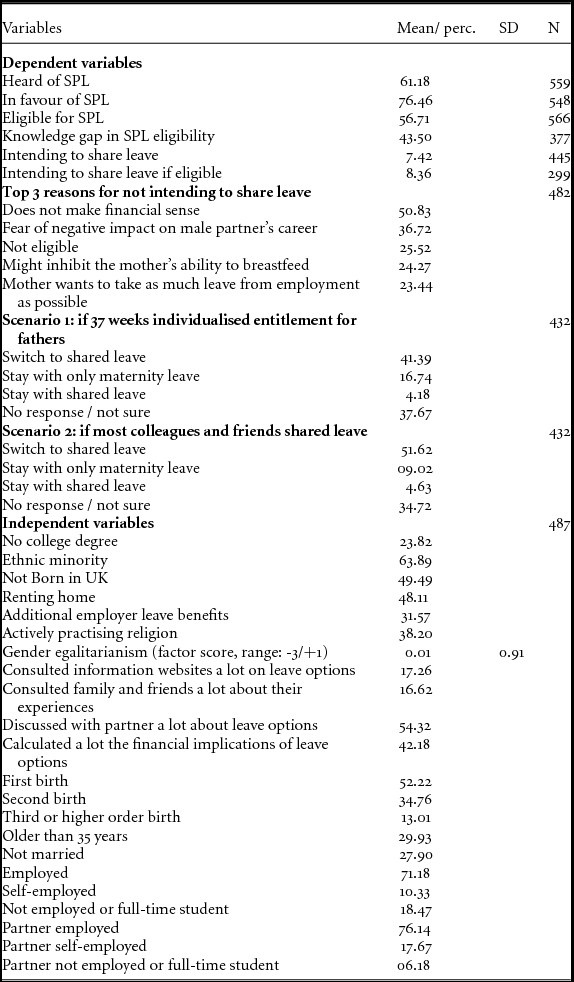
Table 1 reports descriptive statistics. Overall, 61 per cent of expectant mothers reported to have heard of SPL. After a brief description of what SPL entails, 76 per cent expressed favourable views. Based on the reports of their own and their partners’ employment and tenure, 57 per cent of the participants were eligible to take SPL. Among employed expectant mothers only 44 per cent correctly reported their eligibility. The majority of those who did not correctly report this were not sure about their eligibility. Based on the sample of eligible expectant mothers, only 8.4 per cent of the couples were planning to take shared parental leave. The percentage was nearly the same (7.4 percent) for all (self-)employed expectant mothers, who were the target group of this question.
Descriptive statistics

When asked about reasons for not planning to share leave, the following were mentioned most often among the top three reasons: i) it does not make financial sense (51 percent); ii) fear of negative impact on male partner's career (37 per cent); iii) not being eligible (26 per cent); iv) sharing might inhibit the mother's ability to breastfeed (24 percent); and v) mothers wanting to take as much leave from employment as possible (23 per cent).
Context scenarios
To better understand the importance of contextual factors, respondents were asked two hypothetical questions – how much leave each of the partners would take if fathers had individualised leave entitlements of 37 weeksFootnote 8, and if most of the colleagues and friends shared leave, respectively. The findings are displayed in Table 1. Even though the results of the scenario questions can only give us a rough idea whether contextual factors affect take-up, as they may be subject to social desirability bias and respondents may not take into account realistic trade-offs, the large hypothetical changes in take-up intentions from just over 7 to 42 and 52 percent, respectively, indicate that both factors would most likely increase take-up of leave by fathers. This is in line with Hypotheses 1 and 2. Interestingly, social norms seem more important than individual leave entitlements.
Social and ethnic differences
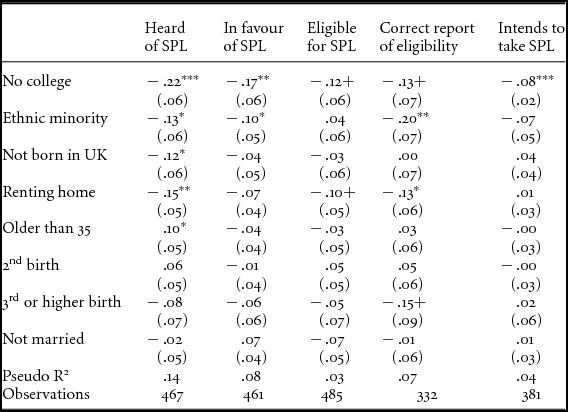
To examine social and ethnic inequalities in attitudes, knowledge and intentions of taking SPL (H3), we consider differences by education, ethnicity, birthplace and home ownership while controlling for demographic characteristics in a first modelling step. Table 2 summarises the results showing average marginal effects based on logistic regression models. For all five dependent variables, we find significant differences between respondents with and without a university degree. University-educated respondents are by 22 percentage points more likely to have heard of SPL and by 17 percentage points more likely to be in favour. They also have a greater chance of meeting the eligibility criteria, with a difference of 12 percentage points. Higher educated women are also significantly more likely to correctly report their eligibility and to intend to take shared leave by 13 and 8 percentage points, respectively. Both can be classified as large given the relatively low baseline probabilities.
Average marginal effect of having heard of SPL, being in favour, being eligible, knowing about one's eligibility, and intention to take up SPL (based on logistic regression models)

Note: Standard errors are shown in parentheses. Questions about knowledge of eligibility and intentions of sharing leave have only been asked to (self-)employed mothers, hence the smaller number of observations.
+ p < 0.10, * p < 0.05, ** p < 0.01, *** p < 0.001
Ethnicity shows mostly smaller associations with the five dependent variables. The probabilities of having heard of SPL and being in favour of SPL are 13 and 10 percentage points higher for White British respondents than for ethnic minorities. The latter are neither less likely to be eligible nor less likely to intend to share leave. However, ethnic minority expectant mothers are 20 percentage points less likely to correctly classify their eligibility. Respondents who were not born in the UK were significantly less likely to have heard of SPL, but no significant differences were found for the four other outcomes. In addition, home ownership correlated significantly with a higher chance of having heard of SPL, of being eligible and of correctly reporting eligibility. Most of the control variables did not show significant associations with the dependent variables except for older mothers who had more often heard of SPL.
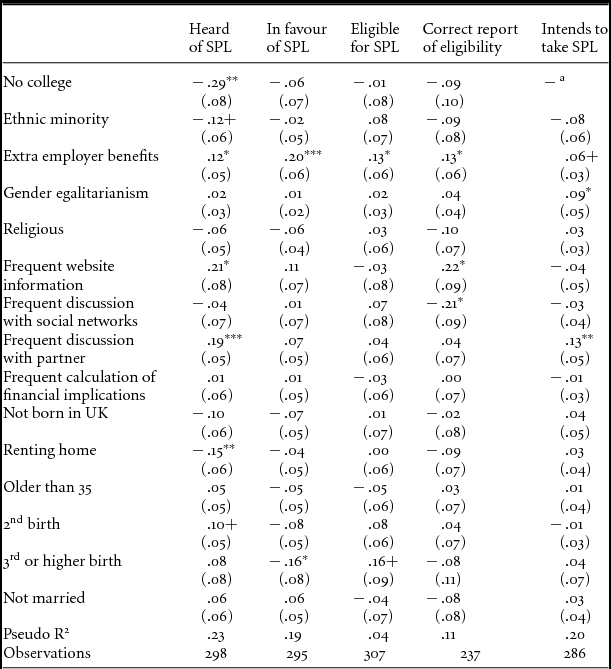
In a second modelling step, we added information on additional employer leave benefits, gender ideologies, religiousness, and information-seeking and discussion processes in couples to the models. Table 3 shows average marginal effects based on the logistic regression models. As some of the questions have only been asked of working women, the number of observations is smaller for all the models. Women whose employers provide additional leave benefits are more likely to have heard of SPL, to favour SPL, to be eligible, to know about their eligibility and to intend to share parental leave with their partners. A one-standard-deviation increase in egalitarian gender ideologies is associated with a roughly 9-percentage-point higher probability of intending to share leave, whereas religiousness is not significantly associated with any of the five outcomes.
Average marginal effects based on logistic regression models for expectant women in (self-)employment (full model)

Note: Standard errors are shown in parentheses. aCollege degree fully predicts planned take-up of shared parental leave, therefore it cannot be included in the model.
+ p < 0.10, * p < 0.05, ** p < 0.01, *** p < 0.001
Women who frequently informed themselves about leave options and eligibility are more likely to have heard of SPL and to correctly report their eligibility. Women who frequently consulted family and friends about their experiences were less likely to correctly classify their leave eligibility status. Frequent discussions about leave options with the partner were predictive of having heard of SPL and of women's take-up intentions. Some of the correlations may imply reverse relationships, with women who are better informed about the option of SPL being more likely to discuss with their partners to achieve actual sharing of leave.
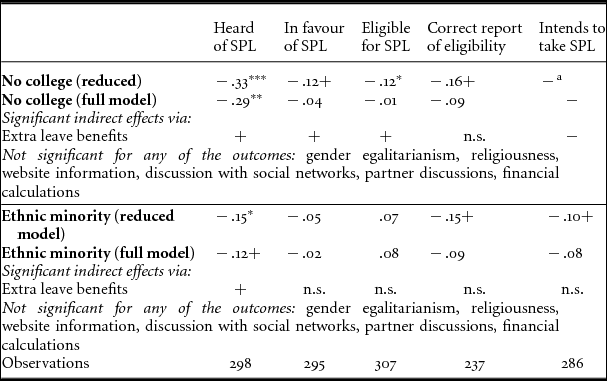
In a third modelling step, we use the KHB-decomposition analysis to examine whether extra employer benefits, gender ideologies, or information-seeking and choice behaviours accounted for any of the differences by educational level and ethnicity. Table 4 shows the estimated average marginal effects for women with a college degree and non-white British ethnicity in a model with just control variables, in comparison to a full model including additional employer benefits, gender ideologies, and information seeking. For all models, including these variables significantly reduces the associations with education and, to a lesser extent, with ethnicity. However, as can be seen from the significance levels of the various indirect paths tested, the only (marginally) significant confounder relationships were found for extra-statutory leave benefits offered by employers. The latter mediated the relationships between college education and having heard of SPL, favouring SPL, and being eligible for SPL. For ethnicity, it only mediated the relationship with having heard of SPL. Its contributions to the differences between the reduced models and the full models, however, were only marginally significant at the 10-percent level. These findings provide partial support for Hypothesis 4, which assumed that extra-statutory employer benefits would account for some of the variations across education and ethnic groups. Hypotheses 5 and 6, however, have to be rejected, as neither gender ideologies and religiousness nor information seeking and deliberation seemed to account significantly for social and ethnic variations in our five outcomes measures. The partly significant direct effects of these factors in Table 2 suggest they may well be important for having heard of SPL, eligibility knowledge, and take-up intentions but they do not contribute much to understanding the differences found between expectant mothers with and without a college degree and of different ethnic origins, respectively.
Average marginal effects and KHB-decomposition of college education and non-white ethnicity

Note: n.s. indicates ‘not statistically significant’. aThe number of not college-educated mothers who plan to share leave is too small to estimate this relationship.
+ p < 0.10, * p < 0.05, ** p < 0.01, *** p < 0.001
Discussion and conclusion
This is a cross-sectional survey of a relatively small and somewhat selective sample of primarily expectant mothers in London, with university-educated women over-represented. Nonetheless, our study provides important insights into eligibility and take-up intentions of the new UK maternity leave transfer policy known as Shared Parental Leave. Our study finds low take-up intention, despite a high proportion of expectant mothers expressing favourable views. Additionally, while a high proportion of respondents report having heard about SPL, there are deficits in knowledge about eligibility, which constitutes a key obstacle to greater take-up of SPL.
Other factors were uncovered that might affect take-up intentions of SPL, including different context features, such as an individual entitlement for fathers and widespread take-up by colleagues and friends. The latter appeared as even more salient in improving take-up levels. This is likely to be due to perceived norms of fathers’ involvement in family care – qualitative research shows that UK parents worry that the ‘unusualness’ of fathers taking extended leave leads to worse career repercussions than for mothers (Kaufman, Reference Kaufman2017). Indeed, the most frequently reported barriers to taking SPL were financial reasons and the risk to the partner's career, highlighting the importance of adequate leave remuneration. Using the language of Grunow and Evertsson (Reference Grunow and Evertsson2016), there is currently a ‘culture-policy gap’ in the UK, with popular support for shared parenting, but policies that encourage the mother's role in care work via a poorly remunerated maternity leave transfer mechanism.
We have also uncovered important findings of considerable social and ethnic variations in attitudes, eligibility, knowledge and take-up intentions. O'Brien et al. (Reference O'Brien, Aldrich and Connolly2017) found similar associations between eligibility of paid maternity and paternity leave and social characteristics, reporting that Pakistani parents and those in intermediate, semi-routine or routine occupations were less likely to be eligible. Some of these variations also correlated with extra-statutory employer benefits. Previous research has shown that when employers provide additional compensation for parental leave, men take longer leaves (Hobson et al., Reference Hobson, Duvander, Halldén and Lewis2006). In a context of low remuneration and low take-up, this is likely to become even more important.
Overall, our findings are in line with hypotheses drawn from the accommodation model (Chaudry et al., Reference Chaudry, Henly and Meyers2010; Meyers and Jordan, Reference Meyers and Jordan2006) as regards education and ethnicity. Gender ideologies and discussions in couples appear to influence relevant outcomes, though for the most part do not significantly account for social and ethnic variations. Future research should consider a large representative longitudinal sample of couples becoming parents to unpack the causal effects of extra employment benefits, gender ideologies and information seeking and couple discussions. A reciprocal relationship is possible with people who value extra-statutory leave benefits more, or who want to share parental leave, being more likely to choose certain jobs and employers and to discuss more with their partner, as, for example, reported by Grunow and Evertsson (Reference Grunow and Evertsson2016).
In line with research from other countries, we have shown that paternal leave take-up tends to be most likely among highly educated parents. Importantly, however, we have shown that eligibility for leave in the UK is stratified, limiting potential choices of parents. As argued by O'Brien et al. (Reference O'Brien, Aldrich and Connolly2017), there is likely to be growing inequalities and divisions between parents with and without access to paid leave as employment contracts further diversify, including via zero-hours contracts and the rise in the number of self-employed (Office for National Statistics, 2017). Future research should aim for a more representative national sample, including findings from fathers, while research and policy design more generally needs to pay more attention to equitable leave access across families.
Acknowledgements
Many thanks to Jacqui Gabb, Francine Hudson, Peter Moss, Ann Oakley, Margaret O'Brien, Jonathan Swan and Jo Swinson for their insightful comments on drafts of this article. Thanks are also due to those who gave their time by participating in the research. The research for this article was funded in part by a Leverhulme Trust Early Career Fellowship.