Introduction
Internationally, recovery has become a key organising principle underpinning mental health service delivery (O’Hagan, Reference O’Hagan2001; Everett et al. Reference Everett, Adams, Johnson, Kurzawa, Quigle and Wright2003). In the Republic of Ireland, the recovery approach is endorsed by the national mental health policy A Vision for Change (Department of Health and Children, 2006) and the Quality Framework for Mental Health Services in Ireland (Mental Health Commission, 2007). To progress the paradigm shift to recovery orientated care, the Mental Health Commission has: (i) published a discussion document outlining a vision for the recovery model in Irish Mental Health Services (Mental Health Commission, 2005); (ii) put forward guidelines for the introduction and development of a recovery approach; and (iii) designed an audit tool to assess recovery model implementation (Mental Health Commission, 2008).
The remit of mental health services now extends beyond symptom remission and functioning restoration (i.e. clinical recovery) to enhancing personal recovery (Slade, Reference Slade2009). While there is no universally endorsed definition of personal recovery, through the development of personal recovery conceptual frameworks (Leamy et al. Reference Leamy, Bird, Le Boutillier, Williams and Slade2011) and measures (Sklar et al. Reference Sklar, Groessl, O’Connell, Davidson and Aarons2013) conceptual clarity is evolving. Personal recovery comprises connectedness, hope and optimism about the future, identity, meaning in life, empowerment (Leamy et al. Reference Leamy, Bird, Le Boutillier, Williams and Slade2011), and taking responsibility and control of one’s illness and one’s life (Andresen et al. Reference Andresen, Oades and Caputi2003). Spirituality, purpose, overcoming stigma, and symptom management have also been identified by service users as central components (Schrank & Slade, Reference Schrank and Slade2007). Clinical recovery is a sub-set of personal recovery (Slade, Reference Slade2009). Successful recovery model implementation requires the integration of both personal recovery and clinical recovery goals in services (Frese et al. Reference Frese, Stanley, Kress and Vogel-Scibilia2001) and research outcome measures should reflect this.
Recovery-based mental health services are holistic, strengths based, collaborative, and empowering (Substance Abuse and Mental Health Services Administration, 2004). They focus on the valuable input of service users in optimising treatment and therefore aim to empower service users to be involved in treatment decisions (Warner, Reference Warner2010). They stress a mutually respectful partnership in care and an emphasis on the service user’s perspective and treatment goals (Silverstein & Bellack, Reference Silverstein and Bellack2008) and place, to a large degree, the responsibility for and control of the recovery process in the hands of the service user, promoting agency and an internal locus of control (Frese et al. Reference Frese, Stanley, Kress and Vogel-Scibilia2001). A recovery orientation emphasises the developing of personal recovery strategies and the enhancement of self-management skills through the drafting of individualised self-management plans (Mental Health Commission, 2005).
Wellness Recovery Action Planning (WRAP) is a cross-diagnostic, patient-centred, self-management intervention that embodies the recovery principles of participation, personal responsibility, empowerment, self-management, autonomy, and person-centred service (Mental Health Commission, 2005). WRAP provides a recovery framework that can assist a person to take ownership over their well-being and integrate self-management into their daily life. To achieve this, WRAP utilises a Wellness Toolbox, which provides a list of strategies to maintain wellness; a six part structured monitoring and response system, which helps keep track of distressing feelings and behaviours in order to reduce, alter, or eliminate them by activating planned responses; and a crisis and post-crisis plan, which enables service users to instruct others on how to provide them with care and support, thus empowering them to contribute to key decisions regarding their treatment and management. A document is created that the service user consults and updates throughout their recovery, which can then be shared with family, friends and/or their mental health care team. WRAP emphasises five key concepts involved in recovery: hope, finding and reconnecting with hope in one’s life; personal responsibility, taking responsibility for one’s own wellness; education, searching for sources of information to determine what will help in the recovery process; self-advocacy, effectively communicating and asserting one’s own needs and rights; and support, developing a strong support system to aid recovery (Copeland, Reference Copeland1997).
Research findings suggest that WRAP can improve psychiatric symptoms, physical health, and personal recovery, and increase hopefulness and self-advocacy (Cook et al. Reference Cook, Copeland, Hamilton, Jonikas, Razzano, Floyd, Hudson, Macfarlane and Grey2009; Starnino et al. Reference Starnino, Mariscal, Holter, Davidson, Cook, Fukui and Rapp2010; Fukui et al. Reference Fukui, Starnino, Susana, Davidson, Cook, Rapp and Gowdy2011). WRAP has also been shown to improve attitudes about recovery and increase recovery knowledge in service users, their family members/carers, and mental health practitioners (Doughty et al. Reference Doughty, Tse, Duncan and McIntyre2008; Higgins et al. Reference Higgins, Callaghan, DeVries, Keogh, Morrissey, Nash, Ryan, Gijbels and Carter2012). These studies, however, did not randomly allocate participants to groups. The strongest evidence of the efficacy of WRAP to date comes from two randomised controlled trials executed in the US. The first trial demonstrated that participating in WRAP can improve personal recovery and quality of life, reduce depression and anxiety, enhance hopefulness, and increase levels of self-advocacy (Jonikas et al. Reference Jonikas, Grey, Copeland, Razzano, Hamilton, Floyd, Hudson and Cook2011; Cook et al. Reference Cook, Copeland, Floyd, Jonikas, Hamilton, Razzano, Carter, Hudson, Grey and Boyd2012a, Reference Cook, Copeland, Jonikas, Hamilton, Razzano, Grey, Floyd, Hudson, Macfarlane, Carter and Boyd2012b). The second trial confirmed that WRAP can reduce the self-reported need for and use of formal mental health services over time (Cook et al. Reference Cook, Jonikas, Hamilton, Goldrick, Steigman, Grey, Burke, Carter, Razzano and Copeland2013).
Although this small evidence base has emerged recently, the pace of the adoption of recovery values by service providers and policy makers has outstripped the evidence for recovery-orientated services at systems and intervention levels (Silverstein & Bellack, Reference Silverstein and Bellack2008). This paucity of evidence may be due to difficulties with the conceptual clarity of personal recovery, which hamper the development of services to support it (Shanks et al. Reference Shanks, Williams, Leamy, Bird, Le Boutillier and Slade2013). Personal recovery assessment is in its infancy; psychometrically adequate instruments have only recently been developed. In order for the recovery model to become substantively integrated into mental health systems, the concept of personal recovery needs to be aligned with evidence-based practice (Kidd et al. Reference Kidd, George, O’Connell, Sylvestre, Kirkpatrick, Browne, Odueyungbo and Davidson2011). Therefore, it is necessary to establish how interventions, which emphasise recovery principles, produce the recovery outcomes that matter to service users and their families. Allowing service developments to occur ahead of research may be detrimental.
While extensive WRAP training and programme development is occurring internationally (Cook et al. Reference Cook, Copeland, Jonikas, Hamilton, Razzano, Grey, Floyd, Hudson, Macfarlane, Carter and Boyd2012b), controlled studies assessing the impact of WRAP on personal and clinical recovery outcomes are scarce. Little is known about the efficacy of WRAP in cultural settings outside of the US. Thus, the objective of this study was to conduct a randomised controlled trial of WRAP in the Republic of Ireland. We tested the primary hypothesis: that the Experimental Group would display a greater improvement in personal recovery than controls. Also tested were four secondary hypothesises: that the Experimental Group (i) would display greater improvement in personal recovery life areas; (ii) show greater enhancement in quality of life; and (iii) exhibit greater symptom reduction than controls; and (iv) that all improvements would be maintained at 6-month follow-up.
Method
Study design
A prospective randomised controlled trial, adhering to all CONSORT principles (Schulz et al. Reference Schulz, Altman and Moher2010) was conducted. Participants were randomly allocated by use of a computer-generated allocation sequence to Experimental Group or Waiting List Control Group conditions in a 1:1 ratio. Using a Waiting List Control design ensured all study participants were offered the opportunity to receive WRAP. Figure 1 details the passage of participants through the randomised controlled trial.
Flow diagram of passage of participants through the randomised controlled trial.

Power analysis and sample size
To calculate the appropriate sample size, an a priori power analysis for a two-group comparison of means was calculated using the following formula:
n⩾2K×(s.d.)2/(Minimum difference to be detected)2 (Daly & Bourke, Reference Daly and Bourke2000).
K is a constant based on power and significance level, the value of which is 7.8 for 80% power and 5% two-sided significance level (Daly & Bourke, Reference Daly and Bourke2000). Our calculations for (i) standard deviation (s.d.=20) and (ii) clinically meaningful difference (±15 on the primary outcome measure MHRM) were based on a previous research (Bullock, Reference Bullock2009). Our sample size goal was determined as follows:
n⩾(2)×(7.8)×(20)2/(15)2=27 participants in each group or 54 in the entire sample.
Procedure
The study took place from July 2012 to August 2013. Ethical approval was granted by the Ethics Committee of the independent psychiatric hospital and outpatient service where participant recruitment took place. Inclusion criteria were: people aged 18–65 with a diagnosis of a mental or behavioural disorder who were inpatients of the private hospital or outpatients of its outpatient service. A mental disorder was denoted by the International Classification of Diseases 10 criteria for: (F10–F19) mental and behavioural disorders due to psychoactive substance use; (F20–F29) schizophrenia, schizotypal and delusional disorders; (F30–F39) mood (affective) disorders; and (F40–F48) neurotic, stress-related, and somatoform disorders. Exclusion criteria were: people with an intellectual disability and people with an organic disorder.
We included both inpatients and outpatients in our sample as (i) WRAP has been delivered in both settings previously (Smith-Merry et al. Reference Smith-Merry, Freeman and Sturdy2011; Cook et al. Reference Cook, Copeland, Jonikas, Hamilton, Razzano, Grey, Floyd, Hudson, Macfarlane, Carter and Boyd2012b); (ii) adopting a recovery orientation requires recovery principles to be applied and recovery opportunities to be offered democratically (Davidson et al. Reference Davidson, Rowe, Tondora, O’Connell and Lawless2008); and (iii) the values and ethics of WRAP state that readiness should not prevent one from attending WRAP (Reference CopelandCopeland, n.d.).
Participants were recruited through Multi-disciplinary Team (MDT) referral or a joint referral method. Joint referral involved service users learning about the study from ward information sessions and communicating an interest in participating to their MDT who then discussed the possibility, assessed risk, and confirmed suitability. We utilised this recruitment strategy as it is consistent with recovery principles. It is the right and responsibility of the service user to make their own decisions regarding their treatment (Davidson et al. Reference Davidson, Rowe, Tondora, O’Connell and Lawless2008). This is empowering and grants people in recovery the ‘dignity of risk’ and the ‘right to fail’ (Deegan, Reference Deegan1992), which is of particular importance as positive risk taking is fundamental to the recovery process (Young & Ensing, Reference Young and Ensing1999).
Following referral, the researcher met with potential participants and provided contact details of the researchers and an information leaflet, which detailed the purpose and nature of the study. If the service user decided to participate, informed consent was obtained by completing a consent form. Anonymity was protected by assigning codes to electronic and hardcopy data and removing identifiable information from the data set. If a participant disclosed suicidal ideation or thoughts of harming others, this information was communicated to their clinical team and supports were offered. Participants were informed that only under these circumstances would confidentiality be broken.
Randomisation was performed by simple random assignment of participants to groups. A social worker employed in the hospital was seconded to the study to generate a random allocation sequence for this purpose. All participants were reminded not to reveal their study condition at any subsequent assessment point. The data collector was blinded to group allocation to prevent the study from being biased towards the beneficial effects of the intervention. This blinding was not compromised during any of the Time 2 assessments. Six-month follow-up assessments were not blinded, as they were conducted with the Experimental Group only. Assessments were conducted in the independent psychiatric hospital by one research assistant at three time points: (i) baseline with both groups, before randomisation, within 3 weeks before intervention commencement (Time 1; n=36); (ii) post intervention with both groups, within 3 weeks post intervention (Time 2; n=34); and (iii) 6-month follow-up with the Experimental Group only, within 3 weeks post 6-month point (Time 3; n=12). Six-month follow-up data was not obtained from the Control Group as we deemed the delay in Control Group Intervention delivery required for this data collection to be unacceptable.
Intervention fidelity
Service user WRAP Ireland Copeland Centre accredited Advanced Level WRAP facilitators guided the WRAP intervention, its design, schedule, format, and delivery. Although WRAP was originally designed to be delivered by service users, it was not feasible to use service user facilitators in this study due to limited funding and a lack of suitable training candidates or available trained and accredited service user WRAP facilitators. Each WRAP intervention was delivered by three allied health professional Copeland Centre accredited WRAP facilitators. These facilitators had completed an intensive, Copeland Centre approved, 4-day training programme involving facilitation observation (09:00 a.m. to 05:30 p.m.) and created and integrated their own WRAP plans in their own lives. WRAP facilitators were required to commit to not using clinical, medical, or diagnostic language and to engage in appropriate self-disclosure to illustrate recovery concepts. By delivering WRAP as users of their own WRAP plan, an emphasis was placed on the personal qualities and life experiences of the facilitators rather than on their formal qualifications and clinical experience, promoting equality in the relationship between facilitator and participant and encouraging engagement in the intervention. Facilitators had not delivered WRAP before this study.
The intervention was delivered to the Experimental Group once and the Control Group once in a 2-day workshop schedule (10:00 a.m. to 04:30 p.m.) approved by the Copeland Centre, covering all aforementioned components of WRAP. Self-evaluation forms were completed by facilitators to measure intervention fidelity and adherence to WRAP values and ethics. The fidelity measure assessed whether or not evidence exists that (i) the core components of WRAP were delivered over the 2 days; (ii) an environment characterised by equality, unconditional acceptance, compassion, and mutual respect was provided; (iii) the workshop supported shared decision-making, personal sharing, peer learning, and the premise that there are no limits to recovery; (iv) each person was considered the expert on themselves; and (v) participants had or were developing a sense of hope. One hundred percent intervention fidelity was achieved for Control Group and Experimental Group WRAP delivery.
Measures
Participant demographic characteristics
Participants completed a demographic profile providing information on gender, age, marital status, highest level of education attained, living arrangements, and employment status. Patient status was also recorded at Time 1, Time 2, and Time 3.
Primary outcome measure
Personal recovery
The Mental Health Recovery Measure (MHRM; Young & Bullock, Reference Young and Bullock2003) is a 30-item self-report comprehensive measure of personal recovery. It measures eight domains related to personal recovery: Overcoming stuckness; Self-empowerment; Learning and self-redefinition; Basic functioning; Overall well-being; New potentials; Spirituality; and Advocacy/enrichment. It has been shown to have excellent internal consistency (α=0.93) and test–retest reliability (r=0.92) and good convergent validity with the Community Living Skills Scale (r=0.57) and the Empowerment Questionnaire (r=0.67) (Bullock, Reference Bullock2005).
Secondary outcome measures
Personal recovery life areas
The Mental Health Recovery Star (MHRS; MacKeith & Burns, Reference MacKeith and Burns2010) is a 10-item measure of 10 personal recovery life areas: managing mental health; self-care; living skills; social networks; work; relationships; addictive behaviour; responsibilities; identity and self-esteem; and trust and hope. Each item is rated jointly by service user and clinician/researcher on a 10-point scale. This scale corresponds to a five-stage ‘ladder of change’ model: being stuck; accepting help; believing; learning; and self-reliance. It has high internal consistency (α=0.85; Dickens et al. Reference Dickens, Weleminsky, Onifade and Sugarman2012).
Quality of life
The World Health Organisation Quality of Life Brief Version (WHOQOL-BREF; Murphy et al. Reference Murphy, Herrman, Hawthorne, Pinzone and Evert2000) is a 26-item self-report measure. It is a short form of the WHOQOL-100 quality of life assessment. It groups 24 facets relating to quality of life into four domains: physical health, psychological health, social relationships, and environment. It has good internal consistency (α>0.7) and performs well in tests of discriminant and construct validity (Skevington et al. Reference Skevington, Lotfy and O'Connell2004).
Symptomatology
In terms of symptomatology, we chose to measure anxiety and depression as they are common features of most psychiatric disorders (Rohde et al. Reference Rohde, Lewinsohn and Seeley1991; Wacker, Reference Wacker1997).
The Hospital Anxiety and Depression Scale (HADS; Zigmond & Snaith, Reference Zigmond and Snaith1983) is a 14-item self-report questionnaire designed to detect the presence and severity of anxiety and depression. It has established face, criterion, content, and concurrent validity (Zigmond & Snaith, Reference Zigmond and Snaith1983). It has good internal consistency; studies have reported Cronbach’s α coefficients of 0.68–0.93 for the anxiety subscale and 0.67–0.90 for the depression subscale (Bjelland et al. Reference Bjelland, Dahl, Haug and Neckelmann2002).
The Beck Depression Inventory II (BDI II; Beck et al. Reference Beck, Steer and Brown1996) is a 21-item self-report measure of depressive symptoms. Validity in a clinical population has been demonstrated. It has also been shown to have high test–retest reliability (r=0.93) and high internal consistency (α=0.91) (Beck et al. Reference Beck, Steer and Brown1996).
Data analysis
Data was analysed in SPSS predictive analytics software (version 21), by available case analysis (observed data without imputation for missing values), using univariate and bivariate methodologies. Descriptive and inferential statistics were calculated; parametric and non-parametric tests were used to compare groups. Non-parametric tests were applied to MHRS scores as MHRS data was ordinal. Square root transformations were applied to BDI II scores and HADS Depression Subscale scores to normalise data.
Results
Thirty-six participants took part in the study; we did not achieve our sample goal of 54. Therefore, the study was underpowered. 36/36 participants completed Time 1 assessments (0% missing data), 34/36 completed Time 2 assessments (5.56% missing data, 94.44% retention rate), and 12/18 completed Time 3 assessments (33.33% missing data, 66.66% retention rate). 14/18 participants in the Experimental Group attended the WRAP intervention (77.78%), 11/18 participants completed all intervention components (61.11%), and 3/18 completed some components (16.67%). 1/18 completed 60%, 2/18 completed 80%. All missing data resulted from dropout. Two participants who were randomised (one in each group) refused the experimental/waiting list control condition following randomisation. Six Experimental Group participants withdrew before Time 3 assessments. Unfortunately, we were not able to collect Time 2 or Time 3 data from these participants because they refused further assessments or were not contactable. We therefore conducted an available case analysis rather than an intention to treat analysis.
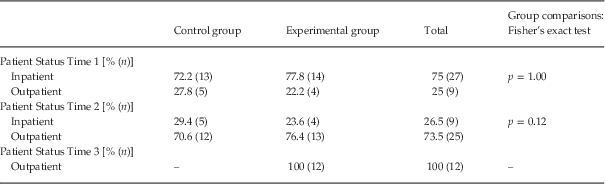
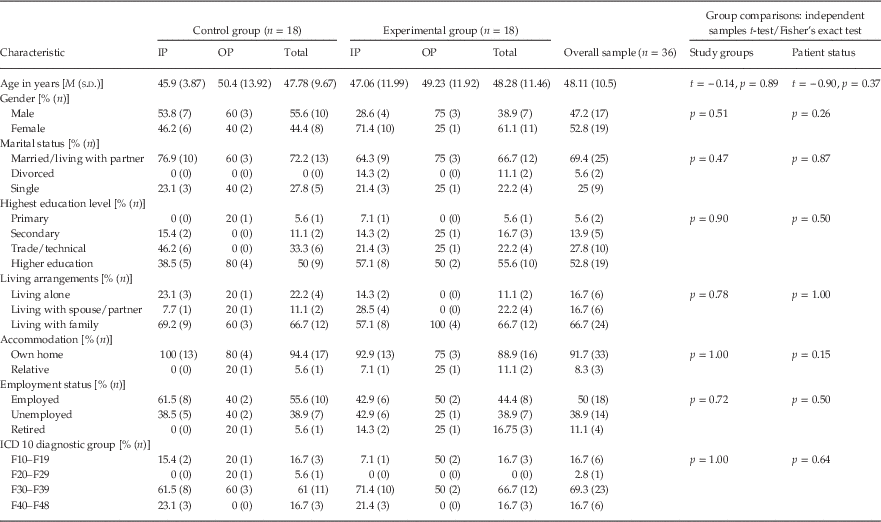
Independent samples t-tests and Mann–Whitney U-tests conducted between the baseline MHRS, MHRM, WHOQOL-BREF, and BDI II scores of the Control and the Experimental Group did not reveal a significant difference between groups, indicating successful randomisation. Both groups had a similar spread of inpatients and outpatients at Time 1 and Time 2. Fisher’s exact tests found no significant association between Time 1 study group and patient status at Time 1 or Time 2 (see Table 1). Independent samples t-tests and Fisher’s-exact tests also found no association between (i) study group or Time 1 patient status and (ii) demographics or ICD 10 diagnoses (see Table 2). From Time 1 to Time 2, 16/34 participants shifted from inpatient status to outpatient status (47.06%) and 18/34 experienced no status change (52.94%). Although, compared with the Control Group (5/17; 29.41%) more Experimental Group participants changed status (11/17; 64.71%), a Fisher’s exact test did not find a significant association between study group and status change: (p=0.08). These results suggest that patient status and patient status shift over the course of the trial did not act as confounding variables.
Patient status comparisons of study groups

Baseline characteristics and ICD 10 diagnostic group comparisons between study groups and baseline patient status groups
IP=inpatient; OP=outpatient; M=mean; s.d.=standard deviation; F10–F19=mental and behavioural disorders due to psychoactive substance use; F20–F29=schizophrenia, schizotypal, and delusional disorders; F30–F39=mood (affective) disorders; F40–F48=neurotic, stress-related, and somatoform disorders.
Reliability
Cronbach’s αs were computed and indicated good internal consistency for all outcome measures: MHRM (α=0.96); MHRS (α=0.86); WHOQOL-BREF (α=0.93); HADS (α=0.93); BDI II (α=0.95).
MHRS domains
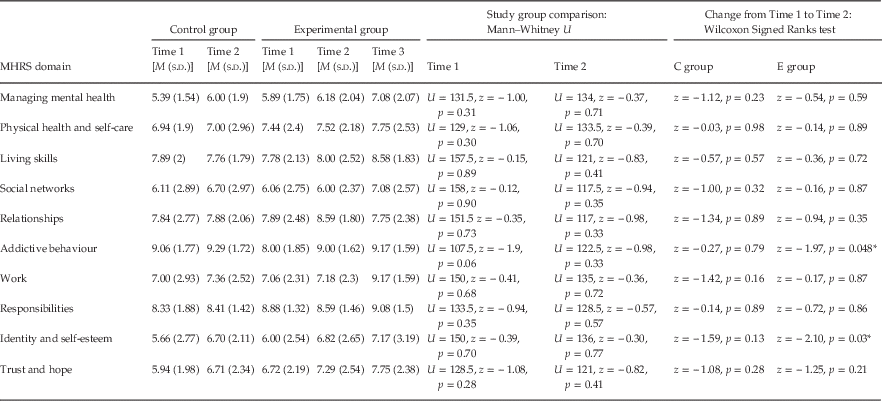
For MHRS scores, Mann–Whitney U-tests were used to examine differences between groups and Wilcoxon Signed Rank tests were conducted to assess change over time. Results are shown in Table 3. Statistically significant improvements in the Experimental Group were found in the personal recovery life areas of (i) Addictive Behaviour and (ii) Identity and Self-Esteem.
Comparison of Mental Health Recovery Star domain scores by study group and assessment time
MHRS=Mental Health Recovery Star; C Group=Control Group; E Group=Experimental group. M=mean; s.d.=standard deviation.
*Statistically significant improvement.
Total scores
A series of mixed between-within subjects analysis of variance were used to assess the effect of WRAP on MHRM, WHOQOL-BREF, HADS, and BDI II scores. Results are displayed in Table 4.
Comparison of Mental Health Recovery Measure, World Health Organisation Quality of Life Brief Version, Hospital Anxiety and Depression Scale, and Beck Depression Inventory II scores by study group and assessment time
MHRM=Mental Health Recovery Measure; WHOQOL-BREF=World Health Organisation Quality of Life Brief Version; HADS=Hospital Anxiety and Depression Scale; BDI II=Beck Depression Inventory II.
*Statistically significant effect.
The relationship between personal recovery (as measured by MHRM scores) and one aspect of clinical recovery (self-reported psychiatric symptoms as measured by HADS and BDI II scores) was investigated using Pearson product-moment correlation coefficients. There were strong negative correlations between personal recovery and (i) anxiety (HADS; r=−0.67, n=82, p<0.001); (ii) depression (BDI II; r=−0.76, n=82, p<0.001); and (iii) depression (HADS; r=−0.74, n=82, p<0.001). Thus, psychiatric symptom expression may play a role in personal recovery.
Discussion
To our knowledge, the current study is (i) the first in the Republic of Ireland to examine the effect of WRAP on clinical outcomes and (ii) the first internationally to evaluate WRAP using an inpatient and outpatient sample. Although there was a significant improvement in personal recovery as measured by the MHRM from Time 1 to Time 2 for all participants, the Experimental Group did not display a greater improvement, contrasting with previous studies (Cook et al. Reference Cook, Copeland, Hamilton, Jonikas, Razzano, Floyd, Hudson, Macfarlane and Grey2009, Reference Cook, Copeland, Jonikas, Hamilton, Razzano, Grey, Floyd, Hudson, Macfarlane, Carter and Boyd2012b). Therefore, WRAP did not have a significant effect on the primary outcome measure. However, the evidence presented indicates that WRAP was efficacious in two personal recovery areas of life measured by the secondary outcome measure the MHRS: (i) addictive behaviour and (ii) identity and self-esteem. These findings are consistent with previous research, which found WRAP to improve personal recovery (Cook et al. Reference Cook, Copeland, Hamilton, Jonikas, Razzano, Floyd, Hudson, Macfarlane and Grey2009, Reference Cook, Copeland, Jonikas, Hamilton, Razzano, Grey, Floyd, Hudson, Macfarlane, Carter and Boyd2012b). WRAP may be particularly suited to service users who have addiction disorders, enabling them to engage in relapse and crisis prevention by managing and responding to triggers and signs of deterioration. Considering the empowering and collaborative nature of WRAP and its emphasis on the expertise of the service user, it follows that participation should have an impact on identity and self-esteem. In WRAP, participants are encouraged to perceive mental health difficulties as something anyone can experience and are invited to view themselves as a person who is seeking to manage difficult feelings and behaviours. This perspective may have reduced psychiatric stigma and contributed to changes in identity and self-esteem.
There was a significant improvement in quality of life from Time 1 to Time 2 for both groups. Research on the clinical meaning of WHOQOL-BREF scores considers these improvements substantial (Skevington et al. Reference Skevington, Lotfy and O'Connell2004). Contrasting with the findings of previous research (Cook et al. Reference Cook, Copeland, Jonikas, Hamilton, Razzano, Grey, Floyd, Hudson, Macfarlane, Carter and Boyd2012b), Experimental Group participants did not report significantly greater quality of life improvement than controls. There was a significant reduction in anxiety, measured by HADS Anxiety Subscale scores, and depression, measured by the BDI II, for both groups over time. However, the Experimental Group did not display greater symptom reduction than controls. These findings differ from those of prior research, which found WRAP to reduce psychiatric symptoms (Cook et al. Reference Cook, Copeland, Hamilton, Jonikas, Razzano, Floyd, Hudson, Macfarlane and Grey2009, Reference Cook, Copeland, Floyd, Jonikas, Hamilton, Razzano, Carter, Hudson, Grey and Boyd2012a, Reference Cook, Copeland, Jonikas, Hamilton, Razzano, Grey, Floyd, Hudson, Macfarlane, Carter and Boyd2012b; Starnino et al. Reference Starnino, Mariscal, Holter, Davidson, Cook, Fukui and Rapp2010; Fukui et al. Reference Fukui, Starnino, Susana, Davidson, Cook, Rapp and Gowdy2011). Personal recovery, quality of life, and self-reported psychiatric symptom improvements in the Experimental Group were maintained at 6-month follow-up.
There are a number of possible explanations as to why we did not replicate the findings of other authors (Cook et al. Reference Cook, Copeland, Floyd, Jonikas, Hamilton, Razzano, Carter, Hudson, Grey and Boyd2012a, Reference Cook, Copeland, Jonikas, Hamilton, Razzano, Grey, Floyd, Hudson, Macfarlane, Carter and Boyd2012b). First, our inability to meet our sample goal of 54 meant that our analysis was underpowered to detect significant effects. Second, not obtaining 6-month follow-up Control Group data meant we were not able to replicate the analysis of these authors (multivariate, longitudinal random-effects linear regression), which may have yielded different results. Third, WRAP was delivered by mental health professionals and not by service users. Although service user guidance ensured intervention fidelity, service user delivery may produce different results. WRAP did not result in significant intervention effects in the areas of personal recovery, quality of life, and psychiatric symptoms, which may be due to the absence of service user facilitators. While research indicates that peer service providers enhance engagement in services, it is not known what elements of peer service delivery are responsible for this engagement (Silverstein & Bellack, Reference Silverstein and Bellack2008). Furthermore, the recovery progress identified for participants in both groups may be attributable to the effectiveness of the mental health care and treatment offered by our service. All participants were in active treatment and exposed to multiple interventions while taking part in the study. These could have included: acute psychiatric inpatient admission; psychiatric intensive care unit admission; psychological interventions (both individual and group Cognitive Behavioural Therapy and Psychoanalytic Therapy); occupational therapy day service; social work support; chaplaincy support; nursing key working; and pharmacological interventions. It is also possible that by discussing WRAP and recovery with all participants, the researcher was promoting recovery by orientating participants to the recovery model and recovery principles. It has been noted in the literature that exposure to recovery-orientated assessment instruments progresses recovery (Dickens et al. Reference Dickens, Weleminsky, Onifade and Sugarman2012). Another explanation is that WRAP is simply less efficacious in the Irish social and cultural context than in the US. Further, it may be the case that the impact of WRAP occurs once a WRAP plan is practiced. Perhaps participants were assessed too soon after the intervention and not afforded enough time to apply Wellness Tools and to integrate their WRAP plans into their daily lives. Moreover, an anticipation effect and a Hawthorne effect may have confounded Control Group outcome measure scores at Time 2.
Study limitations should be considered when interpreting these results. The first caveat is that our study was underpowered. Second, the assessment of the fidelity of the intervention was limited to WRAP facilitator self-report. The absence of 6-month follow-up Control Group data limited our analysis, preventing us from comparing the long-term outcomes of both groups. A further limitation concerns the assessment instruments we used to measure recovery. Since study commencement a paper has been published which concluded that the MHRS cannot be recommended as a routine clinical outcome tool, citing inadequate interrater reliability and problems with convergent validity as reasons for this (Killaspy et al. Reference Killaspy, White, Taylor and King2012). The methodology of this study has, however, been criticised (Dickens & Sugarman, Reference Dickens and Sugarman2012; MacKeith, Reference MacKeith2012). In the absence of a consensus regarding the optimum scale to measure personal recovery (Shanks et al. Reference Shanks, Williams, Leamy, Bird, Le Boutillier and Slade2013), the use of two instruments provides a more detailed assessment of recovery outcome. As with all randomised trials, volunteer bias may limit generalisability of the findings and external validity. The outcomes and characteristics of service users who decided to take part in this study may differ substantially from those who did not. The fact that joint referral was used may further compound this. Also a short follow-up period was employed (6 months); perhaps conducting assessments at 1-year follow-up may yield different results. Finally, the use of available case analysis may have further limited generalisability and power. Findings should be interpreted with caution due to these limitations. Furthermore, although our results indicate that patient status and patient status change did not act as confounding variables, they are important considerations when interpreting study results.
While WRAP embodies the values of recovery and provides a means of enacting those values within mental health services, it is just one of many ‘recovery technologies’ that can diffuse recovery values into the culture, discourse, and behaviour of the mental health system (Smith-Merry et al. Reference Smith-Merry, Freeman and Sturdy2011). Other ‘recovery technologies’ that our organisation has implemented include: peer support; the employment of peer advocates; a service user research committee; recovery narratives (stories that define and exemplify recovery); the routine use of personal recovery outcome measures; and a Consumer and Carer Council that offers input in service and policy developments and representation at a management level. It is through these approaches that a meaningful partnership between service providers and service users can be developed. If WRAP is implemented in isolation, in the absence of a wider recovery orientation, it runs the risk of becoming ‘just another care plan’ subsumed and assimilated into traditional services (Smith-Merry et al. Reference Smith-Merry, Freeman and Sturdy2011).
Conclusion
Although analysis of our primary outcome measure (MHRM) and secondary outcome measures (WHOQOL – BREF, HADS and BDI II) did not confirm an intervention effect, the analysis of one of our secondary outcome measures (MHRS) supports the efficacy of WRAP in the personal recovery life areas of (i) Addictive behaviour and (ii) Identity and self-esteem. By providing service users with opportunities to acquire and demonstrate the competencies required in recovery, WRAP can enrich mental health services; making a valuable contribution to person-centred, strengths-based, collaborative care. Specifically, WRAP may assist in relapse prevention and management in addiction and may improve identity and self-esteem through empowerment and exposure to recovery principles. This study should be viewed as a preliminary assessment of WRAP efficacy in an Irish context, which may provide learning for clinicians and service providers wishing to integrate the recovery model and evidence-based practice. Further research is required to confirm WRAP efficacy in other outcome domains. Efforts to integrate WRAP into recovery-orientated mental health services should be encouraged and evaluated.
Acknowledgements
The authors acknowledge the funding for this study provided by the Saint John of God Research Grants Scheme and would like to thank all service users and staff of Saint John of God Hospital Limited for their assistance in completing this study. Specifically the authors wish to thank Orla Prendergast (Social Worker) for her help with the randomisation of participants and Liam Minogue and Teresa Tuohy of WRAP Ireland for guiding the WRAP intervention and ensuring that intervention delivery adhered to the values and ethics of WRAP.
Conflicts of Interest
None.