INTRODUCTION
Despite the emerging consensus about the causes and consequences of global warming, international climate summits have often fallen short of expectations (Rogelj et al. Reference Rogelj, Nabel, Chen, Hare, Markmann, Meinshausen, Schaeffer, Macey and Höhne2010; Rosen, Reference Rosen2015; Victor et al. Reference Victor, Akimoto, Kaya, Yamaguchi, Cullenward and Hepburn2017). Multilateral negotiations have progressed slowly under the guidelines of the United Nations Framework Convention on Climate Change, and there is widespread skepticism that international talks will advance more quickly in the coming years (Cole Reference Cole2015; Hjerpe and Nasiritousi Reference Hjerpe and Nasiritousi2015). As carbon dioxide emissions continue to increase, scientists believe current efforts may not be sufficient to meet the target of 2 ○C temperature rise above pre-industrial levels (Jordan et al. Reference Jordan, Huitema, Hildén, Van Asselt, Rayner, Schoenefeld, Tosun, Forster and Boasson2015).
These concerns have motivated a growing debate about which institutional characteristics lead to successful climate agreements (e.g., Bechtel and Scheve Reference Bechtel and Scheve2013; Bechtel et al. Reference Bechtel, Genovese and Scheve2019; Keohane and Victor Reference Keohane and Victor2011; Mitchell Reference Mitchell2006; Ostrom Reference Ostrom2014). Climate treaties are incomplete contracts, in which members purposefully design exible provisions that take domestic circumstances into account (Bräuninger and König Reference Bräuninger and König2000, 607). For instance, the Paris Agreement relies on Nationally Determined Contributions, a set of greenhouse gas reduction targets each member state voluntarily pledges to achieve (Winning et al. Reference Winning, Price, Ekins, Pye, Glynn, Watson and McGlade2019). This decentralization increases the importance of local stakeholders in climate negotiations, and studies have shown that the behavior of elite groups – especially that of advocacy coalitions and political networks – largely explains countries’ climate policy performance (Jahn Reference Jahn2016; Karapin Reference Karapin2012). Elites can advance or constrain climate agreements using “societal steering” strategies such as capacity building and rule setting, thus acting as de facto veto players in local environmental policies (Andonova et al. Reference Andonova, Betsill and Bulkeley2009; Bulkeley et al. Reference Bulkeley, Andonova, Betsill, Compagnon, Hale, Hoffmann, Newell, Paterson, VanDeveer and Roger2014).
Although research on public opinion and climate agreements has increased significantly in recent years (e.g., Aklin et al. Reference Aklin, Bayer, Harish and Urpelainen2013; Bechtel and Scheve Reference Bechtel and Scheve2013; Bechtel et al. Reference Bechtel, Genovese and Scheve2019; Mildenberger and Tingley Reference Mildenberger and Tingley2019), elite preferences are not well documented in the literature. This is a significant omission considering that recent work has stressed the impact of elite coalitions in areas such as global finance and international banking regulation (e.g, Chalmers Reference Chalmers2017; Pagliari and Young Reference Pagliari and Young2014). Elites in developing countries are especially understudied, despite the fact that emerging economies account for 63% of the world’s carbon emissions (Busch Reference Busch2015). It is unclear which local climate strategies face lower internal resistance from these groups, or whether their environmental preferences are fundamentally different from those of their developed countries counterparts (Aklin et al. Reference Aklin, Bayer, Harish and Urpelainen2013, 28).
We remedy this gap by assessing which local climate mitigation initiatives Latin American elites are willing to support. In our survey experiment, we asked 654 respondents – academics, members of the executive power, legislators, businesspeople, and members of non-governmental organizations – to select their preferred components for local climate mitigation among seven repetitions of binary choices. We vary the agreements across six dimensions commonly debated in the climate change and institutional design literatures: rulemaking capabilities (Dubash et al. Reference Dubash, Hagemann, Höhne and Upadhyaya2013; Massey et al. Reference Massey, Biesbroek, Huitema and Jordan2014); conflict resolution mechanisms (Huntjens et al. Reference Huntjens, Lebel, Pahl-Wostl, Camkin, Schulze and Kranz2012; Ostrom Reference Ostrom2014); enforcement methods (Barrett Reference Barrett2008); punishment for repeated violators (Ostrom Reference Ostrom1990); cost sharing (Bansak et al. Reference Bansak, Hainmueller and Hangartner2017; Bechtel and Scheve Reference Bechtel and Scheve2013); and agreement duration (Copelovitch and Putnam Reference Copelovitch and Putnam2014; Marcoux Reference Marcoux2009). Variations in any of those features can substantially change the outcomes of climate institutions (Bodin Reference Bodin2017; Ostrom Reference Ostrom2014). Footnote 1
We find that interviewees prefer international organizations to design local climate policies and are favorable to imposing increasing fines on violators and renegotiating agreements every 5 years. Survey participants also want both international institutions and local courts to mediate conflicts, but they are skeptical about non-governmental organizations and consistently reject informal norms as an instrument to solve disputes. The results lend support to theories that define climate governance as a “regime complex” (Colgan et al. Reference Colgan, Keohane and Van de Graaf2012; Keohane and Victor Reference Keohane and Victor2011), that is, “an array of partially overlapping and nonhierarchical institutions [that] govern a particular issue area” (Raustiala and Victor Reference Raustiala and Victor2004, 279). Moreover, following the spirit of the Paris Accords, the regime complex framework stresses the role of elite perceptions on the relationship between local and global climate mitigation efforts. Our findings suggest that Latin American elites embrace the complexity of climate policy and believe mitigation policies should incorporate several layers of governance simultaneously.
This article contributes to three strands of the literature. First, we add experimental evidence to studies on institutional design. Our results confirm previous research that stresses the importance of institutional features on support for climate change policies (Aklin et al. Reference Aklin, Bayer, Harish and Urpelainen2013; Bechtel and Scheve Reference Bechtel and Scheve2013; Bechtel et al. Reference Bechtel, Genovese and Scheve2019). We show that institutional support varies markedly according to elite type and country of origin, and that this heterogeneity has an important impact on collective choice and preference aggregation. In particular, we find that climate negotiations may not reach a unique preferred solution.
Second, we contribute to classical theories on international regimes. Abbott and Snidal (Reference Abbott and Snidal2000) introduce the idea of hard versus soft international law to explain why actors pursue a variety of legal agreements to foster their interests in the international realm. Mildenberger and Tingley (Reference Mildenberger and Tingley2019) and Rosendorff and Milner (Reference Rosendorff and Milner2001) posit that when compliance is hard to observe, incomplete contracts are superior as they avoid unnecessary punishments and improve long-run cooperation stability. Keohane and Victor (Reference Keohane and Victor2011), in turn, argue that nonhierarchical international rulings help states avoid gridlocks by reducing contracting costs and embracing “problem diversity,” in which each particular climate problem requires a specific solution. Our results suggest that flexible regime designs are decisive to foster international cooperation.
Finally, we also present novel information on Latin American elite behavior regarding climate institutions. Our findings indicate that elites in Latin America favor agreements that do not fit into the broad categories of “centralization” or “polycentrism”; instead, they prefer a combination of the two. The results are consistent with the Latin American tradition of heavier reliance on the state than on self-governed solutions, but respondents also believe that both international and subnational institutions should play a role in local climate policy design. The data offer new insights on how Latin American policy-makers can form domestic coalitions and provide a first exploration of how regional elites understand the nature of climate change mitigation efforts.
DATA AND METHODS
We use conjoint experiments to estimate the effect of institutional features on climate mitigation agreements. A conjoint experiment is a statistical technique that allows individuals to express their preferences on multiple attributes of a single topic (Bansak et al. Reference Bansak, Hainmueller and Hangartner2016; Hainmueller et al. Reference Hainmueller, Hopkins and Yamamoto2014). Individuals are presented with two hypothetical scenarios, each containing a randomly assigned series of characteristics a researcher wants to evaluate. The individual selects one of them. As the attributes are randomized, we can estimate how individuals value each of the conjoined elements relative to their alternatives. Footnote 2
We focus on Latin American elites for three reasons. First, elites have an important impact on public decisions, as they are often closer to the policy-making process. Second, Latin American countries are in a region where extreme weather events are likely to produce substantial damages. According to Eckstein et al. (Reference Eckstein, Künzel and Schäfer2017), Central America alone has four countries in the top 10 most affected by extreme weather events. Lastly, Latin America is the most biodiverse region in the world and plays a major role in global climate mitigation projects.
We use an original dataset compiled specifically for this study. From October 1 to December 5, 2018, we ran an elite survey with respondents from Argentina, Bolivia, Brazil, Chile, Colombia, Costa Rica, Ecuador, Mexico, Panama, and Peru. We started by gathering information on potential interviewees. For each country, we collected the profiles of 100 members of the executive branch, 100 members of the legislative branch, 150 academics in the energy sector, and 150 members of the civil society. We then sampled these profiles until we achieved a minimum of 10% of responses within each group. We ran our survey both online and by telephone, collecting information on the climate change agreements and other related questions in a nonintrusive manner (Loewen et al. Reference Loewen, Rubenson and Wantchekon2010). We had two teams of enumerators, one based in São Paulo and another based in Rio de Janeiro, Brazil, composed of Portuguese and Spanish native speakers. Please refer to the Supplementary Material for more information about the sampling process and descriptive statistics (Freire et al. Reference Freire, Mignozzetti and Skarbek2020).
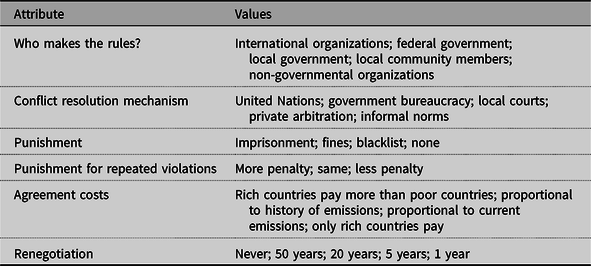
The hypothetical climate change agreements include six attributes: (1) which organizations define the rules; (2) how would conflicts be resolved; (3) what punishment should be applied to rule-breakers; (4) how should repeated violations be sanctioned; (5) which countries should bear the costs of the agreement; and (6) how often should the agreement be renegotiated. Table 1 describes the values we included in each treaty attribute. Footnote 3
Attributes and values for climate change mitigation conjoint experiments

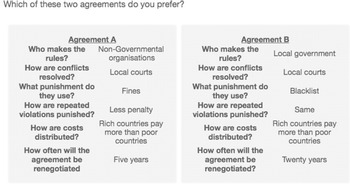
We give no prior indication of whether a certain value is more prevalent in actual agreements to elicit truthful responses from the interviewees. We also randomize the values to ensure that they all have the same probability of being selected. In total, there are 5,500 possible value combinations. Figure 1 illustrates how a typical conjoint element appeared in the respondents’ screen.
Example of conjoint table presented to respondents.

In designing the experiment, we attempted to strike a balance between realism and parsimony. Local implementation of climate agreements may vary among a wide set of dimensions, but including too many attributes in the conjoint design would significantly increase cognitive load and induce respondent fatigue (Pullman et al. Reference Pullman, Dodson and Moore1999). Subjects also use decision heuristics when the number of conjoint attributes is high, such as focusing on the dimensions they care the most or on the ones they see first. These issues lead to uninformative experimental results (Lines and Denstadli Reference Lines and Denstadli2004). In this respect, we decided to restrict the total of categories at the expense of some loss of external validity. However, if individuals found our choice of attributes too unrealistic, we would expect a high number of nonresponses in the survey. Our data show that this was not the case. Conditional on having answered the first task, completion rates for the last task were around 90% across countries and elite types, which suggests that respondents did engage in the experiment and that the offered options made intuitive sense to them.
We estimate our models with the cregg package (Leeper Reference Leeper2018) for the R statistical language (R Core Team, 2018). Here, we report marginal means instead of average marginal conditional effects (AMCEs) of local climate agreement attributes. Leeper et al. (Reference Leeper, Hobolt and Tilley2018) show that AMCEs can be misleading in subgroup analysis as model results are sensitive to the choice of reference categories in interactions. In contrast, marginal means provide a clear description of quantities of interest, in our case preferences toward agreement attributes, while allowing for easy comparisons between groups of respondents. Their interpretation is also straightforward: a 50% marginal means estimate represents that respondents are indifferent when this attribute appears vis-à-vis other attributes. When the coefficient is lower than 50%, respondents dislike packages with this attribute. Conversely, when the point estimate is higher than 50%, respondents prefer packages containing a given attribute. Readers can refer to the Supplementary Material for AMCE estimates.
RESULTS
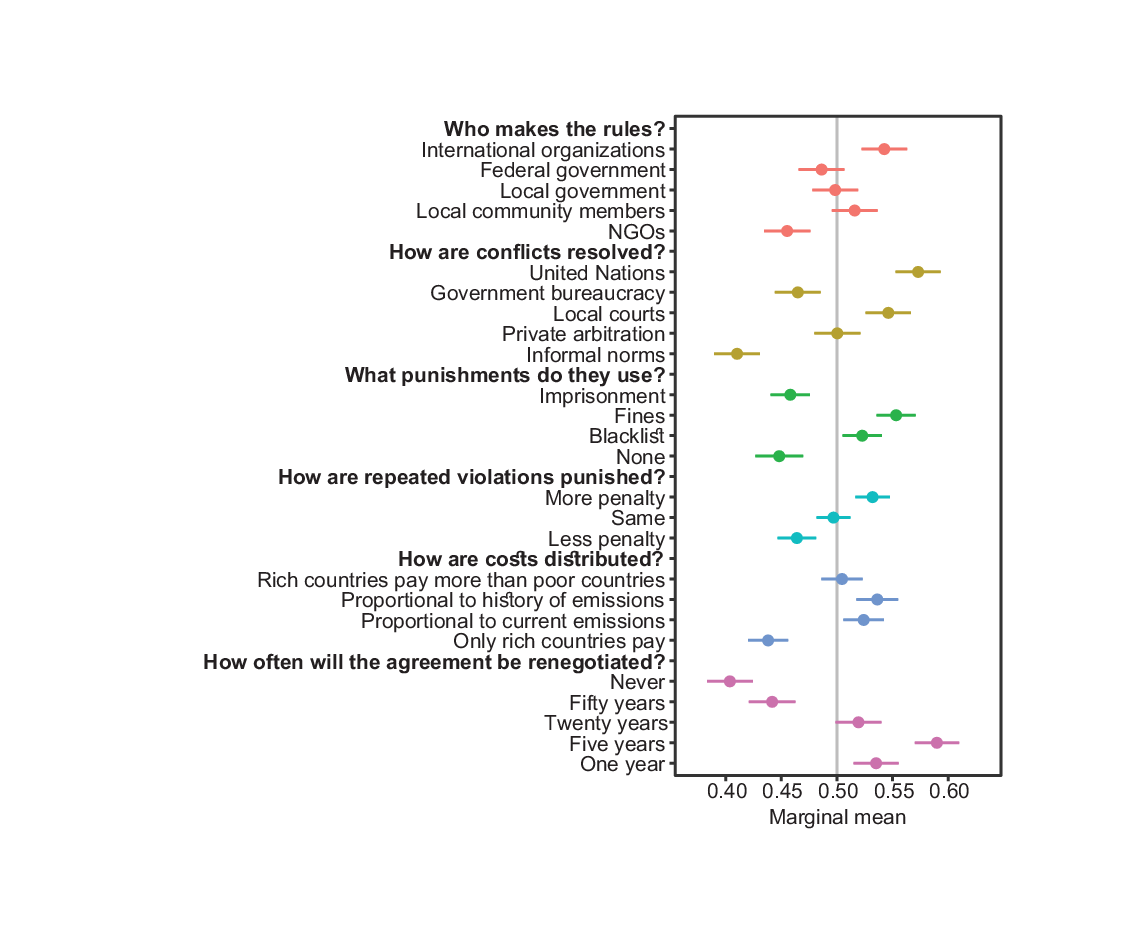
Figure 2 shows our main results. The graph illustrates the preference associated with each attribute of hypothetical local climate governance schemes. Dots with horizontal bars represent point estimates and 95% confidence intervals from linear regressions with robust standard errors clustered at the respondent level.
Relative preferences for institutional attributes in climate change agreements in 10 Latin American countries (pooled data, marginal means).

Respondents prefer international organizations to establish local climate mitigation rules (54%, SE = 1.2), but they also hold relatively favorable views of local communities (51.6%, SE = 1.25). We note that Latin American elites support multiple governance levels simultaneously, which suggests that they are willing to include separate political spheres into a single climate policy design. Local governments (49.8%, SE = 1.2) and federal governments (48.6%, SE = 1.3) are slightly preferred over NGOs, yet the difference between the former two is not statistically significant. Non-governmental organizations are the least preferred option for local climate change rulemaking with 45.5% (SE = 1.3).
We see a similar pattern with respect to conflict resolution. Respondents affirm disputes should be addressed mainly by the United Nations and local courts. These two choices receive 57.3% (SE = 1.2) and 54.6% (SE = 1.2) relative approval, respectively. Private arbitration comes next with 50% (SE = 1.3). Government bureaucracy and informal norms lower the chance of selecting a climate agreement, with 46.4% (SE = 1.3) and 41% (SE = 1.3) of support when compared to the alternatives.
Participants prefer graduated sanctions to repeated offenders (53.2%, SE = 0.9) and they prefer costs to be be allocated according to the country’s history of emissions (53.6%, SE = 1.1). Note, however, that the difference between history of emissions and current emissions is not statistically significant. Moreover, related to the same idea of proportionality, respondents indicate that lawbreakers should be punished with fines (55.3%, SE = 1.1), which can be increased if necessary. This is in line with the literature arguing that climate change agreements present a middle ground between rigidity and flexibility to accommodate domestic demands and increase national and local compliance (Von Stein Reference Von Stein2008).
Elites believe that Latin American countries should contribute to the global provision of public goods. We find no evidence that respondents intend to use local agreements to free ride on global climate change policies, as they position themselves against the idea that rich nations should bear the costs of climate protection. This is conductive to long-term cooperation as placing the burden exclusively on rich countries is likely to be off the equilibrium path and would, presumably, not lead to a stable arrangement.
When we analyze local agreements’ renegotiations, respondents are interested in a balance between stability and flexibility. Interviewees reject agreements that either cannot be modified or that last for 50 years. Their preference lies in agreements that can be renegotiated every 5 years (59%, SE = 1.2). This is consistent with a concern that agreements should be durable enough to provide long-term incentives to the parties, yet remain adaptable to unforeseen demands.
Overall, the results do not conform to strictly top-down or bottom-up approaches, but to a combination of these attributes. While elites favor solutions provided at the macro level, they are also open to input from other government actors and local groups. Further, the rejection on non-governmental organizations points to a discredit of self-governing arrangements as a means to deal with global warming. This result is in line with Latin America’s long reliance on the state to design and implement policies.
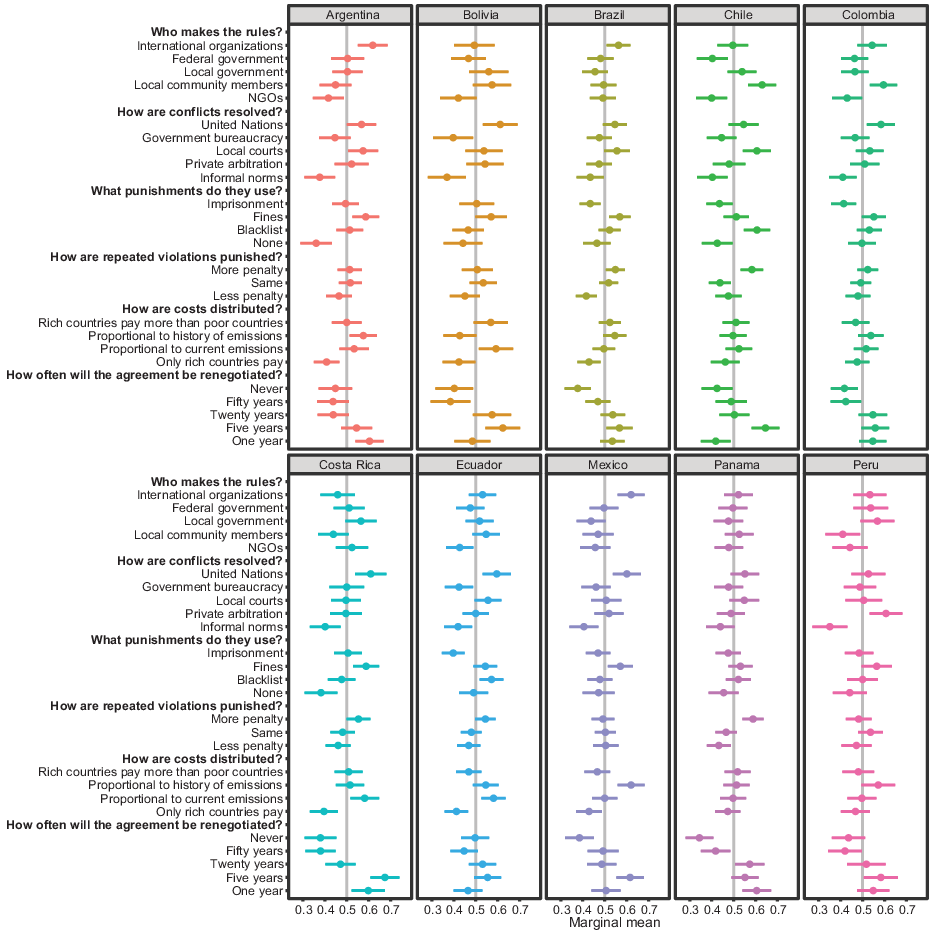
We also examine how our results vary across countries and types of elites. Footnote 4 Figure 3 displays the preferred local climate change agreement characteristics for each of the 10 countries in our sample. The disaggregated data confirm that elites have a generalized preference for international agencies to solve conflicts, and they dislike informal norms. In addition, the cross-country results show a preference for a positive role by federal and local governments and that local community members should also participate in the deliberation process.
Relative preferences for institutional attributes in climate change agreements by country (marginal means).

However, some of the regional preferences are a by-product of sample aggregation. Latin American elites do not have a consensus on which organizations should provide the rules. For example, elites in Costa Rica prefer local to global rulemaking; in Mexico, they prefer global and dislike local, similar to Peru, Argentina, and Brazil; in Colombia, elites favor global and local rulemaking simultaneously; and in Bolivia, respondents prefer local organizations to design local climate rules. This is an important point and might have far-reaching consequences for environmental policy design. The lack of coordination on rulemaking responsibilities can give rise to decision cycles, lowering the chance that a single, favorite climate change solution emerges. Nevertheless, these dissensions might be resolved by decentralization, boosting the idea that flexible regime complexes, such as polycentric governance schemes, might provide a solution to gridlocks.
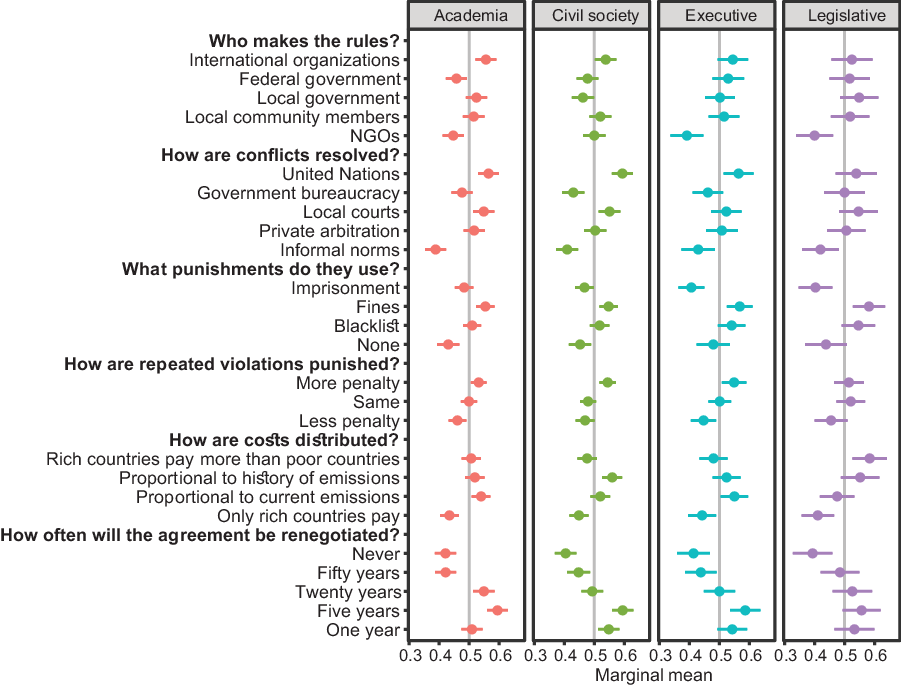
Figure 4 shows the results disaggregated by elite type. Academics, members of the civil society, and representatives in the executive and legislative branches hold similar views about how conflicts should be resolved, what punishment to apply to lawbreakers (fines and blacklisting), and the duration of the agreements.
Relative preferences for institutional attributes in climate change agreements by elite type (marginal means).

Differences emerge in two of the six attributes. Academics and members of the civil society are skeptical about the role of federal government in local climate policy-making, while members of the executive and legislative branches – part of the government themselves – have a more positive view of national institutions. The differences, however, are not large. Second, members of the legislative branch prefer rich countries to bear the larger part of agreement costs (58.4%, SE = 3.5). This provides evidence for the idea of historical responsibility for climate protection, an argument which developing countries have recently brought to climate negotiations (Müller et al. Reference Müller, Höhne and Ellermann2009; Friman and Hjerpe Reference Friman and Hjerpe2015).
DISCUSSION
In this article, we examine which attributes of local climate change mitigation treaties Latin American elites support. We find that interviewees prefer international organizations to resolve conflicts are favorable to imposing increasing fines on violators and renewing agreements every 5 years. Survey participants also signal their distrust of non-governmental organizations and informal norms. Taken together, our evidence suggests that Latin American elites oppose non-governmental organizations as rulemakers and want legal punishment to agreement violators.
While our results corroborate that Latin Americans prefer the state to conduct local public policy, they do not match the typical dichotomy of hierarchical versus decentralized climate change regimes. After disaggregating the data by country and elite type, we find that elites prefer international organizations to resolve disputes and that federal and local sources of governance should design local climate mitigation governance schemes. However, we also find large heterogeneity in the responses, with groups holding different opinions on how competences should be divided.
With regard to environmental policies, we identify that Latin American elites are interested in incorporating different political actors and in strengthening the role of international organizations in climate governance. Building on these insights, our study provides novel information to policy-makers, as it evaluates which climate agreements are politically acceptable for implementation in Latin America. Future climate negotiations can achieve better results if they take those local preferences into account.
We believe our findings can be extended in many ways. The research design we employ here provides only a first step toward understanding the behavior of local elites and their preferences regarding climate change policies. Our use of forced choices implies that we could not measure the overall level of attribute support in the elite population, when respondents can choose any agreement they prefer without constraints. Moreover, further research could better adjudicate between rules associated with the global treaty negotiations themselves and those concerning domestic politics. For instance, future studies may analyze how each country’s specific legal framework imposes constraints we did not include in our experiment and thus provide fine-grained information about local attitudes toward climate agreements. Moreover, scholars may employ other types of research designs, such as vignette experiments or qualitative interviews, to assess the robustness of our results. Lastly, our analysis can also be extended to examine if the Latin American public has the same opinion on multilevel arrangements as do the elites; and if not, it would be important to know what explains the mismatch between groups (Luna and Zechmeister Reference Luna and Zechmeister2005).
Supplementary material
To view supplementary material for this article, please visit https://doi.org/10.1017/XPS.2020.19