INTRODUCTION
Interest in exploring the relationship between spirituality and health has grown markedly over the recent decades. Improvements in our ability to measure quality of life have spurred this development as researchers have been able to provide empirical confirmation of the importance of spiritual well-being to overall quality of life (QOL) and health-related quality of life (HRQOL). While there are various definitions, there is general agreement that spirituality is two-dimensional, with one dimension focusing on religiosity or faith and affiliation with formal religious organizations, and one dimension focusing on a sense of life's meaning and purpose, distinct from one's relationship to God or a higher power (Ellison, Reference Ellison1983).
There have been a number of systematic reviews of the association of spiritual well-being, spirituality, and religious coping with health among community-dwelling adults and among persons with chronic illnesses, including cancer (McCullough et al., Reference McCullough, Hoyt and Larson2000; Nelson et al., Reference Nelson, Rosenfeld and Breitbart2002; Ano & Vasconcelles, Reference Ano and Vasconcelles2005; Chida et al., Reference Chida, Steptoe and Powell2009). While there are a number of studies that suggest that spiritual well-being may have a direct effect on disease progression and mortality, methodological limitations limit the strength of conclusions. In contrast, studies that have focused on the relationship of religious coping and spiritual strengths have consistently shown better psychological adjustment and management of disease-related symptoms (Fitchett & Canada, Reference Fitchett, Canada, Holland, Breitbart and Jacobsen2010; McClain, Rosenfeld, & Breitbart, Reference McClain, Rosenfeld and Breitbart2003).
The precise mechanism through which spiritual well-being (SWB) influences other dimensions of QOL during serious illness are not well understood. Possible explanations include the potential for having a sense of meaning and ultimate purpose in life to buffer the appraisal of physical symptoms or to assist in putting the illness in the perspective of a life well lived. The religious or faith-oriented dimension may offer reassurance and trust in a merciful God and possibly even the perspective of benefit derived from overcoming suffering (Boyle et al., Reference Boyle, Barnes and Buchman2009; Yanez et al., Reference Yanez, Edmondson and Stanton2009). In addition, some have argued for a direct physiologic pathway involving the potential for spirituality to deactivate the sympathetic nervous system, reduce inflammatory cytokines, and thus contribute to reduce symptom experience (Chida et al., Reference Chida, Steptoe and Powell2009).
Regardless of the precise mechanism, improvement in the appraisal of QOL by the ill individual is likely to influence the experience of the family caregiver. The majority of care, both physical and emotional, of persons with advanced cancer falls on informal (i.e., family) caregivers, and the toll this takes is a subject of increasing importance (Given et al., Reference Given, Wyatt and Given2004). Burden and depression are caregiver outcomes that have been most extensively studied, and there is strong evidence that these adverse states in caregivers are associated with aspects of patient QOL. Presence of pain, physical dependency, and depression in patients are correlated with degree of distress among caregivers (Ferrell et al., Reference Ferrell, Rhiner and Cohen1991; Given et al., Reference Given, Wyatt and Given2004; Grunfeld et al., Reference Grunfeld, Coyle and Whelan2004).
In light of the previously demonstrated associations between patient spirituality and patient QOL, it is possible that increased levels of spirituality among patients might be associated with improved emotional outcomes among their family caregivers. Kim et al. (Reference Kim, Carver and Spillers2011) has reported the only investigation of relationships between patient SWB and caregiver SWB. They did not find any independent relationship between the partners' (patient and family member) SWB, but they did report a positive relationship between higher levels of SWB in patients and better physical health of caregivers (CG), and between better physical health of patients and higher levels of SWB in CG. However, they did not report on any relationship between patient SWB and the specific outcome of caregiver depression. Thus, the purposes of this study were to: (1) examine the relationship between patient physical QOL and caregiver depression, and (2) evaluate whether patient spiritual well-being played a mediating role in this relationship.
MATERIALS AND METHODS
A prospective longitudinal design was used and all patients (and their caregivers) meeting the eligibility criteria were enrolled consecutively. The study was conducted from January, 2007 through November, 2010 and 296 patients and their caregivers were enrolled. Institutional Review Board approval was obtained before study initiation.
Subjects
Eligibility criteria for patients were: (1) 18 years of age or older, (2) histological diagnosis of Stage III or Stave IV lung, pancreas, colorectal, or ovarian cancer (either as an initial diagnosis or as a new progression from an earlier diagnosis), (3) life expectancy ≥3 months as estimated by the primary oncologist, (4) Eastern Cooperative Oncology Group (ECOG) performance status ≤3, and (5) ability to speak and comprehend English. Exclusion criteria were: (1) patient planned to transfer care out of the geographic area, (2) patient was too cognitively impaired to participate, or (3) patient had no caregiver available to participate in the study. Caregivers were eligible if they were: (1) identified as the primary caregiver by the patient, (2) age ≥18 years, (3) available to participate in study interviews, and (4) willing to provide written informed consent for study participation.
Setting
Subjects were enrolled from the cancer center at a university-affiliated, not-for-profit medical center. The Cancer Center is an National Cancer Institute (NCI)-designated comprehensive cancer center. Two sites were used: the main campus site as well as one of the community satellite sites.
Data Collection
Research assistants (RAs) screened all patients who had an appointment at the cancer center sites to determine eligibility. Once it was determined that the patient met eligibility criteria, they determined if there was a caregiver and if that individual met eligibility criteria as well. The RA explained the study to potential patients and caregivers and obtained written consent. Patient and caregiver subjects were followed up to 15 months post-enrollment.
Before data collection, RAs were trained in the use and administration of all interview tools. Inter-rater reliabilities (IRR) were assessed; acceptable reliabilities of 80% agreement and Pearson's correlations of at least 0.80 (for continuous variables) and kappa's of at least 0.60 (for categorical variables) were established before data collection proceeded (Landis & Koch, Reference Landis and Koch1977; Bland, Reference Bland1988). Every four months throughout the data collection period, ongoing IRR was also assessed; retraining occurred if reliabilities fell below acceptable levels.
Demographic and clinical information about each patient was obtained from cancer center medical records as well as the enrollment interview. This included age, gender, race, Eastern Cooperative Oncology Group (ECOG), type and stage of cancer, and Charlson index of comorbidity. Demographic information about each caregiver was obtained from baseline interviews conducted by RAs at study enrollment. RAs conducted interviews with patients and caregivers at study enrollment, 3 months, 9 months, and 15 months later.
Instruments: Patients
The Charlson Weighted Index of Comorbidity was used to quantify information about current comorbid conditions. This instrument uses a weighted index that takes into account the number and seriousness of comorbid disease. Weights (ranging from 1–6) are assigned to comorbid conditions and the weighted scores are added to obtain a total score. Scores range from 0–37 with higher scores representing higher numbers and seriousness of comorbid conditions. IRR and concurrent validity has been established (Charlson et al., Reference Charlson, Pompei and Alex1987).
The ECOG was used to estimate disease severity. ECOG is a physician-rated measure of functional ability, ranging from 0 (fully active, able to carry on all pre-disease performance without restriction) to 4 (completely disabled, cannot perform self-care, totally confined to bed or chair) (Oken et al., Reference Oken, Creech and Tormey1982).
The Functional Assessment of Cancer Therapy-General tool (FACT-G) was used to measure HRQOL. This instrument has been used extensively worldwide to measure HRQOL in cancer patients and consists of 27 items that are rated on a 5 point Likert scale (0 = worst QOL; 4 = best QOL). Scores are summed for a total HRQOL score (range: 0–108 with higher scores indicating better overall HRQOL) and four subscale scores are also obtained. These subscales are: physical well-being, social well-being, emotional well-being, and functional well-being and are interpreted in the same manner as the total score. Test-retest reliability has ranged from 0.82–0.92 and internal consistency of subscales has ranged from α = 0.60–0.89. Validity of the FACT-G has also been reported (Victorson et al., Reference Victorson, Barocas and Song2008).
The functional assessment of chronic illness therapy-spiritual well-being (FACIT-Sp) was used to measure spiritual well-being. This tool was developed by the same group who developed the FACT-G and was intended to measure an aspect of HRQOL that is not measured when using the FACT-G. The instrument is comprised of 12 items using a 5-point Likert scale ranging from 0 (not at all) to 4 (very much). All items are summed for a total score that ranges from 0–48 with higher scores indicating a higher degree of spiritual well-being (Peterman et al., Reference Peterman, Fitchett and Brady2002). This tool also includes three subcomponents of spiritual well-being: faith, meaning, and peace. For the purposes of this study, spiritual well-being was conceptualized as a two-factor model with faith representing one factor and meaning + peace representing the second factor (Kim et al., Reference Kim, Carver and Spillers2011). The tool has been reported to be reliable (α = 0.82–0.89) and valid in persons with cancer (McNair et al., Reference McNair, Lorr and Doppleman1992); for this study, internal reliability of the subscales was good (α = 0.78–0.87).
Instruments: Caregivers
The profile mood states-short form (POMS-S) was used to measure mood state. The POMS-S is an adjective rating scale that assesses mood state today and across the past week. It uses a 5-point Likert scale ranging from 0 (not at all) to 4 (extremely). There are five negative mood state subscales (confusion, anxiety, depression, fatigue, tension) and one positive mood state subscale (vigor) that comprise an overall total mood disturbance (TMD) score. Higher numbers represent a higher degree of overall mood disturbance (TMD) as well as a higher degree of the subscale attribute being assessed (depression subscale etc). Reliability and validity have been established for subscales as well as the TMD score (Baron & Kenny, Reference Baron and Kenny1986).
Analysis
Descriptive statistics were performed to examine key descriptive variables for both patient and caregiver subjects. Bivariate correlations were conducted to examine linear relationships between key variables and multivariate analyses included linear regression to examine indirect effects upon the outcome variable (caregiver depression). Established criteria for evaluating proposed mediation pathways were used (Sobel, Reference Sobel and Leinhardt1982; Kenny et al., Reference Kenny, Korchmaros and Bolger2003; Lubans & Sylva, Reference Lubans and Sylva2009; Imai et al., Reference Imai, Keele and Tingley2010; Pearl, Reference Pearl2011). We applied these steps as follows: Step 1: Demonstrate that patient physical QOL was correlated with the caregiver depression. Step 2: Demonstrate that the patient physical QOL was correlated with patient SWB (meaning/peace) [mediator]. Step 3: Demonstrate that patient SWB (meaning/peace) was correlated with caregiver depression. Step 4: Examine the change in the relationship between patient physical QOL and caregiver depression when controlling for the hypothesized mediating variable (patient SWB meaning/peace). The relationship should be substantially reduced when controlling for the hypothesized mediator (Preacher and Hayes, Reference Preacher and Hayes2008). To determine whether the reduction could be considered substantial, the Sobel test was used (Kenny, Reference Kenny2011).
RESULTS
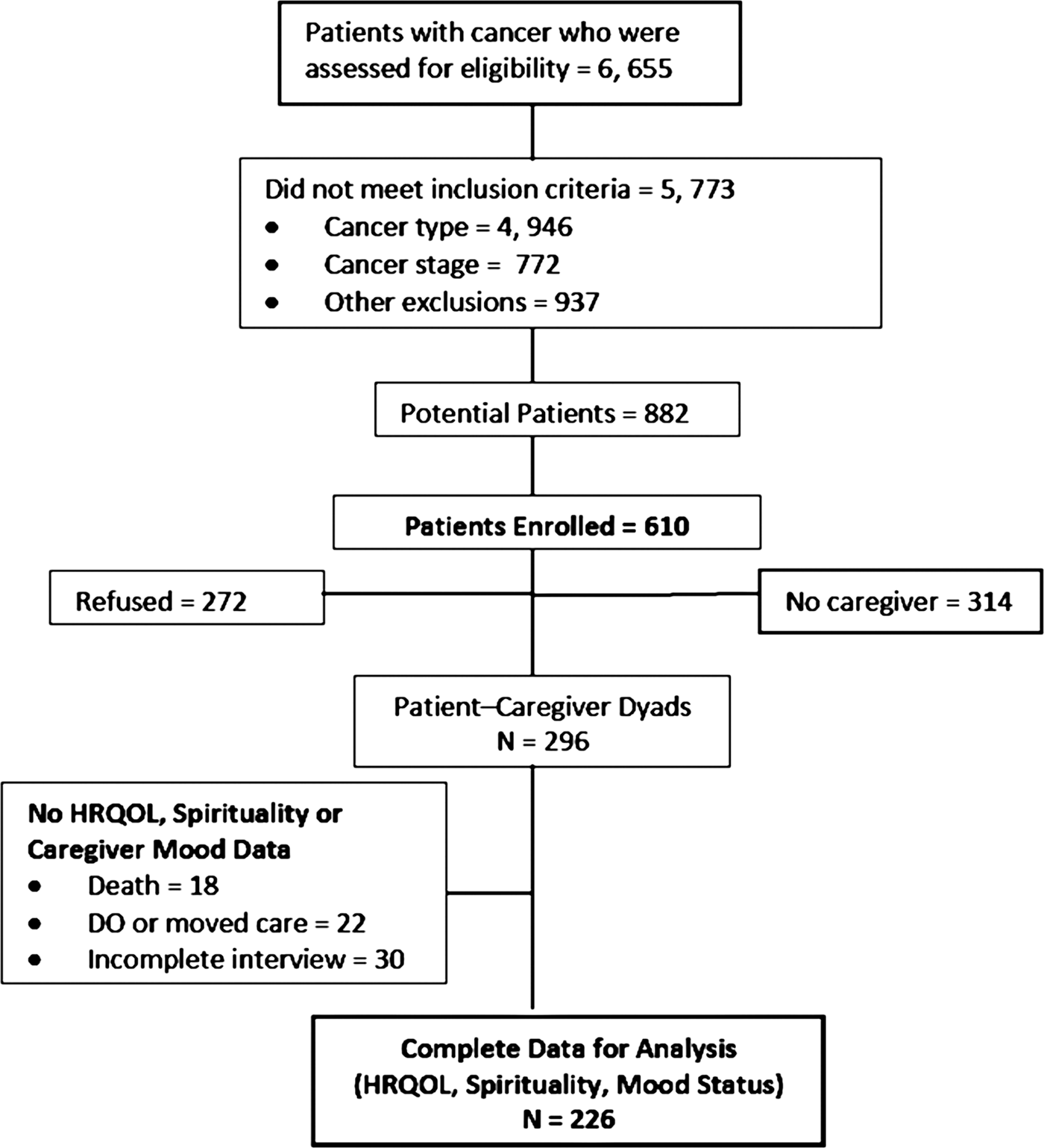
Figure 1 displays the sample enrollment, refusals, and dropouts. For multivariate analyses, there were 226 patient-caregiver dyads that provided complete data. Post-hoc power analysis (one-tailed test, α = 0.05, |ρ| = 0.26, n = 226) yielded power of 0.98 for the bivariate correlations and 0.95 for the relationship between patient physical QOL and caregiver depression when controlling for patient SWB (Step 4 of the mediation analysis) (Erdfelder et al., Reference Erdfelder, Faul and Buchner1996).
Patient and Caregiver Sample Selection.

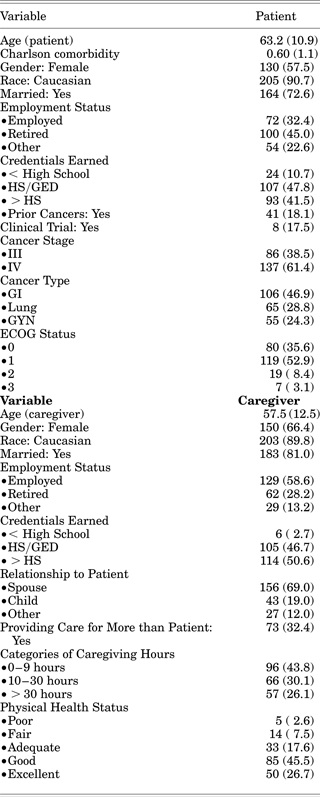
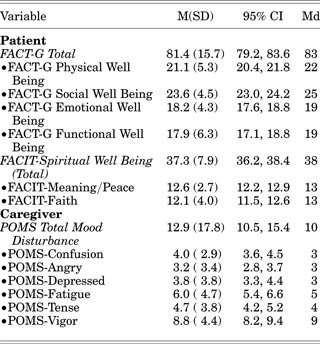
Table 1 provides clinical and demographic descriptions of these patient and caregiver subjects. Patients were primarily Caucasian, married, with less than a college education. Because all patients were either newly diagnosed or newly progressed to advanced cancer, the range of time since original diagnosis was large (3 weeks–13.25 years). The average time from initial diagnosis to enrollment into the study was 60.43 (105.6) weeks (15 months) but because data were highly skewed, the Median is a more appropriate measure of central tendency (Md = 17 weeks; 4.25 months). A majority of patients had no history of prior cancers and were not participating in a clinical trial. More than two-thirds were receiving chemotherapy (85.1%) while only 20.8% were receiving radiation therapy at the time of study enrollment. More than half of the patients had a living will (53.4%), and durable power of attorney (56.4%). Patient health status and SWB scores are reported in Table 2.
Demographic and clinical variables for patients and caregivers (n = 226)
Health related quality of life, spirituality, and mood characteristics of patients and caregivers (n= 226)
Caregivers were, on average, middle-aged, female, married to the patient, and in self-described “good” health. Over half were providing >9 hours/week of caregiving to the patient and almost 60% were employed. Caregiver mood and depression scores are reported in Table 2.
In order to examine the relationship between patient physical QOL and caregiver depression, a bivariate correlation was conducted. Assumptions of normality and linearity were met and the relationship was statistically significant (r(224) = −0.34, CI 0.95: −0.45, −0.22; p = 0.0001). Approximately 11% of the variance in caregiver depression was explained by knowing the patient's physical QOL status.
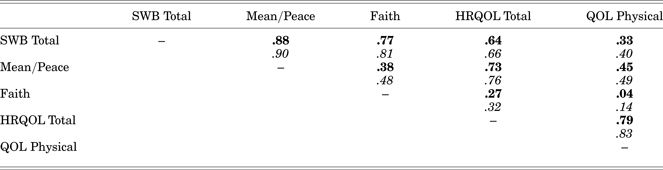
Next, we were interested in examining whether caregiver depression was predicted to be a function not only of the direct effect of the patient's physical QOL but also the indirect effect of the patient's spiritual well-being (SWB meaning/peace subscale). In order to ensure that SWB was related to QOL, we examined bivariate correlations between total and subscale scores for these patient variables (Table 3). All SWB scores (total and subscales) were significantly correlated to one another. QOL total and the physical subscale were strongly correlated with one another and the physical subscale had the strongest relationship with the SWB subscale score of meaning/peace. As we were interested in examining the role of SWB upon the relationship between patient physical QOL and caregiver depression, we chose the subscale with the strongest relationship with physical QOL: meaning/peace.
Zero-order correlation coefficients among spiritual well-being total and subscale scores and HRQOL total and physical subscale scores1
1 Enrollment correlations in bold (n = 226); correlations 3 months later (n = 156) in italics.
Note. All coefficients were significant at p < .0001 except for Faith and QOL-Physical at enrollment (p = .56) and 3 months later (p = .09).
Before proceeding to examine the role of meaning/peace as a mediating variable, assumptions of linearity, normality, homogeneity of error variance, and independence of residuals were examined. The data met all four of these assumptions and mediation analyses proceeded.
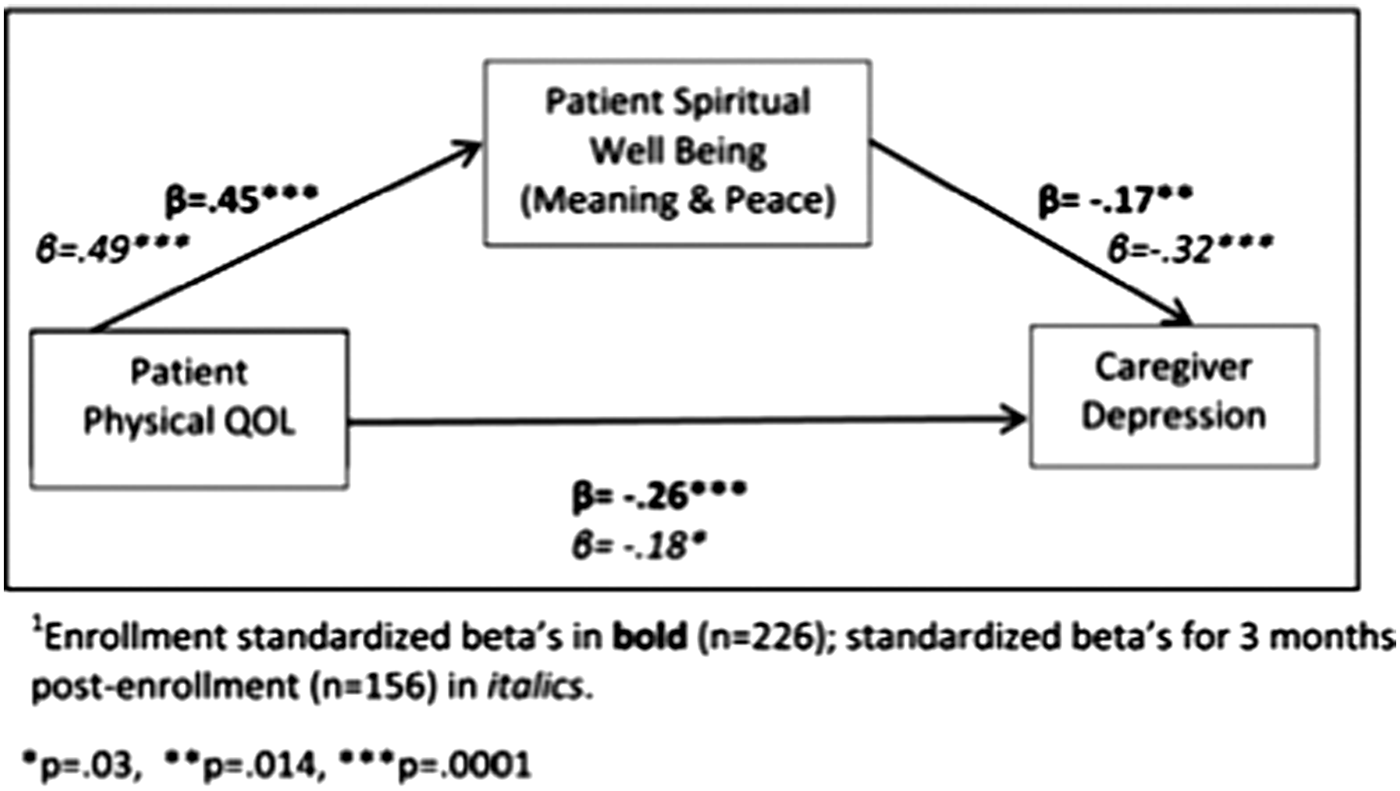
To examine the role of patient's SWB as a mediator between patient's physical QOL and caregiver depression, we used the analytic steps identified by Baron and Kenny (2003). First, to examine whether the predictor variable was correlated with the criterion variable, we regressed caregiver depression upon patient physical QOL. Patient physical QOL was significantly related to caregiver depression (β = −0.34, p = 0.0001). Second, to examine whether the predictor variable was correlated with the mediator, we regressed patient SWB (meaning/peace) upon patient physical QOL and found the relationship to be significant (β = 0.45, p = 0.0001). Third, to examine whether the mediator affected the criterion variable, we regressed caregiver depression upon patient's SWB (meaning/peace) score. This relationship was significant (β = −0.29, p = 0.0001).
In order to examine whether or not the relationship between caregiver depression and patient QOL was significantly reduced when controlling for patient SWB (meaning/peace), we regressed caregiver depression upon patient physical QOL after controlling for patient SWB (meaning/peace). The pathway between physical QOL and caregiver depression was reduced from −0.34 to −0.26 (p = 0.0001). To assess whether this reduction was substantial, the Sobel test was used (Sobel, Reference Sobel and Leinhardt1982; Preacher & Hayes, Reference Preacher and Hayes2008). The Sobel test was significant (z = −3.87, p = 0.0001), suggesting that patient SWB (meaning/peace) satisfied criteria for mediation. To determine the effect size (ES) of SWB as a mediating variable, we used the strategy of Kenny (Reference Kenny2011) who recommends computing the product of the partial correlations for paths a (between predictor and mediator) and b (between mediator and criterion). The computed ES was: (0.45)(−0.29) = 0.13. Since this ES is two partial correlations squared, Kenny (Reference Kenny2011) recommends that interpretation be limited to the following criterion: small = 0.01, medium = 0.09, and large = 0.25. According to this criterion, meaning/peace has a medium sized effect as a mediating variable upon the relationship between patient physical QOL and caregiver depression.
Finally, in order to explore whether the nature of these relationships was stable over time, we conducted the same analytic steps as outlined earlier but used the same variables that had been obtained three months after baseline data were obtained. We found very similar relationships between variables and also found a very similar mediating effect of SWB (Fig. 2). In addition, we found that Sobel test was significant (z = −3.31, p = 0.03) with the ES of SWB being 0.14. Thus, even when examining the relationship of the variables at different points in time, we found that patient SWB (meaning/peace) satisfied the criteria for mediation and had a moderate effect.
Model of indirect mediating effect of patient spiritual well-being upon the relationship between patient physical QOL and caregiver depression1.
DISCUSSION
There are several findings worth note. First, as has been documented in prior work with cancer patients, we found moderate and significant relationships between patient physical QOL and their SWB (meaning and peace). As with others' work, the relationship was clinically meaningful as well with an effect size that was considered to be medium (r = −0.34) (Kenny, Reference Kenny2011). Second, we found significant relationships between SWB total and subscale scores for caregivers of patients with advanced cancer that were similar in strength and direction to those reported among cancer survivors (Kim et al., Reference Kim, Carver and Spillers2011). While not the focus of this study, this finding suggests that the nature of the relationships between subscales and total scores are not contextual as Kim's subjects were survivors and ours had a recent diagnosis of advanced cancer. The examination of spirituality scores (overall and subscales) in a variety of cancer populations will further clarify the nature of these aspects of spirituality.
Third, our findings that patient SWB (meaning/peace) played a significant role as a mediator in the relationship between patient physical QOL and caregiver depression is the first to document this relationship between patient QOL and caregiver depression. These findings help us understand the mechanism through which patient QOL (not “health”) affects caregiver depression. The findings demonstrate that patient spirituality is central to patients' coping and adjustment to cancer and it is this that affects caregiver well-being (depression), not so much patient physical status as was previously thought. Of note is that these relationships remain stable over time and do not appear to be contextual. Therefore, a low level of SWB in the patient may be a risk factor for the caregiver, who may need more support. And, similarly, the most potent intervention for caregiver depression may well be attending to patient spiritual distress.
There are limitations to the present study. First, we reported a 30% refusal rate and it may be the case that patients or caregivers who refused participation and inclusion of data were those who were most distressed and who might have had significantly different caregiver depression or patient spirituality scores than those who chose to participate in the study. While a 30% refusal rate does not risk threats of internal or external validity, generalizability is limited to patients who are like those who agreed to participate (Babbie, Reference Babbie1993). Second, by limiting ourselves to specific cancer types (lung, GI, GYN) we realize that we have excluded some clinical subgroups. As a result, our findings cannot be generalized to all patients with advanced cancer as the nature of relationships between and among variables might be different for those patients.
It is clear that there will be continued growth in the numbers of patients who have advanced cancer and who are in need of support from members of the healthcare team. While the needs of patients have been examined, only recently has the caregiver's need and the relationship between key patient and caregiver variables been examined. Prior work has established the relationship between patient physical QOL and caregiver depression, but the influence of the patient's spiritual well-being upon this relationship had not been examined. Findings from this study show that patients' spiritual well-being (especially their ability to find meaning and peace) plays a critical role in affecting caregiver depression—a relationship that has previously only been documented in patients (Nelson et al., Reference Nelson, Jacobson and Weinberger2009). This finding will be helpful to healthcare providers who may be instrumental in assessing patients for spiritual distress and in providing opportunities for patients and their caregivers to receive spiritual support—especially those that can instill a sense of peace and meaning. Continued research that examines the nature of the relationships between patient physical QOL, patient spiritual well-being, and caregiver depression with different cancer populations will add to the generalizability of study results.
ACKNOWLEDGMENTS
The study was performed at Case Western Reserve University, Seidman Cancer Canter at University Hospitals Case Medical Center (main campus) and Chagrin-Highlands campus, Cleveland, OH. This study was funded by a grant from the National Institute of Nursing Research, NR018717.