Introduction
Eastern Europe and Central Asia are the only regions where HIV prevalence continues to rise (UNAIDS, 2009). Armenia, a country of the former Soviet Union, is no exception (National Centre for AIDS Prevention, Armenia, 2010). Although, according to the last surveillance, the estimated prevalence of HIV in this country was less than 0.1% (Grigoryan et al., Reference Grigoryan, Hakobyan, Papoyan, Manukyan, Ohanyan and Asatryan2008), the number of newly registered cases has been increasing steadily since reporting began in 1988 (National Centre for AIDS Prevention, Armenia, 2010). Around 17% of the 874 HIV cases registered in Armenia since 1988 were reported in 2009 alone, reflecting an alarming trend in HIV rates (National Centre for AIDS Prevention, Armenia, 2010).
The low HIV prevalence in Armenia provides an opportune moment to intervene by targeting HIV prevention efforts to high-risk groups, where the epidemic is currently concentrated, thereby averting a larger-scale epidemic. However, this window of opportunity is narrow due to social, economic and political changes sweeping the country. Similar changes were shown to fuel generalized HIV epidemics in other former Soviet Union countries, such as Russia and Ukraine (Papoyan et al., 2005).
One subgroup – female sex workers (FSWs) – constitutes a group at particularly high risk of HIV infection. Epidemiological surveillance conducted in Armenia in 2007 demonstrated that although the HIV seroprevalence among FSWs was below 2%, it far exceeded that of the general population (Grigoryan et al., Reference Grigoryan, Hakobyan, Papoyan, Manukyan, Ohanyan and Asatryan2008). Access to existing national prevention and care programmes is still limited for FSWs due to stigma and discrimination. Given their vulnerability to HIV infection, the design and implementation of interventions tailored for FSWs is imperative. To that end, it is important to understand the antecedents to preventive sexual behaviours as well as the mechanisms for influencing those behaviours. The sexual behaviour most commonly studied in this context has been frequency of condom use during vaginal sex by FSWs with clients (Kayembe et al., Reference Kayembe, Mapatano, Busangu, Nyandwe, Musema and Kibungu2008; Adu-Oppong et al., Reference Adu-Oppong, Grimes, Ross, Risser and Kessie2007; Markosyan et al., Reference Markosyan, Babikian, DiClemente, Hirsch, Grigoryan and del Rio2007; Todd et al., 2007; Tran et al., Reference Tran, Le and Nguyen2008; Markosyan et al., Reference Markosyan, Lang, Darbinyan, DiClemente and Salazarin press). The interest of behavioural interventionists towards condom use is justified by extant public health research demonstrating the effectiveness of latex condoms in protecting sexually active individuals from acquiring sexually transmissible infections (STIs), including HIV (Centers for Disease Control and Prevention, 2002; Crosby et al., Reference Crosby, DiClemente, Holtgrave and Wingood2002; Holmes et al., Reference Holmes, Levine and Weaver2004). For example, among FSWs in Cambodia, condom promotion has resulted in a sharp decrease in HIV prevalence from 80–90% in 1997 to 21% in 2002 (Population Service International, 2004).
An important condition for the effectiveness of latex condoms in preventing HIV transmission is their consistent use and correct application (Steiner et al., Reference Steiner, Dominik, Rountree, Nanda and Dorflinger2003; Crosby et al., Reference Crosby, Sanders, Yarber and Graham C.2003). Extant interventions with FSWs in other countries target FSWs directly rather than their clients. Therefore, it is important that FSWs acquire condom application skills themselves in an effort to prevent condom failure, which may result when untrained and unskilled clients apply condoms. To the best of the authors' knowledge, there are no studies that have focused on understanding FSWs' ability, confidence and frequency in applying condoms on their male clients. The empirical data concerning the prevalence and correlates of condom application among other female populations are also scant. In a study with high-risk African-American adolescent girls, those receiving a sexual risk reduction intervention reported increased frequency of condom application on their male partners (DiClemente et al., Reference DiClemente, Wingood, Harrington, Lang, Davies and Hook2004). Therefore, understanding factors that influence consistent application of condoms among a high-risk population such as FSWs may be important in informing subsequent HIV/STI prevention programmes tailored for this population. The purpose of the current study was to provide prevalence data and examine correlates of consistent condom application on male clients among a cross-sectional sample of FSWs working in the urban capital of Armenia, Yerevan, focusing specifically on knowledge of HIV transmission dynamics, condom use self-efficacy and perceived barriers to condom use. These constructs have been frequently identified as important variables in HIV prevention efforts among high-risk populations (DiClemente et al., Reference DiClemente, Wingood, Harrington, Lang, Davies and Hook2004; Markosyan et al., Reference Markosyan, Lang, Darbinyan, DiClemente and Salazarin press).
Methods
Participants
Between August 2007 and July 2008, FSWs were recruited, using multiple outreach strategies, to participate in a randomized controlled trial of an HIV risk-reduction intervention designed to reduce the risk of HIV acquisition and transmission via heterosexual sex. Recruiters screened 168 self-identified FSWs. Eligibility criteria were being female, 18 years of age or older, trading sex for money in the past 7 days and being cognitively able to participate in the study (based on recruiter's judgment during interaction with potential participant). One hundred and twenty women agreed to participate (76% participation rate). Women were compensated with US$20 for their participation. Additional incentives included availability of a physician and an attorney to answer questions about sexually transmitted infections and legal/human rights issues, respectively. Due to economic constraints and sex-work-related stigma, access to such professionals is often fiscally and socially prohibitive for this population. Childcare was also made available at the study site. The Institutional Review Boards (IRB) of the American University of Armenia (Yerevan, Armenia) and Emory University (Atlanta, GA, USA) approved the study protocol prior to implementation.
Study design and data collection
This study reports data collected at baseline, prior to randomization and participation in the HIV risk-reduction intervention. Baseline assessment consisted of a face-to-face interview administered by a trained interviewer in a private room. Interviews were conducted in Armenian and were approximately 30 minutes in duration.
Outcome measure
The outcome of the study was self-reported consistent application of condoms by FSWs on their male clients, which was based on assessing the frequency with which FSWs applied condoms on clients during vaginal sex. Response categories used a Likert scale ranging from 0 (never) to 4 (every time). The FSWs' responses were dichotomized such that those who reported applying condoms on clients every time were considered ‘consistent appliers’ while all others were considered ‘inconsistent appliers’. Consistent condom application is considered the most protective behaviour in terms of risk reduction. Conversely, any degree of inconsistent condom application, whether occurring a few times or many times, allows for opportunity of STI/HIV infection, and is therefore considered sub-optimal in terms of risk reduction.
Predictor measures
Socio-demographic and sex-work-related variables were assessed including: age, education, marital status, having children, age of initiation of sex work, and using different methods to prevent STI/HIV. Participants were also asked to report whether or not they ever tested positive for an STI and whether they ever experienced abuse. Abuse was assessed with three dichotomous questions inquiring about lifetime experience of physical, emotional and/or sexual abuse. Responses to each of the three questions were summed and a total score was obtained with values ranging between 0 and 3. Further, the frequency with which participants had sex when drinking alcohol alone or with their male clients in the past 7 days was also assessed.
Psychosocial mediators were derived from underlying theoretical frameworks including Social Cognitive Theory (Bandura, Reference Bandura, DiClemente and Peterson1994), the Information-Motivation-Behavioural Skills Model (Fisher & Fisher, Reference Fisher and Fisher1992), the Health Belief Model (Rosenstock et al., 1994) and the Theory of Gender and Power (Wingood & DiClemente, Reference Wingood and DiClemente2000, Reference Wingood, DiClemente, DiClemente, Crosby and Kegler2002), as well as a review of the empirical literature. Constructs selected were assessed using scales with satisfactory psychometric properties previously used with high-risk adolescent women (DiClemente & Wingood, Reference DiClemente and Wingood1995; DiClemente et al., Reference DiClemente, Wingood, Harrington, Lang, Davies and Hook2004). Barriers to condom use were measured using an eighteen-item scale assessing attitudes that impede participants' ability to effectively use condoms (e.g. ‘I wouldn't know where to get a condom’, ‘Condoms spoil the mood’, and ‘If I asked my clients to use a condom, they might get angry’). Response options ranged from 0 (strongly disagree) to 3 (strongly agree). A summary scale score was obtained by summing the numeric values for each item yielding a range of 0 to 54. The internal consistency of the scale (Cronbach's α) was 0.82.
Condom use self-efficacy was measured using an eight-item scale assessing self-efficacy in using condoms with sex partners (e.g. ‘How much of a problem would it be for you to put a condom on a hard penis?’). Response options ranged from 1 (a lot) to 5 (not at all). A total scale score was obtained with values ranging between 8 and 40 (Cronbach's α=0.95).
Lastly, HIV prevention knowledge measured participants' basic understanding of HIV transmission dynamics using a nine-item index.
Several techniques were used to enhance the validity of participants' self-reported sexual behaviour and psychosocial variables. Participants were asked to report their behaviour over a relatively brief time interval to enhance accurate recall and were provided with calendars specifying the reporting intervals of interest (DiClemente et al., Reference DiClemente, Wingood, Harrington, Lang, Davies and Hook2004). To enhance confidentiality, interviewers assured participants that codes rather than names would be used on all records.
Statistical methods
First, descriptive statistics were computed to summarize socio-demographic variables for the entire sample. Next, differences between FSWs reporting consistent application (every time) and those reporting inconsistent application of condoms on clients were analysed with regard to socio-demographic and other psychosocial and behavioural variables using chi-square and independent samples t-tests for dichotomous and continuous variables, respectively. Finally, a logistic regression model was constructed to identify significant predictors associated with consistent application of condoms on male clients, controlling for other variables in the model. Variables were selected for inclusion in the multivariate model if they reached a statistical level of p≤0.20 in bivariate analyses (Hosmer & Lemeshow, Reference Hosmer and Lemeshow1989). Analyses were performed using SPSS 17 statistical software.
Results
Descriptive analyses
A total of 120 FSWs were recruited between the ages of 20 and 52 (mean=33.7; SD=6.7). Of them, 42.5% (n=51) completed 8 years of education or less. A total of 17.5% (n=21) reported being single, while others reported being either divorced or widowed, married or unmarried but living with a man. Among all participants, 62.5% (n=75) reported having children, and 50% (n=60) reported having a steady partner. History of a positive STI test was reported by 59.2% (n=71) of FSWs. A total of 56.7% (n=68) participants reported a history of physical, emotional and/or sexual abuse with an average abuse score of 1.1.
Further, 49.2% of FSWs in this sample believed that it is the male's responsibility to apply condoms. A total of 25.9% of participants thought that if they asked their clients to use a condom, clients might get turned off or lose erection. Nearly one-third of participants (29.2%) thought that if they asked their clients to use a condom, clients might get angry.
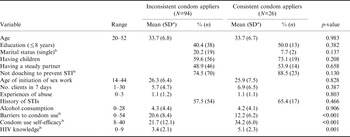
A total of 21.7% (n=26) reported consistently (every time) applying condoms on clients, while 78.3% of the sample (n=94) reported inconsistent application of condoms. Of these, 45.7% (n=43) of participants reported that they never applied condoms on male clients. Additional descriptive data as well as differences between consistent and inconsistent appliers are presented in Table 1. Differences between the two groups that reached significance at p≤0.20 were observed with respect to marital status, using douching as a method to prevent STI/HIV, barriers to condom use, condom use self-efficacy and HIV/AIDS knowledge. While barriers to condom use, condom use self-efficacy and HIV/AIDS knowledge served as the main predictors of consistent condom application in multivariate model, marital status and douching were also included as covariates based on literature suggesting a p=0.20 cut-off for determination of covariates (Hosmer & Lemeshow, Reference Hosmer and Lemeshow1989).
Descriptive characteristics of inconsistent and consistent condom appliers

a SD, standard deviation.
b Variables included in the logistic regression model.
Regression analysis
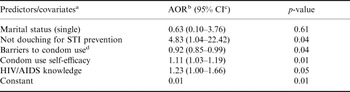
The results of the regression analysis are presented in Table 2. Of the five variables entered into the model, three had a statistically significant association with consistent condom application. Specifically, with each unit increase in condom use self-efficacy score, FSWs were 1.11 times (p=0.01; 95% CI=1.03–1.19) more likely to report consistent application of condoms. Additionally, with each unit decrease in perceived condom use barriers, FSWs were 1.09 times (p=0.04; 95% CI=1.01–1.18) more likely to report consistent application of condoms. Further, those not using douching as a method to prevent STI/HIV were 4.83 times (p=0.04; 95% CI=1.04–22.42) more likely to consistently apply condoms on clients than those douching for STI/HIV prevention. Finally, HIV knowledge had a marginally significant association with condom application. Specifically, with each unit increase in HIV knowledge score, FSWs were 1.29 times (p=0.05; 95% CI=1.00–1.19) more likely to report consistent application of condoms.
Logistic regression model

a Marital status and douching as a method to prevent STI/HIV were included in the model as covariates; perceived barriers to condom use, condom use self-efficacy and HIV/AIDS knowledge were included as predictors.
b AOR, adjusted odds ratio using consistent condom application as the reference category.
c CI, 95% confidence interval.
d The score for barriers to condom use is inversely associated with consistent condom application. To show how much the probability of consistent condom use would increase with each unit decrease in barriers to condom use score, the reversed figures of AOR (1/0.92=1.09) as well as for 95% confidence intervals (1/0.99=1.01 and 1/0.85=1.18) were used.
Discussion and Conclusions
The findings suggest that among Armenian FSWs the prevalence of consistent application of condoms on clients is low. A total of 78.3% of participants reported inconsistently applying condoms on clients, including 45.7% reporting never applying condoms themselves. Given the importance of condom application on male clients by FSWs, the high prevalence of inconsistent condom application found in this study is concerning, especially in light of the fact that this vital protective behaviour has received little attention in research thus far. To the best of the authors' knowledge, the current research study represents one of the first to assess the prevalence of condom application on male clients by FSWs. Results of this study suggest that it is very important for FSWs to acquire and utilize skills that will help them apply condoms on their clients consistently to ensure maximal protection for themselves as well as their clients. The results argue for rigorous research aimed at developing specific interventions addressing this important preventive behaviour.
The results of the regression analysis demonstrated that FSWs who consistently apply condoms on their male clients can be characterized as those who are confident in their ability to use condoms, perceive fewer barriers to condom use, are less likely to use douching as a method of preventing STIs and have higher HIV/AIDS knowledge. These findings are consistent with previous research demonstrating similar associations of perceived barriers toward condom use, condom use self-efficacy and HIV/AIDS knowledge with other protective behaviours such as consistent condom use (Oladosu, Reference Oladosu2005; Tran et al., Reference Tran, Detels and Lan2006; Todd et al., Reference Todd, Alibayeva, Khakimov, Sanchez, Bautista and Earhart2007; Adu-Oppong et al., Reference Adu-Oppong, Grimes, Ross, Risser and Kessie2007; Kayembe et al., Reference Kayembe, Mapatano, Busangu, Nyandwe, Musema and Kibungu2008; Zhao et al., Reference Zhao, Wang, Fang, Li and Stanton2008; Wang et al., Reference Wang, Li, McGuire, Kamali, Fang and Stanton2009) and HIV testing (Adu-Oppong et al., Reference Adu-Oppong, Grimes, Ross, Risser and Kessie2007; Chiao et al., Reference Chiao, Morisky, Ksobiech and Malow2009).
The association of consistent condom application with higher condom use self-efficacy may be viewed in the light of a woman's confidence in applying condoms correctly. With increased confidence, she may be more likely to take the initiative and consistently apply condoms on her clients herself in order to avoid condom failure.
The association between condom application and fewer perceived condom barriers is explainable in light of the fact that some of the items in the scale used to assess condom barriers directly assessed barriers related to condom application. For example, half of FSWs in this sample believed that it is the male's responsibility to apply condoms, which is likely to result in less condom application by FSWs themselves. Similarly, when sex workers cannot assert control over the interaction with clients, they are less likely to apply condoms. In this study, considerable proportions (26–30%) of participants thought that if they asked their clients to use a condom, clients might get turned off or get angry. The latter determinant may be particularly salient given that over half of FSWs in this sample reported prior abuse. Holding such beliefs and having experienced abuse, participants may be less likely to negotiate condom use or attempt to apply condoms out of fear of losing their clients or placing themselves at risk for abuse.
One concerning result is the inverse association found between condom application and douching as a method to prevent STI/HIV. This may be an indication that women believe that douching can protect from STI/HIV and they actively engage in douching as an STI/HIV protective measure. Consequently, they may be less likely to apply condoms on their clients. This finding is supported by a study conducted in Indonesia, where taking antibiotics before sex was viewed by sex workers as a reason for not using condoms (Basuki et al., Reference Basuki, Wolffers, Devillé, Erlaini, Luhpuri, Hargono, Maskuri, Suesen and van Beelen2002).
These findings need to be interpreted within the context of the current study's limitations. Limitations include a relatively small sample size, a relatively low participation rate, recruitment techniques that were limited by the outreach efforts of a local NGO, ‘Hope and Help’, and convenience sampling techniques. All aforementioned factors had a potential for introducing a selection bias that would limit generalizability. In fact, participants in the current study were older (33.7 vs 30.1 years), reported older age of first commercial sex (25.6 vs 22.0 years) and had a greater prevalence of divorce (66.7% vs 38.8%) than the participants of the national FSW surveillance data (Grigoryan et al., Reference Grigoryan, Hakobyan, Papoyan, Manukyan, Ohanyan and Asatryan2008). These variables have been associated with sexual risk behaviour in other FSW subpopulations (Oladosu, Reference Oladosu2005; Tran et al., Reference Tran, Detels and Lan2006; Adu-Oppong et al., Reference Adu-Oppong, Grimes, Ross, Risser and Kessie2007; Todd et al., Reference Todd, Alibayeva, Khakimov, Sanchez, Bautista and Earhart2007). Further research could apply different sampling techniques to reach a larger and more representative sample of FSWs, thus increasing generalizability. Finally, due to the small sample size, there was insufficient power to show strong statistically significant results on all predictor variables, although marginally significant p-values were observed, suggesting that with increased sample size, significance would be firmly established.
Further, this study lacked validation of self-reported behaviours through STI testing. When compared with national surveillance data, the prevalence of socially undesirable behaviours reported by this cohort was much lower, including drug use (0% vs 8.3%), oral sex (8.3% vs 27.3%) and anal sex (0% vs 40.1%) (Grigoryan et al., Reference Grigoryan, Hakobyan, Papoyan, Manukyan, Ohanyan and Asatryan2008), suggesting that social desirability bias might exist.
The findings of this study provide direction for HIV risk-reduction intervention efforts to address the application of condoms by Armenian sex workers on male clients. Interventions must first of all address FSWs' knowledge of HIV transmission, the process of the disease as well as methods to prevent transmission of the virus. Additionally, misconceptions of participants with regard to the protective value of such methods as douching should be dispelled. Interventions should also teach the importance of applying condoms correctly and the skills to do so. Finally, providing FSWs with skills that will eroticize condoms and thus motivate their clients to perceive condoms as a pleasurable aspect of sexual intercourse is likely to supplement and improve the sex workers' efforts to communicate and negotiate condom use. The aforementioned intervention efforts could persuade FSWs that it is in their best interest to use newly learned negotiation and condom application skills to apply condoms on their male clients themselves, as they would probably be more skilled than their clients.
In conclusion, consistent application of condoms by FSWs on their clients could reduce FSW susceptibility to HIV and other STIs. A substantive condom application knowledge and skill component is justified in future interventions, and further research should be conducted on this vital behaviour. By reducing susceptibility to STIs and HIV, interventions including the aforementioned features would curtail the emerging HIV epidemic among FSWs in Yerevan, Armenia.
Acknowledgments
This research was supported by the US Civilian Research and Development Foundation (ARX1-2719-YE-06), the NIH/FIC AIDS International Training and Research Program of the Emory University (2D43TWO1042) and the Centre for AIDS Research, Emory University (P30 AI050409). The authors thank the women who participated in this study as well as Drs Nora Mnatsakanyan and Marina Khachaturyan of ‘Hope and Help’ NGO for their dedication to this study, and to the women of Yerevan, Armenia.